


Automotive Filters Market Analysis APAC, North America, Europe, South America, Middle East and Africa - China, US, India, Germany, UK - Size and Forecast 2024-2028

Automotive Filters Market Analysis APAC, North America, Europe, South America, Middle East and Africa - China, US, India, Germany, UK - Size and Forecast 2024-2028

Published: May 2024 175 Pages SKU: IRTNTR70087

Market Overview at a Glance

$5.93 B
Market Opportunity
3.95%
CAGR
3.74
YoY growth 2023-2024(%)

Automotive Filters Market Size 2024-2028 

The automotive filters market size is forecast to increase by USD 5.93 billion at a CAGR of 3.95% between 2023 and 2028.

  • The market is experiencing significant growth due to several key drivers. Emission regulations continue to tighten, leading to the increasing adoption of advanced filtration technologies such as particle filters and catalytic converters. The trend towards sustainability and fuel efficiency is also driving demand for novel filter materials, including nanofibers and synthetic fibers, which can improve fuel economy and reduce emissions.
  • Additionally, the rising demand for electric vehicles (EVs) is expected to create new opportunities for filtration system providers, as EVs require specialized filters for battery cooling and air filtration. Overall, the market is poised for strong growth in the coming years, driven by these and other market trends.

Automotive Filters Market Analysis
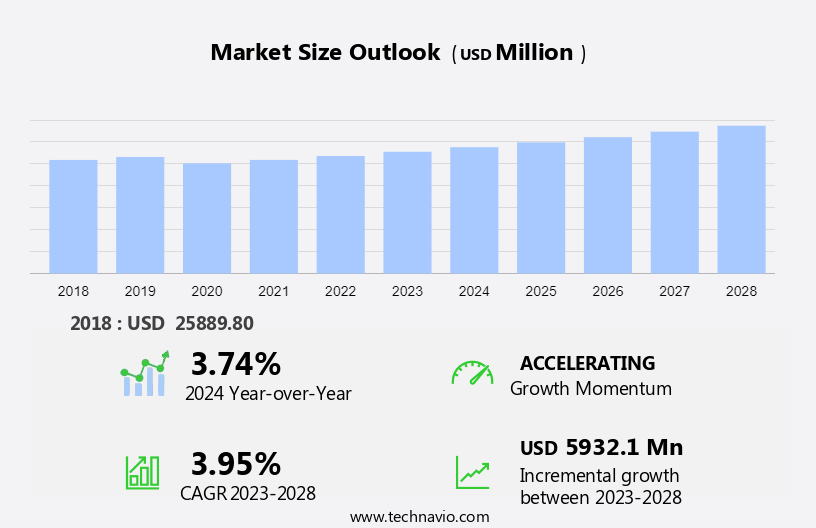
Automotive Filters Market Size

 Request Free Sample

How is this market segmented and which is the largest segment?-

The market research report provides comprehensive data (region-wise segment analysis), with forecasts and estimates in "USD million" for the period 2024-2028, as well as historical data from 2018-2022 for the following segments.

  • Type
    • Air filters
    • Oil filters
    • Fuel filters
  • Distribution Channel
    • Aftermarket
    • OEM
  • Geography
    • APAC
      • China
      • India
    • North America
      • US
    • Europe
      • Germany
      • UK
    • South America
    • Middle East and Africa

By Type Insights

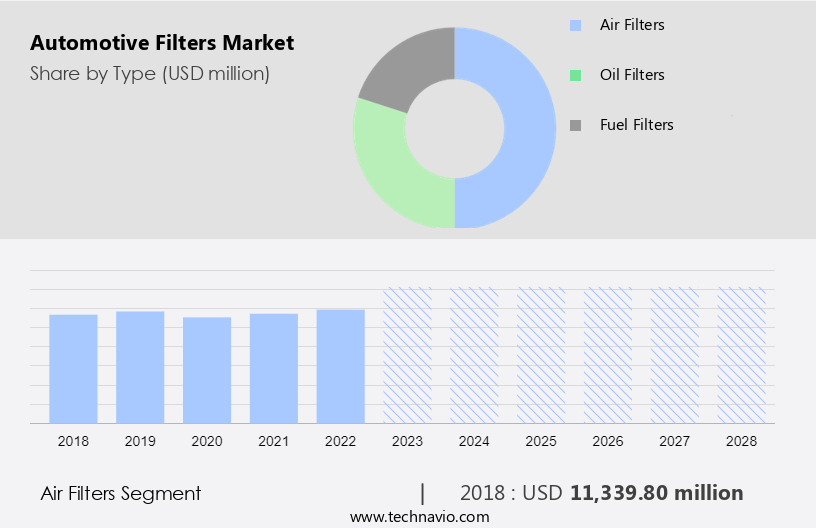
The air filters segment is estimated to witness significant growth during the forecast period. The market is experiencing significant growth due to the increasing demand for automobiles and the need to comply with stringent emissions regulations. Hydrocarbons (HC), nitrogen oxide (NOx), and carbon dioxide (CO2) are major pollutants that contribute to smog and poor air quality. To mitigate these emissions, automakers are integrating various types of filters in vehicles, including diesel particulate filters, gasoline particulate filters, and urea filters. In 2022, the passenger cars segment dominated The market due to the higher sales volume compared to commercial vehicles. Nitrogen oxides (NOx) are a significant concern for regulatory bodies, and the market for NOx filters is projected to grow at a strong rate.
Automotive Filters Market Size

Get a glance at the market share of various segments Request Free Sample

The Air filters segment accounted for USD 11.33 billion in 2018 and showed a gradual increase during the forecast period.

Will Increasing automobile adoption make APAC become the largest contributor to the Automotive Filters Market?

APAC is estimated to contribute 61% to the growth of the global market during the forecast period. Technavio's analysts have elaborately explained the regional trends and drivers that shape the market during the forecast period.
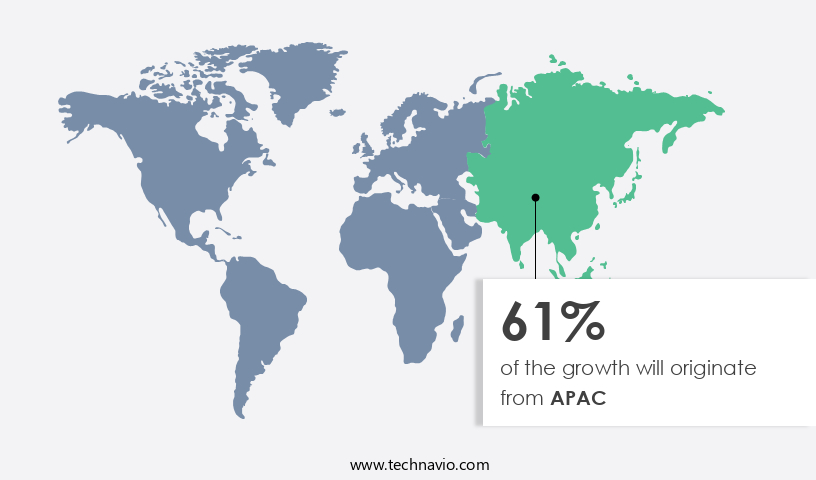
Automotive Filters Market Share by Geography

For more insights on the market share of various regions Request Free Sample

The market in the Asia Pacific (APAC) region is experiencing significant growth due to the increasing adoption of automobiles, particularly commercial vehicles, in countries such as China, India, and South Korea. China is currently the largest market for automotive filters in APAC, accounting for a substantial revenue share. The proliferation of new automotive Original Equipment Manufacturers (OEMs) in the region has led to an increase in automobile sales, thereby driving the demand for automotive filters. The production of automotive filters in APAC is contingent upon the manufacturing and sales of both passenger cars and commercial vehicles, as well as the escalating demand for export-oriented production of automotive components.

The primary focus of automotive filters in this market is on reducing harmful emissions, including hydrocarbons (HC), nitrogen oxides (NOx), and carbon dioxide (CO2). Technologies such as diesel particulate filters, gasoline particulate filters, and urea filters are increasingly being adopted to mitigate smog and NOx emissions in commercial vehicles.

Our researchers analyzed the data with 2023 as the base year, along with the key drivers, trends, and challenges. A holistic analysis of drivers will help companies refine their marketing strategies to gain a competitive advantage.

Market Dynamics

  • The market is witnessing significant growth due to the increasing demand for filtration media in various applications, including heavy duty engines for heavy trucks and battery electric vehicles (BEVs), as well as passenger cars running on alternative fuels. Synthetic media, electrostatic material, and particle filters are popular choices for filtration media in the automotive industry. Heavy duty engines require heavy-duty filters such as electrostatic filters for effective emission control, meeting greenhouse emission standards. In the case of BEVs and Plug-in Hybrid Electric Vehicles (PHEVs), EMI/EMC filters are essential for ensuring efficient power transmission and reducing electromagnetic interference. Air filters, oil filters, fuel filters, coolant filters, and dryer cartridges are crucial components for maintaining engine efficiency and vehicle longevity in the automobile sector.
  • The adoption of novel filter materials, such as advanced ceramics and nanofibers, is expected to improve filtration efficiency and contribute to sustainability and fuel economy. Emission regulations continue to drive the demand for filtration technologies in the automotive industry, with a focus on reducing emissions and improving fuel efficiency. Catalytic converters and particle filters are essential components in meeting these regulations while ensuring optimal engine performance.

What are the key market drivers leading to the rise in adoption of Automotive Filters Market ?

Increasing demand for road transportation is the key driver of the market.

  • The market is witnessing significant growth due to the increasing demand for filtration media in various automotive applications. Synthetic media, Electrostatic material, and other advanced filtration technologies are gaining popularity in the market. Heavy duty engines used in heavy trucks and battery electric vehicles (BEVs) and plug-in hybrid electric vehicles (PHEVs) require efficient filtration systems for optimal engine performance and emissions reduction. Heavy-duty vehicles, particularly in emerging economies like China and India, are experiencing a wave in demand due to the growing preference for road transportation for last-mile delivery. In China, heavy trucks transporting cargo from Inner Mongolia to Beijing face heavy traffic congestion due to the limited availability of rail freight services.
  • As a result, light commercial vehicles (LCVs), medium commercial vehicles (M-HCVs), and heavy commercial vehicles (H-HCVs) are extensively used for cargo transportation, leading to a higher demand for automotive filters. Moreover, the increasing adoption of advanced technologies in the automotive industry, such as EMI/EMC filters and dryer cartridges, is expected to further fuel the growth of the market.

What are the trends shaping the Automotive Filters Market?

Rising demand for multilayer filtration systems is the upcoming trend in the market.

  • Automotive filters serve a vital function in safeguarding the efficiency and durability of automotive components by obstructing contaminants from accessing engines, transmissions, and vehicle cabins. Multilayer filters, in particular, employ multiple filtration stages with varying pore sizes, amplifying the total filtration effectiveness. These filters are proficient in capturing smaller particles and pollutants, thereby providing enhanced protection to essential engine components. The multilayer filtration setup enables the trapping of a more extensive array of contaminants prior to replacement, thereby diminishing maintenance frequency and costs for vehicle proprietors. Additionally, multilayer filters contribute to optimized engine performance and fuel economy by ensuring cleaner air and fluids flow through the engine.
  • Synthetic media, Electrostatic material, and other advanced filtration technologies, including EMI/EMC filters and dryer cartridges, are increasingly being adopted in heavy-duty engines powering heavy trucks, battery electric vehicles (BEVs), and plug-in hybrid electric vehicles (PHEVs). These filters are essential for ensuring the reliable operation of these complex powertrains and meeting stringent emissions regulations.

What challenges does Automotive Filters Market face during the growth?

Rising demand for EVs is a key challenge affecting the market growth.

  • The market is witnessing significant growth due to the increasing adoption of advanced filtration media, such as Synthetic media and Electrostatic material, in heavy duty engines of heavy trucks, buses, and battery electric vehicles (BEVs) and plug-in hybrid electric vehicles (PHEVs). These filtration media enhance engine performance, improve fuel efficiency, and reduce emissions.
  • The demand for heavy-duty filtration systems is increasing due to the stringent emission norms and regulations set by various governments. Moreover, the growing popularity of electric vehicles is driving the demand for EMI/EMC filters and dryer cartridges to ensure efficient charging and battery performance.The increasing awareness among consumers about the importance of filtration systems in maintaining engine health and enhancing vehicle performance is also fueling the market growth.

Exclusive Customer Landscape

The market forecasting report includes the adoption lifecycle of the market, covering from the innovator's stage to the laggard's stage. It focuses on adoption rates in different regions based on penetration. Furthermore, the report also includes key purchase criteria and drivers of price sensitivity to help companies evaluate and develop their market growth analysis strategies.
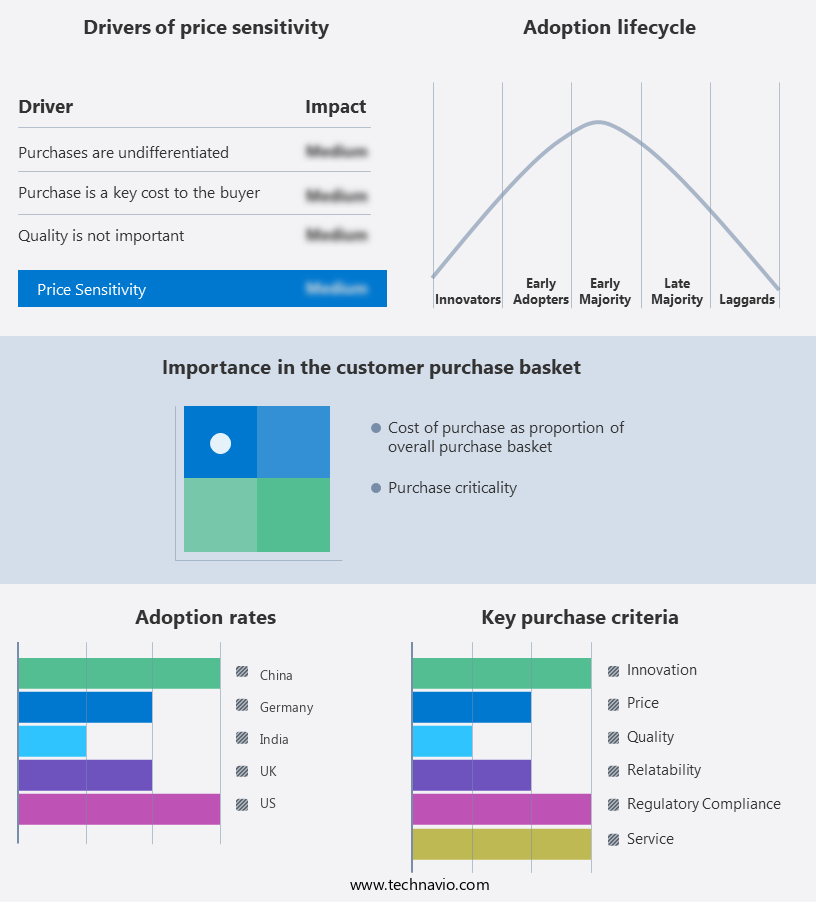
Automotive Filters Market Share by Geography

 Customer Landscape

Key Companies & Market Insights

Companies are implementing various strategies, such as strategic alliances, partnerships, mergers and acquisitions, geographical expansion, and product/service launches, to enhance their presence in the market.

A. Kayser Automotive Systems GmbH: The company offers automotive filters such as air filters with OBD interface and fuel filters.

The market research and growth report includes detailed analyses of the competitive landscape of the market and information about key companies, including:

  • A. Kayser Automotive Systems GmbH
  • Ahlstrom Holding 3 Oy
  • ALCO Filters Ltd.
  • Cummins Inc.
  • DENSO Corp.
  • Donaldson Co. Inc.
  • ELOFIC INDUSTRIES Ltd.
  • First Brands Group
  • Ford Motor Co.
  • Hengst SE
  • MAHLE GmbH
  • MANN HUMMEL International GmbH and Co. KG
  • Parker Hannifin Corp.
  • Purofil Auto India Pvt Ltd
  • Robert Bosch GmbH
  • Sogefi Spa
  • Toyota Motor Corp.
  • UFI filters SPA
  • Valeo SA
  • Zenith Auto Industries Pvt. Ltd.

Qualitative and quantitative analysis of companies has been conducted to help clients understand the wider business environment as well as the strengths and weaknesses of key market players. Data is qualitatively analyzed to categorize companies as pure play, category-focused, industry-focused, and diversified; it is quantitatively analyzed to categorize companies as dominant, leading, strong, tentative, and weak.

Research Analyst Overview

The market is witnessing significant growth due to the increasing focus on engine efficiency, vehicle longevity, and emission regulations. Filtration media, such as synthetic media and electrostatic material, are widely used in various types of automotive filters, including air filters, oil filters, fuel filters, coolant filters, and crankcase ventilation filters. Heavy duty engines in commercial vehicles, such as heavy trucks, buses, and construction equipment, require specialized filters like diesel particulate filters, gasoline particulate filters, and urea filters to meet stringent greenhouse emission standards. The automobile sector is also witnessing a shift towards battery electric vehicles (BEVs), plug-in hybrid vehicles (PHEVs), alternative fuels, and novel filter materials like nanofibers and synthetic fibers to reduce air pollution and improve fuel economy.

Automotive filters are essential for improving engine performance, reducing emissions, and ensuring human health. They help in trapping hydrocarbons (HC), nitrogen oxide (NOx), carbon dioxide (CO2), and other pollutants from the exhaust gases. The market for automotive filters is expected to grow significantly in the coming years due to the increasing demand for cleaner and more efficient transportation. The market is also driven by the growing popularity of passenger cars, including sedans, hatchbacks, SUVs, and crossovers, and the increasing focus on cabin air filtration and battery cooling filters in electric vehicles. Filter media technology continues to evolve, with new materials and designs being developed to improve filtration efficiency and reduce maintenance costs.

Some filters are now non-replaceable, while aftermarket filters offer cost-effective alternatives for vehicle owners. In conclusion, the market is a critical component of the global automotive industry, with a significant impact on engine performance, fuel efficiency, vehicle longevity, and sustainability. The market is expected to grow significantly in the coming years due to the increasing focus on emission regulations, alternative fuels, and the growing popularity of electric vehicles.

Market Scope

Report Coverage

Details

Page number

175

Base year

2023

Historic period

2018-2022

Forecast period

2024-2028

Growth momentum & CAGR

Accelerate at a CAGR of 3.95%

Market growth 2024-2028

USD 5.93 billion

Market structure

Fragmented

YoY growth 2023-2024(%)

3.74

Regional analysis

APAC, North America, Europe, South America, and Middle East and Africa

Performing market contribution

APAC at 61%

Key countries

China, US, India, Germany, and UK

Competitive landscape

Leading Companies, Market Positioning of Companies, Competitive Strategies, and Industry Risks

Key companies profiled

A. Kayser Automotive Systems GmbH, Ahlstrom Holding 3 Oy, ALCO Filters Ltd., Cummins Inc., DENSO Corp., Donaldson Co. Inc., ELOFIC INDUSTRIES Ltd., First Brands Group, Ford Motor Co., Hengst SE, MAHLE GmbH, MANN HUMMEL International GmbH and Co. KG, Parker Hannifin Corp., Purofil Auto India Pvt Ltd, Robert Bosch GmbH, Sogefi Spa, Toyota Motor Corp., UFI filters SPA, Valeo SA, and Zenith Auto Industries Pvt. Ltd.

Market dynamics

Parent market analysis, market growth inducers and obstacles, market forecast, fast-growing and slow-growing segment analysis, COVID-19 impact and recovery analysis and future consumer dynamics, market condition analysis for the forecast period

Customization purview

If our market report has not included the data that you are looking for, you can reach out to our analysts and get segments customized.

Request Free Sample

What are the Key Data Covered in this Market Research and Growth Report?

  • CAGR of the market during the forecast period
  • Detailed information on factors that will drive the market growth and forecasting between 2024 and 2028
  • Precise estimation of the size of the market  and its contribution of the market in focus to the parent market
  • Accurate predictions about upcoming market growth and trends and changes in consumer behaviour
  • Growth of the market across APAC, North America, Europe, South America, and Middle East and Africa
  • Thorough analysis of the market's competitive landscape and detailed information about companies
  • Comprehensive analysis of factors that will challenge the growth of market companies

We can help! Our analysts can customize this market research report to meet your requirements. Get in touch

1 Executive Summary

  • 1.1 Market overview
    • Executive Summary - Chart on Market Overview
    • Executive Summary - Data Table on Market Overview
    • Executive Summary - Chart on Global Market Characteristics
    • Executive Summary - Chart on Market by Geography
    • Executive Summary - Chart on Market Segmentation by Type
    • Executive Summary - Chart on Market Segmentation by Distribution Channel
    • Executive Summary - Chart on Incremental Growth
    • Executive Summary - Data Table on Incremental Growth
    • Executive Summary - Chart on Company Market Positioning

2 Market Landscape

  • 2.1 Market ecosystem
    • Parent Market
    • Data Table on - Parent Market
  • 2.2 Market characteristics
    • Market characteristics analysis
  • 2.3 Value chain analysis
    • Value Chain Analysis

3 Market Sizing

  • 3.1 Market definition
    • Offerings of companies included in the market definition
  • 3.2 Market segment analysis
    • Market segments
  • 3.3 Market size 2023
    • 3.4 Market outlook: Forecast for 2023-2028
      • Chart on Global - Market size and forecast 2023-2028 ($ million)
      • Data Table on Global - Market size and forecast 2023-2028 ($ million)
      • Chart on Global Market: Year-over-year growth 2023-2028 (%)
      • Data Table on Global Market: Year-over-year growth 2023-2028 (%)

    4 Historic Market Size

    • 4.1 Global Automotive Filters Market 2018 - 2022
      • Historic Market Size - Data Table on Global Automotive Filters Market 2018 - 2022 ($ million)
    • 4.2 Type segment analysis 2018 - 2022
      • Historic Market Size - Type Segment 2018 - 2022 ($ million)
    • 4.3 Distribution Channel segment analysis 2018 - 2022
      • Historic Market Size - Distribution Channel Segment 2018 - 2022 ($ million)
    • 4.4 Geography segment analysis 2018 - 2022
      • Historic Market Size - Geography Segment 2018 - 2022 ($ million)
    • 4.5 Country segment analysis 2018 - 2022
      • Historic Market Size - Country Segment 2018 - 2022 ($ million)

    5 Five Forces Analysis

    • 5.1 Five forces summary
      • Five forces analysis - Comparison between 2023 and 2028
    • 5.2 Bargaining power of buyers
      • Bargaining power of buyers - Impact of key factors 2023 and 2028
    • 5.3 Bargaining power of suppliers
      • Bargaining power of suppliers - Impact of key factors in 2023 and 2028
    • 5.4 Threat of new entrants
      • Threat of new entrants - Impact of key factors in 2023 and 2028
    • 5.5 Threat of substitutes
      • Threat of substitutes - Impact of key factors in 2023 and 2028
    • 5.6 Threat of rivalry
      • Threat of rivalry - Impact of key factors in 2023 and 2028
    • 5.7 Market condition
      • Chart on Market condition - Five forces 2023 and 2028

    6 Market Segmentation by Type

    • 6.1 Market segments
      • Chart on Type - Market share 2023-2028 (%)
      • Data Table on Type - Market share 2023-2028 (%)
    • 6.2 Comparison by Type
      • Chart on Comparison by Type
      • Data Table on Comparison by Type
    • 6.3 Air filters - Market size and forecast 2023-2028
      • Chart on Air filters - Market size and forecast 2023-2028 ($ million)
      • Data Table on Air filters - Market size and forecast 2023-2028 ($ million)
      • Chart on Air filters - Year-over-year growth 2023-2028 (%)
      • Data Table on Air filters - Year-over-year growth 2023-2028 (%)
    • 6.4 Oil filters - Market size and forecast 2023-2028
      • Chart on Oil filters - Market size and forecast 2023-2028 ($ million)
      • Data Table on Oil filters - Market size and forecast 2023-2028 ($ million)
      • Chart on Oil filters - Year-over-year growth 2023-2028 (%)
      • Data Table on Oil filters - Year-over-year growth 2023-2028 (%)
    • 6.5 Fuel filters - Market size and forecast 2023-2028
      • Chart on Fuel filters - Market size and forecast 2023-2028 ($ million)
      • Data Table on Fuel filters - Market size and forecast 2023-2028 ($ million)
      • Chart on Fuel filters - Year-over-year growth 2023-2028 (%)
      • Data Table on Fuel filters - Year-over-year growth 2023-2028 (%)
    • 6.6 Market opportunity by Type
      • Market opportunity by Type ($ million)
      • Data Table on Market opportunity by Type ($ million)

    7 Market Segmentation by Distribution Channel

    • 7.1 Market segments
      • Chart on Distribution Channel - Market share 2023-2028 (%)
      • Data Table on Distribution Channel - Market share 2023-2028 (%)
    • 7.2 Comparison by Distribution Channel
      • Chart on Comparison by Distribution Channel
      • Data Table on Comparison by Distribution Channel
    • 7.3 Aftermarket - Market size and forecast 2023-2028
      • Chart on Aftermarket - Market size and forecast 2023-2028 ($ million)
      • Data Table on Aftermarket - Market size and forecast 2023-2028 ($ million)
      • Chart on Aftermarket - Year-over-year growth 2023-2028 (%)
      • Data Table on Aftermarket - Year-over-year growth 2023-2028 (%)
    • 7.4 OEM - Market size and forecast 2023-2028
      • Chart on OEM - Market size and forecast 2023-2028 ($ million)
      • Data Table on OEM - Market size and forecast 2023-2028 ($ million)
      • Chart on OEM - Year-over-year growth 2023-2028 (%)
      • Data Table on OEM - Year-over-year growth 2023-2028 (%)
    • 7.5 Market opportunity by Distribution Channel
      • Market opportunity by Distribution Channel ($ million)
      • Data Table on Market opportunity by Distribution Channel ($ million)

    8 Customer Landscape

    • 8.1 Customer landscape overview
      • Analysis of price sensitivity, lifecycle, customer purchase basket, adoption rates, and purchase criteria

    9 Geographic Landscape

    • 9.1 Geographic segmentation
      • Chart on Market share by geography 2023-2028 (%)
      • Data Table on Market share by geography 2023-2028 (%)
    • 9.2 Geographic comparison
      • Chart on Geographic comparison
      • Data Table on Geographic comparison
    • 9.3 APAC - Market size and forecast 2023-2028
      • Chart on APAC - Market size and forecast 2023-2028 ($ million)
      • Data Table on APAC - Market size and forecast 2023-2028 ($ million)
      • Chart on APAC - Year-over-year growth 2023-2028 (%)
      • Data Table on APAC - Year-over-year growth 2023-2028 (%)
    • 9.4 North America - Market size and forecast 2023-2028
      • Chart on North America - Market size and forecast 2023-2028 ($ million)
      • Data Table on North America - Market size and forecast 2023-2028 ($ million)
      • Chart on North America - Year-over-year growth 2023-2028 (%)
      • Data Table on North America - Year-over-year growth 2023-2028 (%)
    • 9.5 Europe - Market size and forecast 2023-2028
      • Chart on Europe - Market size and forecast 2023-2028 ($ million)
      • Data Table on Europe - Market size and forecast 2023-2028 ($ million)
      • Chart on Europe - Year-over-year growth 2023-2028 (%)
      • Data Table on Europe - Year-over-year growth 2023-2028 (%)
    • 9.6 South America - Market size and forecast 2023-2028
      • Chart on South America - Market size and forecast 2023-2028 ($ million)
      • Data Table on South America - Market size and forecast 2023-2028 ($ million)
      • Chart on South America - Year-over-year growth 2023-2028 (%)
      • Data Table on South America - Year-over-year growth 2023-2028 (%)
    • 9.7 Middle East and Africa - Market size and forecast 2023-2028
      • Chart on Middle East and Africa - Market size and forecast 2023-2028 ($ million)
      • Data Table on Middle East and Africa - Market size and forecast 2023-2028 ($ million)
      • Chart on Middle East and Africa - Year-over-year growth 2023-2028 (%)
      • Data Table on Middle East and Africa - Year-over-year growth 2023-2028 (%)
    • 9.8 China - Market size and forecast 2023-2028
      • Chart on China - Market size and forecast 2023-2028 ($ million)
      • Data Table on China - Market size and forecast 2023-2028 ($ million)
      • Chart on China - Year-over-year growth 2023-2028 (%)
      • Data Table on China - Year-over-year growth 2023-2028 (%)
    • 9.9 US - Market size and forecast 2023-2028
      • Chart on US - Market size and forecast 2023-2028 ($ million)
      • Data Table on US - Market size and forecast 2023-2028 ($ million)
      • Chart on US - Year-over-year growth 2023-2028 (%)
      • Data Table on US - Year-over-year growth 2023-2028 (%)
    • 9.10 India - Market size and forecast 2023-2028
      • Chart on India - Market size and forecast 2023-2028 ($ million)
      • Data Table on India - Market size and forecast 2023-2028 ($ million)
      • Chart on India - Year-over-year growth 2023-2028 (%)
      • Data Table on India - Year-over-year growth 2023-2028 (%)
    • 9.11 Germany - Market size and forecast 2023-2028
      • Chart on Germany - Market size and forecast 2023-2028 ($ million)
      • Data Table on Germany - Market size and forecast 2023-2028 ($ million)
      • Chart on Germany - Year-over-year growth 2023-2028 (%)
      • Data Table on Germany - Year-over-year growth 2023-2028 (%)
    • 9.12 UK - Market size and forecast 2023-2028
      • Chart on UK - Market size and forecast 2023-2028 ($ million)
      • Data Table on UK - Market size and forecast 2023-2028 ($ million)
      • Chart on UK - Year-over-year growth 2023-2028 (%)
      • Data Table on UK - Year-over-year growth 2023-2028 (%)
    • 9.13 Market opportunity by geography
      • Market opportunity by geography ($ million)
      • Data Tables on Market opportunity by geography ($ million)

    10 Drivers, Challenges, and Opportunity/Restraints

    • 10.1 Market drivers
      • 10.2 Market challenges
        • 10.3 Impact of drivers and challenges
          • Impact of drivers and challenges in 2023 and 2028
        • 10.4 Market opportunities/restraints

          11 Competitive Landscape

          • 11.1 Overview
            • 11.2 Competitive Landscape
              • Overview on criticality of inputs and factors of differentiation
            • 11.3 Landscape disruption
              • Overview on factors of disruption
            • 11.4 Industry risks
              • Impact of key risks on business

            12 Competitive Analysis

            • 12.1 Companies profiled
              • Companies covered
            • 12.2 Market positioning of companies
              • Matrix on companies position and classification
            • 12.3 A. Kayser Automotive Systems GmbH
              • A. Kayser Automotive Systems GmbH - Overview
              • A. Kayser Automotive Systems GmbH - Product / Service
              • A. Kayser Automotive Systems GmbH - Key offerings
            • 12.4 Ahlstrom Holding 3 Oy
              • Ahlstrom Holding 3 Oy - Overview
              • Ahlstrom Holding 3 Oy - Product / Service
              • Ahlstrom Holding 3 Oy - Key news
              • Ahlstrom Holding 3 Oy - Key offerings
            • 12.5 ALCO Filters Ltd.
              • ALCO Filters Ltd. - Overview
              • ALCO Filters Ltd. - Product / Service
              • ALCO Filters Ltd. - Key offerings
            • 12.6 DENSO Corp.
              • DENSO Corp. - Overview
              • DENSO Corp. - Business segments
              • DENSO Corp. - Key news
              • DENSO Corp. - Key offerings
              • DENSO Corp. - Segment focus
            • 12.7 ELOFIC INDUSTRIES Ltd.
              • ELOFIC INDUSTRIES Ltd. - Overview
              • ELOFIC INDUSTRIES Ltd. - Product / Service
              • ELOFIC INDUSTRIES Ltd. - Key offerings
            • 12.8 First Brands Group
              • First Brands Group - Overview
              • First Brands Group - Product / Service
              • First Brands Group - Key offerings
            • 12.9 Ford Motor Co.
              • Ford Motor Co. - Overview
              • Ford Motor Co. - Business segments
              • Ford Motor Co. - Key news
              • Ford Motor Co. - Key offerings
              • Ford Motor Co. - Segment focus
            • 12.10 Hengst SE
              • Hengst SE - Overview
              • Hengst SE - Product / Service
              • Hengst SE - Key offerings
            • 12.11 MAHLE GmbH
              • MAHLE GmbH - Overview
              • MAHLE GmbH - Business segments
              • MAHLE GmbH - Key news
              • MAHLE GmbH - Key offerings
              • MAHLE GmbH - Segment focus
            • 12.12 MANN HUMMEL International GmbH and Co. KG
              • MANN HUMMEL International GmbH and Co. KG - Overview
              • MANN HUMMEL International GmbH and Co. KG - Business segments
              • MANN HUMMEL International GmbH and Co. KG - Key news
              • MANN HUMMEL International GmbH and Co. KG - Key offerings
              • MANN HUMMEL International GmbH and Co. KG - Segment focus
            • 12.13 Parker Hannifin Corp.
              • Parker Hannifin Corp. - Overview
              • Parker Hannifin Corp. - Business segments
              • Parker Hannifin Corp. - Key news
              • Parker Hannifin Corp. - Key offerings
              • Parker Hannifin Corp. - Segment focus
            • 12.14 Robert Bosch GmbH
              • Robert Bosch GmbH - Overview
              • Robert Bosch GmbH - Product / Service
              • Robert Bosch GmbH - Key news
              • Robert Bosch GmbH - Key offerings
            • 12.15 Sogefi Spa
              • Sogefi Spa - Overview
              • Sogefi Spa - Business segments
              • Sogefi Spa - Key offerings
              • Sogefi Spa - Segment focus
            • 12.16 Toyota Motor Corp.
              • Toyota Motor Corp. - Overview
              • Toyota Motor Corp. - Business segments
              • Toyota Motor Corp. - Key news
              • Toyota Motor Corp. - Key offerings
              • Toyota Motor Corp. - Segment focus
            • 12.17 Valeo SA
              • Valeo SA - Overview
              • Valeo SA - Business segments
              • Valeo SA - Key news
              • Valeo SA - Key offerings
              • Valeo SA - Segment focus

            13 Appendix

            • 13.1 Scope of the report
              • 13.2 Inclusions and exclusions checklist
                • Inclusions checklist
                • Exclusions checklist
              • 13.3 Currency conversion rates for US$
                • Currency conversion rates for US$
              • 13.4 Research methodology
                • Research methodology
              • 13.5 Data procurement
                • Information sources
              • 13.6 Data validation
                • Data validation
              • 13.7 Validation techniques employed for market sizing
                • Validation techniques employed for market sizing
              • 13.8 Data synthesis
                • Data synthesis
              • 360 degree market analysis
                • 360 degree market analysis
              • 13.10 List of abbreviations
                • List of abbreviations

              Research Methodology

              Technavio presents a detailed picture of the market by way of study, synthesis, and summation of data from multiple sources. The analysts have presented the various facets of the market with a particular focus on identifying the key industry influencers. The data thus presented is comprehensive, reliable, and the result of extensive research, both primary and secondary.

              INFORMATION SOURCES

              Primary sources

              • Manufacturers and suppliers
              • Channel partners
              • Industry experts
              • Strategic decision makers

              Secondary sources

              • Industry journals and periodicals
              • Government data
              • Financial reports of key industry players
              • Historical data
              • Press releases

              DATA ANALYSIS

              Data Synthesis

              • Collation of data
              • Estimation of key figures
              • Analysis of derived insights

              Data Validation

              • Triangulation with data models
              • Reference against proprietary databases
              • Corroboration with industry experts

              REPORT WRITING

              Qualitative

              • Market drivers
              • Market challenges
              • Market trends
              • Five forces analysis

              Quantitative

              • Market size and forecast
              • Market segmentation
              • Geographical insights
              • Competitive landscape

              Interested in this report?

              Get your sample now to see our research methodology and insights!

              Download Now

              Frequently Asked Questions

              Automotive Filters market growth will increase by $ 5932.1 mn during 2024-2028 .

              The Automotive Filters market is expected to grow at a CAGR of 3.95% during 2024-2028 .

              Automotive Filters market is segmented by Type( Air filters, Oil filters, Fuel filters) Distribution Channel( Aftermarket, OEM, Europe, MEA, South America)

              A. Kayser Automotive Systems GmbH, Ahlstrom Holding 3 Oy, ALCO Filters Ltd., Cummins Inc., DENSO Corp., Donaldson Co. Inc., ELOFIC INDUSTRIES Ltd., First Brands Group, Ford Motor Co., Hengst SE, MAHLE GmbH, MANN HUMMEL International GmbH and Co. KG, Parker Hannifin Corp., Purofil Auto India Pvt Ltd, Robert Bosch GmbH, Sogefi Spa, Toyota Motor Corp., UFI filters SPA, Valeo SA, Zenith Auto Industries Pvt. Ltd. are a few of the key vendors in the Automotive Filters market.

              APAC will register the highest growth rate of 61% among the other regions. Therefore, the Automotive Filters market in APAC is expected to garner significant business opportunities for the vendors during the forecast period.

              China, US, India, Germany, UK

              • Increasing demand for road transportationGrowing preference for road transportation for last-mile delivery and the subsequent increase in the use of heavy- is the driving factor this market.
              • medium- is the driving factor this market.
              • and light-duty vehicles in emerging countries such as China and India will reduce the demand for rail transport. In China is the driving factor this market.
              • huge traffic congestion is caused by large heavy-duty trucks transporting goods from Inner Mongolia to Beijing. One of the main reasons for opting for road transport for transporting cargo is the limited number of rail freight services available in the country. The lack of sufficient freight services has led companies to choose roadways as a reliable mode of transportation.LCVs and M and HCVs are used extensively for transporting cargo in China. There has been a subsequent decline in rail freight on a year-over-year basis. In India is the driving factor this market.
              • roads are widely used for transporting containers. Container transport because of high rail freight is the driving factor this market.
              • poor last-mile connectivity is the driving factor this market.
              • and lack of availability of freight trains. Cross-subsidization between freight trains and passenger trains has caused the rates of rail haulage to be expensive.Transportation companies choose road transportation as preference is given to passenger trains. The lack of sufficient freight services has led companies to choose roadways as a reliable mode of transportation. Roadways are more convenient than rail transport is the driving factor this market.
              • cheaper than air transportation is the driving factor this market.
              • and faster than waterways. The rise in the demand for freight transportation through roads has led freight operators to increase their fleet of commercial vehicles is the driving factor this market.
              • which is the driving factor this market.
              • in turn is the driving factor this market.
              • is expected to fuel the demand for automotive filters. Such factors are expected to drive the growth of the global automotive filters market during the forecast period. is the driving factor this market.

              The Automotive Filters market vendors should focus on grabbing business opportunities from the Air filters segment as it accounted for the largest market share in the base year.
