


Binders Excipients Market Analysis APAC, North America, Europe, Middle East and Africa, South America - China, US, Japan, Germany, UK, Canada - Size and Forecast 2024-2028

Binders Excipients Market Analysis APAC, North America, Europe, Middle East and Africa, South America - China, US, Japan, Germany, UK, Canada - Size and Forecast 2024-2028

Published: Aug 2024 181 Pages SKU: IRTNTR73832

Market Overview at a Glance

$354.5 Mn
Market Opportunity
4.5%
CAGR
4.23
YoY growth 2023-2024(%)

Binders Excipients Market Size 2024-2028

The binders excipients market size is forecast to increase by USD 354.5 million at a CAGR of 4.5% between 2023 and 2028.

  • The market is experiencing significant growth due to several key trends. The increasing demand for cellulose-based binders is a major growth factor, as these binders are widely used in pharmaceutical applications due to their excellent binding properties and biocompatibility. Additionally, the development of new excipients to create easily consumable drugs is driving market growth. However, the loss of patents and patent expiry pose challenges to market participants, as generic alternatives flood the market and put pressure on prices. Overall, these trends and challenges create a dynamic market environment for binders excipients.
  • What will be the Size of the Binders Excipients Market During the Forecast Period?

    Binders Excipients Market Size

     Request Free Sample

  • The market plays a crucial role In the pharmaceutical industry, as these excipients are essential components In the production of tablets and capsules. Binders, specifically hydrophilic molecules, facilitate intermolecular interactions between active pharmaceutical ingredients (APIs) and other excipients, ensuring the required compressibility and cohesion in dry formulations. Cellulose derivatives, natural polymers, synthetic polymers, sugars, and starches are common types of binders used in pharmaceutical formulations. The choice of binder depends on various factors, including flow characteristics, dose, and therapeutic effect. For instance, binders impact the compressibility of tablets and capsule filling properties, ensuring proper dosage delivery to patients. In the production of oral medicines, binders contribute to the overall quality and efficacy of the final product.
  • They can be used in both dry and wet form applications, with solvents playing a role In the wet formulations. Estimates suggest that The market will experience steady growth due to increasing demand for oral medicines and advancements in formulation technology. Research methodology for this market includes subject-related expert advice, industry analysis, and market data from reliable sources. The market dynamics are influenced by factors such as regulatory requirements, technological advancements, and consumer preferences. Overall, binders excipients remain a vital component In the pharmaceutical industry, contributing to the development and production of effective and safe medicines.
  • How is this Binders Excipients Industry segmented and which is the largest segment?

    The binders excipients industry research report provides comprehensive data (region-wise segment analysis), with forecasts and estimates in "USD million" for the period 2024-2028, as well as historical data from 2018-2022 for the following segments.

    • Type
      • Cellulosics
      • Lactose
      • Polyols
      • Povidones
      • Others
    • Application
      • Tablets or capsules
      • Solution-based
    • Geography
      • APAC
        • China
        • Japan
      • North America
        • Canada
        • US
      • Europe
        • Germany
        • UK
      • Middle East and Africa
        • South America

        By Type Insights

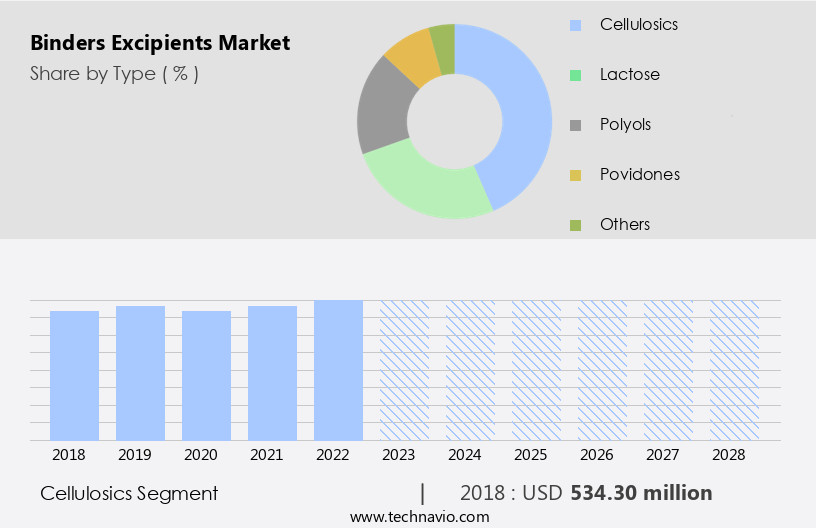
        • The cellulosics segment is estimated to witness significant growth during the forecast period.

        Cellulose derivatives, particularly hydroxypropyl methylcellulose (HPMC), hydroxypropylmethylcellulose acetate (HPMCAS), and microcrystallic cellulose (MCC), dominated the binder excipients market in 2023. HPMC, a chemically modified cellulose polymer, is a popular choice due to its vegetarian source and physical similarities to gelatin and gluten. It is commonly used as a binder and bioadhesive in pharmaceuticals, acting as a compression aid and coating agent for tablets. HPMC's demand continues to rise globally, driving market expansion. In pharmaceutical formulations, tablets, and capsules, binders play a crucial role in ensuring consistency, compressibility, and accurate dosing. Other excipients include starches, sugars, natural and synthetic polymers, and various additives like fillers, diluents, disintegrants, lubricants, coloring agents, and co-processed excipients.

        These materials impact tablets and capsules' mechanical properties, drug delivery characteristics, and therapeutic effect. The market for binders and excipients is expected to grow significantly due to the increasing demand for oral medicines, nutraceuticals, and dietary supplements, as well as the development of innovative therapies and modified-release tablets.
        Binders Excipients Market Size

        Get a glance at the  Binders Excipients Industry report of share of various segments Request Free Sample

        The Cellulosics segment was valued at USD 534.30 million in 2018 and showed a gradual increase during the forecast period.

        Regional Analysis

        • APAC is estimated to contribute 38% to the growth of the global market during the forecast period.

        Technavio’s analysts have elaborately explained the regional trends and drivers that shape the market during the forecast period.

        Binders Excipients Market Share by Geography

        For more insights on the market share of various regions, Request Free Sample

        The pharmaceutical industry in Asia, particularly in countries like China and India, is projected to experience substantial growth due to rising health consciousness among consumers, an aging population, and increasing prevalence of diseases such as diabetes, cancer, and age-related health issues. According to the European Federation of Pharmaceutical Industries and Associations, China and Japan accounted for over 15% of global pharmaceutical sales revenue in 2020. Consequently, the demand for binder excipients is anticipated to increase in this region. Binder excipients, such as starch, polyvinylpyrrolidone (PVP), and cellulose derivatives, play crucial roles in pharmaceutical formulations like tablets and capsules. They ensure the required compressibility, dose consistency, and flow characteristics, enabling accurate dosing and therapeutic effects.

        Natural and synthetic polymers, sugars, starches, and other excipients are used to enhance the stability, consistency, and drug delivery characteristics of oral medicines. The development of modified-release tablets, nutraceuticals, and dietary supplements further boosts the market for binder excipients. Key players in this market include major pharmaceutical companies and excipient manufacturers, who continuously innovate and introduce novel excipients and co-processed excipients to cater to the evolving needs of the industry.

        Market Dynamics

        Our  researchers analyzed the data with 2023 as the base year, along with the key drivers, trends, and challenges. A holistic analysis of drivers will help companies refine their marketing strategies to gain a competitive advantage.

        What are the key market drivers leading to the rise In the adoption of Binders Excipients Industry?

        Increasing demand for cellulose-based binders is the key driver of the market.

      • Binder excipients play a crucial role In the pharmaceutical industry by contributing to the production of various forms of pharmaceutical formulations, including tablets and capsules. These excipients, which include cellulose derivatives, natural polymers, synthetic polymers, sugars, and starches, serve multiple functions in medicinal drugs. They enhance the compressibility and improve the flow characteristics of the powder mixtures, ensuring accurate dosing and convenience for patients. Moreover, binder excipients are essential In the manufacture of modified-release tablets and novel excipients, such as co-processed excipients, which contribute to innovative therapies. Hydrophilic molecules and intermolecular interactions are significant factors influencing the selection and use of binder excipients in pharmaceutical applications.
      • Several companies are expanding their production capacity to cater to the growing demand for binder excipients. For instance, Asahi Kasei Corp. In Japan is increasing its production capacity for Ceolus, a cellulose-based binder, by setting up a second plant in Kurashiki city. The mechanical properties, compatibility, and stability of binder excipients are essential factors In their selection. Fillers, diluents, disintegrants, lubricants, coloring agents, lactose, microcrystalline cellulose, magnesium stearate, talc, and starch are common types of binder excipients used in various pharmaceutical applications. Binder excipients are used in both dry form, such as direct compression, and wet form, such as granulation and liquid formulations.
      • The use of binder excipients in pharmaceutical formulations enhances the therapeutic effect, ensuring patients receive accurate dosing and health benefits from their medicines.
      • What are the market trends shaping the Binders Excipients Industry?

        Demand for new excipients to develop easily consumable drugs is the upcoming market trend.

      • The pharmaceutical industry's demand for binders excipients is escalating due to the increasing production of oral medicines. The convenience of consuming tablets and capsules, particularly for older adults and infants, is a significant factor driving market growth. New excipients, chemically modified grades, and co-processed excipients are in high demand to expand the range of formulations and drug delivery systems. Hydrophilic molecules play a crucial role in intermolecular interactions, ensuring the compressibility and flow characteristics of the powder mixtures. Cellulose derivatives, natural polymers, synthetic polymers, sugars, starches, and other excipients contribute to the therapeutic effect of medicinal drugs. Excipients such as starch, polyvinylpyrrolidone (PVP), and magnesium stearate impact the mechanical properties, compatibility, and release profile of tablets and capsules.
      • The market's growth is also fueled by the development of modified-release tablets, nutraceuticals, and dietary supplements, offering health benefits to patients. The stability and consistency of these excipients are essential for accurate dosing and maintaining the drug delivery characteristics in various applications, including direct compression, wet form, and liquid formulations.
      • What challenges does the Binders Excipients Industry face during its growth?

        Loss of patents and patent expiry is a key challenge affecting the industry growth.

      • The market In the pharmaceutical industry is influenced by several factors, including the expiration of patents on medicinal drugs. With the loss of patents, an influx of generic products enters the market, potentially impacting the competitive edge and profit margins of large pharmaceutical companies. This situation not only affects the businesses of end-users but also hinders the growth of the market. Intellectual property rights infringement allegations can also negatively impact the business of pharmaceutical drug manufacturers. For instance, the patents for Entresto, Promacta, Rubraca, Mektovi, and Votrient are set to expire in 2023. In the production of pharmaceutical formulations such as tablets and capsules, binders play a crucial role in holding the active pharmaceutical ingredients and other excipients together.
      • Hydrophilic molecules and intermolecular interactions are essential considerations when selecting binders. Cellulose derivatives, natural and synthetic polymers, sugars, and starches are commonly used binders. The choice of binders impacts the compressibility, dose, flow characteristics, and therapeutic effect of the medicinal drugs. Compatibility with other excipients, such as fillers, diluents, disintegrants, lubricants, coloring agents, and co-processed excipients, is also essential. The mechanical properties, release profile, and drug delivery characteristics of binders are critical factors In the design and development of oral medicines. Binders are used in both dry form (direct compression) and wet form (granulation) applications. Solvents are used in wet formulations to create granules, which are then dried and compacted into tablets or capsules.
      • The stability and consistency of binders are essential to ensure accurate dosing and maintaIn the desired therapeutic effect. Innovative therapies, such as modified-release tablets, nutraceuticals, and dietary supplements, require novel excipients with unique properties to meet specific requirements. The market for binders is expected to grow as the demand for these advanced pharmaceutical products increases. In summary, the market is a significant component of the pharmaceutical industry, with applications in tablets, capsules, and various pharmaceutical formulations. The selection of binders is influenced by factors such as hydrophilic molecules, intermolecular interactions, compressibility, dose, flow characteristics, therapeutic effect, and drug delivery characteristics.
      • The market is driven by the increasing demand for advanced pharmaceutical products and the need for innovative excipients to meet specific requirements. However, patent expiry and intellectual property rights infringement pose challenges to market growth.
      • Exclusive Customer Landscape

        The binders excipients market forecasting report includes the adoption lifecycle of the market, covering from the innovator’s stage to the laggard’s stage. It focuses on adoption rates in different regions based on penetration. Furthermore, the binders excipients market report also includes key purchase criteria and drivers of price sensitivity to help companies evaluate and develop their market growth analysis strategies.

        Binders Excipients Market Share by Geography

         Customer Landscape

        Key Companies & Market Insights

        Companies are implementing various strategies, such as strategic alliances, binders excipients market forecast, partnerships, mergers and acquisitions, geographical expansion, and product/service launches, to enhance their presence In the industry.

        Asahi Kasei Corp. - The company specializes in providing binder excipients, specifically Ceolus, to the pharmaceutical industry. Binder excipients play a crucial role In the manufacturing process of tablets and capsules by binding active pharmaceutical ingredients and other excipients together. This results in a cohesive and stable dosage form. Ceolus, as a binder excipient, offers advantages such as improved binding efficiency, enhanced compressibility, and excellent flow properties. Its use contributes to the production of high-quality pharmaceutical products.

        The industry research and growth report includes detailed analyses of the competitive landscape of the market and information about key companies, including:

        • Asahi Kasei Corp.
        • Ashland Inc.
        • BASF SE
        • Beneo GmbH
        • CD Formulation
        • Colorcon Inc.
        • DFE Pharma GmbH and Co. KG
        • Dow Chemical Co.
        • DuPont de Nemours Inc.
        • Evonik Industries AG
        • Fuji Chemical Industries Co. Ltd.
        • Ingredion Inc.
        • JRS PHARMA GmbH and Co. KG
        • Kerry Group Plc
        • Merck KGaA
        • Roquette Freres SA
        • Scope Ingredients Pvt. Ltd.

        Qualitative and quantitative analysis of companies has been conducted to help clients understand the wider business environment as well as the strengths and weaknesses of key industry players. Data is qualitatively analyzed to categorize companies as pure play, category-focused, industry-focused, and diversified; it is quantitatively analyzed to categorize companies as dominant, leading, strong, tentative, and weak.

        Research Analyst Overview

        Binders In the context of pharmaceutical formulations play a crucial role in holding the various components of tablets and capsules together. These excipients, as they are called In the industry, contribute significantly to the stability, consistency, and overall performance of oral medicines. Hydrophilic molecules, such as starches and natural polymers, are commonly used as binders due to their ability to absorb water and form a cohesive mass. Cellulose derivatives, synthetic polymers, and sugars are other classes of binders that provide different properties and benefits. The choice of binder depends on several factors, including intermolecular interactions, compressibility, dose, and flow characteristics.

        The therapeutic effect of medicinal drugs is also influenced by the binder's ability to affect the release profile and mechanical properties. Binders are essential in various types of pharmaceutical formulations, including tablets, capsules, and modified-release tablets. They are also used in nutraceuticals and dietary supplements to enhance health benefits and ensure accurate dosing. Innovative therapies and novel excipients continue to emerge In the market, offering improved drug delivery characteristics and enhanced patient convenience. Co-processed excipients, for instance, offer the advantage of reducing the number of processing steps and improving the overall quality of the final product. Binders can be used in both dry form and solvent applications, depending on the specific requirements of the formulation.

        The research methodology for studying binders involves subject-related expert advice, estimates, and laboratory experiments to evaluate their compatibility, release profile, and other critical properties. The market for binders is diverse and dynamic, with a wide range of applications and end-users. The demand for binders is driven by the growing need for accurate dosing, improved patient convenience, and the development of innovative therapies. In summary, binders are essential excipients in pharmaceutical formulations that play a critical role in ensuring stability, consistency, and performance. The choice of binder depends on various factors, including the formulation's composition, therapeutic effect, and manufacturing process.

        The market for binders is diverse and dynamic, driven by the growing demand for accurate dosing, improved patient convenience, and the development of innovative therapies.

        Market Scope

        Report Coverage

        Details

        Page number

        181

        Base year

        2023

        Historic period

        2018-2022

        Forecast period

        2024-2028

        Growth momentum & CAGR

        Accelerate at a CAGR of 4.5%

        Market growth 2024-2028

        USD 354.5 million

        Market structure

        Fragmented

        YoY growth 2023-2024(%)

        4.23

        Key countries

        China, US, Japan, Germany, UK, and Canada

        Competitive landscape

        Leading Companies, Market Positioning of Companies, Competitive Strategies, and Industry Risks

        Request Free Sample

        What are the Key Data Covered in this Binders Excipients Market Research and Growth Report?

        • CAGR of the Binders Excipients industry during the forecast period
        • Detailed information on factors that will drive the growth and forecasting between 2024 and 2028
        • Precise estimation of the size of the market and its contribution of the industry in focus to the parent market
        • Accurate predictions about upcoming growth and trends and changes in consumer behaviour
        • Growth of the market across APAC, North America, Europe, Middle East and Africa, and South America
        • Thorough analysis of the market’s competitive landscape and detailed information about companies
        • Comprehensive analysis of factors that will challenge the binders excipients market growth of industry companies

        We can help! Our analysts can customize this binders excipients market research report to meet your requirements.

        Get in touch


        Table of Contents not available.

        Research Methodology

        Technavio presents a detailed picture of the market by way of study, synthesis, and summation of data from multiple sources. The analysts have presented the various facets of the market with a particular focus on identifying the key industry influencers. The data thus presented is comprehensive, reliable, and the result of extensive research, both primary and secondary.

        INFORMATION SOURCES

        Primary sources

        • Manufacturers and suppliers
        • Channel partners
        • Industry experts
        • Strategic decision makers

        Secondary sources

        • Industry journals and periodicals
        • Government data
        • Financial reports of key industry players
        • Historical data
        • Press releases

        DATA ANALYSIS

        Data Synthesis

        • Collation of data
        • Estimation of key figures
        • Analysis of derived insights

        Data Validation

        • Triangulation with data models
        • Reference against proprietary databases
        • Corroboration with industry experts

        REPORT WRITING

        Qualitative

        • Market drivers
        • Market challenges
        • Market trends
        • Five forces analysis

        Quantitative

        • Market size and forecast
        • Market segmentation
        • Geographical insights
        • Competitive landscape

        Interested in this report?

        Get your sample now to see our research methodology and insights!

        Download Now

        Frequently Asked Questions

        Binders Excipients market growth will increase by $ 354.5 mn during 2024-2028.

        The Binders Excipients market is expected to grow at a CAGR of 4.5% during 2024-2028.

        Binders Excipients market is segmented by Type( Cellulosics, Lactose, Polyols, Povidones, Others) Application( Tablets or capsules, Solution-based)

        Asahi Kasei Corp., Ashland Inc., BASF SE, Beneo GmbH, CD Formulation, Colorcon Inc., DFE Pharma GmbH and Co. KG, Dow Chemical Co., DuPont de Nemours Inc., Evonik Industries AG, Fuji Chemical Industries Co. Ltd., Ingredion Inc., JRS PHARMA GmbH and Co. KG, Kerry Group Plc, Merck KGaA, Roquette Freres SA, Scope Ingredients Pvt. Ltd. are a few of the key vendors in the Binders Excipients market.

        APAC will register the highest growth rate of 38% among the other regions. Therefore, the Binders Excipients market in APAC is expected to garner significant business opportunities for the vendors during the forecast period.

        China, US, Japan, Germany, UK, Canada

        • Increasing demand for cellulose-based bindersBinder excipients form an inherent part of the pharmaceutical industry. The demand for binder excipients is anticipated to increase rapidly during the forecast period is the driving factor this market.
        • owing to their use in pharmaceutical drugs. These add volume to low-active-dose tablets and provide mechanical strength to the tablets.Several vendors are expanding their production capacity of cellulose-based binders. For instance is the driving factor this market.
        • Asahi Kasei Corp. is one of the major vendors in Japan offering tablet binders. In January 2021 is the driving factor this market.
        • the company announced the plan to set up a second plant in Kurashiki city in Japan for the production of Ceolus is the driving factor this market.
        • a cellulose-based binder. The binder excipient enhances the compactibility and flowability of tablets. Again is the driving factor this market.
        • in June 2021 is the driving factor this market.
        • DMV-Fonterra Excipients GmbH and Co. KG introduced Pharmacel sMCC 90 is the driving factor this market.
        • a new binder excipient. This cellulose-based binder can be used for oral solid dosage formulations. Such new compositions of binders in pharmaceutical drugs are emerging in the market. Such developments are expected to drive the growth of the market in focus during the forecast period. is the driving factor this market.

        The Binders Excipients market vendors should focus on grabbing business opportunities from the Cellulosics segment as it accounted for the largest market share in the base year.