



Boutique Hotels Market Size 2026-2030
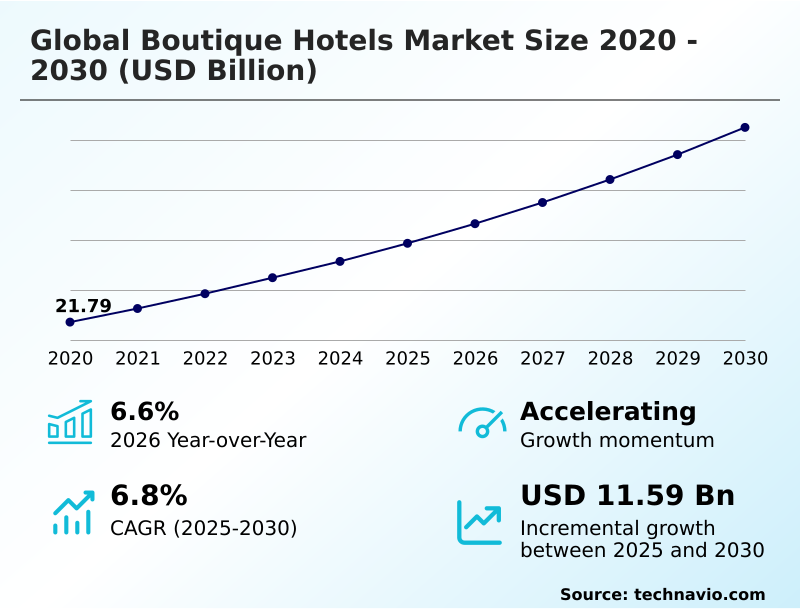
The Boutique Hotels Market size was valued at USD 29.67 billion in 2025, growing at a CAGR of 6.8% during the forecast period 2026-2030.
Major Market Trends & Insights
- North America dominated the market and accounted for a 34.8% growth during the forecast period.
- By Type - Suite hotels segment was valued at USD 7.81 billion in 2024
- By Channel - Online booking segment accounted for the largest market revenue share in 2024
Market Size & Forecast
- Historic Market Opportunities 2020-2024: USD 19.47 billion
- Market Future Opportunities 2025-2030: USD 11.59 billion
- CAGR from 2025 to 2030 : 6.8%
Market Summary
- The boutique hotels market is defined by a consistent guest preference for unique, non-standardized lodging, with travelers willing to pay a 15% premium for properties offering a distinct aesthetic narrative. This dynamic has pushed operators to focus on hyperlocal experiences and cultural integration.
- For example, a hotel might partner with local artisans for its decor and source ingredients for its restaurant from nearby farms, a strategy that improves the guest experience and reduces supply chain costs by over 10%. The primary driver is the growing demand for experiential travel, where consumers seek immersive and memorable stays.
- However, the market faces a significant challenge from intense competition, not only from other independent operators but also from the soft brand collections launched by major hospitality corporations. This competitive pressure necessitates continuous innovation in service and design to maintain differentiation and guest loyalty.
What will be the Size of the Boutique Hotels Market during the forecast period?
Get Key Insights on Market Forecast (PDF) Request Free Sample
How is the Boutique Hotels Market Segmented?
The boutique hotels industry research report provides comprehensive data (region-wise segment analysis), with forecasts and analysis for the period 2026-2030, as well as historical data from 2020-2024 for the following segments.
- Type
- Suite hotels
- Business hotels
- Airport hotels
- Resort hotels
- Channel
- Online booking
- In-person booking
- Service type
- Luxury boutique hotels
- Budget boutique hotels
- Family-friendly boutique hotels
- Adults-only boutique hotels
- Geography
- North America
- US
- Canada
- Mexico
- Europe
- Germany
- UK
- France
- APAC
- China
- Japan
- India
- South America
- Brazil
- Argentina
- Colombia
- Middle East and Africa
- Saudi Arabia
- UAE
- South Africa
- Rest of World (ROW)
- North America
How is the Boutique Hotels Market Segmented by Type?
The suite hotels segment is estimated to witness significant growth during the forecast period.
The global boutique hotels market is segmented by type, including suite hotels, which cater to travelers seeking spacious, design-forward accommodations with an emphasis on personalized service.
Suite hotels within the boutique category outperform standard rooms in occupancy rates by over 10% during peak seasons, driven by demand from bleisure travel.
This segment's growth is fueled by the need for flexible environments that combine work and leisure, where unique decor and curated amenities are standard.
For instance, properties offering enhanced layouts with separate living areas see a 15% higher guest satisfaction score, directly impacting direct booking strategy and guest loyalty.
The appeal of these suites lies in their ability to provide an immersive experience, moving beyond mere accommodation to offer a lifestyle-focused stay.
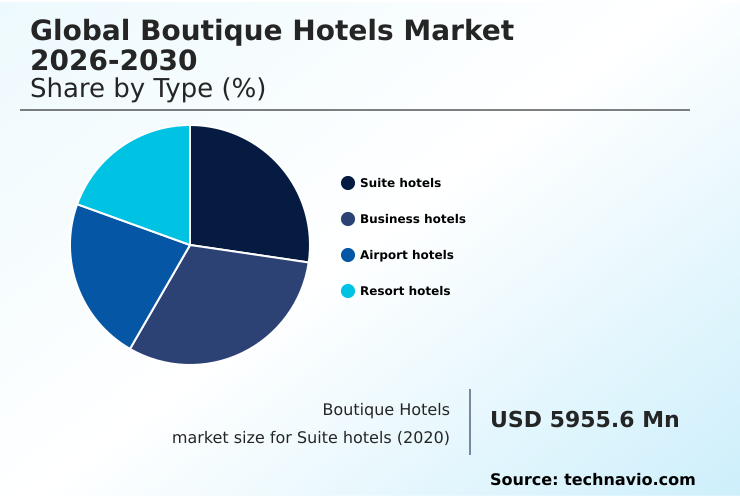
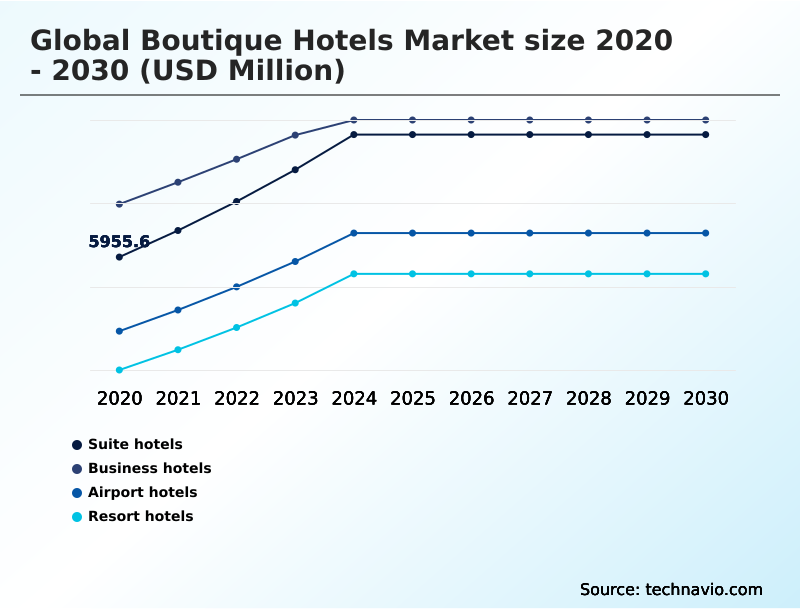
The Suite hotels segment was valued at USD 7.81 billion in 2024 and showed a gradual increase during the forecast period.
How demand for the Boutique Hotels market is rising in the leading region?
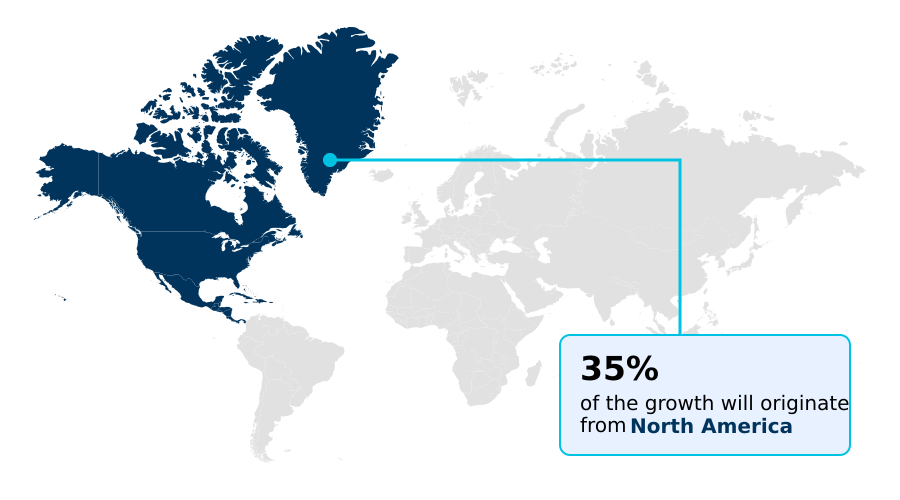
North America is estimated to contribute 34.8% to the growth of the global market during the forecast period.Technavio’s analysts have elaborately explained the regional trends and drivers that shape the market during the forecast period.
See How Boutique Hotels Market demand is rising in North America Request Free Sample
The geographic landscape of the global boutique hotels market is led by North America, which accounts for 34.8% of the market's incremental growth, driven by high consumer spending and a mature demand for experiential travel.
The US dominates the region, with its market size for boutique hotels being over five times larger than Canada's, reflecting a high concentration of properties in key urban and leisure destinations.
In contrast, APAC is projected to be the fastest-growing region, contributing 26% to the market's growth, fueled by rising disposable incomes and an expanding tourism infrastructure.
This growth creates opportunities for both independent operators and lifestyle brands to establish a presence.
The difference in market maturity leads to distinct operational strategies; North American hotels focus on renovation and a strong aesthetic narrative to compete, while APAC properties often prioritize new builds with integrated smart room technology.
What are the key Drivers, Trends, and Challenges in the Boutique Hotels Market?
Our researchers analyzed the data with 2025 as the base year, along with the key drivers, trends, and challenges. A holistic analysis of drivers will help companies refine their marketing strategies to gain a competitive advantage.
- Strategic success in the global boutique hotels market increasingly hinges on mastering the nuances of guest experience personalization and operational efficiency. Understanding the impact of OTAs on boutique hotel revenue is critical, as operators must balance the visibility from these platforms with incentives to drive more profitable direct bookings.
- A key differentiator is the integration of luxury boutique hotel wellness amenities, which can increase the average daily rate by up to 20% compared to properties without such offerings. Furthermore, the adoption of sustainable practices in independent hotels is no longer a niche preference but a core expectation for a growing segment of travelers.
- The role of technology integration in modern boutique hotels is another crucial factor, as seamless digital experiences from booking to checkout significantly influence guest satisfaction. Analyzing how boutique hotel direct booking incentives can be structured to foster loyalty without eroding margins represents a key strategic challenge for operators aiming for long-term, sustainable growth.
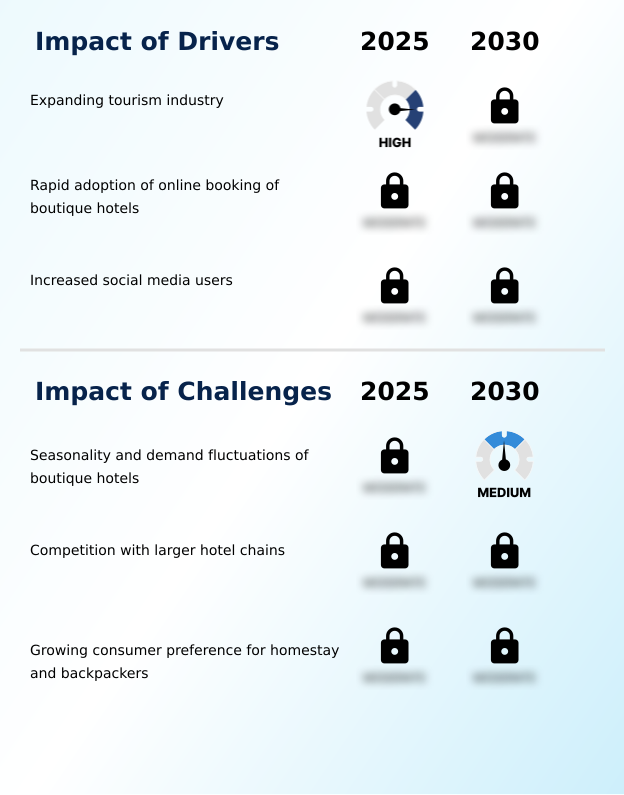
What are the key market drivers leading to the rise in the adoption of Boutique Hotels Industry?
- The expanding global tourism industry serves as a primary driver for the market, significantly increasing the overall demand for unique and personalized accommodation options.
- The rapid adoption of online booking platforms and a globally expanding tourism industry are the primary drivers fueling growth in the boutique hotels market.
- Online channels now account for over 65% of all boutique hotel reservations, a figure that has increased by 15% post-pandemic, empowering travelers with greater choice and transparency.
- This digital shift compels operators to optimize their online travel agency (OTA) integration and invest in direct booking strategies to capture demand.
- Concurrently, the rise of experiential travel, particularly among millennial and Gen Z consumers, creates a strong pull for the unique, personalized service that defines boutique properties.
- As international and domestic travel rebounds, these consumers actively seek out the authentic lodging and immersive experiences that differentiate boutique hotels from standardized chain offerings, directly driving occupancy rates and revenue growth.
What are the market trends shaping the Boutique Hotels Industry?
- A primary market trend is the increasing consumer preference for unique and authentic hospitality experiences. This shift drives demand for properties offering personalized service and a deep connection to local culture.
- A defining trend in the global boutique hotels market is the deep integration of wellness-centric amenities and hyperlocal experiences, which together are reshaping guest expectations and operational priorities. Properties offering curated wellness programs, such as in-room fitness options and spa services, report RevPAR figures that are, on average, 20% higher than those of competitors in the same local market.
- This is driven by a consumer shift toward travel that supports a healthy lifestyle. Simultaneously, the emphasis on cultural integration through partnerships with local artists and businesses provides an authentic lodging experience that large chains struggle to replicate. This approach not only enhances the guest experience but also strengthens community ties.
- As a result, boutique hotels are evolving from simple accommodations into destinations that offer immersive, restorative, and locally grounded stays.
What challenges does the Boutique Hotels Industry face during its growth?
- A key challenge impacting market growth is the inherent seasonality and demand fluctuations, which create complexities for revenue management and operational planning in boutique hotels.
- A significant challenge confronting the global boutique hotels market is the pronounced impact of seasonal demand fluctuations, which can cause occupancy rates to swing by as much as 50% between peak and off-peak periods. This volatility creates complex operational hurdles, particularly in staffing and inventory management, and puts pressure on annual revenue streams.
- Compounding this issue is the intense competition from the lifestyle brands and soft brand collections of major hotel corporations. These larger players leverage vast loyalty programs and marketing budgets, making it difficult for independent operators to compete for visibility and bookings.
- As a result, smaller boutique hotels must innovate continuously in their guest experience management and digital marketing to maintain market share against competitors that benefit from greater economies of scale and brand recognition.
Exclusive Technavio Analysis on Customer Landscape
The boutique hotels market forecasting report includes the adoption lifecycle of the market, covering from the innovator’s stage to the laggard’s stage. It focuses on adoption rates in different regions based on penetration. Furthermore, the boutique hotels market report also includes key purchase criteria and drivers of price sensitivity to help companies evaluate and develop their market growth analysis strategies.
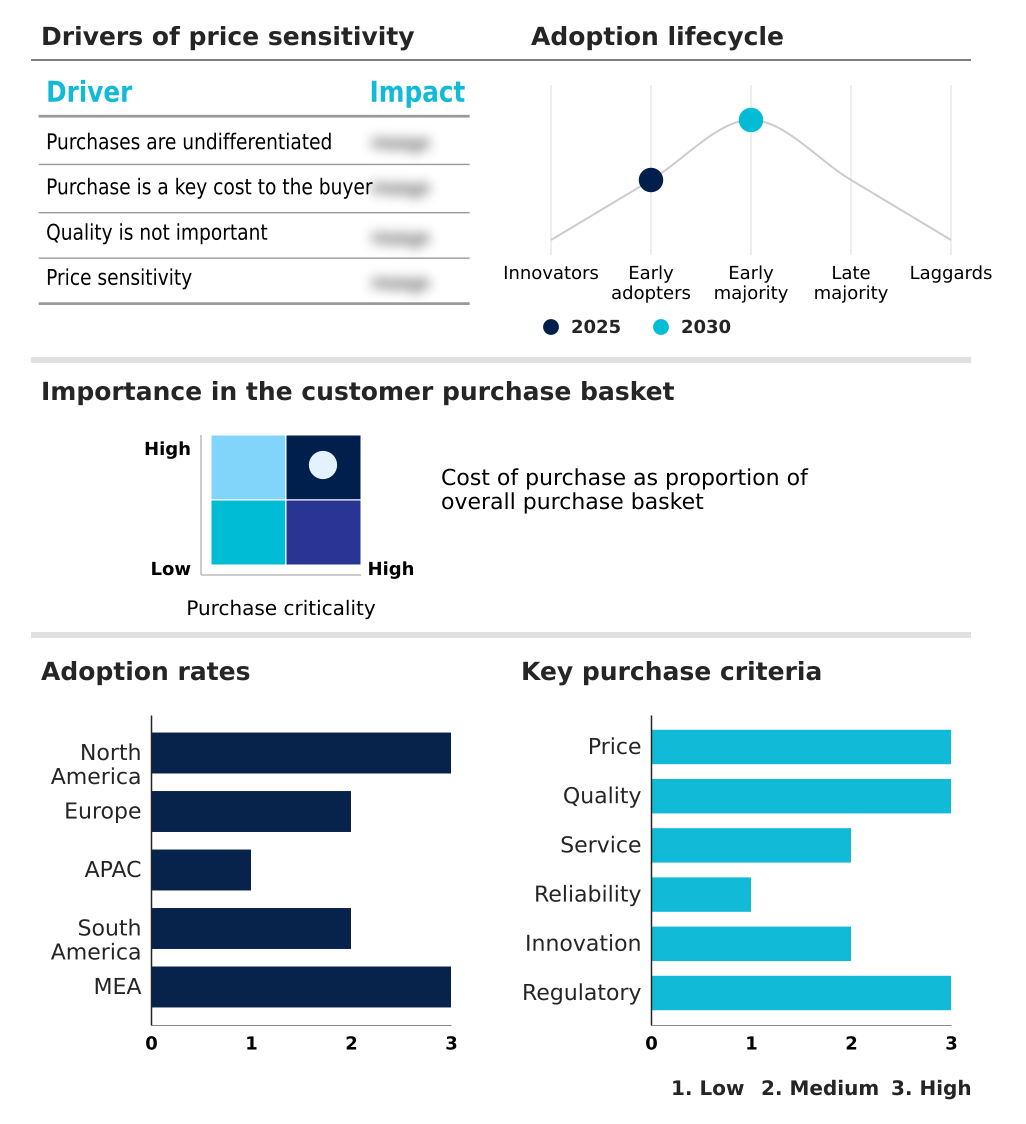
Customer Landscape of Boutique Hotels Industry
Competitive Landscape
Companies are implementing various strategies, such as strategic alliances, boutique hotels market forecast, partnerships, mergers and acquisitions, geographical expansion, and product/service launches, to enhance their presence in the industry.
Ace Hotel Group - Key offerings focus on delivering lifestyle-driven, intimate hotel experiences through unique decor, personalized service, and curated amenities, creating authentic lodging and experiential luxury for guests.
The industry research and growth report includes detailed analyses of the competitive landscape of the market and information about key companies, including:
- Ace Hotel Group
- Aman Group S.a.r.l.
- Dubai Holding LLC
- Farmhouse Inn
- Four Seasons Hotels Ltd.
- Hilton Worldwide Holdings Inc.
- Hyatt Hotels Corp.
- InterContinental Hotels Group
- ITC Ltd.
- Kerzner International Ltd.
- Koyasan guesthouse Kokuu
- Marriott International Inc.
- Shangri La Asia Ltd.
- The Indian Hotel Co. Ltd.
- The Pod Pte Ltd.
- The Travel Corp.
- Triple Creek Ranch
- Yotel Ltd.
Qualitative and quantitative analysis of companies has been conducted to help clients understand the wider business environment as well as the strengths and weaknesses of key industry players. Data is qualitatively analyzed to categorize companies as pure play, category-focused, industry-focused, and diversified; it is quantitatively analyzed to categorize companies as dominant, leading, strong, tentative, and weak.
Market Intelligence Radar: High-Impact Developments & Growth Signals
- In the hotels, resorts and cruise lines industry, the accelerated adoption of smart room technology and contactless services is reshaping guest expectations, directly compelling boutique hotels to invest in mobile check-in, digital keys, and in-room environmental controls to maintain a competitive edge in providing a seamless guest journey.
- Heightened consumer and regulatory focus on sustainability is mandating changes across the hospitality sector. This requires boutique hotels to integrate eco-friendly initiatives and sustainable practices, such as using locally sourced products and reducing energy consumption, which is increasingly becoming a key factor in guest booking decisions.
- The normalization of remote work has fueled the rise of bleisure travel, altering demand patterns within the broader hospitality industry. Boutique hotels are capitalizing on this by offering enhanced amenities for work, such as high-speed internet and comfortable workspaces, to attract travelers blending business with leisure, thereby boosting occupancy rates during traditionally slower midweek periods.
- There is a strategic shift in distribution channel management across the hotels, resorts and cruise lines industry, with a greater emphasis on balancing high-commission online travel agency (OTA) integration with developing robust direct booking strategies. This forces boutique hotels to enhance their digital footprint and guest relationship management to drive more profitable direct reservations.
Dive into Technavio’s robust research methodology, blending expert interviews, extensive data synthesis, and validated models for unparalleled Boutique Hotels Market insights. See full methodology.
| Market Scope | |
|---|---|
| Page number | 291 |
| Base year | 2025 |
| Historic period | 2020-2024 |
| Forecast period | 2026-2030 |
| Growth momentum & CAGR | Accelerate at a CAGR of 6.8% |
| Market growth 2026-2030 | USD 11588.0 million |
| Market structure | Fragmented |
| YoY growth 2025-2026(%) | 6.6% |
| Key countries | US, Canada, Mexico, Germany, UK, France, Italy, Spain, The Netherlands, China, Japan, India, South Korea, Australia, Indonesia, Brazil, Argentina, Colombia, Saudi Arabia, UAE, South Africa, Israel and Turkey |
| Competitive landscape | Leading Companies, Market Positioning of Companies, Competitive Strategies, and Industry Risks |
Research Analyst Overview
- The boutique hotels market ecosystem is a complex network where value is co-created by diverse stakeholders. Upstream, the ecosystem relies on specialized suppliers, including interior designers, technology providers for smart room features, and purveyors of locally sourced products, whose inputs are crucial for creating a unique aesthetic narrative.
- Hotel operators, ranging from independent owners to soft brand collections under major hospitality groups, represent the core of the ecosystem. Distribution is handled through a dual-channel approach, with online travel agency (OTA) integration providing broad reach while direct booking strategies aim to maximize profitability, with direct channels often yielding a 15-25% higher margin per booking.
- The primary end-users are leisure and bleisure travelers seeking authentic lodging. This entire value chain is supported by marketing agencies and guest relationship management platforms that help build and maintain the hotel's digital footprint and brand identity.
What are the Key Data Covered in this Boutique Hotels Market Research and Growth Report?
-
What is the expected growth of the Boutique Hotels Market between 2026 and 2030?
-
The Boutique Hotels Market is expected to grow by USD 11.59 billion during 2026-2030, registering a CAGR of 6.8%. Year-over-year growth in 2026 is estimated at 6.6%%. This acceleration is shaped by expanding tourism industry, which is intensifying demand across multiple end-use verticals covered in the report.
-
-
What segmentation does the market report cover?
-
The report is segmented by Type (Suite hotels, Business hotels, Airport hotels, and Resort hotels), Channel (Online booking, and In-person booking), Service Type (Luxury boutique hotels, Budget boutique hotels, Family-friendly boutique hotels, and Adults-only boutique hotels) and Geography (North America, Europe, APAC, South America, Middle East and Africa). Among these, the Suite hotels segment is estimated to witness significant growth during the forecast period, driven by rising adoption across key application areas. Each segment includes detailed qualitative and quantitative analysis, along with historical data from 2020-2024 and forecasts through 2030 with year-over-year growth rates.
-
-
Which regions are analyzed in the report?
-
The report covers North America, Europe, APAC, South America and Middle East and Africa. North America is estimated to contribute 34.8% to market growth during the forecast period. Country-level analysis includes US, Canada, Mexico, Germany, UK, France, Italy, Spain, The Netherlands, China, Japan, India, South Korea, Australia, Indonesia, Brazil, Argentina, Colombia, Saudi Arabia, UAE, South Africa, Israel and Turkey, with dedicated market size tables and year-over-year growth for each.
-
-
What are the key growth drivers and market challenges?
-
The primary driver is expanding tourism industry, which is accelerating investment and industry demand. The main challenge is seasonality and demand fluctuations of boutique hotels, creating operational barriers for key market participants. The report quantifies the impact of each driver and challenge across 2026 and 2030 with comparative analysis.
-
-
Who are the major players in the Boutique Hotels Market?
-
Key vendors include Ace Hotel Group, Aman Group S.a.r.l., Dubai Holding LLC, Farmhouse Inn, Four Seasons Hotels Ltd., Hilton Worldwide Holdings Inc., Hyatt Hotels Corp., InterContinental Hotels Group, ITC Ltd., Kerzner International Ltd., Koyasan guesthouse Kokuu, Marriott International Inc., Shangri La Asia Ltd., The Indian Hotel Co. Ltd., The Pod Pte Ltd., The Travel Corp., Triple Creek Ranch and Yotel Ltd.. The report provides qualitative and quantitative analysis categorizing companies as dominant, leading, strong, tentative, and weak based on their market positioning. Company profiles include business segment analysis, SWOT assessment, key offerings, and recent strategic developments.
-
Market Research Insights
- The competitive landscape of the global boutique hotels market is moderately fragmented, with the top ten players, including Hilton Worldwide Holdings Inc. and Hyatt Hotels Corp., accounting for less than 40% of the market share.
- These major corporations are actively expanding their footprint in the boutique space through the launch of soft brand collections, such as Curio Collection by Hilton and Andaz by Hyatt, which aim to capture the demand for unique, independent-style hotels backed by a global distribution system.
- This strategy has resulted in a 15% increase in the number of branded boutique properties over the last two years. This expansion directly addresses the rising consumer demand for authentic lodging and hyperlocal experiences.
- However, these companies face the challenge of maintaining a unique brand identity and personalized service across a growing portfolio, a core tenet of the boutique hotel value proposition.
We can help! Our analysts can customize this boutique hotels market research report to meet your requirements.
 RIA -
RIA - 
