


Brazil Office Furniture Market Size 2026-2030
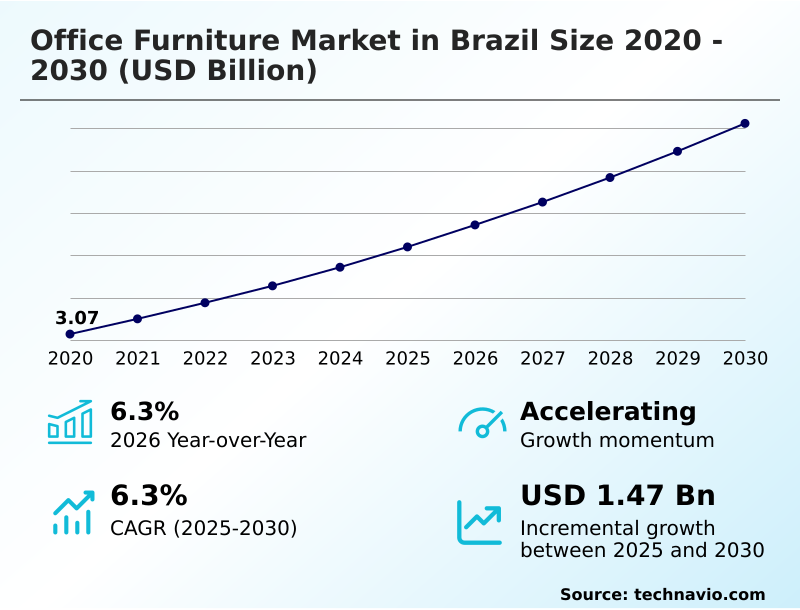
The brazil office furniture market size is valued to increase by USD 1.47 billion, at a CAGR of 6.3% from 2025 to 2030. Heightened adoption of hybrid work models driving office redesigns and modernization will drive the brazil office furniture market.
Major Market Trends & Insights
- By End-user - Commercial office furniture segment was valued at USD 2.83 billion in 2024
- By Distribution Channel - Offline segment accounted for the largest market revenue share in 2024
Market Size & Forecast
- Market Opportunities: USD 2.49 billion
- Market Future Opportunities: USD 1.47 billion
- CAGR from 2025 to 2030 : 6.3%
Market Summary
- The office furniture market in Brazil is undergoing a strategic evolution, driven by a fundamental shift in how workspaces are perceived and utilized. The widespread adoption of hybrid work models has redefined the office as a central hub for collaboration, innovation, and reinforcing corporate culture, rather than just a location for individual tasks.
- This paradigm shift fuels demand for agile environments featuring collaborative furniture, private acoustic pods, and reconfigurable workstations. Companies now prioritize employee wellbeing, leading to significant investments in certified ergonomic chairs and height-adjustable desks to comply with occupational health standards and boost productivity.
- For instance, a financial services firm redesigning its headquarters will now focus on creating a variety of work settings—from quiet zones for focused tasks to open lounges for team interaction—using modular systems. Sustainability is also a core purchasing criterion, with a growing preference for products with transparent life cycles and those made from recycled or certified materials.
- This confluence of trends is compelling manufacturers to innovate beyond products and offer holistic, human-centric workplace solutions.
What will be the Size of the Brazil Office Furniture Market during the forecast period?
Get Key Insights on Market Forecast (PDF) Get Free Sample
How is the Brazil Office Furniture Market Segmented?
The brazil office furniture industry research report provides comprehensive data (region-wise segment analysis), with forecasts and estimates in "USD million" for the period 2026-2030, as well as historical data from 2020-2024 for the following segments.
- End-user
- Commercial office furniture
- Home office furniture
- Distribution channel
- Offline
- Online
- Product
- Seating
- Systems
- Tables
- Storage units and files
- Overhead bins
- Material
- Wood
- Steel
- Others
- Geography
- South America
- Brazil
- South America
By End-user Insights
The commercial office furniture segment is estimated to witness significant growth during the forecast period.
The commercial office furniture segment is transforming as corporations reimagine physical offices as hubs for collaboration and culture. This flight-to-quality trend, essential for talent attraction and retention, fuels demand for solutions that support activity-based working.
Investments in modular furniture and acoustic pods are rising, with corporate real estate strategy now prioritizing flexible space utilization.
The market is seeing a pivot towards human-centric design, where the integration of ergonomic accessories and certified ergonomic chairs supports new occupational health standards.
This is reflected in procurement decisions, where ESG reporting compliance now influences over 60% of large-scale contracts, mandating supply chain transparency and the use of sustainable materials from certified sources to create an experiential workplace design.
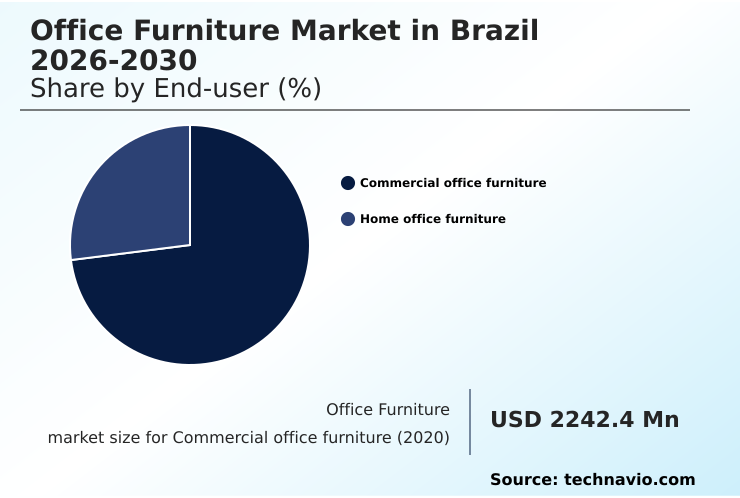
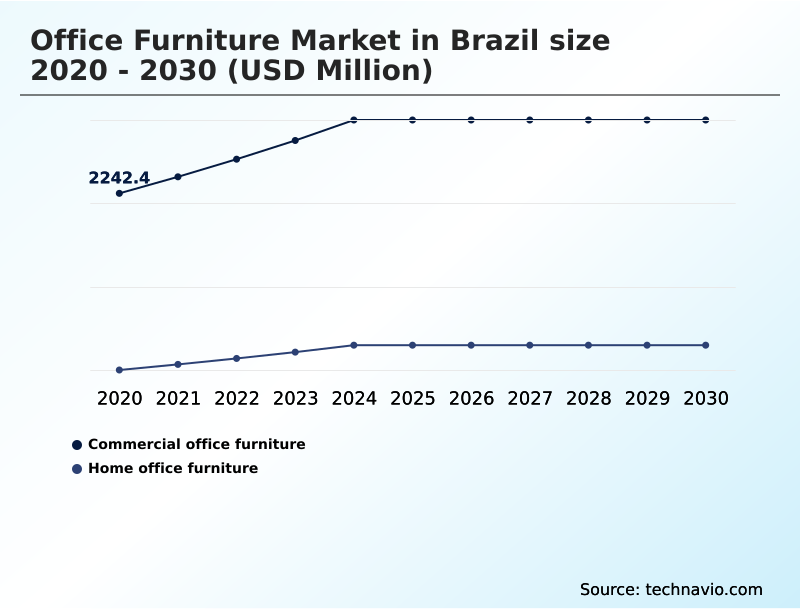
The Commercial office furniture segment was valued at USD 2.83 billion in 2024 and showed a gradual increase during the forecast period.
Market Dynamics
Our researchers analyzed the data with 2025 as the base year, along with the key drivers, trends, and challenges. A holistic analysis of drivers will help companies refine their marketing strategies to gain a competitive advantage.
- Corporate decision-making in the office furniture market in Brazil has become a complex balancing act. When planning an office redesign for employee wellbeing ROI, facility managers must now consider a wide range of factors beyond simple aesthetics. The initial analysis often contrasts modular furniture solutions for agile offices with the long-term benefits of biophilic design impact on employee productivity.
- Procurement teams are tasked with navigating the ESG compliance in office furniture supply chains, carefully weighing the premium for sustainable office furniture procurement criteria against budget constraints.
- A critical debate involves the role of FaaS in corporate real estate, assessing whether leasing models offer better financial flexibility than outright capital expenditure, especially given the impact of interest rates on furniture capex.
- The rise of remote work introduces further complexity, with HR departments evaluating the necessity of providing certified ergonomic chairs for remote workers to mitigate health risks and calculating the cost of non-ergonomic workstation setups. This is influenced by the digital nomad visa impact on furniture sales in urban rental markets and the growth drivers for the home office segment.
- Simultaneously, companies must manage intense competition from the informal furniture market sector and address the persistent logistics challenges in the furniture distribution network. The technology integration in modern workspace design is no longer optional, with a focus on smart furniture for workplace space optimization and acoustic solutions for open-plan environments.
- Finally, large-scale projects may be influenced by government investment in public office furniture, which sets a benchmark for quality and durability, demonstrating that firms that master these interconnected challenges achieve a market positioning that is nearly 20% stronger than their competitors.
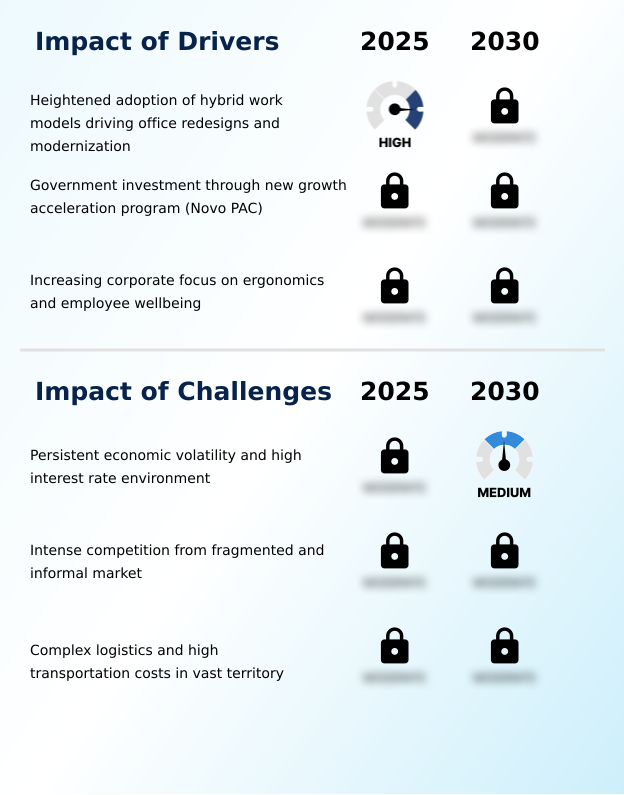
What are the key market drivers leading to the rise in the adoption of Brazil Office Furniture Industry?
- A key market driver is the heightened adoption of hybrid work models, which is compelling extensive office redesigns and modernization efforts across the corporate sector.
- Market growth is significantly propelled by the corporate focus on enhancing the employee experience as a tool for talent attraction and retention.
- This has led to widespread office modernization projects centered on technologically integrated workstations and creating an experiential workplace design. Companies that invest in such environments see a measurable impact, with some reporting a 10% reduction in employee turnover.
- A second major driver is the increasing emphasis on health and compliance with occupational health standards, fueling investments in post-consumer recycled (PCR) content and other sustainable materials that contribute to green building certifications.
- The public sector also provides a stable demand stream, with government programs funding the outfitting of new facilities.
- Finally, the formalization of remote work has created a robust secondary market for high-quality home office setups, driven by a need for proper remote work ergonomics.
What are the market trends shaping the Brazil Office Furniture Industry?
- A primary market trend is the growing ascendancy of ergonomic designs and flexible furnishings. This shift is a direct response to the widespread adoption of hybrid work models.
- Key trends are reshaping the market, with a strong emphasis on flexibility and sustainability. The move towards hybrid work models is driving demand for resimercial design aesthetics and biophilic design elements, creating more inviting and productive office environments. Organizations implementing these design principles have reported an 18% increase in employee engagement.
- Another dominant trend is the adoption of circular supply chains, evidenced by the rise of take-back programs and furniture refurbishment. This focus on life cycle assessments is a direct response to corporate ESG mandates. Furthermore, the integration of technology is becoming standard, with products featuring integrated power solutions and wireless charging pads.
- The demand for intelligent spaces is also growing, supported by digital twin simulations and predictive maintenance alerts that can reduce facility management overhead by up to 20%.
What challenges does the Brazil Office Furniture Industry face during its growth?
- Persistent economic volatility, compounded by a high interest rate environment, presents a significant challenge to the industry's growth and corporate investment capacity.
- The market faces considerable headwinds from economic and structural factors. Persistent economic volatility and high interest rates suppress corporate capital expenditure, with project deferrals increasing by an estimated 25% during periods of uncertainty. Another significant challenge is the intense price pressure from a fragmented and informal market sector, which often circumvents regulations and erodes margins for compliant manufacturers.
- This makes it difficult for legitimate businesses to compete, particularly in price-sensitive segments. Moreover, Brazil's vast geography and underdeveloped logistics infrastructure create substantial operational hurdles. Inefficient transportation networks can inflate final product costs by over 15% and lead to unreliable delivery schedules, hindering the ability of manufacturers to serve a national client base effectively.
- These factors collectively constrain market growth and demand strategic operational planning.
Exclusive Technavio Analysis on Customer Landscape
The brazil office furniture market forecasting report includes the adoption lifecycle of the market, covering from the innovator’s stage to the laggard’s stage. It focuses on adoption rates in different regions based on penetration. Furthermore, the brazil office furniture market report also includes key purchase criteria and drivers of price sensitivity to help companies evaluate and develop their market growth analysis strategies.
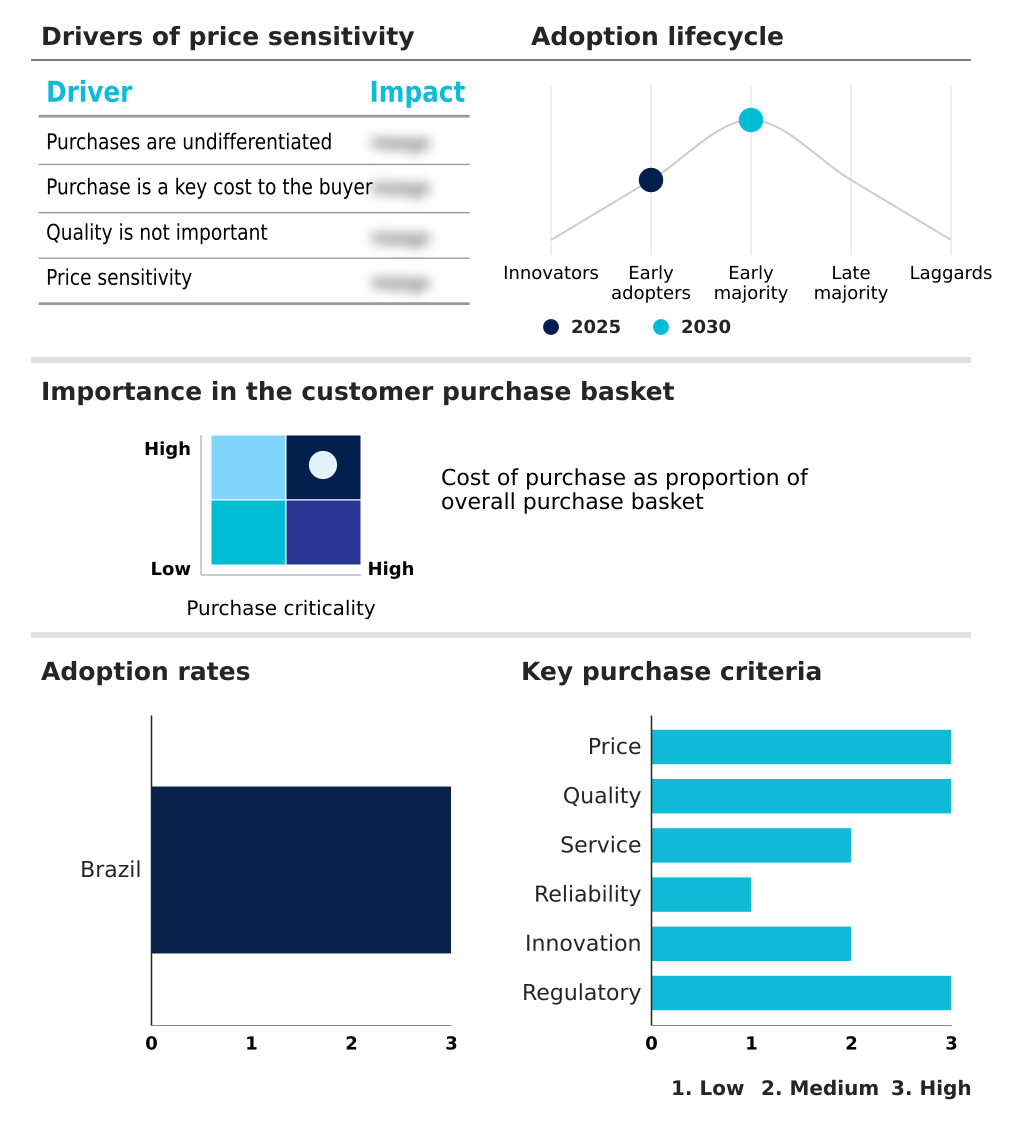
Customer Landscape of Brazil Office Furniture Industry
Competitive Landscape
Companies are implementing various strategies, such as strategic alliances, brazil office furniture market forecast, partnerships, mergers and acquisitions, geographical expansion, and product/service launches, to enhance their presence in the industry.
Alan Desk Business Interiors Inc. - The market is defined by a diverse range of offerings from domestic and global suppliers, focusing on ergonomic, sustainable, and technology-integrated solutions for modern workplaces.
The industry research and growth report includes detailed analyses of the competitive landscape of the market and information about key companies, including:
- Alan Desk Business Interiors Inc.
- Alberflex Industria de Moveis Ltda
- Artopex
- Bortolini Furniture
- Cavaletti S.A
- Eroflex
- FK Grupo S.A.
- Flexform
- Functional Corporate Furniture
- Gebb Work Industria Ltda
- Global Furniture Group
- Haworth Inc.
- Herman Miller Inc.
- HNI Corp.
- Masotti Furniture
- PLAXMETAL
- Ricco
- Securit
- Steelcase Inc.
Qualitative and quantitative analysis of companies has been conducted to help clients understand the wider business environment as well as the strengths and weaknesses of key industry players. Data is qualitatively analyzed to categorize companies as pure play, category-focused, industry-focused, and diversified; it is quantitatively analyzed to categorize companies as dominant, leading, strong, tentative, and weak.
Recent Development and News in Brazil office furniture market
- In September, 2024, Cavaletti S.A announced it secured a major government contract under the Novo PAC initiative to furnish new federal administrative centers, a deal valued at over $15 million.
- In November, 2024, Steelcase Inc. launched its new line of 'Sync' smart furniture in the Brazilian market, featuring integrated IoT sensors to provide businesses with advanced space optimization data.
- In February, 2025, Herman Miller Inc. published a new corporate ESG report highlighting that its Brazilian manufacturing operations now use 95% locally sourced, sustainable materials, including FSC-certified wood and recycled metals.
- In April, 2025, Flexform entered a strategic partnership with a leading national technology firm to integrate advanced workplace management software directly into its modular furniture systems, enhancing hot desking efficiency.
Dive into Technavio’s robust research methodology, blending expert interviews, extensive data synthesis, and validated models for unparalleled Brazil Office Furniture Market insights. See full methodology.
| Market Scope | |
|---|---|
| Page number | 205 |
| Base year | 2025 |
| Historic period | 2020-2024 |
| Forecast period | 2026-2030 |
| Growth momentum & CAGR | Accelerate at a CAGR of 6.3% |
| Market growth 2026-2030 | USD 1466.8 million |
| Market structure | Fragmented |
| YoY growth 2025-2026(%) | 6.3% |
| Key countries | Brazil |
| Competitive landscape | Leading Companies, Market Positioning of Companies, Competitive Strategies, and Industry Risks |
Research Analyst Overview
- The office furniture market in Brazil is defined by a strategic shift towards integrated and adaptable workplace ecosystems. The core demand is no longer for standalone products but for holistic solutions that blend human-centric design with functional efficiency.
- Key product categories such as ergonomic chairs, height-adjustable desks, and modular furniture are now standard, but differentiation comes from advanced features like sit-stand desks and certified ergonomic chairs that meet stringent NR-17 standards.
- A major boardroom-level consideration is sustainability, where procurement decisions are increasingly tied to ESG compliance, mandating materials with Forest Stewardship Council (FSC) certification and low-VOC finishes to qualify for LEED certification. Firms leveraging this trend have seen a 15% improvement in their success rate for corporate tenders.
- Innovation is prominent in smart furniture, which uses IoT sensors to generate space optimization data, and in the adoption of circular economy models like furniture-as-a-service (FaaS). The market is also characterized by solutions for new work paradigms, including hot desking, activity-based working, and agile desking, supported by movable partitions, acoustic pods, and sound-absorbing PET felt panels.
- This evolution reflects a deeper understanding of how physical space impacts productivity and wellbeing.
What are the Key Data Covered in this Brazil Office Furniture Market Research and Growth Report?
-
What is the expected growth of the Brazil Office Furniture Market between 2026 and 2030?
-
USD 1.47 billion, at a CAGR of 6.3%
-
-
What segmentation does the market report cover?
-
The report is segmented by End-user (Commercial office furniture, and Home office furniture), Distribution Channel (Offline, and Online), Product (Seating, Systems, Tables, Storage units and files, and Overhead bins), Material (Wood, Steel, and Others) and Geography (South America)
-
-
Which regions are analyzed in the report?
-
South America
-
-
What are the key growth drivers and market challenges?
-
Heightened adoption of hybrid work models driving office redesigns and modernization, Persistent economic volatility and high interest rate environment
-
-
Who are the major players in the Brazil Office Furniture Market?
-
Alan Desk Business Interiors Inc., Alberflex Industria de Moveis Ltda, Artopex, Bortolini Furniture, Cavaletti S.A, Eroflex, FK Grupo S.A., Flexform, Functional Corporate Furniture, Gebb Work Industria Ltda, Global Furniture Group, Haworth Inc., Herman Miller Inc., HNI Corp., Masotti Furniture, PLAXMETAL, Ricco, Securit and Steelcase Inc.
-
Market Research Insights
- The market's momentum is shaped by the strategic alignment of corporate real estate strategy with new workforce expectations. The implementation of agile working environments and hybrid work models has become critical for talent attraction and retention. This shift is quantifiable, as companies adopting user-centric product development in their office designs report a 15% increase in employee satisfaction scores.
- Furthermore, the focus on remote work ergonomics has led to a surge in direct-to-consumer (D2C) portals, which have seen a 40% growth in sales for specialized home office equipment.
- Meanwhile, B2B marketplaces are expanding to offer greater supply chain transparency, allowing corporate buyers to vet suppliers based on ESG reporting compliance, a factor now critical in over half of all major procurement decisions.
We can help! Our analysts can customize this brazil office furniture market research report to meet your requirements.
 RIA -
RIA - 
