
Circular Economy Enablement Platforms Market Analysis, Size, and Forecast 2026-2030: Europe (Germany, UK, and France), North America (US, Canada, and Mexico), APAC (China, India, and Japan), South America (Brazil, Argentina, and Colombia), Middle East and Africa (Saudi Arabia, UAE, and South Africa), and Rest of World (ROW)

Circular Economy Enablement Platforms Market Analysis, Size, and Forecast 2026-2030:
Europe (Germany, UK, and France), North America (US, Canada, and Mexico), APAC (China, India, and Japan), South America (Brazil, Argentina, and Colombia), Middle East and Africa (Saudi Arabia, UAE, and South Africa), and Rest of World (ROW)

Published: Mar 2026 305 Pages SKU: IRTNTR81320

Market Overview at a Glance

$5.11 B
Market Opportunity
14.6%
CAGR 2025 - 2030
32.1%
Europe Growth
$1.37 B
Resource recovery platforms segment 2024

Circular Economy Enablement Platforms Market Size 2026-2030

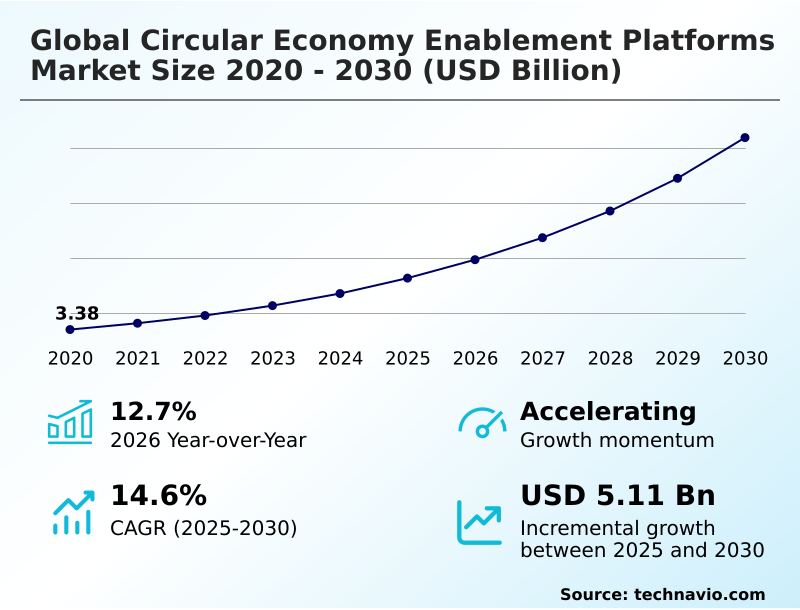
The circular economy enablement platforms market size is valued to increase by USD 5.11 billion, at a CAGR of 14.6% from 2025 to 2030. Escalating regulatory pressures and environmental mandates will drive the circular economy enablement platforms market.

Major Market Trends & Insights

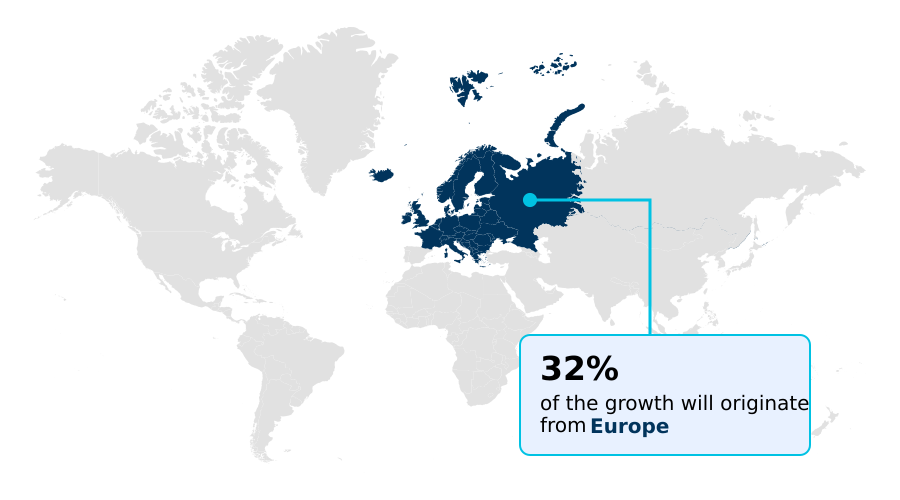
  • Europe dominated the market and accounted for a 32.1% growth during the forecast period.
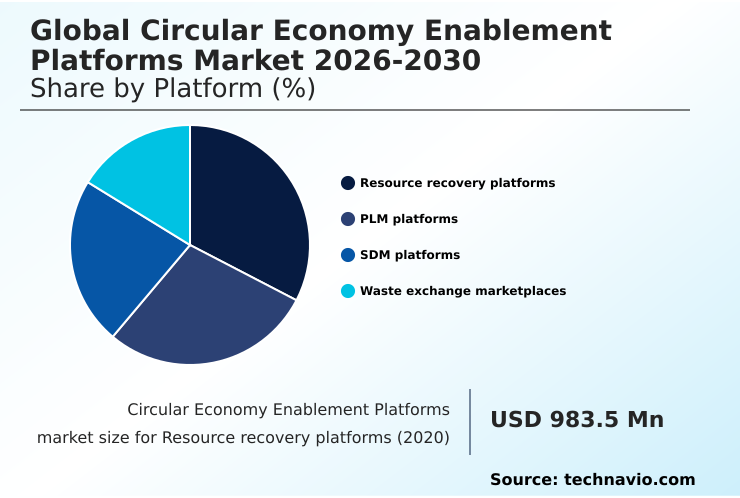
  • By Platform - Resource recovery platforms segment was valued at USD 1.37 billion in 2024
  • By Deployment - Cloud segment accounted for the largest market revenue share in 2024

Market Size & Forecast

  • Market Opportunities: USD 6.98 billion
  • Market Future Opportunities: USD 5.11 billion
  • CAGR from 2025 to 2030 : 14.6%

Market Summary

  • The Circular Economy Enablement Platforms market is transitioning from a niche concept to a core strategic imperative for global enterprises. Driven by stringent environmental regulations and mounting stakeholder pressure for supply chain transparency, organizations are compelled to adopt digital solutions that facilitate a shift from linear to regenerative models.
  • Key trends include the integration of a digital product passport, verified via blockchain, and the use of AI for material matching in secondary marketplaces. These platforms provide the digital infrastructure for complex processes like reverse logistics management, lifecycle assessment, and compliance reporting automation.
  • For example, a multinational electronics firm can deploy a platform to manage its take-back program logistics, track components for refurbishment, and verify recycled content, thereby mitigating raw material price volatility and enhancing brand reputation. However, challenges such as high implementation costs and data interoperability issues persist.
  • The market's trajectory is defined by the need for interoperable, scalable systems that can provide a single source of truth for all sustainability data, turning circularity into a measurable and profitable business strategy.

What will be the Size of the Circular Economy Enablement Platforms Market during the forecast period?

Get Key Insights on Market Forecast (PDF) Request Free Sample

How is the Circular Economy Enablement Platforms Market Segmented?

The circular economy enablement platforms industry research report provides comprehensive data (region-wise segment analysis), with forecasts and estimates in "USD million" for the period 2026-2030, as well as historical data from 2020-2024 for the following segments.

  • Platform
    • Resource recovery platforms
    • PLM platforms
    • SDM platforms
    • Waste exchange marketplaces
    • Compliance and analytics platforms
  • Deployment
    • Cloud
    • On-premises
    • Hybrid
  • Component
    • Software
    • Services
  • Geography
    • Europe
      • Germany
      • UK
      • France
    • North America
      • US
      • Canada
      • Mexico
    • APAC
      • China
      • India
      • Japan
    • South America
      • Brazil
      • Argentina
      • Colombia
    • Middle East and Africa
      • Saudi Arabia
      • UAE
      • South Africa
    • Rest of World (ROW)

By Platform Insights

The resource recovery platforms segment is estimated to witness significant growth during the forecast period.

Resource recovery platforms are a cornerstone of the circular economy, focused on maximizing end-of-life value recovery from products and byproducts.

These circular economy software solutions utilize waste-to-value analytics to convert discarded materials into revenue, driving a shift from traditional waste management to continuous material utility.

A key function is facilitating industrial symbiosis networks, where one facility's waste becomes another's input, contributing to over 30% of new market adoption in key industrial regions.

The effectiveness of any resource recovery platform hinges on a robust material traceability system and raw material tracking systems.

These platforms serve as a critical supply chain transparency tool, enabling enterprises to close material loops and transform waste into a verifiable asset.

Request Free Sample

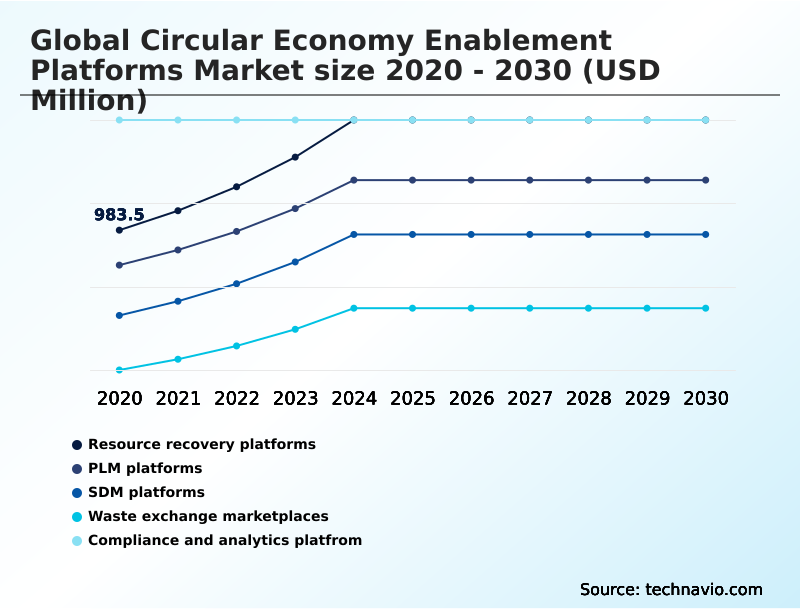
The Resource recovery platforms segment was valued at USD 1.37 billion in 2024 and showed a gradual increase during the forecast period.
Request Free Sample

Regional Analysis

Europe is estimated to contribute 32.1% to the growth of the global market during the forecast period.Technavio’s analysts have elaborately explained the regional trends and drivers that shape the market during the forecast period.

See How Circular Economy Enablement Platforms Market Demand is Rising in Europe Request Free Sample

The geographic landscape is characterized by varied adoption rates, with APAC showing the fastest growth at 16%, compared to Europe's 13.7%.

In mature markets, the focus is on sophisticated circular economy software solutions, including advanced product lifecycle management and circular asset management tools.

An asset exchange manager or a similar resource exchange platform is becoming standard for b2b resource management, with a focus on resource utilization optimization. These platforms often incorporate asset recovery software to manage asset refurbishment management and remanufacturing process optimization.

In emerging regions, the emphasis is on foundational technologies like reverse logistics optimization tools and material passport technology.

Across all regions, effective material lifecycle management solutions are critical for enabling a regenerative economic model and improving material recapture by over 25% in some industries.

Market Dynamics

Our researchers analyzed the data with 2025 as the base year, along with the key drivers, trends, and challenges. A holistic analysis of drivers will help companies refine their marketing strategies to gain a competitive advantage.

  • Navigating the transition to a circular model requires a deep understanding of specialized digital tools and strategies. A key question for many is how to implement digital product passports, a process that relies heavily on blockchain for verifying recycled content to ensure data integrity.
  • Concurrently, businesses are focused on optimizing reverse logistics with ai, which can yield efficiency gains far greater than manual methods. The choice of software is critical; for instance, understanding the sustainability data management platform features is essential before committing to a system. For specific sectors, targeted solutions are paramount.
  • The benefits of industrial symbiosis platforms are most evident in connecting different industries, while a dedicated waste exchange marketplace for construction can unlock significant value from debris. Similarly, a resource recovery platform for automotive is designed for complex part-retrieval, while a circular economy platform for electronics handles high-value e-waste.
  • Design-phase tools like plm software for circular design are crucial for embedding sustainability from the start. On the compliance side, businesses need the best software for epr reporting and effective compliance management for plastic packaging. Operationally, managing trade-in programs with software is vital for retail, while ai-powered food waste reduction solutions address a major global issue.
  • Ultimately, understanding the difference between linear and circular supply is the first step, followed by deploying tools for tracking carbon footprint across supply chain, improving material traceability in textiles, assessing the roi of circularity platforms, using tools for lifecycle assessment reporting, and integrating circular principles in manufacturing, including the logistics for fashion resale-as-a-service.

What are the key market drivers leading to the rise in the adoption of Circular Economy Enablement Platforms Industry?

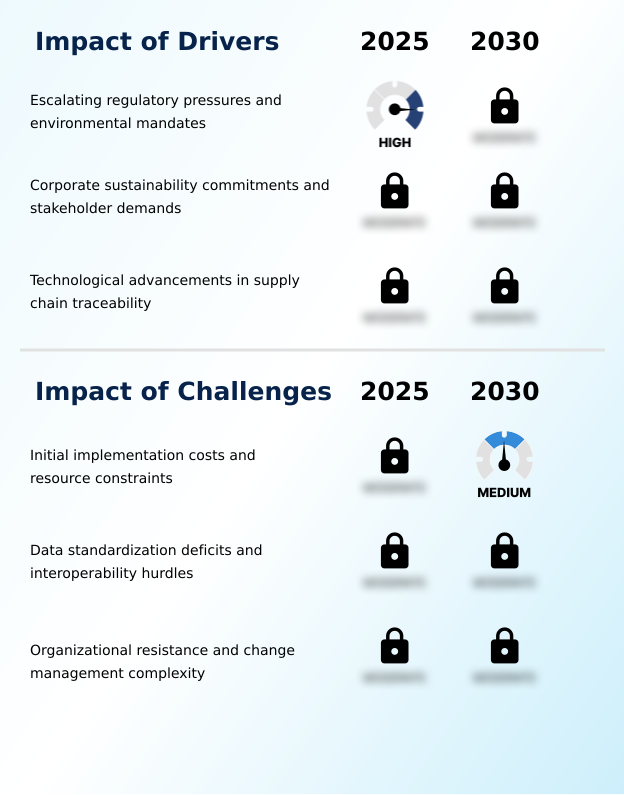
  • Escalating regulatory pressures and environmental mandates are key drivers compelling enterprises to adopt circular economy enablement platforms for compliance and resource management.

  • Escalating regulatory pressures and stakeholder demands are primary market drivers, with corporate sustainability commitments necessitating investment in robust supply chain traceability platforms.
  • Demand for sustainability reporting platforms is set to double over the next five-year cycle as companies seek to manage ESG metrics.
  • The use of lifecycle assessment software and a digital twin for circularity allows organizations to model environmental impacts, reducing resource use by up to 20% in the design phase.
  • The adoption of a sustainable procurement portal and specialized extended producer responsibility software is no longer optional. These epr compliance solutions streamline compliance reporting automation.
  • Furthermore, blockchain for supply chain offers immutable carbon footprint tracking, while material flow analysis software provides the data backbone for all circularity reporting tools and environmental compliance software.

What are the market trends shaping the Circular Economy Enablement Platforms Industry?

  • The integration of Digital Product Passports, verified by blockchain technology, is becoming a pivotal market trend. This shift enhances data transparency and immutability throughout a product's lifecycle.

  • The market is rapidly evolving beyond simple waste tracking, driven by the convergence of reverse logistics and financial technology. The integration of a digital product passport is becoming standard, facilitating new product-as-a-service models and circular business model platforms.
  • Advanced ai-driven material matching is transforming the efficiency of any secondary marketplace platform, with some platforms reporting a 40% improvement in match accuracy. In consumer-facing sectors, the rise of resale-as-a-service and specialized fashion resale technology is notable.
  • These digital matchmaking platforms, often functioning as a white-label resale platform or online consignment platform, depend on sophisticated take-back program logistics to succeed, with adoption in electronics recommerce platforms growing 15% faster than in other retail segments. This is all underpinned by effective take-back program management.

What challenges does the Circular Economy Enablement Platforms Industry face during its growth?

  • High initial implementation costs and significant resource constraints present a primary challenge to the widespread adoption of circular economy enablement platforms.

  • Despite strong drivers, significant hurdles remain, primarily around data standardization and interoperability. The lack of universal protocols for sustainability data management hinders the establishment of a truly closed-loop supply chain system. Integrating disparate waste management software systems can represent up to 15% of an SME's annual IT budget.
  • The complexity of sharing material composition data for chemical recycling traceability or performing recycling credit verification across platforms is a major issue. Even specialized solutions like food waste measurement tools struggle without a coherent managed marketplace infrastructure.
  • This fragmentation impacts the effectiveness of food waste reduction technology, closed-loop manufacturing software, remanufacturing management systems, and sustainable design software rooted in circular design principles.

Exclusive Technavio Analysis on Customer Landscape

The circular economy enablement platforms market forecasting report includes the adoption lifecycle of the market, covering from the innovator’s stage to the laggard’s stage. It focuses on adoption rates in different regions based on penetration. Furthermore, the circular economy enablement platforms market report also includes key purchase criteria and drivers of price sensitivity to help companies evaluate and develop their market growth analysis strategies.
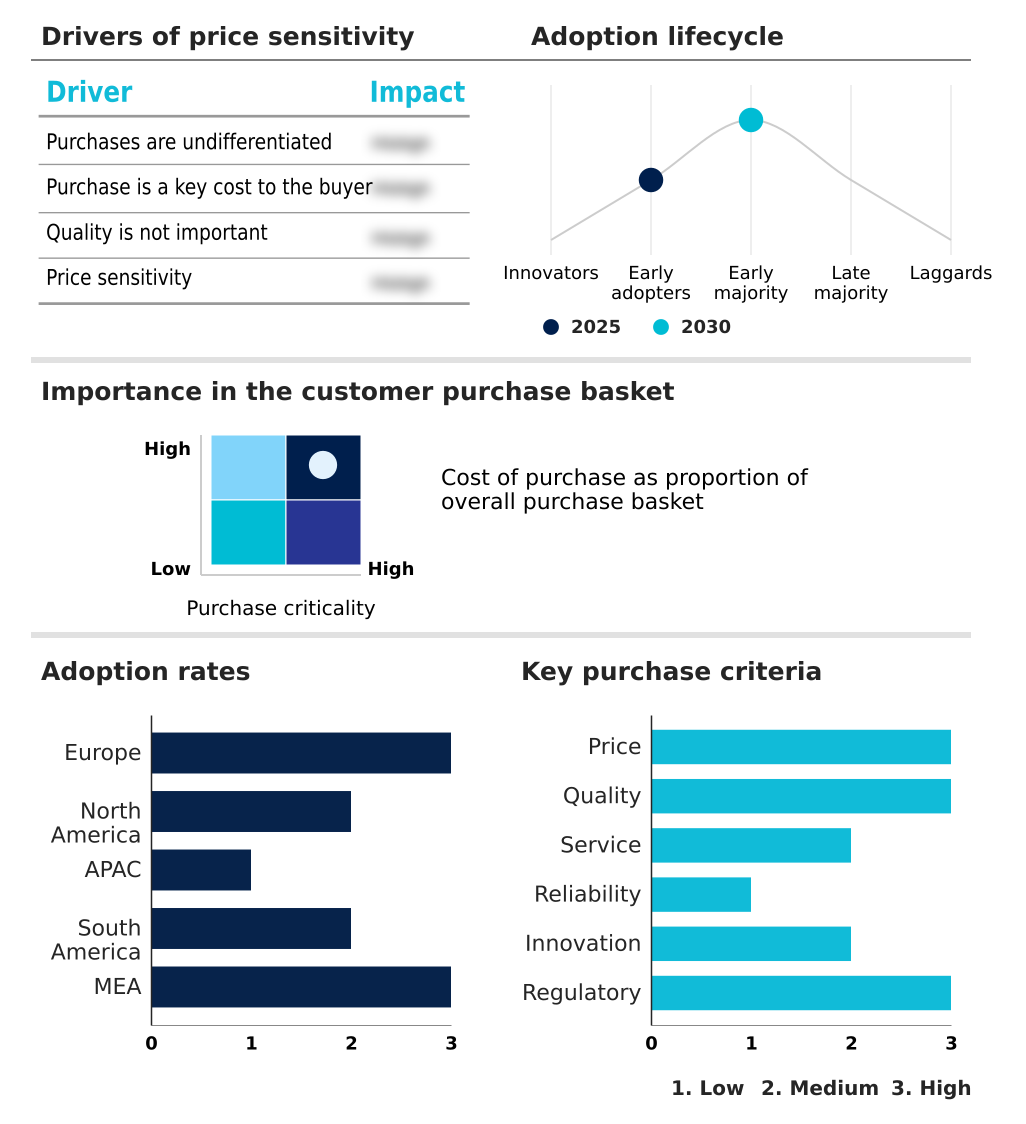
Customer Landscape of Circular Economy Enablement Platforms Industry

Competitive Landscape

Companies are implementing various strategies, such as strategic alliances, circular economy enablement platforms market forecast, partnerships, mergers and acquisitions, geographical expansion, and product/service launches, to enhance their presence in the industry.

BACK MARKET Inc. - Blockchain platforms create Digital Product Passports, enabling secure material data sharing across supply chains without revealing proprietary information, enhancing traceability and trust.

The industry research and growth report includes detailed analyses of the competitive landscape of the market and information about key companies, including:

  • BACK MARKET Inc.
  • Circularise
  • Circulor
  • EON Group Holding Inc.
  • Everledger Limited
  • Excess Materials Exchange
  • Grover Deutschland GmbH
  • IBM Corp.
  • iFixit
  • Optel Group
  • Oracle Corp.
  • Rebuy recommerce GmbH
  • Refurbed Marketplace GmbH
  • Rheaply
  • RTS Holding Inc.
  • SAP SE
  • TerraCycle Inc.
  • ThredUp Inc.
  • Trove Recommerce Inc.
  • Winnow Solutions Ltd.

Qualitative and quantitative analysis of companies has been conducted to help clients understand the wider business environment as well as the strengths and weaknesses of key industry players. Data is qualitatively analyzed to categorize companies as pure play, category-focused, industry-focused, and diversified; it is quantitatively analyzed to categorize companies as dominant, leading, strong, tentative, and weak.

Recent Development and News in Circular economy enablement platforms market

  • In October 2024, Campine acquired the French battery recycling operations of Ecobat, a move designed to strengthen vertical integration within battery recycling value chains and support the expansion of circular infrastructure in Europe.
  • In November 2024, German startup aevoloop secured approximately USD 8.9 million in seed funding and public grants to advance its chemically recyclable plastics, which are engineered for true circularity and aim to eliminate downcycling.
  • In January 2025, Splitstone Capital acquired Ecobat's UK battery recycling division, continuing the trend of consolidation within industrial recycling markets and enhancing circular material recovery capacity in the United Kingdom.
  • In April 2025, Circulate Capital expanded its Southeast Asia portfolio with strategic investments in Indonesian recycling companies Pelita Mekar Semesta and Polindo Utama, aiming to strengthen plastic waste processing infrastructure.

Dive into Technavio’s robust research methodology, blending expert interviews, extensive data synthesis, and validated models for unparalleled Circular Economy Enablement Platforms Market insights. See full methodology.

Market Scope
Page number 305
Base year 2025
Historic period 2020-2024
Forecast period 2026-2030
Growth momentum & CAGR Accelerate at a CAGR of 14.6%
Market growth 2026-2030 USD 5107.8 million
Market structure Fragmented
YoY growth 2025-2026(%) 12.7%
Key countries Germany, UK, France, Italy, The Netherlands, Spain, US, Canada, Mexico, China, India, Japan, Australia, South Korea, Indonesia, Brazil, Argentina, Colombia, Saudi Arabia, UAE, South Africa, Israel and Turkey
Competitive landscape Leading Companies, Market Positioning of Companies, Competitive Strategies, and Industry Risks

Request Free Sample

Research Analyst Overview

  • The market's evolution is defined by a shift toward integrated, data-driven systems. Boardroom decisions now hinge on deploying a comprehensive circular asset management strategy supported by robust product lifecycle management and a closed-loop supply chain system. The adoption of a digital product passport, underpinned by material passport technology and blockchain for supply chain, is becoming a prerequisite for market access.
  • This enables transparent material composition data and recycling credit verification. Platforms now combine an asset exchange manager with a resource exchange platform, facilitating industrial symbiosis networks and resale-as-a-service models. Key functionalities include advanced compliance reporting automation, extended producer responsibility software, and lifecycle assessment software.
  • Technologies like ai-driven material matching, a digital twin for circularity, and food waste measurement are transforming efficiency. Core processes such as reverse logistics management, remanufacturing process optimization, and asset refurbishment management are being digitized.
  • The goal is end-of-life value recovery, achieved through waste-to-value analytics, chemical recycling traceability, and effective take-back program logistics, all visible through a single supply chain transparency tool. This approach is rooted in circular design principles and supported by sustainability data management and white-label resale platforms.

What are the Key Data Covered in this Circular Economy Enablement Platforms Market Research and Growth Report?

  • What is the expected growth of the Circular Economy Enablement Platforms Market between 2026 and 2030?

    • USD 5.11 billion, at a CAGR of 14.6%

  • What segmentation does the market report cover?

    • The report is segmented by Platform (Resource recovery platforms, PLM platforms, SDM platforms, Waste exchange marketplaces, and Compliance and analytics platfrom), Deployment (Cloud, On-premises, and Hybrid), Component (Software, and Services) and Geography (Europe, North America, APAC, South America, Middle East and Africa)

  • Which regions are analyzed in the report?

    • Europe, North America, APAC, South America and Middle East and Africa

  • What are the key growth drivers and market challenges?

    • Escalating regulatory pressures and environmental mandates, Initial implementation costs and resource constraints

  • Who are the major players in the Circular Economy Enablement Platforms Market?

    • BACK MARKET Inc., Circularise, Circulor, EON Group Holding Inc., Everledger Limited, Excess Materials Exchange, Grover Deutschland GmbH, IBM Corp., iFixit, Optel Group, Oracle Corp., Rebuy recommerce GmbH, Refurbed Marketplace GmbH, Rheaply, RTS Holding Inc., SAP SE, TerraCycle Inc., ThredUp Inc., Trove Recommerce Inc. and Winnow Solutions Ltd.

Market Research Insights

  • Market dynamics are shaped by an urgent need for resource utilization optimization and robust supply chain traceability platforms. Adoption has seen a year-over-year increase of nearly 13%, with mature regions accounting for more than 32% of the market opportunity. Companies are deploying circular economy software solutions to manage everything from raw material tracking systems to complex epr compliance solutions.
  • The push for transparency is driving investment in sustainability reporting platforms and material flow analysis software. These tools are no longer seen as a cost center but as a strategic asset for enhancing operational resilience.
  • The ability of these platforms to provide verifiable data for circularity reporting tools is critical for maintaining investor confidence and meeting consumer demands for sustainable products.

We can help! Our analysts can customize this circular economy enablement platforms market research report to meet your requirements.

Get in touch

1. Executive Summary

1.1 Market overview

Executive Summary - Chart on Market Overview
Executive Summary - Data Table on Market Overview
Executive Summary - Chart on Global Market Characteristics
Executive Summary - Chart on Market by Geography
Executive Summary - Chart on Market Segmentation by Platform
Executive Summary - Chart on Market Segmentation by Deployment
Executive Summary - Chart on Market Segmentation by Component
Executive Summary - Chart on Incremental Growth
Executive Summary - Data Table on Incremental Growth
Executive Summary - Chart on Company Market Positioning

2. Technavio Analysis

2.1 Analysis of price sensitivity, lifecycle, customer purchase basket, adoption rates, and purchase criteria

2.2 Criticality of inputs and Factors of differentiation

Chart on Overview on criticality of inputs and factors of differentiation

2.3 Factors of disruption

Chart on Overview on factors of disruption

2.4 Impact of drivers and challenges

Chart on Impact of drivers and challenges in 2025 and 2030

3. Market Landscape

3.1 Market ecosystem

Chart on Parent Market
Data Table on - Parent Market

3.2 Market characteristics

Chart on Market characteristics analysis

3.3 Value chain analysis

Chart on Value chain analysis

4. Market Sizing

4.1 Market definition

Data Table on Offerings of companies included in the market definition

4.2 Market segment analysis

Market segments

4.3 Market size 2025

4.4 Market outlook: Forecast for 2025-2030

Chart on Global - Market size and forecast 2025-2030 ($ million)
Data Table on Global - Market size and forecast 2025-2030 ($ million)
Chart on Global Market: Year-over-year growth 2025-2030 (%)
Data Table on Global Market: Year-over-year growth 2025-2030 (%)

5. Historic Market Size

5.1 Global Circular Economy Enablement Platforms Market 2020 - 2024

Historic Market Size - Data Table on Global Circular Economy Enablement Platforms Market 2020 - 2024 ($ million)

5.2 Platform segment analysis 2020 - 2024

Historic Market Size - Platform Segment 2020 - 2024 ($ million)

5.3 Deployment segment analysis 2020 - 2024

Historic Market Size - Deployment Segment 2020 - 2024 ($ million)

5.4 Component segment analysis 2020 - 2024

Historic Market Size - Component Segment 2020 - 2024 ($ million)

5.5 Geography segment analysis 2020 - 2024

Historic Market Size - Geography Segment 2020 - 2024 ($ million)

5.6 Country segment analysis 2020 - 2024

Historic Market Size - Country Segment 2020 - 2024 ($ million)

6. Qualitative Analysis

6.1 Impact of AI on Global Circular Economy Enablement Platforms Market

7. Five Forces Analysis

7.1 Five forces summary

Five forces analysis - Comparison between 2025 and 2030

7.2 Bargaining power of buyers

Bargaining power of buyers - Impact of key factors 2025 and 2030

7.3 Bargaining power of suppliers

Bargaining power of suppliers - Impact of key factors in 2025 and 2030

7.4 Threat of new entrants

Threat of new entrants - Impact of key factors in 2025 and 2030

7.5 Threat of substitutes

Threat of substitutes - Impact of key factors in 2025 and 2030

7.6 Threat of rivalry

Threat of rivalry - Impact of key factors in 2025 and 2030

7.7 Market condition

Chart on Market condition - Five forces 2025 and 2030

8. Market Segmentation by Platform

8.1 Market segments

Chart on Platform - Market share 2025-2030 (%)
Data Table on Platform - Market share 2025-2030 (%)

8.2 Comparison by Platform

Chart on Comparison by Platform
Data Table on Comparison by Platform

8.3 Resource recovery platforms - Market size and forecast 2025-2030

Chart on Resource recovery platforms - Market size and forecast 2025-2030 ($ million)
Data Table on Resource recovery platforms - Market size and forecast 2025-2030 ($ million)
Chart on Resource recovery platforms - Year-over-year growth 2025-2030 (%)
Data Table on Resource recovery platforms - Year-over-year growth 2025-2030 (%)

8.4 PLM platforms - Market size and forecast 2025-2030

Chart on PLM platforms - Market size and forecast 2025-2030 ($ million)
Data Table on PLM platforms - Market size and forecast 2025-2030 ($ million)
Chart on PLM platforms - Year-over-year growth 2025-2030 (%)
Data Table on PLM platforms - Year-over-year growth 2025-2030 (%)

8.5 SDM platforms - Market size and forecast 2025-2030

Chart on SDM platforms - Market size and forecast 2025-2030 ($ million)
Data Table on SDM platforms - Market size and forecast 2025-2030 ($ million)
Chart on SDM platforms - Year-over-year growth 2025-2030 (%)
Data Table on SDM platforms - Year-over-year growth 2025-2030 (%)

8.6 Waste exchange marketplaces - Market size and forecast 2025-2030

Chart on Waste exchange marketplaces - Market size and forecast 2025-2030 ($ million)
Data Table on Waste exchange marketplaces - Market size and forecast 2025-2030 ($ million)
Chart on Waste exchange marketplaces - Year-over-year growth 2025-2030 (%)
Data Table on Waste exchange marketplaces - Year-over-year growth 2025-2030 (%)

8.7 Compliance and analytics platforms - Market size and forecast 2025-2030

Chart on Compliance and analytics platforms - Market size and forecast 2025-2030 ($ million)
Data Table on Compliance and analytics platforms - Market size and forecast 2025-2030 ($ million)
Chart on Compliance and analytics platforms - Year-over-year growth 2025-2030 (%)
Data Table on Compliance and analytics platforms - Year-over-year growth 2025-2030 (%)

8.8 Market opportunity by Platform

Market opportunity by Platform ($ million)
Data Table on Market opportunity by Platform ($ million)

9. Market Segmentation by Deployment

9.1 Market segments

Chart on Deployment - Market share 2025-2030 (%)
Data Table on Deployment - Market share 2025-2030 (%)

9.2 Comparison by Deployment

Chart on Comparison by Deployment
Data Table on Comparison by Deployment

9.3 Cloud - Market size and forecast 2025-2030

Chart on Cloud - Market size and forecast 2025-2030 ($ million)
Data Table on Cloud - Market size and forecast 2025-2030 ($ million)
Chart on Cloud - Year-over-year growth 2025-2030 (%)
Data Table on Cloud - Year-over-year growth 2025-2030 (%)

9.4 On-premises - Market size and forecast 2025-2030

Chart on On-premises - Market size and forecast 2025-2030 ($ million)
Data Table on On-premises - Market size and forecast 2025-2030 ($ million)
Chart on On-premises - Year-over-year growth 2025-2030 (%)
Data Table on On-premises - Year-over-year growth 2025-2030 (%)

9.5 Hybrid - Market size and forecast 2025-2030

Chart on Hybrid - Market size and forecast 2025-2030 ($ million)
Data Table on Hybrid - Market size and forecast 2025-2030 ($ million)
Chart on Hybrid - Year-over-year growth 2025-2030 (%)
Data Table on Hybrid - Year-over-year growth 2025-2030 (%)

9.6 Market opportunity by Deployment

Market opportunity by Deployment ($ million)
Data Table on Market opportunity by Deployment ($ million)

10. Market Segmentation by Component

10.1 Market segments

Chart on Component - Market share 2025-2030 (%)
Data Table on Component - Market share 2025-2030 (%)

10.2 Comparison by Component

Chart on Comparison by Component
Data Table on Comparison by Component

10.3 Software - Market size and forecast 2025-2030

Chart on Software - Market size and forecast 2025-2030 ($ million)
Data Table on Software - Market size and forecast 2025-2030 ($ million)
Chart on Software - Year-over-year growth 2025-2030 (%)
Data Table on Software - Year-over-year growth 2025-2030 (%)

10.4 Services - Market size and forecast 2025-2030

Chart on Services - Market size and forecast 2025-2030 ($ million)
Data Table on Services - Market size and forecast 2025-2030 ($ million)
Chart on Services - Year-over-year growth 2025-2030 (%)
Data Table on Services - Year-over-year growth 2025-2030 (%)

10.5 Market opportunity by Component

Market opportunity by Component ($ million)
Data Table on Market opportunity by Component ($ million)

11. Customer Landscape

11.1 Customer landscape overview

Analysis of price sensitivity, lifecycle, customer purchase basket, adoption rates, and purchase criteria

12. Geographic Landscape

12.1 Geographic segmentation

Chart on Market share by geography 2025-2030 (%)
Data Table on Market share by geography 2025-2030 (%)

12.2 Geographic comparison

Chart on Geographic comparison
Data Table on Geographic comparison

12.3 Europe - Market size and forecast 2025-2030

Chart on Europe - Market size and forecast 2025-2030 ($ million)
Data Table on Europe - Market size and forecast 2025-2030 ($ million)
Chart on Europe - Year-over-year growth 2025-2030 (%)
Data Table on Europe - Year-over-year growth 2025-2030 (%)
Chart on Regional Comparison - Europe
Data Table on Regional Comparison - Europe

12.3.1 Germany - Market size and forecast 2025-2030

Chart on Germany - Market size and forecast 2025-2030 ($ million)
Data Table on Germany - Market size and forecast 2025-2030 ($ million)
Chart on Germany - Year-over-year growth 2025-2030 (%)
Data Table on Germany - Year-over-year growth 2025-2030 (%)

12.3.2 UK - Market size and forecast 2025-2030

Chart on UK - Market size and forecast 2025-2030 ($ million)
Data Table on UK - Market size and forecast 2025-2030 ($ million)
Chart on UK - Year-over-year growth 2025-2030 (%)
Data Table on UK - Year-over-year growth 2025-2030 (%)

12.3.3 France - Market size and forecast 2025-2030

Chart on France - Market size and forecast 2025-2030 ($ million)
Data Table on France - Market size and forecast 2025-2030 ($ million)
Chart on France - Year-over-year growth 2025-2030 (%)
Data Table on France - Year-over-year growth 2025-2030 (%)

12.3.4 Italy - Market size and forecast 2025-2030

Chart on Italy - Market size and forecast 2025-2030 ($ million)
Data Table on Italy - Market size and forecast 2025-2030 ($ million)
Chart on Italy - Year-over-year growth 2025-2030 (%)
Data Table on Italy - Year-over-year growth 2025-2030 (%)

12.3.5 The Netherlands - Market size and forecast 2025-2030

Chart on The Netherlands - Market size and forecast 2025-2030 ($ million)
Data Table on The Netherlands - Market size and forecast 2025-2030 ($ million)
Chart on The Netherlands - Year-over-year growth 2025-2030 (%)
Data Table on The Netherlands - Year-over-year growth 2025-2030 (%)

12.3.6 Spain - Market size and forecast 2025-2030

Chart on Spain - Market size and forecast 2025-2030 ($ million)
Data Table on Spain - Market size and forecast 2025-2030 ($ million)
Chart on Spain - Year-over-year growth 2025-2030 (%)
Data Table on Spain - Year-over-year growth 2025-2030 (%)

12.4 North America - Market size and forecast 2025-2030

Chart on North America - Market size and forecast 2025-2030 ($ million)
Data Table on North America - Market size and forecast 2025-2030 ($ million)
Chart on North America - Year-over-year growth 2025-2030 (%)
Data Table on North America - Year-over-year growth 2025-2030 (%)
Chart on Regional Comparison - North America
Data Table on Regional Comparison - North America

12.4.1 US - Market size and forecast 2025-2030

Chart on US - Market size and forecast 2025-2030 ($ million)
Data Table on US - Market size and forecast 2025-2030 ($ million)
Chart on US - Year-over-year growth 2025-2030 (%)
Data Table on US - Year-over-year growth 2025-2030 (%)

12.4.2 Canada - Market size and forecast 2025-2030

Chart on Canada - Market size and forecast 2025-2030 ($ million)
Data Table on Canada - Market size and forecast 2025-2030 ($ million)
Chart on Canada - Year-over-year growth 2025-2030 (%)
Data Table on Canada - Year-over-year growth 2025-2030 (%)

12.4.3 Mexico - Market size and forecast 2025-2030

Chart on Mexico - Market size and forecast 2025-2030 ($ million)
Data Table on Mexico - Market size and forecast 2025-2030 ($ million)
Chart on Mexico - Year-over-year growth 2025-2030 (%)
Data Table on Mexico - Year-over-year growth 2025-2030 (%)

12.5 APAC - Market size and forecast 2025-2030

Chart on APAC - Market size and forecast 2025-2030 ($ million)
Data Table on APAC - Market size and forecast 2025-2030 ($ million)
Chart on APAC - Year-over-year growth 2025-2030 (%)
Data Table on APAC - Year-over-year growth 2025-2030 (%)
Chart on Regional Comparison - APAC
Data Table on Regional Comparison - APAC

12.5.1 China - Market size and forecast 2025-2030

Chart on China - Market size and forecast 2025-2030 ($ million)
Data Table on China - Market size and forecast 2025-2030 ($ million)
Chart on China - Year-over-year growth 2025-2030 (%)
Data Table on China - Year-over-year growth 2025-2030 (%)

12.5.2 India - Market size and forecast 2025-2030

Chart on India - Market size and forecast 2025-2030 ($ million)
Data Table on India - Market size and forecast 2025-2030 ($ million)
Chart on India - Year-over-year growth 2025-2030 (%)
Data Table on India - Year-over-year growth 2025-2030 (%)

12.5.3 Japan - Market size and forecast 2025-2030

Chart on Japan - Market size and forecast 2025-2030 ($ million)
Data Table on Japan - Market size and forecast 2025-2030 ($ million)
Chart on Japan - Year-over-year growth 2025-2030 (%)
Data Table on Japan - Year-over-year growth 2025-2030 (%)

12.5.4 Australia - Market size and forecast 2025-2030

Chart on Australia - Market size and forecast 2025-2030 ($ million)
Data Table on Australia - Market size and forecast 2025-2030 ($ million)
Chart on Australia - Year-over-year growth 2025-2030 (%)
Data Table on Australia - Year-over-year growth 2025-2030 (%)

12.5.5 South Korea - Market size and forecast 2025-2030

Chart on South Korea - Market size and forecast 2025-2030 ($ million)
Data Table on South Korea - Market size and forecast 2025-2030 ($ million)
Chart on South Korea - Year-over-year growth 2025-2030 (%)
Data Table on South Korea - Year-over-year growth 2025-2030 (%)

12.5.6 Indonesia - Market size and forecast 2025-2030

Chart on Indonesia - Market size and forecast 2025-2030 ($ million)
Data Table on Indonesia - Market size and forecast 2025-2030 ($ million)
Chart on Indonesia - Year-over-year growth 2025-2030 (%)
Data Table on Indonesia - Year-over-year growth 2025-2030 (%)

12.6 South America - Market size and forecast 2025-2030

Chart on South America - Market size and forecast 2025-2030 ($ million)
Data Table on South America - Market size and forecast 2025-2030 ($ million)
Chart on South America - Year-over-year growth 2025-2030 (%)
Data Table on South America - Year-over-year growth 2025-2030 (%)
Chart on Regional Comparison - South America
Data Table on Regional Comparison - South America

12.6.1 Brazil - Market size and forecast 2025-2030

Chart on Brazil - Market size and forecast 2025-2030 ($ million)
Data Table on Brazil - Market size and forecast 2025-2030 ($ million)
Chart on Brazil - Year-over-year growth 2025-2030 (%)
Data Table on Brazil - Year-over-year growth 2025-2030 (%)

12.6.2 Argentina - Market size and forecast 2025-2030

Chart on Argentina - Market size and forecast 2025-2030 ($ million)
Data Table on Argentina - Market size and forecast 2025-2030 ($ million)
Chart on Argentina - Year-over-year growth 2025-2030 (%)
Data Table on Argentina - Year-over-year growth 2025-2030 (%)

12.6.3 Colombia - Market size and forecast 2025-2030

Chart on Colombia - Market size and forecast 2025-2030 ($ million)
Data Table on Colombia - Market size and forecast 2025-2030 ($ million)
Chart on Colombia - Year-over-year growth 2025-2030 (%)
Data Table on Colombia - Year-over-year growth 2025-2030 (%)

12.7 Middle East and Africa - Market size and forecast 2025-2030

Chart on Middle East and Africa - Market size and forecast 2025-2030 ($ million)
Data Table on Middle East and Africa - Market size and forecast 2025-2030 ($ million)
Chart on Middle East and Africa - Year-over-year growth 2025-2030 (%)
Data Table on Middle East and Africa - Year-over-year growth 2025-2030 (%)
Chart on Regional Comparison - Middle East and Africa
Data Table on Regional Comparison - Middle East and Africa

12.7.1 Saudi Arabia - Market size and forecast 2025-2030

Chart on Saudi Arabia - Market size and forecast 2025-2030 ($ million)
Data Table on Saudi Arabia - Market size and forecast 2025-2030 ($ million)
Chart on Saudi Arabia - Year-over-year growth 2025-2030 (%)
Data Table on Saudi Arabia - Year-over-year growth 2025-2030 (%)

12.7.2 UAE - Market size and forecast 2025-2030

Chart on UAE - Market size and forecast 2025-2030 ($ million)
Data Table on UAE - Market size and forecast 2025-2030 ($ million)
Chart on UAE - Year-over-year growth 2025-2030 (%)
Data Table on UAE - Year-over-year growth 2025-2030 (%)

12.7.3 South Africa - Market size and forecast 2025-2030

Chart on South Africa - Market size and forecast 2025-2030 ($ million)
Data Table on South Africa - Market size and forecast 2025-2030 ($ million)
Chart on South Africa - Year-over-year growth 2025-2030 (%)
Data Table on South Africa - Year-over-year growth 2025-2030 (%)

12.7.4 Israel - Market size and forecast 2025-2030

Chart on Israel - Market size and forecast 2025-2030 ($ million)
Data Table on Israel - Market size and forecast 2025-2030 ($ million)
Chart on Israel - Year-over-year growth 2025-2030 (%)
Data Table on Israel - Year-over-year growth 2025-2030 (%)

12.7.5 Turkey - Market size and forecast 2025-2030

Chart on Turkey - Market size and forecast 2025-2030 ($ million)
Data Table on Turkey - Market size and forecast 2025-2030 ($ million)
Chart on Turkey - Year-over-year growth 2025-2030 (%)
Data Table on Turkey - Year-over-year growth 2025-2030 (%)

12.8 Market opportunity by geography

Market opportunity by geography ($ million)
Data Tables on Market opportunity by geography ($ million)

13. Drivers, Challenges, and Opportunity

13.1 Market drivers

Escalating regulatory pressures and environmental mandates
Corporate sustainability commitments and stakeholder demands
Technological advancements in supply chain traceability

13.2 Market challenges

Initial implementation costs and resource constraints
Data standardization deficits and interoperability hurdles
Organizational resistance and change management complexity

13.3 Impact of drivers and challenges

Impact of drivers and challenges in 2025 and 2030

13.4 Market opportunities

Integration of digital product passports and blockchain verification
Convergence of reverse logistics and financial technology (Fintech)
AI-Driven material matching and secondary marketplaces

14. Competitive Landscape

14.1 Overview

14.2

Overview on criticality of inputs and factors of differentiation

14.3 Landscape disruption

Overview on factors of disruption

14.4 Industry risks

Impact of key risks on business

15. Competitive Analysis

15.1 Companies profiled

Companies covered

15.2 Company ranking index

15.3 Market positioning of companies

Matrix on companies position and classification

15.4 Circularise

Circularise - Overview
Circularise - Product / Service
Circularise - Key offerings
SWOT

15.5 Circulor

Circulor - Overview
Circulor - Product / Service
Circulor - Key offerings
SWOT

15.6 EON Group Holding Inc.

EON Group Holding Inc. - Overview
EON Group Holding Inc. - Product / Service
EON Group Holding Inc. - Key offerings
SWOT

15.7 Everledger Limited

Everledger Limited - Overview
Everledger Limited - Product / Service
Everledger Limited - Key offerings
SWOT

15.8 Grover Deutschland GmbH

Grover Deutschland GmbH - Overview
Grover Deutschland GmbH - Product / Service
Grover Deutschland GmbH - Key offerings
SWOT

15.9 IBM Corp.

IBM Corp. - Overview
IBM Corp. - Business segments
IBM Corp. - Key news
IBM Corp. - Key offerings
IBM Corp. - Segment focus
SWOT

15.10 Optel Group

Optel Group - Overview
Optel Group - Product / Service
Optel Group - Key offerings
SWOT

15.11 Oracle Corp.

Oracle Corp. - Overview
Oracle Corp. - Business segments
Oracle Corp. - Key news
Oracle Corp. - Key offerings
Oracle Corp. - Segment focus
SWOT

15.12 Refurbed Marketplace GmbH

Refurbed Marketplace GmbH - Overview
Refurbed Marketplace GmbH - Product / Service
Refurbed Marketplace GmbH - Key offerings
SWOT

15.13 Rheaply

Rheaply - Overview
Rheaply - Product / Service
Rheaply - Key offerings
SWOT

15.14 SAP SE

SAP SE - Overview
SAP SE - Business segments
SAP SE - Key news
SAP SE - Key offerings
SAP SE - Segment focus
SWOT

15.15 TerraCycle Inc.

TerraCycle Inc. - Overview
TerraCycle Inc. - Product / Service
TerraCycle Inc. - Key offerings
SWOT

15.16 ThredUp Inc.

ThredUp Inc. - Overview
ThredUp Inc. - Product / Service
ThredUp Inc. - Key offerings
SWOT

15.17 Trove Recommerce Inc.

Trove Recommerce Inc. - Overview
Trove Recommerce Inc. - Product / Service
Trove Recommerce Inc. - Key offerings
SWOT

15.18 Winnow Solutions Ltd.

Winnow Solutions Ltd. - Overview
Winnow Solutions Ltd. - Product / Service
Winnow Solutions Ltd. - Key offerings
SWOT

16. Appendix

16.1 Scope of the report

Market definition
Objectives
Notes and caveats

16.2 Inclusions and exclusions checklist

Inclusions checklist
Exclusions checklist

16.3 Currency conversion rates for US$

16.4 Research methodology

16.5 Data procurement

Information sources

16.6 Data validation

16.7 Validation techniques employed for market sizing

16.8 Data synthesis

16.9 360 degree market analysis

16.10 List of abbreviations

Research Methodology

Technavio presents a detailed picture of the market by way of study, synthesis, and summation of data from multiple sources. The analysts have presented the various facets of the market with a particular focus on identifying the key industry influencers. The data thus presented is comprehensive, reliable, and the result of extensive research, both primary and secondary.

INFORMATION SOURCES

Primary sources

  • Manufacturers and suppliers
  • Channel partners
  • Industry experts
  • Strategic decision makers

Secondary sources

  • Industry journals and periodicals
  • Government data
  • Financial reports of key industry players
  • Historical data
  • Press releases

DATA ANALYSIS

Data Synthesis

  • Collation of data
  • Estimation of key figures
  • Analysis of derived insights

Data Validation

  • Triangulation with data models
  • Reference against proprietary databases
  • Corroboration with industry experts

REPORT WRITING

Qualitative

  • Market drivers
  • Market challenges
  • Market trends
  • Five forces analysis

Quantitative

  • Market size and forecast
  • Market segmentation
  • Geographical insights
  • Competitive landscape

Interested in this report?

Get your sample now to see our research methodology and insights!

Download Now

Frequently Asked Questions

Circular Economy Enablement Platforms market growth will increase by USD 5107.8 million during 2026-2030.

The Circular Economy Enablement Platforms market is expected to grow at a CAGR of 14.6% during 2026-2030.

Circular Economy Enablement Platforms market is segmented by Platform (Resource recovery platforms, PLM platforms, SDM platforms, Waste exchange marketplaces, Compliance and analytics platforms) Deployment (Cloud, On-premises, Hybrid) Component (Software, Services)

BACK MARKET Inc., Circularise, Circulor, EON Group Holding Inc., Everledger Limited, Excess Materials Exchange, Grover Deutschland GmbH, IBM Corp., iFixit, Optel Group, Oracle Corp., Rebuy recommerce GmbH, Refurbed Marketplace GmbH, Rheaply, RTS Holding Inc., SAP SE, TerraCycle Inc., ThredUp Inc., Trove Recommerce Inc., Winnow Solutions Ltd. are a few of the key vendors in the Circular Economy Enablement Platforms market.

Europe will register the highest growth rate of 32.1% among the other regions. Therefore, the Circular Economy Enablement Platforms market in Europe is expected to garner significant business opportunities for the vendors during the forecast period.

Germany, UK, France, Italy, The Netherlands, Spain, US, Canada, Mexico, China, India, Japan, Australia, South Korea, Indonesia, Brazil, Argentina, Colombia, Saudi Arabia, UAE, South Africa, Israel, Turkey

  • Escalating regulatory pressures and environmental mandates is the driving factor this market.

The Circular Economy Enablement Platforms market vendors should focus on grabbing business opportunities from the Platform segment as it accounted for the largest market share in the base year.
RIA - Research AI Assistant
Ask RIA