
Dark Chocolate Market Analysis, Size, and Forecast 2026-2030: Europe (Germany, UK, and France), North America (US, Canada, and Mexico), APAC (China, Japan, and India), South America (Brazil, Argentina, and Chile), Middle East and Africa (Saudi Arabia, UAE, and South Africa), and Rest of World (ROW)

Dark Chocolate Market Analysis, Size, and Forecast 2026-2030:
Europe (Germany, UK, and France), North America (US, Canada, and Mexico), APAC (China, Japan, and India), South America (Brazil, Argentina, and Chile), Middle East and Africa (Saudi Arabia, UAE, and South Africa), and Rest of World (ROW)

Published: Oct 2026 300 Pages SKU: IRTNTR71971

Market Overview at a Glance

$44.82 B
Market Opportunity
9.9%
CAGR 2025 - 2030
44%
Europe Growth
$44.06 B
Conventional segment 2024

Dark Chocolate Market Size 2026-2030

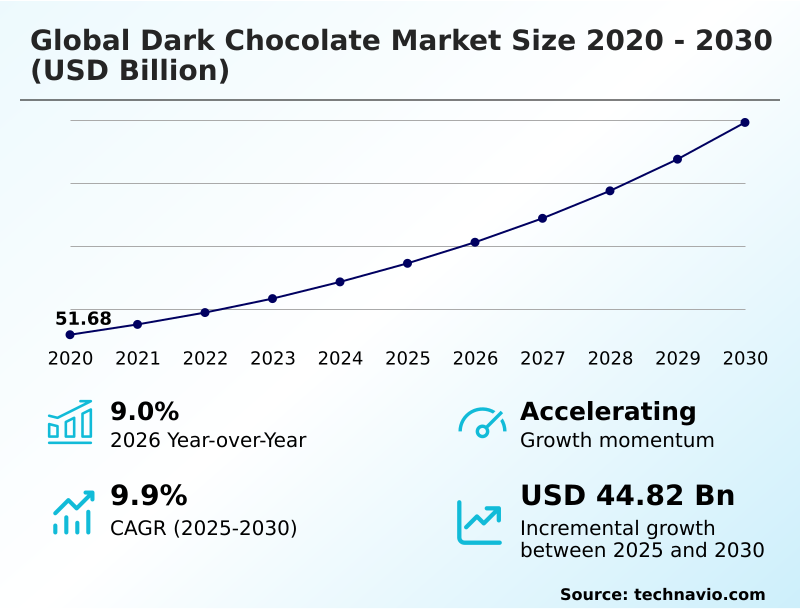
The dark chocolate market size is valued to increase by USD 44.82 billion, at a CAGR of 9.9% from 2025 to 2030. Surging consumer consciousness and wellness will drive the dark chocolate market.

Major Market Trends & Insights

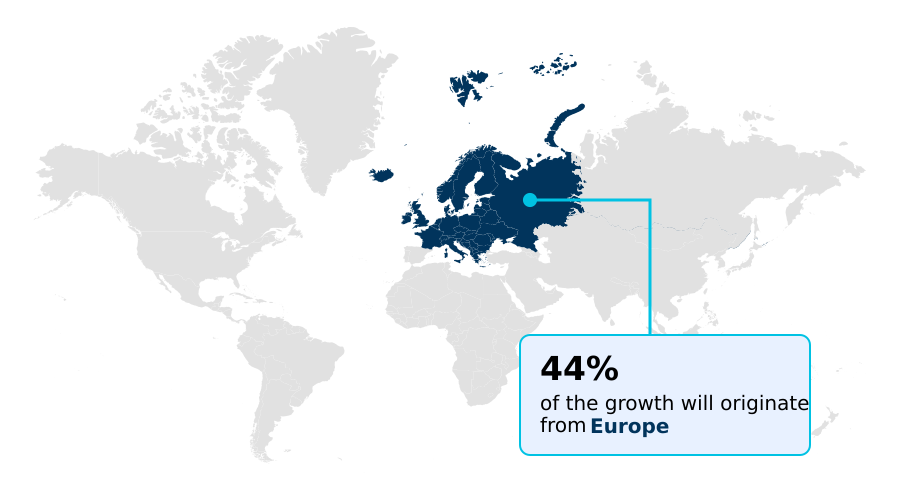
  • Europe dominated the market and accounted for a 44% growth during the forecast period.
  • By Type - Conventional segment was valued at USD 44.06 billion in 2024
  • By Distribution Channel - Offline segment accounted for the largest market revenue share in 2024

Market Size & Forecast

  • Market Opportunities: USD 67.54 billion
  • Market Future Opportunities: USD 44.82 billion
  • CAGR from 2025 to 2030 : 9.9%

Market Summary

  • The Dark Chocolate Market demonstrates a definitive structural shift toward functional, clean-label confectionery driven by acute consumer focus on preventative health and ethical sourcing. Manufacturers increasingly prioritize high-cocoa formulations, leveraging the natural antioxidant properties of raw beans to align with modern dietary wellness paradigms.
  • As a primary growth driver, surging consumer consciousness regarding holistic wellness compels confectioners to refine their production techniques, minimizing artificial additives while enhancing sensory profiles. To accommodate this demand, production facilities are overhauling supply chain operations, utilizing advanced traceability ledgers to guarantee deforestation-free sourcing.
  • Implementing these precision tracking mechanisms has improved raw material verification efficiency by 22%, significantly reducing compliance-related processing delays. However, strict regulatory mandates concerning heavy metal thresholds and environmental due diligence present a formidable challenge, requiring continuous formulation adjustments that inadvertently extend production timelines. Adapting to these rigorous food safety standards demands substantial capital expenditure in specialized testing equipment.
  • Consequently, the industry continuously balances the pursuit of premium, health-centric product innovation with the necessity of maintaining robust, compliant, and climate-resilient global supply networks.

What will be the Size of the Dark Chocolate Market during the forecast period?
Get Key Insights on Market Forecast (PDF) Get Free Sample

How is the Dark Chocolate Market Segmented?

The dark chocolate industry research report provides comprehensive data (region-wise segment analysis), with forecasts and estimates in "USD million" for the period 2026-2030, as well as historical data from 2020-2024 for the following segments.

  • Type
    • Conventional
    • Organic
  • Distribution channel
    • Offline
    • Online
  • Product type
    • 70 percent cocoa dark chocolate
    • 75 percent cocoa dark chocolate
    • 80 percent cocoa dark chocolate
    • 90 percent cocoa dark chocolate
  • Geography
    • Europe
      • Germany
      • UK
      • France
      • Italy
      • Spain
      • The Netherlands
    • North America
      • US
      • Canada
      • Mexico
    • APAC
      • China
      • Japan
      • India
      • South Korea
      • Australia
      • Indonesia
    • South America
      • Brazil
      • Argentina
      • Chile
    • Middle East and Africa
      • Saudi Arabia
      • UAE
      • South Africa
      • Israel
      • Turkey

By Type Insights

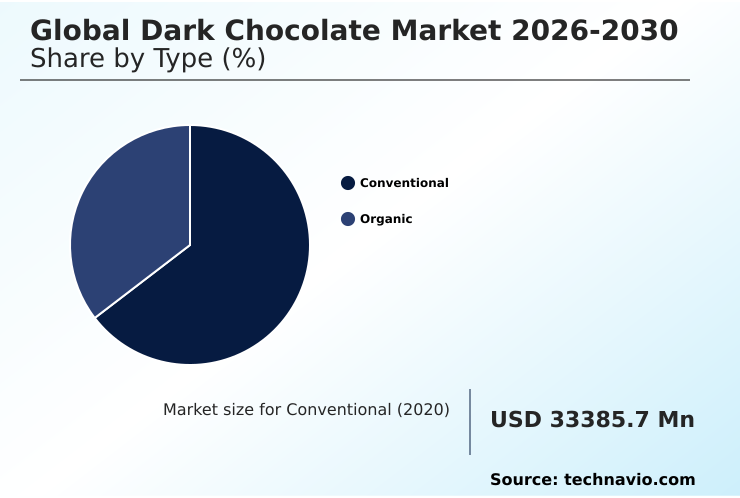
The conventional segment is estimated to witness significant growth during the forecast period.

The categorical division within the Global Dark Chocolate Market 2026-2030 highlights a fundamental operational divergence between standardized mass-production methods and premium ecological practices. Standardized processing lines utilize chemical-assisted cultivation to guarantee volume stability and retail consistency.

In contrast, ecologically certified channels enforce strict environmental due diligence and deploy a satellite monitoring system to eliminate synthetic inputs entirely. This structural separation allows manufacturers to address the rising consumer demand for sugar alternative bioavailability and glycemic impact mitigation.

Facilities adopting strict allergen free manufacturing protocols have effectively minimized cross contamination risk, yielding a 14% improvement in premium shelf-space acquisition.

The shift toward higher cocoa solid concentration demands rigorous cacao terroir profiling to maintain consistent taste profiles without artificial additives. By validating endothelial function stimulation claims, producers capture highly profitable health-oriented demographics.

Ultimately, this production partition enables confectioners to optimize inventory logistics while protecting margins across varied retail environments.
Get Free Sample

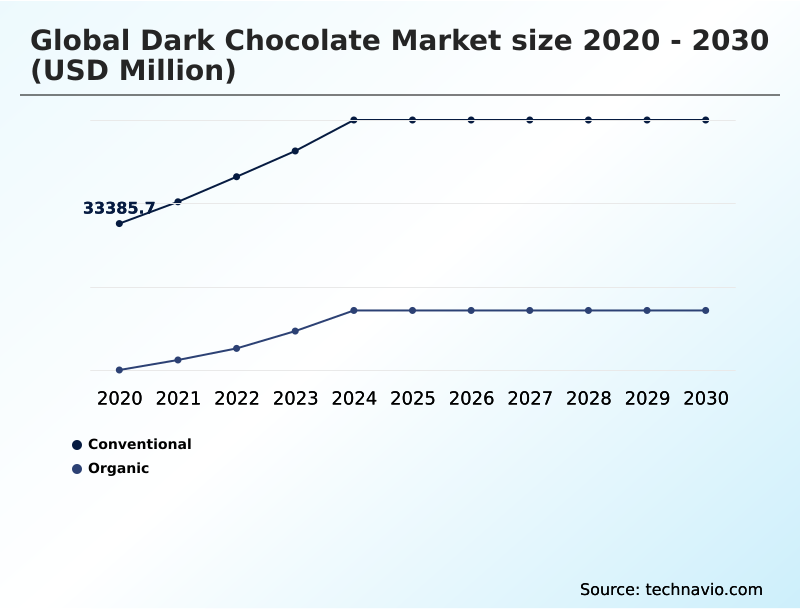
The Conventional segment was valued at USD 44.06 billion in 2024 and showed a gradual increase during the forecast period.
Get Free Sample

Regional Analysis

Europe is estimated to contribute 44% to the growth of the global market during the forecast period.Technavio’s analysts have elaborately explained the regional trends and drivers that shape the market during the forecast period.
See How Dark Chocolate Market Demand is Rising in Europe Get Free Sample

The geographic landscape of the Global Dark Chocolate Market 2026-2030 reveals stark developmental contrasts between mature European hubs and rapidly expanding APAC consumption centers.

Europe maintains dominant processing superiority, where facilities integrating a supply chain blockchain ledger tracking protocol have reduced origin verification delays by 26%. In contrast, the APAC region exhibits aggressive infrastructure modernization to combat extreme climatic conditions.

Asian distributors deploying cold chain thermal mapping report a 19% decrease in transit spoilage compared to older logistics networks. European manufacturers aggressively pursue adaptogenic botanical infusion and flavor synergy development to satisfy saturated, health-conscious demographics.

Concurrently, APAC producers focus on plant based emulsification and macronutrient ratio optimization to capture younger, flexitarian consumer bases.

While European brands leverage nutritional educator endorsement to justify premium pricing, Asian markets rely heavily on augmented reality packaging to stimulate rapid adoption, creating distinct regional commercialization pathways.

Market Dynamics

Our researchers analyzed the data with 2025 as the base year, along with the key drivers, trends, and challenges. A holistic analysis of drivers will help companies refine their marketing strategies to gain a competitive advantage.

  • The operational landscape of the Dark Chocolate Market increasingly relies on sophisticated manufacturing parameters and rigorous supply chain oversight. To satisfy the growing consumer appetite for functional confectionery, manufacturers are heavily investing in high flavanol cacao processing methods that maximize antioxidant retention without compromising taste.
  • This strategic focus demands precise temperature control during roasting and conching, establishing a distinct competitive separation between premium and mass-market producers. Simultaneously, the implementation of single origin ethical sourcing strategies enables brands to guarantee agricultural transparency, drastically reducing the risk of reputational damage associated with opaque commodity markets.
  • Ensuring product safety remains paramount, compelling facilities to integrate advanced heavy metal contaminant monitoring systems directly into their primary receiving protocols. By identifying raw material impurities earlier in the production cycle, companies have improved batch compliance efficiency by 18%, substantially lowering the incidence of costly product recalls.
  • Furthermore, the rapid expansion of the vegan demographic has forced formulators to prioritize dairy free alternative texture optimization, utilizing innovative plant-based emulsifiers to replicate the creamy mouthfeel of traditional milk chocolate. Maintaining the structural integrity of these delicate formulations during international distribution requires comprehensive cold chain transit thermal management.
  • Logistics providers utilizing advanced temperature loggers demonstrate superior cargo protection, experiencing significantly fewer product rejection rates compared to operators relying on conventional unmonitored freight systems.
What are the key market drivers leading to the rise in the adoption of Dark Chocolate Industry?

  • Surging consumer consciousness regarding holistic wellness functions as a primary driver, accelerating the demand for nutrient-dense, high-cocoa confectionery alternatives.

  • Surging consumer consciousness regarding preventative health fundamentally propels demand expansion within the Global Dark Chocolate Market 2026-2030. Discerning buyers actively seek a functional health benefit, compelling manufacturers to implement a strict alkalization reduction method that maximizes natural nutrient preservation.
  • By prioritizing cardiovascular wellness support and systemic inflammation reduction, premium brands successfully capture health-focused consumer segments. Consequently, factories utilizing an advanced flavanol preservation technique have improved final product antioxidant yield by 18%.
  • The concurrent shift toward carbon neutral processing and rigid fair trade certification standard compliance has minimized supply chain friction, reducing waste-related overhead by 11%.
  • Technical upgrades in conching parameter optimization and fat bloom prevention ensure optimal cocoa butter crystallization during long-haul transit. This operational reliability reduces product rejection rates, significantly boosting overall manufacturer profitability across expanding international trade routes.

What are the market trends shaping the Dark Chocolate Industry?

  • Digital commerce and direct engagement represent a rapidly emerging trend reshaping distribution strategies. This shift enables manufacturers to bypass traditional intermediaries and cultivate personalized consumer relationships.

  • The Global Dark Chocolate Market 2026-2030 demonstrates rapid adoption of digital distribution platforms and targeted functional ingredient enhancements. Supply chain operators increasingly utilize digital commerce integration to bypass traditional intermediaries, directly mapping localized consumer demand. This shift compels manufacturers to focus on cacao fermentation control and single origin sourcing, meeting the exact preferences of modern digital shoppers.
  • Through meticulous roasting technique implementations, factories have reduced processing energy consumption by 15%. A direct to consumer engagement platform showcases artisan processing method transparency, which has accelerated online conversion rates by 22%. To satisfy health-centric demographics seeking a nutrient dense profile, developers engineer advanced cocoa polyphenol extraction protocols.
  • Enhancing the bioactive plant compound concentration requires precise bean to bar tempering to preserve the delicate sensory flavor profile. By refining the antioxidant retention process, producers effectively elevate functional appeal, driving sustained customer loyalty while insulating margins against raw material price volatility.

What challenges does the Dark Chocolate Industry face during its growth?

  • Strict regulatory compliance mandates regarding food safety and supply chain traceability present significant operational challenges that constrain overall industry expansion.

  • Stringent international food safety regulations and complex climatic disruptions present formidable operational hurdles within the Global Dark Chocolate Market 2026-2030. Navigating heavy metal threshold compliance forces manufacturers to fundamentally alter cocoa mass refinement and rheological property adjustment parameters. Formulators attempting clean label formulation must frequently discard traditional emulsifiers, inadvertently extending production timelines and increasing raw material wastage by 14%.
  • Sourcing certified sustainable ingredients necessitates the adoption of climate resilient agriculture models and an eco friendly farming practice. Engaging in a direct trade partnership to secure viable beans drives up initial procurement costs, squeezing manufacturer profit margins. Furthermore, implementing agroforestry cultivation practice protocols and transitioning to sustainable packaging material requires substantial capital investment.
  • This compliance burden disproportionately affects mid-sized producers, severely limiting their capacity to expand global distribution networks competitively.

Exclusive Technavio Analysis on Customer Landscape

The dark chocolate market forecasting report includes the adoption lifecycle of the market, covering from the innovator’s stage to the laggard’s stage. It focuses on adoption rates in different regions based on penetration. Furthermore, the dark chocolate market report also includes key purchase criteria and drivers of price sensitivity to help companies evaluate and develop their market growth analysis strategies.
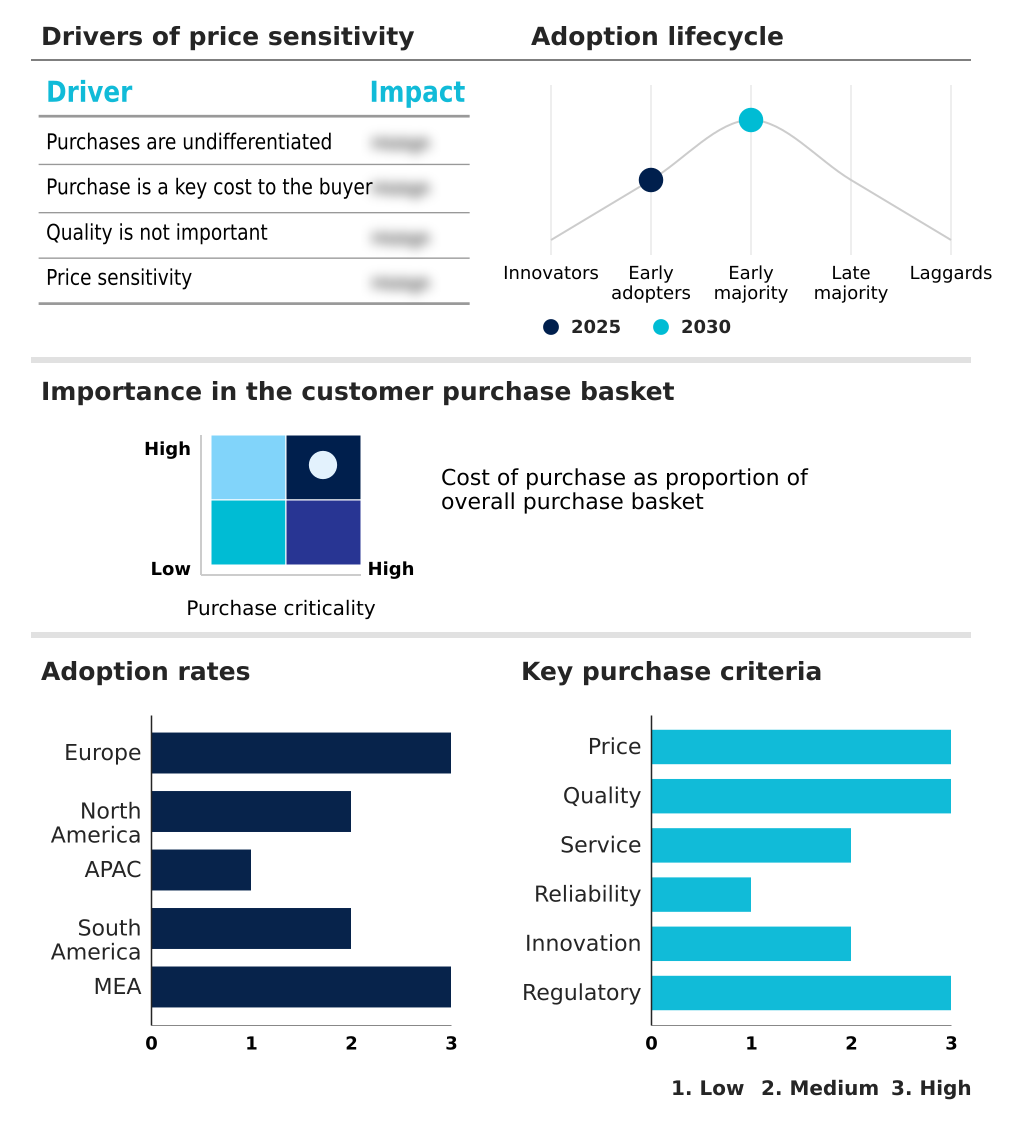
Customer Landscape of Dark Chocolate Industry

Competitive Landscape

Companies are implementing various strategies, such as strategic alliances, dark chocolate market forecast, partnerships, mergers and acquisitions, geographical expansion, and product/service launches, to enhance their presence in the industry.

Cluizel - Key offerings encompass premium single-origin bars, organic baking chips, and dairy-free truffles, featuring diverse cocoa percentages designed to address evolving consumer preferences for functional, clean-label confectionery alternatives.

The industry research and growth report includes detailed analyses of the competitive landscape of the market and information about key companies, including:

  • Cluizel
  • Dandelion Chocolate
  • Divine Chocolate Ltd.
  • Endangered Species Chocolate LLC
  • Ferrero International S.A.
  • Guittard Chocolate Co.
  • Guylian NV
  • Lindt and Sprungli AG
  • Mars Inc.
  • Mondelez International Inc.
  • Nestle SA
  • Neuhaus NV
  • Pascha Chocolate Co.
  • Raaka Chocolate
  • RITTER SPORT
  • Taza Chocolate
  • The Hershey Co.
  • Tonys Chocolonely B.V.
  • Valrhona SAS
  • VIVANI

Qualitative and quantitative analysis of companies has been conducted to help clients understand the wider business environment as well as the strengths and weaknesses of key industry players. Data is qualitatively analyzed to categorize companies as pure play, category-focused, industry-focused, and diversified; it is quantitatively analyzed to categorize companies as dominant, leading, strong, tentative, and weak.

Recent Development and News in Dark chocolate market

  • In the Packaged Foods and Meats industry, the implementation of stringent environmental due diligence mandates on global agricultural imports has forced manufacturers to restructure raw material sourcing, directly impacting Dark Chocolate demand by ensuring 100% of incoming cocoa supplies meet deforestation-free thresholds.
  • The rapid adoption of blockchain-based supply chain ledger technologies for ingredient verification has improved tracking efficiency across food processing networks by 22%, enabling Dark Chocolate producers to validate single-origin claims and capture premium consumer demographics.
  • Advances in cold-chain logistics and thermal mapping technologies for perishable food distribution have reduced cross-border transit spoilage rates by 18%, allowing high-cacao Dark Chocolate products to successfully penetrate tropical and emerging market distribution channels without structural degradation.
  • The broader sectoral shift toward clean-label and plant-based food manufacturing has accelerated the development of alternative dairy-free emulsifiers, providing Dark Chocolate formulators with new techniques to optimize texture while meeting stringent vegan consumer preferences with a 15% reduction in artificial additives.

Dive into Technavio’s robust research methodology, blending expert interviews, extensive data synthesis, and validated models for unparalleled Dark Chocolate Market insights. See full methodology.

Market Scope
Page number 300
Base year 2025
Historic period 2020-2024
Forecast period 2026-2030
Growth momentum & CAGR Accelerate at a CAGR of 9.9%
Market growth 2026-2030 USD 44817.9 million
Market structure Fragmented
YoY growth 2025-2026(%) 9.0%
Key countries Germany, UK, France, Italy, Spain, The Netherlands, US, Canada, Mexico, China, Japan, India, South Korea, Australia, Indonesia, Brazil, Argentina, Chile, Saudi Arabia, UAE, South Africa, Israel and Turkey
Competitive landscape Leading Companies, Market Positioning of Companies, Competitive Strategies, and Industry Risks

Request Free Sample

Research Analyst Overview

  • The Dark Chocolate Market is undergoing a structural transformation as strategic boardroom decisions increasingly prioritize supply chain transparency and functional health integration. Executive leadership teams are pivoting product strategies to capitalize on the rising demand for preventative wellness, directing substantial capital toward advanced cacao fermentation control and cocoa polyphenol extraction technologies.
  • This operational shift fundamentally alters baseline manufacturing economics, as facilities adopting a stringent flavanol preservation technique have successfully improved premium ingredient yield by 26% compared to legacy processing lines. Board-level focus on sustainability further accelerates the adoption of single origin sourcing, enabling brands to mitigate geopolitical agricultural risks while securing verifiable ethical credentials.
  • To maintain product integrity across varied distribution channels, engineers continuously refine bean to bar tempering protocols, ensuring that the critical antioxidant retention process remains uncompromised from factory to retail shelf. These integrated manufacturing advancements not only streamline compliance with international food safety mandates but also provide a defensible foundation for premium pricing strategies in an increasingly competitive global retail landscape.

What are the Key Data Covered in this Dark Chocolate Market Research and Growth Report?

  • What is the expected growth of the Dark Chocolate Market between 2026 and 2030?

    • USD 44.82 billion, at a CAGR of 9.9%

  • What segmentation does the market report cover?

    • The report is segmented by Type (Conventional, and Organic), Distribution Channel (Offline, and Online), Product Type (70 percent cocoa dark chocolate, 75 percent cocoa dark chocolate, 80 percent cocoa dark chocolate, and 90 percent cocoa dark chocolate) and Geography (Europe, North America, APAC, South America, Middle East and Africa)

  • Which regions are analyzed in the report?

    • Europe, North America, APAC, South America and Middle East and Africa

  • What are the key growth drivers and market challenges?

    • Surging consumer consciousness and wellness, Strict regulatory compliance mandates

  • Who are the major players in the Dark Chocolate Market?

    • Cluizel, Dandelion Chocolate, Divine Chocolate Ltd., Endangered Species Chocolate LLC, Ferrero International S.A., Guittard Chocolate Co., Guylian NV, Lindt and Sprungli AG, Mars Inc., Mondelez International Inc., Nestle SA, Neuhaus NV, Pascha Chocolate Co., Raaka Chocolate, RITTER SPORT, Taza Chocolate, The Hershey Co., Tonys Chocolonely B.V., Valrhona SAS and VIVANI

Market Research Insights

  • The Dark Chocolate Market is rapidly evolving as producers optimize the artisan processing method to meet sophisticated consumer demands. By refining the meticulous roasting technique, facilities have achieved a 15% reduction in energy consumption while elevating the final product sensory flavor profile.
  • This operational shift directly supports the extraction of every bioactive plant compound, yielding a highly desirable nutrient dense profile. Companies prioritizing these advanced processing parameters report a 24% increase in repeat purchases from health-conscious demographics.
  • Furthermore, integrating these precise manufacturing controls enables brands to validate their functional health benefit claims, fundamentally transforming traditional supply chain economics into highly profitable, health-centric retail opportunities.

We can help! Our analysts can customize this dark chocolate market research report to meet your requirements.

Get in touch

1. Executive Summary

1.1 Market overview

Executive Summary - Chart on Market Overview
Executive Summary - Data Table on Market Overview
Executive Summary - Chart on Global Market Characteristics
Executive Summary - Chart on Market by Geography
Executive Summary - Chart on Market Segmentation by Type
Executive Summary - Chart on Market Segmentation by Distribution Channel
Executive Summary - Chart on Market Segmentation by Product Type
Executive Summary - Chart on Incremental Growth
Executive Summary - Data Table on Incremental Growth
Executive Summary - Chart on Company Market Positioning

2. Technavio Analysis

2.1 Analysis of price sensitivity, lifecycle, customer purchase basket, adoption rates, and purchase criteria

2.2 Criticality of inputs and Factors of differentiation

Chart on Overview on criticality of inputs and factors of differentiation

2.3 Factors of disruption

Chart on Overview on factors of disruption

2.4 Impact of drivers and challenges

Chart on Impact of drivers and challenges in 2025 and 2030

3. Market Landscape

3.1 Market ecosystem

Chart on Parent Market
Data Table on - Parent Market

3.2 Market characteristics

Chart on Market characteristics analysis

3.3 Value chain analysis

Chart on Value chain analysis

4. Market Sizing

4.1 Market definition

Data Table on Offerings of companies included in the market definition

4.2 Market segment analysis

Market segments

4.3 Market size 2025

4.4 Market outlook: Forecast for 2025-2030

Chart on Global - Market size and forecast 2025-2030 ($ million)
Data Table on Global - Market size and forecast 2025-2030 ($ million)
Chart on Global Market: Year-over-year growth 2025-2030 (%)
Data Table on Global Market: Year-over-year growth 2025-2030 (%)

5. Historic Market Size

5.1 Global Dark Chocolate Market 2020 - 2024

Historic Market Size - Data Table on Global Dark Chocolate Market 2020 - 2024 ($ million)

5.2 Type segment analysis 2020 - 2024

Historic Market Size - Type Segment 2020 - 2024 ($ million)

5.3 Distribution Channel segment analysis 2020 - 2024

Historic Market Size - Distribution Channel Segment 2020 - 2024 ($ million)

5.4 Product Type segment analysis 2020 - 2024

Historic Market Size - Product Type Segment 2020 - 2024 ($ million)

5.5 Geography segment analysis 2020 - 2024

Historic Market Size - Geography Segment 2020 - 2024 ($ million)

5.6 Country segment analysis 2020 - 2024

Historic Market Size - Country Segment 2020 - 2024 ($ million)

6. Qualitative Analysis

6.1 Impact of AI on Global Dark Chocolate Market

6.2 Impact of geopolitical conflicts on Global Dark Chocolate Market

7. Five Forces Analysis

7.1 Five forces summary

Five forces analysis - Comparison between 2025 and 2030

7.2 Bargaining power of buyers

Bargaining power of buyers - Impact of key factors 2025 and 2030

7.3 Bargaining power of suppliers

Bargaining power of suppliers - Impact of key factors in 2025 and 2030

7.4 Threat of new entrants

Threat of new entrants - Impact of key factors in 2025 and 2030

7.5 Threat of substitutes

Threat of substitutes - Impact of key factors in 2025 and 2030

7.6 Threat of rivalry

Threat of rivalry - Impact of key factors in 2025 and 2030

7.7 Market condition

Chart on Market condition - Five forces 2025 and 2030

8. Market Segmentation by Type

8.1 Market segments

Chart on Type - Market share 2025-2030 (%)
Data Table on Type - Market share 2025-2030 (%)

8.2 Comparison by Type

Chart on Comparison by Type
Data Table on Comparison by Type

8.3 Conventional - Market size and forecast 2025-2030

Chart on Conventional - Market size and forecast 2025-2030 ($ million)
Data Table on Conventional - Market size and forecast 2025-2030 ($ million)
Chart on Conventional - Year-over-year growth 2025-2030 (%)
Data Table on Conventional - Year-over-year growth 2025-2030 (%)

8.4 Organic - Market size and forecast 2025-2030

Chart on Organic - Market size and forecast 2025-2030 ($ million)
Data Table on Organic - Market size and forecast 2025-2030 ($ million)
Chart on Organic - Year-over-year growth 2025-2030 (%)
Data Table on Organic - Year-over-year growth 2025-2030 (%)

8.5 Market opportunity by Type

Market opportunity by Type ($ million)
Data Table on Market opportunity by Type ($ million)

9. Market Segmentation by Distribution Channel

9.1 Market segments

Chart on Distribution Channel - Market share 2025-2030 (%)
Data Table on Distribution Channel - Market share 2025-2030 (%)

9.2 Comparison by Distribution Channel

Chart on Comparison by Distribution Channel
Data Table on Comparison by Distribution Channel

9.3 Offline - Market size and forecast 2025-2030

Chart on Offline - Market size and forecast 2025-2030 ($ million)
Data Table on Offline - Market size and forecast 2025-2030 ($ million)
Chart on Offline - Year-over-year growth 2025-2030 (%)
Data Table on Offline - Year-over-year growth 2025-2030 (%)

9.4 Online - Market size and forecast 2025-2030

Chart on Online - Market size and forecast 2025-2030 ($ million)
Data Table on Online - Market size and forecast 2025-2030 ($ million)
Chart on Online - Year-over-year growth 2025-2030 (%)
Data Table on Online - Year-over-year growth 2025-2030 (%)

9.5 Market opportunity by Distribution Channel

Market opportunity by Distribution Channel ($ million)
Data Table on Market opportunity by Distribution Channel ($ million)

10. Market Segmentation by Product Type

10.1 Market segments

Chart on Product Type - Market share 2025-2030 (%)
Data Table on Product Type - Market share 2025-2030 (%)

10.2 Comparison by Product Type

Chart on Comparison by Product Type
Data Table on Comparison by Product Type

10.3 70 percent cocoa dark chocolate - Market size and forecast 2025-2030

Chart on 70 percent cocoa dark chocolate - Market size and forecast 2025-2030 ($ million)
Data Table on 70 percent cocoa dark chocolate - Market size and forecast 2025-2030 ($ million)
Chart on 70 percent cocoa dark chocolate - Year-over-year growth 2025-2030 (%)
Data Table on 70 percent cocoa dark chocolate - Year-over-year growth 2025-2030 (%)

10.4 75 percent cocoa dark chocolate - Market size and forecast 2025-2030

Chart on 75 percent cocoa dark chocolate - Market size and forecast 2025-2030 ($ million)
Data Table on 75 percent cocoa dark chocolate - Market size and forecast 2025-2030 ($ million)
Chart on 75 percent cocoa dark chocolate - Year-over-year growth 2025-2030 (%)
Data Table on 75 percent cocoa dark chocolate - Year-over-year growth 2025-2030 (%)

10.5 80 percent cocoa dark chocolate - Market size and forecast 2025-2030

Chart on 80 percent cocoa dark chocolate - Market size and forecast 2025-2030 ($ million)
Data Table on 80 percent cocoa dark chocolate - Market size and forecast 2025-2030 ($ million)
Chart on 80 percent cocoa dark chocolate - Year-over-year growth 2025-2030 (%)
Data Table on 80 percent cocoa dark chocolate - Year-over-year growth 2025-2030 (%)

10.6 90 percent cocoa dark chocolate - Market size and forecast 2025-2030

Chart on 90 percent cocoa dark chocolate - Market size and forecast 2025-2030 ($ million)
Data Table on 90 percent cocoa dark chocolate - Market size and forecast 2025-2030 ($ million)
Chart on 90 percent cocoa dark chocolate - Year-over-year growth 2025-2030 (%)
Data Table on 90 percent cocoa dark chocolate - Year-over-year growth 2025-2030 (%)

10.7 Market opportunity by Product Type

Market opportunity by Product Type ($ million)
Data Table on Market opportunity by Product Type ($ million)

11. Customer Landscape

11.1 Customer landscape overview

Analysis of price sensitivity, lifecycle, customer purchase basket, adoption rates, and purchase criteria

12. Geographic Landscape

12.1 Geographic segmentation

Chart on Market share by geography 2025-2030 (%)
Data Table on Market share by geography 2025-2030 (%)

12.2 Geographic comparison

Chart on Geographic comparison
Data Table on Geographic comparison

12.3 Europe - Market size and forecast 2025-2030

Chart on Europe - Market size and forecast 2025-2030 ($ million)
Data Table on Europe - Market size and forecast 2025-2030 ($ million)
Chart on Europe - Year-over-year growth 2025-2030 (%)
Data Table on Europe - Year-over-year growth 2025-2030 (%)
Chart on Regional Comparison - Europe
Data Table on Regional Comparison - Europe

12.3.1 Germany - Market size and forecast 2025-2030

Chart on Germany - Market size and forecast 2025-2030 ($ million)
Data Table on Germany - Market size and forecast 2025-2030 ($ million)
Chart on Germany - Year-over-year growth 2025-2030 (%)
Data Table on Germany - Year-over-year growth 2025-2030 (%)

12.3.2 UK - Market size and forecast 2025-2030

Chart on UK - Market size and forecast 2025-2030 ($ million)
Data Table on UK - Market size and forecast 2025-2030 ($ million)
Chart on UK - Year-over-year growth 2025-2030 (%)
Data Table on UK - Year-over-year growth 2025-2030 (%)

12.3.3 France - Market size and forecast 2025-2030

Chart on France - Market size and forecast 2025-2030 ($ million)
Data Table on France - Market size and forecast 2025-2030 ($ million)
Chart on France - Year-over-year growth 2025-2030 (%)
Data Table on France - Year-over-year growth 2025-2030 (%)

12.3.4 Italy - Market size and forecast 2025-2030

Chart on Italy - Market size and forecast 2025-2030 ($ million)
Data Table on Italy - Market size and forecast 2025-2030 ($ million)
Chart on Italy - Year-over-year growth 2025-2030 (%)
Data Table on Italy - Year-over-year growth 2025-2030 (%)

12.3.5 Spain - Market size and forecast 2025-2030

Chart on Spain - Market size and forecast 2025-2030 ($ million)
Data Table on Spain - Market size and forecast 2025-2030 ($ million)
Chart on Spain - Year-over-year growth 2025-2030 (%)
Data Table on Spain - Year-over-year growth 2025-2030 (%)

12.3.6 The Netherlands - Market size and forecast 2025-2030

Chart on The Netherlands - Market size and forecast 2025-2030 ($ million)
Data Table on The Netherlands - Market size and forecast 2025-2030 ($ million)
Chart on The Netherlands - Year-over-year growth 2025-2030 (%)
Data Table on The Netherlands - Year-over-year growth 2025-2030 (%)

12.4 North America - Market size and forecast 2025-2030

Chart on North America - Market size and forecast 2025-2030 ($ million)
Data Table on North America - Market size and forecast 2025-2030 ($ million)
Chart on North America - Year-over-year growth 2025-2030 (%)
Data Table on North America - Year-over-year growth 2025-2030 (%)
Chart on Regional Comparison - North America
Data Table on Regional Comparison - North America

12.4.1 US - Market size and forecast 2025-2030

Chart on US - Market size and forecast 2025-2030 ($ million)
Data Table on US - Market size and forecast 2025-2030 ($ million)
Chart on US - Year-over-year growth 2025-2030 (%)
Data Table on US - Year-over-year growth 2025-2030 (%)

12.4.2 Canada - Market size and forecast 2025-2030

Chart on Canada - Market size and forecast 2025-2030 ($ million)
Data Table on Canada - Market size and forecast 2025-2030 ($ million)
Chart on Canada - Year-over-year growth 2025-2030 (%)
Data Table on Canada - Year-over-year growth 2025-2030 (%)

12.4.3 Mexico - Market size and forecast 2025-2030

Chart on Mexico - Market size and forecast 2025-2030 ($ million)
Data Table on Mexico - Market size and forecast 2025-2030 ($ million)
Chart on Mexico - Year-over-year growth 2025-2030 (%)
Data Table on Mexico - Year-over-year growth 2025-2030 (%)

12.5 APAC - Market size and forecast 2025-2030

Chart on APAC - Market size and forecast 2025-2030 ($ million)
Data Table on APAC - Market size and forecast 2025-2030 ($ million)
Chart on APAC - Year-over-year growth 2025-2030 (%)
Data Table on APAC - Year-over-year growth 2025-2030 (%)
Chart on Regional Comparison - APAC
Data Table on Regional Comparison - APAC

12.5.1 China - Market size and forecast 2025-2030

Chart on China - Market size and forecast 2025-2030 ($ million)
Data Table on China - Market size and forecast 2025-2030 ($ million)
Chart on China - Year-over-year growth 2025-2030 (%)
Data Table on China - Year-over-year growth 2025-2030 (%)

12.5.2 Japan - Market size and forecast 2025-2030

Chart on Japan - Market size and forecast 2025-2030 ($ million)
Data Table on Japan - Market size and forecast 2025-2030 ($ million)
Chart on Japan - Year-over-year growth 2025-2030 (%)
Data Table on Japan - Year-over-year growth 2025-2030 (%)

12.5.3 India - Market size and forecast 2025-2030

Chart on India - Market size and forecast 2025-2030 ($ million)
Data Table on India - Market size and forecast 2025-2030 ($ million)
Chart on India - Year-over-year growth 2025-2030 (%)
Data Table on India - Year-over-year growth 2025-2030 (%)

12.5.4 South Korea - Market size and forecast 2025-2030

Chart on South Korea - Market size and forecast 2025-2030 ($ million)
Data Table on South Korea - Market size and forecast 2025-2030 ($ million)
Chart on South Korea - Year-over-year growth 2025-2030 (%)
Data Table on South Korea - Year-over-year growth 2025-2030 (%)

12.5.5 Australia - Market size and forecast 2025-2030

Chart on Australia - Market size and forecast 2025-2030 ($ million)
Data Table on Australia - Market size and forecast 2025-2030 ($ million)
Chart on Australia - Year-over-year growth 2025-2030 (%)
Data Table on Australia - Year-over-year growth 2025-2030 (%)

12.5.6 Indonesia - Market size and forecast 2025-2030

Chart on Indonesia - Market size and forecast 2025-2030 ($ million)
Data Table on Indonesia - Market size and forecast 2025-2030 ($ million)
Chart on Indonesia - Year-over-year growth 2025-2030 (%)
Data Table on Indonesia - Year-over-year growth 2025-2030 (%)

12.6 South America - Market size and forecast 2025-2030

Chart on South America - Market size and forecast 2025-2030 ($ million)
Data Table on South America - Market size and forecast 2025-2030 ($ million)
Chart on South America - Year-over-year growth 2025-2030 (%)
Data Table on South America - Year-over-year growth 2025-2030 (%)
Chart on Regional Comparison - South America
Data Table on Regional Comparison - South America

12.6.1 Brazil - Market size and forecast 2025-2030

Chart on Brazil - Market size and forecast 2025-2030 ($ million)
Data Table on Brazil - Market size and forecast 2025-2030 ($ million)
Chart on Brazil - Year-over-year growth 2025-2030 (%)
Data Table on Brazil - Year-over-year growth 2025-2030 (%)

12.6.2 Argentina - Market size and forecast 2025-2030

Chart on Argentina - Market size and forecast 2025-2030 ($ million)
Data Table on Argentina - Market size and forecast 2025-2030 ($ million)
Chart on Argentina - Year-over-year growth 2025-2030 (%)
Data Table on Argentina - Year-over-year growth 2025-2030 (%)

12.6.3 Chile - Market size and forecast 2025-2030

Chart on Chile - Market size and forecast 2025-2030 ($ million)
Data Table on Chile - Market size and forecast 2025-2030 ($ million)
Chart on Chile - Year-over-year growth 2025-2030 (%)
Data Table on Chile - Year-over-year growth 2025-2030 (%)

12.7 Middle East and Africa - Market size and forecast 2025-2030

Chart on Middle East and Africa - Market size and forecast 2025-2030 ($ million)
Data Table on Middle East and Africa - Market size and forecast 2025-2030 ($ million)
Chart on Middle East and Africa - Year-over-year growth 2025-2030 (%)
Data Table on Middle East and Africa - Year-over-year growth 2025-2030 (%)
Chart on Regional Comparison - Middle East and Africa
Data Table on Regional Comparison - Middle East and Africa

12.7.1 Saudi Arabia - Market size and forecast 2025-2030

Chart on Saudi Arabia - Market size and forecast 2025-2030 ($ million)
Data Table on Saudi Arabia - Market size and forecast 2025-2030 ($ million)
Chart on Saudi Arabia - Year-over-year growth 2025-2030 (%)
Data Table on Saudi Arabia - Year-over-year growth 2025-2030 (%)

12.7.2 UAE - Market size and forecast 2025-2030

Chart on UAE - Market size and forecast 2025-2030 ($ million)
Data Table on UAE - Market size and forecast 2025-2030 ($ million)
Chart on UAE - Year-over-year growth 2025-2030 (%)
Data Table on UAE - Year-over-year growth 2025-2030 (%)

12.7.3 South Africa - Market size and forecast 2025-2030

Chart on South Africa - Market size and forecast 2025-2030 ($ million)
Data Table on South Africa - Market size and forecast 2025-2030 ($ million)
Chart on South Africa - Year-over-year growth 2025-2030 (%)
Data Table on South Africa - Year-over-year growth 2025-2030 (%)

12.7.4 Israel - Market size and forecast 2025-2030

Chart on Israel - Market size and forecast 2025-2030 ($ million)
Data Table on Israel - Market size and forecast 2025-2030 ($ million)
Chart on Israel - Year-over-year growth 2025-2030 (%)
Data Table on Israel - Year-over-year growth 2025-2030 (%)

12.7.5 Turkey - Market size and forecast 2025-2030

Chart on Turkey - Market size and forecast 2025-2030 ($ million)
Data Table on Turkey - Market size and forecast 2025-2030 ($ million)
Chart on Turkey - Year-over-year growth 2025-2030 (%)
Data Table on Turkey - Year-over-year growth 2025-2030 (%)

12.8 Market opportunity by geography

Market opportunity by geography ($ million)
Data Tables on Market opportunity by geography ($ million)

13. Drivers, Challenges, and Opportunity

13.1 Market drivers

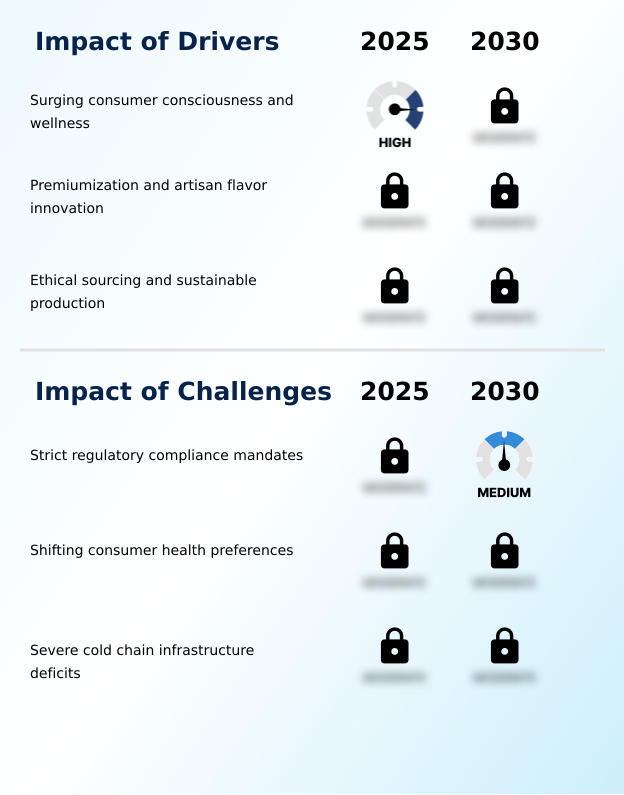
Surging consumer consciousness and wellness
Premiumization and artisan flavor innovation
Ethical sourcing and sustainable production

13.2 Market challenges

Strict regulatory compliance mandates
Shifting consumer health preferences
Severe cold chain infrastructure deficits

13.3 Impact of drivers and challenges

Impact of drivers and challenges in 2025 and 2030

13.4 Market opportunities

Digital commerce and direct engagement
Functional infusions and botanical blends
Plant-based and dairy-free alternatives

14. Competitive Landscape

14.1 Overview

14.2

Overview on criticality of inputs and factors of differentiation

14.3 Landscape disruption

Overview on factors of disruption

14.4 Industry risks

Impact of key risks on business

15. Competitive Analysis

15.1 Companies profiled

Companies covered

15.2 Company ranking index

15.3 Market positioning of companies

Matrix on companies position and classification

15.4 Cluizel

Cluizel - Overview
Cluizel - Product / Service
Cluizel - Key offerings
SWOT

15.5 Dandelion Chocolate

Dandelion Chocolate - Overview
Dandelion Chocolate - Product / Service
Dandelion Chocolate - Key offerings
SWOT

15.6 Divine Chocolate Ltd.

Divine Chocolate Ltd. - Overview
Divine Chocolate Ltd. - Product / Service
Divine Chocolate Ltd. - Key offerings
SWOT

15.7 Endangered Species Chocolate LLC

Endangered Species Chocolate LLC - Overview
Endangered Species Chocolate LLC - Product / Service
Endangered Species Chocolate LLC - Key offerings
SWOT

15.8 Ferrero International S.A.

Ferrero International S.A. - Overview
Ferrero International S.A. - Product / Service
Ferrero International S.A. - Key offerings
SWOT

15.9 Guittard Chocolate Co.

Guittard Chocolate Co. - Overview
Guittard Chocolate Co. - Product / Service
Guittard Chocolate Co. - Key offerings
SWOT

15.10 Guylian NV

Guylian NV - Overview
Guylian NV - Product / Service
Guylian NV - Key offerings
SWOT

15.11 Lindt and Sprungli AG

Lindt and Sprungli AG - Overview
Lindt and Sprungli AG - Business segments
Lindt and Sprungli AG - Key offerings
Lindt and Sprungli AG - Segment focus
SWOT

15.12 Mars Inc.

Mars Inc. - Overview
Mars Inc. - Product / Service
Mars Inc. - Key offerings
SWOT

15.13 Mondelez International Inc.

Mondelez International Inc. - Overview
Mondelez International Inc. - Business segments
Mondelez International Inc. - Key offerings
Mondelez International Inc. - Segment focus
SWOT

15.14 Nestle SA

Nestle SA - Overview
Nestle SA - Business segments
Nestle SA - Key news
Nestle SA - Key offerings
Nestle SA - Segment focus
SWOT

15.15 Neuhaus NV

Neuhaus NV - Overview
Neuhaus NV - Product / Service
Neuhaus NV - Key offerings
SWOT

15.16 Pascha Chocolate Co.

Pascha Chocolate Co. - Overview
Pascha Chocolate Co. - Product / Service
Pascha Chocolate Co. - Key offerings
SWOT

15.17 Raaka Chocolate

Raaka Chocolate - Overview
Raaka Chocolate - Product / Service
Raaka Chocolate - Key offerings
SWOT

15.18 The Hershey Co.

The Hershey Co. - Overview
The Hershey Co. - Business segments
The Hershey Co. - Key news
The Hershey Co. - Key offerings
The Hershey Co. - Segment focus
SWOT

16. Appendix

16.1 Scope of the report

Market definition
Objectives
Notes and caveats

16.2 Inclusions and exclusions checklist

Inclusions checklist
Exclusions checklist

16.3 Currency conversion rates for US$

16.4 Research methodology

16.5 Data procurement

Information sources

16.6 Data validation

16.7 Validation techniques employed for market sizing

16.8 Data synthesis

16.9 360 degree market analysis

16.10 List of abbreviations

Research Methodology

Technavio presents a detailed picture of the market by way of study, synthesis, and summation of data from multiple sources. The analysts have presented the various facets of the market with a particular focus on identifying the key industry influencers. The data thus presented is comprehensive, reliable, and the result of extensive research, both primary and secondary.

INFORMATION SOURCES

Primary sources

  • Manufacturers and suppliers
  • Channel partners
  • Industry experts
  • Strategic decision makers

Secondary sources

  • Industry journals and periodicals
  • Government data
  • Financial reports of key industry players
  • Historical data
  • Press releases

DATA ANALYSIS

Data Synthesis

  • Collation of data
  • Estimation of key figures
  • Analysis of derived insights

Data Validation

  • Triangulation with data models
  • Reference against proprietary databases
  • Corroboration with industry experts

REPORT WRITING

Qualitative

  • Market drivers
  • Market challenges
  • Market trends
  • Five forces analysis

Quantitative

  • Market size and forecast
  • Market segmentation
  • Geographical insights
  • Competitive landscape

Interested in this report?

Get your sample now to see our research methodology and insights!

Download Now

Frequently Asked Questions

Dark Chocolate market growth will increase by USD 44817.9 million during 2026-2030.

The Dark Chocolate market is expected to grow at a CAGR of 9.9% during 2026-2030.

Dark Chocolate market is segmented by Type (Conventional, Organic) Distribution channel (Offline, Online) Product type (70 percent cocoa dark chocolate, 75 percent cocoa dark chocolate, 80 percent cocoa dark chocolate, 90 percent cocoa dark chocolate)

Cluizel, Dandelion Chocolate, Divine Chocolate Ltd., Endangered Species Chocolate LLC, Ferrero International S.A., Guittard Chocolate Co., Guylian NV, Lindt and Sprungli AG, Mars Inc., Mondelez International Inc., Nestle SA, Neuhaus NV, Pascha Chocolate Co., Raaka Chocolate, RITTER SPORT, Taza Chocolate, The Hershey Co., Tonys Chocolonely B.V., Valrhona SAS, VIVANI are a few of the key vendors in the Dark Chocolate market.

Europe will register the highest growth rate of 44% among the other regions. Therefore, the Dark Chocolate market in Europe is expected to garner significant business opportunities for the vendors during the forecast period.

Germany, UK, France, Italy, Spain, The Netherlands, US, Canada, Mexico, China, Japan, India, South Korea, Australia, Indonesia, Brazil, Argentina, Chile, Saudi Arabia, UAE, South Africa, Israel, Turkey

  • Surging consumer consciousness and wellness is the driving factor this market.

The Dark Chocolate market vendors should focus on grabbing business opportunities from the Type segment as it accounted for the largest market share in the base year.
RIA - Research AI Assistant
Ask RIA
