


Malaysia Dark Fiber Market Size 2026-2030
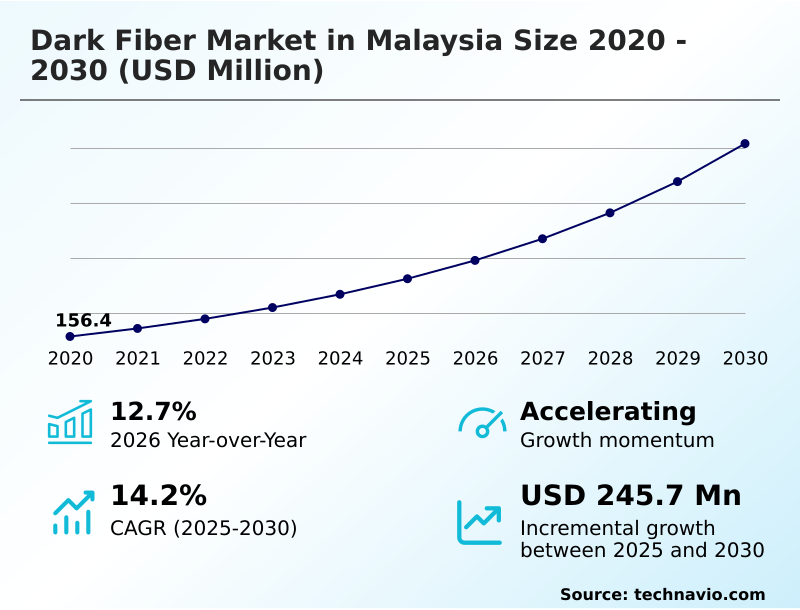
The malaysia dark fiber market size is valued to increase by USD 245.7 million, at a CAGR of 14.2% from 2025 to 2030. Rapid expansion of fifth-generation mobile networks will drive the malaysia dark fiber market.
Major Market Trends & Insights
- By Service - Long-haul services segment was valued at USD 90.6 million in 2024
- By Type - Multi-mode segment accounted for the largest market revenue share in 2024
Market Size & Forecast
- Market Opportunities: USD 350.7 million
- Market Future Opportunities: USD 245.7 million
- CAGR from 2025 to 2030 : 14.2%
Market Summary
- The dark fiber market in Malaysia is undergoing significant expansion, driven by the convergence of 5G mobile networks, the proliferation of AI data centers, and government-led smart city initiatives. This unlit optical fiber infrastructure provides organizations with complete bandwidth control and network management, fostering the development of private communication networks.
- A key trend is the architectural shift to support massive east-west traffic for AI workloads, necessitating hyper-dense fiber mesh deployments and advanced optical fiber transmission technologies. For instance, a financial services firm can leverage dark fiber to create low-latency optical interconnects between its data centers and trading exchanges, achieving a significant reduction in transaction times and ensuring network reliability.
- However, the industry faces challenges related to physical infrastructure security and the high rural deployment costs. The ongoing legacy network migration away from copper also presents operational hurdles. As demand for high-capacity connectivity escalates, the market is characterized by strategic infrastructure sharing and a focus on maximizing the spectral efficiency of existing fiber assets to enable terabit-scale transmission.
What will be the Size of the Malaysia Dark Fiber Market during the forecast period?
Get Key Insights on Market Forecast (PDF) Get Free Sample
How is the Malaysia Dark Fiber Market Segmented?
The malaysia dark fiber industry research report provides comprehensive data (region-wise segment analysis), with forecasts and estimates in "USD million" for the period 2026-2030, as well as historical data from 2020-2024 for the following segments.
- Service
- Long-haul services
- Short-haul services
- Colocation facilities services
- Type
- Multi-mode
- Single-mode
- Material
- Glass
- Plastic
- Geography
- APAC
By Service Insights
The long-haul services segment is estimated to witness significant growth during the forecast period.
The dark fiber market in Malaysia is segmented by service type, including long-haul services, short-haul services, and solutions for colocation facilities. Long-haul routes form the national backbone, linking major cities and the primary cable landing station for international traffic.
This segment is defined by dense wavelength division multiplexing and the adoption of G.654.E glass to support future terabit-scale transmission. Short-haul services, or metro networks, are crucial for 5G mobile networks and smart city infrastructure.
By type, single-mode fiber dominates for distance, while multi-mode fiber, including OM5 wideband multi-mode fiber, is used within data centers.
These facilities leverage campus rings and Data Center Interconnect (DCI) links to support the AI factory architecture model, which has increased internal bandwidth demand by over 300%.
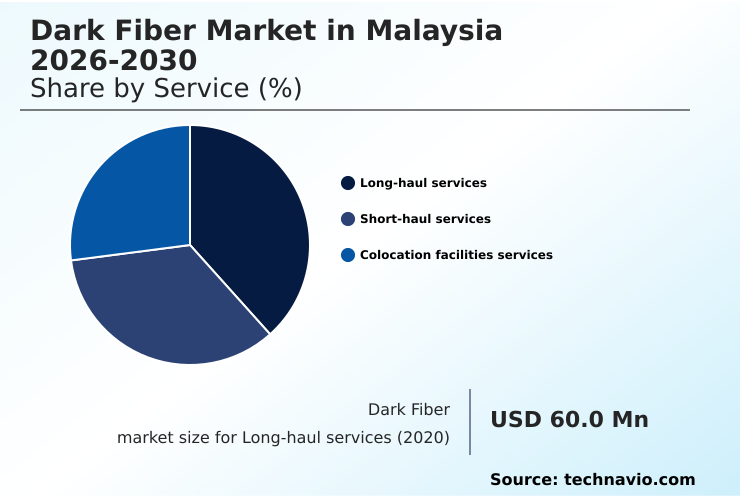
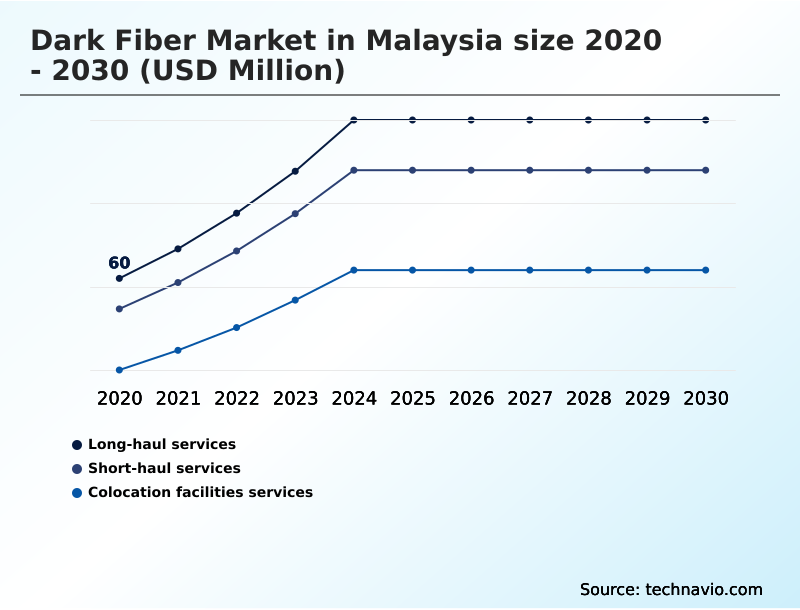
The Long-haul services segment was valued at USD 90.6 million in 2024 and showed a gradual increase during the forecast period.
Market Dynamics
Our researchers analyzed the data with 2025 as the base year, along with the key drivers, trends, and challenges. A holistic analysis of drivers will help companies refine their marketing strategies to gain a competitive advantage.
- Strategic decisions in the dark fiber market in Malaysia increasingly weigh the leasing dark fiber versus lit services benefits, especially for applications like dark fiber for 5G network backhaul and dark fiber for AI data center interconnect. The use of high-count dark fiber for campus rings is now standard for creating low-latency connectivity within and between facilities.
- For nationwide connectivity, long-haul dark fiber for subsea backhaul is critical. Differentiating between multi-mode versus single-mode dark fiber is essential for network design, with the former often used for short-reach applications and the latter for distance. The market also sees growing adoption of dark fiber networks for industrial automation and plastic optical fiber in manufacturing due to its resilience.
- Public sector adoption is seen in dark fiber for smart city surveillance and its role in public safety networks. For providers, dark fiber asset monetization strategies are key, as is understanding the coherent optics impact on dark fiber value.
- Operationally, managing security for dark fiber assets is a top priority, alongside navigating the cost of dark fiber in rural areas and addressing regulatory challenges in dark fiber deployment.
- The expansion of dark fiber for cloud availability zones and infrastructure supporting edge computing continues to drive investment, while the transition from copper to dark fiber networks nears completion, with a more than 90% reduction in copper-based subscriber lines compared to five years ago. Short-haul dark fiber for metro access completes the connectivity ecosystem.
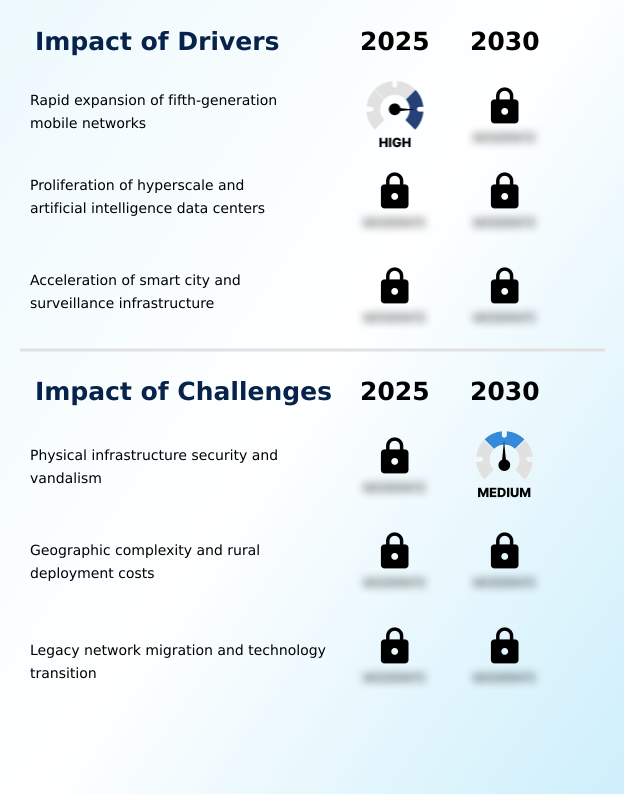
What are the key market drivers leading to the rise in the adoption of Malaysia Dark Fiber Industry?
- The rapid expansion and densification of 5G mobile networks represents the primary driver for the dark fiber market.
- The primary market driver is the rapid expansion of 5G mobile networks, which mandates the use of a robust fiber-based backhaul and backhaul infrastructure. This shift promotes asset-light models, enabling operators to achieve a 20% reduction in capital expenditure.
- A parallel driver is the growth of hyperscale data centers, creating demand for massive data center interconnect deployments. These facilities, often designed with an AI factory architecture, require low-latency optical interconnects.
- Additionally, the acceleration of smart city infrastructure, including telemetry networks for public services, is converting municipal assets into digital endpoints and driving a 15% year-over-year expansion in metro fiber deployments for industrial automation networks.
What are the market trends shaping the Malaysia Dark Fiber Industry?
- The integration of artificial intelligence workloads into optical network architecture is an emerging market trend. This shift fundamentally reshapes data traffic patterns and connectivity requirements.
- The market is witnessing a fundamental shift in optical network architecture, driven by the need to support AI factory architecture and its massive east-west traffic demands. This trend, moving beyond traditional north-south traffic patterns, necessitates hyper-dense fiber mesh deployments. The adoption of next-generation coherent optical technologies is crucial, enabling a 35% improvement in spectral efficiency on existing unlit optical fiber.
- A key development is the strategic focus on asset monetization through infrastructure sharing, with specialized Fibrecos managing passive assets. This allows operators to utilize terabit-ready fiber for ultra-reliable low-latency communications, essential for services built on 5G-Advanced standards, while reducing capital expenditure by over 25%.
What challenges does the Malaysia Dark Fiber Industry face during its growth?
- The security of physical infrastructure, particularly its vulnerability to vandalism, poses a key challenge to industry growth and operational stability.
- Maintaining physical infrastructure security is a primary challenge, as copper theft collateral damage on unmonitored fiber routes degrades network reliability, with some providers seeing a 15% increase in annual maintenance costs. Geographic complexity and high rural deployment costs also constrain expansion of the fiber optic backbone. Another challenge is the final phase of copper-based network retirement and legacy network migration.
- This involves replacing customer premises equipment (CPE) and upgrading building local area networks. The transition from older multi-mode fiber systems to superior single-mode fiber requires careful planning to avoid disruptions during synchronous data replication for enterprise clients, a process that can absorb 25% of field technician resources.
Exclusive Technavio Analysis on Customer Landscape
The malaysia dark fiber market forecasting report includes the adoption lifecycle of the market, covering from the innovator’s stage to the laggard’s stage. It focuses on adoption rates in different regions based on penetration. Furthermore, the malaysia dark fiber market report also includes key purchase criteria and drivers of price sensitivity to help companies evaluate and develop their market growth analysis strategies.

Customer Landscape of Malaysia Dark Fiber Industry
Competitive Landscape
Companies are implementing various strategies, such as strategic alliances, malaysia dark fiber market forecast, partnerships, mergers and acquisitions, geographical expansion, and product/service launches, to enhance their presence in the industry.
ARNet - Offering dedicated private dark fiber links for enterprises, ensuring secure, scalable, and fully controlled network infrastructure.
The industry research and growth report includes detailed analyses of the competitive landscape of the market and information about key companies, including:
- ARNet
- AT and T Inc.
- Bullish Aim Sdn. Bhd
- CelcomDigi Berhad
- Extreme Broadband Sdn Bhd.
- FIBERAIL SDN. BHD
- ITMAX SYSTEM BERHAD
- MSA Resources Sdn Bhd
- OpenDC SDN BHD
- SEAX GLOBAL
- SHCorp Sdn Bhd
- TelcoHubX
- Telekom Malaysia Berhad
- Theta Edge Berhad
- TIME dotCom Bhd
Qualitative and quantitative analysis of companies has been conducted to help clients understand the wider business environment as well as the strengths and weaknesses of key industry players. Data is qualitatively analyzed to categorize companies as pure play, category-focused, industry-focused, and diversified; it is quantitatively analyzed to categorize companies as dominant, leading, strong, tentative, and weak.
Recent Development and News in Malaysia dark fiber market
- In October, 2024, Oracle announced a planned investment of more than $6.5 billion to establish a public cloud region in Malaysia, a move aimed at meeting escalating demand for AI and cloud services which requires extensive dark fiber interconnectivity.
- In February, 2025, Telekom Malaysia initiated the mandatory phase-out of its legacy Streamyx and Unifi Lite copper-based services, accelerating the nationwide migration of subscribers to its fiber broadband infrastructure.
- In March, 2025, Telekom Malaysia and U Mobile formed a strategic partnership valued at approximately $586 million over ten years, focused on providing fiber backhaul infrastructure to support U Mobile's nationwide 5G rollout.
- In April, 2025, Theta Edge announced a joint venture with AGMO Holdings to develop and deliver a range of digital solutions targeted at government and enterprise clients, driving underlying demand for robust connectivity.
Dive into Technavio’s robust research methodology, blending expert interviews, extensive data synthesis, and validated models for unparalleled Malaysia Dark Fiber Market insights. See full methodology.
| Market Scope | |
|---|---|
| Page number | 178 |
| Base year | 2025 |
| Historic period | 2020-2024 |
| Forecast period | 2026-2030 |
| Growth momentum & CAGR | Accelerate at a CAGR of 14.2% |
| Market growth 2026-2030 | USD 245.7 million |
| Market structure | Fragmented |
| YoY growth 2025-2026(%) | 12.7% |
| Key countries | Malaysia |
| Competitive landscape | Leading Companies, Market Positioning of Companies, Competitive Strategies, and Industry Risks |
Research Analyst Overview
- The dark fiber market in Malaysia is evolving from a niche telecom commodity into a foundational utility for the digital economy. The aggressive rollout of 5G mobile networks necessitates a dense fiber-based backhaul, while the rise of AI data centers requires extreme-capacity data center interconnect solutions using low-latency optical interconnects.
- This demand is met through a combination of long-haul services connecting to the national cable landing station and short-haul services creating metro fiber rings for smart city infrastructure and video surveillance networks. Key industry shifts include strategic asset monetization through infrastructure sharing and the technical migration to coherent optical technology for terabit-scale transmission, which improves spectral efficiency by over 40%.
- The transition involves not just copper-based network retirement but a broader legacy network migration, including the replacement of older optical network units. As providers deploy advanced G.654.E glass and manage a complex ecosystem of unlit optical fiber, they must also contend with challenges like physical infrastructure security and high rural deployment costs.
- This dynamic is pushing the adoption of Fiber-as-a-Service models, reshaping bandwidth control, and redefining network management for private communication networks.
What are the Key Data Covered in this Malaysia Dark Fiber Market Research and Growth Report?
-
What is the expected growth of the Malaysia Dark Fiber Market between 2026 and 2030?
-
USD 245.7 million, at a CAGR of 14.2%
-
-
What segmentation does the market report cover?
-
The report is segmented by Service (Long-haul services, Short-haul services, and Colocation facilities services), Type (Multi-mode, and Single-mode), Material (Glass, and Plastic) and Geography (APAC)
-
-
Which regions are analyzed in the report?
-
APAC
-
-
What are the key growth drivers and market challenges?
-
Rapid expansion of fifth-generation mobile networks, Physical infrastructure security and vandalism
-
-
Who are the major players in the Malaysia Dark Fiber Market?
-
ARNet, AT and T Inc., Bullish Aim Sdn. Bhd, CelcomDigi Berhad, Extreme Broadband Sdn Bhd., FIBERAIL SDN. BHD, ITMAX SYSTEM BERHAD, MSA Resources Sdn Bhd, OpenDC SDN BHD, SEAX GLOBAL, SHCorp Sdn Bhd, TelcoHubX, Telekom Malaysia Berhad, Theta Edge Berhad and TIME dotCom Bhd
-
Market Research Insights
- The market's dynamics are shaped by the technical demands of next-generation applications and infrastructure models. The adoption of 5G-Advanced standards is driving a shift toward asset-light models, where mobile operators lease backhaul infrastructure from specialized Fibrecos, reducing their capital outlay by over 20%.
- In the data center segment, the rise of the AI factory architecture necessitates a complex optical network architecture for hyperscale data centers, connecting multiple availability zones with high-count fiber cables. This has led to a 40% increase in demand for Data Center Interconnect (DCI) capacity.
- Furthermore, the move to proprietary high-throughput protocols for synchronous data replication and ultra-reliable low-latency communications is compelling providers to upgrade their networks with terabit-ready fiber, supported by long-term power purchase agreements for energy-intensive facilities.
We can help! Our analysts can customize this malaysia dark fiber market research report to meet your requirements.
 RIA -
RIA - 
