



Data Center Construction Market Size 2026-2030
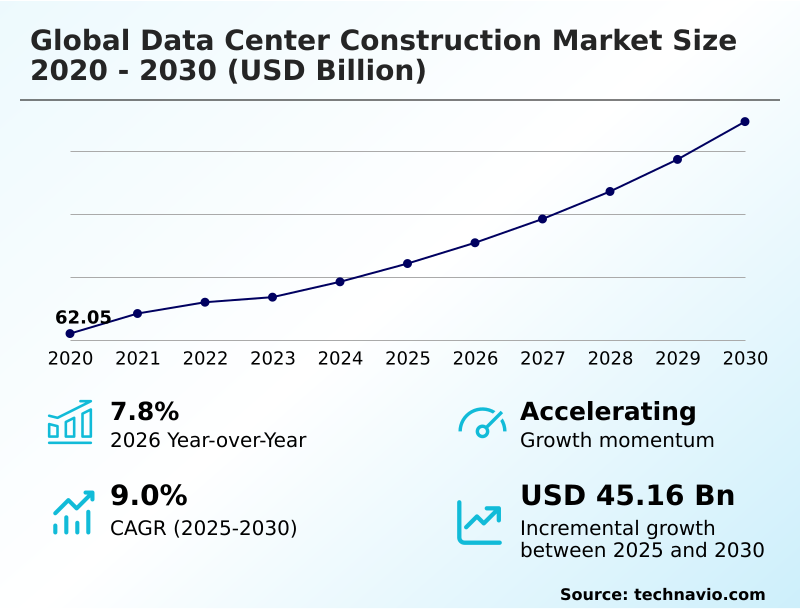
The data center construction market size is valued to increase by USD 45.16 billion, at a CAGR of 9% from 2025 to 2030. Exponential growth in global data generation and widespread digital transformation will drive the data center construction market.
Major Market Trends & Insights
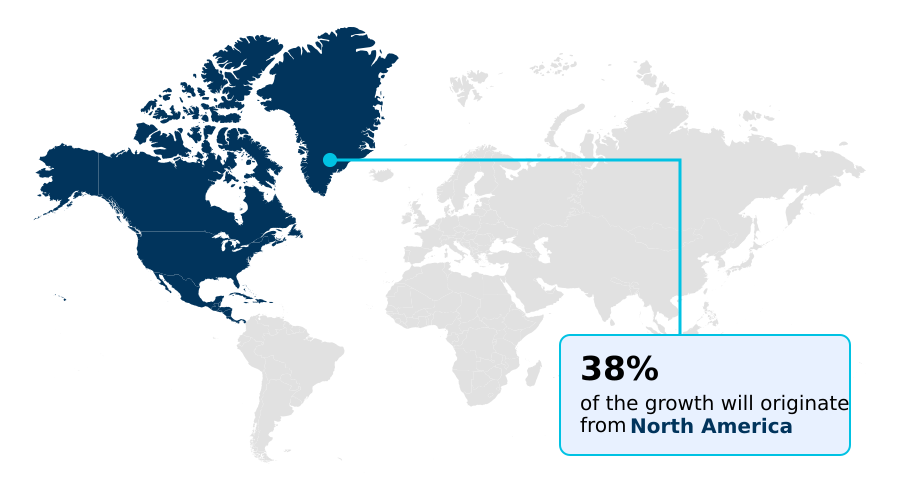
- North America dominated the market and accounted for a 37.9% growth during the forecast period.
- By Application - Enterprise segment was valued at USD 29.54 billion in 2024
- By Type - Electrical construction segment accounted for the largest market revenue share in 2024
Market Size & Forecast
- Market Opportunities: USD 67.44 billion
- Market Future Opportunities: USD 45.16 billion
- CAGR from 2025 to 2030 : 9%
Market Summary
- The data center construction market is undergoing unprecedented expansion, driven by the relentless growth in digital data and the mass migration of IT workloads to cloud platforms. This demand is amplified by the rise of AI and IoT, which require specialized, high-performance computing environments with advanced thermal management solutions.
- In response, the industry is industrializing its processes, with a strategic shift toward modular and prefabricated approaches to accelerate speed-to-market and enhance quality control. A key business scenario involves hyperscale operators leveraging these methods to establish new cloud regions, compressing project timelines from years to months to gain a competitive edge.
- This emphasis on rapid, scalable deployment is balanced against significant headwinds, including global supply chain volatility for mission-critical components, severe power availability constraints in primary hubs, and an acute shortage of skilled labor.
- As a result, construction firms are evolving into sophisticated integrators, focusing on sustainability, high-density designs, and strategic partnerships to navigate this complex and capital-intensive landscape, ensuring the digital infrastructure can support a data-driven global economy.
What will be the Size of the Data Center Construction Market during the forecast period?
Get Key Insights on Market Forecast (PDF) Get Free Sample
How is the Data Center Construction Market Segmented?
The data center construction industry research report provides comprehensive data (region-wise segment analysis), with forecasts and estimates in "USD million" for the period 2026-2030, as well as historical data from 2020-2024 for the following segments.
- Application
- Enterprise
- Cloud
- Colocation
- Hyperscale
- Type
- Electrical construction
- Mechanical construction
- General construction
- Product type
- IT infrastructure
- PD and cooling infrastructure
- Miscellaneous infrastructure
- Geography
- North America
- US
- Canada
- Mexico
- Europe
- Germany
- UK
- France
- APAC
- China
- Japan
- India
- South America
- Brazil
- Argentina
- Middle East and Africa
- UAE
- Saudi Arabia
- South Africa
- Rest of World (ROW)
- North America
By Application Insights
The enterprise segment is estimated to witness significant growth during the forecast period.
The enterprise segment is evolving, with construction shifting from large corporate builds to modernized facilities driven by hybrid cloud strategies.
This transformation, influenced by IT workload migration patterns, retains only latency-sensitive or secure applications on-premises, demanding mission-critical facility design and advanced data center infrastructure management.
New projects prioritize sophisticated general and specialized mechanical engineering to support high-density private clouds while adhering to data sovereignty laws.
This focus on optimizing capital expenditure and operational expenditure has led to designs achieving up to a 15% reduction in power consumption for equivalent workloads, making sustainable design principles a core component of enterprise data center modernization.
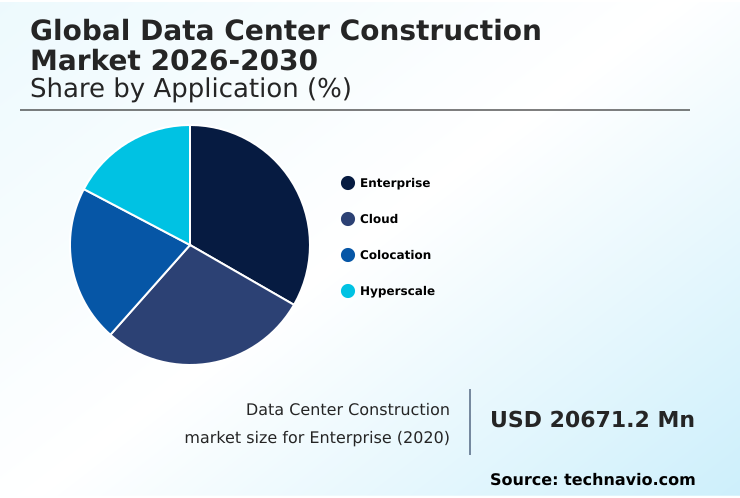
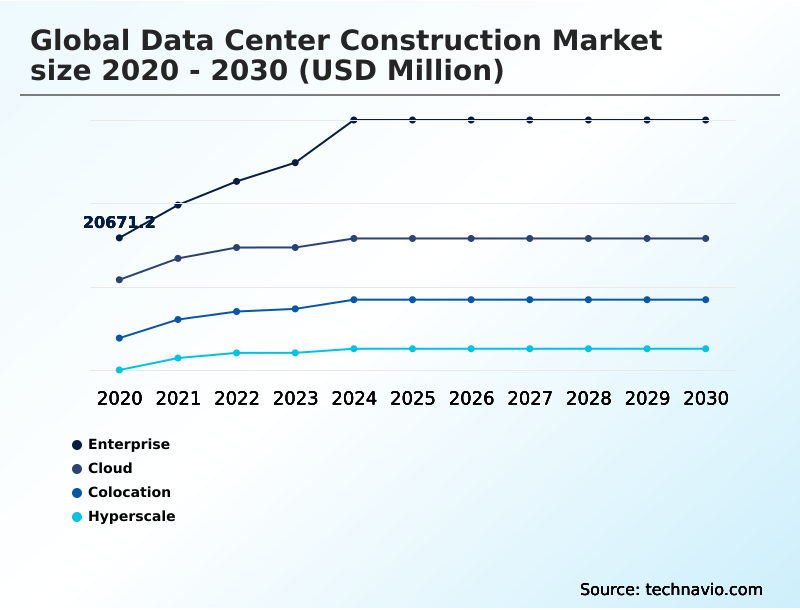
The Enterprise segment was valued at USD 29.54 billion in 2024 and showed a gradual increase during the forecast period.
Regional Analysis
North America is estimated to contribute 37.9% to the growth of the global market during the forecast period.Technavio’s analysts have elaborately explained the regional trends and drivers that shape the market during the forecast period.
See How Data Center Construction Market Demand is Rising in North America Get Free Sample
The geographic landscape of the data center construction market is undergoing a significant diversification away from traditional hubs due to regional power availability constraints.
This has spurred the development of a geographically distributed architecture, with North America leading this expansion, accounting for 37.9% of the incremental growth. This shift involves extensive electrical construction and general construction of carrier-neutral facilities in secondary and tertiary markets.
The mission-critical facility design in these new locations increasingly incorporates on-site power generation and battery energy storage systems to ensure resilient power distribution.
This trend toward enterprise data center modernization in new regions is supported by long-term power purchase agreements, reflecting a holistic approach to data center lifecycle management that balances cost, resilience, and sustainability across a wider geographic footprint.
Market Dynamics
Our researchers analyzed the data with 2025 as the base year, along with the key drivers, trends, and challenges. A holistic analysis of drivers will help companies refine their marketing strategies to gain a competitive advantage.
- Navigating the complexities of the global data center construction market 2026-2030 requires a deep understanding of evolving technical requirements and economic trade-offs. The cost benefits of modular data center construction are increasingly compelling, as the ROI analysis of prefabricated electrical skids shows a significant reduction in deployment time compared to traditional builds.
- However, firms face challenges of implementing direct-to-chip liquid cooling and managing water usage effectiveness in arid climates. The impact of power availability on data center site selection has become a primary gating factor, forcing developers to navigate utility interconnection for new data centers in emerging geographic markets.
- Strategies for managing data center equipment lead times and enhancing supply chain resilience for critical components are now central to capital expenditure planning for hyperscale build-outs. Furthermore, designing facilities for improved power usage effectiveness is critical, especially when retrofitting legacy data centers for high-density computing. The skilled labor requirements for AI-ready infrastructure builds are substantial, pushing the industry to innovate.
- This is evident when comparing air cooling versus immersion cooling efficiency, where the latter's superior thermal performance comes with unique engineering for waste heat reuse in urban environments and strict physical security design for mission-critical facilities.
- Successfully integrating on-site renewable power generation while ensuring compliance with data sovereignty laws in new construction requires advanced planning, often leveraging the role of BIM in complex data center projects.
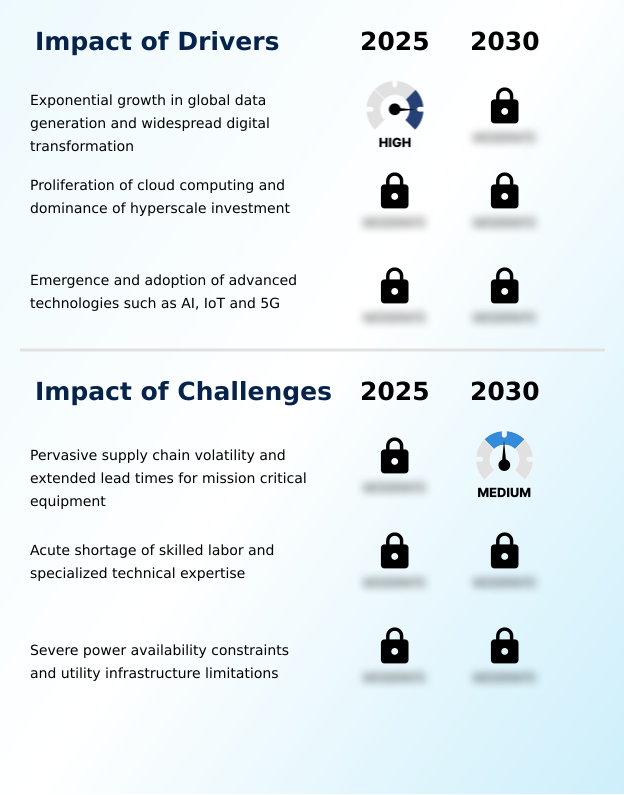
What are the key market drivers leading to the rise in the adoption of Data Center Construction Industry?
- The exponential growth in global data generation, coupled with widespread digital transformation across all economic sectors, is the foundational driver for data center construction.
- The primary driver for the data center construction market is the demand created by high-density computing and the widespread adoption of AI-ready infrastructure. This is fueled by IT workload migration patterns toward hyperscale data center construction and colocation facility buildouts.
- To serve this, operators are expanding into new low-latency connectivity hubs to support high-performance computing environments. This technological shift necessitates advanced cooling methodologies, with liquid cooling technologies becoming standard for data center thermal management.
- The need to comply with data sovereignty laws also propels the construction of in-country facilities.
- This convergence has led to a 50% increase in power density requirements for AI-specific racks, fundamentally altering design and construction strategies across the digital infrastructure ecosystem and expanding the need for edge computing infrastructure.
What are the market trends shaping the Data Center Construction Industry?
- The pervasive integration of sustainability and energy efficiency is a defining trend, moving beyond peripheral consideration to become a fundamental business imperative in data center construction.
- A defining trend in the data center construction market is the systematic integration of sustainable design principles, driven by the need for operational expenditure reduction. The adoption of modular prefabricated approaches through industrialized construction processes and off-site manufacturing compresses project timelines by up to 40%.
- This shift aligns with stringent green building certifications and circular economy principles, mandating the use of sustainable building materials like low-carbon concrete. The focus on efficiency is quantified by improvements in power usage effectiveness, with new designs showing a 15% gain over legacy facilities.
- Moreover, the emphasis on water usage effectiveness is driving innovation in thermal management solutions, while the engineering of waste heat reuse systems turns facilities into valuable components of local energy ecosystems.
What challenges does the Data Center Construction Industry face during its growth?
- Pervasive supply chain volatility and extended lead times for mission-critical equipment represent a formidable and persistent challenge constraining industry growth.
- A significant challenge facing the data center construction market is navigating supply chain disruptions for mission-critical equipment, which has increased lead times by over 60% for key components. This requires sophisticated digital supply chain management and strategic sourcing partnerships for capital expenditure optimization.
- The industry also grapples with a severe shortage of specialized trade skillsets, with firms reporting a 25% deficit in qualified personnel for specialized mechanical engineering tasks. This is compounded by the technical demands of new technologies, which require expertise in areas like dielectric fluid management and ensuring adequate structural floor loading capacity for immersion cooling tanks.
- These constraints place immense pressure on project timelines and budgets, making the management of human and material resources a primary determinant of success.
Exclusive Technavio Analysis on Customer Landscape
The data center construction market forecasting report includes the adoption lifecycle of the market, covering from the innovator’s stage to the laggard’s stage. It focuses on adoption rates in different regions based on penetration. Furthermore, the data center construction market report also includes key purchase criteria and drivers of price sensitivity to help companies evaluate and develop their market growth analysis strategies.
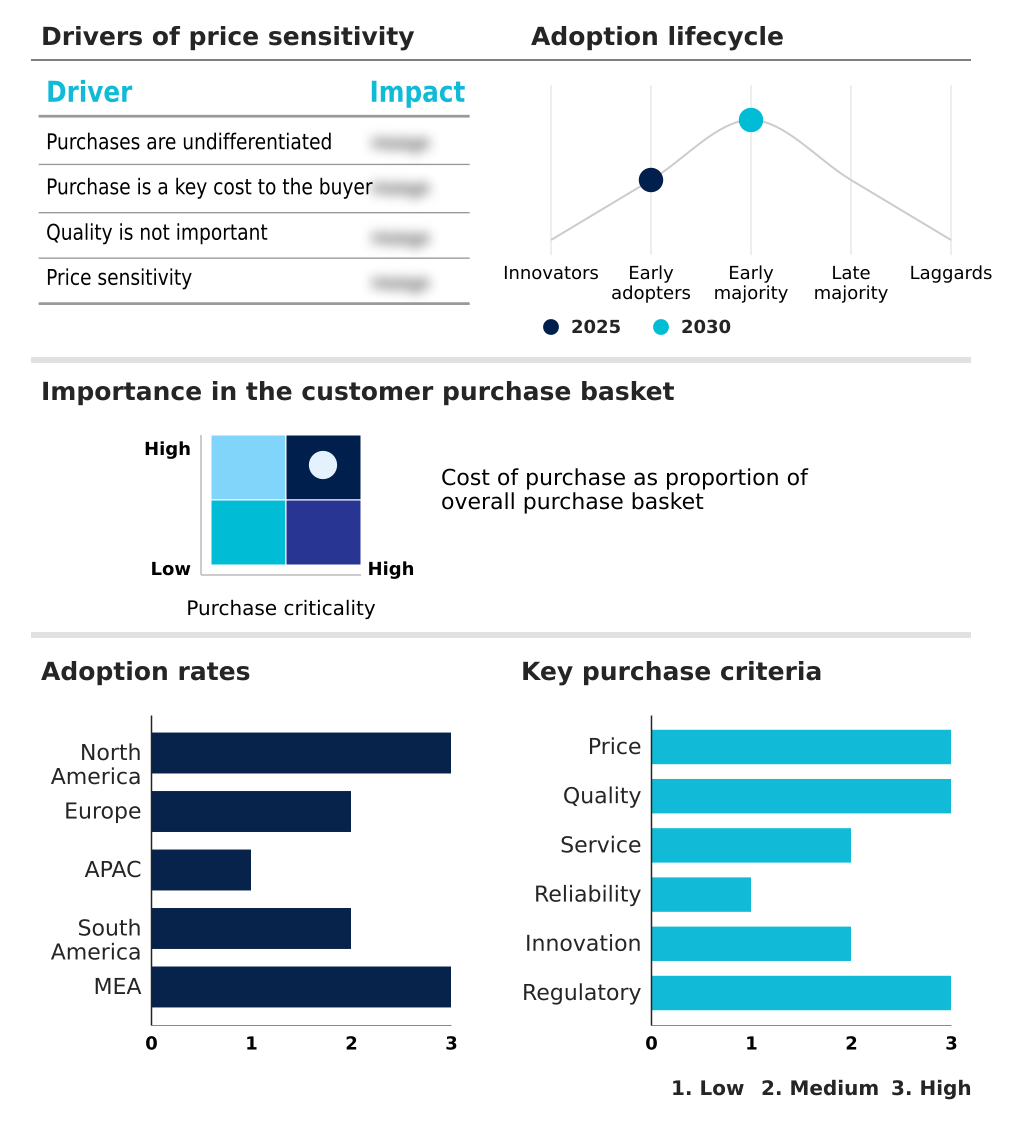
Customer Landscape of Data Center Construction Industry
Competitive Landscape
Companies are implementing various strategies, such as strategic alliances, data center construction market forecast, partnerships, mergers and acquisitions, geographical expansion, and product/service launches, to enhance their presence in the industry.
ABB Ltd. - Delivers modular prefabricated electrical and cooling systems, integrating critical power components for rapid deployment and high reliability in mission-critical facilities.
The industry research and growth report includes detailed analyses of the competitive landscape of the market and information about key companies, including:
- ABB Ltd.
- AECOM
- AMETEK Inc.
- Arup Group Ltd.
- Asetek
- Clune Construction Co.
- Delta Electronics Inc.
- DPR Construction
- Eaton Corp. Plc
- Emerson Electric Co.
- FORTIS CONSTRUCTION Inc.
- Gilbane Inc.
- HDR Inc.
- Hensel Phelps
- HITT Contracting Inc.
- Iron Mountain Inc.
- J.E. Dunn Construction Co.
- Nippon Telegraph and Corp.
- SAS Institute Inc.
- Siemens AG
Qualitative and quantitative analysis of companies has been conducted to help clients understand the wider business environment as well as the strengths and weaknesses of key industry players. Data is qualitatively analyzed to categorize companies as pure play, category-focused, industry-focused, and diversified; it is quantitatively analyzed to categorize companies as dominant, leading, strong, tentative, and weak.
Recent Development and News in Data center construction market
- In January 2025, Microsoft announced an $80 billion investment plan for new data center construction, with a significant portion allocated to expanding its infrastructure footprint within the United States.
- In January 2025, Meta Platforms Inc. revealed plans to construct a $10 billion, four-million-square-foot data center campus in Louisiana, slated to be its largest facility upon completion.
- In February 2025, Compass Datacenters broke ground on a $10 billion AI-ready campus in Mississippi, highlighting a strategic move to build large-scale facilities in emerging regional markets.
- In February 2025, Brookfield and Data4 committed $20 billion to construct AI-focused data center infrastructure in France, addressing the explosive demand for high-capacity, specialized facilities in Europe.
Dive into Technavio’s robust research methodology, blending expert interviews, extensive data synthesis, and validated models for unparalleled Data Center Construction Market insights. See full methodology.
| Market Scope | |
|---|---|
| Page number | 306 |
| Base year | 2025 |
| Historic period | 2020-2024 |
| Forecast period | 2026-2030 |
| Growth momentum & CAGR | Accelerate at a CAGR of 9% |
| Market growth 2026-2030 | USD 45162.0 million |
| Market structure | Fragmented |
| YoY growth 2025-2026(%) | 7.8% |
| Key countries | US, Canada, Mexico, Germany, UK, France, The Netherlands, Italy, Spain, China, Japan, India, South Korea, Australia, Indonesia, Brazil, Argentina, Chile, UAE, Saudi Arabia, South Africa, Egypt and Kenya |
| Competitive landscape | Leading Companies, Market Positioning of Companies, Competitive Strategies, and Industry Risks |
Research Analyst Overview
- The data center construction market is defined by a convergence of complex technical demands, from electrical construction and mechanical construction to highly specialized general construction. The proliferation of high-density computing and AI-ready infrastructure necessitates a pivot to advanced thermal management solutions, including liquid cooling technologies such as direct-to-chip liquid cooling and single-phase immersion cooling.
- In response, the industry is adopting modular prefabricated approaches and utilizing building information modeling to accelerate deployment. This trend involves using prefabricated electrical skids and sophisticated power distribution units to create fault-tolerant electrical systems.
- Boardroom decisions are now heavily influenced by the need to balance speed with sustainability, integrating sustainable design principles, green building certifications, and waste heat reuse to improve power usage effectiveness. This requires navigating data sovereignty laws through a geographically distributed architecture of carrier-neutral facilities, often secured by power purchase agreements.
- The entire data center lifecycle management is under scrutiny, from managing the supply chain for mission-critical equipment like uninterruptible power supply systems and computer room air handlers to ensuring resilient power distribution via high-voltage substations, making supply chain resilience and strategic sourcing partnerships critical.
- Facilities must also feature robust physical security, including raised access flooring, secure perimeter fencing, and multi-layered physical security. The growth of hybrid cloud strategies and edge computing infrastructure further complicates design, pushing for more adaptive and efficient data center infrastructure management.
What are the Key Data Covered in this Data Center Construction Market Research and Growth Report?
-
What is the expected growth of the Data Center Construction Market between 2026 and 2030?
-
USD 45.16 billion, at a CAGR of 9%
-
-
What segmentation does the market report cover?
-
The report is segmented by Application (Enterprise, Cloud, Colocation, and Hyperscale), Type (Electrical construction, Mechanical construction, and General construction), Product Type (IT infrastructure, PD and cooling infrastructure, and Miscellaneous infrastructure) and Geography (North America, Europe, APAC, South America, Middle East and Africa)
-
-
Which regions are analyzed in the report?
-
North America, Europe, APAC, South America and Middle East and Africa
-
-
What are the key growth drivers and market challenges?
-
Exponential growth in global data generation and widespread digital transformation, Pervasive supply chain volatility and extended lead times for mission critical equipment
-
-
Who are the major players in the Data Center Construction Market?
-
ABB Ltd., AECOM, AMETEK Inc., Arup Group Ltd., Asetek, Clune Construction Co., Delta Electronics Inc., DPR Construction, Eaton Corp. Plc, Emerson Electric Co., FORTIS CONSTRUCTION Inc., Gilbane Inc., HDR Inc., Hensel Phelps, HITT Contracting Inc., Iron Mountain Inc., J.E. Dunn Construction Co., Nippon Telegraph and Corp., SAS Institute Inc. and Siemens AG
-
Market Research Insights
- The dynamics of the data center construction market are shaped by the strategic pursuit of efficiency and scalability. The adoption of industrialized construction processes, including off-site manufacturing, has enabled a 30% reduction in on-site labor requirements, addressing critical skill shortages.
- This shift toward capital expenditure optimization is further evidenced by the rise of colocation facility buildouts, which offer enterprises a less capital-intensive path to modernization. In parallel, advanced cooling methodologies are being deployed to manage the heat from high-density computing, with some liquid cooling systems improving energy efficiency by over 20% compared to traditional air-based methods.
- These strategic adjustments in design and execution are essential for meeting the demands of a rapidly evolving digital infrastructure ecosystem.
We can help! Our analysts can customize this data center construction market research report to meet your requirements.
 RIA -
RIA - 
