



Data Wrangling Market Size 2026-2030
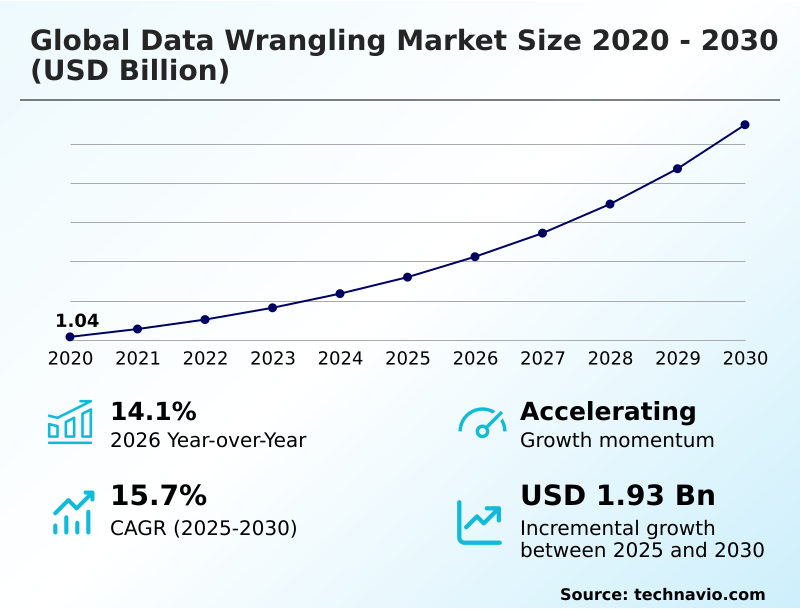
The data wrangling market size is valued to increase by USD 1.93 billion, at a CAGR of 15.7% from 2025 to 2030. Numerous benefits provided by data wrangling solutions will drive the data wrangling market.
Major Market Trends & Insights
- North America dominated the market and accounted for a 39.2% growth during the forecast period.
- By Sector - BFSI segment was valued at USD 481.1 million in 2024
- By Deployment - Cloud segment accounted for the largest market revenue share in 2024
Market Size & Forecast
- Market Opportunities: USD 2.70 billion
- Market Future Opportunities: USD 1.93 billion
- CAGR from 2025 to 2030 : 15.7%
Market Summary
- The data wrangling market is foundational to modern digital enterprise strategy, enabling organizations to transform raw, chaotic data into analysis-ready assets. As businesses are inundated with information from diverse sources, the necessity for efficient data cleansing, transformation, and validation has become paramount.
- These platforms facilitate critical processes such as data normalization and data enrichment, which are essential for reliable business intelligence and advanced analytics. For instance, in the financial services industry, sophisticated data wrangling is used to consolidate transaction records, customer data, and market feeds for real-time fraud detection.
- By implementing robust data preparation for ml and data wrangling for analytics, firms can identify suspicious patterns with greater accuracy, significantly reducing financial risk and ensuring regulatory compliance. This shift from manual, error-prone spreadsheets to automated, scalable solutions underscores the market's role in driving operational efficiency and enabling data-driven decision-making.
- The emphasis on data quality metrics and data governance frameworks ensures that insights are not only fast but also trustworthy, supporting strategic initiatives across the enterprise. The market continues to evolve with capabilities like self-service data preparation, empowering a wider range of users to harness the power of their data.
What will be the Size of the Data Wrangling Market during the forecast period?
Get Key Insights on Market Forecast (PDF) Get Free Sample
How is the Data Wrangling Market Segmented?
The data wrangling industry research report provides comprehensive data (region-wise segment analysis), with forecasts and estimates in "USD million" for the period 2026-2030, as well as historical data from 2020-2024 for the following segments.
- Sector
- BFSI
- Government and public sector
- Healthcare
- Others
- Deployment
- Cloud
- On-premises
- End-user
- Large enterprises
- Small and medium-sized enterprises
- Geography
- North America
- US
- Canada
- Mexico
- Europe
- UK
- Germany
- France
- APAC
- China
- India
- Japan
- Middle East and Africa
- UAE
- Saudi Arabia
- South Africa
- South America
- Brazil
- Argentina
- Rest of World (ROW)
- North America
By Sector Insights
The bfsi segment is estimated to witness significant growth during the forecast period.
The BFSI sector's adoption is driven by the critical need for robust data governance. Financial institutions leverage these solutions to manage master data management and ensure data privacy compliance, which is essential for meeting strict regulatory standards.
The integration of cloud-native data wrangling and support for hybrid data environments allow for scalable operations, enabling real-time data streaming for fraud detection and risk analysis. Implementing a strong dataops methodology and ensuring enterprise data readiness are key priorities.
These platforms enhance data consistency checks and strengthen data security in wrangling, which has been shown to reduce regulatory reporting errors by over 15%.
This focus on data wrangling for compliance and treating data-as-a-product underpins the sector's strategy for data democratization and operational excellence, sometimes using tools like data wrangling in jupyter for advanced analytics.
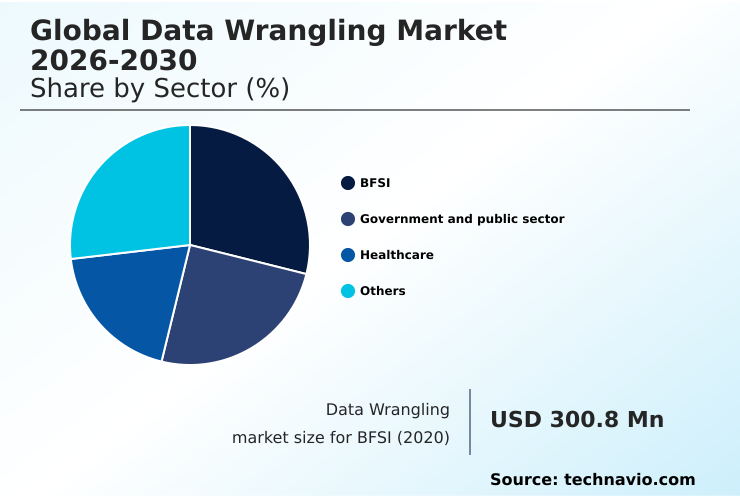
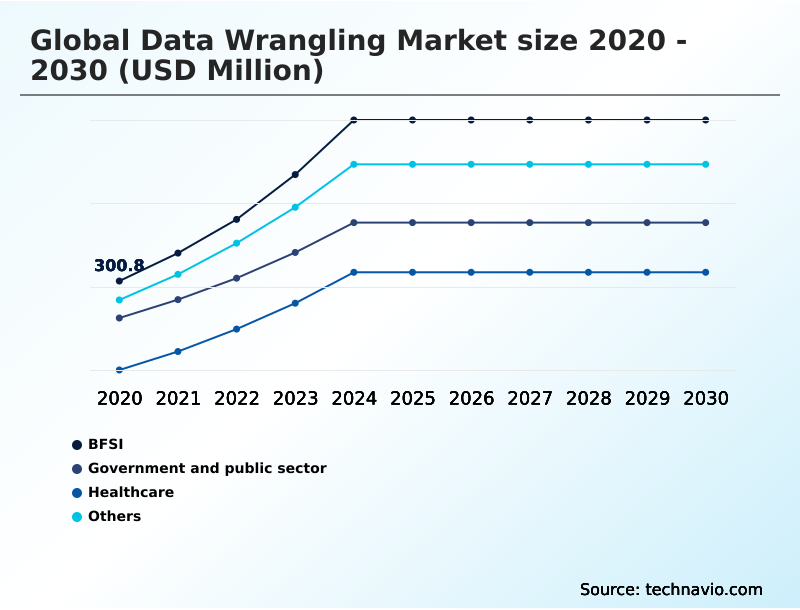
The BFSI segment was valued at USD 481.1 million in 2024 and showed a gradual increase during the forecast period.
Regional Analysis
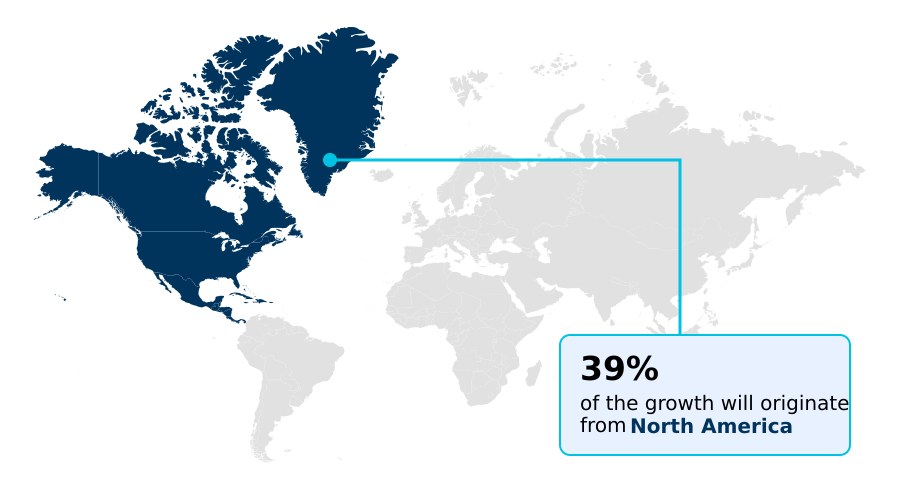
North America is estimated to contribute 39.2% to the growth of the global market during the forecast period.Technavio’s analysts have elaborately explained the regional trends and drivers that shape the market during the forecast period.
See How Data Wrangling Market Demand is Rising in North America Get Free Sample
The geographic landscape is characterized by distinct regional adoption patterns, with North America accounting for nearly 39% of the opportunity, driven by its mature analytics and AI ecosystems.
In contrast, the APAC market, representing over 24%, is fueled by rapid digitalization and investment in data infrastructure. Across regions, the emphasis is on ETL process automation and effective data harmonization to manage disparate data sources.
Advanced platforms offer data observability platforms and integrated data catalog integration to enhance transparency. The application of data wrangling for analytics and specialized data preparation for ML is universal, with organizations reporting up to a 20% improvement in model accuracy.
In sectors like finance and healthcare, tools for financial data reconciliation and healthcare data anonymization are critical, while IoT data aggregation and log file analysis are key for industrial applications, all of which benefit from automated schema detection and operational data wrangling linked to customer data platform integration.
Market Dynamics
Our researchers analyzed the data with 2025 as the base year, along with the key drivers, trends, and challenges. A holistic analysis of drivers will help companies refine their marketing strategies to gain a competitive advantage.
- Strategic adoption hinges on understanding how to leverage specific capabilities to solve core business problems. The focus on automating data preparation for machine learning is no longer a niche but a central tenet of competitive AI development. This requires improving data quality for business intelligence, a foundational step that impacts all downstream analytics.
- The rise of real-time data wrangling for streaming analytics addresses the need for immediate insights in dynamic environments. Simultaneously, enabling self-service data preparation for business analysts is critical for scaling data culture and agility. When evaluating solutions, enterprise data wrangling platform selection criteria must be robust, considering factors beyond features to include governance and scalability.
- The context of deployment, whether in data wrangling in cloud data warehouses or scaling data wrangling for big data, dictates architectural choices. Data lineage for regulatory compliance is a non-negotiable requirement in many industries, directly addressed by modern platforms. Navigating data wrangling challenges in hybrid environments remains a key focus for IT leaders.
- The ability to perform data wrangling for unstructured text data and data wrangling for IoT data streams unlocks value from new, high-volume sources. Mastering the best practices for data wrangling automation is essential for efficiency. This is particularly true for data wrangling tools for financial services and ensuring data wrangling for healthcare data interoperability.
- Securing sensitive data during wrangling and managing data wrangling in multi-cloud environments are critical governance tasks. Ultimately, the goal is optimizing ETL with modern data wrangling, supporting initiatives like data wrangling for customer data platforms, and enforcing data governance in self-service data wrangling.
- The benefits of AI in data wrangling are clear, with some systems demonstrating a 2x increase in data processing efficiency compared to traditional manual methods.
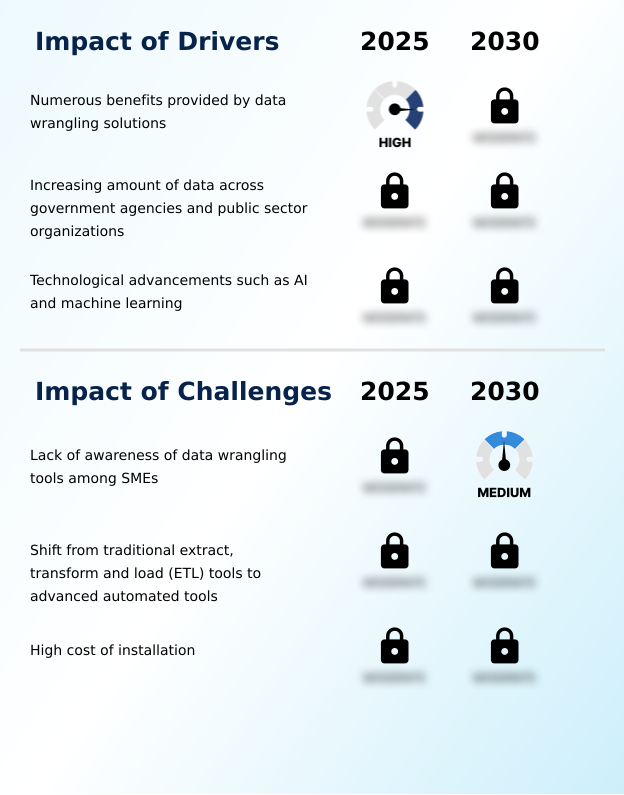
What are the key market drivers leading to the rise in the adoption of Data Wrangling Industry?
- The numerous benefits offered by data wrangling solutions, including enhanced data quality, faster preparation, and improved decision-making, are a key driver of market growth.
- The market's growth is fundamentally driven by the escalating volume and complexity of data, compelling organizations to adopt more sophisticated processing methods. The proliferation of unstructured data processing and semi-structured data handling requires advanced tools beyond traditional ETL.
- There is a pressing need for efficient data pipeline automation to manage both real-time data ingestion from streaming sources and large-scale batch data processing.
- Implementing strong data quality metrics and automated anomaly detection has become essential for maintaining trust in analytics. As organizations increasingly rely on data wrangling for BI and data preparation for AI, the quality of input data directly impacts business outcomes.
- Effective data ingestion automation, combined with continuous data quality monitoring and the development of a semantic data layer, improves decision-making speed by over 30%. This is further enhanced by knowledge graph integration, which adds critical context to raw data.
What are the market trends shaping the Data Wrangling Industry?
- The growing reliance on advanced technology within the healthcare sector represents a significant emerging market trend, driving the adoption of sophisticated data management and analytics solutions.
- A dominant trend is the infusion of automation and intelligence into data preparation workflows, fundamentally reshaping how organizations handle data. The adoption of AI-driven data preparation is accelerating, with platforms now capable of automating complex tasks like schema mapping and data validation, reducing manual effort by up to 60%.
- This shift toward low-code data transformation and interactive data exploration empowers a broader range of users. Effective data cleansing, data transformation, and data normalization are now augmented by intelligent data profiling, which automatically identifies inconsistencies. Consequently, organizations see a significant uplift in the reliability of their analytics, with some reporting a 15% improvement in predictive model accuracy.
- The emphasis on collaborative data preparation and scalable data processing, supported by robust data lineage tracking and data enrichment, ensures that data is not only clean but also contextualized and trusted across the enterprise.
What challenges does the Data Wrangling Industry face during its growth?
- A key challenge restraining market growth is the lack of awareness regarding data wrangling tools and their strategic benefits among small and medium-sized enterprises.
- A significant challenge is navigating the complexity of modern data ecosystems while ensuring governance and accessibility. As enterprises adopt data fabric architecture and data mesh principles, managing data integration workflows and metadata management becomes more distributed and intricate. The reliance on manual data wrangling scripts is inefficient and error-prone, creating bottlenecks that hinder agility.
- While the move toward self-service data preparation and no-code data preparation tools aims to empower users, it introduces risks without robust data governance frameworks. Organizations must implement consistent data standardization rules and use automated data profiling to maintain data integrity. The integration with cloud data warehouse and data lakehouse platforms requires sophisticated data parsing techniques to handle diverse formats.
- Adopting these modern architectures without a clear strategy can increase data chaos, with some firms reporting that data discovery times actually worsened by 10% before proper governance was established.
Exclusive Technavio Analysis on Customer Landscape
The data wrangling market forecasting report includes the adoption lifecycle of the market, covering from the innovator’s stage to the laggard’s stage. It focuses on adoption rates in different regions based on penetration. Furthermore, the data wrangling market report also includes key purchase criteria and drivers of price sensitivity to help companies evaluate and develop their market growth analysis strategies.
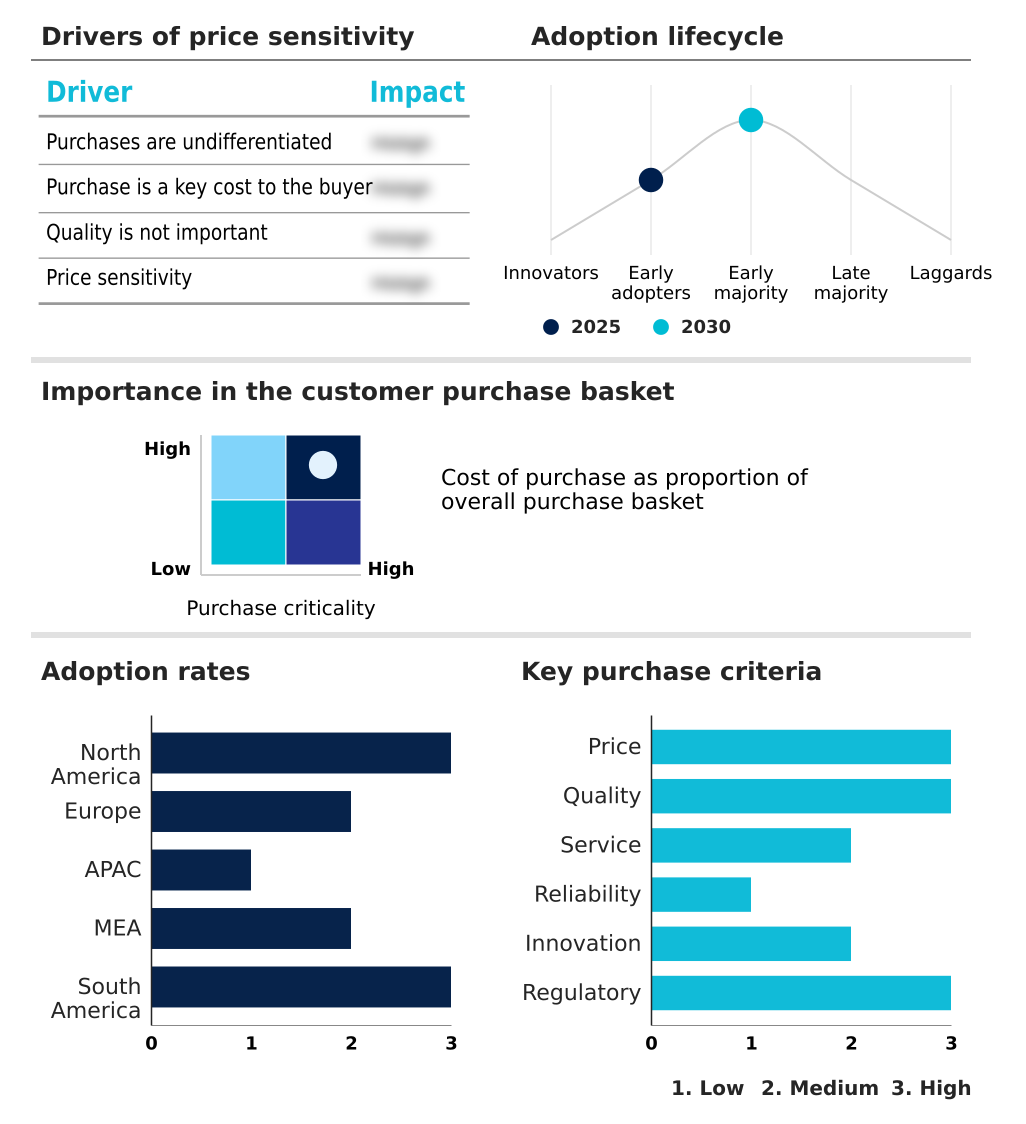
Customer Landscape of Data Wrangling Industry
Competitive Landscape
Companies are implementing various strategies, such as strategic alliances, data wrangling market forecast, partnerships, mergers and acquisitions, geographical expansion, and product/service launches, to enhance their presence in the industry.
Altair Engineering Inc. - Enterprise-grade platforms automate data preparation, enhance analytics workflows, and ensure data quality across complex IT environments.
The industry research and growth report includes detailed analyses of the competitive landscape of the market and information about key companies, including:
- Altair Engineering Inc.
- Dataiku Inc.
- DataRobot Inc.
- Dell Technologies Inc.
- eXalt Solutions Inc.
- Hitachi Ltd.
- IBM Corp.
- Ideata Analytics
- Impetus Technologies Inc.
- IRI Inc.
- Medallia Inc.
- Microsoft Corp.
- Oracle Corp.
- SAS Institute Inc.
- Teradata Corp.
- TIBCO Software Inc.
- Wipro Ltd.
- Zoho Corp. Pvt. Ltd.
Qualitative and quantitative analysis of companies has been conducted to help clients understand the wider business environment as well as the strengths and weaknesses of key industry players. Data is qualitatively analyzed to categorize companies as pure play, category-focused, industry-focused, and diversified; it is quantitatively analyzed to categorize companies as dominant, leading, strong, tentative, and weak.
Recent Development and News in Data wrangling market
- In November 2025, ZL Tech delivered its next-generation platform aimed at advancing unstructured data curation and governance for data wrangling, enabling organizations to process massive volumes of content for analytics and AI use cases.
- In July 2025, Informatica released new cloud-native data wrangling features as part of its Intelligent Data Management Cloud, emphasizing automation, governance, and integration across multi-cloud environments.
- In June 2025, Snowflake announced the launch of enhanced data preparation and transformation capabilities within its Snowflake AI Data Cloud, enabling automated data wrangling and improved readiness of enterprise data for analytics and AI workloads.
- In May 2025, Alteryx announced the launch of enhanced automated data preparation capabilities within its analytics platform, focusing on intelligent data profiling, anomaly detection, and scalable cloud execution.
Dive into Technavio’s robust research methodology, blending expert interviews, extensive data synthesis, and validated models for unparalleled Data Wrangling Market insights. See full methodology.
| Market Scope | |
|---|---|
| Page number | 289 |
| Base year | 2025 |
| Historic period | 2020-2024 |
| Forecast period | 2026-2030 |
| Growth momentum & CAGR | Accelerate at a CAGR of 15.7% |
| Market growth 2026-2030 | USD 1932.8 million |
| Market structure | Fragmented |
| YoY growth 2025-2026(%) | 14.1% |
| Key countries | US, Canada, Mexico, UK, Germany, France, The Netherlands, Italy, Spain, China, India, Japan, Australia, South Korea, Singapore, UAE, Saudi Arabia, South Africa, Israel, Qatar, Brazil, Argentina and Chile |
| Competitive landscape | Leading Companies, Market Positioning of Companies, Competitive Strategies, and Industry Risks |
Research Analyst Overview
- The data wrangling market is distinguished by its vital role in underpinning enterprise data strategies, where the focus has shifted from mere data collection to achieving enterprise data readiness. Boardroom decisions on digital transformation are increasingly tied to the organization's ability to execute efficient data pipeline automation and maintain stringent data governance frameworks.
- This involves a comprehensive approach covering data cleansing, transformation, and validation, alongside sophisticated unstructured data processing and semi-structured data handling. The integration of data lineage tracking and metadata management is now a standard expectation for compliance. Platforms are evolving to offer advanced real-time data ingestion and scalable batch data processing, enhanced by anomaly detection and robust data quality metrics.
- The push toward self-service data preparation is balanced by the need for automated data profiling and consistent data standardization rules. As firms adopt cloud-native data wrangling for hybrid data environments, ensuring data consistency checks, data security in wrangling, and data privacy compliance becomes critical.
- This disciplined approach, which includes data harmonization and ETL process automation, has enabled organizations to achieve over a 30% reduction in data preparation time, accelerating data wrangling for analytics and data preparation for ML. Success now depends on mastering data parsing techniques, data integration workflows, automated schema detection, and integrating with data observability platforms and the data catalog integration.
What are the Key Data Covered in this Data Wrangling Market Research and Growth Report?
-
What is the expected growth of the Data Wrangling Market between 2026 and 2030?
-
USD 1.93 billion, at a CAGR of 15.7%
-
-
What segmentation does the market report cover?
-
The report is segmented by Sector (BFSI, Government and public sector, Healthcare, and Others), Deployment (Cloud, and On-premises), End-user (Large enterprises, and Small and medium-sized enterprises) and Geography (North America, Europe, APAC, Middle East and Africa, South America)
-
-
Which regions are analyzed in the report?
-
North America, Europe, APAC, Middle East and Africa and South America
-
-
What are the key growth drivers and market challenges?
-
Numerous benefits provided by data wrangling solutions, Lack of awareness of data wrangling tools among SMEs
-
-
Who are the major players in the Data Wrangling Market?
-
Altair Engineering Inc., Dataiku Inc., DataRobot Inc., Dell Technologies Inc., eXalt Solutions Inc., Hitachi Ltd., IBM Corp., Ideata Analytics, Impetus Technologies Inc., IRI Inc., Medallia Inc., Microsoft Corp., Oracle Corp., SAS Institute Inc., Teradata Corp., TIBCO Software Inc., Wipro Ltd. and Zoho Corp. Pvt. Ltd.
-
Market Research Insights
- The market's momentum is driven by the adoption of intelligent, automated platforms that deliver measurable business outcomes. Organizations implementing AI-driven data preparation report improvements in data-to-insight cycle times by as much as 40%, a critical advantage in competitive industries.
- The use of low-code data transformation and collaborative data preparation tools fosters greater data democratization, empowering business users to engage directly with data. This shift is substantiated by a 25% increase in productivity for analytics teams that adopt such self-service models. Furthermore, integrating data wrangling for BI directly into workflows enhances the reliability of reports and dashboards.
- In regulated sectors, the focus on data quality monitoring and building a semantic data layer reduces compliance reporting errors by up to 30%, mitigating significant financial and reputational risks.
We can help! Our analysts can customize this data wrangling market research report to meet your requirements.
 RIA -
RIA - 
