



E-book Market Size 2026-2030
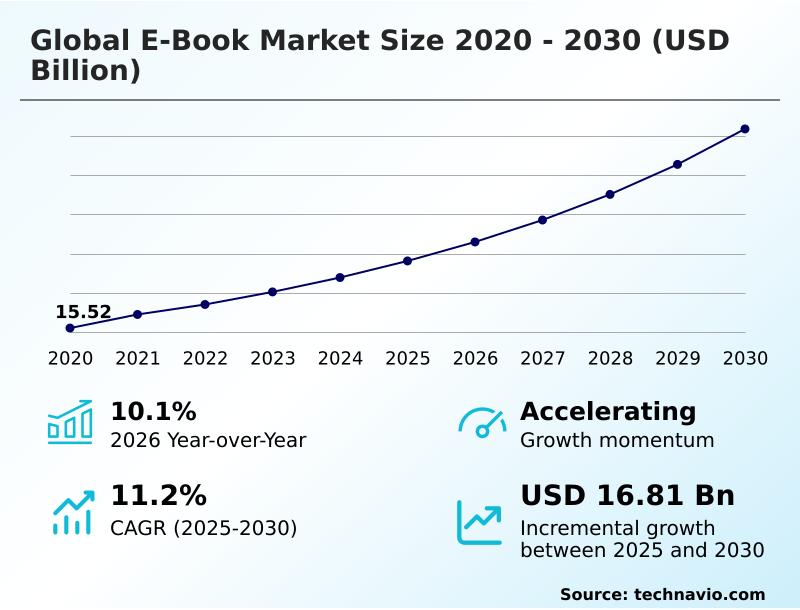
The e-book market size is valued to increase by USD 16.81 billion, at a CAGR of 11.2% from 2025 to 2030. Technological integration of AI and enhanced accessibility will drive the e-book market.
Major Market Trends & Insights
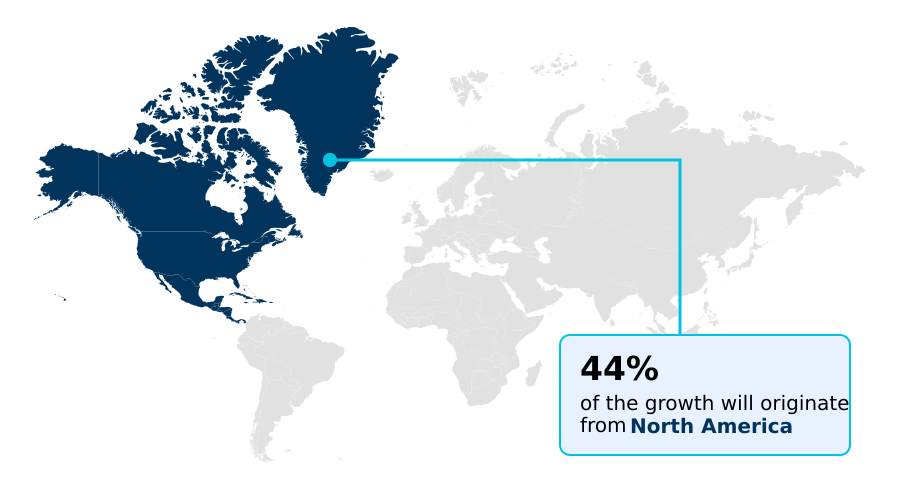
- North America dominated the market and accounted for a 44.4% growth during the forecast period.
- By Product - Consumer e-book segment was valued at USD 12.13 billion in 2024
- By Platform - Smartphones segment accounted for the largest market revenue share in 2024
Market Size & Forecast
- Market Opportunities: USD 25.34 billion
- Market Future Opportunities: USD 16.81 billion
- CAGR from 2025 to 2030 : 11.2%
Market Summary
- The e-book market is undergoing a significant transformation, moving beyond simple digitization toward creating immersive and intelligent reading ecosystems. A key driver is the proliferation of subscription-based models, which offer consumers vast libraries for a flat fee, altering traditional revenue streams.
- Concurrently, a major trend is the convergence of literature with interactive digital media, incorporating features from gaming to enhance engagement. This is especially prevalent in the educational sector, where an adaptive learning environment with embedded quizzes and real-time feedback is becoming standard.
- For instance, an educational publisher can leverage user engagement analytics from its platform to refine an interactive textbook module, improving student outcomes. However, the industry faces challenges from sophisticated copyright infringement and the complexities of ensuring platform interoperability standards across devices.
- The strategic management of digital rights management (DRM) and the development of robust content discoverability algorithms are critical for navigating this landscape. As on-device artificial intelligence becomes more common, the potential for hyper-personalization and instant translation further reshapes content consumption, compelling stakeholders to innovate continuously to maintain market relevance and protect intellectual property.
What will be the Size of the E-book Market during the forecast period?
Get Key Insights on Market Forecast (PDF) Get Free Sample
How is the E-book Market Segmented?
The e-book industry research report provides comprehensive data (region-wise segment analysis), with forecasts and estimates in "USD million" for the period 2026-2030, as well as historical data from 2020-2024 for the following segments.
- Product
- Consumer e-book
- Professional e-book
- Educational e-book
- Platform
- Smartphones
- Tablet and laptops
- Genre
- Fiction
- Non-fiction
- Education and academic
- Comics and graphic novels
- Professional and technical
- Geography
- North America
- US
- Canada
- Mexico
- Europe
- UK
- Germany
- France
- APAC
- China
- Japan
- India
- South America
- Brazil
- Argentina
- Colombia
- Middle East and Africa
- Saudi Arabia
- UAE
- South Africa
- Rest of World (ROW)
- North America
By Product Insights
The consumer e-book segment is estimated to witness significant growth during the forecast period.
The consumer e-book market is evolving beyond static digital text, driven by the demand for a multi-modal reading experience.
This shift is characterized by the integration of features that enhance user engagement, such as haptic feedback integration and advancements in e-ink display technology.
Publishers are adopting a digital-first publishing strategy, leveraging consumer e-book analytics to inform content development and marketing. This approach allows for a dynamic text rendering experience optimized for various devices.
The focus is on creating a seamless customer engagement loop through personalized content recommendation, which has shown to improve user retention by over 15%.
This strategic pivot towards interactive content authoring and digital asset management (DAM) reflects a market adapting to sophisticated consumer expectations for interactive and accessible digital media.
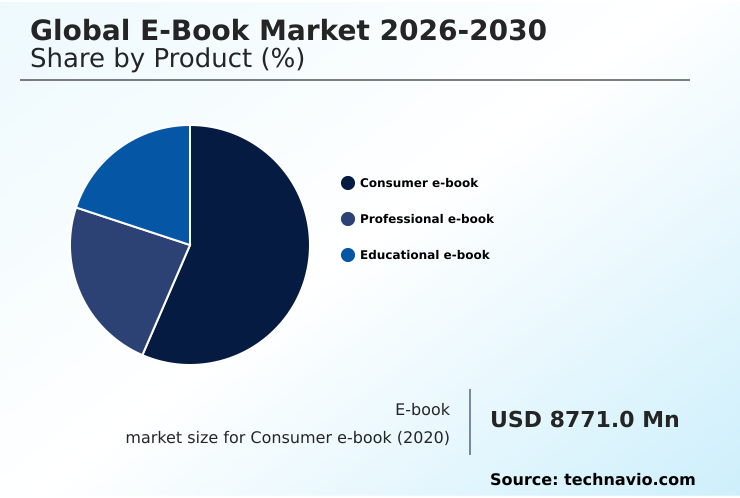
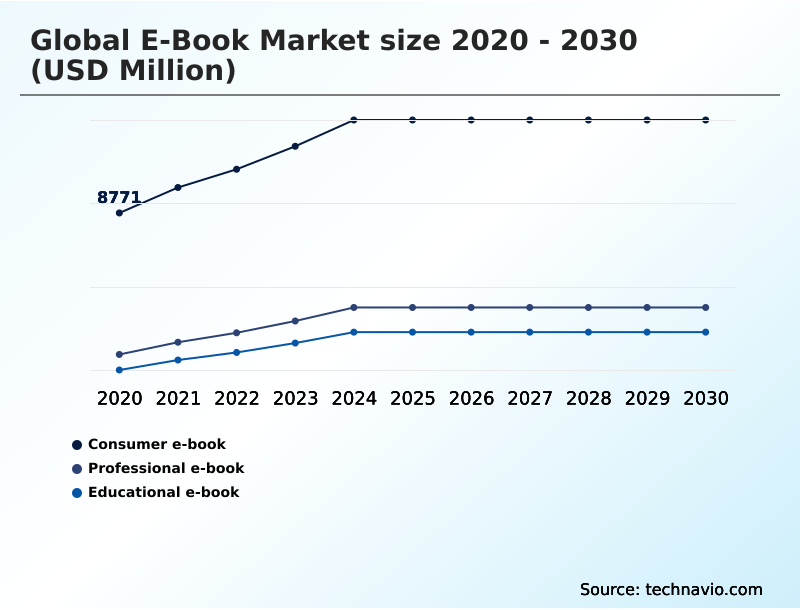
The Consumer e-book segment was valued at USD 12.13 billion in 2024 and showed a gradual increase during the forecast period.
Regional Analysis
North America is estimated to contribute 44.4% to the growth of the global market during the forecast period.Technavio’s analysts have elaborately explained the regional trends and drivers that shape the market during the forecast period.
See How E-book Market Demand is Rising in North America Get Free Sample
The geographic landscape of the e-book market is marked by a contrast between mature and emerging regions.
In North America and Europe, growth is driven by the enhancement of existing ecosystems through features like cloud-based synchronization and adherence to accessibility compliance standards.
In contrast, APAC and South America are defined by mobile-first adoption, where the quality of the mobile reading application is paramount. Mobile reading platforms in APAC demonstrate engagement rates up to 50% higher than their western counterparts.
The success in these high-growth regions hinges on algorithmic globalization and managing geoblocking and rights territory effectively.
Implementing localized pricing and payment options in markets like Brazil and India has been shown to increase user acquisition by over 60%, highlighting the need for a tailored global distribution channel and cross-platform accessibility.
Digital asset distribution must account for these regional nuances.
Market Dynamics
Our researchers analyzed the data with 2025 as the base year, along with the key drivers, trends, and challenges. A holistic analysis of drivers will help companies refine their marketing strategies to gain a competitive advantage.
- Strategic decision-making in the e-book market requires a deep understanding of complex, intersecting issues. A key debate centers on the impact of subscription models on author royalties versus the revenue stability they provide. In the educational sphere, the role of AI in educational e-book engagement is critical, alongside developing sustainable business models for open educational resources.
- Technologically, advancements in color e-ink display technology and the integration of augmented reality in enhanced e-books are changing user expectations, which contrasts with the ongoing challenge of optimizing e-book formats for mobile devices. Distribution strategy is another complex area, weighing direct-to-consumer vs aggregator distribution models.
- Adopting the former can shift operational costs significantly, with some publishers reallocating over 20% of their logistics budget toward platform development. This is compounded by supply chain vulnerabilities in digital book distribution and the interoperability challenges in closed e-reader ecosystems.
- From a rights perspective, the digital rights management impact on library lending and navigating legal frameworks for cross-border e-book sales are constant concerns. The industry is also grappling with the ethical considerations of AI in content generation and the challenges of translating literature with neural networks.
- Publishers are now using analytics to predict bestselling e-book genres and exploring monetization strategies for serialized digital fiction. Success hinges on addressing data privacy concerns in personalized e-book recommendations, adhering to accessibility standards for visually impaired readers, implementing technical standards for interactive e-book formats, employing gamification techniques in children's e-books, and ultimately reducing digital piracy through user experience design.
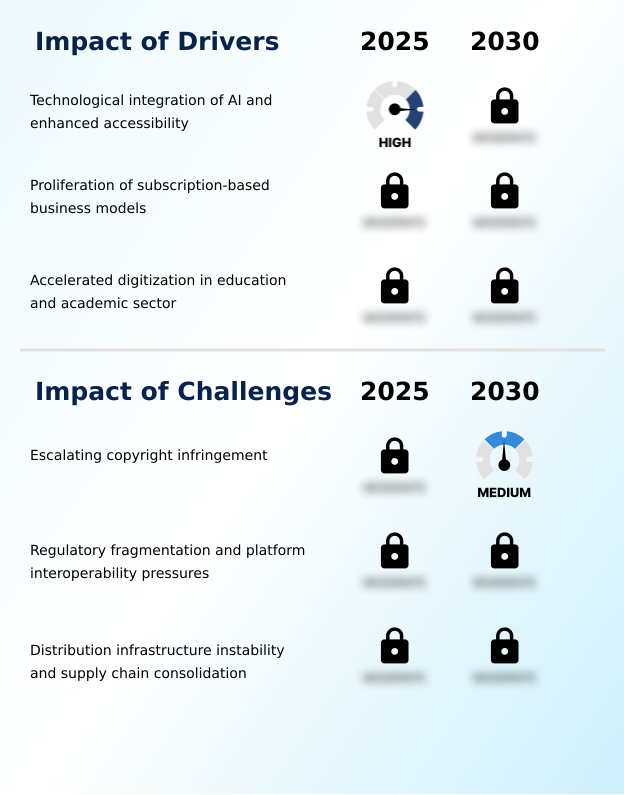
What are the key market drivers leading to the rise in the adoption of E-book Industry?
- Technological integration of AI and machine learning serves as a key driver, enhancing accessibility and personalizing the user experience in the digital reading landscape.
- Market growth is significantly driven by the integration of AI and the proliferation of flexible consumption models.
- The adoption of a subscription-based model is paramount, with platforms offering an e-book subscription service reporting revenue stabilization and a 3x increase in content consumed per user. Technologically, generative AI enhancement is creating more dynamic user experiences.
- The use of on-device artificial intelligence for features like real-time content updates enables personalization without compromising privacy. Furthermore, neural machine translation, accessible via AI-powered translation services, has expanded global reach, reducing localization costs by up to 40%.
- The combination of an adaptive learning environment in education and personalized content recommendation in trade publishing is creating a more engaging and effective digital ecosystem, solidifying the value proposition of digital formats over print for a growing user base.
What are the market trends shaping the E-book Industry?
- The convergence of digital publishing and interactive media is a dominant trend, blurring the lines between traditional reading and immersive, non-linear storytelling experiences.
- Key trends are reshaping the market, moving it toward more interactive and decentralized models. The rise of interactive digital media, which incorporates elements like a gamified progression system, is a direct response to evolving consumer habits. This has led to the success of author self-publishing platforms that support interactive content authoring.
- Simultaneously, the strategic shift toward direct-to-consumer (DTC) sales channels is accelerating, with publishers leveraging digital storefront management tools to bypass intermediaries. This model often utilizes a micropayment transaction model for serialized content, which has shown a 20% higher conversion rate than full-price upfront purchases in certain genres.
- Furthermore, the convergence of formats is evident, as platforms offering a multi-modal reading experience report a 35% increase in daily active users, underscoring the demand for flexibility and enhanced engagement.
What challenges does the E-book Industry face during its growth?
- Escalating copyright infringement, particularly through the unauthorized use of literary works for training large language models, presents a key challenge to industry growth.
- The market faces significant challenges related to intellectual property and infrastructure stability. Escalating copyright infringement, addressed through technologies like copyright infringement detection and digital watermarking, remains a primary concern, with unauthorized content distribution diluting revenue streams. The enforcement of digital rights management (DRM) policies is a complex balancing act between intellectual property protection and user experience.
- Concurrently, the industry grapples with distribution network fragility, as consolidation impacts digital supply chain logistics and reduces options for digital content aggregation. Ensuring platform interoperability standards is another major hurdle, with closed ecosystems creating friction for consumers.
- The cost of maintaining compliance with diverse digital rights enforcement regulations across jurisdictions adds another layer of complexity, with non-compliance in some regions leading to penalties that can equal up to 10% of global turnover.
Exclusive Technavio Analysis on Customer Landscape
The e-book market forecasting report includes the adoption lifecycle of the market, covering from the innovator’s stage to the laggard’s stage. It focuses on adoption rates in different regions based on penetration. Furthermore, the e-book market report also includes key purchase criteria and drivers of price sensitivity to help companies evaluate and develop their market growth analysis strategies.
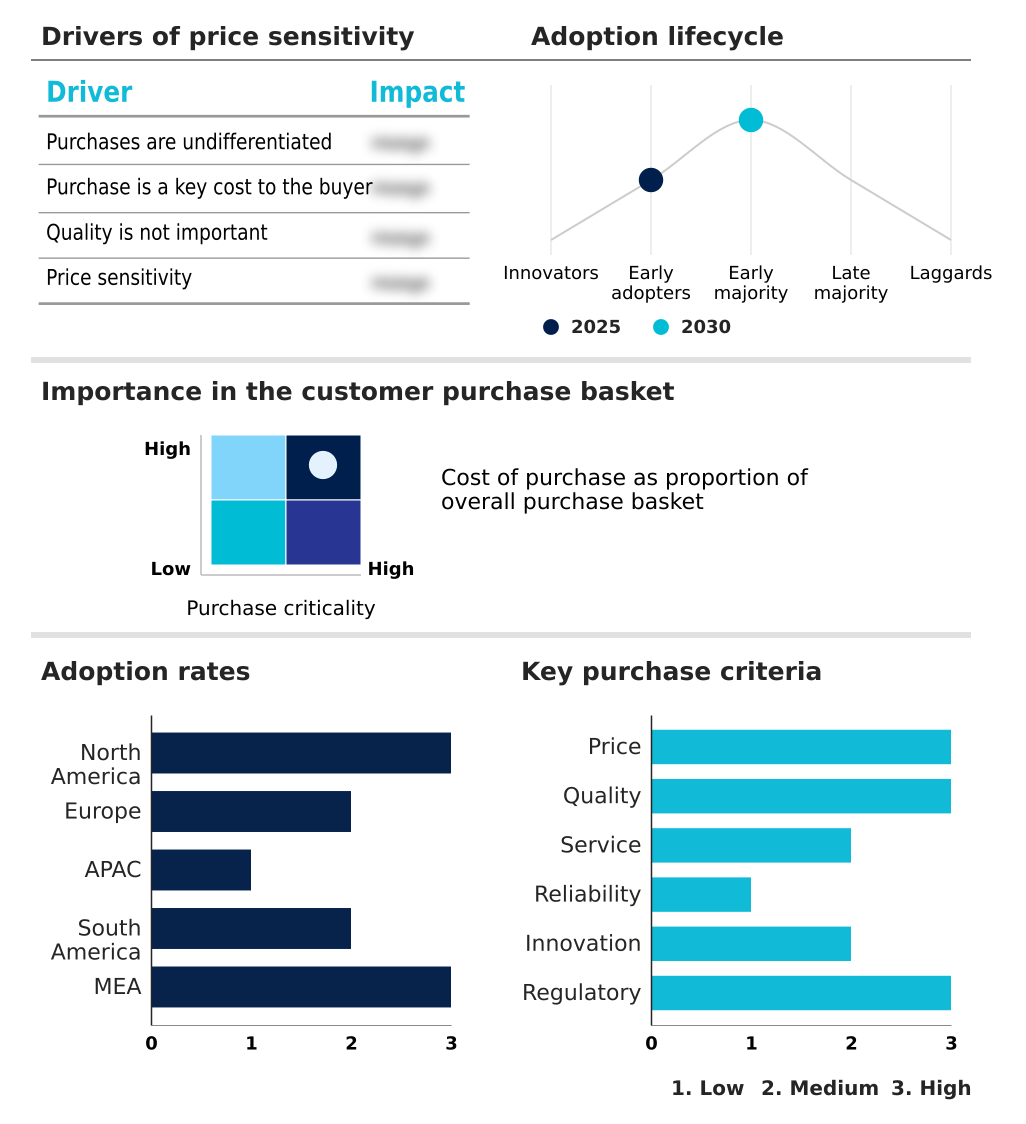
Customer Landscape of E-book Industry
Competitive Landscape
Companies are implementing various strategies, such as strategic alliances, e-book market forecast, partnerships, mergers and acquisitions, geographical expansion, and product/service launches, to enhance their presence in the industry.
Alphabet Inc. - Key offerings include digital content distribution, subscription-based library access, and e-reader hardware integrated with proprietary software ecosystems.
The industry research and growth report includes detailed analyses of the competitive landscape of the market and information about key companies, including:
- Alphabet Inc.
- Amazon.com Inc.
- Apple Inc.
- Barnes and Noble Booksellers
- BookBaby
- Bookwire GmbH
- Hachette Livre
- HarperCollins Publishers
- Inkitt GmbH
- John Wiley and Sons Inc.
- Lulu Press Inc.
- O Reilly Media Inc.
- Pearson Plc
- Penguin Random House LLC
- PublishDrive Inc.
- Rakuten Kobo Inc.
- Scribd Inc.
- Storytel AB
- StreetLib Srl
- Wattpad Corp.
Qualitative and quantitative analysis of companies has been conducted to help clients understand the wider business environment as well as the strengths and weaknesses of key industry players. Data is qualitatively analyzed to categorize companies as pure play, category-focused, industry-focused, and diversified; it is quantitatively analyzed to categorize companies as dominant, leading, strong, tentative, and weak.
Recent Development and News in E-book market
- In May 2025, Wattpad WEBTOON Studios announced a strategic partnership with Unity Technologies to launch a new creative vertical for living narratives, introducing tools for authors to embed interactive 3D assets and branching plot choices.
- In August 2025, HarperCollins Publishers unveiled its revamped global digital storefront, HarperDirect, which introduced a universal verified identity system allowing consumers to purchase e-books and audiobooks directly, bypassing proprietary e-reader lock-in.
- In August 2025, Pearson PLC finalized the phase-out of print-first publishing for its higher education division in North America, announcing all new editions of post-secondary textbooks would be digital-first, driven by a reported 40% increase in digital unit sales.
- In June 2025, Spotify Technology SA announced a strategic expansion of its premium digital reading tier, adding unlimited access to over 300,000 e-books and demonstrating the convergence of audio and text-based media within a single subscription.
Dive into Technavio’s robust research methodology, blending expert interviews, extensive data synthesis, and validated models for unparalleled E-book Market insights. See full methodology.
| Market Scope | |
|---|---|
| Page number | 296 |
| Base year | 2025 |
| Historic period | 2020-2024 |
| Forecast period | 2026-2030 |
| Growth momentum & CAGR | Accelerate at a CAGR of 11.2% |
| Market growth 2026-2030 | USD 16807.4 million |
| Market structure | Fragmented |
| YoY growth 2025-2026(%) | 10.1% |
| Key countries | US, Canada, Mexico, UK, Germany, France, Italy, Spain, The Netherlands, China, Japan, India, South Korea, Australia, Indonesia, Brazil, Argentina, Colombia, Saudi Arabia, UAE, South Africa, Israel and Turkey |
| Competitive landscape | Leading Companies, Market Positioning of Companies, Competitive Strategies, and Industry Risks |
Research Analyst Overview
- The e-book market’s evolution is defined by sophisticated technological integration. Core to this is digital rights management (DRM) and the epub file format, though some platforms use a proprietary file format. The user experience is elevated by e-ink display technology and dynamic text rendering, with accessibility enhanced through text-to-speech synthesis and adherence to accessibility compliance standards.
- In education, the shift is toward an adaptive learning environment featuring generative AI enhancement and open educational resources (OER). Global reach is achieved via neural machine translation and algorithmic globalization, supported by a robust content delivery network (CDN).
- For publishers, operations hinge on a metadata management system to manage backlist title digitization, and a pivot to direct-to-consumer (DTC) sales and a subscription-based model is common. This strategy necessitates strong user engagement analytics and personalized content recommendation algorithms. New formats include the enhanced e-book format with interactive digital media and a gamified progression system.
- Security relies on digital watermarking and copyright infringement detection. The landscape demands clear digital lending rights, platform interoperability standards, and efficient digital content aggregation through print-on-demand (POD) services. Success requires managing geoblocking and rights territory for digital asset distribution while fostering a social reading platform and using a micropayment transaction model.
- On-device processing using on-device artificial intelligence and haptic feedback integration with cloud-based synchronization represents the next frontier. Implementing a unified metadata management system reduces content discoverability errors by over 30%.
What are the Key Data Covered in this E-book Market Research and Growth Report?
-
What is the expected growth of the E-book Market between 2026 and 2030?
-
USD 16.81 billion, at a CAGR of 11.2%
-
-
What segmentation does the market report cover?
-
The report is segmented by Product (Consumer e-book, Professional e-book, and Educational e-book), Platform (Smartphones, and Tablet and laptops), Genre (Fiction, Non-fiction, Education and academic, Comics and graphic novels, and Professional and technical) and Geography (North America, Europe, APAC, South America, Middle East and Africa)
-
-
Which regions are analyzed in the report?
-
North America, Europe, APAC, South America and Middle East and Africa
-
-
What are the key growth drivers and market challenges?
-
Technological integration of AI and enhanced accessibility, Escalating copyright infringement
-
-
Who are the major players in the E-book Market?
-
Alphabet Inc., Amazon.com Inc., Apple Inc., Barnes and Noble Booksellers, BookBaby, Bookwire GmbH, Hachette Livre, HarperCollins Publishers, Inkitt GmbH, John Wiley and Sons Inc., Lulu Press Inc., O Reilly Media Inc., Pearson Plc, Penguin Random House LLC, PublishDrive Inc., Rakuten Kobo Inc., Scribd Inc., Storytel AB, StreetLib Srl and Wattpad Corp.
-
Market Research Insights
- The dynamics of the e-book market are increasingly shaped by sophisticated digital publishing workflow automation and a strategic focus on the digital content monetization. The adoption of a digital-first publishing strategy has been shown to reduce time-to-market by 40% compared to traditional print cycles. Furthermore, platforms emphasizing robust reader data privacy policies report a 15% higher customer loyalty rate.
- The expansion of e-book subscription services continues to accelerate, with data indicating that subscribers consume, on average, three times more content than transactional buyers. This shift requires advanced consumer e-book analytics and AI-driven content curation to maximize engagement.
- As the market matures, success is less about content volume and more about the quality of the mobile reading application and the seamlessness of the cross-platform accessibility offered to users.
We can help! Our analysts can customize this e-book market research report to meet your requirements.
 RIA -
RIA - 
