



E-gates Market Size 2026-2030
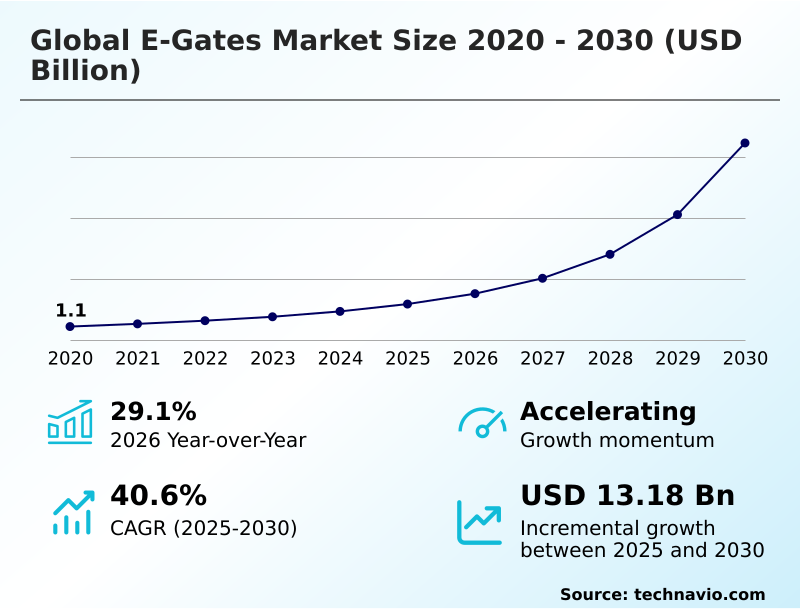
The e-gates market size is valued to increase by USD 13.18 billion, at a CAGR of 40.6% from 2025 to 2030. Reduced airport operating expenses will drive the e-gates market.
Major Market Trends & Insights
- Europe dominated the market and accounted for a 38.5% growth during the forecast period.
- By Type - Hardware segment was valued at USD 1.66 billion in 2024
- By Application - Airport segment accounted for the largest market revenue share in 2024
Market Size & Forecast
- Market Opportunities: USD 15.02 billion
- Market Future Opportunities: USD 13.18 billion
- CAGR from 2025 to 2030 : 40.6%
Market Summary
- The e-gates market is rapidly transforming border security and passenger management by leveraging automated immigration systems to enhance both efficiency and safety. At its core, the industry is driven by the need to reduce airport operational expenses and accelerate passenger processing times, replacing time-consuming manual checks with sophisticated biometric verification technologies.
- A significant trend is the increasing reliance on facial recognition technology, iris recognition, and fingerprint scanning to create a seamless passenger journey. For instance, a major international airport operator can deploy an end-to-end biometric identity management system, allowing travelers to use their biometrics as a biometric single token from check-in to boarding.
- This not only streamlines passenger flow management but also enables security personnel to be reallocated from routine identity verification to higher-value threat analysis and passenger screening. However, the market is not without challenges; ensuring the security of biometric data management and overcoming interoperability issues between disparate hardware and software components remain critical hurdles for sustained growth.
What will be the Size of the E-gates Market during the forecast period?
Get Key Insights on Market Forecast (PDF) Get Free Sample
How is the E-gates Market Segmented?
The e-gates industry research report provides comprehensive data (region-wise segment analysis), with forecasts and estimates in "USD million" for the period 2026-2030, as well as historical data from 2020-2024 for the following segments.
- Type
- Hardware
- Software
- Service
- Application
- Airport
- Government
- Product type
- Automated e-gates
- Traditional e-gates
- Geography
- Europe
- Germany
- UK
- France
- North America
- US
- Canada
- Mexico
- APAC
- China
- Japan
- India
- Middle East and Africa
- Saudi Arabia
- UAE
- South Africa
- South America
- Brazil
- Argentina
- Rest of World (ROW)
- Europe
By Type Insights
The hardware segment is estimated to witness significant growth during the forecast period.
The hardware segment is foundational to the Global E-Gates Market 2026-2030, encompassing the physical components that enable automated passenger processing.
This includes biometric hardware such as cameras for facial recognition technology, specialized scanners for fingerprint scanning and iris recognition, and the automated gate systems themselves.
Reliability is paramount, as this equipment must function flawlessly to support passenger flow management and queue management systems.
The high cost of these durable components, which use radio-frequency identification and must be resistant to security breaches, is justified by performance gains.
Advanced hardware, a key part of traveler identity management, improves identity verification accuracy by over 99.5%, forming the backbone of secure and efficient automated border crossing infrastructure worldwide.
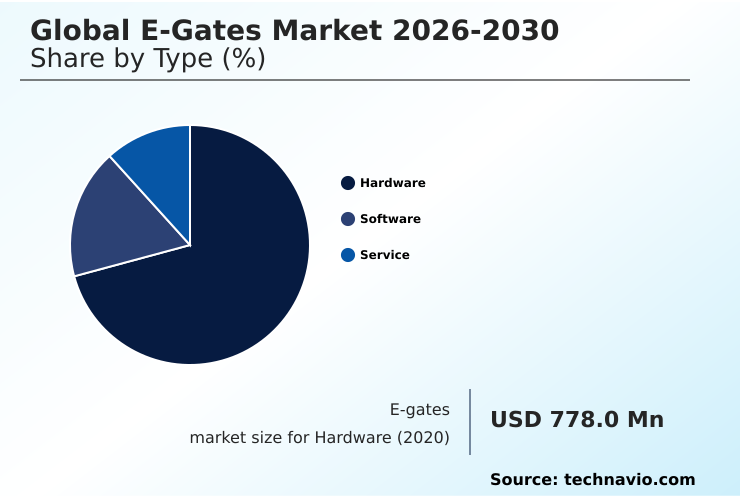
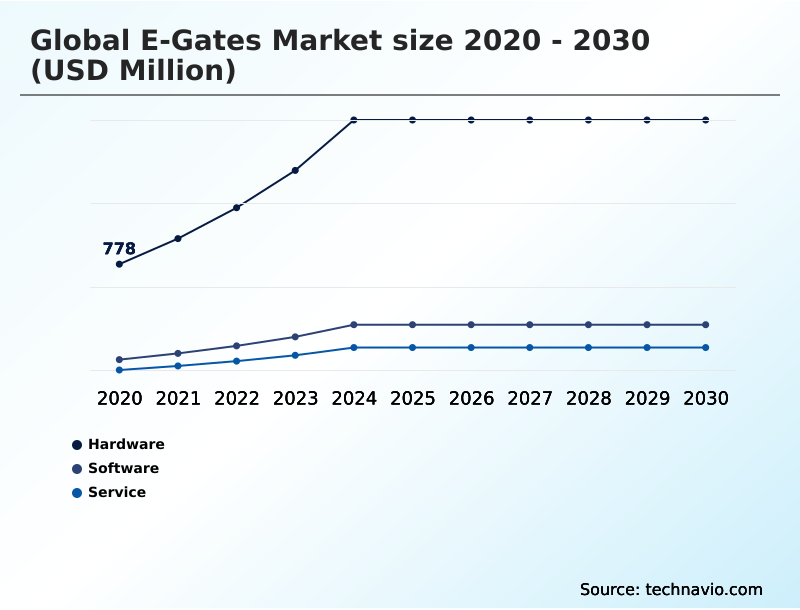
The Hardware segment was valued at USD 1.66 billion in 2024 and showed a gradual increase during the forecast period.
Regional Analysis
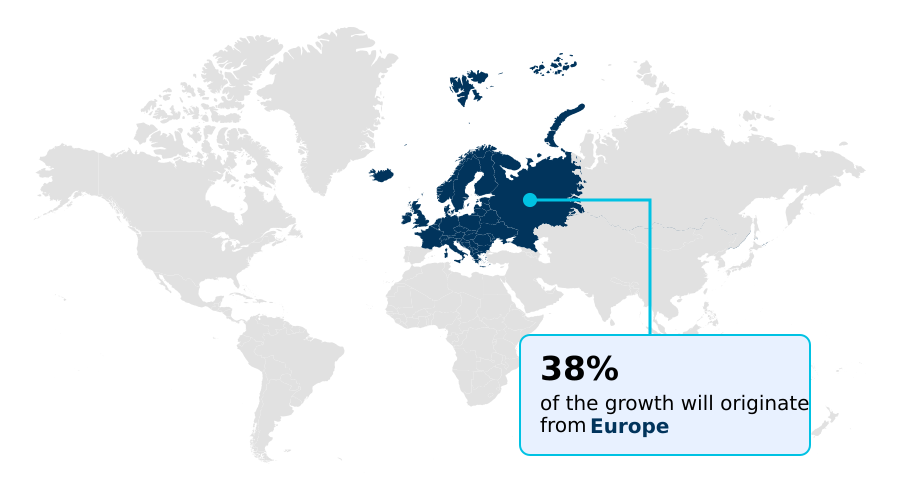
Europe is estimated to contribute 38.5% to the growth of the global market during the forecast period.Technavio’s analysts have elaborately explained the regional trends and drivers that shape the market during the forecast period.
See How E-gates Market Demand is Rising in Europe Get Free Sample
The geographic landscape is characterized by diverse adoption rates, with Europe leading in incremental growth, contributing 38.5% of the market's expansion.
This is driven by large-scale initiatives like the EU's Entry/Exit System, which mandates biometric entry-exit systems and the adoption of the digital travel credential. In contrast, the APAC region is notable for its rapid technological modernization.
For instance, Singapore's passport-less clearance system, a pinnacle of self-service border control, has reduced processing times by approximately 40%.
These regional deployments showcase the global move from physical document checks to fully digital identity assurance platforms and liveness detection technologies, setting new standards for international travel and security.
Market Dynamics
Our researchers analyzed the data with 2025 as the base year, along with the key drivers, trends, and challenges. A holistic analysis of drivers will help companies refine their marketing strategies to gain a competitive advantage.
- The successful implementation of e-gate systems extends beyond hardware installation, demanding a strategic approach to technology integration and operational design. A critical factor is the cost-benefit analysis of airport e-gates, where the initial ROI of automated gate installation must be weighed against long-term maintenance and upgrade costs.
- For instance, a key consideration is the comparison of facial recognition vs iris scanning accuracy, as the chosen modality affects both user experience and security robustness. A major operational hurdle involves the challenges in upgrading legacy e-gate systems to be compatible with new interoperability standards and security protocols.
- Moreover, the integration of biometrics with security databases is a complex task, requiring seamless data exchange to prevent vulnerabilities in automated border control. The ultimate goal is to achieve biometric single token travel implementation, where a passenger's identity is verified once and then used across all airport touchpoints.
- This approach has a significant impact of e-gates on passenger flow, with airports deploying such systems reporting operational staff reallocations that are three times more effective than those relying on manual checks alone. Navigating e-gate compliance with data privacy regulations and understanding the future of biometric border management are crucial for long-term success and preventing spoofing attacks on e-gates.
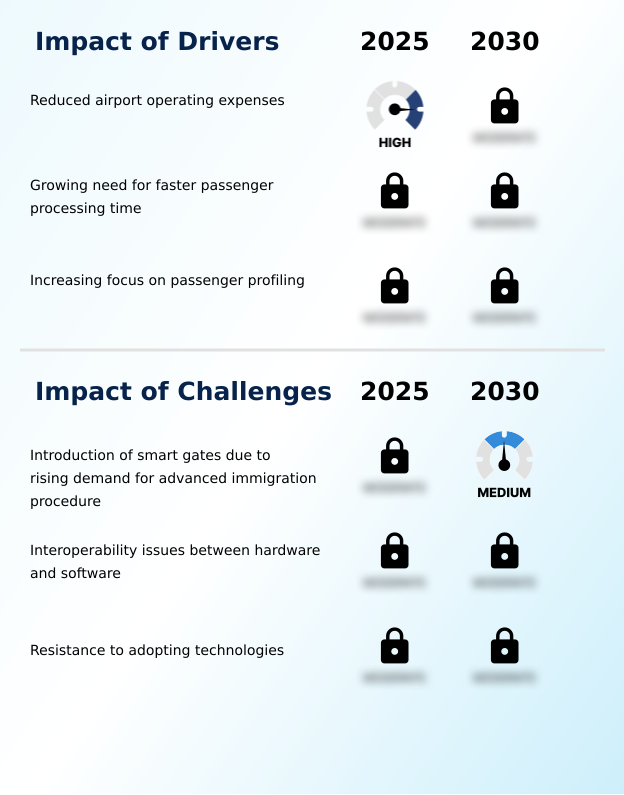
What are the key market drivers leading to the rise in the adoption of E-gates Industry?
- The reduction of airport operating expenses is a key driver for the market's growth.
- The primary driver for market expansion is the compelling financial and operational case for automated border control.
- The deployment of automated gate systems delivers substantial cost savings, with analyses showing that a single e-gate can supplant the need for up to six manual inspection officers.
- This allows for strategic reallocation of personnel to more complex security tasks, optimizing workforce efficiency. For passengers, this translates to faster passenger processing and shorter queues, a key component of biometric-enabled self-service.
- The passport control automation offered by these systems increases passenger throughput by over 25% during peak hours, directly improving airport operational capacity and traveler satisfaction through enhanced biometric single token travel.
What are the market trends shaping the E-gates Industry?
- The growing demand for cost-efficient security solutions is emerging as a significant market trend. This is driven by the need to optimize security personnel allocation while enhancing passenger screening protocols.
- A key trend shaping the market is the pivot towards a completely contactless passenger journey, driven by demand for both hygiene and efficiency. The adoption of advanced facial recognition technology is central to this shift, with new systems performing identity verification in under two seconds. This enhances the seamless passenger journey and aligns with smart airport solutions.
- This evolution is not just about speed; it is about integration. Leading airports are now connecting e-gates with passenger profiling algorithms and broader security platforms, creating a unified security network. This integrated approach has proven to improve real-time threat detection capabilities by more than 20% compared to siloed legacy systems, establishing a new benchmark for border security technology.
What challenges does the E-gates Industry face during its growth?
- The introduction of smart gates, driven by the rising demand for advanced immigration procedures, presents a key challenge to the industry's growth.
- Despite strong growth drivers, the market faces significant challenges, primarily interoperability standards between hardware and software. A lack of cohesion between different vendors' biometric middleware and biometric software can lead to system failures, reducing processing efficiency by up to 20% during outages. Furthermore, ensuring robust biometric data security is a persistent hurdle.
- A single data breach could erode public trust in automated identity verification and the biometric data management processes. The emergence of next-generation smart gates, which promise even faster processing, also poses a competitive threat, while cultural resistance to technology replacing human interaction hinders adoption in certain key markets.
Exclusive Technavio Analysis on Customer Landscape
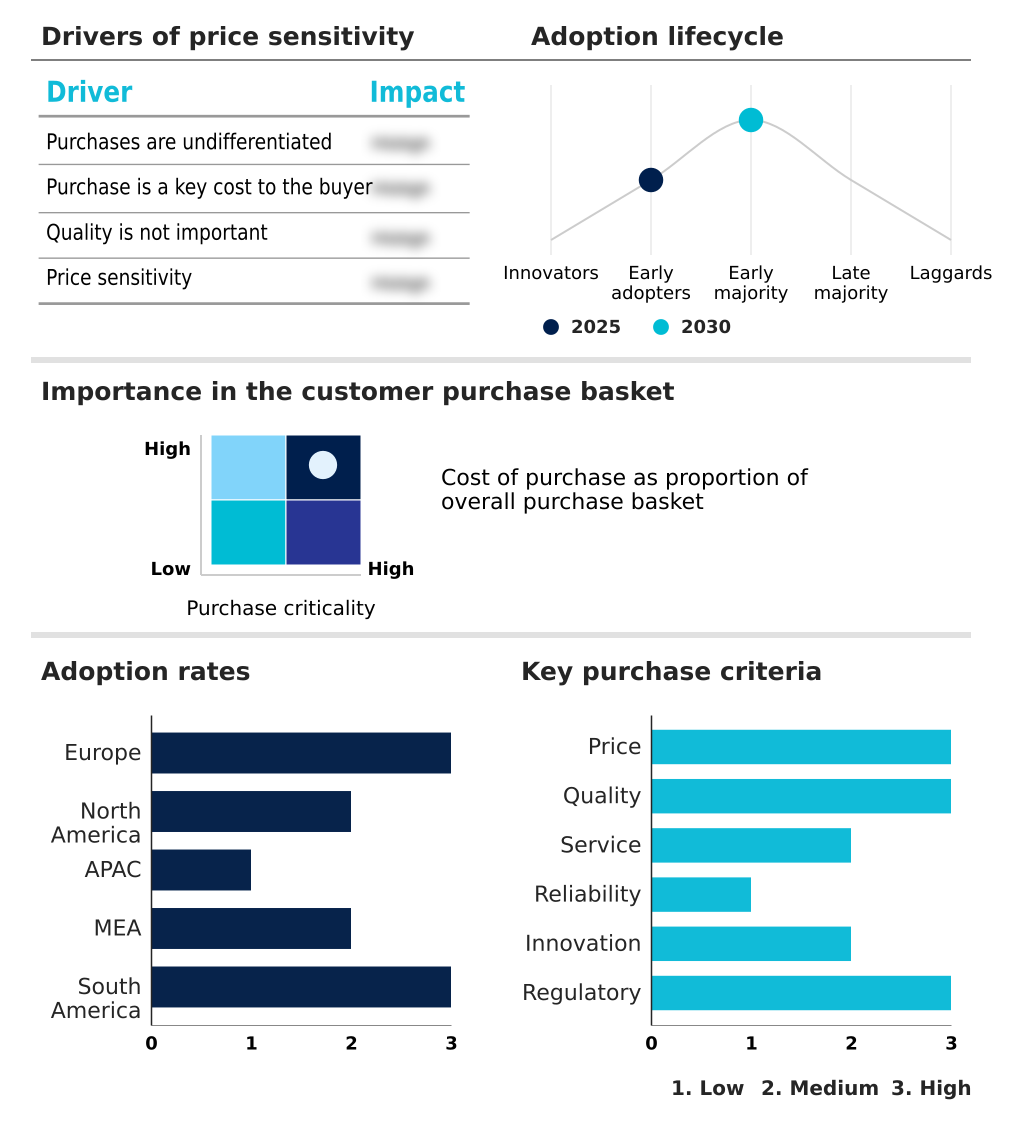
The e-gates market forecasting report includes the adoption lifecycle of the market, covering from the innovator’s stage to the laggard’s stage. It focuses on adoption rates in different regions based on penetration. Furthermore, the e-gates market report also includes key purchase criteria and drivers of price sensitivity to help companies evaluate and develop their market growth analysis strategies.
Customer Landscape of E-gates Industry
Competitive Landscape
Companies are implementing various strategies, such as strategic alliances, e-gates market forecast, partnerships, mergers and acquisitions, geographical expansion, and product/service launches, to enhance their presence in the industry.
Amadeus IT Group SA - Offering automated passenger handling solutions that integrate advanced e-gate technology to streamline airport operations and enhance traveler throughput.
The industry research and growth report includes detailed analyses of the competitive landscape of the market and information about key companies, including:
- Amadeus IT Group SA
- Atos SE
- Cognitec Systems GmbH
- COMINFO a.s
- DERMALOG Systems GmbH
- E Gates Technologies Pvt. Ltd.
- Giesecke Devrient GmbH
- Gunnebo AB
- IDEMIA France SAS
- IN Groupe
- Indra Sistemas SA
- Magnetic Autocontrol GmbH
- NEC Corp.
- RTX Corp.
- secunet Security Networks AG
- SITA
- Thales Group
- Wanzl GmbH and Co. KGaA
Qualitative and quantitative analysis of companies has been conducted to help clients understand the wider business environment as well as the strengths and weaknesses of key industry players. Data is qualitatively analyzed to categorize companies as pure play, category-focused, industry-focused, and diversified; it is quantitatively analyzed to categorize companies as dominant, leading, strong, tentative, and weak.
Recent Development and News in E-gates market
- In December 2024, Thales deployed new biometric e-gates featuring advanced facial and fingerprint recognition at the Ceuta and Melilla land borders in Spain to manage high-volume crossings.
- In December 2024, IDEMIA Public Security secured a ten-year contract extension with the Australian Department of Home Affairs to support and upgrade smart gates across eight international airports.
- In November 2024, Vision-Box, an Amadeus company, announced the successful deployment of its Seamless Border Programme at Princess Juliana International Airport in Sint Maarten, featuring a new generation of biometric gates.
- In March 2025, NEC Corp. was awarded a major contract by the Immigration Services Agency of Japan to install new facial recognition walkthrough gates at Haneda, Kansai, and Narita airports.
Dive into Technavio’s robust research methodology, blending expert interviews, extensive data synthesis, and validated models for unparalleled E-gates Market insights. See full methodology.
| Market Scope | |
|---|---|
| Page number | 290 |
| Base year | 2025 |
| Historic period | 2020-2024 |
| Forecast period | 2026-2030 |
| Growth momentum & CAGR | Accelerate at a CAGR of 40.6% |
| Market growth 2026-2030 | USD 13180.4 million |
| Market structure | Fragmented |
| YoY growth 2025-2026(%) | 29.1% |
| Key countries | Germany, UK, France, Italy, Spain, The Netherlands, US, Canada, Mexico, China, Japan, India, South Korea, Australia, Indonesia, Saudi Arabia, UAE, South Africa, Israel, Turkey, Brazil, Argentina and Chile |
| Competitive landscape | Leading Companies, Market Positioning of Companies, Competitive Strategies, and Industry Risks |
Research Analyst Overview
- The Global E-Gates Market 2026-2030 is maturing beyond standalone automated gate systems into deeply integrated biometric identity management ecosystems. The core technology, once focused on simple biometric passport scans using a machine readable zone, now centers on multi-modal biometric verification, including advanced facial recognition technology and liveness detection to prevent fraud.
- This evolution presents a critical boardroom decision: investing heavily in next-generation border security technology to create a seamless passenger journey versus managing the significant costs and compliance risks associated with biometric data management and privacy regulations. The business case is compelling, as modern deployments have demonstrated a 30% reduction in passenger processing times.
- As airports and governments prioritize both security and traveler experience, the strategic adoption of these automated immigration systems for comprehensive passenger screening and identity verification is becoming a competitive necessity rather than an optional upgrade.
What are the Key Data Covered in this E-gates Market Research and Growth Report?
-
What is the expected growth of the E-gates Market between 2026 and 2030?
-
USD 13.18 billion, at a CAGR of 40.6%
-
-
What segmentation does the market report cover?
-
The report is segmented by Type (Hardware, Software, and Service), Application (Airport, and Government), Product Type (Automated e-gates, and Traditional e-gates) and Geography (Europe, North America, APAC, Middle East and Africa, South America)
-
-
Which regions are analyzed in the report?
-
Europe, North America, APAC, Middle East and Africa and South America
-
-
What are the key growth drivers and market challenges?
-
Reduced airport operating expenses, Introduction of smart gates due to rising demand for advanced immigration procedure
-
-
Who are the major players in the E-gates Market?
-
Amadeus IT Group SA, Atos SE, Cognitec Systems GmbH, COMINFO a.s, DERMALOG Systems GmbH, E Gates Technologies Pvt. Ltd., Giesecke Devrient GmbH, Gunnebo AB, IDEMIA France SAS, IN Groupe, Indra Sistemas SA, Magnetic Autocontrol GmbH, NEC Corp., RTX Corp., secunet Security Networks AG, SITA, Thales Group and Wanzl GmbH and Co. KGaA
-
Market Research Insights
- The market's dynamics are dictated by a convergence of technological innovation and pressing operational demands. The shift toward a frictionless border control experience is accelerating, with automated identity verification adoption rates increasing by over 30% in key airports. This is enabled by biometric-enabled self-service platforms that create a contactless passenger journey.
- These smart airport solutions do more than just speed up lines; they enhance security, with some systems demonstrating a 15% improvement in anomaly detection over manual processes. As traveler identity management evolves with the digital travel credential, the focus is on creating interoperable identity assurance platforms that provide a single, secure token for the entire travel process.
We can help! Our analysts can customize this e-gates market research report to meet your requirements.
 RIA -
RIA - 
