



Electromagnetic Compatibility (EMC) Test Equipment Market Size 2026-2030
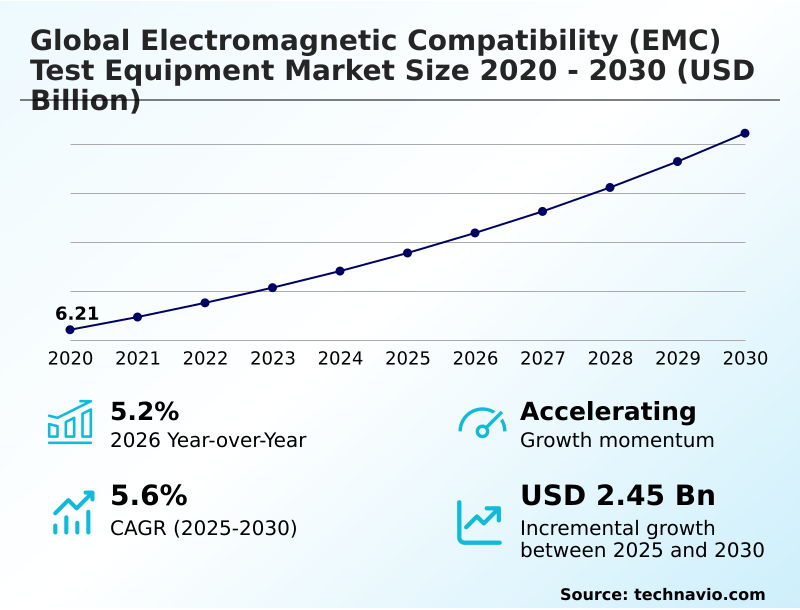
The electromagnetic compatibility (emc) test equipment market size is valued to increase by USD 2.45 billion, at a CAGR of 5.6% from 2025 to 2030. Institutionalization of high-frequency 5G and next generation telecomm will drive the electromagnetic compatibility (emc) test equipment market.
Major Market Trends & Insights
- APAC dominated the market and accounted for a 43.4% growth during the forecast period.
- By End-user - Consumer electronics segment was valued at USD 2.66 billion in 2024
- By Product - EMI test receiver segment accounted for the largest market revenue share in 2024
Market Size & Forecast
- Market Opportunities: USD 4.02 billion
- Market Future Opportunities: USD 2.45 billion
- CAGR from 2025 to 2030 : 5.6%
Market Summary
- The electromagnetic compatibility (EMC) test equipment market is defined by the critical need to ensure electronic devices function without causing or succumbing to interference. Growth is fueled by the proliferation of high-frequency 5G networks and the complex high-voltage architectures of electric vehicles. Key trends include the integration of AI-powered predictive analytics to accelerate validation, with automated compliance frameworks becoming standard.
- For instance, an automotive OEM developing an electric SUV utilizes hardware-in-the-loop simulation and digital twin integration for pre-compliance testing of its powertrain. This allows engineers to assess electromagnetic immunity and manage conducted emissions from the battery management system early in the design phase, ensuring the vehicle's advanced driver-assistance systems are not compromised.
- However, challenges persist, including the technical complexity of millimeter-wave frequency testing and supply chain constraints on specialized radio-frequency components. The industry is responding with modular, software-defined solutions, from advanced EMI test receivers and spectrum analyzers to full anechoic chambers, to address these evolving requirements for robust electromagnetic shielding and signal integrity validation.
What will be the Size of the Electromagnetic Compatibility (EMC) Test Equipment Market during the forecast period?
Get Key Insights on Market Forecast (PDF) Get Free Sample
How is the Electromagnetic Compatibility (EMC) Test Equipment Market Segmented?
The electromagnetic compatibility (emc) test equipment industry research report provides comprehensive data (region-wise segment analysis), with forecasts and estimates in "USD million" for the period 2026-2030, as well as historical data from 2020-2024 for the following segments.
- End-user
- Consumer electronics
- Telecommunications
- Aerospace and defense
- Automotive
- Others
- Product
- EMI test receiver
- Signal generator
- Broadband amplifiers
- Spectrum analyzer
- Others
- Application
- Third-party laboratories
- In-house laboratories
- Governments
- Geography
- APAC
- China
- Japan
- South Korea
- North America
- US
- Canada
- Mexico
- Europe
- Germany
- UK
- France
- South America
- Brazil
- Argentina
- Middle East and Africa
- Saudi Arabia
- UAE
- South Africa
- Rest of World (ROW)
- APAC
By End-user Insights
The consumer electronics segment is estimated to witness significant growth during the forecast period.
The consumer electronics segment mandates rapid, high-fidelity validation to support compressed product launch cycles. The integration of high-frequency wireless protocols into compact devices complicates internal electromagnetic shielding, elevating the importance of pre-compliance testing.
Engineering teams now leverage digital twin integration and hardware-in-the-loop simulation to model complex component interactions and forecast performance early in the design phase.
This proactive approach, focused on EMC design for compliance, aims to ensure devices pass stringent radiated immunity testing and conducted susceptibility testing during final certification.
Firms are increasingly performing shielding effectiveness measurement and other forms of EMC troubleshooting in-house, reducing dependency on external labs with EMC laboratory accreditation.
While full validation may require reverberation chambers, the use of on-site EMC testing and specialized EMC consulting services for complex products is growing, with advanced EMI filter bandwidths analysis improving diagnostic precision by over 15%.
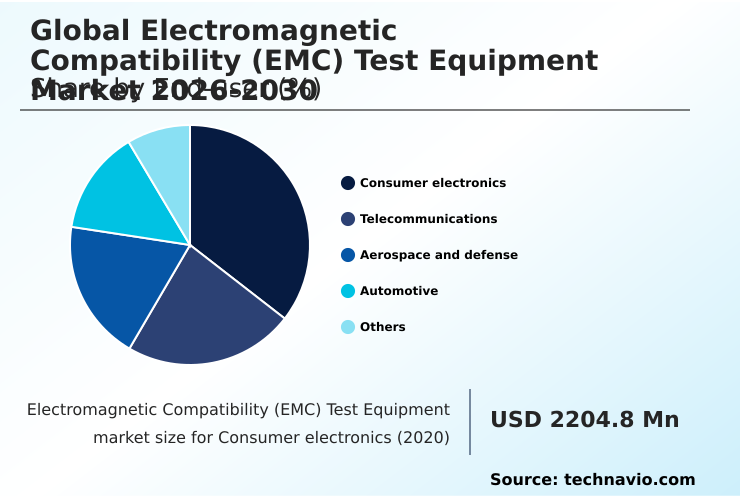
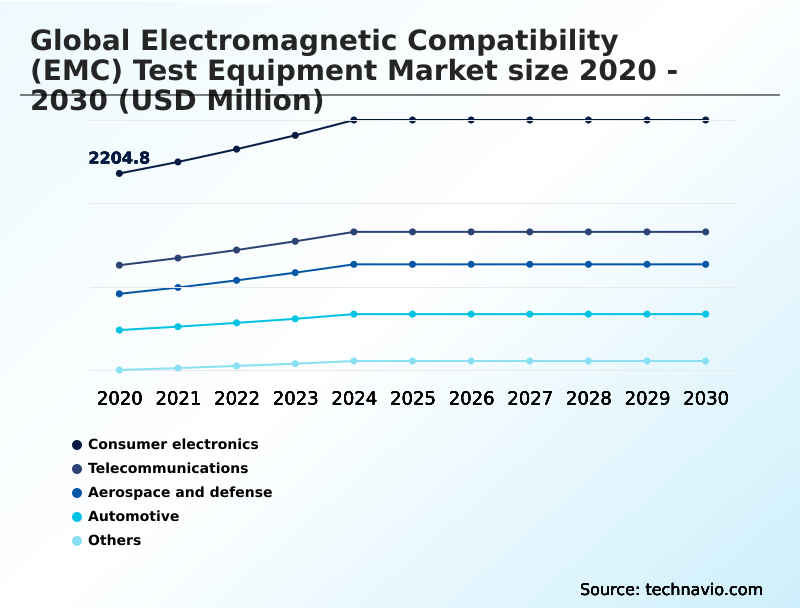
The Consumer electronics segment was valued at USD 2.66 billion in 2024 and showed a gradual increase during the forecast period.
Regional Analysis
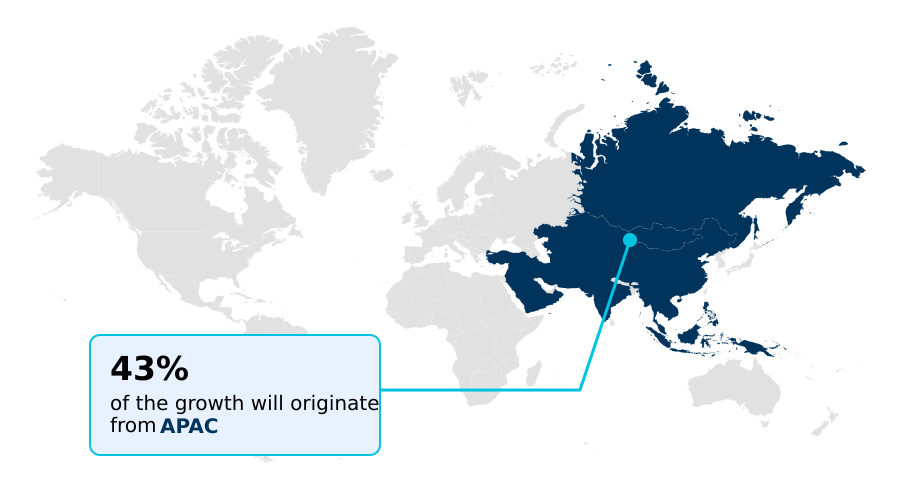
APAC is estimated to contribute 43.4% to the growth of the global market during the forecast period.Technavio’s analysts have elaborately explained the regional trends and drivers that shape the market during the forecast period.
See How Electromagnetic Compatibility (EMC) Test Equipment Market Demand is Rising in APAC Get Free Sample
The market's geographic landscape is characterized by distinct regional priorities.
APAC is poised to contribute over 43% of the market's incremental growth, fueled by its dominance in high-volume electronics manufacturing, which drives demand for production-line tools like ESD simulators and EMI probes.
In contrast, North America and Europe emphasize research and development in high-stakes industries, creating strong demand for specialized test solutions that meet stringent aerospace EMC requirements and defense EMC standards.
This includes the use of high-gain antennas for long-range communication testing and surge generators for immunity validation.
Globally, medical device EMC compliance is a non-negotiable standard, while evolving telecommunication EMC regulations for 5G require advanced network analyzers and RF power meters.
Concurrently, the rise of industrial automation EMC is increasing the need for portable field probes to conduct on-site verification and diagnostics.
Market Dynamics
Our researchers analyzed the data with 2025 as the base year, along with the key drivers, trends, and challenges. A holistic analysis of drivers will help companies refine their marketing strategies to gain a competitive advantage.
- Ensuring electronic product reliability in a dense signal environment requires a multifaceted approach to validation. For instance, developing compliant connected products necessitates robust emc testing for iot devices to prevent interference.
- In the automotive sector, the focus is on emi shielding for consumer electronics integrated into the dashboard and comprehensive emc testing for electric vehicles, which includes the emc validation of electric drivetrains to ensure safety and performance. The process often begins with using a spectrum analyzer for emi troubleshooting at the component level.
- For high-stakes applications, adherence to strict protocols is mandatory, such as following mil-std-461 emc test procedures in defense and emc testing for medical device certification in healthcare. Achieving certification requires measuring radiated emissions in anechoic chambers and following cispr standards for emc compliance.
- Both emi test receiver for compliance testing and broadband amplifiers for susceptibility testing are foundational tools in this process. The industrial sector is also seeing increased focus on emc testing for industrial automation, while the aerospace and defense sector requires specialized emc test for aerospace and defense.
- This rigorous testing ecosystem ensures that devices from all sectors operate safely and effectively.
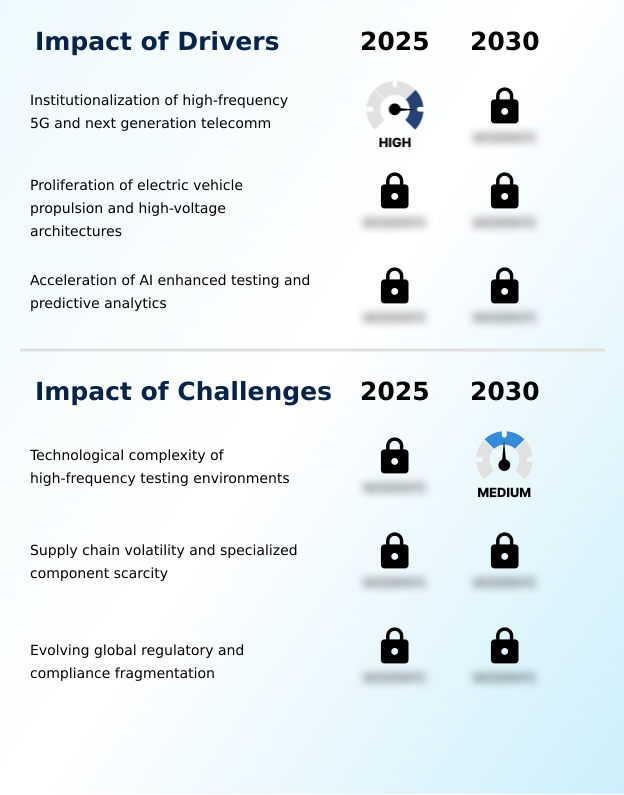
What are the key market drivers leading to the rise in the adoption of Electromagnetic Compatibility (EMC) Test Equipment Industry?
- The institutionalization of high-frequency 5G and next-generation telecommunications infrastructure serves as a key market driver, increasing demand for advanced testing solutions.
- Market growth is fundamentally driven by the dual trends of next-generation telecommunications and vehicle electrification. The rollout of 5G and 6G networks necessitates sophisticated high-frequency testing at millimeter-wave frequencies, demanding advanced signal integrity validation.
- Concurrently, the automotive industry's shift to electric vehicles requires extensive full-vehicle antenna testing and validation of components within specialized EMC test chambers to manage conducted emissions and ensure electromagnetic immunity.
- This has spurred demand for comprehensive EMC testing services and EMC certification solutions that include wireless testing solutions and over-the-air calibration.
- Essential technologies like electromagnetic shielding and specialized RF shielding components are critical for ensuring that densely packed electronic systems coexist without interference, making robust compliance a prerequisite for market entry.
What are the market trends shaping the Electromagnetic Compatibility (EMC) Test Equipment Industry?
- The industrialization of AI-driven automated compliance frameworks represents a significant market trend. This evolution is set to streamline complex testing protocols and improve the overall efficiency of regulatory validation.
- Key market trends are centered on automation and advanced simulation to manage increasing product complexity. The adoption of automated compliance frameworks, which leverage predictive analytics in testing, has been shown to reduce certification timelines for complex 5G infrastructure by nearly 30%.
- This shift toward intelligent validation is supported by next-generation instrumentation, including the EMI test receiver, signal generator, and spectrum analyzer, all capable of real-time spectrum analysis. For immunity assessments, high-power broadband amplifiers and transient generators are essential for simulating high-intensity radiated fields and electromagnetic pulse simulation.
- These tests are conducted in controlled environments like anechoic chambers to accurately measure radiated emissions. The industry is also seeing advancements in sub-terahertz materials characterization, pushing the boundaries of high-frequency measurement.
What challenges does the Electromagnetic Compatibility (EMC) Test Equipment Industry face during its growth?
- The technological complexity inherent in high-frequency testing environments poses a key challenge that affects the industry's growth trajectory.
- Navigating the market's challenges requires addressing technical complexity, supply chain instability, and regulatory fragmentation. Adherence to evolving standards like CISPR 16-1-1 for commercial goods and MIL-STD-461 for defense applications is increasingly difficult. The rise of high-voltage architectures in electric vehicles, governed by standards such as ISO 7637, creates significant validation hurdles.
- While technologies like time-domain scanning and quasi-peak detectors enhance measurement speed, the scarcity of critical radio-frequency components has inflated costs by over 28%. This impacts the price of essential hardware, including line impedance stabilization networks and high-power transient generators.
- Although electromagnetic simulation software aids in early design, verifying electromagnetic susceptibility and performing reliable transient interference detection still requires rigorous physical testing guided by comprehensive EMC test plans.
Exclusive Technavio Analysis on Customer Landscape
The electromagnetic compatibility (emc) test equipment market forecasting report includes the adoption lifecycle of the market, covering from the innovator’s stage to the laggard’s stage. It focuses on adoption rates in different regions based on penetration. Furthermore, the electromagnetic compatibility (emc) test equipment market report also includes key purchase criteria and drivers of price sensitivity to help companies evaluate and develop their market growth analysis strategies.
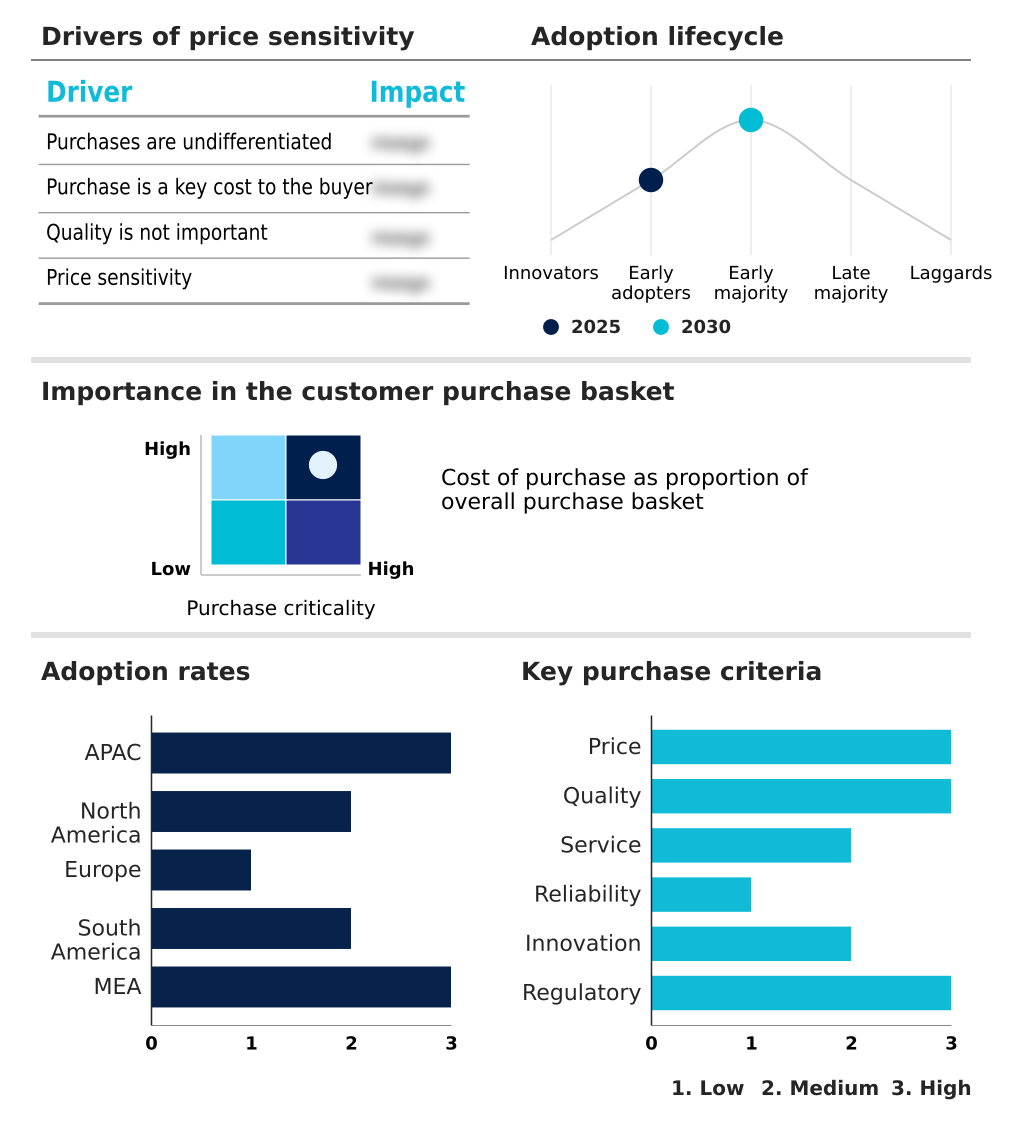
Customer Landscape of Electromagnetic Compatibility (EMC) Test Equipment Industry
Competitive Landscape
Companies are implementing various strategies, such as strategic alliances, electromagnetic compatibility (emc) test equipment market forecast, partnerships, mergers and acquisitions, geographical expansion, and product/service launches, to enhance their presence in the industry.
AMETEK Inc. - Offers specialized EMC test equipment, including signal generators and analytical instruments, for verifying device compliance in complex electromagnetic environments.
The industry research and growth report includes detailed analyses of the competitive landscape of the market and information about key companies, including:
- AMETEK Inc.
- Amplifier Research
- Anritsu Corp.
- Bureau Veritas
- Com Power Corp.
- DEKRA SE
- ESCO Technologies Inc.
- Eurofins Scientific SE
- Fortive Corp.
- Frankonia Solutions GmbH
- GAUSS INSTRUMENTS Intl. GmbH
- Good Will Instrument Co. Ltd.
- Intertek Group Plc
- Keysight Technologies Inc.
- Laird Connectivity
- Parker Hannifin Corp.
- Rohde and Schwarz GmbH
- SGS SA
- TUV SUD AG
Qualitative and quantitative analysis of companies has been conducted to help clients understand the wider business environment as well as the strengths and weaknesses of key industry players. Data is qualitatively analyzed to categorize companies as pure play, category-focused, industry-focused, and diversified; it is quantitatively analyzed to categorize companies as dominant, leading, strong, tentative, and weak.
Recent Development and News in Electromagnetic compatibility (emc) test equipment market
- In October 2024, Keysight Technologies released a significant upgrade to its PXE EMI Receiver, introducing real-time Time Domain Scanning up to 1 GHz to accelerate the certification process for high-speed consumer devices.
- In November 2024, Rohde and Schwarz introduced a comprehensive new hardware-in-the-loop simulation environment that allows engineers to perform full-spectrum electromagnetic compatibility validation of electric drivetrains before physical prototypes are constructed.
- In January 2025, Anritsu Corp. enhanced its field testing portfolio by launching an ultra-portable millimeter-wave spectrum analyzer engineered to address complex interference patterns in dense standalone 5G network environments.
- In April 2025, TUV Rheinland launched an AI-assisted pre-compliance screening service for data center compute clusters, utilizing machine learning for failure prediction and automated spectrum analysis to identify interference issues more rapidly.
Dive into Technavio’s robust research methodology, blending expert interviews, extensive data synthesis, and validated models for unparalleled Electromagnetic Compatibility (EMC) Test Equipment Market insights. See full methodology.
| Market Scope | |
|---|---|
| Page number | 315 |
| Base year | 2025 |
| Historic period | 2020-2024 |
| Forecast period | 2026-2030 |
| Growth momentum & CAGR | Accelerate at a CAGR of 5.6% |
| Market growth 2026-2030 | USD 2449.8 million |
| Market structure | Fragmented |
| YoY growth 2025-2026(%) | 5.2% |
| Key countries | China, Japan, South Korea, India, Australia, Indonesia, US, Canada, Mexico, Germany, UK, France, Italy, The Netherlands, Spain, Brazil, Argentina, Chile, Saudi Arabia, UAE, South Africa, Israel and Turkey |
| Competitive landscape | Leading Companies, Market Positioning of Companies, Competitive Strategies, and Industry Risks |
Research Analyst Overview
- The electromagnetic compatibility (EMC) test equipment market is evolving beyond simple compliance, becoming a strategic enabler of technological innovation. The convergence of high-frequency testing for 5G and the demands of high-voltage architectures in electric vehicles necessitates a new class of instrumentation.
- Boardroom decisions increasingly center on upfront investment in pre-compliance testing and digital twin integration to de-risk product launches, a strategy validated by data showing AI-driven platforms can reduce certification timelines by up to 30%. Core instrumentation, including the EMI test receiver, signal generator, and spectrum analyzer, now features advanced time-domain scanning.
- Broadband amplifiers and transient generators are crucial for radiated immunity testing and conducted susceptibility testing. Validation occurs within anechoic chambers or reverberation chambers, using tools like EMI probes, field probes, and high-gain antennas.
- Adherence to standards such as CISPR 16-1-1, MIL-STD-461, and ISO 7637 is managed with specialized equipment like ESD simulators, surge generators, and line impedance stabilization networks, all underpinned by precise network analyzers and RF power meters to ensure complete system integrity.
What are the Key Data Covered in this Electromagnetic Compatibility (EMC) Test Equipment Market Research and Growth Report?
-
What is the expected growth of the Electromagnetic Compatibility (EMC) Test Equipment Market between 2026 and 2030?
-
USD 2.45 billion, at a CAGR of 5.6%
-
-
What segmentation does the market report cover?
-
The report is segmented by End-user (Consumer electronics, Telecommunications, Aerospace and defense, Automotive, and Others), Product (EMI test receiver, Signal generator, Broadband amplifiers, Spectrum analyzer, and Others), Application (Third-party laboratories, In-house laboratories, and Governments) and Geography (APAC, North America, Europe, South America, Middle East and Africa)
-
-
Which regions are analyzed in the report?
-
APAC, North America, Europe, South America and Middle East and Africa
-
-
What are the key growth drivers and market challenges?
-
Institutionalization of high-frequency 5G and next generation telecomm, Technological complexity of high-frequency testing environments
-
-
Who are the major players in the Electromagnetic Compatibility (EMC) Test Equipment Market?
-
AMETEK Inc., Amplifier Research, Anritsu Corp., Bureau Veritas, Com Power Corp., DEKRA SE, ESCO Technologies Inc., Eurofins Scientific SE, Fortive Corp., Frankonia Solutions GmbH, GAUSS INSTRUMENTS Intl. GmbH, Good Will Instrument Co. Ltd., Intertek Group Plc, Keysight Technologies Inc., Laird Connectivity, Parker Hannifin Corp., Rohde and Schwarz GmbH, SGS SA and TUV SUD AG
-
Market Research Insights
- The market is shaped by a strategic shift toward proactive validation, where automated compliance frameworks are reducing certification timelines by up to 30%. Organizations are adopting advanced EMC testing services and comprehensive EMC certification solutions to mitigate risks associated with regulatory non-compliance, which can necessitate retrofits in nearly 40% of new industrial automation systems.
- The proliferation of electric vehicles is driving investment in full-vehicle antenna testing, while the aerospace sector relies on sophisticated over-the-air calibration for mission-critical systems. Predictive analytics in testing, combined with advanced wireless testing solutions, enables engineers to forecast and resolve potential interference issues, ensuring robust signal integrity validation across a complex and crowded electromagnetic spectrum.
We can help! Our analysts can customize this electromagnetic compatibility (emc) test equipment market research report to meet your requirements.
 RIA -
RIA - 
