



Enterprise Decision Intelligence Platforms Market Size and Growth Forecast 2026-2030
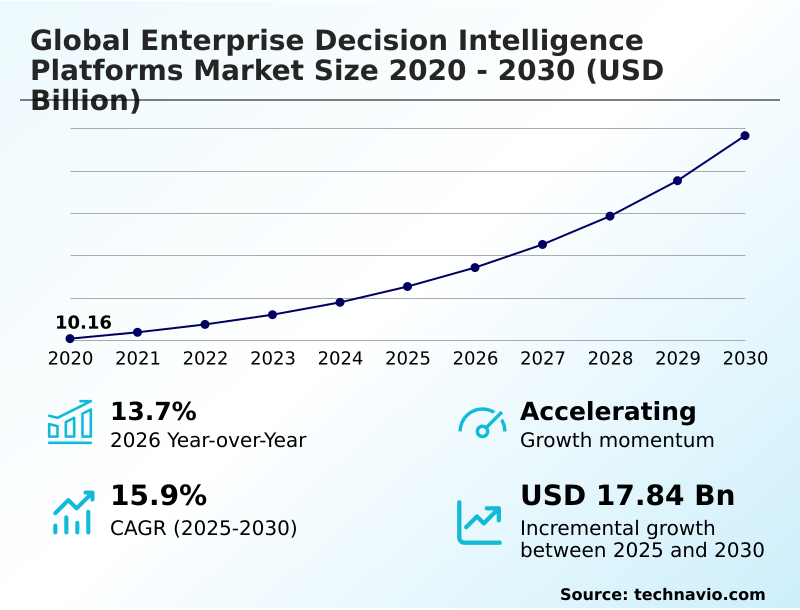
The Enterprise Decision Intelligence Platforms Market size was valued at USD 16.32 billion in 2025 growing at a CAGR of 15.9% during the forecast period 2026-2030.
North America accounts for 31.2% of incremental growth during the forecast period. The Solutions segment by Component was valued at USD 9.94 billion in 2024, while the On premises segment holds the largest revenue share by Deployment.
The market is projected to grow by USD 23.99 billion from 2020 to 2030, with USD 17.84 billion of the growth expected during the forecast period of 2025 to 2030.
Get Key Insights on Market Forecast (PDF) Request Free Sample
Enterprise Decision Intelligence Platforms Market Overview
The enterprise decision intelligence platforms market is expanding at a significant pace, with year-over-year growth reaching 13.7% as organizations move beyond retrospective analytics. This expansion is driven by the need for automated reasoning and predictive capabilities to navigate complex business environments. By integrating behavioral science methodologies with advanced AI, these platforms bridge the gap between data analysis and actionable business outcomes. A practical application is seen in the logistics sector, where a freight forwarder uses a platform to run what-if scenarios for optimizing shipping routes against fuel costs, weather, and geopolitical risk, typically reducing transit delays by over 15%. This capability for data-driven precision is essential for maintaining a competitive edge. The technology allows for the harmonization of disparate data streams, enhancing operational agility and reducing the cognitive biases inherent in manual strategic planning. As a result, these intelligent systems are becoming indispensable for enterprises in high-velocity industries seeking to improve decision quality.
Drivers, Trends, and Challenges in the Enterprise Decision Intelligence Platforms Market
The enterprise decision intelligence platforms market is evolving to address highly specific and complex operational challenges. The demand for enterprise decision intelligence for supply chain optimization is intensifying as global logistics networks face unprecedented volatility.
Concurrently, causal AI integration in financial risk assessment is becoming standard practice for institutions seeking to comply with frameworks like Basel III, with platforms often reducing complex risk modeling times by over 50% compared to manual methods.
This drive for efficiency is matched by a growing focus on governance, with an emphasis on deploying explainable AI for corporate governance to satisfy auditors and regulators.
For instance, a multinational manufacturing firm uses a platform for real-time edge analytics at its smart factories to predict equipment failure, while its central office uses the same underlying technology for high-level strategic planning.
The future of the market hinges on advanced architectures, where the quantum computing impact on enterprise decision making promises to solve previously intractable optimization problems, moving the industry further toward fully automated, auditable, and intelligent business processes.
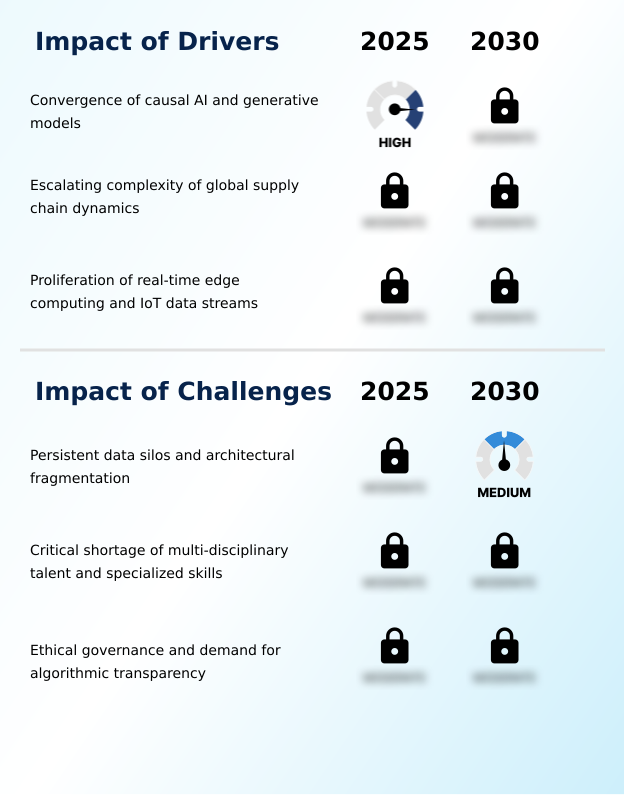
Primary Growth Driver: The convergence of causal AI and generative models is a primary market driver, enabling platforms to deliver explainable, data-driven strategies.
Market expansion is primarily driven by technological convergence and escalating operational complexity.
The fusion of causal AI with generative pre-trained transformers allows platforms to move beyond correlation to understand causality, providing a logical framework for strategic planning and reducing reliance on intuition.
This is critical as enterprises navigate increasingly intricate global supply chains, where real-time visibility and predictive capabilities are essential for supply chain resilience.
Another significant driver is the proliferation of the Internet of Things (IoT), which generates massive data streams from industrial equipment.
The subsequent rise of real-time edge computing and decentralized processing enables organizations to make instantaneous, automated adjustments in manufacturing and energy management, thereby gaining a significant competitive advantage through enhanced operational agility.
Emerging Market Trend: A key market trend involves the integration of affective computing into executive decision interfaces. This enhances outcomes by providing cognitive prompts based on real-time emotional and physiological data.
Emerging trends are centered on creating a more symbiotic relationship between human decision-makers and intelligent systems. The integration of affective computing is a notable advancement, where platforms use biometric data to detect emotional bias or fatigue, delivering cognitive prompts to guide users toward more objective analysis within the decision-making loop.
Concurrently, the rise of quantum-classic hybrid architectures enables firms to solve complex combinatorial optimization problems in logistics and energy management that are beyond the scope of classical computers.
To ensure accountability, organizations are adopting decentralized autonomous decision protocols, which create verifiable decision trails on a distributed ledger, crucial for sectors where algorithmic auditing under regulations like the EU AI Act is becoming standard. These trends collectively push the market toward more transparent, efficient, and human-aware decision support systems.
Key Industry Challenge: Persistent data silos and fragmented data architectures present a key challenge, limiting the efficacy of decision intelligence platforms by preventing access to unified datasets.
Significant challenges constrain the market, primarily stemming from foundational data issues and governance complexities. Persistent data silos and fragmented data architectures within large organizations prevent platforms from accessing the unified, high-quality data essential for accurate modeling. This fragmentation increases implementation costs and limits the enterprise-wide impact of the technology.
A critical shortage of talent with multidisciplinary domain knowledge in both data science and business strategy creates a bottleneck, hampering the effective use of sophisticated algorithmic outputs.
Furthermore, the demand for algorithmic transparency, driven by regulations such as the General Data Protection Regulation (GDPR), conflicts with the 'black box' nature of some advanced models, creating significant legal and reputational risks related to ethical guidelines and potential bias.
Explore Full Market Dynamics Analysis Request Free Sample
Enterprise Decision Intelligence Platforms Market Segmentation
The enterprise decision intelligence platforms industry research report provides comprehensive data including region-wise segment analysis, with forecasts and analysis for the period 2026-2030, as well as historical data from 2020-2024 for the following segments.
Component Segment Analysis
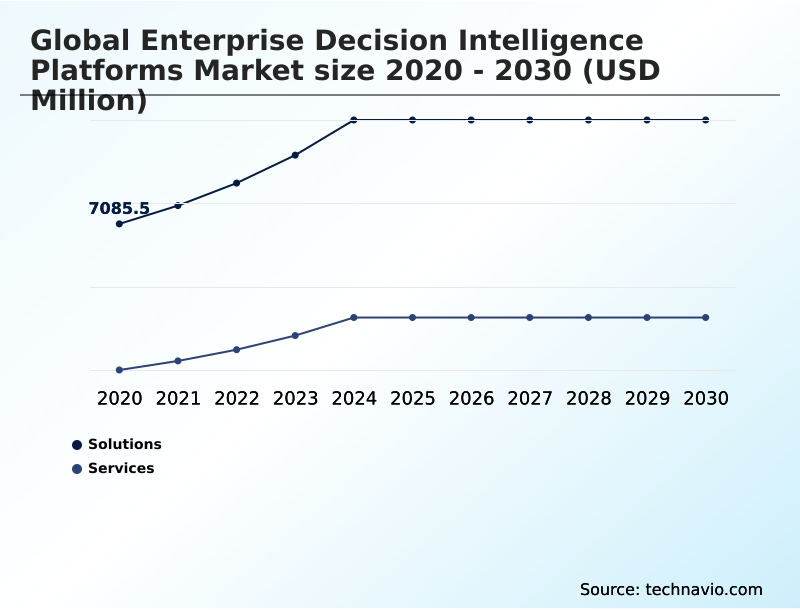
The solutions segment is estimated to witness significant growth during the forecast period.
The solutions segment is the technological core of the enterprise decision intelligence platforms market, representing approximately 68.4% of the total market value. These software offerings integrate sophisticated machine learning algorithms and automated reasoning to translate complex data into strategic action.
Demand is centered on platforms that provide predictive capabilities to manage massive datasets that exceed human cognitive limits. The evolution of generative AI now allows these solutions to offer natural language explanations for intricate recommendations, enhancing trust among executive leadership.
Adoption is particularly high in sectors requiring data-driven precision, where these platforms provide a centralized environment for modeling various scenarios and assessing the impact of strategic choices, ensuring operational execution aligns with corporate goals.
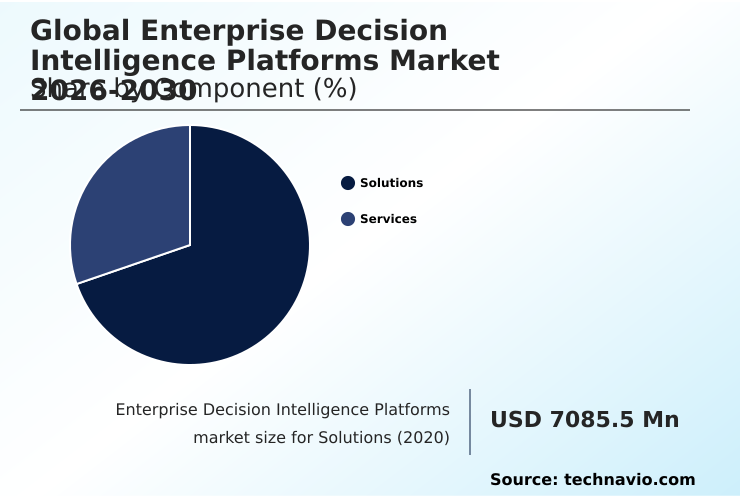
The Solutions segment was valued at USD 9.94 billion in 2024 and showed a gradual increase during the forecast period.
Enterprise Decision Intelligence Platforms Market by Region: North America Leads with 31.2% Growth Share
North America is estimated to contribute 31.2% to the growth of the global market during the forecast period.
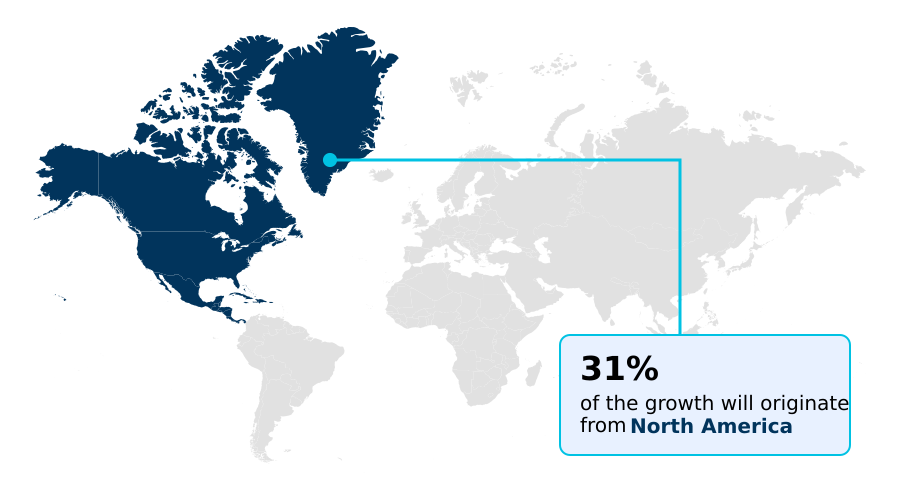
The geographic landscape for enterprise decision intelligence platforms is increasingly multipolar, with North America, Europe, and APAC contributing 31.2%, 28.8%, and 29.8% of incremental growth, respectively.
In North America, adoption is driven by a high concentration of technology providers and early adoption in finance and healthcare.
The European market, governed by strict data sovereignty rules under the General Data Protection Regulation (GDPR), prioritizes explainable AI tools and ethical guidelines. This has led to demand for platforms that offer algorithmic transparency.
APAC is the fastest-growing region, fueled by government-led digital transformation initiatives and the modernization of manufacturing and supply chain infrastructure.
Across all regions, the core challenge is adapting these intelligent systems to diverse regulatory frameworks while delivering consistent, data-driven precision in business operations.
Customer Landscape Analysis for the Enterprise Decision Intelligence Platforms Market
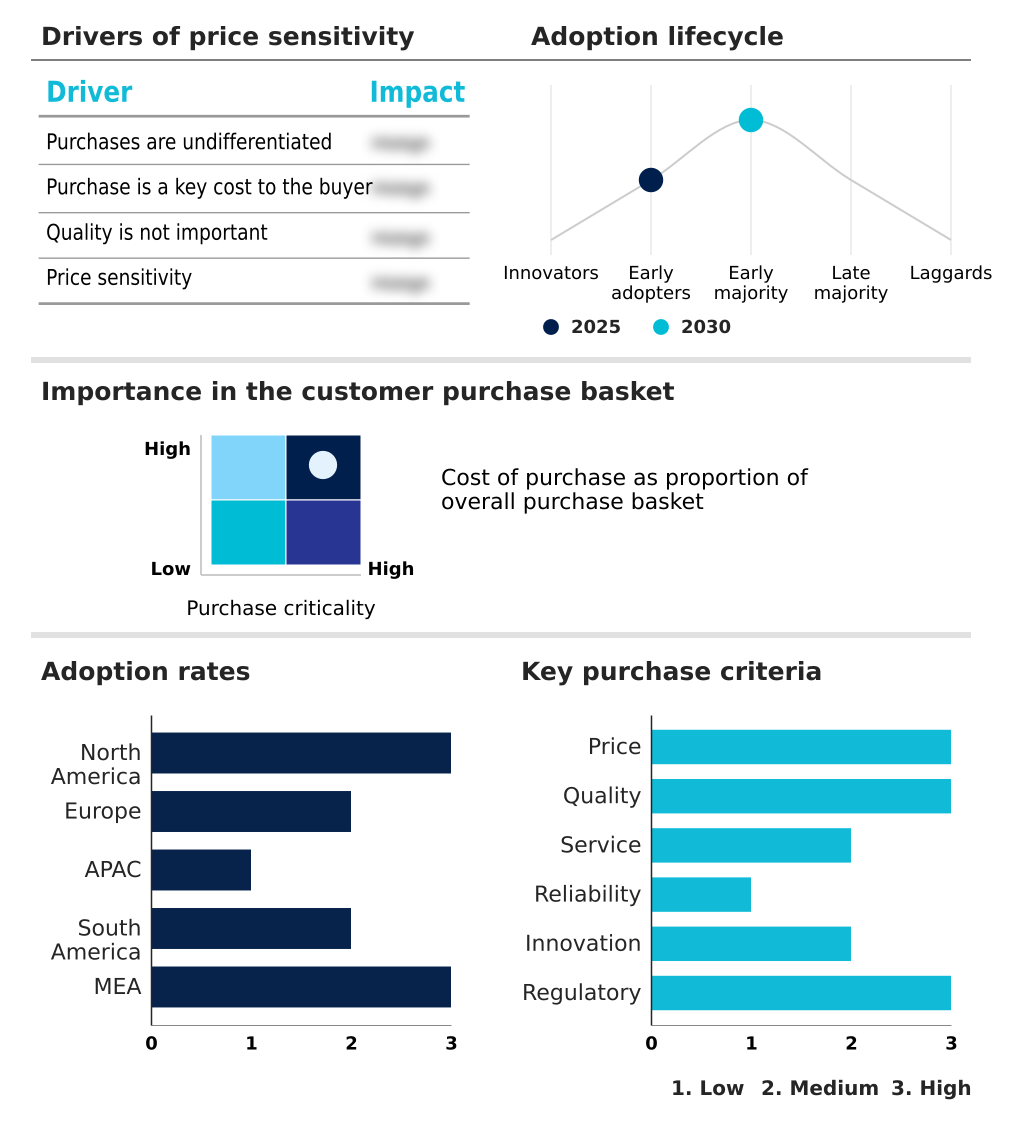
The enterprise decision intelligence platforms market forecasting report includes the adoption lifecycle of the market, covering from the innovator’s stage to the laggard’s stage. It focuses on adoption rates in different regions based on penetration. Furthermore, the enterprise decision intelligence platforms market report also includes key purchase criteria and drivers of price sensitivity to help companies evaluate and develop their market growth analysis strategies.
Competitive Landscape of the Enterprise Decision Intelligence Platforms Market
Companies are implementing various strategies, such as strategic alliances, partnerships, mergers and acquisitions, geographical expansion, and product/service launches, to enhance their presence in the enterprise decision intelligence platforms market industry.
Aera Technology - Key offerings integrate AI and analytics into unified platforms, automating complex business decisions and augmenting strategic planning for enhanced operational intelligence.
The industry research and growth report includes detailed analyses of the competitive landscape of the market and information about key companies, including:
- Aera Technology
- Alteryx Inc.
- Amazon.com Inc.
- Celonis SE
- Databricks Inc.
- DataRobot Inc.
- Google LLC
- IBM Corp.
- Oracle Corp.
- Palantir Technologies Inc.
- Pyramid Analytics BV
- QlikTech International AB
- Quantexa Ltd.
- Salesforce Inc.
- SAP SE
- SAS Institute Inc.
- Snowflake Inc.
- Tellius Inc.
- Teradata Corp.
- ThoughtSpot Inc.
Qualitative and quantitative analysis of companies has been conducted to help clients understand the wider business environment as well as the strengths and weaknesses of key industry players. Data is qualitatively analyzed to categorize companies as pure play, category-focused, industry-focused, and diversified; it is quantitatively analyzed to categorize companies as dominant, leading, strong, tentative, and weak.
Recent Developments in the Enterprise Decision Intelligence Platforms Market
- In January, 2025, Bamboo Rose completed the acquisition of Verteego, an AI platform specializing in retail analytics. The acquisition enabled Bamboo Rose to launch a retail-focused decision intelligence platform designed to improve merchandising, pricing, and supply-chain decision processes.
- In May, 2025, a National Health Service in a Northern European country implemented a decision intelligence platform to optimize the allocation of medical resources and staff during seasonal health crises, highlighting a move toward data-driven public sector management.
- In September, 2025, procurement intelligence provider Beroe acquired London-based Forestreet, a startup focused on AI-powered supplier discovery. The acquisition is intended to strengthen Beroe's procurement decision intelligence capabilities by accelerating the development of an AI-first supplier intelligence platform.
- In November, 2025, BigBear.ai agreed to acquire Ask Sage, a generative AI platform designed for secure AI deployment in government and regulated sectors. The transaction aims to combine BigBear.ai's decision intelligence software with generative AI tools to support automated operational decision-making.
Research Analyst Overview: Enterprise Decision Intelligence Platforms Market
The enterprise decision intelligence platforms market is defined by a strategic shift from retrospective business intelligence to forward-looking, prescriptive insights. This transition is fueled by the integration of causal AI and generative pre-trained transformers, which deliver data-driven precision that was previously unattainable.
Boardroom decisions regarding capital allocation are now directly influenced by the outputs of these intelligent systems, which can model complex what-if scenarios for strategic planning. With APAC growing at a notable 17.7%, the global competitive landscape is intensifying.
Compliance with guidelines from bodies like the Federal Trade Commission, which emphasize the need for explainable AI tools, is also shaping product development. The core technology, incorporating sophisticated machine learning algorithms and automated reasoning, is enabling a new level of operational execution.
Enterprises are leveraging these platforms to enhance supply chain resilience and achieve a sustainable competitive advantage in a volatile global economy, making data science a central pillar of modern business operations.
Dive into Technavio’s robust research methodology, blending expert interviews, extensive data synthesis, and validated models for unparalleled Enterprise Decision Intelligence Platforms Market insights. See full methodology.
| Market Scope | |
|---|---|
| Page number | 292 |
| Base year | 2025 |
| Historic period | 2020-2024 |
| Forecast period | 2026-2030 |
| Growth momentum & CAGR | Accelerate at a CAGR of 15.9% |
| Market growth 2026-2030 | USD 17837.3 million |
| Market structure | Fragmented |
| YoY growth 2025-2026(%) | 13.7% |
| Key countries | US, Canada, Mexico, Germany, UK, France, The Netherlands, Italy, Spain, China, India, Japan, Australia, South Korea, Indonesia, Brazil, Argentina, Colombia, South Africa, Saudi Arabia, UAE, Israel and Turkey |
| Competitive landscape | Leading Companies, Market Positioning of Companies, Competitive Strategies, and Industry Risks |
Enterprise Decision Intelligence Platforms Market: Key Questions Answered in This Report
-
What is the expected growth of the Enterprise Decision Intelligence Platforms Market between 2026 and 2030?
-
The Enterprise Decision Intelligence Platforms Market is expected to grow by USD 17.84 billion during 2026-2030, registering a CAGR of 15.9%. Year-over-year growth in 2026 is estimated at 13.7%%. This acceleration is shaped by convergence of causal ai and generative models, which is intensifying demand across multiple end-use verticals covered in the report.
-
-
What segmentation does the market report cover?
-
The report is segmented by Component (Solutions, and Services), Deployment (On premises, Cloud based, and Hybrid), End-user (Large enterprises, and SMEs) and Geography (North America, Europe, APAC, South America, Middle East and Africa). Among these, the Solutions segment is estimated to witness significant growth during the forecast period, driven by rising adoption across key application areas. Each segment includes detailed qualitative and quantitative analysis, along with historical data from 2020-2024 and forecasts through 2030 with year-over-year growth rates.
-
-
Which regions are analyzed in the report?
-
The report covers North America, Europe, APAC, South America and Middle East and Africa. North America is estimated to contribute 31.2% to market growth during the forecast period. Country-level analysis includes US, Canada, Mexico, Germany, UK, France, The Netherlands, Italy, Spain, China, India, Japan, Australia, South Korea, Indonesia, Brazil, Argentina, Colombia, South Africa, Saudi Arabia, UAE, Israel and Turkey, with dedicated market size tables and year-over-year growth for each.
-
-
What are the key growth drivers and market challenges?
-
The primary driver is convergence of causal ai and generative models, which is accelerating investment and industry demand. The main challenge is persistent data silos and architectural fragmentation, creating operational barriers for key market participants. The report quantifies the impact of each driver and challenge across 2026 and 2030 with comparative analysis.
-
-
Who are the major players in the Enterprise Decision Intelligence Platforms Market?
-
Key vendors include Aera Technology, Alteryx Inc., Amazon.com Inc., Celonis SE, Databricks Inc., DataRobot Inc., Google LLC, IBM Corp., Oracle Corp., Palantir Technologies Inc., Pyramid Analytics BV, QlikTech International AB, Quantexa Ltd., Salesforce Inc., SAP SE, SAS Institute Inc., Snowflake Inc., Tellius Inc., Teradata Corp. and ThoughtSpot Inc.. The report provides qualitative and quantitative analysis categorizing companies as dominant, leading, strong, tentative, and weak based on their market positioning. Company profiles include business segment analysis, SWOT assessment, key offerings, and recent strategic developments.
-
Enterprise Decision Intelligence Platforms Market Research Insights
Market dynamics are shaped by the drive for autonomous business logic and hyper-personalization, with platform adoption varying by regional regulatory climates. In Europe, the EU AI Act mandates stringent oversight, promoting human-in-the-loop systems, whereas North America focuses on innovation speed. This is reflected in regional growth, with APAC's 17.7% rate outpacing North America's 14.8% due to rapid digitalization.
Enterprises are processing vast data streams to gain a competitive advantage in real-time. For instance, a telecommunications firm might use a decision intelligence platform to analyze network traffic data streams in real time, automatically adjusting bandwidth allocation to prevent service degradation during peak usage, a process that requires both machine speed and human oversight for strategic adjustments.
This balance between automation and human judgment is central to modern enterprise management.
We can help! Our analysts can customize this enterprise decision intelligence platforms market research report to meet your requirements.
 RIA -
RIA - 
