


Electric Vehicle (EV) Traction Motor Market Analysis APAC, Europe, North America, South America, Middle East and Africa - China, US, Germany, South Korea, India - Size and Forecast 2024-2028

Electric Vehicle (EV) Traction Motor Market Analysis APAC, Europe, North America, South America, Middle East and Africa - China, US, Germany, South Korea, India - Size and Forecast 2024-2028

Published: Jul 2024 183 Pages SKU: IRTNTR74730

Market Overview at a Glance

$2.71 B
Market Opportunity
8.12%
CAGR
7.2
YoY growth 2023-2024(%)

Electric Vehicle (EV) Traction Motor Market Size 2024-2028

The electric vehicle (EV) traction motor market size is valued to increase USD 2.71 billion, at a CAGR of 8.12% from 2023 to 2028. Increasing sales of EVs will drive the EV traction motor market.

Major Market Trends & Insights

  • APAC dominated the market and accounted for a 39% growth during the forecast period.
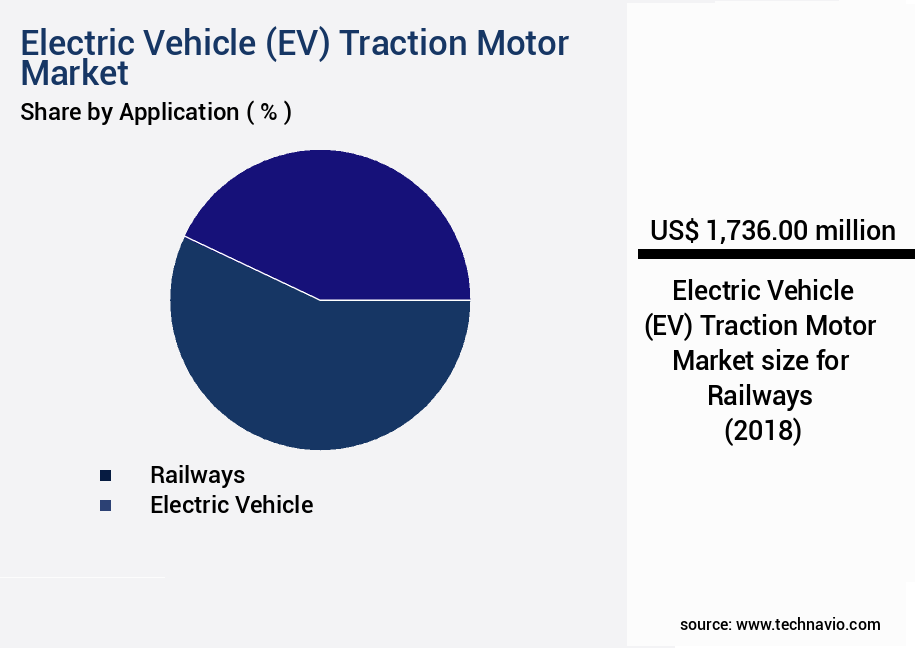
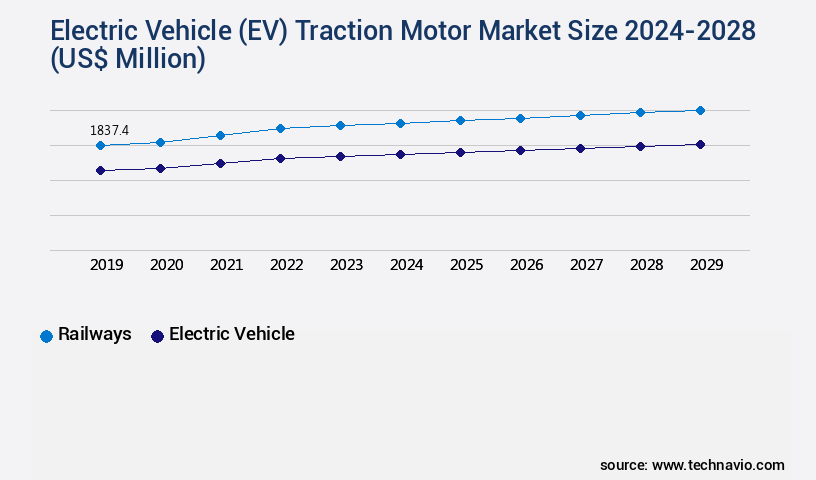
  • By Application - Railways segment was valued at USD 1.74 billion in 2022
  • By Power Rating - Below 200 kW segment accounted for the largest market revenue share in 2022

Market Size & Forecast

  • Market Opportunities: USD 90.97 million
  • Market Future Opportunities: USD 2713.40 million
  • CAGR : 8.12%
  • APAC: Largest market in 2022

Market Summary

  • The market is experiencing significant growth, driven by the increasing sales of electric vehicles (EVs) worldwide. According to recent statistics, the global EV market is projected to reach a 27% market share by 2027, signifying a notable shift in the automotive industry. This expansion is primarily fueled by the rapid development of luxury EVs, which offer superior performance and advanced features, appealing to consumers seeking sustainable and technologically advanced transportation solutions. However, challenges persist, such as the lack of operational infrastructure in emerging markets, which may hinder market growth.
  • Core technologies, including battery management systems and power electronics, continue to evolve, enhancing EV efficiency and driving innovation. Regions like Europe and Asia Pacific are leading the charge in EV adoption, with stringent regulations and incentives encouraging the transition towards sustainable transportation.

What will be the Size of the Electric Vehicle (EV) Traction Motor Market during the forecast period?
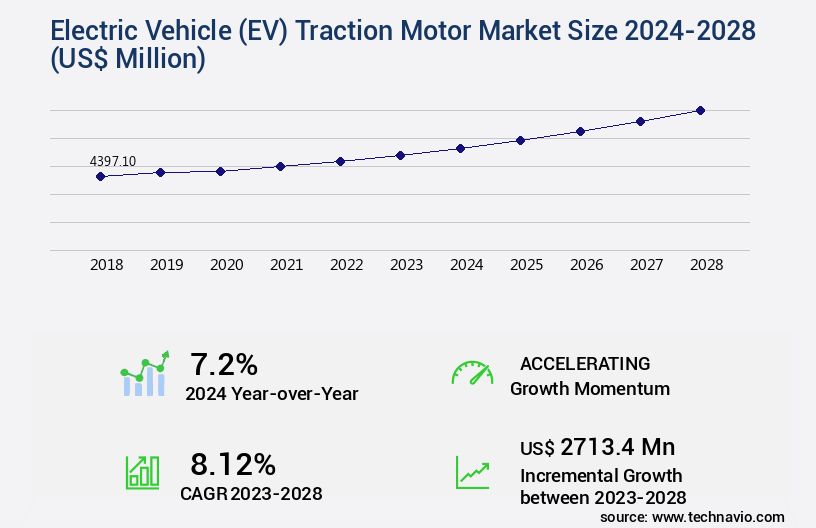
Electric Vehicle (EV) Traction Motor Market Size

Get Key Insights on Market Forecast (PDF) Request Free Sample

How is the Electric Vehicle (EV) Traction Motor Market Segmented and what are the key trends of market segmentation?

The electric vehicle (ev) traction motor industry research report provides comprehensive data (region-wise segment analysis), with forecasts and estimates in "USD million" for the period 2024-2028, as well as historical data from 2018-2022 for the following segments.

  • Application
    • Railways
    • Electric vehicle
    • Others
  • Power Rating
    • Below 200 kW
    • 200 to 400 kW
    • Above 400 kW
  • Geography
    • North America
      • US
    • Europe
      • Germany
    • APAC
      • China
      • India
      • South Korea
    • Rest of World (ROW)

By Application Insights

The railways segment is estimated to witness significant growth during the forecast period.

In the market, direct torque control and vector control techniques play significant roles in enhancing motor performance and efficiency. Traction motor control, energy consumption models, and battery power delivery are crucial aspects of EV design, with power electronics inverters converting DC power from the battery to AC power for the motor. Synchronous reluctance motors, flux weakening control, and rotor design optimization contribute to high-speed motor drives, ensuring electric motor reliability and improved powertrain efficiency. High-torque density motors, sensorless motor control, and permanent magnet materials are essential for maximizing motor performance and reducing vehicle acceleration metrics.

Induction motor efficiency, field-oriented control, and permanent magnet motors further optimize motor drive architecture and efficiency testing. Motor efficiency testing, motor control algorithms, and electric motor torque are essential considerations for motor manufacturers. Motor noise reduction, motor thermal management, and stator cooling methods are crucial for enhancing user experience and extending motor lifespan. Torque ripple reduction and regenerative braking systems are vital for optimizing energy recovery and improving overall system efficiency. Rare earth magnets, motor diagnostic systems, electric motor windings, and electric vehicle range are ongoing areas of research and development in the EV traction motor market.

The market for EV traction motors is expected to grow substantially, with a reported 25% of global automotive traction motor sales coming from electric vehicles by 2025. The integration of advanced technologies, such as power electronics, motor control algorithms, and sensorless motor control, is driving innovation in the EV traction motor market. These advancements are enabling the development of high-performance, energy-efficient electric motors, which are essential for the widespread adoption of electric vehicles.

Furthermore, the growing demand for sustainable transportation solutions and government incentives for electric vehicle adoption are expected to fuel market growth in the coming years.
Electric Vehicle (EV) Traction Motor Market Size

Request Free Sample

The Railways segment was valued at USD 1.74 billion in 2018 and showed a gradual increase during the forecast period.
Electric Vehicle (EV) Traction Motor Market Size

Request Free Sample

Regional Analysis

APAC is estimated to contribute 39% to the growth of the global market during the forecast period.Technavio's analysts have elaborately explained the regional trends and drivers that shape the market during the forecast period.
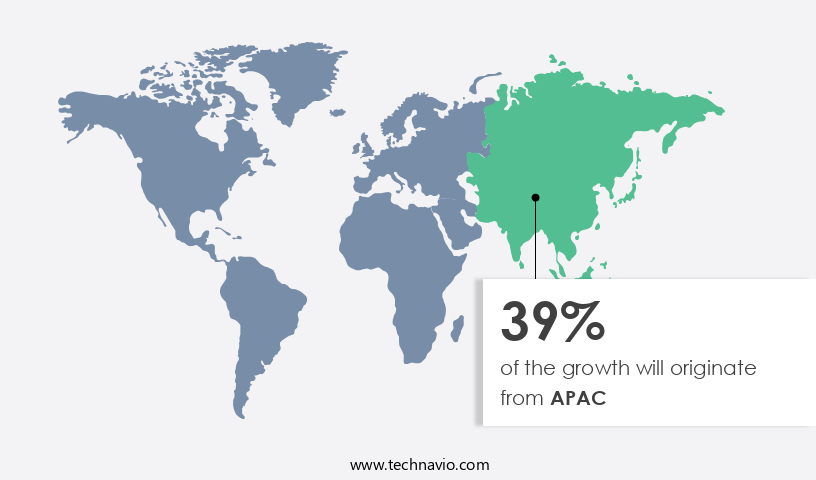
Electric Vehicle (EV) Traction Motor Market Share by Geography

See How Electric Vehicle (EV) Traction Motor Market Demand is Rising in APAC Request Free Sample

The market in the Asia Pacific (APAC) region is experiencing significant growth, driven by the increasing demand for EVs in countries such as China, Japan, India, Singapore, Thailand, and South Korea. China and Japan are currently the leading contributors to this market due to the high production and sales of EVs and related components. China dominates the market with the largest number of EV sales, followed closely by Japan. South Korea, India, and Hong Kong are also expected to become major markets for EVs and, consequently, for EV traction motors, during the forecast period.

This trend is attributed to the growing environmental concerns, government incentives, and advancements in technology. The EV traction motor market in APAC is a dynamic and evolving landscape, reflecting the continuous growth and expansion of the EV industry.

Market Dynamics

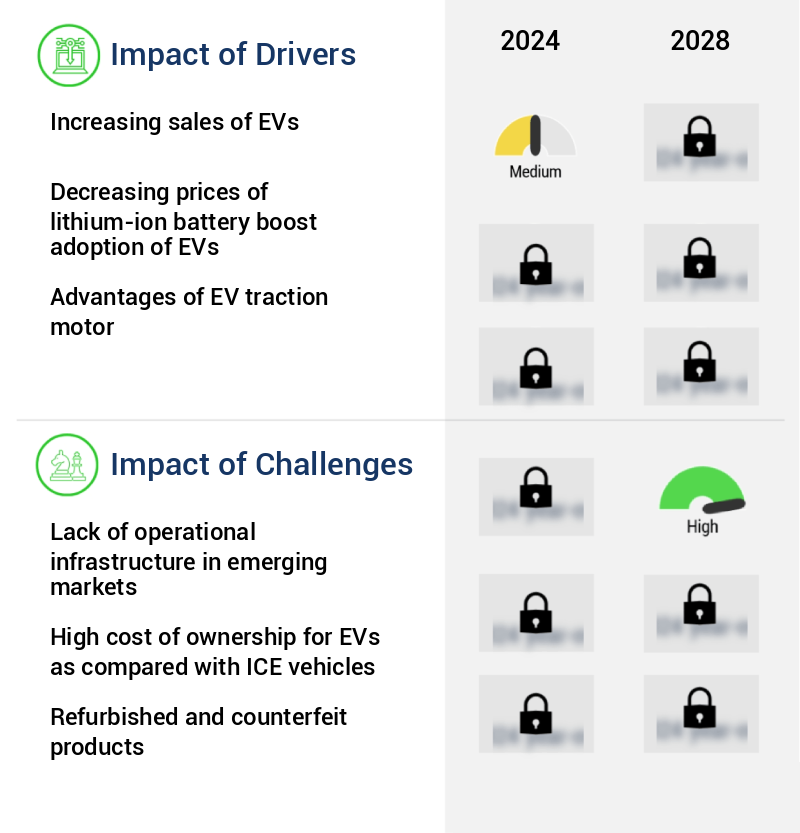
Our researchers analyzed the data with 2023 as the base year, along with the key drivers, trends, and challenges. A holistic analysis of drivers will help companies refine their marketing strategies to gain a competitive advantage.

The market is witnessing significant growth due to the increasing demand for sustainable and eco-friendly transportation solutions. This market encompasses various advanced technologies, including permanent magnet motor thermal modeling, induction motor efficiency optimization techniques, and electric motor torque ripple reduction strategies. One of the critical aspects of EV traction motor development is enhancing motor efficiency. This is achieved through various methods, such as high-speed motor drive control algorithms and electric motor winding design and analysis. Moreover, rotor design optimization for high torque density and stator cooling methods for high-performance motors are essential to ensure motor longevity and reliability.

Another essential aspect of EV traction motor technology is the implementation of regenerative braking systems for energy recovery. This feature significantly improves vehicle acceleration performance and reduces overall energy consumption. Motor control algorithms for electric vehicles play a pivotal role in optimizing energy consumption and powertrain efficiency. The market for EV traction motors is witnessing intense competition, with various motor types, such as brushless DC motors, synchronous reluctance motors, and asynchronous motors, vying for market share. For instance, brushless DC motor design considerations and synchronous reluctance motor efficiency analysis are crucial in differentiating these motor types. Moreover, flux weakening control strategies and field-oriented control implementation and tuning are essential for high-performance applications.

In contrast, asynchronous motor control challenges necessitate continuous innovation to improve motor efficiency and performance. Notably, the industrial application segment accounts for a significantly larger share in the EV traction motor market compared to the academic segment. This trend is driven by the increasing adoption of EVs in commercial transportation and logistics sectors. In conclusion, the EV traction motor market is a dynamic and innovative space, with continuous advancements in motor design, control algorithms, and energy recovery systems. The market is expected to witness robust growth in the coming years, driven by the increasing demand for sustainable transportation solutions and technological innovations.
Electric Vehicle (EV) Traction Motor Market Size

What are the key market drivers leading to the rise in the adoption of Electric Vehicle (EV) Traction Motor Industry?

  • The significant growth in electric vehicle (EV) sales serves as the primary market catalyst. 
  • Governments worldwide are actively promoting the sale of Electric Vehicles (EVs) through various initiatives. Unlike Internal Combustion Engine (ICE) vehicles, EVs contribute significantly to air quality improvement by eliminating emissions of pollutants such as particulates, carbon monoxide, hydrocarbons, and volatile organic compounds. The market's growth is fueled by incentives offered by governments, rising environmental consciousness, stringent emission norms, and increased competition from both domestic and international players.
  • Companies are under pressure to reduce their average CO2 emissions, leading to a surge in EV development. Moreover, buyers are increasingly opting for EVs due to their environmental benefits and cost savings over time. This dynamic market landscape continues to evolve, with ongoing advancements in battery technology and charging infrastructure.

What are the market trends shaping the Electric Vehicle (EV) Traction Motor Industry?

  • The trend in the automotive industry is shifting towards the rapid development of luxury electric vehicles. A growing number of consumers are expressing interest in high-end electric vehicles, signaling a significant market trend.
  • The electrification trend in the automotive industry is gaining momentum, with luxury vehicle manufacturers leading the charge. BMW, for instance, has introduced ten electrified vehicle models, a mix of plug-in hybrids and pure electric vehicles, and plans to launch 25 more by 2025. Daimler, Volvo Car, and Jaguar Land Rover Automotive are among other manufacturers following suit. Supercar manufacturers are also joining the electrification movement, while established premium electric vehicle manufacturers like Tesla continue expanding their product offerings with new models.
  • This shift towards electrification reflects the growing concern for reducing vehicular emissions and the increasing demand for sustainable transportation solutions. The market for electrified vehicles is expected to grow significantly, with numerous players investing in research and development to cater to this evolving consumer preference. The competition in the electrified vehicle market is intensifying, leading to advancements in technology and improvements in performance and efficiency.

What challenges does the Electric Vehicle (EV) Traction Motor Industry face during its growth?

  • In emerging markets, the absence of sufficient operational infrastructure represents a significant challenge impeding industry expansion. 
  • In the electric vehicle (EV) market, the absence of sufficient charging infrastructure, particularly in emerging markets in Asia Pacific, excluding China, poses a significant challenge to market expansion. In countries like India and Southeast Asian nations, the scarcity of adequate charging stations restricts the growth of EV charging infrastructure. The inadequate road infrastructure in India further impedes the large-scale development of EV charging stations. Consequently, individuals and commercial fleet operators primarily confine their EV usage to major cities due to the limited availability of charging facilities in smaller urban areas.
  • Despite the potential benefits of EVs, the lack of infrastructure development in these regions hinders the market's full potential. This situation underscores the need for substantial investment in building charging infrastructure to support the growing adoption of electric vehicles.

Exclusive Customer Landscape

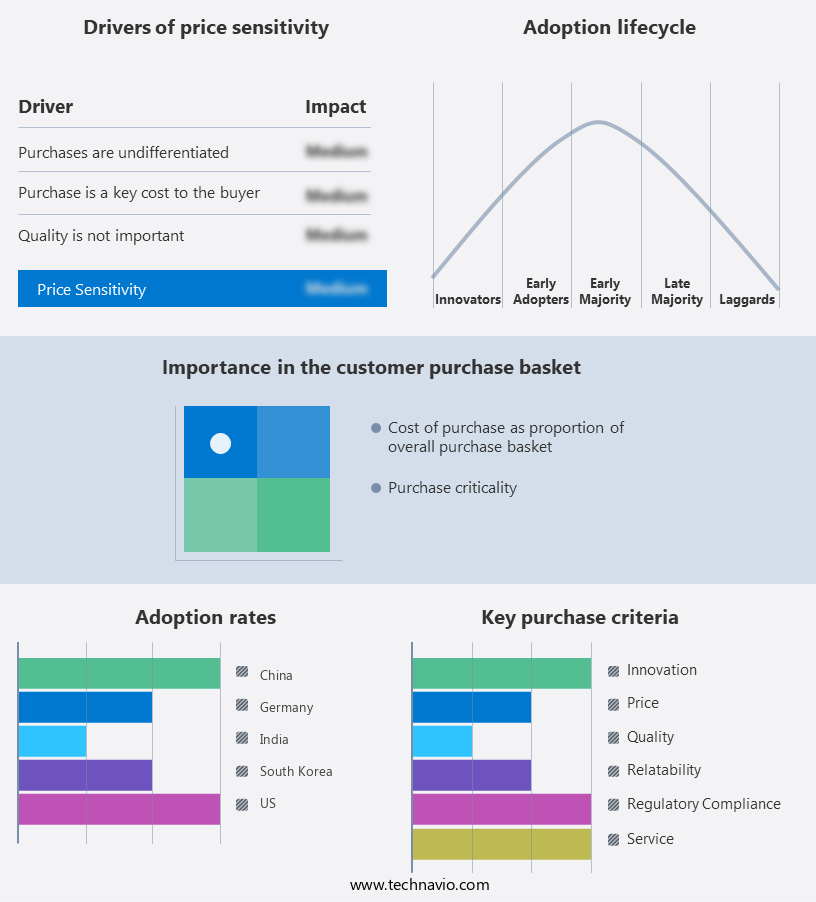
The electric vehicle (ev) traction motor market forecasting report includes the adoption lifecycle of the market, covering from the innovator's stage to the laggard's stage. It focuses on adoption rates in different regions based on penetration. Furthermore, the electric vehicle (ev) traction motor market report also includes key purchase criteria and drivers of price sensitivity to help companies evaluate and develop their market growth analysis strategies.
Electric Vehicle (EV) Traction Motor Market Share by Geography

 Customer Landscape of Electric Vehicle (EV) Traction Motor Industry

Competitive Landscape & Market Insights

Companies are implementing various strategies, such as strategic alliances, electric vehicle (ev) traction motor market forecast, partnerships, mergers and acquisitions, geographical expansion, and product/service launches, to enhance their presence in the industry.

ABB Ltd. - The company specializes in providing advanced EV traction motors, including those from ABB, for metro systems. These motors contribute significantly to the efficient operation and performance of electric transportation.

The industry research and growth report includes detailed analyses of the competitive landscape of the market and information about key companies, including:

  • ABB Ltd.
  • AC Propulsion Inc.
  • AISIN CORP.
  • Allied Motion Technologies Inc.
  • BorgWarner Inc.
  • Bowe Digital Ltd
  • Continental AG
  • Delta Electronics Inc.
  • Hitachi Ltd.
  • LG Magna e Powertrain
  • MAHLE GmbH
  • Nidec Corp.
  • Parker Hannifin Corp.
  • Robert Bosch GmbH
  • Saini Group
  • Siemens AG
  • SONA BLW Precision Forgings Ltd.
  • Toshiba Corp.
  • Valeo SA
  • Yasa Ltd.

Qualitative and quantitative analysis of companies has been conducted to help clients understand the wider business environment as well as the strengths and weaknesses of key industry players. Data is qualitatively analyzed to categorize companies as pure play, category-focused, industry-focused, and diversified; it is quantitatively analyzed to categorize companies as dominant, leading, strong, tentative, and weak.

Recent Development and News in Electric Vehicle (EV) Traction Motor Market

  • In January 2024, Tesla, the leading electric vehicle (EV) manufacturer, announced the production ramp-up of its new 4680 battery cells and in-house produced traction motors at its Gigafactory Texas. These advancements aimed to increase the energy density and reduce the cost per kilowatt-hour (kWh) of its EVs (Tesla Press Release, 2024).
  • In March 2024, CATL (Contemporary Amperex Technology Co. Limited), the world's largest lithium-ion battery manufacturer, formed a strategic partnership with Magna International, a global automotive supplier, to develop and produce traction motors for EVs. This collaboration aimed to enhance CATL's market presence in the EV traction motor market (Magna International Press Release, 2024).
  • In May 2024, Aptiv, a global technology company, completed its acquisition of Meridian Automotive Systems, a leading designer and manufacturer of electric drivetrain systems. This acquisition expanded Aptiv's capabilities in the EV traction motor market and strengthened its position as a key supplier to major automakers (Aptiv Press Release, 2024).
  • In April 2025, the European Union (EU) approved the Fit for 55 package, a set of legislative proposals aimed at reducing greenhouse gas emissions by at least 55% by 2030. This initiative is expected to significantly boost the demand for EVs and their components, including traction motors, in Europe (European Commission Press Release, 2025).

Dive into Technavio's robust research methodology, blending expert interviews, extensive data synthesis, and validated models for unparalleled Electric Vehicle (EV) Traction Motor Market insights. See full methodology.

Market Scope

Report Coverage

Details

Page number

183

Base year

2023

Historic period

2018-2022

Forecast period

2024-2028

Growth momentum & CAGR

Accelerate at a CAGR of 8.12%

Market growth 2024-2028

USD 2713.4 million

Market structure

Fragmented

YoY growth 2023-2024(%)

7.2

Key countries

China, US, Germany, South Korea, and India

Competitive landscape

Leading Companies, Market Positioning of Companies, Competitive Strategies, and Industry Risks

Request Free Sample

Research Analyst Overview

  • The market is a dynamic and evolving landscape, driven by continuous advancements in motor technology and control systems. Traction motor control, a critical component of EV powertrains, is undergoing significant transformation through the adoption of direct torque control and vector control techniques. These methods enhance motor efficiency and powertrain performance, reducing energy consumption and improving vehicle acceleration metrics. Battery power delivery and power electronics inverters play a pivotal role in optimizing motor performance. Synchronous reluctance motors, with their high-speed motor drives and flux weakening control, are gaining popularity due to their energy efficiency and high-torque density. Rotor design optimization and sensorless motor control further contribute to motor reliability and efficiency.
  • Electric motor efficiency is a key focus area, with research centered on improving the efficiency of permanent magnet motors through material optimization and motor drive architecture enhancements. Induction motor efficiency is also under scrutiny, with advancements in field-oriented control and sensorless control systems. Motor efficiency testing and motor control algorithms are essential for optimizing motor performance and reducing motor noise and thermal management challenges. Stator cooling methods and torque ripple reduction techniques are also gaining traction, as are regenerative braking systems and rare earth magnet usage in motor designs. The EV traction motor market is characterized by ongoing innovation and competition, with various motor types, including permanent magnet motors, brushless DC motors, and asynchronous motors, vying for market dominance.
  • Motor diagnostic systems and electric motor windings are other areas of active research, as the industry strives to improve motor reliability and reduce overall vehicle operating costs.

What are the Key Data Covered in this Electric Vehicle (EV) Traction Motor Market Research and Growth Report?

  • What is the expected growth of the Electric Vehicle (EV) Traction Motor Market between 2024 and 2028?

    • USD 2.71 billion, at a CAGR of 8.12%

  • What segmentation does the market report cover?

    • The report is segmented by Application (Railways, Electric vehicle, and Others), Power Rating (Below 200 kW, 200 to 400 kW, and Above 400 kW), and Geography (APAC, Europe, North America, South America, and Middle East and Africa)

  • Which regions are analyzed in the report?

    • APAC, Europe, North America, South America, and Middle East and Africa

  • What are the key growth drivers and market challenges?

    • Increasing sales of EVs, Lack of operational infrastructure in emerging markets

  • Who are the major players in the Electric Vehicle (EV) Traction Motor Market?

    • ABB Ltd., AC Propulsion Inc., AISIN CORP., Allied Motion Technologies Inc., BorgWarner Inc., Bowe Digital Ltd, Continental AG, Delta Electronics Inc., Hitachi Ltd., LG Magna e Powertrain, MAHLE GmbH, Nidec Corp., Parker Hannifin Corp., Robert Bosch GmbH, Saini Group, Siemens AG, SONA BLW Precision Forgings Ltd., Toshiba Corp., Valeo SA, and Yasa Ltd.

Market Research Insights

  • The market encompasses a diverse range of technologies and innovations, with motor speed control, wirelessly transferring power, and gallium nitride transistors among the key components driving advancements. Notably, the market's relentless pursuit of efficiency optimization has led to a 15% increase in the average motor efficiency over the past decade. Furthermore, the integration of motor controller systems, including motor current control and fault detection methods, has significantly enhanced overall vehicle performance. The implementation of advanced cooling system designs, motor design software, and high-voltage motor drives has also contributed to power density improvement, enabling lighter motor designs and extended vehicle range.
  • Despite the challenges posed by IGBT switching losses and the need for noise vibration harshness reduction, the market continues to evolve, with digital twin technology, electric power steering, and silicon carbide MOSFETs shaping the future landscape.

We can help! Our analysts can customize this electric vehicle (EV) traction motor market research report to meet your requirements.

Get in touch

1 Executive Summary

  • 1.1 Market overview
    • Executive Summary - Chart on Market Overview
    • Executive Summary - Data Table on Market Overview
    • Executive Summary - Chart on Global Market Characteristics
    • Executive Summary - Chart on Market by Geography
    • Executive Summary - Chart on Market Segmentation by Application
    • Executive Summary - Chart on Market Segmentation by Power Rating
    • Executive Summary - Chart on Incremental Growth
    • Executive Summary - Data Table on Incremental Growth
    • Executive Summary - Chart on Company Market Positioning

2 Market Landscape

  • 2.1 Market ecosystem
    • Parent Market
    • Data Table on - Parent Market
  • 2.2 Market characteristics
    • Market characteristics analysis
  • 2.3 Value chain analysis
    • Value Chain Analysis

3 Market Sizing

  • 3.1 Market definition
    • Offerings of companies included in the market definition
  • 3.2 Market segment analysis
    • Market segments
  • 3.3 Market size 2023
    • 3.4 Market outlook: Forecast for 2023-2028
      • Chart on Global - Market size and forecast 2023-2028 ($ million)
      • Data Table on Global - Market size and forecast 2023-2028 ($ million)
      • Chart on Global Market: Year-over-year growth 2023-2028 (%)
      • Data Table on Global Market: Year-over-year growth 2023-2028 (%)

    4 Historic Market Size

    • 4.1 Global Electric Vehicle (EV) Traction Motor Market 2018 - 2022
      • Historic Market Size - Data Table on Global Electric Vehicle (EV) Traction Motor Market 2018 - 2022 ($ million)
    • 4.2 Application segment analysis 2018 - 2022
      • Historic Market Size - Application Segment 2018 - 2022 ($ million)
    • 4.3 Power Rating segment analysis 2018 - 2022
      • Historic Market Size - Power Rating Segment 2018 - 2022 ($ million)
    • 4.4 Geography segment analysis 2018 - 2022
      • Historic Market Size - Geography Segment 2018 - 2022 ($ million)
    • 4.5 Country segment analysis 2018 - 2022
      • Historic Market Size - Country Segment 2018 - 2022 ($ million)

    5 Five Forces Analysis

    • 5.1 Five forces summary
      • Five forces analysis - Comparison between 2023 and 2028
    • 5.2 Bargaining power of buyers
      • Bargaining power of buyers - Impact of key factors 2023 and 2028
    • 5.3 Bargaining power of suppliers
      • Bargaining power of suppliers - Impact of key factors in 2023 and 2028
    • 5.4 Threat of new entrants
      • Threat of new entrants - Impact of key factors in 2023 and 2028
    • 5.5 Threat of substitutes
      • Threat of substitutes - Impact of key factors in 2023 and 2028
    • 5.6 Threat of rivalry
      • Threat of rivalry - Impact of key factors in 2023 and 2028
    • 5.7 Market condition
      • Chart on Market condition - Five forces 2023 and 2028

    6 Market Segmentation by Application

    • 6.1 Market segments
      • Chart on Application - Market share 2023-2028 (%)
      • Data Table on Application - Market share 2023-2028 (%)
    • 6.2 Comparison by Application
      • Chart on Comparison by Application
      • Data Table on Comparison by Application
    • 6.3 Railways - Market size and forecast 2023-2028
      • Chart on Railways - Market size and forecast 2023-2028 ($ million)
      • Data Table on Railways - Market size and forecast 2023-2028 ($ million)
      • Chart on Railways - Year-over-year growth 2023-2028 (%)
      • Data Table on Railways - Year-over-year growth 2023-2028 (%)
    • 6.4 Electric vehicle - Market size and forecast 2023-2028
      • Chart on Electric vehicle - Market size and forecast 2023-2028 ($ million)
      • Data Table on Electric vehicle - Market size and forecast 2023-2028 ($ million)
      • Chart on Electric vehicle - Year-over-year growth 2023-2028 (%)
      • Data Table on Electric vehicle - Year-over-year growth 2023-2028 (%)
    • 6.5 Others - Market size and forecast 2023-2028
      • Chart on Others - Market size and forecast 2023-2028 ($ million)
      • Data Table on Others - Market size and forecast 2023-2028 ($ million)
      • Chart on Others - Year-over-year growth 2023-2028 (%)
      • Data Table on Others - Year-over-year growth 2023-2028 (%)
    • 6.6 Market opportunity by Application
      • Market opportunity by Application ($ million)
      • Data Table on Market opportunity by Application ($ million)

    7 Market Segmentation by Power Rating

    • 7.1 Market segments
      • Chart on Power Rating - Market share 2023-2028 (%)
      • Data Table on Power Rating - Market share 2023-2028 (%)
    • 7.2 Comparison by Power Rating
      • Chart on Comparison by Power Rating
      • Data Table on Comparison by Power Rating
    • 7.3 Below 200 kW - Market size and forecast 2023-2028
      • Chart on Below 200 kW - Market size and forecast 2023-2028 ($ million)
      • Data Table on Below 200 kW - Market size and forecast 2023-2028 ($ million)
      • Chart on Below 200 kW - Year-over-year growth 2023-2028 (%)
      • Data Table on Below 200 kW - Year-over-year growth 2023-2028 (%)
    • 200 to 400 kW - Market size and forecast 2023-2028
      • Chart on 200 to 400 kW - Market size and forecast 2023-2028 ($ million)
      • Data Table on 200 to 400 kW - Market size and forecast 2023-2028 ($ million)
      • Chart on 200 to 400 kW - Year-over-year growth 2023-2028 (%)
      • Data Table on 200 to 400 kW - Year-over-year growth 2023-2028 (%)
    • 7.5 Above 400 kW - Market size and forecast 2023-2028
      • Chart on Above 400 kW - Market size and forecast 2023-2028 ($ million)
      • Data Table on Above 400 kW - Market size and forecast 2023-2028 ($ million)
      • Chart on Above 400 kW - Year-over-year growth 2023-2028 (%)
      • Data Table on Above 400 kW - Year-over-year growth 2023-2028 (%)
    • 7.6 Market opportunity by Power Rating
      • Market opportunity by Power Rating ($ million)
      • Data Table on Market opportunity by Power Rating ($ million)

    8 Customer Landscape

    • 8.1 Customer landscape overview
      • Analysis of price sensitivity, lifecycle, customer purchase basket, adoption rates, and purchase criteria

    9 Geographic Landscape

    • 9.1 Geographic segmentation
      • Chart on Market share by geography 2023-2028 (%)
      • Data Table on Market share by geography 2023-2028 (%)
    • 9.2 Geographic comparison
      • Chart on Geographic comparison
      • Data Table on Geographic comparison
    • 9.3 APAC - Market size and forecast 2023-2028
      • Chart on APAC - Market size and forecast 2023-2028 ($ million)
      • Data Table on APAC - Market size and forecast 2023-2028 ($ million)
      • Chart on APAC - Year-over-year growth 2023-2028 (%)
      • Data Table on APAC - Year-over-year growth 2023-2028 (%)
    • 9.4 Europe - Market size and forecast 2023-2028
      • Chart on Europe - Market size and forecast 2023-2028 ($ million)
      • Data Table on Europe - Market size and forecast 2023-2028 ($ million)
      • Chart on Europe - Year-over-year growth 2023-2028 (%)
      • Data Table on Europe - Year-over-year growth 2023-2028 (%)
    • 9.5 North America - Market size and forecast 2023-2028
      • Chart on North America - Market size and forecast 2023-2028 ($ million)
      • Data Table on North America - Market size and forecast 2023-2028 ($ million)
      • Chart on North America - Year-over-year growth 2023-2028 (%)
      • Data Table on North America - Year-over-year growth 2023-2028 (%)
    • 9.6 South America - Market size and forecast 2023-2028
      • Chart on South America - Market size and forecast 2023-2028 ($ million)
      • Data Table on South America - Market size and forecast 2023-2028 ($ million)
      • Chart on South America - Year-over-year growth 2023-2028 (%)
      • Data Table on South America - Year-over-year growth 2023-2028 (%)
    • 9.7 Middle East and Africa - Market size and forecast 2023-2028
      • Chart on Middle East and Africa - Market size and forecast 2023-2028 ($ million)
      • Data Table on Middle East and Africa - Market size and forecast 2023-2028 ($ million)
      • Chart on Middle East and Africa - Year-over-year growth 2023-2028 (%)
      • Data Table on Middle East and Africa - Year-over-year growth 2023-2028 (%)
    • 9.8 China - Market size and forecast 2023-2028
      • Chart on China - Market size and forecast 2023-2028 ($ million)
      • Data Table on China - Market size and forecast 2023-2028 ($ million)
      • Chart on China - Year-over-year growth 2023-2028 (%)
      • Data Table on China - Year-over-year growth 2023-2028 (%)
    • 9.9 Germany - Market size and forecast 2023-2028
      • Chart on Germany - Market size and forecast 2023-2028 ($ million)
      • Data Table on Germany - Market size and forecast 2023-2028 ($ million)
      • Chart on Germany - Year-over-year growth 2023-2028 (%)
      • Data Table on Germany - Year-over-year growth 2023-2028 (%)
    • 9.10 US - Market size and forecast 2023-2028
      • Chart on US - Market size and forecast 2023-2028 ($ million)
      • Data Table on US - Market size and forecast 2023-2028 ($ million)
      • Chart on US - Year-over-year growth 2023-2028 (%)
      • Data Table on US - Year-over-year growth 2023-2028 (%)
    • 9.11 South Korea - Market size and forecast 2023-2028
      • Chart on South Korea - Market size and forecast 2023-2028 ($ million)
      • Data Table on South Korea - Market size and forecast 2023-2028 ($ million)
      • Chart on South Korea - Year-over-year growth 2023-2028 (%)
      • Data Table on South Korea - Year-over-year growth 2023-2028 (%)
    • 9.12 India - Market size and forecast 2023-2028
      • Chart on India - Market size and forecast 2023-2028 ($ million)
      • Data Table on India - Market size and forecast 2023-2028 ($ million)
      • Chart on India - Year-over-year growth 2023-2028 (%)
      • Data Table on India - Year-over-year growth 2023-2028 (%)
    • 9.13 Market opportunity by geography
      • Market opportunity by geography ($ million)
      • Data Tables on Market opportunity by geography ($ million)

    10 Drivers, Challenges, and Opportunity/Restraints

    • 10.1 Market drivers
      • 10.2 Market challenges
        • 10.3 Impact of drivers and challenges
          • Impact of drivers and challenges in 2023 and 2028
        • 10.4 Market opportunities/restraints

          11 Competitive Landscape

          • 11.1 Overview
            • 11.2 Competitive Landscape
              • Overview on criticality of inputs and factors of differentiation
            • 11.3 Landscape disruption
              • Overview on factors of disruption
            • 11.4 Industry risks
              • Impact of key risks on business

            12 Competitive Analysis

            • 12.1 Companies profiled
              • Companies covered
            • 12.2 Market positioning of companies
              • Matrix on companies position and classification
            • 12.3 ABB Ltd.
              • ABB Ltd. - Overview
              • ABB Ltd. - Business segments
              • ABB Ltd. - Key news
              • ABB Ltd. - Key offerings
              • ABB Ltd. - Segment focus
            • 12.4 AISIN CORP.
              • AISIN CORP. - Overview
              • AISIN CORP. - Business segments
              • AISIN CORP. - Key news
              • AISIN CORP. - Key offerings
              • AISIN CORP. - Segment focus
            • 12.5 Allied Motion Technologies Inc.
              • Allied Motion Technologies Inc. - Overview
              • Allied Motion Technologies Inc. - Product / Service
              • Allied Motion Technologies Inc. - Key offerings
            • 12.6 Continental AG
              • Continental AG - Overview
              • Continental AG - Business segments
              • Continental AG - Key news
              • Continental AG - Key offerings
              • Continental AG - Segment focus
            • 12.7 Delta Electronics Inc.
              • Delta Electronics Inc. - Overview
              • Delta Electronics Inc. - Business segments
              • Delta Electronics Inc. - Key news
              • Delta Electronics Inc. - Key offerings
              • Delta Electronics Inc. - Segment focus
            • 12.8 Hitachi Ltd.
              • Hitachi Ltd. - Overview
              • Hitachi Ltd. - Business segments
              • Hitachi Ltd. - Key news
              • Hitachi Ltd. - Key offerings
              • Hitachi Ltd. - Segment focus
            • 12.9 LG Magna e Powertrain
              • LG Magna e Powertrain - Overview
              • LG Magna e Powertrain - Product / Service
              • LG Magna e Powertrain - Key offerings
            • 12.10 MAHLE GmbH
              • MAHLE GmbH - Overview
              • MAHLE GmbH - Business segments
              • MAHLE GmbH - Key news
              • MAHLE GmbH - Key offerings
              • MAHLE GmbH - Segment focus
            • 12.11 Nidec Corp.
              • Nidec Corp. - Overview
              • Nidec Corp. - Business segments
              • Nidec Corp. - Key news
              • Nidec Corp. - Key offerings
              • Nidec Corp. - Segment focus
            • 12.12 Parker Hannifin Corp.
              • Parker Hannifin Corp. - Overview
              • Parker Hannifin Corp. - Business segments
              • Parker Hannifin Corp. - Key news
              • Parker Hannifin Corp. - Key offerings
              • Parker Hannifin Corp. - Segment focus
            • 12.13 Robert Bosch GmbH
              • Robert Bosch GmbH - Overview
              • Robert Bosch GmbH - Product / Service
              • Robert Bosch GmbH - Key news
              • Robert Bosch GmbH - Key offerings
            • 12.14 Siemens AG
              • Siemens AG - Overview
              • Siemens AG - Business segments
              • Siemens AG - Key news
              • Siemens AG - Key offerings
              • Siemens AG - Segment focus
            • 12.15 Toshiba Corp.
              • Toshiba Corp. - Overview
              • Toshiba Corp. - Business segments
              • Toshiba Corp. - Key news
              • Toshiba Corp. - Key offerings
              • Toshiba Corp. - Segment focus
            • 12.16 Valeo SA
              • Valeo SA - Overview
              • Valeo SA - Business segments
              • Valeo SA - Key news
              • Valeo SA - Key offerings
              • Valeo SA - Segment focus
            • 12.17 Yasa Ltd.
              • Yasa Ltd. - Overview
              • Yasa Ltd. - Product / Service
              • Yasa Ltd. - Key offerings

            13 Appendix

            • 13.1 Scope of the report
              • 13.2 Inclusions and exclusions checklist
                • Inclusions checklist
                • Exclusions checklist
              • 13.3 Currency conversion rates for US$
                • Currency conversion rates for US$
              • 13.4 Research methodology
                • Research methodology
              • 13.5 Data procurement
                • Information sources
              • 13.6 Data validation
                • Data validation
              • 13.7 Validation techniques employed for market sizing
                • Validation techniques employed for market sizing
              • 13.8 Data synthesis
                • Data synthesis
              • 13.9 360 degree market analysis
                • 360 degree market analysis
              • 13.10 List of abbreviations
                • List of abbreviations

              Research Methodology

              Technavio presents a detailed picture of the market by way of study, synthesis, and summation of data from multiple sources. The analysts have presented the various facets of the market with a particular focus on identifying the key industry influencers. The data thus presented is comprehensive, reliable, and the result of extensive research, both primary and secondary.

              INFORMATION SOURCES

              Primary sources

              • Manufacturers and suppliers
              • Channel partners
              • Industry experts
              • Strategic decision makers

              Secondary sources

              • Industry journals and periodicals
              • Government data
              • Financial reports of key industry players
              • Historical data
              • Press releases

              DATA ANALYSIS

              Data Synthesis

              • Collation of data
              • Estimation of key figures
              • Analysis of derived insights

              Data Validation

              • Triangulation with data models
              • Reference against proprietary databases
              • Corroboration with industry experts

              REPORT WRITING

              Qualitative

              • Market drivers
              • Market challenges
              • Market trends
              • Five forces analysis

              Quantitative

              • Market size and forecast
              • Market segmentation
              • Geographical insights
              • Competitive landscape

              Interested in this report?

              Get your sample now to see our research methodology and insights!

              Download Now

              Frequently Asked Questions

              Electric Vehicle (Ev) Traction Motor market growth will increase by $ 2713.4 mn during 2024-2028.

              The Electric Vehicle (Ev) Traction Motor market is expected to grow at a CAGR of 8.12% during 2024-2028.

              Electric Vehicle (Ev) Traction Motor market is segmented by Application( Railways, Electric vehicle, Others) Power Rating( Below 200 kW, 200 to 400 kW, Above 400 kW)

              ABB Ltd., AC Propulsion Inc., AISIN CORP., Allied Motion Technologies Inc., BorgWarner Inc., Bowe Digital Ltd, Continental AG, Delta Electronics Inc., Hitachi Ltd., LG Magna e Powertrain, MAHLE GmbH, Nidec Corp., Parker Hannifin Corp., Robert Bosch GmbH, Saini Group, Siemens AG, SONA BLW Precision Forgings Ltd., Toshiba Corp., Valeo SA, Yasa Ltd. are a few of the key vendors in the Electric Vehicle (Ev) Traction Motor market.

              APAC will register the highest growth rate of 39% among the other regions. Therefore, the Electric Vehicle (Ev) Traction Motor market in APAC is expected to garner significant business opportunities for the vendors during the forecast period.

              China, US, Germany, South Korea, India

              • Increasing sales of EVsMost government bodies globally are taking several initiatives to promote the sales of EVs. Unlike ICE-powered vehicles is the driving factor this market.
              • EVs significantly reduce air pollution as they do not emit harmful pollutants is the driving factor this market.
              • such as particulates is the driving factor this market.
              • carbon monoxide is the driving factor this market.
              • hydrocarbons is the driving factor this market.
              • and volatile organic compounds. The factors driving the demand for EVs are various benefits and perks provided by the governments is the driving factor this market.
              • increased awareness to curb the emission of greenhouse gas is the driving factor this market.
              • stringent carbon emission norms such as reducing the average CO2 emission emitted by the fleets of OEMs is the driving factor this market.
              • increase in participation from the foreign as well as the regional players for the development of EVs is the driving factor this market.
              • and increased buyers' intent to adopt EVs. For instance is the driving factor this market.
              • global electric car sales surged 60% in August 2022 is the driving factor this market.
              • as compared to August 2021. Sales of EVs increased in developing nations such as China and India. In September 2021 is the driving factor this market.
              • a production-linked incentive scheme for the automotive sector was approved by the Indian government to boost the manufacturing of EVs and hydrogen fuel cell vehicles. Also is the driving factor this market.
              • India reported sales of 277 is the driving factor this market.
              • 910 electric two-wheelers from April to September 2022. Additionally is the driving factor this market.
              • new manufacturing hubs and an increased push to improve charging infrastructure has been significantly increasing the sales of EVs. Thus is the driving factor this market.
              • the increasing sales of EVs will increase the demand for EV traction motors and is the driving factor this market.
              • in turn is the driving factor this market.
              • will drive the growth of the market in focus during the forecast period. is the driving factor this market.

              The Electric Vehicle (Ev) Traction Motor market vendors should focus on grabbing business opportunities from the Railways segment as it accounted for the largest market share in the base year.
