


Forestry Equipment Market Size 2026-2030
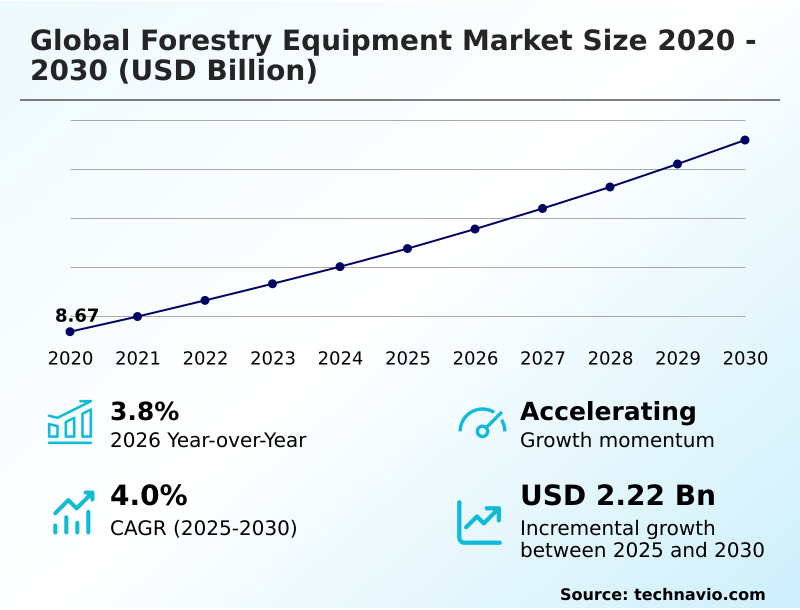
The forestry equipment market size is valued to increase by USD 2.22 billion, at a CAGR of 4% from 2025 to 2030. Technological innovation and integration of precision forestry systems will drive the forestry equipment market.
Major Market Trends & Insights
- APAC dominated the market and accounted for a 36.4% growth during the forecast period.
- By Product Type - Felling equipment segment was valued at USD 3.48 billion in 2024
- By End-user - Commercial logging companies segment accounted for the largest market revenue share in 2024
Market Size & Forecast
- Market Opportunities: USD 3.92 billion
- Market Future Opportunities: USD 2.22 billion
- CAGR from 2025 to 2030 : 4%
Market Summary
- The forestry equipment market is undergoing a significant transformation, driven by the dual imperatives of industrial efficiency and environmental stewardship. The shift toward a bio-based economy and the rising global demand for sustainable wood products necessitate a higher degree of mechanization and technological sophistication in timber harvesting.
- Modern machinery, including feller bunchers, skidders, and forwarders, are no longer just tools for extraction but are integral components of a digitally connected ecosystem. These machines leverage advanced hydraulic systems and real-time diagnostic software to maximize productivity while minimizing environmental impact.
- For instance, a large-scale timber operation can utilize fleet management software to coordinate its harvesters and forwarders, ensuring that cut-to-length logs are transported to the roadside with minimal delay and fuel consumption.
- This optimization not only improves the company's bottom line but also enhances its ability to comply with stringent sustainable forest management certifications, ensuring long-term access to valuable timber resources. The continuous innovation in areas like low-impact harvesting methods and autonomous navigation systems is crucial for addressing labor shortages and improving operational safety.
What will be the Size of the Forestry Equipment Market during the forecast period?
Get Key Insights on Market Forecast (PDF) Get Free Sample
How is the Forestry Equipment Market Segmented?
The forestry equipment industry research report provides comprehensive data (region-wise segment analysis), with forecasts and estimates in "USD million" for the period 2026-2030, as well as historical data from 2020-2024 for the following segments.
- Product type
- Felling equipment
- Extracting equipment
- On site processing equipment
- Spare parts
- Others
- End-user
- Commercial logging companies
- Timberland investment managers
- Government forestry agencies
- Rental service providers
- Individual contractors
- Application
- Logging
- Land clearing
- Forest fire management
- Others
- Geography
- North America
- US
- Canada
- Mexico
- APAC
- China
- India
- Australia
- Europe
- Germany
- France
- Spain
- South America
- Brazil
- Argentina
- Colombia
- Middle East and Africa
- South Africa
- Turkey
- Saudi Arabia
- Rest of World (ROW)
- North America
By Product Type Insights
The felling equipment segment is estimated to witness significant growth during the forecast period.
Felling equipment represents the primary stage of industrial-scale harvesting, encompassing machines like harvesters and feller bunchers. These are central to modern sustainable forest management, facilitating both commercial timber extraction and ecological restoration.
The integration of advanced computerized control interfaces and high-performance hydraulic systems allows for precise operations, which is critical for wildfire mitigation through effective fuel load reduction.
Modern cut-to-length systems utilize real-time diagnostic software to optimize performance, with some intelligent control systems reducing fuel consumption by ten percent.
As operations move to more challenging terrain, features like the winch-assist mechanism become essential, while predictive maintenance schedules derived from machine data ensure maximum uptime and support a continuous, efficient supply chain.
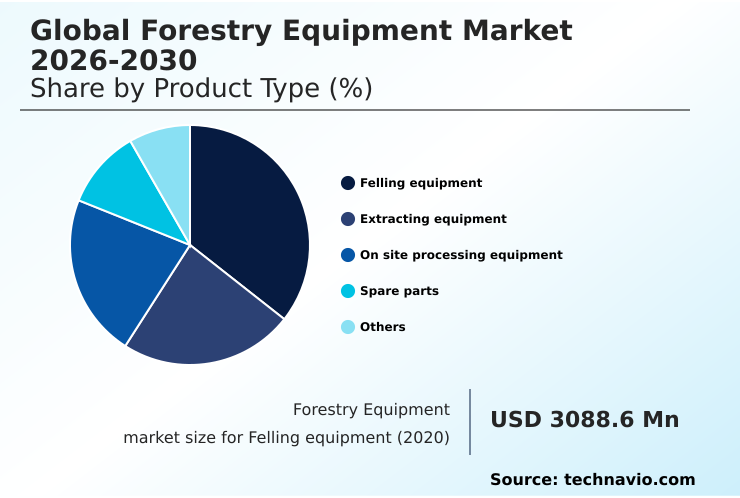
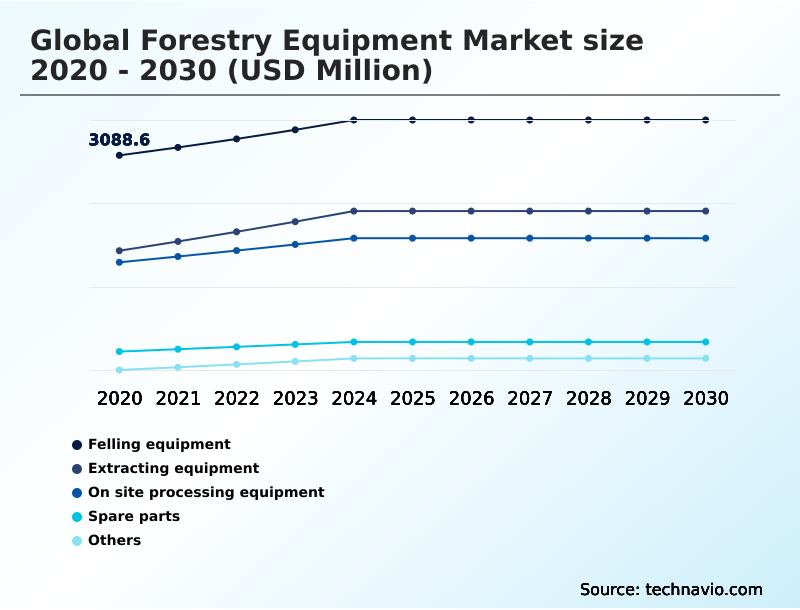
The Felling equipment segment was valued at USD 3.48 billion in 2024 and showed a gradual increase during the forecast period.
Regional Analysis
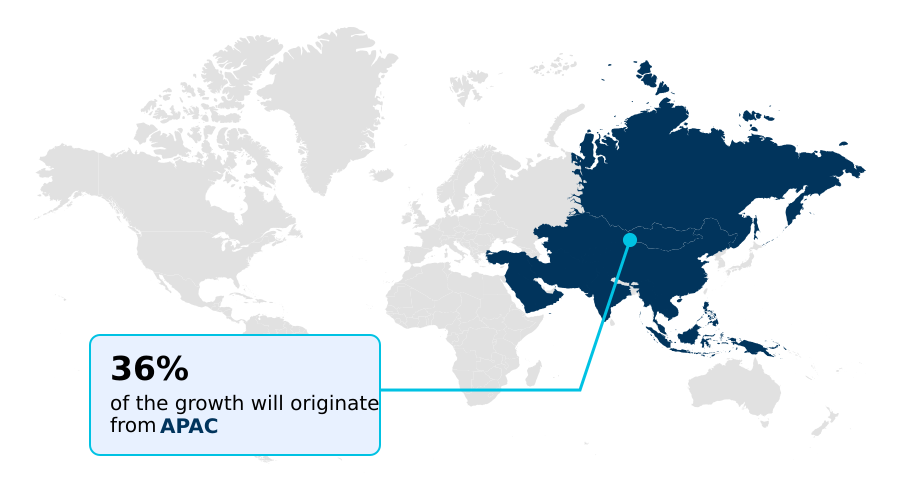
APAC is estimated to contribute 36.4% to the growth of the global market during the forecast period.Technavio’s analysts have elaborately explained the regional trends and drivers that shape the market during the forecast period.
See How Forestry Equipment Market Demand is Rising in APAC Get Free Sample
The geographic landscape dictates equipment specialization. APAC is set to contribute over 36% of the market growth, driven by industrial-scale harvesting in tropical regions that require specialized tracked carriers and amphibious excavators.
In contrast, Europe's focus on steep-slope operations in alpine regions creates demand for advanced cable yarders. North America prioritizes machinery for land-clearing and right-of-way maintenance, with a growing need for forestry mulchers to manage wildfire risk.
The Middle East represents a niche but growing segment focused on arid-zone afforestation, where soil stabilizers are critical.
This regional diversity is significant; while APAC's growth rate approaches 4.7%, Europe's more mature market expands at a steadier 3.4%, reflecting different stages of mechanization and environmental focus.
Market Dynamics
Our researchers analyzed the data with 2025 as the base year, along with the key drivers, trends, and challenges. A holistic analysis of drivers will help companies refine their marketing strategies to gain a competitive advantage.
- Achieving peak operational efficiency in the forestry equipment market requires a granular focus on specific performance metrics. Key industry discussions center on optimizing feller buncher fuel consumption and enhancing harvester head cutting accuracy metrics to reduce waste at the stump. The use of telematics data for predictive maintenance is becoming standard practice, allowing fleet managers to prevent costly downtime.
- A major focus is the evaluation of hybrid power systems in forestry equipment, which promise lower emissions and operational costs. For next-generation machinery, the successful implementation of autonomous forwarder navigation in dense forests is a critical milestone, heavily reliant on integrating lidar sensors on harvesters for precise environmental mapping.
- Firms are also addressing the challenge of reducing soil compaction with skidders through improved machine design. The push for advanced telematics for supply chain transparency is driven by regulatory demands, while the development of robust battery management systems for electric excavators is key to their wider adoption.
- Furthermore, the application of AI-driven real-time yield optimization promises to maximize the value of every log. A detailed cut-to-length system efficiency analysis often reveals that improving winch-assist safety mechanisms can reduce setup times in steep-slope operations, leading to productivity gains that are twice as high as those from minor engine power upgrades alone.
- Other critical areas include improving forestry mulcher performance on steep slopes, mobile chipper throughput optimization, and increasing horizontal grinder wear part durability. The ultimate goal combines low-impact harvesting and biodiversity preservation with the strategic use of ecological restoration with specialized equipment. Innovations like an active suspension for operator comfort and digital forestry for carbon tracking are also vital.
- However, overcoming fleet management software integration challenges remains a persistent hurdle for many operators.
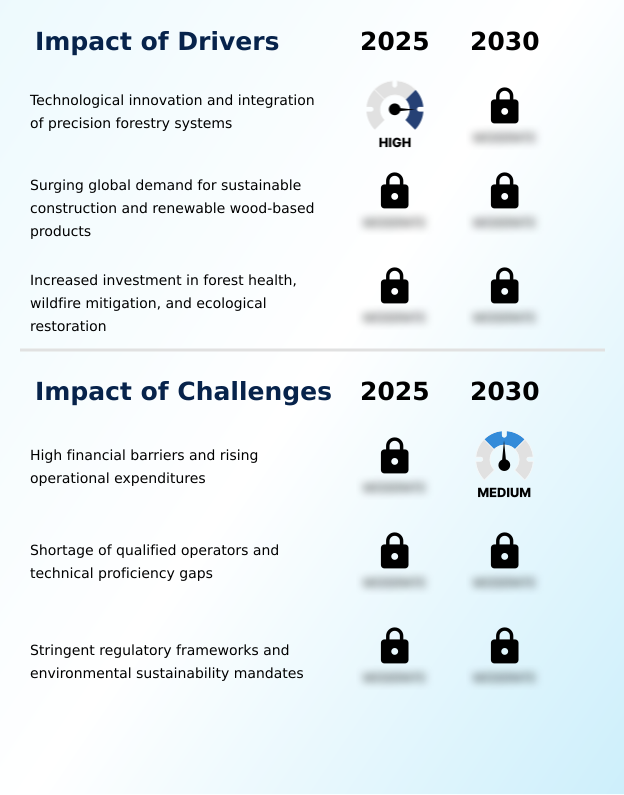
What are the key market drivers leading to the rise in the adoption of Forestry Equipment Industry?
- Technological innovation and the integration of precision forestry systems are primary drivers of market expansion.
- The surging global demand for a sustainable, bio-based economy is a primary market driver, compelling investment in high-efficiency machinery. Precision forestry systems are essential for modern environmental stewardship, allowing operators to meet stringent certification standards.
- The use of advanced feller bunchers in cut-to-length systems has been shown to increase harvesting efficiency by up to 25% in plantation settings.
- Fleet management software now incorporates modules for carbon sequestration reporting, providing the verifiable data needed to participate in the circular bioeconomy.
- Furthermore, these systems enable predictive maintenance schedules, which can reduce machine downtime by over 30%, ensuring a reliable supply of raw materials for construction and renewable energy.
What are the market trends shaping the Forestry Equipment Industry?
- The acceleration of electrification and the adoption of hybrid power systems are prominent trends reshaping the heavy machinery landscape.
- The rapid shift toward electrification is a defining market trend, with new battery-electric engines and hybrid-electric drivetrains helping operators pursue goals for zero-emission machinery. The development of high-capacity battery technology is crucial, with recent advancements extending the operational range of some mid-sized excavators by over 15%. Simultaneously, the adoption of autonomous navigation systems represents a leap in digital forestry.
- These systems use a combination of lidar sensors and stereo-vision cameras for environmental mapping, enabling remote monitoring capabilities that improve safety and productivity. The integration of advanced telematics allows for real-time yield optimization, with some systems demonstrating a 10% improvement in value recovery per log by making superior bucking decisions.
What challenges does the Forestry Equipment Industry face during its growth?
- High financial barriers and rising operational expenditures present a significant challenge affecting industry growth.
- High financial barriers and rising operational expenditures create significant challenges, with the cost of a modern forwarder or skidder excluding many smaller contractors. The pervasive skilled labor shortage is intensified by the technical proficiency gap; operating complex computerized control interfaces requires extensive training. Vacancy rates for mechanized logging positions have reached 15% in some key regions.
- Stringent regulatory frameworks add another layer of complexity and cost. For example, deploying a high-performance positioning solution for compliance can add thousands to the initial equipment price. While real-time diagnostic software helps manage maintenance costs, the specialized expertise required to use it effectively can increase labor expenses by as much as 20% compared to traditional mechanics.
Exclusive Technavio Analysis on Customer Landscape
The forestry equipment market forecasting report includes the adoption lifecycle of the market, covering from the innovator’s stage to the laggard’s stage. It focuses on adoption rates in different regions based on penetration. Furthermore, the forestry equipment market report also includes key purchase criteria and drivers of price sensitivity to help companies evaluate and develop their market growth analysis strategies.
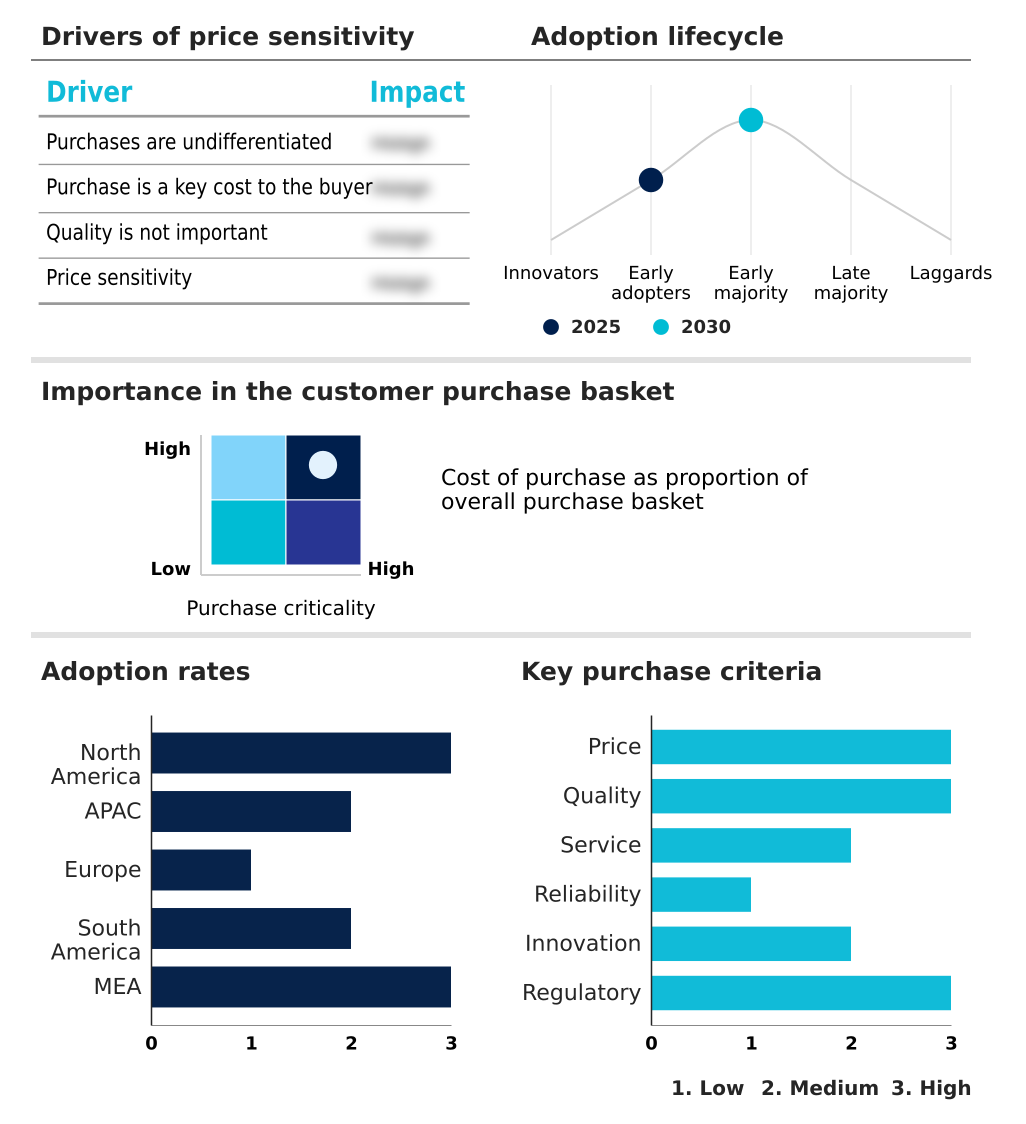
Customer Landscape of Forestry Equipment Industry
Competitive Landscape
Companies are implementing various strategies, such as strategic alliances, forestry equipment market forecast, partnerships, mergers and acquisitions, geographical expansion, and product/service launches, to enhance their presence in the industry.
ALBACH Maschinenbau AG. - Analysis indicates a strategic focus on heavy-duty self-propelled wood chippers and specialized mechanical engineering for high-performance forestry and agricultural applications.
The industry research and growth report includes detailed analyses of the competitive landscape of the market and information about key companies, including:
- ALBACH Maschinenbau AG.
- ANDREAS STIHL AG and Co. KG
- Astec Industries Inc.
- Caterpillar Inc.
- Doppstadt Umwelttechnik GmbH
- Eco Log Sweden AB
- Hitachi Construction Machinery
- Husqvarna AB
- J C Bamford Excavators Ltd.
- Kesla Oyj
- Kobe Steel Ltd.
- Komatsu Ltd.
- Liebherr International AG
- Logset Oy
- Morbark LLC.
- PALFINGER AG
- Ponsse Plc
- Sany Heavy Industry Co. Ltd.
- Tigercat International Inc.
- Volvo Construction Equipment
Qualitative and quantitative analysis of companies has been conducted to help clients understand the wider business environment as well as the strengths and weaknesses of key industry players. Data is qualitatively analyzed to categorize companies as pure play, category-focused, industry-focused, and diversified; it is quantitatively analyzed to categorize companies as dominant, leading, strong, tentative, and weak.
Recent Development and News in Forestry equipment market
- In May 2025, Trimble introduced a high-performance positioning solution engineered for forestry environments that maintains centimeter-level accuracy under dense forest canopies.
- In March 2025, Volvo Construction Equipment announced the commercial launch of its first mid-sized electric excavator configured for forest land clearing.
- In June 2025, the Skogforsk research institute in Sweden successfully concluded field trials for a fully autonomous forwarder that navigated a pre-mapped harvest site.
- In February 2025, John Deere expanded its manufacturing operations to include a dedicated assembly line for autonomous timber skidders designed for dense forest environments.
Dive into Technavio’s robust research methodology, blending expert interviews, extensive data synthesis, and validated models for unparalleled Forestry Equipment Market insights. See full methodology.
| Market Scope | |
|---|---|
| Page number | 321 |
| Base year | 2025 |
| Historic period | 2020-2024 |
| Forecast period | 2026-2030 |
| Growth momentum & CAGR | Accelerate at a CAGR of 4% |
| Market growth 2026-2030 | USD 2220.2 million |
| Market structure | Fragmented |
| YoY growth 2025-2026(%) | 3.8% |
| Key countries | US, Canada, Mexico, China, India, Australia, Japan, Indonesia, South Korea, Germany, Sweden, France, Finland, Spain, UK, Brazil, Argentina, Colombia, South Africa, Turkey, Saudi Arabia, Israel and UAE |
| Competitive landscape | Leading Companies, Market Positioning of Companies, Competitive Strategies, and Industry Risks |
Research Analyst Overview
- Strategic boardroom decisions in the forestry equipment market are increasingly influenced by the technical capabilities of modern machinery. The adoption of advanced feller bunchers, harvester heads, and forwarders is no longer optional for firms aiming to remain competitive. The integration of cut-to-length systems and precision forestry systems, enabled by autonomous navigation systems and sophisticated telematics, is fundamental.
- Onboard technologies such as lidar sensors, stereo-vision cameras, and computerized control interfaces are essential for data-driven operations. The core of these machines, their hydraulic systems, are being re-engineered for efficiency. For ecological and regulatory compliance, the deployment of low-impact harvesters, forestry mulchers, and horizontal grinders is critical. Mobile chippers, debarkers, and site preparation equipment support the circular bioeconomy.
- For logistics, knuckleboom loaders and winch-assist mechanisms are key. The shift toward hybrid-electric drivetrains, battery-electric engines, and diesel-electric hybrid engines is driven by decarbonization goals. Innovations like an active suspension system and satellite-based navigation are now standard expectations.
- A firm that fully integrates its fleet management software and real-time diagnostic software can achieve a 30% reduction in unplanned maintenance events, directly impacting budget certainty and asset availability. The effective use of carbon sequestration reporting, high-performance positioning solutions, steep-slope harvesters, tracked carriers, amphibious excavators, cable yarders, swing yarders, and soil stabilizers separates market leaders from laggards.
What are the Key Data Covered in this Forestry Equipment Market Research and Growth Report?
-
What is the expected growth of the Forestry Equipment Market between 2026 and 2030?
-
USD 2.22 billion, at a CAGR of 4%
-
-
What segmentation does the market report cover?
-
The report is segmented by Product Type (Felling equipment, Extracting equipment, On site processing equipment, Spare parts, and Others), End-user (Commercial logging companies, Timberland investment managers, Government forestry agencies, Individual contractors, and Rental service providers), Application (Logging, Land clearing, Forest fire management, and Others) and Geography (North America, APAC, Europe, South America, Middle East and Africa)
-
-
Which regions are analyzed in the report?
-
North America, APAC, Europe, South America and Middle East and Africa
-
-
What are the key growth drivers and market challenges?
-
Technological innovation and integration of precision forestry systems, High financial barriers and rising operational expenditures
-
-
Who are the major players in the Forestry Equipment Market?
-
ALBACH Maschinenbau AG., ANDREAS STIHL AG and Co. KG, Astec Industries Inc., Caterpillar Inc., Doppstadt Umwelttechnik GmbH, Eco Log Sweden AB, Hitachi Construction Machinery, Husqvarna AB, J C Bamford Excavators Ltd., Kesla Oyj, Kobe Steel Ltd., Komatsu Ltd., Liebherr International AG, Logset Oy, Morbark LLC., PALFINGER AG, Ponsse Plc, Sany Heavy Industry Co. Ltd., Tigercat International Inc. and Volvo Construction Equipment
-
Market Research Insights
- The forestry equipment market's dynamics are shaped by a commitment to sustainable forest management and ecological restoration. The industry's focus on wildfire mitigation and comprehensive forest health management is driving innovation. Adherence to principles of environmental stewardship, including soil compaction prevention and biodiversity preservation, is now a prerequisite for market access.
- The move toward zero-emission machinery and digital forestry, supported by remote monitoring capabilities, is accelerating. Firms are implementing automated timber sorting and predictive maintenance schedules, which has been shown to improve processing throughput by over 20%. The development of high-capacity battery technology is critical, with new systems extending operational time by up to 15% in certain applications.
- This transition facilitates real-time yield optimization and more effective digital inventory management through low-impact harvesting methods. This supports value-added processing and a circular bioeconomy, essential for everything from industrial-scale harvesting and land-clearing to niche applications like urban forestry and disaster mitigation.
- The need for specialized equipment for site preparation, vegetation management, right-of-way maintenance, and steep-slope operations in arid-zone afforestation continues to grow.
We can help! Our analysts can customize this forestry equipment market research report to meet your requirements.
 RIA -
RIA - 
