


Grain Silos And Storage System Market Size and Growth Forecast 2026-2030
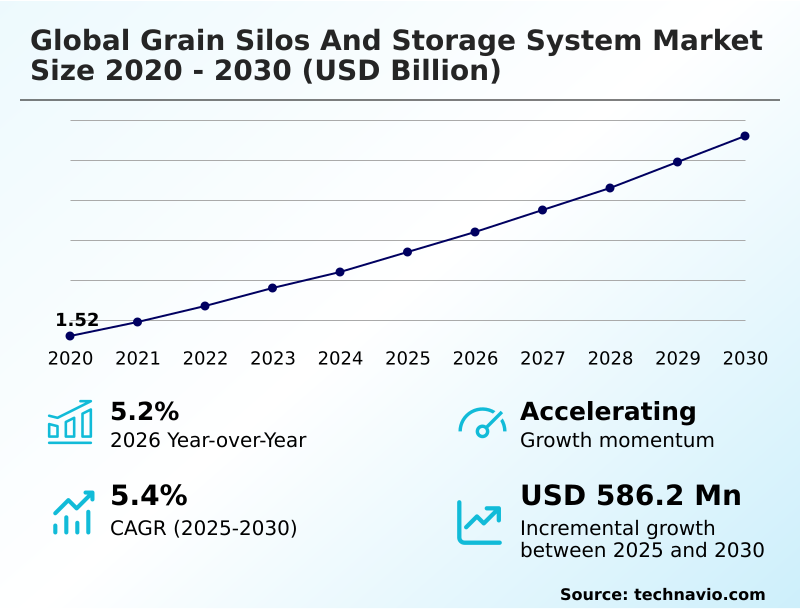
The Grain Silos And Storage System Market size was valued at USD 1.94 billion in 2025 growing at a CAGR of 5.4% during the forecast period 2026-2030.
APAC accounts for 41.3% of incremental growth during the forecast period. The Flat bottom silos segment by Type was valued at USD 767.9 million in 2024, while the Metal silos segment holds the largest revenue share by Material.
The market is projected to grow by USD 1.00 billion from 2020 to 2030, with USD 586.2 million of the growth expected during the forecast period of 2025 to 2030.
Get Key Insights on Market Forecast (PDF) Request Free Sample
Grain Silos And Storage System Market Overview
The grain silos and storage system market is undergoing a significant transformation, driven by the dual imperatives of food security and supply chain optimization. Modernization extends beyond simple storage to encompass sophisticated post-harvest loss reduction techniques. In North America, which accounts for over 30% of market growth, a key focus is retrofitting existing commercial grain elevators with automated grain handling and IoT-enabled grain monitoring systems. For instance, a large cooperative in the US Midwest, by integrating real-time spoilage prediction algorithms with its existing infrastructure, can achieve a 5-7% reduction in spoilage-related losses, directly improving profitability. This data-driven approach, compliant with food grade storage standards under the Food Safety Modernization Act (FSMA), ensures superior grain quality preservation. The emphasis is on creating intelligent, responsive assets that use technologies like slip-form silo construction and advanced hermetic bagging to manage everything from moisture content management to pest infestation control, reflecting a shift toward proactive, technology-enabled stewardship of agricultural commodities.
Drivers, Trends, and Challenges in the Grain Silos And Storage System Market
Procurement decisions in the grain silos and storage system market hinge on a complex evaluation of total cost of ownership versus operational flexibility. The upfront cost of high-capacity grain silos remains a primary consideration, but the long-term calculus is shifting.
For example, a decision-maker at a large-scale feed mill must weigh metal vs concrete silo durability, where concrete offers superior thermal mass but higher initial CAPEX. The integration of AI in grain storage is complicating this analysis by introducing software and sensor-related lifecycle costs, even as it promises significant gains in reducing post-harvest loss with silos.
Adherence to energy management standards like ISO 50001 is compelling operators to invest in energy-efficient aeration cycles, where AI-driven systems can reduce consumption by over 20% compared to manually controlled fans.
Simultaneously, the demand for modular silo systems for remote areas is growing, particularly in regions with underdeveloped infrastructure, as they offer a scalable and rapidly deployable alternative to traditional construction methods.
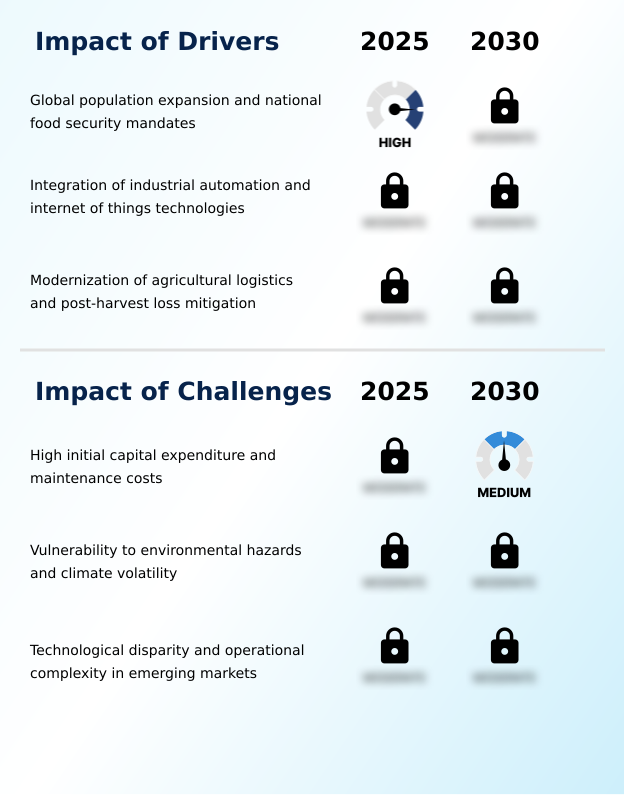
Primary Growth Driver: Global population expansion, coupled with mandates for national food security, serves as a primary driver for the development of robust grain storage infrastructure.
The primary driver for the market, which is projected to see an incremental expansion of over USD 586 million, is the global imperative to reduce post-harvest losses and enhance food security.
National governments are escalating investments in strategic grain reserve management, replacing outdated storage with modern systems capable of long-term grain quality preservation. This includes the modernization of agricultural logistics through the construction of commercial grain elevators at key transport hubs.
The adoption of automated grain handling and advanced hermetic bagging technologies directly supports these goals by minimizing spoilage and contamination, thereby maximizing the value of harvested crops.
These efforts are often aligned with international guidelines, such as those from the UN FAO, on safe and effective grain storage practices.
Emerging Market Trend: The market is increasingly defined by the digitalization of storage assets and the integration of predictive AI. This trend is shifting grain management from a reactive process to a proactive, data-driven discipline.
Key trends are centered on the digitalization and automation of storage infrastructure, fundamentally reshaping operational efficiency. The integration of predictive AI for aeration allows facilities to optimize energy usage, a critical factor as energy costs rise, with year-over-year market growth standing at 5.2%.
This move toward smart systems includes the widespread adoption of IoT-enabled grain monitoring, providing real-time data on conditions within the silo. Sustainability is also a major focus, with a shift toward sustainable construction materials and energy-efficient aeration cycles, often as part of broader green building certifications like LEED.
These technological advancements are transforming silos from passive storage vessels into active, data-rich nodes in the agricultural supply chain, enabling more precise management and reducing operational risks.
Key Industry Challenge: The substantial initial capital expenditure required for modern silo systems, along with ongoing maintenance costs, presents a significant challenge to market growth.
A significant challenge remains the high initial capital expenditure required for modern storage systems, which can be prohibitive for smaller operators and in emerging markets. The cost of high-tensile steel fabrication and complex silo foundation engineering, necessary to meet seismic and wind load standards like Eurocode 8, presents a substantial financial barrier.
Furthermore, the operational complexity of advanced systems creates a technological disparity. The effective use of cloud-based grain management and real-time spoilage prediction platforms is contingent on reliable connectivity and skilled technicians, which are not universally available. This digital divide restricts the widespread adoption of efficiency-enhancing technologies, limiting the potential for uniform improvements in global grain storage capacity and performance.
Explore Full Market Dynamics Analysis Request Free Sample
Grain Silos And Storage System Market Segmentation
The grain silos and storage system industry research report provides comprehensive data including region-wise segment analysis, with forecasts and analysis for the period 2026-2030, as well as historical data from 2020-2024 for the following segments.
Type Segment Analysis
The flat bottom silos segment is estimated to witness significant growth during the forecast period.
Flat bottom silos represent the foundational solution for long-term, high-volume storage in the grain silos and storage system market.
These units, primarily utilizing galvanized steel silo construction, are engineered for the immense pressures of static grain columns, necessitating robust silo foundation engineering compliant with local seismic and soil standards.
Unlike other designs, they depend on mechanical sweep auger mechanisms for full discharge, a critical consideration in operational planning for commercial grain elevators.
The integration of advanced grain aeration systems and networks of temperature monitoring cables is standard, ensuring effective moisture content management and grain quality preservation.
These systems are central to post-harvest loss reduction strategies, constituting a significant portion of the market's infrastructure.
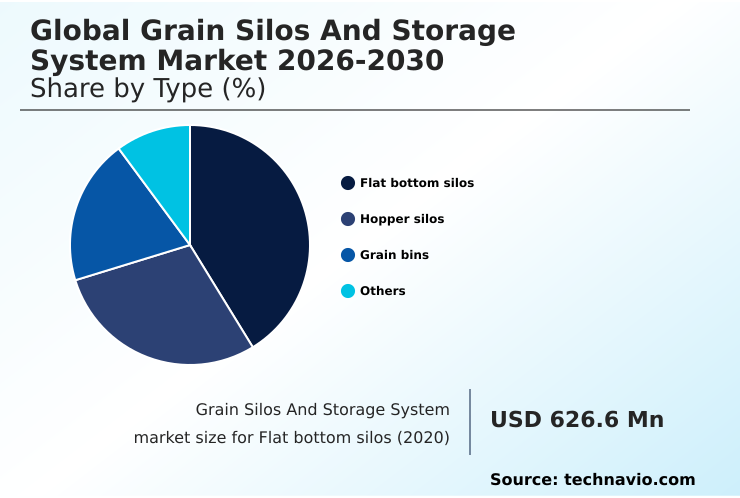
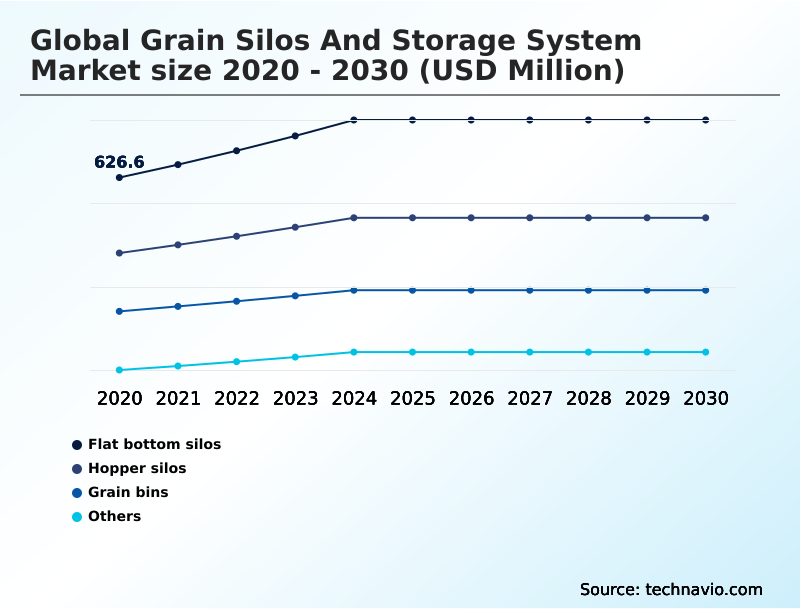
The Flat bottom silos segment was valued at USD 767.9 million in 2024 and showed a gradual increase during the forecast period.
Grain Silos And Storage System Market by Region: APAC Leads with 41.3% Growth Share
APAC is estimated to contribute 41.3% to the growth of the global market during the forecast period.
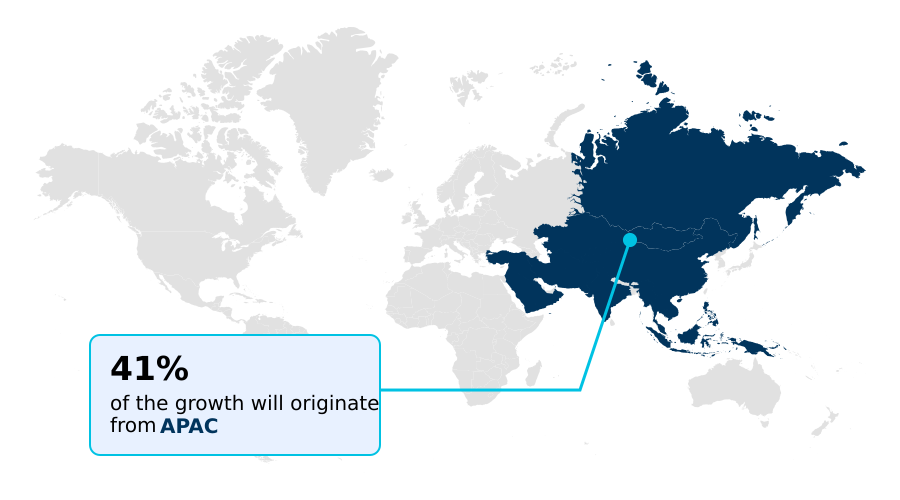
The geographic landscape of the grain silos and storage system market is characterized by divergent regional priorities, with APAC poised to contribute 41.3% of the incremental growth.
In this region, nations like India and China are focused on building out strategic grain reserve management capabilities to enhance food security, driving demand for large-scale reinforced concrete silo design.
North America, contributing 30.6% to growth, is centered on technological upgrades to an established infrastructure, emphasizing IoT-enabled grain monitoring and solutions that ensure compliance with ISO 22000 for food safety in the export chain.
This involves optimizing commercial grain elevators with high-tensile steel fabrication for greater durability and integrating cloud-based grain management platforms for enhanced logistical control.
Across all regions, the selection of storage technology is increasingly influenced by localized climate conditions and the need for resilient infrastructure.
Customer Landscape Analysis for the Grain Silos And Storage System Market
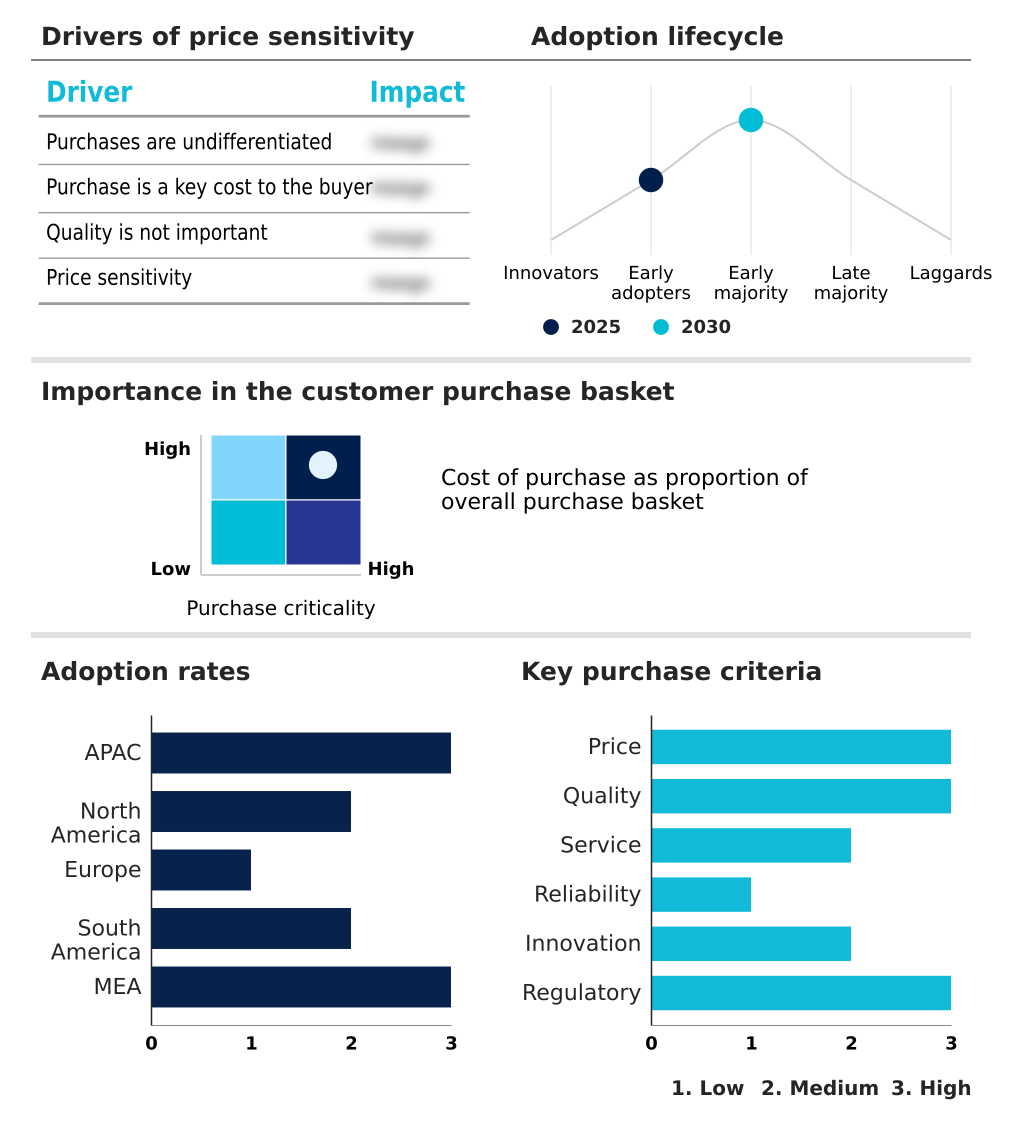
The grain silos and storage system market forecasting report includes the adoption lifecycle of the market, covering from the innovator’s stage to the laggard’s stage. It focuses on adoption rates in different regions based on penetration. Furthermore, the grain silos and storage system market report also includes key purchase criteria and drivers of price sensitivity to help companies evaluate and develop their market growth analysis strategies.
Competitive Landscape of the Grain Silos And Storage System Market
Companies are implementing various strategies, such as strategic alliances, partnerships, mergers and acquisitions, geographical expansion, and product/service launches, to enhance their presence in the grain silos and storage system market industry.
Ag Growth International Inc. - Offers comprehensive grain management solutions, integrating on-farm storage, handling, and conditioning with large-scale commercial systems for port terminals and food processors.
The industry research and growth report includes detailed analyses of the competitive landscape of the market and information about key companies, including:
- Ag Growth International Inc.
- ALTINBILEK
- BBCA Storex
- Behlen Mfg Co.
- BROCK GRAIN SYSTEMS.
- Chief Agri Industrial Group
- CST Industries Inc.
- Grain and Protein Technologies.
- Grain Silo International Co
- Meridian Manufacturing Inc.
- Mysilo Grain Storage Systems
- Prado Storage Solutions SL
- Rostfrei Steels Pvt Ltd.
- SCG SILOS GRUPO SL.
- SILOS METALICOS ZARAGOZA S.L.U.
- Sioux Steel Co.
- Sukup Manufacturing Co.
- Symaga SA
- Top-Siloconstructions BV
- Tornum AB.
Qualitative and quantitative analysis of companies has been conducted to help clients understand the wider business environment as well as the strengths and weaknesses of key industry players. Data is qualitatively analyzed to categorize companies as pure play, category-focused, industry-focused, and diversified; it is quantitatively analyzed to categorize companies as dominant, leading, strong, tentative, and weak.
Recent Developments in the Grain Silos And Storage System Market
- In March 2025, Ag Growth International completed the assembly of a modular grain terminal in North Africa, featuring a reconfigurable design to handle seasonal harvest fluctuations and evolving import requirements.
- In May 2025, International Business Machines Corp. launched a specialized software platform that leverages historical climate data and real-time sensor inputs to optimize grain silo aeration cycles, advancing predictive analytics in agriculture.
- In April 2025, Banco de la Nacion in Argentina revised its lending criteria for agricultural infrastructure projects, temporarily halting several silo construction plans due to increased volatility in steel prices and the cost of imported components.
- In March 2025, the government of India successfully operationalized ten new mega-silo complexes under a Public-Private Partnership model, facilitating bulk handling of wheat to modernize its national grain procurement and distribution system.
Research Analyst Overview: Grain Silos And Storage System Market
The grain silos and storage system market's evolution is now dictated by the total cost of ownership and technology integration rather than mere capacity expansion. While new galvanized steel silo construction continues, a significant share of capital expenditure is directed at retrofitting the existing installed base.
The industry is grappling with decisions on whether to invest in comprehensive structural integrity analysis and upgrade older assets with modern grain aeration systems and dust explosion suppression technology or to pursue new builds.
With metal silos accounting for over 70% of the market, boardroom discussions center on the ROI of integrating advanced features like temperature monitoring cables and sweep auger mechanisms into legacy structures. This decision is increasingly influenced by compliance with structural codes like ASCE/SEI 7, which sets stringent requirements for wind and seismic loads, impacting the feasibility and cost of upgrades.
The focus is shifting from passive storage to active asset management, where grain quality preservation is achieved through a combination of robust physical infrastructure and intelligent digital oversight.
Dive into Technavio’s robust research methodology, blending expert interviews, extensive data synthesis, and validated models for unparalleled Grain Silos And Storage System Market insights. See full methodology.
| Market Scope | |
|---|---|
| Page number | 302 |
| Base year | 2025 |
| Historic period | 2020-2024 |
| Forecast period | 2026-2030 |
| Growth momentum & CAGR | Accelerate at a CAGR of 5.4% |
| Market growth 2026-2030 | USD 586.2 million |
| Market structure | Fragmented |
| YoY growth 2025-2026(%) | 5.2% |
| Key countries | China, India, Australia, Japan, Indonesia, Thailand, US, Canada, Mexico, France, Germany, Ukraine, Russia, Spain, Italy, Brazil, Argentina, Chile, Saudi Arabia, South Africa, Egypt, Turkey and UAE |
| Competitive landscape | Leading Companies, Market Positioning of Companies, Competitive Strategies, and Industry Risks |
Grain Silos And Storage System Market: Key Questions Answered in This Report
-
What is the expected growth of the Grain Silos And Storage System Market between 2026 and 2030?
-
The Grain Silos And Storage System Market is expected to grow by USD 586.2 million during 2026-2030, registering a CAGR of 5.4%. Year-over-year growth in 2026 is estimated at 5.2%%. This acceleration is shaped by global population expansion and national food security mandates, which is intensifying demand across multiple end-use verticals covered in the report.
-
-
What segmentation does the market report cover?
-
The report is segmented by Type (Flat bottom silos, Hopper silos, Grain bins, and Others), Material (Metal silos, Concrete silos, and Others), Capacity (1000 to 5000 tons, Above 5000 tons, and Up to 1000 tons) and Geography (APAC, North America, Europe, South America, Middle East and Africa). Among these, the Flat bottom silos segment is estimated to witness significant growth during the forecast period, driven by rising adoption across key application areas. Each segment includes detailed qualitative and quantitative analysis, along with historical data from 2020-2024 and forecasts through 2030 with year-over-year growth rates.
-
-
Which regions are analyzed in the report?
-
The report covers APAC, North America, Europe, South America and Middle East and Africa. APAC is estimated to contribute 41.3% to market growth during the forecast period. Country-level analysis includes China, India, Australia, Japan, Indonesia, Thailand, US, Canada, Mexico, France, Germany, Ukraine, Russia, Spain, Italy, Brazil, Argentina, Chile, Saudi Arabia, South Africa, Egypt, Turkey and UAE, with dedicated market size tables and year-over-year growth for each.
-
-
What are the key growth drivers and market challenges?
-
The primary driver is global population expansion and national food security mandates, which is accelerating investment and industry demand. The main challenge is high initial capital expenditure and maintenance costs, creating operational barriers for key market participants. The report quantifies the impact of each driver and challenge across 2026 and 2030 with comparative analysis.
-
-
Who are the major players in the Grain Silos And Storage System Market?
-
Key vendors include Ag Growth International Inc., ALTINBILEK, BBCA Storex, Behlen Mfg Co., BROCK GRAIN SYSTEMS., Chief Agri Industrial Group, CST Industries Inc., Grain and Protein Technologies., Grain Silo International Co, Meridian Manufacturing Inc., Mysilo Grain Storage Systems, Prado Storage Solutions SL, Rostfrei Steels Pvt Ltd., SCG SILOS GRUPO SL., SILOS METALICOS ZARAGOZA S.L.U., Sioux Steel Co., Sukup Manufacturing Co., Symaga SA, Top-Siloconstructions BV and Tornum AB.. The report provides qualitative and quantitative analysis categorizing companies as dominant, leading, strong, tentative, and weak based on their market positioning. Company profiles include business segment analysis, SWOT assessment, key offerings, and recent strategic developments.
-
Grain Silos And Storage System Market Research Insights
Market dynamics are shaped by a strategic push toward technological integration and operational resilience. The growth in APAC, with a year-over-year rate of 6.2%, is outpacing Europe's 4.5% expansion, driven by large-scale food security initiatives. In North America, the focus is on upgrading existing infrastructure with advanced digital tools.
Port terminal operators are deploying remote silo monitoring and digital twin for silo simulation to optimize throughput and ensure compliance with OSHA regulations on dust hazards, specifically standard 29 CFR 1910.272. This allows for predictive maintenance on bulk solids handling equipment and minimizes downtime.
The adoption of predictive AI for aeration and automated thermal management is becoming a key differentiator, enabling facilities to reduce energy costs while maintaining optimal storage conditions, thereby enhancing the overall value proposition of modern storage systems.
We can help! Our analysts can customize this grain silos and storage system market research report to meet your requirements.
 RIA -
RIA - 
