

Green Methanol Market Analysis, Size, and Forecast 2026-2030: North America (US, Canada, and Mexico), Europe (Germany, The Netherlands, and France), APAC (China, Japan, and South Korea), South America (Brazil, Argentina, and Colombia), Middle East and Africa (Saudi Arabia, UAE, and South Africa), and Rest of World (ROW)

Green Methanol Market Analysis, Size, and Forecast 2026-2030:
North America (US, Canada, and Mexico), Europe (Germany, The Netherlands, and France), APAC (China, Japan, and South Korea), South America (Brazil, Argentina, and Colombia), Middle East and Africa (Saudi Arabia, UAE, and South Africa), and Rest of World (ROW)

Published: Jan 2026 293 Pages SKU: IRTNTR81236

Market Overview at a Glance

$3.99 B
Market Opportunity
30.8%
CAGR 2025 - 2030
36.4%
North America Growth
$606.6 Mn
Biomethanol segment 2024

Green Methanol Market Size 2026-2030

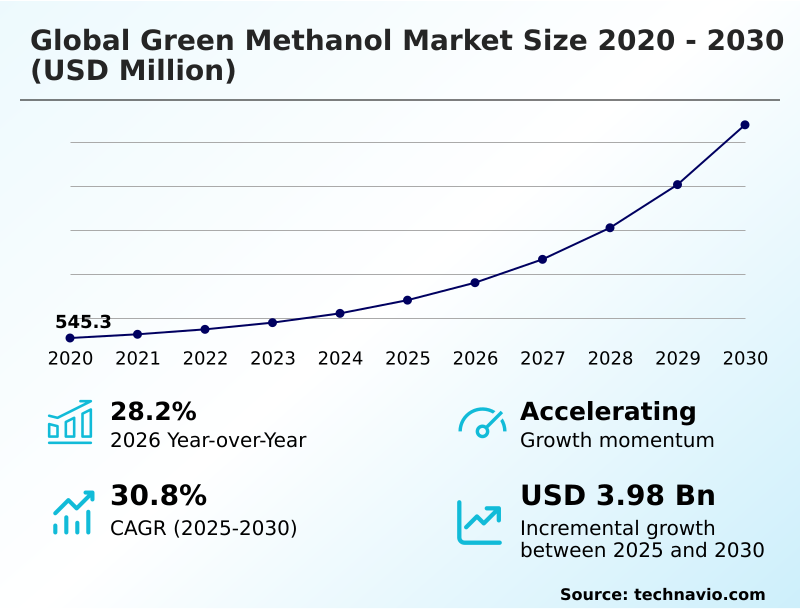
The green methanol market size is valued to increase by USD 3.99 billion, at a CAGR of 30.8% from 2025 to 2030. Accelerated decarbonization in maritime shipping sector will drive the green methanol market.

Major Market Trends & Insights

  • North America dominated the market and accounted for a 36.4% growth during the forecast period.
  • By Type - Biomethanol segment was valued at USD 606.6 million in 2024
  • By Method - Power to methanol segment accounted for the largest market revenue share in 2024

Market Size & Forecast

  • Market Opportunities: USD 4.85 billion
  • Market Future Opportunities: USD 3.99 billion
  • CAGR from 2025 to 2030 : 30.8%

Market Summary

  • The green methanol market is undergoing accelerated expansion, driven by the dual mandates of decarbonizing maritime shipping and chemical manufacturing. This transition is catalyzed by stringent regulatory frameworks and significant investments in renewable energy infrastructure. The market is witnessing a fundamental shift from pilot projects to full-scale operationalization, with major logistics firms ordering dual-fuel vessels that require sustainable marine fuel.
  • This creates secured demand, enabling final investment decision criteria for large production plants. In a typical business scenario, a chemical producer seeking scope 3 emission reduction transitions to low-carbon chemical feedstock. This requires securing a reliable supply via long-term offtake agreements, navigating complex carbon intensity calculation methodologies, and integrating new logistics for a net-zero supply chain.
  • While the high levelized cost of production compared to fossil fuels remains a barrier, government incentives and consumer demand for sustainable products continue to fuel momentum.

What will be the Size of the Green Methanol Market during the forecast period?
Get Key Insights on Market Forecast (PDF) Request Free Sample

How is the Green Methanol Market Segmented?

The green methanol industry research report provides comprehensive data (region-wise segment analysis), with forecasts and estimates in "USD million" for the period 2026-2030, as well as historical data from 2020-2024 for the following segments.

  • Type
    • Biomethanol
    • E-methanol
  • Method
    • Power to methanol
    • Biomethane reforming
    • Biomass gasification
    • Waste to methanol
  • End-user
    • Fuel
    • Chemical
  • Geography
    • North America
      • US
      • Canada
      • Mexico
    • Europe
      • Germany
      • The Netherlands
      • France
    • APAC
      • China
      • Japan
      • South Korea
    • South America
      • Brazil
      • Argentina
      • Colombia
    • Middle East and Africa
      • Saudi Arabia
      • UAE
      • South Africa
    • Rest of World (ROW)

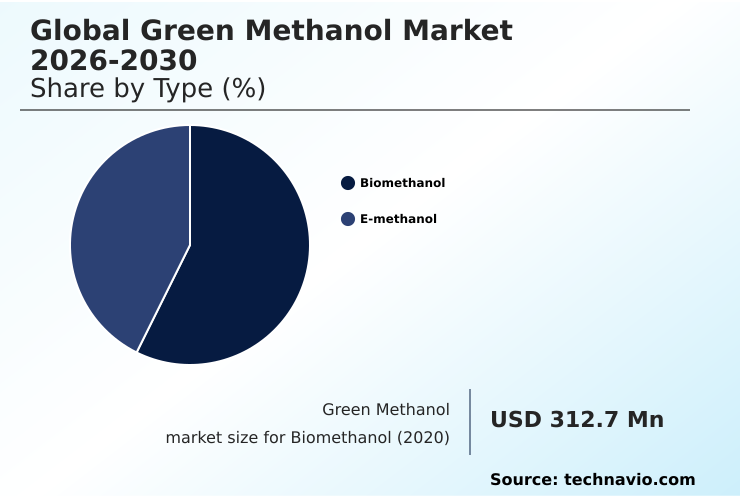
By Type Insights

The biomethanol segment is estimated to witness significant growth during the forecast period.

The biomethanol segment leverages biological feedstocks through processes like the biomass gasification system and anaerobic digestion process. A key advantage is its role in a circular economy model integration, as it transforms waste into high-value energy products.

The pathway is attractive in regions with strong agricultural sectors, enabling agricultural waste valorization. However, the segment's growth is constrained by feedstock logistics optimization and challenges in sustainable biomass sourcing of materials like forestry residue feedstock.

Despite the waste valorization process benefits, the levelized cost of production remains a factor in its adoption for the decarbonization of maritime shipping. Production via this pathway has demonstrated a 20% increase in conversion efficiency in recent pilot projects.
Request Free Sample

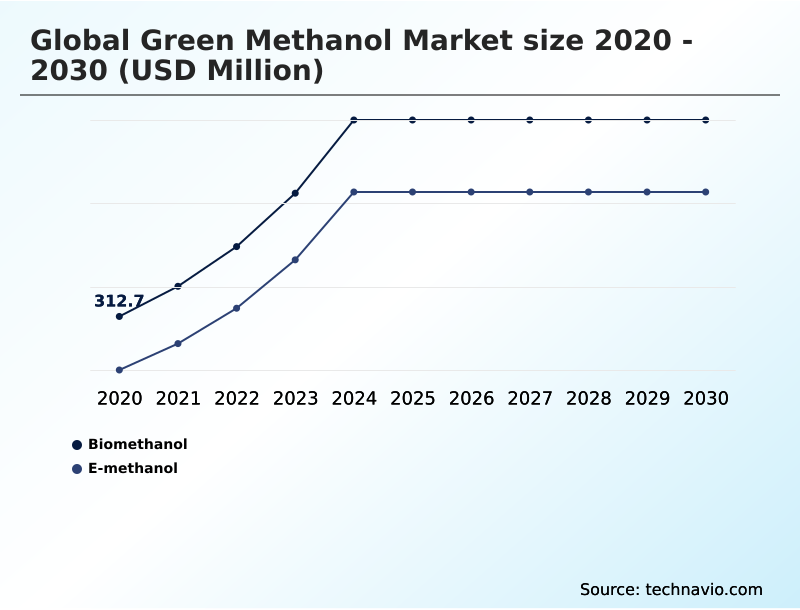
The Biomethanol segment was valued at USD 606.6 million in 2024 and showed a gradual increase during the forecast period.
Request Free Sample

Regional Analysis

North America is estimated to contribute 36.4% to the growth of the global market during the forecast period.Technavio’s analysts have elaborately explained the regional trends and drivers that shape the market during the forecast period.

See How Green Methanol Market Demand is Rising in North America Request Free Sample

The geographic landscape is defined by a division between production and consumption hubs. North America is emerging as a production powerhouse for e-methanol production, leveraging incentives that lower the cost of green hydrogen feedstock by up to 30%.

Europe acts as the primary demand center, driven by regulations supporting the decarbonization of maritime shipping and its goal of a net-zero supply chain.

APAC, led by China, is a major hub for biomethanol production using technologies like municipal solid waste conversion. South America is a competitive exporter due to a low levelized cost of production.

Meanwhile, the use of methanol as a hydrogen carrier liquid or liquid organic hydrogen carrier is a key factor in shaping global trade routes, facilitating the industrial decarbonization pathway by connecting resource-rich regions with industrial demand centers.

Market Dynamics

Our researchers analyzed the data with 2025 as the base year, along with the key drivers, trends, and challenges. A holistic analysis of drivers will help companies refine their marketing strategies to gain a competitive advantage.

  • Strategic decision-making in the global green methanol market 2026-2030 requires a deep understanding of competing production pathways and end-use applications. A critical comparison is biomethane reforming vs biomass gasification, where the former leverages existing infrastructure while the latter utilizes diverse sustainable biomass for biomethanol.
  • The pathway for e-methanol production from green hydrogen is gaining traction, heavily influenced by the impact of IRA on e-methanol, which can reduce production costs significantly. Its role as a fuel is paramount, with green methanol for maritime fuel leading the demand charge, supported by advances in dual-fuel engine green methanol performance.
  • However, challenges in green methanol production, including high costs and logistical hurdles in the green methanol supply chain logistics, persist. The use of e-methanol as a hydrogen carrier also presents a growing opportunity. In the chemical industry, green methanol in chemical industry is pivotal, especially for methanol-to-olefins for green plastics.
  • The design of a power-to-x methanol plant design is complex, often requiring carbon capture for e-methanol synthesis. Understanding the cost comparison of green methanol pathways is crucial, as are the evolving regulatory frameworks for green methanol. The viability of waste-to-methanol conversion technology depends on tipping fees and feedstock consistency.
  • Ultimately, securing bunkering infrastructure for green methanol and the role of offtake agreements in financing are key to decarbonizing shipping with green methanol, aligning with circular economy principles in biomethanol.
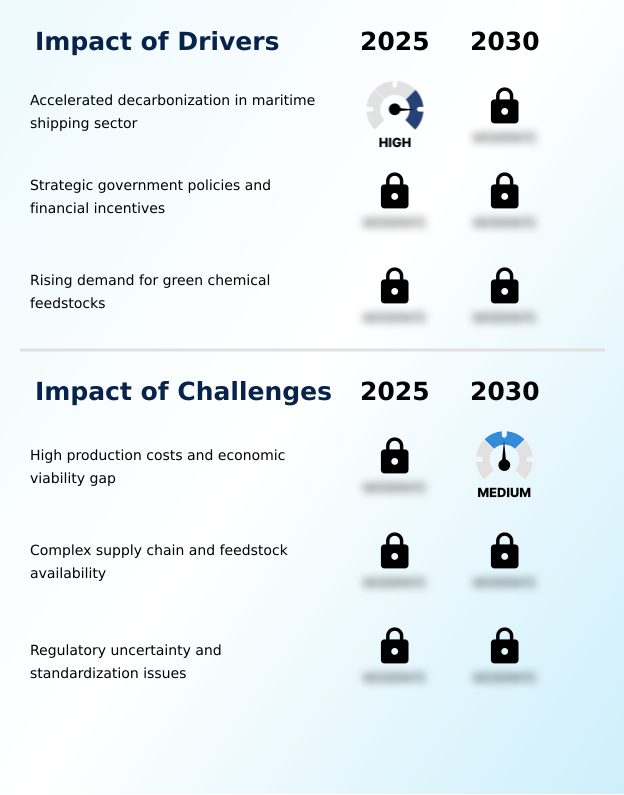
What are the key market drivers leading to the rise in the adoption of Green Methanol Industry?

  • Accelerated decarbonization within the maritime shipping sector is a key market driver, compelling a shift toward cleaner alternative fuels.

  • Regulatory frameworks mandating fuel EU maritime compliance are a primary driver, accelerating demand for sustainable marine fuel. This creates a guaranteed market, making it a viable drop-in fuel solution.
  • Concurrently, a growing green chemical procurement strategy in the chemical sector boosts demand for low-carbon chemical feedstock for applications like the methanol-to-olefins pathway and low-carbon plastics production.
  • This push for scope 3 emission reduction improves the business case for technologies such as emissions-to-liquids technology. Investment in an advanced waste-to-methanol plant now sees returns up to 15% faster due to government incentives.
  • These dual drivers from both fuel and chemical sectors are fundamentally reshaping the industry's economic landscape.

What are the market trends shaping the Green Methanol Industry?

  • A significant market trend is the rapid operationalization of dual-fuel methanol vessels within the maritime logistics sector, driven by stringent regulatory pressures to reduce greenhouse gas emissions.

  • A key trend is the dual-fuel vessel operationalization for ships with dual-fuel engine compatibility, creating massive demand and improving offtake agreement security. This shift relies on the industrial scaling of power-to-x synthesis and electrolyzer technology integration within integrated energy hub development projects. These projects often include carbon capture and utilization and are assessed against strict final investment decision criteria.
  • The build-out of port bunkering infrastructure is also critical, with some new facilities demonstrating a 30% reduction in refueling times. A focus on well-to-wake emissions analysis further drives adoption of these cleaner technologies, changing how fuel life-cycle impacts are measured.

What challenges does the Green Methanol Industry face during its growth?

  • The high production costs and the economic viability gap compared to conventional fuels represent a key challenge affecting industry growth.

  • A significant challenge is the lack of harmonized regulations, complicating carbon intensity calculation and adherence to strict renewable energy directive criteria. This uncertainty affects projects involving biomethane reforming and renewable natural gas upgrading, which rely on consistent standards. Technical hurdles in processes like catalytic methanol conversion and syngas conditioning unit operation also persist.
  • Furthermore, the logistical complexity of biogenic CO2 sourcing and the need for a grid-balancing mechanism to manage intermittent renewables add costs. For brownfield projects, a steam methane reforming modification can reduce initial capital outlay by 40%, yet operational viability remains dependent on stable feedstock costs. These factors create a complex risk profile for the broader industrial decarbonization pathway.

Exclusive Technavio Analysis on Customer Landscape

The green methanol market forecasting report includes the adoption lifecycle of the market, covering from the innovator’s stage to the laggard’s stage. It focuses on adoption rates in different regions based on penetration. Furthermore, the green methanol market report also includes key purchase criteria and drivers of price sensitivity to help companies evaluate and develop their market growth analysis strategies.
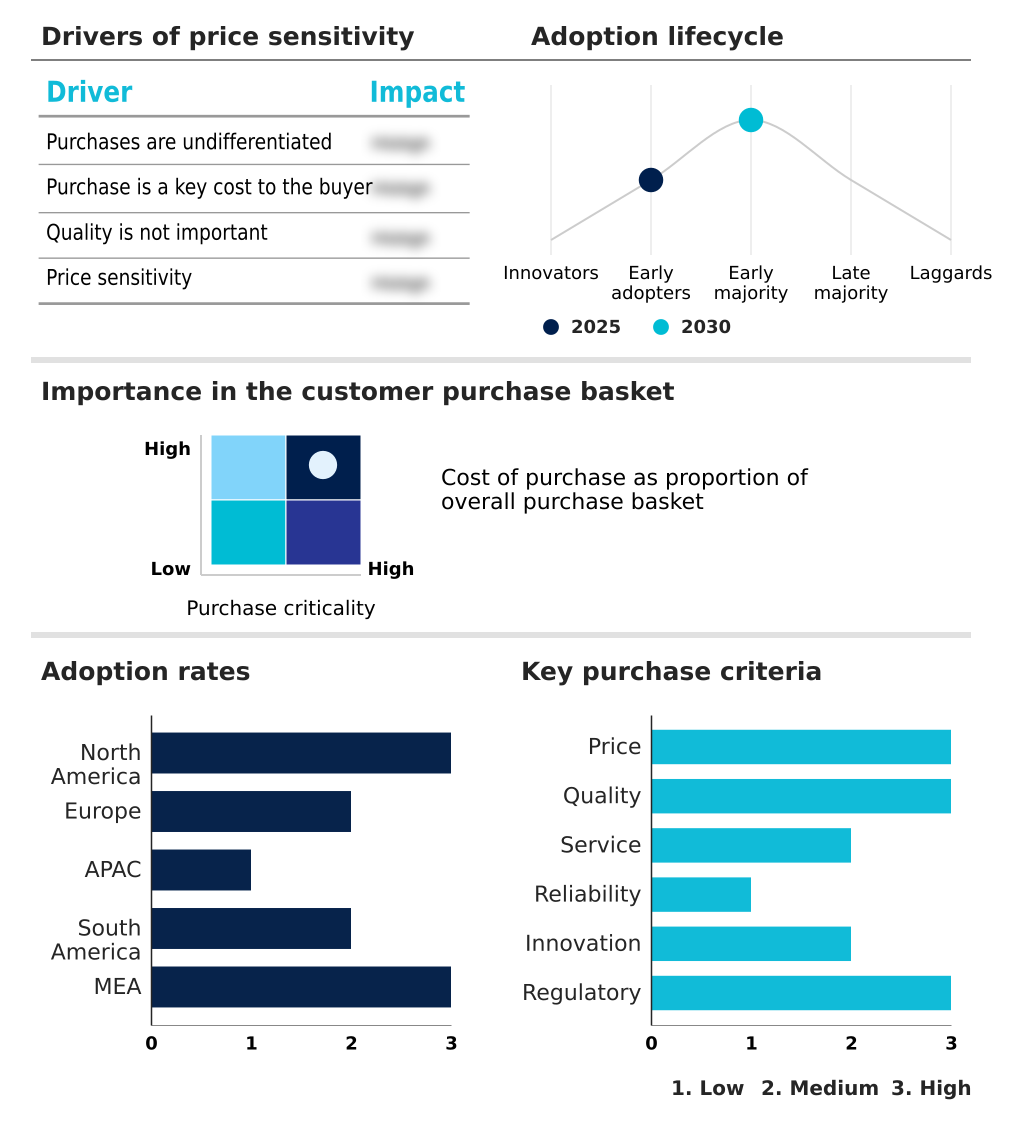
Customer Landscape of Green Methanol Industry

Competitive Landscape

Companies are implementing various strategies, such as strategic alliances, green methanol market forecast, partnerships, mergers and acquisitions, geographical expansion, and product/service launches, to enhance their presence in the industry.

ABEL Energy Pty Ltd - Analysis indicates a focus on commercial-scale renewable methanol production, utilizing proprietary Emissions-to-Liquids technology that converts captured carbon dioxide into fuel for industrial applications.

The industry research and growth report includes detailed analyses of the competitive landscape of the market and information about key companies, including:

  • ABEL Energy Pty Ltd
  • Avaada
  • C2X
  • Carbon Recycling International
  • ENERKEM Inc.
  • European Energy
  • GIDARA Energy
  • Iberdrola SA
  • Johnson Matthey Plc
  • KBR Inc.
  • Lhyfe
  • Linde Plc
  • Liquid Wind
  • Methanex Corp.
  • OCI NV
  • Sodra
  • SunGas Renewables
  • Thyssenkrupp Uhde GmbH
  • Topsoes AS
  • WASTEFUEL

Qualitative and quantitative analysis of companies has been conducted to help clients understand the wider business environment as well as the strengths and weaknesses of key industry players. Data is qualitatively analyzed to categorize companies as pure play, category-focused, industry-focused, and diversified; it is quantitatively analyzed to categorize companies as dominant, leading, strong, tentative, and weak.

Recent Development and News in Green methanol market

  • In August 2024, the Port of Singapore Authority successfully completed a green methanol bunkering simulation with a capacity exceeding 3,000 metric tons, validating the safety protocols required for mainstream adoption.
  • In September 2024, Sinopec announced the conversion of one of its existing coal-to-methanol units to accept green hydrogen and biomass inputs, creating a hybrid green methanol facility.
  • In January 2025, a consortium of German automotive manufacturers released a joint procurement strategy detailing their requirement for green methanol-based polymers for vehicle interiors, signaling rising demand.
  • In May 2025, Sumitomo Chemical in Japan initiated a pilot project to gasify rice straw and husks for methanol synthesis, highlighting the adaptability of gasification technology to diverse regional feedstocks.

Dive into Technavio’s robust research methodology, blending expert interviews, extensive data synthesis, and validated models for unparalleled Green Methanol Market insights. See full methodology.

Market Scope
Page number 293
Base year 2025
Historic period 2020-2024
Forecast period 2026-2030
Growth momentum & CAGR Accelerate at a CAGR of 30.8%
Market growth 2026-2030 USD 3985.0 million
Market structure Fragmented
YoY growth 2025-2026(%) 28.2%
Key countries US, Canada, Mexico, Germany, The Netherlands, France, UK, Italy, Spain, China, Japan, South Korea, India, Australia, Indonesia, Brazil, Argentina, Colombia, Saudi Arabia, UAE, South Africa, Israel and Turkey
Competitive landscape Leading Companies, Market Positioning of Companies, Competitive Strategies, and Industry Risks

Request Free Sample

Research Analyst Overview

  • The green methanol market is defined by a complex interplay of technology, policy, and infrastructure development. Production is scaling through pathways like biomethane reforming and power-to-x synthesis, utilizing green hydrogen feedstock and biogenic carbon dioxide. Technologies such as the biomass gasification system enable agricultural waste valorization and municipal solid waste conversion.
  • In boardroom decisions, the choice between investing in an advanced waste-to-methanol plant versus securing supply through offtake agreements is critical. For instance, vertical integration into production can offer a 15% greater control over price volatility. The methanol-to-olefins pathway is creating new value chains for low-carbon chemical feedstock.
  • Success hinges on mastering processes from syngas conditioning unit operation and catalytic methanol conversion to electrolyzer technology integration for producing sustainable marine fuel. Managing sustainable biomass sourcing and establishing port bunkering infrastructure are crucial for leveraging methanol as a hydrogen carrier liquid and ensuring dual-fuel engine compatibility across global fleets.

What are the Key Data Covered in this Green Methanol Market Research and Growth Report?

  • What is the expected growth of the Green Methanol Market between 2026 and 2030?

    • USD 3.99 billion, at a CAGR of 30.8%

  • What segmentation does the market report cover?

    • The report is segmented by Type (Biomethanol, and E-methanol), Method (Power to methanol, Biomethane reforming, Biomass gasification, and Waste to methanol), End-user (Fuel, and Chemical) and Geography (North America, Europe, APAC, South America, Middle East and Africa)

  • Which regions are analyzed in the report?

    • North America, Europe, APAC, South America and Middle East and Africa

  • What are the key growth drivers and market challenges?

    • Accelerated decarbonization in maritime shipping sector, High production costs and economic viability gap

  • Who are the major players in the Green Methanol Market?

    • ABEL Energy Pty Ltd, Avaada, C2X, Carbon Recycling International, ENERKEM Inc., European Energy, GIDARA Energy, Iberdrola SA, Johnson Matthey Plc, KBR Inc., Lhyfe, Linde Plc, Liquid Wind, Methanex Corp., OCI NV, Sodra, SunGas Renewables, Thyssenkrupp Uhde GmbH, Topsoes AS and WASTEFUEL

Market Research Insights

  • Market dynamics are shaped by the convergence of regulatory mandates and technological maturation. The decarbonization of maritime shipping is a powerful force, with new dual-fuel vessel operationalization increasing demand at a rate 25% higher than previously anticipated. This prompts investment in integrated energy hub development to secure supply.
  • In the chemical sector, a green chemical procurement strategy is becoming standard, as firms seek to achieve scope 3 emission reduction targets. This has led to a 15% premium for products with certified low carbon intensity. The market is also defined by the complexity of its inputs, including biogenic CO2 sourcing and feedstock logistics.
  • Companies that successfully navigate feedstock logistics optimization and secure offtake agreements are better positioned to achieve profitability.

We can help! Our analysts can customize this green methanol market research report to meet your requirements.

Get in touch

1. Executive Summary

1.1 Market overview

Executive Summary - Chart on Market Overview
Executive Summary - Data Table on Market Overview
Executive Summary - Chart on Global Market Characteristics
Executive Summary - Chart on Market by Geography
Executive Summary - Chart on Market Segmentation by Type
Executive Summary - Chart on Market Segmentation by Method
Executive Summary - Chart on Market Segmentation by End-user
Executive Summary - Chart on Incremental Growth
Executive Summary - Data Table on Incremental Growth
Executive Summary - Chart on Company Market Positioning

2. Technavio Analysis

2.1 Analysis of price sensitivity, lifecycle, customer purchase basket, adoption rates, and purchase criteria

2.2 Criticality of inputs and Factors of differentiation

Chart on Overview on criticality of inputs and factors of differentiation

2.3 Factors of disruption

Chart on Overview on factors of disruption

2.4 Impact of drivers and challenges

Chart on Impact of drivers and challenges in 2025 and 2030

3. Market Landscape

3.1 Market ecosystem

Chart on Parent Market
Data Table on - Parent Market

3.2 Market characteristics

Chart on Market characteristics analysis

3.3 Value chain analysis

Chart on Value chain analysis

4. Market Sizing

4.1 Market definition

Data Table on Offerings of companies included in the market definition

4.2 Market segment analysis

Market segments

4.3 Market size 2025

4.4 Market outlook: Forecast for 2025-2030

Chart on Global - Market size and forecast 2025-2030 ($ million)
Data Table on Global - Market size and forecast 2025-2030 ($ million)
Chart on Global Market: Year-over-year growth 2025-2030 (%)
Data Table on Global Market: Year-over-year growth 2025-2030 (%)

5. Historic Market Size

5.1 Global Green Methanol Market 2020 - 2024

Historic Market Size - Data Table on Global Green Methanol Market 2020 - 2024 ($ million)

5.2 Type segment analysis 2020 - 2024

Historic Market Size - Type Segment 2020 - 2024 ($ million)

5.3 Method segment analysis 2020 - 2024

Historic Market Size - Method Segment 2020 - 2024 ($ million)

5.4 End-user segment analysis 2020 - 2024

Historic Market Size - End-user Segment 2020 - 2024 ($ million)

5.5 Geography segment analysis 2020 - 2024

Historic Market Size - Geography Segment 2020 - 2024 ($ million)

5.6 Country segment analysis 2020 - 2024

Historic Market Size - Country Segment 2020 - 2024 ($ million)

6. Qualitative Analysis

6.1 Impact of AI on the Global Green Methanol Market

7. Five Forces Analysis

7.1 Five forces summary

Five forces analysis - Comparison between 2025 and 2030

7.2 Bargaining power of buyers

Bargaining power of buyers - Impact of key factors 2025 and 2030

7.3 Bargaining power of suppliers

Bargaining power of suppliers - Impact of key factors in 2025 and 2030

7.4 Threat of new entrants

Threat of new entrants - Impact of key factors in 2025 and 2030

7.5 Threat of substitutes

Threat of substitutes - Impact of key factors in 2025 and 2030

7.6 Threat of rivalry

Threat of rivalry - Impact of key factors in 2025 and 2030

7.7 Market condition

Chart on Market condition - Five forces 2025 and 2030

8. Market Segmentation by Type

8.1 Market segments

Chart on Type - Market share 2025-2030 (%)
Data Table on Type - Market share 2025-2030 (%)

8.2 Comparison by Type

Chart on Comparison by Type
Data Table on Comparison by Type

8.3 Biomethanol - Market size and forecast 2025-2030

Chart on Biomethanol - Market size and forecast 2025-2030 ($ million)
Data Table on Biomethanol - Market size and forecast 2025-2030 ($ million)
Chart on Biomethanol - Year-over-year growth 2025-2030 (%)
Data Table on Biomethanol - Year-over-year growth 2025-2030 (%)

8.4 E-methanol - Market size and forecast 2025-2030

Chart on E-methanol - Market size and forecast 2025-2030 ($ million)
Data Table on E-methanol - Market size and forecast 2025-2030 ($ million)
Chart on E-methanol - Year-over-year growth 2025-2030 (%)
Data Table on E-methanol - Year-over-year growth 2025-2030 (%)

8.5 Market opportunity by Type

Market opportunity by Type ($ million)
Data Table on Market opportunity by Type ($ million)

9. Market Segmentation by Method

9.1 Market segments

Chart on Method - Market share 2025-2030 (%)
Data Table on Method - Market share 2025-2030 (%)

9.2 Comparison by Method

Chart on Comparison by Method
Data Table on Comparison by Method

9.3 Power to methanol - Market size and forecast 2025-2030

Chart on Power to methanol - Market size and forecast 2025-2030 ($ million)
Data Table on Power to methanol - Market size and forecast 2025-2030 ($ million)
Chart on Power to methanol - Year-over-year growth 2025-2030 (%)
Data Table on Power to methanol - Year-over-year growth 2025-2030 (%)

9.4 Biomethane reforming - Market size and forecast 2025-2030

Chart on Biomethane reforming - Market size and forecast 2025-2030 ($ million)
Data Table on Biomethane reforming - Market size and forecast 2025-2030 ($ million)
Chart on Biomethane reforming - Year-over-year growth 2025-2030 (%)
Data Table on Biomethane reforming - Year-over-year growth 2025-2030 (%)

9.5 Biomass gasification - Market size and forecast 2025-2030

Chart on Biomass gasification - Market size and forecast 2025-2030 ($ million)
Data Table on Biomass gasification - Market size and forecast 2025-2030 ($ million)
Chart on Biomass gasification - Year-over-year growth 2025-2030 (%)
Data Table on Biomass gasification - Year-over-year growth 2025-2030 (%)

9.6 Waste to methanol - Market size and forecast 2025-2030

Chart on Waste to methanol - Market size and forecast 2025-2030 ($ million)
Data Table on Waste to methanol - Market size and forecast 2025-2030 ($ million)
Chart on Waste to methanol - Year-over-year growth 2025-2030 (%)
Data Table on Waste to methanol - Year-over-year growth 2025-2030 (%)

9.7 Market opportunity by Method

Market opportunity by Method ($ million)
Data Table on Market opportunity by Method ($ million)

10. Market Segmentation by End-user

10.1 Market segments

Chart on End-user - Market share 2025-2030 (%)
Data Table on End-user - Market share 2025-2030 (%)

10.2 Comparison by End-user

Chart on Comparison by End-user
Data Table on Comparison by End-user

10.3 Fuel - Market size and forecast 2025-2030

Chart on Fuel - Market size and forecast 2025-2030 ($ million)
Data Table on Fuel - Market size and forecast 2025-2030 ($ million)
Chart on Fuel - Year-over-year growth 2025-2030 (%)
Data Table on Fuel - Year-over-year growth 2025-2030 (%)

10.4 Chemical - Market size and forecast 2025-2030

Chart on Chemical - Market size and forecast 2025-2030 ($ million)
Data Table on Chemical - Market size and forecast 2025-2030 ($ million)
Chart on Chemical - Year-over-year growth 2025-2030 (%)
Data Table on Chemical - Year-over-year growth 2025-2030 (%)

10.5 Market opportunity by End-user

Market opportunity by End-user ($ million)
Data Table on Market opportunity by End-user ($ million)

11. Customer Landscape

11.1 Customer landscape overview

Analysis of price sensitivity, lifecycle, customer purchase basket, adoption rates, and purchase criteria

12. Geographic Landscape

12.1 Geographic segmentation

Chart on Market share by geography 2025-2030 (%)
Data Table on Market share by geography 2025-2030 (%)

12.2 Geographic comparison

Chart on Geographic comparison
Data Table on Geographic comparison

12.3 North America - Market size and forecast 2025-2030

Chart on North America - Market size and forecast 2025-2030 ($ million)
Data Table on North America - Market size and forecast 2025-2030 ($ million)
Chart on North America - Year-over-year growth 2025-2030 (%)
Data Table on North America - Year-over-year growth 2025-2030 (%)
Chart on Regional Comparison - North America
Data Table on Regional Comparison - North America

12.3.1 US - Market size and forecast 2025-2030

Chart on US - Market size and forecast 2025-2030 ($ million)
Data Table on US - Market size and forecast 2025-2030 ($ million)
Chart on US - Year-over-year growth 2025-2030 (%)
Data Table on US - Year-over-year growth 2025-2030 (%)

12.3.2 Canada - Market size and forecast 2025-2030

Chart on Canada - Market size and forecast 2025-2030 ($ million)
Data Table on Canada - Market size and forecast 2025-2030 ($ million)
Chart on Canada - Year-over-year growth 2025-2030 (%)
Data Table on Canada - Year-over-year growth 2025-2030 (%)

12.3.3 Mexico - Market size and forecast 2025-2030

Chart on Mexico - Market size and forecast 2025-2030 ($ million)
Data Table on Mexico - Market size and forecast 2025-2030 ($ million)
Chart on Mexico - Year-over-year growth 2025-2030 (%)
Data Table on Mexico - Year-over-year growth 2025-2030 (%)

12.4 Europe - Market size and forecast 2025-2030

Chart on Europe - Market size and forecast 2025-2030 ($ million)
Data Table on Europe - Market size and forecast 2025-2030 ($ million)
Chart on Europe - Year-over-year growth 2025-2030 (%)
Data Table on Europe - Year-over-year growth 2025-2030 (%)
Chart on Regional Comparison - Europe
Data Table on Regional Comparison - Europe

12.4.1 Germany - Market size and forecast 2025-2030

Chart on Germany - Market size and forecast 2025-2030 ($ million)
Data Table on Germany - Market size and forecast 2025-2030 ($ million)
Chart on Germany - Year-over-year growth 2025-2030 (%)
Data Table on Germany - Year-over-year growth 2025-2030 (%)

12.4.2 The Netherlands - Market size and forecast 2025-2030

Chart on The Netherlands - Market size and forecast 2025-2030 ($ million)
Data Table on The Netherlands - Market size and forecast 2025-2030 ($ million)
Chart on The Netherlands - Year-over-year growth 2025-2030 (%)
Data Table on The Netherlands - Year-over-year growth 2025-2030 (%)

12.4.3 France - Market size and forecast 2025-2030

Chart on France - Market size and forecast 2025-2030 ($ million)
Data Table on France - Market size and forecast 2025-2030 ($ million)
Chart on France - Year-over-year growth 2025-2030 (%)
Data Table on France - Year-over-year growth 2025-2030 (%)

12.4.4 UK - Market size and forecast 2025-2030

Chart on UK - Market size and forecast 2025-2030 ($ million)
Data Table on UK - Market size and forecast 2025-2030 ($ million)
Chart on UK - Year-over-year growth 2025-2030 (%)
Data Table on UK - Year-over-year growth 2025-2030 (%)

12.4.5 Italy - Market size and forecast 2025-2030

Chart on Italy - Market size and forecast 2025-2030 ($ million)
Data Table on Italy - Market size and forecast 2025-2030 ($ million)
Chart on Italy - Year-over-year growth 2025-2030 (%)
Data Table on Italy - Year-over-year growth 2025-2030 (%)

12.4.6 Spain - Market size and forecast 2025-2030

Chart on Spain - Market size and forecast 2025-2030 ($ million)
Data Table on Spain - Market size and forecast 2025-2030 ($ million)
Chart on Spain - Year-over-year growth 2025-2030 (%)
Data Table on Spain - Year-over-year growth 2025-2030 (%)

12.5 APAC - Market size and forecast 2025-2030

Chart on APAC - Market size and forecast 2025-2030 ($ million)
Data Table on APAC - Market size and forecast 2025-2030 ($ million)
Chart on APAC - Year-over-year growth 2025-2030 (%)
Data Table on APAC - Year-over-year growth 2025-2030 (%)
Chart on Regional Comparison - APAC
Data Table on Regional Comparison - APAC

12.5.1 China - Market size and forecast 2025-2030

Chart on China - Market size and forecast 2025-2030 ($ million)
Data Table on China - Market size and forecast 2025-2030 ($ million)
Chart on China - Year-over-year growth 2025-2030 (%)
Data Table on China - Year-over-year growth 2025-2030 (%)

12.5.2 Japan - Market size and forecast 2025-2030

Chart on Japan - Market size and forecast 2025-2030 ($ million)
Data Table on Japan - Market size and forecast 2025-2030 ($ million)
Chart on Japan - Year-over-year growth 2025-2030 (%)
Data Table on Japan - Year-over-year growth 2025-2030 (%)

12.5.3 South Korea - Market size and forecast 2025-2030

Chart on South Korea - Market size and forecast 2025-2030 ($ million)
Data Table on South Korea - Market size and forecast 2025-2030 ($ million)
Chart on South Korea - Year-over-year growth 2025-2030 (%)
Data Table on South Korea - Year-over-year growth 2025-2030 (%)

12.5.4 India - Market size and forecast 2025-2030

Chart on India - Market size and forecast 2025-2030 ($ million)
Data Table on India - Market size and forecast 2025-2030 ($ million)
Chart on India - Year-over-year growth 2025-2030 (%)
Data Table on India - Year-over-year growth 2025-2030 (%)

12.5.5 Australia - Market size and forecast 2025-2030

Chart on Australia - Market size and forecast 2025-2030 ($ million)
Data Table on Australia - Market size and forecast 2025-2030 ($ million)
Chart on Australia - Year-over-year growth 2025-2030 (%)
Data Table on Australia - Year-over-year growth 2025-2030 (%)

12.5.6 Indonesia - Market size and forecast 2025-2030

Chart on Indonesia - Market size and forecast 2025-2030 ($ million)
Data Table on Indonesia - Market size and forecast 2025-2030 ($ million)
Chart on Indonesia - Year-over-year growth 2025-2030 (%)
Data Table on Indonesia - Year-over-year growth 2025-2030 (%)

12.6 South America - Market size and forecast 2025-2030

Chart on South America - Market size and forecast 2025-2030 ($ million)
Data Table on South America - Market size and forecast 2025-2030 ($ million)
Chart on South America - Year-over-year growth 2025-2030 (%)
Data Table on South America - Year-over-year growth 2025-2030 (%)
Chart on Regional Comparison - South America
Data Table on Regional Comparison - South America

12.6.1 Brazil - Market size and forecast 2025-2030

Chart on Brazil - Market size and forecast 2025-2030 ($ million)
Data Table on Brazil - Market size and forecast 2025-2030 ($ million)
Chart on Brazil - Year-over-year growth 2025-2030 (%)
Data Table on Brazil - Year-over-year growth 2025-2030 (%)

12.6.2 Argentina - Market size and forecast 2025-2030

Chart on Argentina - Market size and forecast 2025-2030 ($ million)
Data Table on Argentina - Market size and forecast 2025-2030 ($ million)
Chart on Argentina - Year-over-year growth 2025-2030 (%)
Data Table on Argentina - Year-over-year growth 2025-2030 (%)

12.6.3 Colombia - Market size and forecast 2025-2030

Chart on Colombia - Market size and forecast 2025-2030 ($ million)
Data Table on Colombia - Market size and forecast 2025-2030 ($ million)
Chart on Colombia - Year-over-year growth 2025-2030 (%)
Data Table on Colombia - Year-over-year growth 2025-2030 (%)

12.7 Middle East and Africa - Market size and forecast 2025-2030

Chart on Middle East and Africa - Market size and forecast 2025-2030 ($ million)
Data Table on Middle East and Africa - Market size and forecast 2025-2030 ($ million)
Chart on Middle East and Africa - Year-over-year growth 2025-2030 (%)
Data Table on Middle East and Africa - Year-over-year growth 2025-2030 (%)
Chart on Regional Comparison - Middle East and Africa
Data Table on Regional Comparison - Middle East and Africa

12.7.1 Saudi Arabia - Market size and forecast 2025-2030

Chart on Saudi Arabia - Market size and forecast 2025-2030 ($ million)
Data Table on Saudi Arabia - Market size and forecast 2025-2030 ($ million)
Chart on Saudi Arabia - Year-over-year growth 2025-2030 (%)
Data Table on Saudi Arabia - Year-over-year growth 2025-2030 (%)

12.7.2 UAE - Market size and forecast 2025-2030

Chart on UAE - Market size and forecast 2025-2030 ($ million)
Data Table on UAE - Market size and forecast 2025-2030 ($ million)
Chart on UAE - Year-over-year growth 2025-2030 (%)
Data Table on UAE - Year-over-year growth 2025-2030 (%)

12.7.3 South Africa - Market size and forecast 2025-2030

Chart on South Africa - Market size and forecast 2025-2030 ($ million)
Data Table on South Africa - Market size and forecast 2025-2030 ($ million)
Chart on South Africa - Year-over-year growth 2025-2030 (%)
Data Table on South Africa - Year-over-year growth 2025-2030 (%)

12.7.4 Israel - Market size and forecast 2025-2030

Chart on Israel - Market size and forecast 2025-2030 ($ million)
Data Table on Israel - Market size and forecast 2025-2030 ($ million)
Chart on Israel - Year-over-year growth 2025-2030 (%)
Data Table on Israel - Year-over-year growth 2025-2030 (%)

12.7.5 Turkey - Market size and forecast 2025-2030

Chart on Turkey - Market size and forecast 2025-2030 ($ million)
Data Table on Turkey - Market size and forecast 2025-2030 ($ million)
Chart on Turkey - Year-over-year growth 2025-2030 (%)
Data Table on Turkey - Year-over-year growth 2025-2030 (%)

12.8 Market opportunity by geography

Market opportunity by geography ($ million)
Data Tables on Market opportunity by geography ($ million)

13. Drivers, Challenges, and Opportunity

13.1 Market drivers

Accelerated decarbonization in maritime shipping sector
Strategic government policies and financial incentives
Rising demand for green chemical feedstocks

13.2 Market challenges

High production costs and economic viability gap
Complex supply chain and feedstock availability
Regulatory uncertainty and standardization issues

13.3 Impact of drivers and challenges

Impact of drivers and challenges in 2025 and 2030

13.4 Market opportunities

Rapid operationalization of dual-fuel methanol vessels
Integration of green hydrogen and carbon capture for Power-to-X (PtX) scalability
Strategic shift toward low-carbon value chains

14. Competitive Landscape

14.1 Overview

14.2

Overview on criticality of inputs and factors of differentiation

14.3 Landscape disruption

Overview on factors of disruption

14.4 Industry risks

Impact of key risks on business

15. Competitive Analysis

15.1 Companies profiled

Companies covered

15.2 Company ranking index

15.3 Market positioning of companies

Matrix on companies position and classification

15.4 Carbon Recycling International

Carbon Recycling International - Overview
Carbon Recycling International - Product / Service
Carbon Recycling International - Key offerings
SWOT

15.5 ENERKEM Inc.

ENERKEM Inc. - Overview
ENERKEM Inc. - Product / Service
ENERKEM Inc. - Key offerings
SWOT

15.6 European Energy

European Energy - Overview
European Energy - Product / Service
European Energy - Key offerings
SWOT

15.7 GIDARA Energy

GIDARA Energy - Overview
GIDARA Energy - Product / Service
GIDARA Energy - Key offerings
SWOT

15.8 Iberdrola SA

Iberdrola SA - Overview
Iberdrola SA - Business segments
Iberdrola SA - Key offerings
Iberdrola SA - Segment focus
SWOT

15.9 Johnson Matthey Plc

Johnson Matthey Plc - Overview
Johnson Matthey Plc - Business segments
Johnson Matthey Plc - Key offerings
Johnson Matthey Plc - Segment focus
SWOT

15.10 KBR Inc.

KBR Inc. - Overview
KBR Inc. - Business segments
KBR Inc. - Key offerings
KBR Inc. - Segment focus
SWOT

15.11 Linde Plc

Linde Plc - Overview
Linde Plc - Business segments
Linde Plc - Key news
Linde Plc - Key offerings
Linde Plc - Segment focus
SWOT

15.12 Liquid Wind

Liquid Wind - Overview
Liquid Wind - Product / Service
Liquid Wind - Key offerings
SWOT

15.13 Methanex Corp.

Methanex Corp. - Overview
Methanex Corp. - Product / Service
Methanex Corp. - Key offerings
SWOT

15.14 OCI NV

OCI NV - Overview
OCI NV - Business segments
OCI NV - Key offerings
OCI NV - Segment focus
SWOT

15.15 Sodra

Sodra - Overview
Sodra - Product / Service
Sodra - Key offerings
SWOT

15.16 SunGas Renewables

SunGas Renewables - Overview
SunGas Renewables - Product / Service
SunGas Renewables - Key offerings
SWOT

15.17 Thyssenkrupp Uhde GmbH

Thyssenkrupp Uhde GmbH - Overview
Thyssenkrupp Uhde GmbH - Product / Service
Thyssenkrupp Uhde GmbH - Key offerings
SWOT

15.18 WASTEFUEL

WASTEFUEL - Overview
WASTEFUEL - Product / Service
WASTEFUEL - Key offerings
SWOT

16. Appendix

16.1 Scope of the report

Market definition
Objectives
Notes and caveats

16.2 Inclusions and exclusions checklist

Inclusions checklist
Exclusions checklist

16.3 Currency conversion rates for US$

16.4 Research methodology

16.5 Data procurement

Information sources

16.6 Data validation

16.7 Validation techniques employed for market sizing

16.8 Data synthesis

16.9 360 degree market analysis

16.10 List of abbreviations

Research Methodology

Technavio presents a detailed picture of the market by way of study, synthesis, and summation of data from multiple sources. The analysts have presented the various facets of the market with a particular focus on identifying the key industry influencers. The data thus presented is comprehensive, reliable, and the result of extensive research, both primary and secondary.

INFORMATION SOURCES

Primary sources

  • Manufacturers and suppliers
  • Channel partners
  • Industry experts
  • Strategic decision makers

Secondary sources

  • Industry journals and periodicals
  • Government data
  • Financial reports of key industry players
  • Historical data
  • Press releases

DATA ANALYSIS

Data Synthesis

  • Collation of data
  • Estimation of key figures
  • Analysis of derived insights

Data Validation

  • Triangulation with data models
  • Reference against proprietary databases
  • Corroboration with industry experts

REPORT WRITING

Qualitative

  • Market drivers
  • Market challenges
  • Market trends
  • Five forces analysis

Quantitative

  • Market size and forecast
  • Market segmentation
  • Geographical insights
  • Competitive landscape

Interested in this report?

Get your sample now to see our research methodology and insights!

Download Now

Frequently Asked Questions

Green Methanol market growth will increase by USD 3985.0 million during 2026-2030 .

The Green Methanol market is expected to grow at a CAGR of 30.8% during 2026-2030 .

Green Methanol market is segmented by Type (Biomethanol, E-methanol) Method (Power to methanol, Biomethane reforming, Biomass gasification, Waste to methanol) End-user (Fuel, Chemical)

ABEL Energy Pty Ltd, Avaada, C2X, Carbon Recycling International, ENERKEM Inc., European Energy, GIDARA Energy, Iberdrola SA, Johnson Matthey Plc, KBR Inc., Lhyfe, Linde Plc, Liquid Wind, Methanex Corp., OCI NV, Sodra, SunGas Renewables, Thyssenkrupp Uhde GmbH, Topsoes AS, WASTEFUEL are a few of the key vendors in the Green Methanol market.

North America will register the highest growth rate of 36.4% among the other regions. Therefore, the Green Methanol market in North America is expected to garner significant business opportunities for the vendors during the forecast period.

US, Canada, Mexico, Germany, The Netherlands, France, UK, Italy, Spain, China, Japan, South Korea, India, Australia, Indonesia, Brazil, Argentina, Colombia, Saudi Arabia, UAE, South Africa, Israel, Turkey

  • Accelerated decarbonization in maritime shipping sector is the driving factor this market.

The Green Methanol market vendors should focus on grabbing business opportunities from the Type segment as it accounted for the largest market share in the base year.
