



Handicrafts Market Size 2026-2030
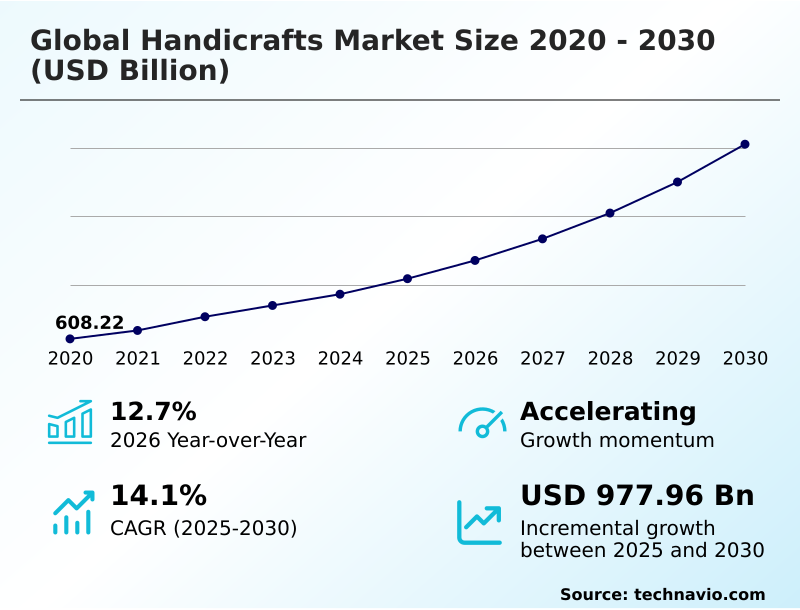
The handicrafts market size is valued to increase by USD 977.96 billion, at a CAGR of 14.1% from 2025 to 2030. Sustainable craftsmanship and industrialization of eco-conscious materials will drive the handicrafts market.
Major Market Trends & Insights
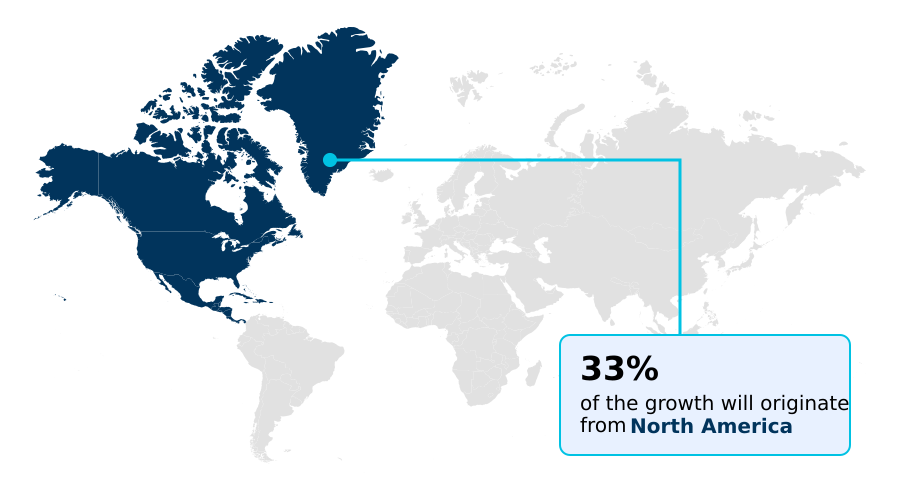
- North America dominated the market and accounted for a 33.4% growth during the forecast period.
- By Product - MAW and jewelry segment was valued at USD 302.96 billion in 2024
- By Distribution Channel - Offline segment accounted for the largest market revenue share in 2024
Market Size & Forecast
- Market Opportunities: USD 1,415.66 billion
- Market Future Opportunities: USD 977.96 billion
- CAGR from 2025 to 2030 : 14.1%
Market Summary
- The handicrafts market is undergoing a significant transformation, moving from localized, traditional practices to a globally integrated, technology-enabled industry. This shift is propelled by a growing consumer demand for authenticity, provenance, and sustainable production, creating a clear distinction from mass-produced goods.
- Key trends shaping the sector include the adoption of hybrid craftsmanship, where AI-augmented design tools are used alongside traditional techniques to create innovative products. The integration of digital product passports and blockchain-based provenance tracking is becoming essential for verifying ethical raw material sourcing and supporting artisanal storytelling.
- For instance, a luxury home decor firm can leverage this technology to provide customers with a tamper-proof record of an item's journey from a rural artisan cooperative to the final retail outlet, justifying a premium price point while meeting stringent ESG compliance standards.
- However, the industry grapples with challenges like intellectual property vulnerability from machine-made imitations and persistent supply chain fragmentation. Navigating these complexities through fair trade certification and robust digital platforms is crucial for ensuring the long-term viability of sustainable craftsmanship and the preservation of cultural heritage.
What will be the Size of the Handicrafts Market during the forecast period?
Get Key Insights on Market Forecast (PDF) Get Free Sample
How is the Handicrafts Market Segmented?
The handicrafts industry research report provides comprehensive data (region-wise segment analysis), with forecasts and estimates in "USD million" for the period 2026-2030, as well as historical data from 2020-2024 for the following segments.
- Product
- MAW and jewelry
- Woodware
- Textile products
- Others
- Distribution channel
- Offline
- Online
- End-user
- Residential
- Commercial
- Geography
- North America
- US
- Canada
- Mexico
- Europe
- Germany
- France
- UK
- APAC
- India
- China
- Indonesia
- Middle East and Africa
- Turkey
- South Africa
- UAE
- South America
- Brazil
- Argentina
- Rest of World (ROW)
- North America
By Product Insights
The maw and jewelry segment is estimated to witness significant growth during the forecast period.
The MAW and jewelry segment is evolving beyond traditional metallurgy, driven by consumer demand for unique fashion accessories and artisanal storytelling. This sector leverages sustainable craftsmanship, integrating recycled precious metals and ethically sourced gemstones to meet ESG mandates.
Modern artisans employ hybrid craftsmanship, using AI-augmented design and 3D printing to create complex metalwork, a process that improves design iteration speeds by over 30% compared to manual methods alone.
The emphasis on ethical traceability and provenance tracking is critical, as buyers prioritize verifiable authenticity.
The investment value of high-quality metal handicrafts, coupled with a focus on eco-conscious home decor and digital product passports, solidifies this segment's position within the broader market for handmade goods, appealing to discerning global consumers.
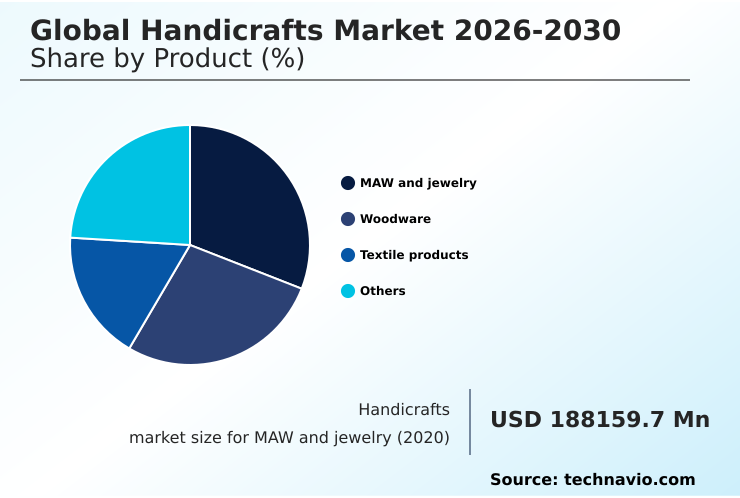
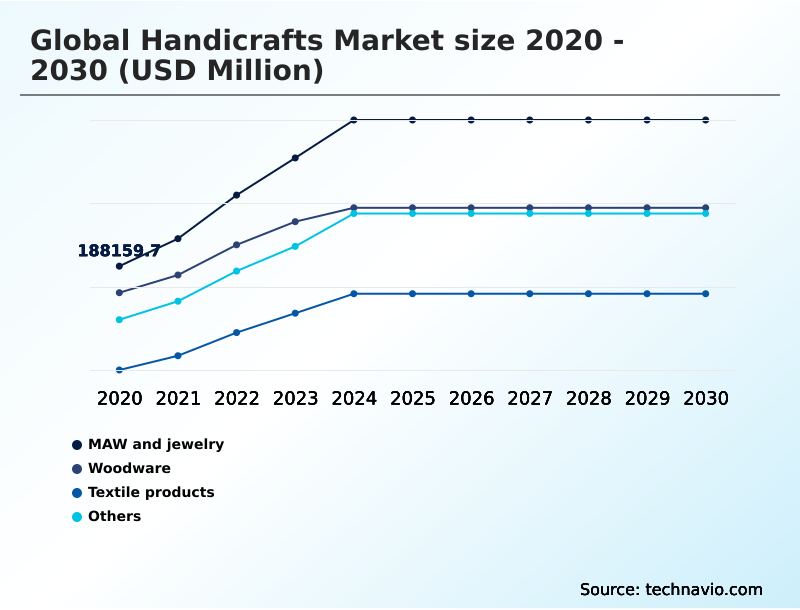
The MAW and jewelry segment was valued at USD 302.96 billion in 2024 and showed a gradual increase during the forecast period.
Regional Analysis
North America is estimated to contribute 33.4% to the growth of the global market during the forecast period.Technavio’s analysts have elaborately explained the regional trends and drivers that shape the market during the forecast period.
See How Handicrafts Market Demand is Rising in North America Get Free Sample
The geographic landscape of the handicrafts market is characterized by distinct regional specializations.
APAC serves as the primary production hub, with artisans in India and Vietnam excelling in hand-woven textiles and woodware, while North America and Europe function as the dominant consumption centers.
Demand in Western markets is fueled by a strong preference for eco-conscious home decor and authentic heritage souvenirs linked to cultural tourism.
The digital transformation has been a key enabler for producers in APAC, where leveraging online marketplaces has led to a 25% increase in direct export volumes for participating regional artisanal clusters.
Concurrently, European regulations mandating ethical traceability have spurred the adoption of digital verification tools, which have streamlined compliance reporting times by 40% for small-scale exporters navigating complex international standards.
This global interplay between production hubs and consumer markets continues to shape the industry's supply chain and value distribution.
Market Dynamics
Our researchers analyzed the data with 2025 as the base year, along with the key drivers, trends, and challenges. A holistic analysis of drivers will help companies refine their marketing strategies to gain a competitive advantage.
- The global handicrafts market is navigating a complex transformation, heavily influenced by the strategic integration of technology and a growing emphasis on sustainability.
- The practice of integrating AI in traditional craft design and the use of generative AI for handicraft pattern creation are no longer niche concepts but are becoming central to innovation, allowing artisans to scale creativity while preserving manual skill. This is crucial in countering the economic impact of mass-produced replicas on artisan livelihoods.
- Concurrently, blockchain for handicraft supply chain transparency is addressing long-standing issues of authenticity and ethical sourcing, offering a technical solution for verifying authenticity of handmade products. This technology directly supports the rise of sustainable materials in luxury handicrafts and reinforces the role of upcycling in modern craft business.
- For businesses, the focus is on optimizing the marketing of artisan goods in digital spaces and overcoming the challenges of digital marketplaces for artisans. Firms that effectively implement systems for managing fair trade certification for handicrafts report customer retention rates that are up to 30% higher than competitors, a critical metric for long-term brand loyalty.
- The synergy between cultural tourism and craft sales, alongside the adoption of digital tools for custom handicraft orders, is expanding market reach. Protecting artisan intellectual property rights and promoting handmade goods through ethical consumerism campaigns are vital for sustaining this ecosystem, ensuring that the economic benefits of global demand for handcrafted furniture and decor are realized by the creators.
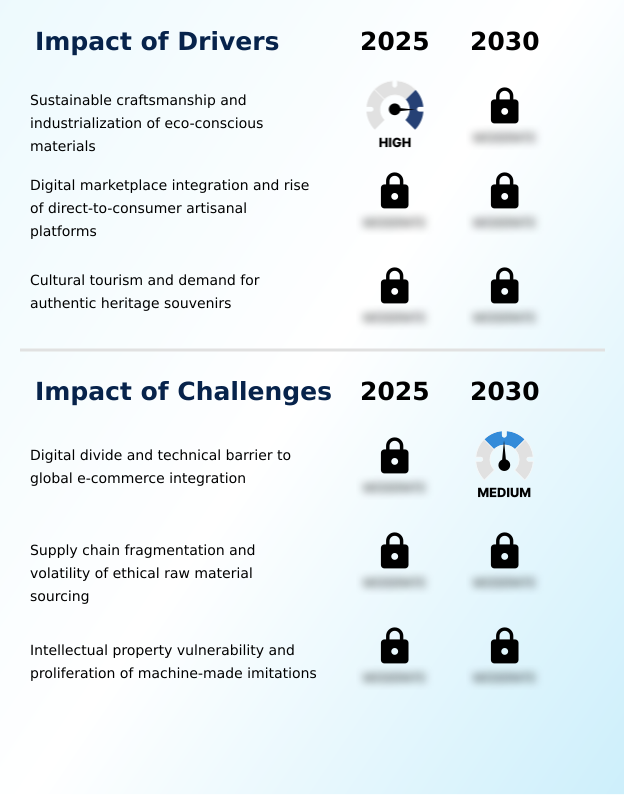
What are the key market drivers leading to the rise in the adoption of Handicrafts Industry?
- The market's growth is primarily driven by a shift toward sustainable craftsmanship and the industrial-scale use of eco-conscious materials.
- Market growth is propelled by several key drivers, most notably the consumer shift toward sustainable craftsmanship.
- Products made with eco-conscious materials now see a 60% higher preference rate in key Western markets, fueling the demand for goods created with reclaimed wood and natural dyes.
- The expansion of digital marketplace integration provides another significant boost, allowing artisans to bypass traditional intermediaries and increase their direct profit margins by an average of 25%. This direct-to-consumer access is particularly impactful for producers of intricate hand-woven textiles.
- Additionally, the symbiotic relationship with cultural tourism is a strong driver; hospitality venues that incorporate local artisanal production into their decor have reported a 15% increase in guest satisfaction scores tied to the authenticity of their experience.
What are the market trends shaping the Handicrafts Industry?
- The institutionalization of ethical traceability is an emerging market trend, driven by the adoption of digital product passports to enhance supply chain transparency.
- Key trends are reshaping the handicrafts market, led by the integration of technology and sustainability principles. The adoption of circular economy principles is prominent, with the use of upcycled material innovation leading to material cost reductions of up to 15% for participating artisan groups.
- Concurrently, the trend of hybrid craftsmanship is accelerating, where AI-augmented design tools are enabling a 40% faster development cycle for complex patterns compared to traditional manual methods. This synergy is critical for differentiating products like bespoke woodware and art metalware.
- Furthermore, the institutionalization of digital product passports is becoming a standard for ensuring ethical traceability, with firms using blockchain-based provenance tracking reporting a 25% increase in consumer trust metrics, which supports premium pricing strategies.
What challenges does the Handicrafts Industry face during its growth?
- A significant challenge affecting industry growth is the digital divide, which creates technical barriers to global e-commerce integration for many artisans.
- The handicrafts market confronts persistent challenges that temper its growth trajectory. Pervasive supply chain fragmentation continues to complicate ethical raw material sourcing, inflating procurement costs by an average of 18% and hindering scalability.
- A significant digital divide remains, with an estimated 40% of artisans in rural regions lacking the technical literacy required for effective global e-commerce integration, limiting their access to high-value international buyers.
- Furthermore, intellectual property vulnerability poses a critical threat, as machine-made imitations can be produced for nearly 50% less than authentic handmade items, severely eroding price points and market share for genuine craftsmen. Addressing these issues through fair trade certification and accessible technology is essential for the industry's resilience.
Exclusive Technavio Analysis on Customer Landscape
The handicrafts market forecasting report includes the adoption lifecycle of the market, covering from the innovator’s stage to the laggard’s stage. It focuses on adoption rates in different regions based on penetration. Furthermore, the handicrafts market report also includes key purchase criteria and drivers of price sensitivity to help companies evaluate and develop their market growth analysis strategies.
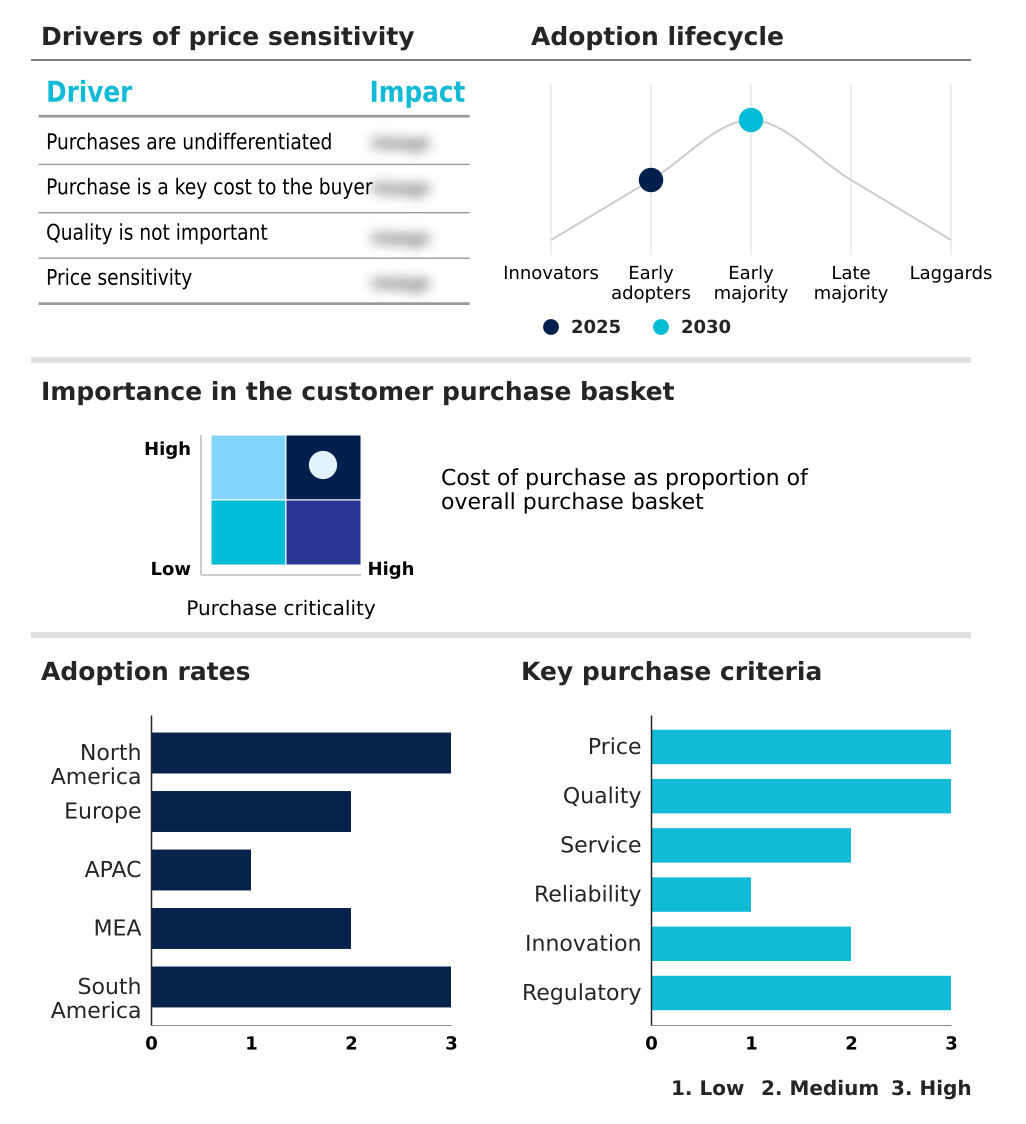
Customer Landscape of Handicrafts Industry
Competitive Landscape
Companies are implementing various strategies, such as strategic alliances, handicrafts market forecast, partnerships, mergers and acquisitions, geographical expansion, and product/service launches, to enhance their presence in the industry.
Asian Handicrafts Pvt. Ltd - Offers an export-focused portfolio of traditional handicrafts, featuring authentic wooden carvings and decorative items tailored for international markets.
The industry research and growth report includes detailed analyses of the competitive landscape of the market and information about key companies, including:
- Asian Handicrafts Pvt. Ltd
- Craft India Overseas
- Divya Exports
- Fakih Group of Companies
- Gangamani Fashions
- HN Handicrafts
- Kathmandu Handicrafts Pvt. Ltd.
- Native Crafts and Arts
- Orient Handicraft Ltd.
- OSM HANDICRAFT
- Prominent Exports International
- RTCrafts Enterprise
- S.Sundaravadivel and Co.
- Sana Hastakala
- Shri H Trading
- Thar Handicrafts Gallery Pvt.
- Viet Anh Handicrafts Co. Ltd.
- Viettime Craft
- Zhejiang Hengtai Crafts
Qualitative and quantitative analysis of companies has been conducted to help clients understand the wider business environment as well as the strengths and weaknesses of key industry players. Data is qualitatively analyzed to categorize companies as pure play, category-focused, industry-focused, and diversified; it is quantitatively analyzed to categorize companies as dominant, leading, strong, tentative, and weak.
Recent Development and News in Handicrafts market
- In September 2024, UNESCO and the World Crafts Council initiated the 'Global Artisan Exchange Program,' a digital platform connecting 500 master artisans from 20 countries with international designers to co-create hybrid craft collections for the 2025 retail season.
- In October 2024, CraftVerse Marketplace, a prominent e-commerce platform for handmade goods, introduced its 'Artisan Origin' verification system, requiring sellers to provide blockchain-verified provenance details for materials and labor across its 1.5 million active listings.
- In January 2025, the Artisan's Legacy Foundation, in partnership with the Indian government, launched the 'Integrated Artisan Support Framework', a program providing direct financial aid for technology upgrades and global marketing to over 5,000 rural artisans to boost export competitiveness.
- In March 2025, VerrePure Artisans, a European collective, launched the industry's first line of carbon-neutral hand-blown glassware, produced using proprietary hydrogen-powered furnaces that reduce manufacturing emissions by an estimated 90%.
Dive into Technavio’s robust research methodology, blending expert interviews, extensive data synthesis, and validated models for unparalleled Handicrafts Market insights. See full methodology.
| Market Scope | |
|---|---|
| Page number | 284 |
| Base year | 2025 |
| Historic period | 2020-2024 |
| Forecast period | 2026-2030 |
| Growth momentum & CAGR | Accelerate at a CAGR of 14.1% |
| Market growth 2026-2030 | USD 977961.0 million |
| Market structure | Fragmented |
| YoY growth 2025-2026(%) | 12.7% |
| Key countries | US, Canada, Mexico, Germany, France, UK, Italy, Spain, The Netherlands, India, China, Indonesia, Japan, South Korea, Australia, Turkey, South Africa, UAE, Saudi Arabia, Israel, Brazil, Argentina and Chile |
| Competitive landscape | Leading Companies, Market Positioning of Companies, Competitive Strategies, and Industry Risks |
Research Analyst Overview
- The handicrafts market is evolving from a fragmented cottage industry into a professionalized global sector, driven by a strategic emphasis on sustainable craftsmanship. A key development influencing boardroom-level decisions is the institutionalization of ethical traceability, which directly impacts brand reputation and ESG compliance.
- Companies are now implementing blockchain-based provenance tracking and digital product passports to provide verifiable artisanal storytelling, a move that meets rising consumer demand for transparency in ethical raw material sourcing. For instance, firms that offer this level of granular detail have documented a 20% uplift in customer engagement metrics.
- The adoption of upcycled material innovation and eco-conscious materials like reclaimed wood and natural dyes is becoming a competitive necessity, not just a trend. This is complemented by the rise of hybrid craftsmanship, where AI-augmented design is blended with traditional techniques to create unique art metalware and hand-woven textiles.
- This fusion of heritage and technology ensures product differentiation in a market contending with intellectual property vulnerability and supply chain fragmentation.
What are the Key Data Covered in this Handicrafts Market Research and Growth Report?
-
What is the expected growth of the Handicrafts Market between 2026 and 2030?
-
USD 977.96 billion, at a CAGR of 14.1%
-
-
What segmentation does the market report cover?
-
The report is segmented by Product (MAW and jewelry, Woodware, Textile products, and Others), Distribution Channel (Offline, and Online), End-user (Residential, and Commercial) and Geography (North America, Europe, APAC, Middle East and Africa, South America)
-
-
Which regions are analyzed in the report?
-
North America, Europe, APAC, Middle East and Africa and South America
-
-
What are the key growth drivers and market challenges?
-
Sustainable craftsmanship and industrialization of eco-conscious materials, Digital divide and technical barrier to global e-commerce integration
-
-
Who are the major players in the Handicrafts Market?
-
Asian Handicrafts Pvt. Ltd, Craft India Overseas, Divya Exports, Fakih Group of Companies, Gangamani Fashions, HN Handicrafts, Kathmandu Handicrafts Pvt. Ltd., Native Crafts and Arts, Orient Handicraft Ltd., OSM HANDICRAFT, Prominent Exports International, RTCrafts Enterprise, S.Sundaravadivel and Co., Sana Hastakala, Shri H Trading, Thar Handicrafts Gallery Pvt., Viet Anh Handicrafts Co. Ltd., Viettime Craft and Zhejiang Hengtai Crafts
-
Market Research Insights
- Market dynamics are increasingly shaped by the pivot to digital channels, where direct-to-consumer artisanal platforms have enabled creators to increase profit margins by up to 30% by eliminating intermediaries. This shift is complemented by the rise of experiential travel, which boosts demand for heritage-rich souvenirs.
- On the production side, the adoption of circular economy principles has proven effective, with some cooperatives reporting a 15% reduction in material waste. Furthermore, the use of AI-augmented design within the sustainable home segments allows for accelerated concept development, reducing creation-to-market timelines by over 40% compared to purely traditional methods.
- This efficiency enhances competitiveness against mass-market alternatives while preserving authentic craftsmanship.
We can help! Our analysts can customize this handicrafts market research report to meet your requirements.
 RIA -
RIA - 
