
India Induction Furnace Market Analysis, Size, and Forecast 2025-2029

India Induction Furnace Market Analysis, Size, and Forecast 2025-2029

Published: Jun 2025 164 Pages SKU: IRTNTR70818

Market Overview at a Glance

$113.6 Mn
Market Opportunity
7.2%
CAGR
6.7
YoY growth 2024-2025(%)

India Induction Furnace Market Size 2025-2029 

The India induction furnace market size is forecast to increase by USD 113.6 million, at a CAGR of 7.2% between 2024 and 2029.

  • The Induction Furnace Market is witnessing significant growth, driven by the escalating demand for steel and alloys in India's burgeoning infrastructure and manufacturing sectors. The Equipment as a Service business model is gaining traction, enabling smaller enterprises to access advanced induction furnace technology without substantial upfront investment. This industry serves diverse sectors, including construction, aerospace, electronics, and industrial machinery. However, the market faces challenges, including the shortage of highly skilled manpower, particularly in the installation, operation, and maintenance of these complex systems.
  • This labor scarcity could hinder market expansion and necessitate strategic workforce development initiatives from key players. Companies seeking to capitalize on this market's potential must address this challenge while also staying abreast of technological advancements and evolving customer requirements. The integration of Artificial Intelligence (AI) in design processes is gaining significant traction.

What will be the size of the India Induction Furnace Market during the forecast period?
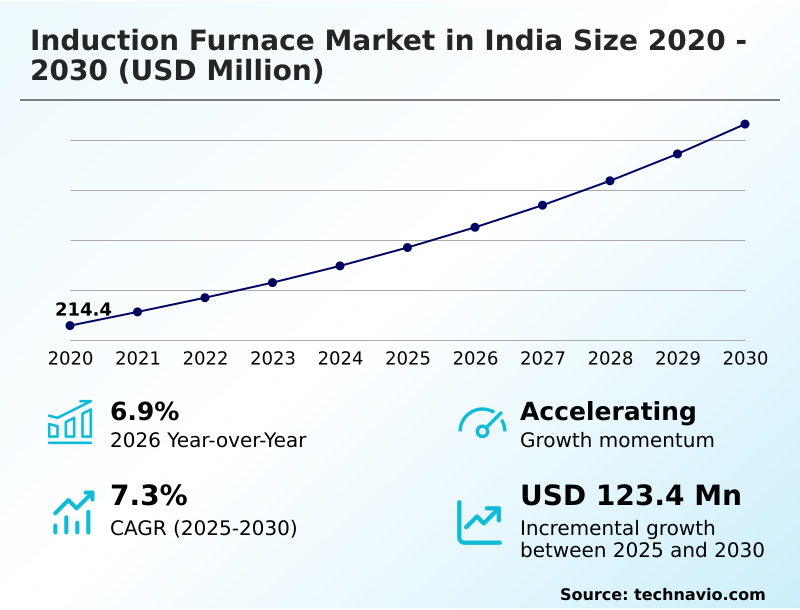
Induction Furnace Market in India Size

Explore in-depth regional segment analysis with market size data - historical 2019-2023 and forecasts 2025-2029 - in the full report.   
Request Free Sample

  • In the induction furnace market, advancements in material science and power electronics are driving innovation. The market's size is substantial, with significant demand from OEMs and the Internet of Things (IoT) sector for electrical and mechanical components. Phase diagrams and refractory coatings are essential in optimizing heat treatment cycles and improving wear resistance. Deep learning algorithms and ceramic composites enhance the performance of high-frequency generators, enabling better control and efficiency. Magnetic fields and computational fluid dynamics are used in process simulation, ensuring precise temperature distribution and energy savings. Power electronics and control systems are key components, with optimization algorithms and PID control ensuring stable and efficient operation. Injection molding and solid state devices benefit from remote monitoring and digital twins, allowing for real-time process adjustments and predictive maintenance.
  • Skin effect and eddy currents are critical factors in heat treatment and corrosion protection, requiring advanced control systems and finite element analysis. The market is also witnessing the integration of artificial intelligence and machine learning, enabling microstructure control and predictive maintenance. Thermal shock resistance and wear resistance coatings are essential for prolonging furnace life and improving productivity. Internet of Things technology and smart manufacturing are transforming the industry, enabling real-time data acquisition and process optimization. Overall, the induction furnace market is dynamic, with continuous advancements in technology and a focus on improving efficiency, productivity, and sustainability. Moreover, the market is adopting adopting automation, robotics, digitalization, and green foundry practices to enhance production capabilities and meet the evolving needs of their customers.

How is this market segmented?

The market research report provides comprehensive data (region-wise segment analysis), with forecasts and estimates in "USD million" for the period 2025-2029, as well as historical data from 2019-2023 for the following segments.

  • Type
    • Channel induction furnaces
    • Coreless induction furnaces
  • End-user
    • Steel industry
    • Copper industry
    • Aluminum industry
    • Zinc industry
  • Capacity
    • More than 100 ton
    • Upto 1 ton
  • Geography
    • APAC
      • India

By Type Insights

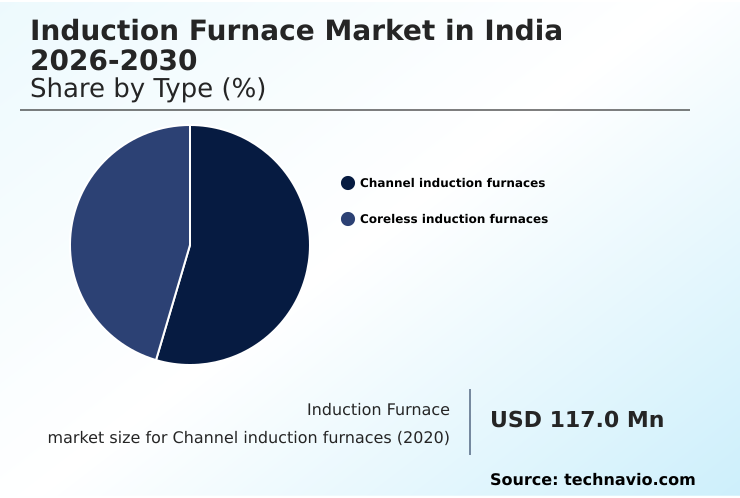
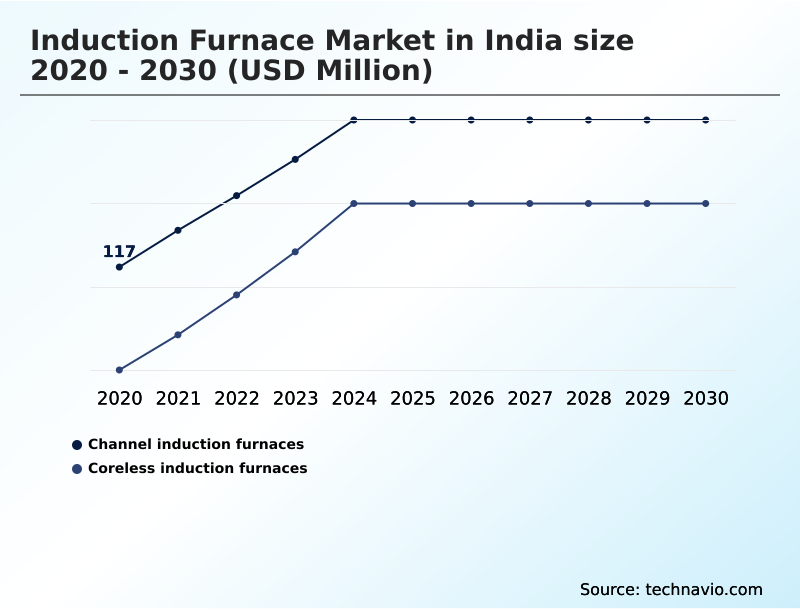
The channel induction furnaces segment is estimated to witness significant growth during the forecast period. Induction furnaces, specifically channel furnaces, play a significant role in various industries due to their ability to melt metals with low melting points. These furnaces, which consist of a refractory-lined steel shell containing molten metal, are available in horizontal and vertical types. Vertical channel furnaces, lined with brick, castable, or dry-vibe refractory, are utilized in processes with continuous operations, low power densities, and bulky charge materials, commonly for copper and aluminum alloys. Horizontal channel furnaces, lined with brick refractory, are preferred for applications requiring better heat transfer and uniformity. Inert gases are supplied through channels in the inductor to melt the metal, typically in the furnace neck region, generating a flow. Silicone molds and the integration of plastic and sand in casting processes further expand the market's scope.

Induction furnaces are essential in processes that demand high thermal efficiency, precise temperature control, and cost optimization. They are extensively used in metal casting, heat treatment, and powder metallurgy. In glass manufacturing, they are employed for melting and homogenizing glass batches, while in medical device manufacturing, they ensure the production of high-quality implants. Environmental regulations necessitate the implementation of cooling systems, emissions control, and waste management practices. Non-destructive testing, hardness testing, and metallographic analysis are crucial for ensuring product quality. Safety standards, such as those related to electromagnetic induction, surface hardening, and coil design, are essential considerations.

Induction furnaces are also used in heat treatment processes, including annealing, normalizing, and hardening. In the electronics industry, they are employed for brazing and soldering components. Refractory materials and ceramic processing are other applications where induction furnaces are indispensable. The process of induction heating involves the conversion of electrical energy into heat through electromagnetic induction. This heating method offers advantages such as rapid heating, precise temperature control, and energy efficiency. Induction furnaces are also used for scrap metal processing and recycling. Frequency control, operator training, and power supply are essential aspects of induction furnace operation. The adoption of green foundry practices, such as the use of renewable energy sources and sustainable manufacturing techniques, is also on the rise.

Induction Furnace Market in India Share by Type

Get a glance at the market share of various segments Request Free Sample

The Channel induction furnaces segment was valued at  USD 123.00 million in 2019 and showed a gradual increase during the forecast period.
Market Dynamics

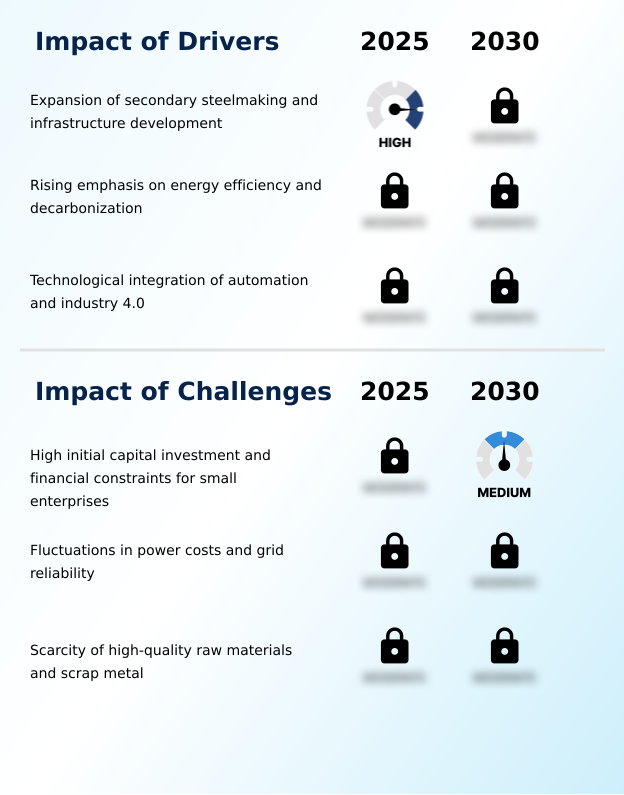
Our researchers analyzed the data with 2024 as the base year, along with the key drivers, trends, and challenges. A holistic analysis of drivers will help companies refine their marketing strategies to gain a competitive advantage.

What are the key market drivers leading to the rise in the adoption of Induction Furnace in India Industry?

  • The significant increase in demand for steel and alloys in India serves as the primary market driver. Induction furnaces play a crucial role in the production of steel and alloys, particularly in markets with significant demand for these materials. The process control technologies integrated in induction furnaces ensure consistent melting point and temperature maintenance, leading to improved tensile strength and corrosion resistance in the final product. These properties are essential for various industries, including metal casting and glass manufacturing, where the materials' performance under extreme conditions is vital. Moreover, metallographic analysis and phase transformation during the melting process enable cost optimization by reducing the need for extensive post-production processing. Induction furnaces' ability to achieve precise hardness testing and maintain deep conditions throughout the melting process is a significant advantage for manufacturers.
  • These factors contribute to the growing adoption of induction furnaces in diverse industries, driving market growth. In the context of research and development, induction furnaces have been a focus for innovation, with advancements in energy efficiency and automation. The emphasis on improving process control and optimizing phase transformations continues to propel the market forward. Ultimately, induction furnaces' ability to deliver high-quality, reliable materials with consistent properties makes them an indispensable tool for industries reliant on steel and alloys.

What are the market trends shaping the Induction Furnace in India Industry?

  • Equipment-as-a-Service (EaaS) is an emerging market trend where organizations pay for the use of equipment instead of owning it outright. This model allows businesses to reduce capital expenditures and gain access to the latest technology while benefiting from predictable monthly expenses. Induction furnaces play a pivotal role in the steel industry, significantly impacting the operational efficiency of integrated steel plants. In response to this, steel producers have been entering into performance-based contracts with equipment providers, including induction furnace manufacturers. These contracts transfer a significant portion of the equipment and service costs to the equipment providers, with payments linked to the financial performance of the steel plant. To meet the demands of these contracts, induction furnace companies are focusing on value-added services that enhance operational efficiency and profitability. Key areas of emphasis include quality control, thermal efficiency, and non-destructive testing.
  • Advanced technologies, such as heat transfer optimization and cooling systems, are being implemented to improve performance and reduce energy consumption. Environmental regulations are also driving innovation in the induction furnace market. Companies are developing eco-friendly solutions to minimize emissions and adhere to stringent environmental standards. Safety standards are another critical concern, with a focus on robust design and advanced safety features to ensure worker safety and plant security. Scrap metal processing and medical device manufacturing are other sectors benefiting from the adoption of induction furnaces. These industries require precise temperature control and high thermal efficiency, which induction furnaces provide.
  • Overall, the induction furnace market is driven by the need for enhanced operational efficiency, profitability, and adherence to stringent industry standards.

What challenges does the Induction Furnace in India Industry face during its growth?

  • The lack of a sufficient workforce comprised of highly skilled individuals poses a significant challenge to the industry's growth trajectory. Induction furnaces, which utilize electromagnetic induction for heating, play a significant role in various industries, including heat treatment for electronics manufacturing. In the context of India, the market for induction furnaces is primarily driven by MSMEs, which account for over 90% of the foundries. However, the workforce in these enterprises lacks the necessary skills to operate advanced induction furnaces effectively. To address this challenge, investments in organized training facilities and skill development programs are essential. These initiatives will enable employees to gain expertise in various aspects of induction furnace operation, such as molding processes, patterning, casting methods, and new furnace technologies.
  • The importance of induction heating in industries like surface hardening, powder metallurgy, ceramic processing, and refractory materials manufacturing is undeniable. However, the adoption of advanced induction furnace technologies necessitates continuous learning and upskilling. Emissions control is another critical factor that requires attention, as stricter regulations mandate the use of cleaner heating processes. 

Exclusive Customer Landscape

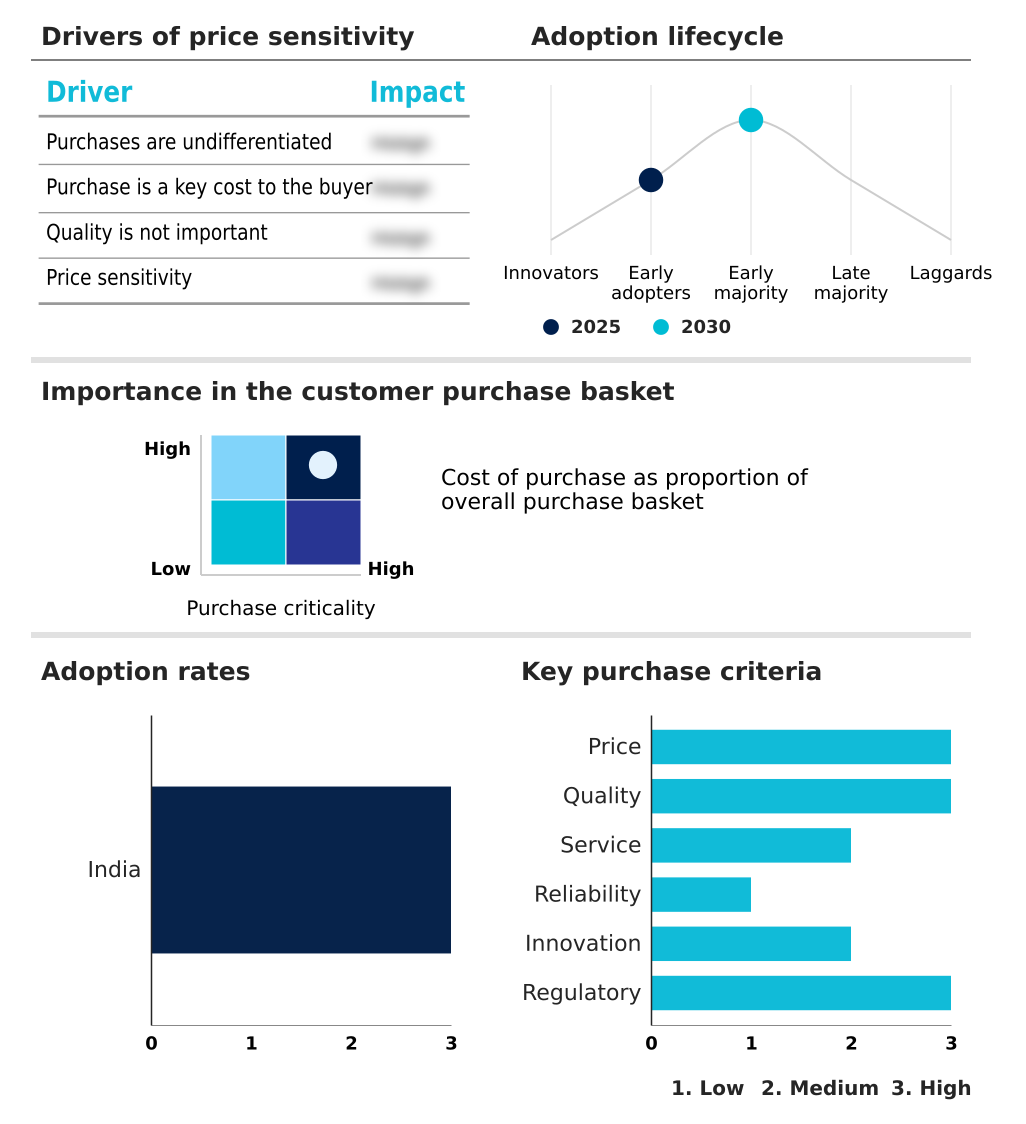
The induction furnace market in India forecasting report includes the adoption lifecycle of the market, covering from the innovator's stage to the laggard's stage. It focuses on adoption rates in different regions based on penetration. Furthermore, the induction furnace market in India report also includes key purchase criteria and drivers of price sensitivity to help companies evaluate and develop their market growth analysis strategies.
Induction Furnace Market in India Share by Geography

 Customer Landscape

Key Companies & Market Insights

Companies are implementing various strategies, such as strategic alliances, induction furnace market in India forecast, partnerships, mergers and acquisitions, geographical expansion, and product/service launches, to enhance their presence in the industry.

Agni Electrical Pvt. Ltd. - This company specializes in providing advanced induction furnace solutions. 

The industry research and growth report includes detailed analyses of the competitive landscape of the market and information about key companies, including:

  • Agni Electrical Pvt. Ltd.
  • Electro Power Enterprise
  • Eltech Electrodesigns and Energy Systems Pvt. Ltd.
  • Foster Induction Pvt. Ltd.
  • Heatcon Sensors Pvt. Ltd.
  • HK Malvi Industries
  • Indotherm Furnace Pvt. Ltd.
  • Inductotherm Group
  • Jyoti CNC Automation Ltd.
  • Magnalenz
  • Megatherm Electronics Pvt. Ltd.
  • Microtech Inductions Pvt. Ltd.
  • Naksh Induction
  • Nutrotherm Induction
  • Orbit Induction
  • Plasma Induction India Pvt. Ltd.
  • Priyanka Induction Supermelt
  • Shapet Induction Co.
  • Srishtech Metal Casting Pvt. Ltd.

Qualitative and quantitative analysis of companies has been conducted to help clients understand the wider business environment as well as the strengths and weaknesses of key industry players. Data is qualitatively analyzed to categorize companies as pure play, category-focused, industry-focused, and diversified; it is quantitatively analyzed to categorize companies as dominant, leading, strong, tentative, and weak.

Recent Development and News in Induction Furnace Market In India

  • In February 2023, ABB, a leading technology provider, announced the launch of its new induction furnace solution, the ABB Ability™ eMotors Induction Furnace, designed to improve energy efficiency and productivity in the steel industry. This innovative product integrates ABB's advanced digital technologies, enabling real-time monitoring and predictive maintenance (ABB Press Release, 2023).
  • In June 2024, Sandvik and Voestalpine, global engineering groups, entered into a strategic partnership to develop and manufacture induction furnaces for the production of high-performance steel. This collaboration combines Sandvik's expertise in induction heating technology with Voestalpine's steel manufacturing capabilities, aiming to create more efficient and sustainable steelmaking processes (Sandvik Press Release, 2024).
  • In September 2024, Siemens Energy secured a major order from Baosteel, a leading Chinese steel producer, to supply induction melting furnaces for its new steel plant in China. This significant contract, worth over €100 million, underlines Siemens Energy's strong position in the global induction furnace market and its ability to cater to the increasing demand for high-capacity steel production facilities (Siemens Energy Press Release, 2024).
  • In March 2025, Hyundai Heavy Industries Co. Ltd. unveiled its latest technological advancement, a high-frequency induction furnace with a capacity of 1,000 tons. This development marks a significant leap in the production capacity of induction furnaces, addressing the growing demand for large-scale steel manufacturing and positioning Hyundai as a major player in the global market (Hyundai Heavy Industries Press Release, 2025).

Research Analyst Overview

The induction furnace market is characterized by continuous evolution and dynamic market activities, driven by the diverse applications across various sectors. In the realm of metal casting, induction furnaces offer process control, enabling precise melting point management and ensuring optimal tensile strength and corrosion resistance. The glass manufacturing industry leverages induction furnaces for their thermal efficiency and ability to maintain precise temperatures during phase transformations. Induction furnaces are also integral to scrap metal processing, where they optimize cost and enhance the quality of the final product through efficient heat transfer and non-destructive testing. In the medical device manufacturing sector, induction furnaces ensure safety standards and provide the necessary heat treatment for producing components with high hardness and wear resistance.

Environmental regulations continue to shape the induction furnace market, with a focus on emissions control and energy consumption reduction. Cooling systems and power supply solutions are essential components in addressing these concerns, while also contributing to improved production capacity and lead time. Induction furnaces find applications in various industries, including electronics manufacturing, where they facilitate surface hardening and precise coil design. In the realm of powder metallurgy and ceramic processing, induction heating enables efficient production and enhances the properties of refractory materials. The ongoing market activities in the induction furnace sector underscore the importance of quality control, thermal efficiency, and adherence to safety standards.

As technological advancements continue to unfold, the induction furnace market will continue to evolve, offering innovative solutions for diverse industries and applications.

Dive into Technavio's robust research methodology, blending expert interviews, extensive data synthesis, and validated models for unparalleled Induction Furnace Market in India insights. See full methodology.

Market Scope

Report Coverage

Details

Page number

164

Base year

2024

Historic period

2019-2023

Forecast period

2025-2029

Growth momentum & CAGR

Accelerate at a CAGR of 7.2%

Market growth 2025-2029

USD 113.6 million

Market structure

Fragmented

YoY growth 2024-2025(%)

6.7

Key countries

India

Competitive landscape

Leading Companies, Market Positioning of Companies, Competitive Strategies, Industry Risks, 

Request Free Sample

What are the Key Data Covered in this Induction Furnace Market in India Research and Growth Report?

  • CAGR of the Induction Furnace in India industry during the forecast period
  • Detailed information on factors that will drive the growth and forecasting between 2025 and 2029
  • Precise estimation of the size of the market and its contribution of the industry in focus to the parent market
  • Accurate predictions about upcoming growth and trends and changes in consumer behaviour
  • Growth of the market across India
  • Thorough analysis of the market's competitive landscape and detailed information about companies
  • Comprehensive analysis of factors that will challenge the induction furnace market in India growth of industry companies

We can help! Our analysts can customize this induction furnace market in India research report to meet your requirements.

Get in touch

1 Executive Summary

  • 1.1 Market overview
    • Executive Summary - Chart on Market Overview
    • Executive Summary - Data Table on Market Overview
    • Executive Summary - Chart on Country Market Characteristics
    • Executive Summary - Chart on Market Segmentation by Type
    • Executive Summary - Chart on Market Segmentation by End-user
    • Executive Summary - Chart on Market Segmentation by Capacity
    • Executive Summary - Chart on Company Market Positioning

2 Technavio Analysis

  • 2.1 Analysis of price sensitivity, lifecycle, customer purchase basket, adoption rates, and purchase criteria
    • Analysis of price sensitivity, lifecycle, customer purchase basket, adoption rates, and purchase criteria
  • 2.2 Criticality of inputs and Factors of differentiation
    • Overview on criticality of inputs and factors of differentiation
  • 2.3 Factors of disruption
    • Overview on factors of disruption
  • 2.4 Impact of drivers and challenges
    • Impact of drivers and challenges in 2024 and 2029

3 Market Landscape

  • 3.1 Market ecosystem
    • Parent Market
    • Data Table on - Parent Market
  • 3.2 Market characteristics
    • Market characteristics analysis
  • 3.3 Value chain analysis
    • Value chain analysis

4 Market Sizing

  • 4.1 Market definition
    • Offerings of companies included in the market definition
  • 4.2 Market segment analysis
    • Market segments
  • 4.3 Market size 2024
    • 4.4 Market outlook: Forecast for 2024-2029
      • Chart on India - Market size and forecast 2024-2029 ($ million)
      • Data Table on India - Market size and forecast 2024-2029 ($ million)
      • Chart on India: Year-over-year growth 2024-2029 (%)
      • Data Table on India: Year-over-year growth 2024-2029 (%)

    5 Historic Market Size

    • 5.1 Induction Furnace Market in India 2019 - 2023
      • Historic Market Size - Data Table on Induction Furnace Market in India 2019 - 2023 ($ million)
    • 5.2 Type segment analysis 2019 - 2023
      • Historic Market Size - Type Segment 2019 - 2023 ($ million)
    • 5.3 End-user segment analysis 2019 - 2023
      • Historic Market Size - End-user Segment 2019 - 2023 ($ million)
    • 5.4 Capacity segment analysis 2019 - 2023
      • Historic Market Size - Capacity Segment 2019 - 2023 ($ million)

    6 Qualitative Analysis

    • 6.1 The AI impact on induction furnace market in India

      7 Five Forces Analysis

      • 7.1 Five forces summary
        • Five forces analysis - Comparison between 2024 and 2029
      • 7.2 Bargaining power of buyers
        • Bargaining power of buyers - Impact of key factors 2024 and 2029
      • 7.3 Bargaining power of suppliers
        • Bargaining power of suppliers - Impact of key factors in 2024 and 2029
      • 7.4 Threat of new entrants
        • Threat of new entrants - Impact of key factors in 2024 and 2029
      • 7.5 Threat of substitutes
        • Threat of substitutes - Impact of key factors in 2024 and 2029
      • 7.6 Threat of rivalry
        • Threat of rivalry - Impact of key factors in 2024 and 2029
      • 7.7 Market condition
        • Chart on Market condition - Five forces 2024 and 2029

      8 Market Segmentation by Type

      • 8.1 Market segments
        • Chart on Type - Market share 2024-2029 (%)
        • Data Table on Type - Market share 2024-2029 (%)
      • 8.2 Comparison by Type
        • Chart on Comparison by Type
        • Data Table on Comparison by Type
      • 8.3 Channel induction furnaces - Market size and forecast 2024-2029
        • Chart on Channel induction furnaces - Market size and forecast 2024-2029 ($ million)
        • Data Table on Channel induction furnaces - Market size and forecast 2024-2029 ($ million)
        • Chart on Channel induction furnaces - Year-over-year growth 2024-2029 (%)
        • Data Table on Channel induction furnaces - Year-over-year growth 2024-2029 (%)
      • 8.4 Coreless induction furnaces - Market size and forecast 2024-2029
        • Chart on Coreless induction furnaces - Market size and forecast 2024-2029 ($ million)
        • Data Table on Coreless induction furnaces - Market size and forecast 2024-2029 ($ million)
        • Chart on Coreless induction furnaces - Year-over-year growth 2024-2029 (%)
        • Data Table on Coreless induction furnaces - Year-over-year growth 2024-2029 (%)
      • 8.5 Market opportunity by Type
        • Market opportunity by Type ($ million)
        • Data Table on Market opportunity by Type ($ million)

      9 Market Segmentation by End-user

      • 9.1 Market segments
        • Chart on End-user - Market share 2024-2029 (%)
        • Data Table on End-user - Market share 2024-2029 (%)
      • 9.2 Comparison by End-user
        • Chart on Comparison by End-user
        • Data Table on Comparison by End-user
      • 9.3 Steel industry - Market size and forecast 2024-2029
        • Chart on Steel industry - Market size and forecast 2024-2029 ($ million)
        • Data Table on Steel industry - Market size and forecast 2024-2029 ($ million)
        • Chart on Steel industry - Year-over-year growth 2024-2029 (%)
        • Data Table on Steel industry - Year-over-year growth 2024-2029 (%)
      • 9.4 Copper industry - Market size and forecast 2024-2029
        • Chart on Copper industry - Market size and forecast 2024-2029 ($ million)
        • Data Table on Copper industry - Market size and forecast 2024-2029 ($ million)
        • Chart on Copper industry - Year-over-year growth 2024-2029 (%)
        • Data Table on Copper industry - Year-over-year growth 2024-2029 (%)
      • 9.5 Aluminum industry - Market size and forecast 2024-2029
        • Chart on Aluminum industry - Market size and forecast 2024-2029 ($ million)
        • Data Table on Aluminum industry - Market size and forecast 2024-2029 ($ million)
        • Chart on Aluminum industry - Year-over-year growth 2024-2029 (%)
        • Data Table on Aluminum industry - Year-over-year growth 2024-2029 (%)
      • 9.6 Zinc industry - Market size and forecast 2024-2029
        • Chart on Zinc industry - Market size and forecast 2024-2029 ($ million)
        • Data Table on Zinc industry - Market size and forecast 2024-2029 ($ million)
        • Chart on Zinc industry - Year-over-year growth 2024-2029 (%)
        • Data Table on Zinc industry - Year-over-year growth 2024-2029 (%)
      • 9.7 Market opportunity by End-user
        • Market opportunity by End-user ($ million)
        • Data Table on Market opportunity by End-user ($ million)

      10 Market Segmentation by Capacity

      • 10.1 Market segments
        • Chart on Capacity - Market share 2024-2029 (%)
        • Data Table on Capacity - Market share 2024-2029 (%)
      • 10.2 Comparison by Capacity
        • Chart on Comparison by Capacity
        • Data Table on Comparison by Capacity
      • 10.3 More than 100 ton - Market size and forecast 2024-2029
        • Chart on More than 100 ton - Market size and forecast 2024-2029 ($ million)
        • Data Table on More than 100 ton - Market size and forecast 2024-2029 ($ million)
        • Chart on More than 100 ton - Year-over-year growth 2024-2029 (%)
        • Data Table on More than 100 ton - Year-over-year growth 2024-2029 (%)
      • 10.4 Upto 1 ton - Market size and forecast 2024-2029
        • Chart on Upto 1 ton - Market size and forecast 2024-2029 ($ million)
        • Data Table on Upto 1 ton - Market size and forecast 2024-2029 ($ million)
        • Chart on Upto 1 ton - Year-over-year growth 2024-2029 (%)
        • Data Table on Upto 1 ton - Year-over-year growth 2024-2029 (%)
      • 10.5 Market opportunity by Capacity
        • Market opportunity by Capacity ($ million)
        • Data Table on Market opportunity by Capacity ($ million)

      11 Customer Landscape

      • 11.1 Customer landscape overview
        • Analysis of price sensitivity, lifecycle, customer purchase basket, adoption rates, and purchase criteria

      12 Drivers, Challenges, and Opportunity/Restraints

      • 12.1 Market drivers
        • 12.2 Market challenges
          • 12.3 Impact of drivers and challenges
            • Impact of drivers and challenges in 2024 and 2029
          • 12.4 Market opportunities/restraints

            13 Competitive Landscape

            • 13.1 Overview
              • 13.2 Competitive Landscape
                • Overview on criticality of inputs and factors of differentiation
              • 13.3 Landscape disruption
                • Overview on factors of disruption
              • 13.4 Industry risks
                • Impact of key risks on business

              14 Competitive Analysis

              • 14.1 Companies profiled
                • Companies covered
              • 14.2 Company ranking index
                • Company ranking index
              • 14.3 Market positioning of companies
                • Matrix on companies position and classification
              • 14.4 Agni Electrical Pvt. Ltd.
                • Agni Electrical Pvt. Ltd. - Overview
                • Agni Electrical Pvt. Ltd. - Product / Service
                • Agni Electrical Pvt. Ltd. - Key offerings
                • SWOT
              • 14.5 Electro Power Enterprise
                • Electro Power Enterprise - Overview
                • Electro Power Enterprise - Product / Service
                • Electro Power Enterprise - Key offerings
                • SWOT
              • 14.6 Eltech Electrodesigns and Energy Systems Pvt. Ltd.
                • Eltech Electrodesigns and Energy Systems Pvt. Ltd. - Overview
                • Eltech Electrodesigns and Energy Systems Pvt. Ltd. - Product / Service
                • Eltech Electrodesigns and Energy Systems Pvt. Ltd. - Key offerings
                • SWOT
              • 14.7 Foster Induction Pvt. Ltd.
                • Foster Induction Pvt. Ltd. - Overview
                • Foster Induction Pvt. Ltd. - Product / Service
                • Foster Induction Pvt. Ltd. - Key offerings
                • SWOT
              • 14.8 Heatcon Sensors Pvt. Ltd.
                • Heatcon Sensors Pvt. Ltd. - Overview
                • Heatcon Sensors Pvt. Ltd. - Product / Service
                • Heatcon Sensors Pvt. Ltd. - Key offerings
                • SWOT
              • 14.9 HK Malvi Industries
                • HK Malvi Industries - Overview
                • HK Malvi Industries - Product / Service
                • HK Malvi Industries - Key offerings
                • SWOT
              • 14.10 Indotherm Furnace Pvt. Ltd.
                • Indotherm Furnace Pvt. Ltd. - Overview
                • Indotherm Furnace Pvt. Ltd. - Product / Service
                • Indotherm Furnace Pvt. Ltd. - Key offerings
                • SWOT
              • 14.11 Inductotherm Group
                • Inductotherm Group - Overview
                • Inductotherm Group - Product / Service
                • Inductotherm Group - Key offerings
                • SWOT
              • 14.12 Jyoti CNC Automation Ltd.
                • Jyoti CNC Automation Ltd. - Overview
                • Jyoti CNC Automation Ltd. - Product / Service
                • Jyoti CNC Automation Ltd. - Key offerings
                • SWOT
              • 14.13 Magnalenz
                • Magnalenz - Overview
                • Magnalenz - Product / Service
                • Magnalenz - Key offerings
                • SWOT
              • 14.14 Megatherm Electronics Pvt. Ltd.
                • Megatherm Electronics Pvt. Ltd. - Overview
                • Megatherm Electronics Pvt. Ltd. - Product / Service
                • Megatherm Electronics Pvt. Ltd. - Key offerings
                • SWOT
              • 14.15 Microtech Inductions Pvt. Ltd.
                • Microtech Inductions Pvt. Ltd. - Overview
                • Microtech Inductions Pvt. Ltd. - Product / Service
                • Microtech Inductions Pvt. Ltd. - Key offerings
                • SWOT
              • 14.16 Naksh Induction
                • Naksh Induction - Overview
                • Naksh Induction - Product / Service
                • Naksh Induction - Key offerings
                • SWOT
              • 14.17 Nutrotherm Induction
                • Nutrotherm Induction - Overview
                • Nutrotherm Induction - Product / Service
                • Nutrotherm Induction - Key offerings
                • SWOT
              • 14.18 Orbit Induction
                • Orbit Induction - Overview
                • Orbit Induction - Product / Service
                • Orbit Induction - Key offerings
                • SWOT

              15 Appendix

              • 15.1 Scope of the report
                • 15.2 Inclusions and exclusions checklist
                  • Inclusions checklist
                  • Exclusions checklist
                • 15.3 Currency conversion rates for US$
                  • Currency conversion rates for US$
                • 15.4 Research methodology
                  • Research methodology
                • 15.5 Data procurement
                  • Information sources
                • 15.6 Data validation
                  • Data validation
                • 15.7 Validation techniques employed for market sizing
                  • Validation techniques employed for market sizing
                • 15.8 Data synthesis
                  • Data synthesis
                • 15.9 360 degree market analysis
                  • 360 degree market analysis
                • 15.10 List of abbreviations
                  • List of abbreviations

                Research Methodology

                Technavio presents a detailed picture of the market by way of study, synthesis, and summation of data from multiple sources. The analysts have presented the various facets of the market with a particular focus on identifying the key industry influencers. The data thus presented is comprehensive, reliable, and the result of extensive research, both primary and secondary.

                INFORMATION SOURCES

                Primary sources

                • Manufacturers and suppliers
                • Channel partners
                • Industry experts
                • Strategic decision makers

                Secondary sources

                • Industry journals and periodicals
                • Government data
                • Financial reports of key industry players
                • Historical data
                • Press releases

                DATA ANALYSIS

                Data Synthesis

                • Collation of data
                • Estimation of key figures
                • Analysis of derived insights

                Data Validation

                • Triangulation with data models
                • Reference against proprietary databases
                • Corroboration with industry experts

                REPORT WRITING

                Qualitative

                • Market drivers
                • Market challenges
                • Market trends
                • Five forces analysis

                Quantitative

                • Market size and forecast
                • Market segmentation
                • Geographical insights
                • Competitive landscape

                Interested in this report?

                Get your sample now to see our research methodology and insights!

                Download Now

                Frequently Asked Questions

                Induction Furnace market growth will increase by $ 113.6 mn during 2025-2029 .

                The Induction Furnace market is expected to grow at a CAGR of 7.2% during 2025-2029 .

                Induction Furnace market is segmented by Type( Channel induction furnaces, Coreless induction furnaces, Aluminum industr, Zinc industry) End-user( Steel industry, Copper industry, Aluminum industry, Zinc industry) Capacity( More than 100 ton, Upto 1 ton)

                Agni Electrical Pvt. Ltd., Electro Power Enterprise, Eltech Electrodesigns and Energy Systems Pvt. Ltd., Foster Induction Pvt. Ltd., Heatcon Sensors Pvt. Ltd., HK Malvi Industries, Indotherm Furnace Pvt. Ltd., Inductotherm Group, Jyoti CNC Automation Ltd., Magnalenz, Megatherm Electronics Pvt. Ltd., Microtech Inductions Pvt. Ltd., Naksh Induction, Nutrotherm Induction, Orbit Induction, Plasma Induction India Pvt. Ltd., Priyanka Induction Supermelt, Shapet Induction Co., Srishtech Metal Casting Pvt. Ltd. are a few of the key vendors in the Induction Furnace market.

                APAC will register the highest growth rate of 100% among the other regions. Therefore, the Induction Furnace market in APAC is expected to garner significant business opportunities for the vendors during the forecast period.

                India

                • Rising demand for steel and alloys in IndiaThe escalating demand for steel and alloys in India is a driving force behind the countrys industrial growth and economic development. Indias burgeoning population is the driving factor this market.
                • rapid urbanization is the driving factor this market.
                • and infrastructure expansion have propelled the need for these essential materials across multiple sectors is the driving factor this market.
                • shaping the nations economic landscape. The construction industry is the driving factor this market.
                • for instance is the driving factor this market.
                • is a primary consumer of steel and alloys is the driving factor this market.
                • with projects ranging from residential complexes and commercial buildings to infrastructure ventures like highways and bridges. Initiatives such as Housing for All and the development of smart cities have further fueled the demand for steel is the driving factor this market.
                • as it remains the backbone of structural support. In the automotive sector is the driving factor this market.
                • Indias growing middle class and increased disposable incomes have led to a surge in automobile sales. Steel and advanced alloys are vital components in vehicle manufacturing is the driving factor this market.
                • driving the demand for lightweight and high-strength materials. As the nation adopts greener transportation solutions is the driving factor this market.
                • the shift toward electric vehicles also demands specialized alloys for battery and chassis components. Infrastructure development projects is the driving factor this market.
                • including airports is the driving factor this market.
                • seaports is the driving factor this market.
                • railways is the driving factor this market.
                • and mass transit systems is the driving factor this market.
                • are driving significant steel consumption. Government-led schemes like Bharatmala and Sagarmala have accelerated the requirement for steel in constructing bridges is the driving factor this market.
                • tracks is the driving factor this market.
                • terminals is the driving factor this market.
                • and more. Moreover is the driving factor this market.
                • Indias robust manufacturing and machinery sector relies heavily on steel and alloys for equipment and machinery production. The nations position as a steel exporter underscores its competitiveness in the global steel industry is the driving factor this market.
                • further increasing domestic steel production. Thus is the driving factor this market.
                • the growing demand for steel and alloys in India is expected to drive the growth of the market in focus during the forecast period. is the driving factor this market.

                The Induction Furnace market vendors should focus on grabbing business opportunities from the Channel induction furnaces segment as it accounted for the largest market share in the base year.