

Modular Kitchen Market Analysis Europe, APAC, North America, Middle East and Africa, South America - US, China, Japan, Germany, UK - Size and Forecast 2024-2028

Modular Kitchen Market Analysis Europe, APAC, North America, Middle East and Africa, South America - US, China, Japan, Germany, UK - Size and Forecast 2024-2028

Published: Jan 2024 169 Pages SKU: IRTNTR70721

Market Overview at a Glance

$15.11 B
Market Opportunity
6.43%
CAGR
6.29
YoY growth 2023-2024(%)

Modular Kitchen Market Size 2024-2028

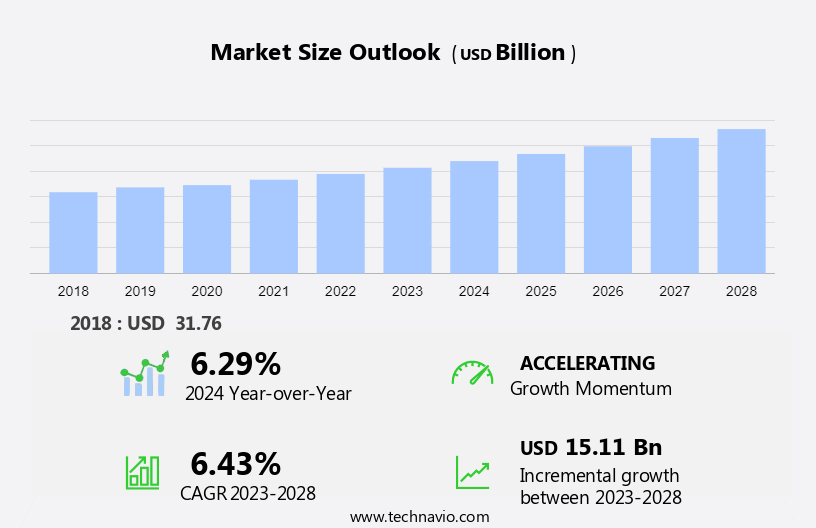
The modular kitchen market size is forecast to increase by USD 15.11 bn at a CAGR of 6.43% between 2023 and 2028.

  • The market is experiencing significant growth due to the increasing demand for convenient and customized kitchen solutions with a wide design variety. Open modular kitchens, in particular, are gaining popularity for their sleek and modern appearance. However, market fragmentation and competition from local carpenters pose challenges for market players. Consumers are increasingly seeking out modular kitchens for their space-saving design and ease of installation. Additionally, the trend towards open-plan living has fueled the demand for modular kitchens that can seamlessly integrate with other areas of the home. Despite these opportunities, market players must navigate the competitive landscape and maintain quality to differentiate themselves from local carpenters and other competitors.

What will be the Size of the Modular Kitchen Market During the Forecast Period?
Modular Kitchen Market Size

 Request Free Sample

  • The market encompasses the production and sale of prefabricated kitchen units, including wall units, base units, and cabinets. These systems offer enhanced hygiene, space management, and cost-efficiency compared to traditional kitchens. The market's growth is driven by various factors, such as the increasing nuclear families' standard of living and socio-economic conditions. Post-lockdown, there has been a surge in demand for modular kitchens due to their ease of installation and customization. Aesthetics play a significant role In the market's expansion, with consumers seeking sleek designs and innovative features. In the food service industry, fast-food chains and restaurants are increasingly adopting modular kitchens for their cost-effectiveness and streamlined operations.
  • New product developments continue to emerge, with advancements in ventilation systems addressing cooking fumes, and the integration of natural light, overhead lights, under-cabinet lights, and raw materials like plastic, metal, and wood. Maintenance costs remain a consideration, with domestic brands offering competitive pricing and ongoing support.

How is this Modular Kitchen Industry segmented and which is the largest segment?

The modular kitchen industry research report provides comprehensive data (region-wise segment analysis), with forecasts and estimates in "USD billion" for the period 2024-2028, as well as historical data from 2018-2022 for the following segments.

  • Type
    • L-shaped
    • U-shaped
    • Straight kitchen
    • G-shaped and others
  • Product
    • Floor cabinets
    • Wall cabinets
    • Tall storage
  • Geography
    • Europe
      • Germany
      • UK
    • APAC
      • China
      • Japan
    • North America
      • US
    • Middle East and Africa
    • South America

By Type Insights

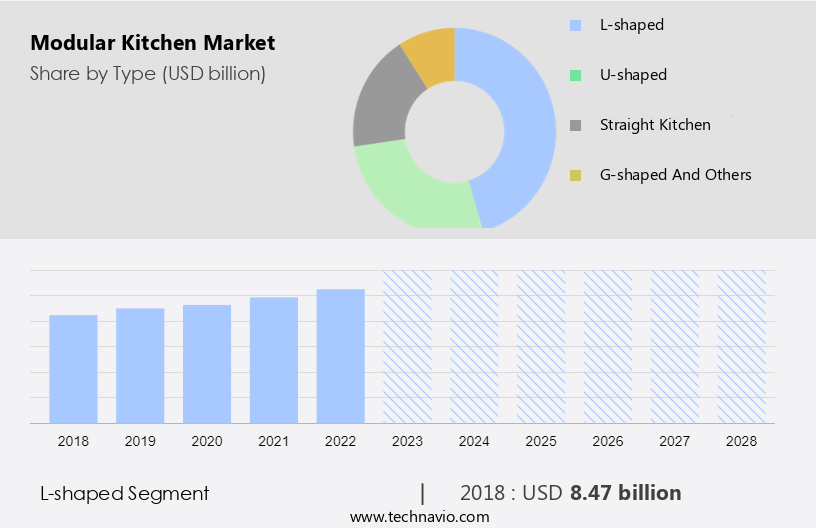
The l-shaped segment is estimated to witness significant growth during the forecast period. The L-shaped modular kitchen segment experiences continuous growth In the global market due to its functionality, practicality, and aesthetic value. This kitchen design, characterized by an L-shaped counter and cabinets along two adjoining walls, optimizes space utilization and facilitates seamless workflow. With ample storage options, countertop space, and flexibility in appliance placement, it caters to various kitchen sizes. The design's popularity stems from its ability to combine efficiency and style. Incorporating essential elements such as hygiene, space management, and cost-efficiency, this kitchen layout caters to the needs of nuclear families and the increasing standard of living. Socio-economic conditions and customer tastes influence its demand.

Aesthetics are addressed through various raw materials like plastic, metal, and wood, as well as eco-friendly alternatives such as recycled plastic, granules, enamel stones, and charcoal grays. Fast-food chains and open kitchen concepts have also contributed to the market's growth. New products, such as ventilation systems, chimneys, exhaust fans, natural light, overhead lights, and under-cabinet lights, enhance the kitchen experience. Maintenance costs and domestic brands influence purchasing power, while tariffs and trade routes impact market dynamics. The middle-class population's expansion and the increasing number of housing units further fuel the market's growth. Premiumization, contractors, and living spaces are other key factors shaping the market.
Modular Kitchen Market Size

Get a glance at the market report of various segments Request Free Sample

The L-shaped segment was valued at USD 8.47 bn in 2018 and showed a gradual increase during the forecast period.

Regional Analysis

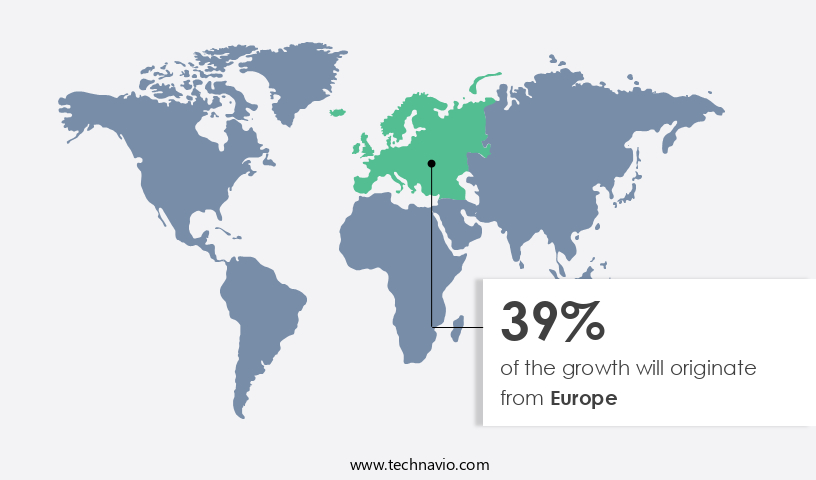
Europe is estimated to contribute 39% to the growth of the global market during the forecast period. Technavio's analysts have elaborately explained the regional trends and drivers that shape the market during the forecast period.
Modular Kitchen Market Share by Geography

For more insights on the market size of various regions, Request Free Sample

The European the market is experiencing growth due to the rising adoption of smart homes. This trend is driving the demand for advanced, tech-enabled modular kitchens. Key European countries leading this market include Germany, the UK, France, Russia, Italy, Benelux, and Spain. In 2023, there was a notable increase In the construction of smart homes. This development will fuel the need for modern kitchens, focusing on appliances, design, space management, and storage solutions for groceries, kitchenware, and utensils. Hygiene, cost-efficiency, maintenance, and aesthetics are other significant factors influencing the market. The middle-class population's increasing standard of living and socio-economic conditions are also contributing factors.

Materials like plastic, metal, and wood are commonly used, with eco-friendly alternatives gaining popularity. Key players In the market include domestic brands and international players, with domestic tariffs and trade routes impacting pricing. The market is further influenced by the increasing number of housing units, premiumization, and the involvement of contractors In the construction sector. Light colors, charcoal grays, red, and eco-friendly materials are popular choices for modern kitchen designs. Additionally, ventilation systems, such as chimneys and exhaust fans, are essential for managing cooking fumes. Natural light, overhead lights, and under-cabinet lights contribute to the overall functionality and aesthetic appeal of modular kitchens.

Market Dynamics

Our researchers analyzed the data with 2023 as the base year, along with the key drivers, trends, and challenges. A holistic analysis of drivers will help companies refine their marketing strategies to gain a competitive advantage.

What are the key market drivers leading to the rise In the adoption of Modular Kitchen Industry?

  • High demand for convenient and customized kitchens with wide design variety is the key driver of the market.Modular kitchens have gained popularity In the market due to their space-efficient and cost-effective design. Unlike traditional kitchens, which are typically made by carpenters and offer fewer design alternatives, modular kitchens can be customized to meet individual needs. This trend is driven by changing lifestyles and consumer preferences, as people seek organized facilities that enhance the ease of cooking. Modular kitchens offer several advantages, including maximum utilization of space. Tall storage units can accommodate various sizes of food containers, even in small areas. Corner spaces are utilized effectively, ensuring no space is wasted. Moreover, modular kitchens are known for their hygienic design, which is essential in today's socio-economic condition.

    The market is characterized by the use of various raw materials, such as plastic, metal, and wood. Maintenance costs are relatively low due to the durability of these materials. The market also caters to various customer tastes, with eco-friendly materials like recycled plastic, granules, and enamel stones gaining popularity. New products In the market include advanced ventilation systems, such as chimneys and exhaust fans, to manage cooking fumes effectively. Natural light and overhead, under-cabinet lights are also incorporated to enhance the aesthetics of the kitchen. The middle-class population's purchasing power and the increasing number of housing units are key factors driving the growth of the market.

    Contractors and open kitchen designs are also gaining traction in living spaces. Premiumization and the use of light colors, such as charcoal grays and red, add to the appeal of modular kitchens. In conclusion, the market is witnessing significant growth due to its space management, cost-efficiency, and hygiene benefits. The market caters to various customer tastes and socio-economic conditions while offering advanced features like ventilation systems and lighting options.

What are the market trends shaping the Modular Kitchen market?

  • Growing popularity of open modular kitchens is the upcoming market trend.Modular kitchens, comprised of base units, wall units, and cabinets, have become a significant part of modern living spaces. With the shift in socio-economic conditions and the rise of nuclear families, the standard of living has led to an increased focus on hygiene, space management, and cost-efficiency in kitchen design. Open kitchens, which are partially open to the living area, have gained popularity as they offer a blend of functionality and aesthetics. Modern kitchens are no longer just places for cooking; they serve as living areas, libraries, party zones, and entertainment spaces. Electronic appliances like coffee machines, ice makers, and others have become essential kitchen additions, enhancing convenience and reducing cooking time.

    Minimalistic furniture pieces and automation for worktops and chimneys are growing trends in modular kitchens. The demand for eco-friendly, anti-bacterial kitchens is on the rise, reflecting consumers' increasing focus on health and sustainability. The use of raw materials like plastic, metal, and wood, as well as eco-friendly materials such as recycled plastic, granules, enamel stones, and charcoal grays, red, and light colors, adds to the kitchen's appeal. Maintenance costs, a crucial factor for homeowners, have led to the preference for domestic brands and the implementation of domestic tariffs to support local industries. Contractors play a vital role In the design and installation of modular kitchens, ensuring they cater to the middle-class population's purchasing power and customer tastes.

    The introduction of new products like ventilation systems, exhaust fans, natural light, and overhead and under-cabinet lights, further enhances the functionality and aesthetics of modular kitchens. The market dynamics continue to evolve as consumers seek cost-effective, functional, and aesthetically pleasing kitchen solutions.

What challenges does the Modular Kitchen Industry face during its growth?

  • Market fragmentation and challenges from local carpenters is a key challenge affecting the industry growth.The market encompasses a wide array of cabinetry solutions, including wall units and base units, for efficient space management in both traditional and contemporary kitchen designs. Hygiene and cost-efficiency are key considerations, with consumers seeking low maintenance options. Nuclear families and the growing middle-class population drive demand, as does the increasing standard of living and socio-economic condition. Aesthetics also play a significant role, with consumers gravitating towards natural light, overhead lights, under-cabinet lights, and a variety of raw materials such as plastic, metal, and wood. New product innovations include ventilation solutions for cooking fumes, chimneys, and exhaust fans. Eco-friendly materials, such as recycled plastic, granules, and enamel stones, are gaining popularity due to their sustainability and affordability.

    Despite the presence of numerous local players, cost-efficiency remains a significant factor influencing consumer purchasing decisions. Maintenance costs and domestic tariffs impact the market dynamics, while contractors and open kitchen designs contribute to the expansion of living spaces. Premiumization trends include the use of light colors, charcoal grays, red, and other bold hues.

Exclusive Customer Landscape

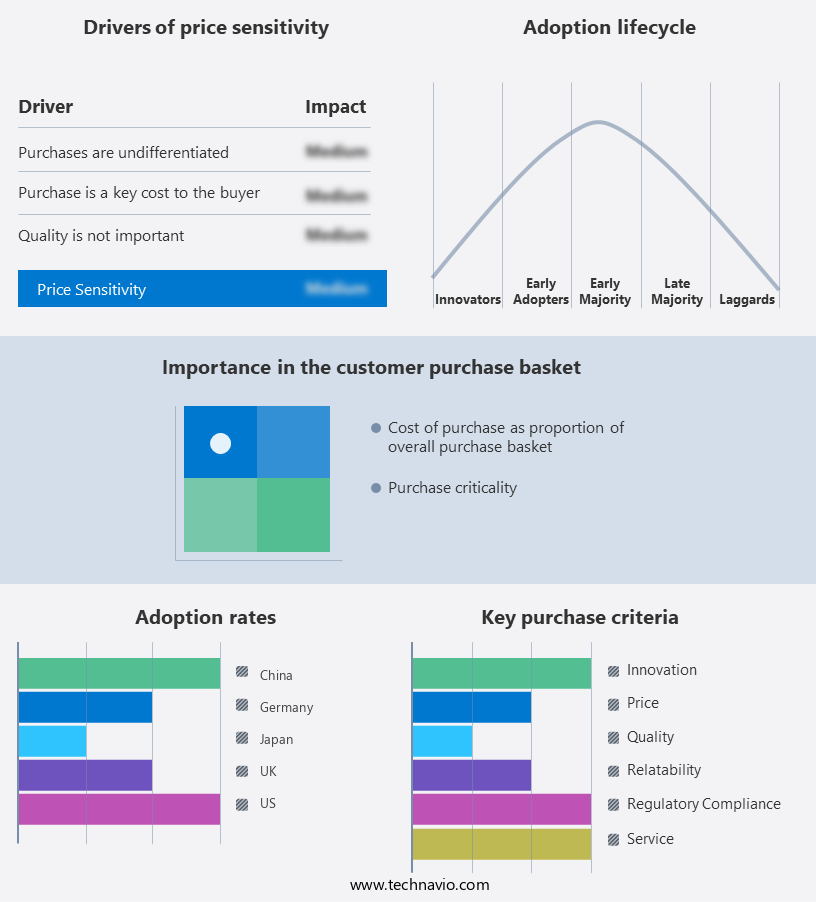
The modular kitchen market forecasting report includes the adoption lifecycle of the market, covering from the innovator's stage to the laggard's stage. It focuses on adoption rates in different regions based on penetration. Furthermore, the modular kitchen market report also includes key purchase criteria and drivers of price sensitivity to help companies evaluate and develop their market growth analysis strategies.
Modular Kitchen Market Share by Geography

 Customer Landscape

Key Companies & Market Insights

Companies are implementing various strategies, such as strategic alliances, modular kitchen market forecast, partnerships, mergers and acquisitions, geographical expansion, and product/service launches, to enhance their presence In the industry.

ALPES INOX - The company provides a range of modular kitchen solutions, catering to various sectors including residential and commercial applications, as well as multi-unit contractors. Their offerings encompass diverse models such as Moonshine Finish, G Street, Luxor Shaker Cabinets, and Cubitac Cabinets, among others, under the product categories of home kitchens and commercial kitchens.

The industry research and growth report includes detailed analyses of the competitive landscape of the market and information about key companies, including:

  • ALPES INOX
  • Asian Paints Ltd.
  • Boston Cabinets Inc.
  • eggersmann kuchen GmbH and Co. KG
  • Frama APS
  • Godrej and Boyce Manufacturing Co. Ltd.
  • Hacker Kuchen GmbH and Co. KG
  • Hettich Holding GmbH and Co. oHG
  • Homevista Decor and Furnishings Pvt. Ltd.
  • Inter IKEA Holding BV
  • Modular Kitchen Co.
  • Nobia AB
  • nobilia
  • Pedini SpA
  • Poggenpohl Manufacturing GmbH
  • Schuller Mobelwerk KG
  • SieMatic Mobelwerke GmbH and Co. KG
  • Snaidero Rino Spa
  • Veneta Cucine Spa
  • Welcome Kitchen World
  • Woodstone Cabinetry
  • Hafele America Co
  • Todeschini

Qualitative and quantitative analysis of companies has been conducted to help clients understand the wider business environment as well as the strengths and weaknesses of key industry players. Data is qualitatively analyzed to categorize companies as pure play, category-focused, industry-focused, and diversified; it is quantitatively analyzed to categorize companies as dominant, leading, strong, tentative, and weak.

Research Analyst Overview

The market continues to evolve, driven by various factors that shape its dynamics. One significant trend is the increasing focus on hygiene and space management in residential living spaces. With the rise of nuclear families and improving standards of living, the demand for cost-efficient and easy-to-maintain kitchen solutions has grown. Aesthetics also play a crucial role In the market. The preference for modern, sleek designs has led to the popularity of wall units, base units, and open kitchen concepts. The use of raw materials such as plastic, metal, and wood in modular kitchens caters to diverse customer tastes and preferences.

Another essential factor is the integration of advanced technologies. Ventilation systems, including chimneys and exhaust fans, help manage cooking fumes and maintain a clean kitchen environment. Natural light and various lighting options, including overhead lights and under-cabinet lights, enhance the overall kitchen experience. The market for modular kitchens is influenced by socio-economic conditions and purchasing power. In many regions, domestic brands have emerged, offering competitive pricing and catering to local tastes. Domestic tariffs and trade routes impact the market's competitiveness and pricing dynamics. New products and innovations continue to shape the market. Eco-friendly materials, such as recycled plastic, granules, and enamel stones, are gaining popularity due to their sustainability and cost-effectiveness.

Premiumization and customization are also key trends, with contractors offering personalized solutions to cater to unique customer requirements. In conclusion, the market is driven by various factors, including hygiene, space management, cost-efficiency, aesthetics, and advanced technologies. Socio-economic conditions, purchasing power, and customer preferences also significantly impact the market's dynamics. As the market continues to evolve, it is essential to stay informed about these trends and factors to make informed business decisions.

Market Scope

Report Coverage

Details

Page number

169

Base year

2023

Historic period

2018-2022

Forecast period

2024-2028

Growth momentum & CAGR

Accelerate at a CAGR of 6.43%

Market growth 2024-2028

USD 15.11 billion

Market structure

Fragmented

YoY growth 2023-2024(%)

6.29

Key countries

US, China, Japan, Germany, and UK

Competitive landscape

Leading Companies, Market Positioning of Companies, Competitive Strategies, and Industry Risks

Request Free Sample

What are the Key Data Covered in this Modular Kitchen Market Research and Growth Report?

  • CAGR of the Modular Kitchen industry during the forecast period
  • Detailed information on factors that will drive the growth and forecasting between 2024 and 2028
  • Precise estimation of the size of the market and its contribution of the industry in focus to the parent market
  • Accurate predictions about upcoming growth and trends and changes in consumer behaviour
  • Growth of the market across Europe, APAC, North America, Middle East and Africa, and South America
  • Thorough analysis of the market's competitive landscape and detailed information about companies
  • Comprehensive analysis of factors that will challenge the modular kitchen market growth of industry companies

We can help! Our analysts can customize this modular kitchen market research report to meet your requirements.

Get in touch

1 Executive Summary

  • 1.1 Market overview
    • Exhibit 01: Executive Summary – Chart on Market Overview
    • Exhibit 02: Executive Summary – Data Table on Market Overview
    • Exhibit 03: Executive Summary – Chart on Global Market Characteristics
    • Exhibit 04: Executive Summary – Chart on Market by Geography
    • Exhibit 05: Executive Summary – Chart on Market Segmentation by Type
    • Exhibit 06: Executive Summary – Chart on Market Segmentation by Product
    • Exhibit 07: Executive Summary – Chart on Incremental Growth
    • Exhibit 08: Executive Summary – Data Table on Incremental Growth
    • Exhibit 09: Executive Summary – Chart on Vendor Market Positioning

2 Market Landscape

  • 2.1 Market ecosystem
    • Exhibit 10: Parent market
    • Exhibit 11: Market Characteristics

3 Market Sizing

  • 3.1 Market definition
    • Exhibit 12: Offerings of vendors included in the market definition
  • 3.2 Market segment analysis
    • Exhibit 13: Market segments
  • 3.3 Market size 2023
    • 3.4 Market outlook: Forecast for 2023-2028
      • Exhibit 14: Chart on Global - Market size and forecast 2023-2028 ($ billion)
      • Exhibit 15: Data Table on Global - Market size and forecast 2023-2028 ($ billion)
      • Exhibit 16: Chart on Global Market: Year-over-year growth 2023-2028 (%)
      • Exhibit 17: Data Table on Global Market: Year-over-year growth 2023-2028 (%)

    4 Historic Market Size

    • 4.1 Global modular kitchen market 2018 - 2022
      • Exhibit 18: Historic Market Size – Data Table on global modular kitchen market 2018 - 2022 ($ billion)
    • 4.2 Type Segment Analysis 2018 - 2022
      • Exhibit 19: Historic Market Size – Type Segment 2018 - 2022 ($ billion)
    • 4.3 Product Segment Analysis 2018 - 2022
      • Exhibit 20: Historic Market Size – Product Segment 2018 - 2022 ($ billion)
    • 4.4 Geography Segment Analysis 2018 - 2022
      • Exhibit 21: Historic Market Size – Geography Segment 2018 - 2022 ($ billion)
    • 4.5 Country Segment Analysis 2018 - 2022
      • Exhibit 22: Historic Market Size – Country Segment 2018 - 2022 ($ billion)

    5 Five Forces Analysis

    • 5.1 Five forces summary
      • Exhibit 23: Five forces analysis - Comparison between 2023 and 2028
    • 5.2 Bargaining power of buyers
      • Exhibit 24: Chart on Bargaining power of buyers – Impact of key factors 2023 and 2028
    • 5.3 Bargaining power of suppliers
      • Exhibit 25: Bargaining power of suppliers – Impact of key factors in 2023 and 2028
    • 5.4 Threat of new entrants
      • Exhibit 26: Threat of new entrants – Impact of key factors in 2023 and 2028
    • 5.5 Threat of substitutes
      • Exhibit 27: Threat of substitutes – Impact of key factors in 2023 and 2028
    • 5.6 Threat of rivalry
      • Exhibit 28: Threat of rivalry – Impact of key factors in 2023 and 2028
    • 5.7 Market condition
      • Exhibit 29: Chart on Market condition - Five forces 2023 and 2028

    6 Market Segmentation by Type

    • 6.1 Market segments
      • Exhibit 30: Chart on Type - Market share 2023-2028 (%)
      • Exhibit 31: Data Table on Type - Market share 2023-2028 (%)
    • 6.2 Comparison by Type
      • Exhibit 32: Chart on Comparison by Type
      • Exhibit 33: Data Table on Comparison by Type
    • 6.3 L-shaped - Market size and forecast 2023-2028
      • Exhibit 34: Chart on L-shaped - Market size and forecast 2023-2028 ($ billion)
      • Exhibit 35: Data Table on L-shaped - Market size and forecast 2023-2028 ($ billion)
      • Exhibit 36: Chart on L-shaped - Year-over-year growth 2023-2028 (%)
      • Exhibit 37: Data Table on L-shaped - Year-over-year growth 2023-2028 (%)
    • 6.4 U-shaped - Market size and forecast 2023-2028
      • Exhibit 38: Chart on U-shaped - Market size and forecast 2023-2028 ($ billion)
      • Exhibit 39: Data Table on U-shaped - Market size and forecast 2023-2028 ($ billion)
      • Exhibit 40: Chart on U-shaped - Year-over-year growth 2023-2028 (%)
      • Exhibit 41: Data Table on U-shaped - Year-over-year growth 2023-2028 (%)
    • 6.5 Straight kitchen or one-walled modular kitchen - Market size and forecast 2023-2028
      • Exhibit 42: Chart on Straight kitchen or one-walled modular kitchen - Market size and forecast 2023-2028 ($ billion)
      • Exhibit 43: Data Table on Straight kitchen or one-walled modular kitchen - Market size and forecast 2023-2028 ($ billion)
      • Exhibit 44: Chart on Straight kitchen or one-walled modular kitchen - Year-over-year growth 2023-2028 (%)
      • Exhibit 45: Data Table on Straight kitchen or one-walled modular kitchen - Year-over-year growth 2023-2028 (%)
    • 6.6 G-shaped modular kitchen and others - Market size and forecast 2023-2028
      • Exhibit 46: Chart on G-shaped modular kitchen and others - Market size and forecast 2023-2028 ($ billion)
      • Exhibit 47: Data Table on G-shaped modular kitchen and others - Market size and forecast 2023-2028 ($ billion)
      • Exhibit 48: Chart on G-shaped modular kitchen and others - Year-over-year growth 2023-2028 (%)
      • Exhibit 49: Data Table on G-shaped modular kitchen and others - Year-over-year growth 2023-2028 (%)
    • 6.7 Market opportunity by Type
      • Exhibit 50: Market opportunity by Type ($ billion)
      • Exhibit 51: Data Table on Market opportunity by Type ($ billion)

    7 Market Segmentation by Product

    • 7.1 Market segments
      • Exhibit 52: Chart on Product - Market share 2023-2028 (%)
      • Exhibit 53: Data Table on Product - Market share 2023-2028 (%)
    • 7.2 Comparison by Product
      • Exhibit 54: Chart on Comparison by Product
      • Exhibit 55: Data Table on Comparison by Product
    • 7.3 Floor cabinets - Market size and forecast 2023-2028
      • Exhibit 56: Chart on Floor cabinets - Market size and forecast 2023-2028 ($ billion)
      • Exhibit 57: Data Table on Floor cabinets - Market size and forecast 2023-2028 ($ billion)
      • Exhibit 58: Chart on Floor cabinets - Year-over-year growth 2023-2028 (%)
      • Exhibit 59: Data Table on Floor cabinets - Year-over-year growth 2023-2028 (%)
    • 7.4 Wall cabinets - Market size and forecast 2023-2028
      • Exhibit 60: Chart on Wall cabinets - Market size and forecast 2023-2028 ($ billion)
      • Exhibit 61: Data Table on Wall cabinets - Market size and forecast 2023-2028 ($ billion)
      • Exhibit 62: Chart on Wall cabinets - Year-over-year growth 2023-2028 (%)
      • Exhibit 63: Data Table on Wall cabinets - Year-over-year growth 2023-2028 (%)
    • 7.5 Tall storage - Market size and forecast 2023-2028
      • Exhibit 64: Chart on Tall storage - Market size and forecast 2023-2028 ($ billion)
      • Exhibit 65: Data Table on Tall storage - Market size and forecast 2023-2028 ($ billion)
      • Exhibit 66: Chart on Tall storage - Year-over-year growth 2023-2028 (%)
      • Exhibit 67: Data Table on Tall storage - Year-over-year growth 2023-2028 (%)
    • 7.6 Market opportunity by Product
      • Exhibit 68: Market opportunity by Product ($ billion)
      • Exhibit 69: Data Table on Market opportunity by Product ($ billion)

    8 Customer Landscape

    • 8.1 Customer landscape overview
      • Exhibit 70: Analysis of price sensitivity, lifecycle, customer purchase basket, adoption rates, and purchase criteria

    9 Geographic Landscape

    • 9.1 Geographic segmentation
      • Exhibit 71: Chart on Market share by geography 2023-2028 (%)
      • Exhibit 72: Data Table on Market share by geography 2023-2028 (%)
    • 9.2 Geographic comparison
      • Exhibit 73: Chart on Geographic comparison
      • Exhibit 74: Data Table on Geographic comparison
    • 9.3 Europe - Market size and forecast 2023-2028
      • Exhibit 75: Chart on Europe - Market size and forecast 2023-2028 ($ billion)
      • Exhibit 76: Data Table on Europe - Market size and forecast 2023-2028 ($ billion)
      • Exhibit 77: Chart on Europe - Year-over-year growth 2023-2028 (%)
      • Exhibit 78: Data Table on Europe - Year-over-year growth 2023-2028 (%)
    • 9.4 APAC - Market size and forecast 2023-2028
      • Exhibit 79: Chart on APAC - Market size and forecast 2023-2028 ($ billion)
      • Exhibit 80: Data Table on APAC - Market size and forecast 2023-2028 ($ billion)
      • Exhibit 81: Chart on APAC - Year-over-year growth 2023-2028 (%)
      • Exhibit 82: Data Table on APAC - Year-over-year growth 2023-2028 (%)
    • 9.5 North America - Market size and forecast 2023-2028
      • Exhibit 83: Chart on North America - Market size and forecast 2023-2028 ($ billion)
      • Exhibit 84: Data Table on North America - Market size and forecast 2023-2028 ($ billion)
      • Exhibit 85: Chart on North America - Year-over-year growth 2023-2028 (%)
      • Exhibit 86: Data Table on North America - Year-over-year growth 2023-2028 (%)
    • 9.6 Middle East and Africa - Market size and forecast 2023-2028
      • Exhibit 87: Chart on Middle East and Africa - Market size and forecast 2023-2028 ($ billion)
      • Exhibit 88: Data Table on Middle East and Africa - Market size and forecast 2023-2028 ($ billion)
      • Exhibit 89: Chart on Middle East and Africa - Year-over-year growth 2023-2028 (%)
      • Exhibit 90: Data Table on Middle East and Africa - Year-over-year growth 2023-2028 (%)
    • 9.7 South America - Market size and forecast 2023-2028
      • Exhibit 91: Chart on South America - Market size and forecast 2023-2028 ($ billion)
      • Exhibit 92: Data Table on South America - Market size and forecast 2023-2028 ($ billion)
      • Exhibit 93: Chart on South America - Year-over-year growth 2023-2028 (%)
      • Exhibit 94: Data Table on South America - Year-over-year growth 2023-2028 (%)
    • 9.8 US - Market size and forecast 2023-2028
      • Exhibit 95: Chart on US - Market size and forecast 2023-2028 ($ billion)
      • Exhibit 96: Data Table on US - Market size and forecast 2023-2028 ($ billion)
      • Exhibit 97: Chart on US - Year-over-year growth 2023-2028 (%)
      • Exhibit 98: Data Table on US - Year-over-year growth 2023-2028 (%)
    • 9.9 Germany - Market size and forecast 2023-2028
      • Exhibit 99: Chart on Germany - Market size and forecast 2023-2028 ($ billion)
      • Exhibit 100: Data Table on Germany - Market size and forecast 2023-2028 ($ billion)
      • Exhibit 101: Chart on Germany - Year-over-year growth 2023-2028 (%)
      • Exhibit 102: Data Table on Germany - Year-over-year growth 2023-2028 (%)
    • 9.10 UK - Market size and forecast 2023-2028
      • Exhibit 103: Chart on UK - Market size and forecast 2023-2028 ($ billion)
      • Exhibit 104: Data Table on UK - Market size and forecast 2023-2028 ($ billion)
      • Exhibit 105: Chart on UK - Year-over-year growth 2023-2028 (%)
      • Exhibit 106: Data Table on UK - Year-over-year growth 2023-2028 (%)
    • 9.11 China - Market size and forecast 2023-2028
      • Exhibit 107: Chart on China - Market size and forecast 2023-2028 ($ billion)
      • Exhibit 108: Data Table on China - Market size and forecast 2023-2028 ($ billion)
      • Exhibit 109: Chart on China - Year-over-year growth 2023-2028 (%)
      • Exhibit 110: Data Table on China - Year-over-year growth 2023-2028 (%)
    • 9.12 Japan - Market size and forecast 2023-2028
      • Exhibit 111: Chart on Japan - Market size and forecast 2023-2028 ($ billion)
      • Exhibit 112: Data Table on Japan - Market size and forecast 2023-2028 ($ billion)
      • Exhibit 113: Chart on Japan - Year-over-year growth 2023-2028 (%)
      • Exhibit 114: Data Table on Japan - Year-over-year growth 2023-2028 (%)
    • 9.13 Market opportunity by geography
      • Exhibit 115: Market opportunity by geography ($ billion)
      • Exhibit 116: Data Tables on Market opportunity by geography ($ billion)

    10 Drivers, Challenges, and Trends

    • 10.1 Market drivers
      • 10.2 Market challenges
        • 10.3 Impact of drivers and challenges
          • Exhibit 117: Impact of drivers and challenges in 2023 and 2028
        • 10.4 Market trends

          11 Vendor Landscape

          • 11.1 Overview
            • 11.2 Vendor landscape
              • Exhibit 118: Overview on Criticality of inputs and Factors of differentiation
            • 11.3 Landscape disruption
              • Exhibit 119: Overview on factors of disruption
            • 11.4 Industry risks
              • Exhibit 120: Impact of key risks on business

            12 Vendor Analysis

            • 12.1 Vendors covered
              • Exhibit 121: Vendors covered
            • 12.2 Market positioning of vendors
              • Exhibit 122: Matrix on vendor position and classification
            • 12.3 Boston Cabinets Inc.
              • Exhibit 123: Boston Cabinets Inc. - Overview
              • Exhibit 124: Boston Cabinets Inc. - Product / Service
              • Exhibit 125: Boston Cabinets Inc. - Key offerings
            • 12.4 eggersmann kuchen GmbH and Co. KG
              • Exhibit 126: eggersmann kuchen GmbH and Co. KG - Overview
              • Exhibit 127: eggersmann kuchen GmbH and Co. KG - Product / Service
              • Exhibit 128: eggersmann kuchen GmbH and Co. KG - Key offerings
            • 12.5 Hacker Kuchen GmbH and Co. KG
              • Exhibit 129: Hacker Kuchen GmbH and Co. KG - Overview
              • Exhibit 130: Hacker Kuchen GmbH and Co. KG - Product / Service
              • Exhibit 131: Hacker Kuchen GmbH and Co. KG - Key offerings
            • 12.6 Hafele America Co
              • Exhibit 132: Hafele America Co - Overview
              • Exhibit 133: Hafele America Co - Product / Service
              • Exhibit 134: Hafele America Co - Key offerings
            • 12.7 Hettich Holding GmbH and Co. oHG
              • Exhibit 135: Hettich Holding GmbH and Co. oHG - Overview
              • Exhibit 136: Hettich Holding GmbH and Co. oHG - Product / Service
              • Exhibit 137: Hettich Holding GmbH and Co. oHG - Key offerings
            • 12.8 Homevista Decor and Furnishings Pvt. Ltd.
              • Exhibit 138: Homevista Decor and Furnishings Pvt. Ltd. - Overview
              • Exhibit 139: Homevista Decor and Furnishings Pvt. Ltd. - Product / Service
              • Exhibit 140: Homevista Decor and Furnishings Pvt. Ltd. - Key offerings
            • 12.9 Inter IKEA Holding BV
              • Exhibit 141: Inter IKEA Holding BV - Overview
              • Exhibit 142: Inter IKEA Holding BV - Product / Service
              • Exhibit 143: Inter IKEA Holding BV - Key news
              • Exhibit 144: Inter IKEA Holding BV - Key offerings
            • 12.10 Nobia AB
              • Exhibit 145: Nobia AB - Overview
              • Exhibit 146: Nobia AB - Business segments
              • Exhibit 147: Nobia AB - Key news
              • Exhibit 148: Nobia AB - Key offerings
              • Exhibit 149: Nobia AB - Segment focus
            • 12.11 nobilia
              • Exhibit 150: nobilia - Overview
              • Exhibit 151: nobilia - Product / Service
              • Exhibit 152: nobilia - Key offerings
            • 12.12 Pedini SpA
              • Exhibit 153: Pedini SpA - Overview
              • Exhibit 154: Pedini SpA - Product / Service
              • Exhibit 155: Pedini SpA - Key offerings
            • 12.13 Poggenpohl Manufacturing GmbH
              • Exhibit 156: Poggenpohl Manufacturing GmbH - Overview
              • Exhibit 157: Poggenpohl Manufacturing GmbH - Product / Service
              • Exhibit 158: Poggenpohl Manufacturing GmbH - Key offerings
            • 12.14 Schuller Mobelwerk KG
              • Exhibit 159: Schuller Mobelwerk KG - Overview
              • Exhibit 160: Schuller Mobelwerk KG - Product / Service
              • Exhibit 161: Schuller Mobelwerk KG - Key offerings
            • 12.15 SieMatic Mobelwerke GmbH and Co. KG
              • Exhibit 162: SieMatic Mobelwerke GmbH and Co. KG - Overview
              • Exhibit 163: SieMatic Mobelwerke GmbH and Co. KG - Product / Service
              • Exhibit 164: SieMatic Mobelwerke GmbH and Co. KG - Key offerings
            • 12.16 Snaidero Rino Spa
              • Exhibit 165: Snaidero Rino Spa - Overview
              • Exhibit 166: Snaidero Rino Spa - Product / Service
              • Exhibit 167: Snaidero Rino Spa - Key offerings
            • 12.17 Veneta Cucine Spa
              • Exhibit 168: Veneta Cucine Spa - Overview
              • Exhibit 169: Veneta Cucine Spa - Product / Service
              • Exhibit 170: Veneta Cucine Spa - Key offerings

            13 Appendix

            • 13.1 Scope of the report
              • 13.2 Inclusions and exclusions checklist
                • Exhibit 171: Inclusions checklist
                • Exhibit 172: Exclusions checklist
              • 13.3 Currency conversion rates for US$
                • Exhibit 173: Currency conversion rates for US$
              • 13.4 Research methodology
                • Exhibit 174: Research methodology
                • Exhibit 175: Validation techniques employed for market sizing
                • Exhibit 176: Information sources
              • 13.5 List of abbreviations
                • Exhibit 177: List of abbreviations

              Research Methodology

              Technavio presents a detailed picture of the market by way of study, synthesis, and summation of data from multiple sources. The analysts have presented the various facets of the market with a particular focus on identifying the key industry influencers. The data thus presented is comprehensive, reliable, and the result of extensive research, both primary and secondary.

              INFORMATION SOURCES

              Primary sources

              • Manufacturers and suppliers
              • Channel partners
              • Industry experts
              • Strategic decision makers

              Secondary sources

              • Industry journals and periodicals
              • Government data
              • Financial reports of key industry players
              • Historical data
              • Press releases

              DATA ANALYSIS

              Data Synthesis

              • Collation of data
              • Estimation of key figures
              • Analysis of derived insights

              Data Validation

              • Triangulation with data models
              • Reference against proprietary databases
              • Corroboration with industry experts

              REPORT WRITING

              Qualitative

              • Market drivers
              • Market challenges
              • Market trends
              • Five forces analysis

              Quantitative

              • Market size and forecast
              • Market segmentation
              • Geographical insights
              • Competitive landscape

              Interested in this report?

              Get your sample now to see our research methodology and insights!

              Download Now

              Frequently Asked Questions

              Modular Kitchen market growth will increase by $ 15.11 bn during 2024-2028 .

              The Modular Kitchen market is expected to grow at a CAGR of 6.43% during 2024-2028 .

              Modular Kitchen market is segmented by Type( L-shaped, U-shaped, Straight kitchen, G-shaped and others) Product( Floor cabinets, Wall cabinets, Tall storage, South America, MEA)

              ALPES INOX, Asian Paints Ltd., Boston Cabinets Inc., eggersmann kuchen GmbH and Co. KG, Frama APS, Godrej and Boyce Manufacturing Co. Ltd., Hacker Kuchen GmbH and Co. KG, Hettich Holding GmbH and Co. oHG, Homevista Decor and Furnishings Pvt. Ltd., Inter IKEA Holding BV, Modular Kitchen Co., Nobia AB, nobilia, Pedini SpA, Poggenpohl Manufacturing GmbH, Schuller Mobelwerk KG, SieMatic Mobelwerke GmbH and Co. KG, Snaidero Rino Spa, Veneta Cucine Spa, Welcome Kitchen World, Woodstone Cabinetry, Hafele America Co, Todeschini are a few of the key vendors in the Modular Kitchen market.

              Europe will register the highest growth rate of 39% among the other regions. Therefore, the Modular Kitchen market in Europe is expected to garner significant business opportunities for the vendors during the forecast period.

              US, China, Japan, Germany, UK

              • High demand for convenient and customized kitchens with wide design varietyCompared with a modular kitchen is the driving factor this market.
              • which offers a large selection of designs is the driving factor this market.
              • a traditional kitchen offers fewer design alternatives. Changes in lifestyles and consumer preferences have induced a growing demand for organized facilities and kitchens that would enhance the ease in cooking. A modular kitchen can be designed and customized to meet the users requirements. It provides convenience and higher accessibility to kitchen tools. Tall storage can store all sizes of food containers is the driving factor this market.
              • even in a small area. Corner spaces in a modular kitchen also enable maximum utilization of space. A traditional kitchen is the driving factor this market.
              • which is mostly made by carpenters is the driving factor this market.
              • usually has rough edges and an uneven finish. Any kind of replacement cannot be guaranteed is the driving factor this market.
              • and servicing consumes time. In comparison is the driving factor this market.
              • a modular kitchen has a smooth and seamless finish. Several modular kitchen companies is the driving factor this market.
              • such as Sleek is the driving factor this market.
              • provide easy replacements and contracts for regular services to maintain high kitchen quality. Thus is the driving factor this market.
              • the high demand for convenient and customized kitchens with a wide design variety will drive the growth of the global modular kitchen market during the forecast period. is the driving factor this market.

              The Modular Kitchen market vendors should focus on grabbing business opportunities from the L-shaped segment as it accounted for the largest market share in the base year.
