
Open System MRI Market Size 2025-2029
The open system mri market size is forecast to increase by USD 288.5 million, at a CAGR of 4.6% between 2024 and 2029.
The open system MRI market is expanding, driven by the rising prevalence of chronic health conditions and a growing elderly population requiring advanced diagnostic imaging. These systems are crucial in orthopedic medical imaging and for assessing cardiovascular and neurological disorders, as their design helps alleviate patient anxiety and claustrophobia, leading to more effective scans. Enhanced patient comfort in pediatric and bariatric populations further supports adoption. The integration of advanced magnetic resonance imaging (MRI) coils and improved software contributes to better diagnostic outcomes. This patient-centric approach aligns with modern healthcare demands, making open architecture systems a vital tool in diagnostic imaging market for a diverse range of clinical scenarios.Key market dynamics include significant software advancements in MRI technology, which enable faster and more precise scans with greater detail. Innovations like simultaneous multi-slice applications are reducing acquisition times, making advanced techniques such as diffusion tensor imaging more accessible for routine clinical use. These developments in the image guided therapy system market are enhancing the appeal of open MRI platforms across the healthcare sector. However, the market's growth is constrained by the high cost of the systems themselves, which includes substantial expenses for installation, servicing, and software upgrades. This financial barrier limits adoption, particularly for smaller healthcare facilities, and may affect investment in new magnetic resonance imaging (MRI) systems.
What will be the Size of the Open System MRI Market during the forecast period?
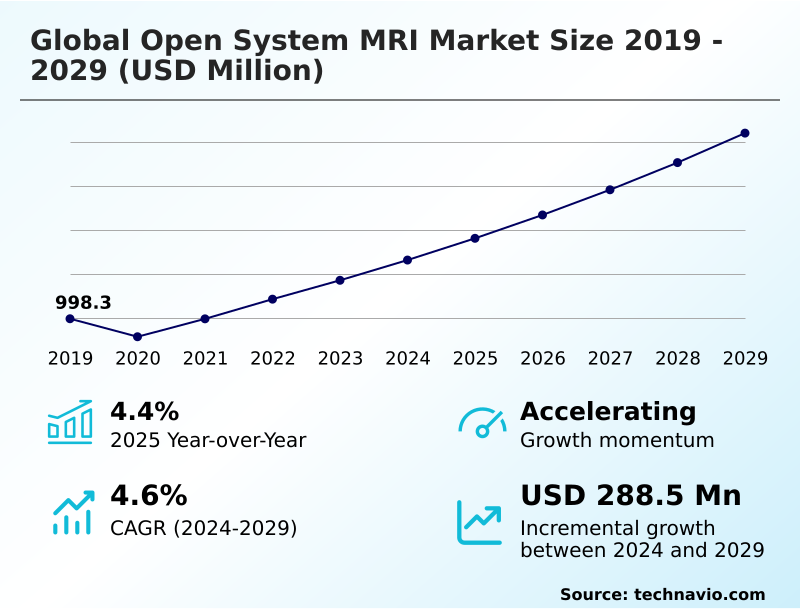
Explore in-depth regional segment analysis with market size data - historical 2019 - 2023 and forecasts 2025-2029 - in the full report.
Request Free Sample
The market's evolution is shaped by the interplay between advanced diagnostic procedures and the practical demands of patient-centric healthcare. Innovations in superconducting magnet technology and cryogen-free magnet designs are addressing operational costs, while developments in AI-enabled open system MRI are enhancing image resolution. The focus on reducing motion artifacts through better system design is critical, particularly in pediatric neurology imaging and for bariatric patients. These advancements are crucial for applications within the image guided therapy system market and for improving soft tissue contrast in orthopedic medical imaging.Operational efficiency is a key theme, with advancements in imaging application software and simultaneous multi-slice techniques reducing acquisition times. This allows for higher patient throughput and the integration of sophisticated methods like diffusion tensor imaging into routine clinical use. However, the market must contend with the challenge of magnetic field homogeneity in open architectures and the persistent issue of a lower signal-to-noise ratio in some systems. The demand for advanced magnetic resonance imaging (MRI) systems continues to be influenced by these technical considerations and their impact on diagnostic confidence.
How is this Open System MRI Industry segmented?
The open system mri industry research report provides comprehensive data (region-wise segment analysis), with forecasts and estimates in "USD million" for the period 2025-2029, as well as historical data from 2019 - 2023 for the following segments.
- Type
- Low field scanner
- Medium field scanner
- High field scanner
- Technology
- Superconducting magnet
- Permanent magnet
- Hybrid systems
- End-user
- Neurology
- Oncology
- Cardiology
- Others
- Geography
- North America
- Europe
- Germany
- UK
- France
- Italy
- Spain
- The Netherlands
- Asia
- Rest of World (ROW)
By Type Insights
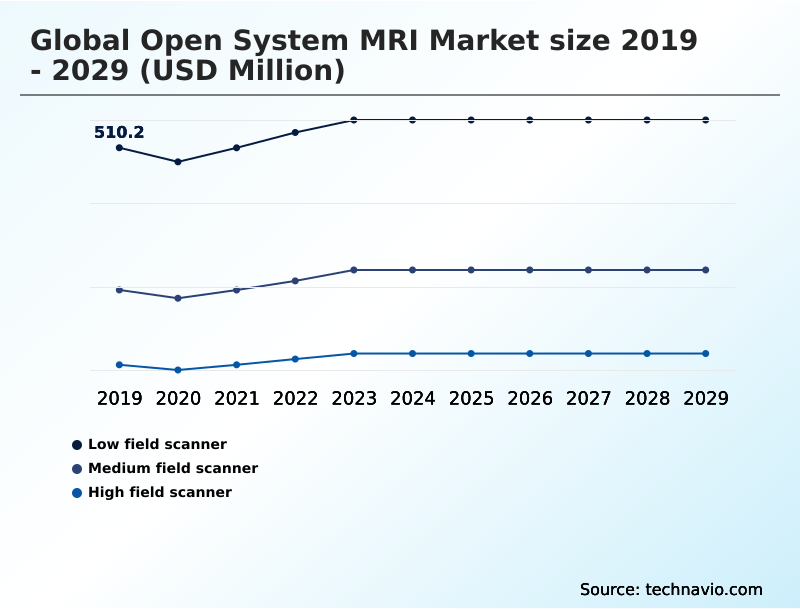
The low field scanner segment is estimated to witness significant growth during the forecast period.
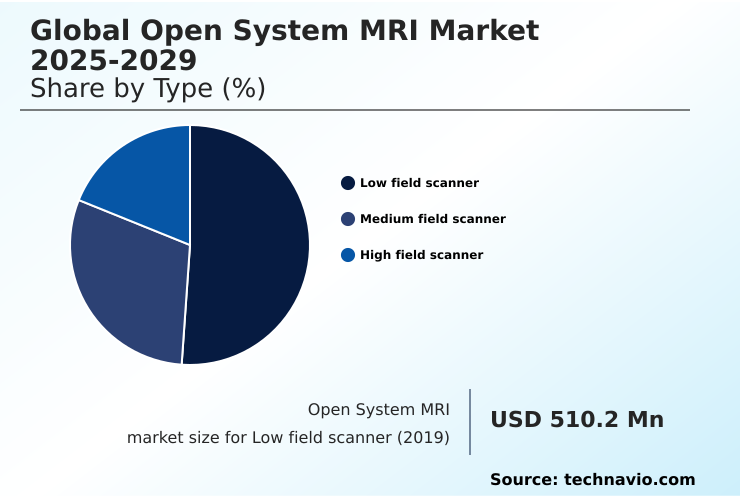
Low-field MRI devices have experienced a resurgence due to significant technological advancements in both hardware and software. Initially considered to have lower clinical utility, their performance has become increasingly comparable to high-field scanners for many applications. This has led to greater acceptance of high-performance low-field systems, which now hold over 50.8% of the market share. Vendors are focusing on developing models that improve patient comfort while providing accurate diagnoses, making them advantageous in various clinical settings.
These systems are designed to enhance accessibility to MRI technology, especially in environments where traditional high-field systems are not practical. The designs aim to improve patient comfort and reduce operational costs, making MRI more available to diverse populations, including individuals with mobility challenges or those in remote locations. Such developments are expected to continue driving demand for low-field scanners. The focus on patient-centric design and cost-effective operation supports their growing role in the diagnostic imaging landscape.

Request Free Sample
The Low field scanner segment was valued at USD 510.20 million in 2019 and showed a gradual increase during the forecast period.
Regional Analysis
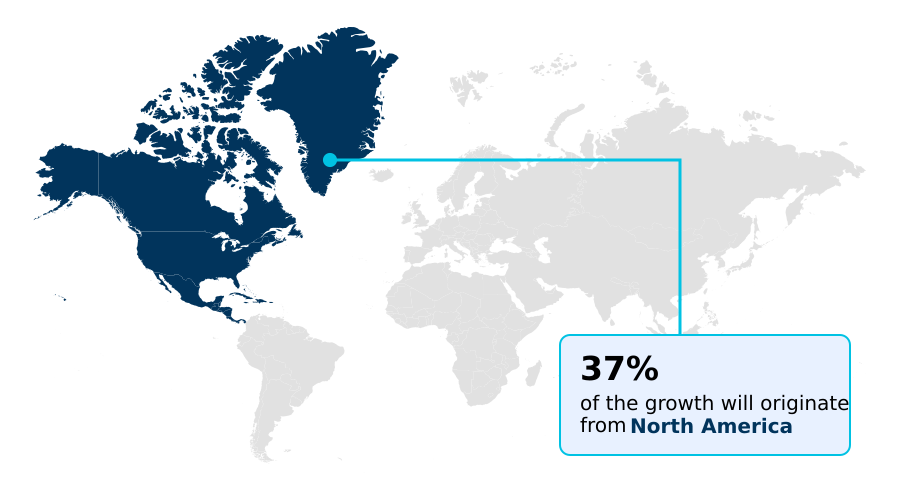
North America is estimated to contribute 36.8% to the growth of the global market during the forecast period.Technavio’s analysts have elaborately explained the regional trends and drivers that shape the market during the forecast period.
Request Free Sample
North America stands as the leading region in the global open system MRI market, driven by its advanced healthcare infrastructure and high prevalence of chronic medical conditions. The region benefits from favorable reimbursement policies, a strong presence of established vendors, and a high volume of MRI examinations. The significant incidence of cardiovascular and orthopedic diseases fuels demand for effective diagnostic procedures. The US market alone accounts for nearly 79.4% of the region's revenue, reflecting its dominance in technology adoption and healthcare spending.
Furthermore, the demand for advanced diagnostic procedures continues to rise across North America. Healthcare providers are increasingly adopting innovative technologies to improve patient outcomes and operational efficiency. The introduction of AI-enabled imaging capabilities and systems designed to enhance patient comfort meets the growing needs of a diverse patient population. This sustained investment in advanced medical technology ensures the region's continued leadership and growth in the open system MRI market, particularly in countries with high rates of chronic illness and aging populations.
Market Dynamics
Our researchers analyzed the data with 2024 as the base year, along with the key drivers, trends, and challenges. A holistic analysis of drivers will help companies refine their marketing strategies to gain a competitive advantage.
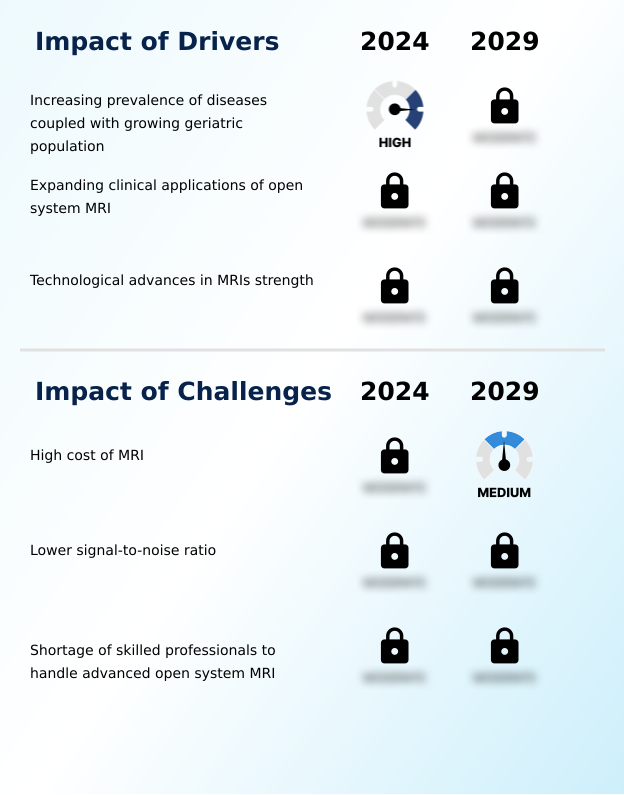
The Global Open System MRI market is experiencing significant growth, driven by the increasing prevalence of chronic diseases and the growing geriatric population and mri needs. Key market accelerators include the expanding clinical applications of open mri and ongoing technological advances in mri field strength. The industry is witnessing a strong focus on helium-free open mri development alongside the development of helium-free open system mri to reduce operational costs. Concurrently, software advancement in mri technology and broader software advancements in mri imaging are enhancing diagnostic capabilities. The adoption of AI-enabled diagnostic procedures in mri and a commitment to patient-centric design in diagnostic imaging are further revolutionizing the sector by reducing patient anxiety and claustrophobia in mri.However, the market faces significant hurdles, notably the high cost of advanced mri systems. Furthermore, the shortage of skilled professionals for mri poses operational challenges, necessitating effective strategies for managing shortage of skilled mri professionals. A persistent technical issue is the lower signal-to-noise ratio in mri, but OEM are focused on addressing low signal-to-noise ratio challenges. Despite these issues, the demand for specialized clinical applications of open system mri is rising, providing crucial imaging solutions for bariatric and geriatric patients, enabling effective pediatric imaging with open mri systems, and facilitating complex interventional procedures using open mri.

What are the key market drivers leading to the rise in the adoption of Open System MRI Industry?
- The increasing prevalence of chronic diseases, in conjunction with a growing global geriatric population, is a primary driver for the market.
The rising incidence of chronic diseases and an expanding geriatric demographic are key factors contributing to market demand. Open system MRI is increasingly utilized for examining the central nervous system, orthopedic conditions, and cardiovascular diseases (CVDS). Early diagnosis of CVDs is critical for preventing complications, and open systems provide detailed information while mitigating claustrophobia-related issues for patients. The growing prevalence of such health conditions is directly linked to lifestyle factors and an aging population, which now constitutes over 36.78% of the market opportunity in key developed regions. This demographic shift, coupled with the need for non-invasive diagnostic tools, sustains the demand for these advanced imaging systems.Expanding clinical applications for open system MRI are broadening its utility beyond traditional uses. The technology's patient-friendly design makes it suitable for a wider range of diagnostic procedures, including those for bariatric and pediatric patients who may not be comfortable in conventional closed-bore scanners. The open architecture is also advantageous for certain interventional procedures where physicians require direct access to the patient during imaging. This versatility enhances the value proposition for healthcare providers, allowing them to serve a more diverse patient population and optimize asset utilization. As clinical research continues to uncover new applications, the functional scope of open MRI systems is set to grow, supporting continued market adoption.
What are the market trends shaping the Open System MRI Industry?
- Advancements in MRI software and computing technology represent a significant upcoming trend in the market.
Software advancements are significantly influencing the trajectory of the open system MRI market. Innovations in computing and application software allow for the acquisition of faster, more accurate scans with superior detail, enhancing the capabilities of diagnostic imaging. For instance, specific imaging applications can accelerate 2D imaging acquisition times threefold, enabling the integration of advanced techniques like diffusion tensor imaging and blood oxygenation level dependent analysis into routine clinical workflows. This progress is pivotal for the image guided therapy system market. These software-driven improvements enhance the diagnostic utility and operational efficiency of open MRI systems, making them more competitive. In regions that account for over 30.92% of the market opportunity, such technological enhancements are driving adoption across healthcare facilities.The emergence of Asia as a high-potential market presents a significant opportunity for growth. Rapid economic development, increasing healthcare expenditure, and a large, aging population in key Asian countries are creating a fertile ground for the adoption of advanced medical technologies, including magnetic resonance imaging (MRI) systems. As healthcare infrastructure in the region continues to improve, the demand for sophisticated diagnostic equipment that can cater to a diverse patient base is rising. This trend is opening up new avenues for market participants to expand their geographic footprint and tap into a growing need for patient-centric imaging solutions, including orthopedic medical imaging.
What challenges does the Open System MRI Industry face during its growth?
- The high cost associated with the acquisition, installation, and maintenance of MRI systems presents a significant challenge to market growth.
The high cost associated with MRI systems remains a primary impediment to widespread adoption. A single system can represent a multi-million dollar investment, with substantial additional expenses required for suite construction, installation, servicing, and ongoing software maintenance. These high capital and operational expenditures significantly constrain purchasing decisions, particularly for smaller hospitals and independent imaging centers with limited budgets. The cost varies based on the field strength, with high-field open systems being considerably more expensive than low-field alternatives. In developing markets, which represent approximately 28.28% of the global opportunity, these financial barriers are particularly acute, restricting access to advanced diagnostic imaging technologies for a large portion of the population.The lower signal-to-noise ratio (SNR) inherent in some open MRI designs compared to high-field closed-bore systems presents a technical challenge. A lower SNR can potentially compromise image quality, affecting diagnostic confidence, particularly in applications requiring very high resolution and fine detail. While technological advancements in coil design and reconstruction algorithms have made significant strides in mitigating this issue, the perception of inferior image quality can still influence purchasing decisions. Clinicians may prefer high-field closed systems for complex neurological or musculoskeletal imaging where maximum SNR is critical. This factor creates a competitive disadvantage and necessitates continuous innovation from manufacturers to balance the patient-comfort benefits of open architecture with the image quality demands of advanced clinical practice.
Exclusive Customer Landscape
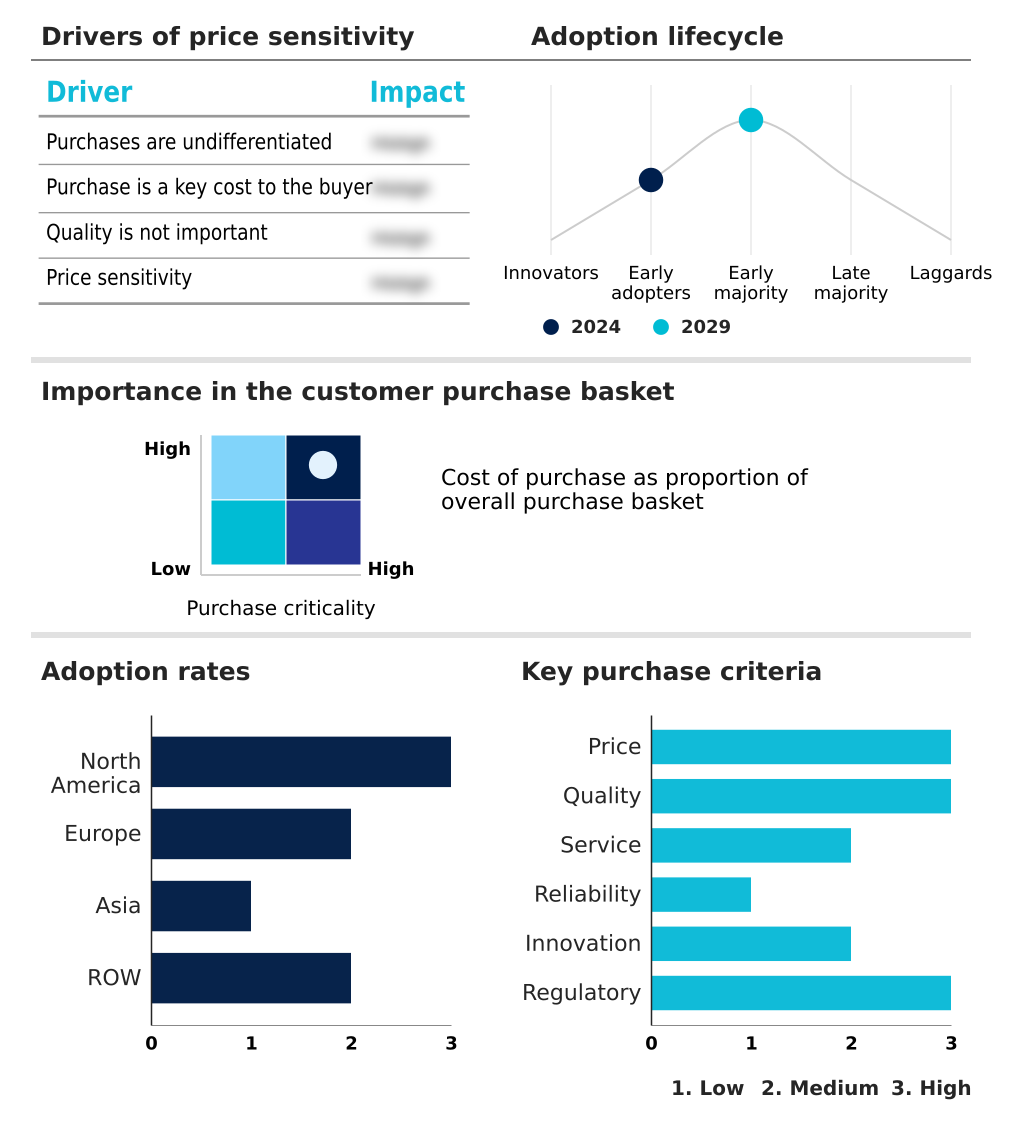
The open system mri market forecasting report includes the adoption lifecycle of the market, covering from the innovator’s stage to the laggard’s stage. It focuses on adoption rates in different regions based on penetration. Furthermore, the open system mri market report also includes key purchase criteria and drivers of price sensitivity to help companies evaluate and develop their market growth analysis strategies.
Customer Landscape
Key Companies & Market Insights
Companies are implementing various strategies, such as strategic alliances, open system mri market forecast, partnerships, mergers and acquisitions, geographical expansion, and product/service launches, to enhance their presence in the industry.
Alltech Inc. - The company provides a range of open magnetic resonance imaging systems, including models that combine the performance of superconducting magnets with cryogen-less designs and four-sided open architectures, as well as systems featuring various field strengths to meet diverse clinical and operational needs.
The industry research and growth report includes detailed analyses of the competitive landscape of the market and information about key companies, including:
- Alltech Inc.
- ASG Superconductors Spa
- Aspect Imaging Ltd.
- AURORA HEALTHCARE US Corp.
- Beijing Wandong Medical Technology Co. Ltd.
- Canon Inc.
- Esaote Spa
- FONAR Corp.
- FUJIFILM Holdings Corp.
- General Electric Co.
- Hitachi Ltd.
- Koninklijke Philips NV
- Medonica Co. Ltd.
- Neusoft Corp.
- Siemens AG
- Toshiba Corp.
Qualitative and quantitative analysis of companies has been conducted to help clients understand the wider business environment as well as the strengths and weaknesses of key industry players. Data is qualitatively analyzed to categorize companies as pure play, category-focused, industry-focused, and diversified; it is quantitatively analyzed to categorize companies as dominant, leading, strong, tentative, and weak.
Recent Development and News in Open System Mri Market
In March 2024, Siemens Healthineers unveiled its MAGNETOM Flow, a 1.5 Tesla MRI scanner featuring a closed-bore design but with a wide 70-cm opening and simplified, AI-powered workflows designed to expand access to MRI technology.In February 2024, GE HealthCare announced the launch of Signa Champion, a 1.5T wide-bore MRI system, designed to enhance patient comfort and workflow efficiency through AI-driven features.In February 2024, Royal Philips showcased its latest AI-enhanced diagnostic imaging portfolio at the European Congress of Radiology, highlighting new software for its MR systems aimed at improving image quality and reducing scan times.
Research Analyst Overview
The global open system MRI market is characterized by advancements in both low-field MRI scanners and high-field open MRI systems, driven by a shift towards patient-centric healthcare. Innovations in superconducting magnet technology and the development of permanent magnet systems, including cryogen-free magnet and helium-free MRI designs, are reshaping system capabilities. These developments focus on improving the signal-to-noise ratio, achieving greater magnetic field homogeneity, and delivering superior soft tissue contrast and image resolution enhancement. The emphasis on claustrophobia reduction design expands accessibility, particularly for bariatric patient imaging and pediatric neurology imaging, aligning with evolving diagnostic needs.The integration of AI-enabled open system MRI is expanding advanced MRI applications and optimizing workflows for diagnostic imaging procedures, with the industry expecting an expansion of nearly 8% in adoption for specialized diagnostics. Techniques such as diffusion tensor imaging, blood oxygenation level dependent functional imaging, and simultaneous multi-slice acquisition are becoming more prevalent for assessing neurological health conditions while also reducing 2D imaging acquisition time. The use of intraoperative MRI with real-time imaging guidance supports complex neurosurgical procedures and interventional procedures, while high signal-to-noise ratio coils aid in motion artifacts reduction. The ecosystem encompasses whole-body imaging capabilities for orthopedic health conditions and cardiovascular diseases diagnosis, alongside sophisticated imaging application software and considerations for MRI suite installation and MRI system maintenance, with refurbished MRI systems presenting an alternative within the value-based care model.
Dive into Technavio’s robust research methodology, blending expert interviews, extensive data synthesis, and validated models for unparalleled Open System MRI Market insights. See full methodology.
|
Market Scope
|
|
Report Coverage
|
Details
|
|
Page number
|
292
|
|
Base year
|
2024
|
|
Historic period
|
2019 - 2023 |
|
Forecast period
|
2025-2029
|
|
Growth momentum & CAGR
|
Accelerating at a CAGR of 4.6%
|
|
Market growth 2024-2029
|
USD 288.5 million
|
|
Market structure
|
Fragmented
|
|
YoY growth 2024-2029(%)
|
4.4%
|
|
Key countries
|
US, Canada, Mexico, Germany, UK, France, Italy, Spain, The Netherlands, China, India, Japan, South Korea, Thailand, Indonesia, Brazil, Saudi Arabia, UAE, Turkey, Argentina, Colombia, South Africa, Israel
|
|
Competitive landscape
|
Leading Companies, Market Positioning of Companies, Competitive Strategies, and Industry Risks
|
Request Free Sample
What are the Key Data Covered in this Open System MRI Market Research and Growth Report?
- CAGR of the Open System MRI industry during the forecast period
- Detailed information on factors that will drive the growth and forecasting between 2024 and 2029
- Precise estimation of the size of the market and its contribution of the industry in focus to the parent market
- Accurate predictions about upcoming growth and trends and changes in consumer behaviour
- Growth of the market across North America, Europe, Asia, Rest of World (ROW)
- Thorough analysis of the market’s competitive landscape and detailed information about companies
- Comprehensive analysis of factors that will challenge the open system mri market growth of industry companies
We can help! Our analysts can customize this open system mri market research report to meet your requirements.
Get in touch
1 Executive Summary
- 1 Executive Summary
- 1.1 Market overview
- Executive Summary - Chart on Market Overview
- Executive Summary - Data Table on Market Overview
- Executive Summary - Chart on Global Market Characteristics
- Executive Summary - Chart on Market by Geography
- Executive Summary - Chart on Market Segmentation by Type
- Executive Summary - Chart on Market Segmentation by Technology
- Executive Summary - Chart on Market Segmentation by End-user
- Executive Summary - Chart on Incremental Growth
- Executive Summary - Data Table on Incremental Growth
- Executive Summary - Chart on Company Market Positioning
2 Technavio Analysis
- 2 Technavio Analysis
- 2.1 Analysis of price sensitivity, lifecycle, customer purchase basket, adoption rates, and purchase criteria
- Analysis of price sensitivity, lifecycle, customer purchase basket, adoption rates, and purchase criteria
- 2.2 Criticality of inputs and Factors of differentiation
- Chart on Overview on criticality of inputs and factors of differentiation
- 2.3 Factors of disruption
- Chart on Overview on factors of disruption
- 2.4 Impact of drivers and challenges
- Chart on Impact of drivers and challenges in 2024 and 2029
3 Market Landscape
- 3 Market Landscape
- 3.1 Market ecosystem
- Chart on Parent Market
- Data Table on - Parent Market
- 3.2 Market characteristics
- Chart on Market characteristics analysis
- 3.3 Value chain analysis
- Chart on Value chain analysis
4 Market Sizing
- 4 Market Sizing
- 4.1 Market definition
- Data Table on Offerings of companies included in the market definition
- 4.2 Market segment analysis
- 4.3 Market size 2024
- 4.4 Market outlook: Forecast for 2024-2029
- Chart on Global - Market size and forecast 2024-2029 ($ billion)
- Data Table on Global - Market size and forecast 2024-2029 ($ billion)
- Chart on Global Market: Year-over-year growth 2024-2029 (%)
- Data Table on Global Market: Year-over-year growth 2024-2029 (%)
5 Historic Market Size
- 5 Historic Market Size
- 5.1 Global Open System MRI Market 2019 - 2023
- Historic Market Size - Data Table on Global Open System MRI Market 2019 - 2023 ($ billion)
- 5.2 Type segment analysis 2019 - 2023
- Historic Market Size - Type Segment 2019 - 2023 ($ billion)
- 5.3 Technology segment analysis 2019 - 2023
- Historic Market Size - Technology Segment 2019 - 2023 ($ billion)
- 5.4 End-user segment analysis 2019 - 2023
- Historic Market Size - End-user Segment 2019 - 2023 ($ billion)
- 5.5 Geography segment analysis 2019 - 2023
- Historic Market Size - Geography Segment 2019 - 2023 ($ billion)
- 5.6 Country segment analysis 2019 - 2023
- Historic Market Size - Country Segment 2019 - 2023 ($ billion)
6 Qualitative Analysis
- 6 Qualitative Analysis
- 6.1 The AI impact on Global Open System MRI Market
7 Five Forces Analysis
- 7 Five Forces Analysis
- 7.1 Five forces summary
- Five forces analysis - Comparison between 2024 and 2029
- 7.2 Bargaining power of buyers
- Bargaining power of buyers - Impact of key factors 2024 and 2029
- 7.3 Bargaining power of suppliers
- Bargaining power of suppliers - Impact of key factors in 2024 and 2029
- 7.4 Threat of new entrants
- Threat of new entrants - Impact of key factors in 2024 and 2029
- 7.5 Threat of substitutes
- Threat of substitutes - Impact of key factors in 2024 and 2029
- 7.6 Threat of rivalry
- Threat of rivalry - Impact of key factors in 2024 and 2029
- 7.7 Market condition
- Chart on Market condition - Five forces 2024 and 2029
8 Market Segmentation by Type
- 8 Market Segmentation by Type
- 8.1 Market segments
- Chart on Type - Market share 2024-2029 (%)
- Data Table on Type - Market share 2024-2029 (%)
- 8.2 Comparison by Type
- Chart on Comparison by Type
- Data Table on Comparison by Type
- 8.3 Low field scanner - Market size and forecast 2024-2029
- Chart on Low field scanner - Market size and forecast 2024-2029 ($ billion)
- Data Table on Low field scanner - Market size and forecast 2024-2029 ($ billion)
- Chart on Low field scanner - Year-over-year growth 2024-2029 (%)
- Data Table on Low field scanner - Year-over-year growth 2024-2029 (%)
- 8.4 Medium field scanner - Market size and forecast 2024-2029
- Chart on Medium field scanner - Market size and forecast 2024-2029 ($ billion)
- Data Table on Medium field scanner - Market size and forecast 2024-2029 ($ billion)
- Chart on Medium field scanner - Year-over-year growth 2024-2029 (%)
- Data Table on Medium field scanner - Year-over-year growth 2024-2029 (%)
- 8.5 High field scanner - Market size and forecast 2024-2029
- Chart on High field scanner - Market size and forecast 2024-2029 ($ billion)
- Data Table on High field scanner - Market size and forecast 2024-2029 ($ billion)
- Chart on High field scanner - Year-over-year growth 2024-2029 (%)
- Data Table on High field scanner - Year-over-year growth 2024-2029 (%)
- 8.6 Market opportunity by Type
- Market opportunity by Type ($ billion)
- Data Table on Market opportunity by Type ($ billion)
9 Market Segmentation by Technology
- 9 Market Segmentation by Technology
- 9.1 Market segments
- Chart on Technology - Market share 2024-2029 (%)
- Data Table on Technology - Market share 2024-2029 (%)
- 9.2 Comparison by Technology
- Chart on Comparison by Technology
- Data Table on Comparison by Technology
- 9.3 Superconducting magnet - Market size and forecast 2024-2029
- Chart on Superconducting magnet - Market size and forecast 2024-2029 ($ billion)
- Data Table on Superconducting magnet - Market size and forecast 2024-2029 ($ billion)
- Chart on Superconducting magnet - Year-over-year growth 2024-2029 (%)
- Data Table on Superconducting magnet - Year-over-year growth 2024-2029 (%)
- 9.4 Permanent magnet - Market size and forecast 2024-2029
- Chart on Permanent magnet - Market size and forecast 2024-2029 ($ billion)
- Data Table on Permanent magnet - Market size and forecast 2024-2029 ($ billion)
- Chart on Permanent magnet - Year-over-year growth 2024-2029 (%)
- Data Table on Permanent magnet - Year-over-year growth 2024-2029 (%)
- 9.5 Hybrid systems - Market size and forecast 2024-2029
- Chart on Hybrid systems - Market size and forecast 2024-2029 ($ billion)
- Data Table on Hybrid systems - Market size and forecast 2024-2029 ($ billion)
- Chart on Hybrid systems - Year-over-year growth 2024-2029 (%)
- Data Table on Hybrid systems - Year-over-year growth 2024-2029 (%)
- 9.6 Market opportunity by Technology
- Market opportunity by Technology ($ billion)
- Data Table on Market opportunity by Technology ($ billion)
10 Market Segmentation by End-user
- 10 Market Segmentation by End-user
- 10.1 Market segments
- Chart on End-user - Market share 2024-2029 (%)
- Data Table on End-user - Market share 2024-2029 (%)
- 10.2 Comparison by End-user
- Chart on Comparison by End-user
- Data Table on Comparison by End-user
- 10.3 Neurology - Market size and forecast 2024-2029
- Chart on Neurology - Market size and forecast 2024-2029 ($ billion)
- Data Table on Neurology - Market size and forecast 2024-2029 ($ billion)
- Chart on Neurology - Year-over-year growth 2024-2029 (%)
- Data Table on Neurology - Year-over-year growth 2024-2029 (%)
- 10.4 Oncology - Market size and forecast 2024-2029
- Chart on Oncology - Market size and forecast 2024-2029 ($ billion)
- Data Table on Oncology - Market size and forecast 2024-2029 ($ billion)
- Chart on Oncology - Year-over-year growth 2024-2029 (%)
- Data Table on Oncology - Year-over-year growth 2024-2029 (%)
- 10.5 Cardiology - Market size and forecast 2024-2029
- Chart on Cardiology - Market size and forecast 2024-2029 ($ billion)
- Data Table on Cardiology - Market size and forecast 2024-2029 ($ billion)
- Chart on Cardiology - Year-over-year growth 2024-2029 (%)
- Data Table on Cardiology - Year-over-year growth 2024-2029 (%)
- 10.6 Others - Market size and forecast 2024-2029
- Chart on Others - Market size and forecast 2024-2029 ($ billion)
- Data Table on Others - Market size and forecast 2024-2029 ($ billion)
- Chart on Others - Year-over-year growth 2024-2029 (%)
- Data Table on Others - Year-over-year growth 2024-2029 (%)
- 10.7 Market opportunity by End-user
- Market opportunity by End-user ($ billion)
- Data Table on Market opportunity by End-user ($ billion)
11 Customer Landscape
- 11 Customer Landscape
- 11.1 Customer landscape overview
- Analysis of price sensitivity, lifecycle, customer purchase basket, adoption rates, and purchase criteria
12 Geographic Landscape
- 12 Geographic Landscape
- 12.1 Geographic segmentation
- Chart on Market share by geography 2024-2029 (%)
- Data Table on Market share by geography 2024-2029 (%)
- 12.2 Geographic comparison
- Chart on Geographic comparison
- Data Table on Geographic comparison
- 12.3 North America - Market size and forecast 2024-2029
- Chart on North America - Market size and forecast 2024-2029 ($ billion)
- Data Table on North America - Market size and forecast 2024-2029 ($ billion)
- Chart on North America - Year-over-year growth 2024-2029 (%)
- Data Table on North America - Year-over-year growth 2024-2029 (%)
- Chart on Regional Comparison - North America
- Data Table on Regional Comparison - North America
- 12.3.1 US - Market size and forecast 2024-2029
- Chart on US - Market size and forecast 2024-2029 ($ billion)
- Data Table on US - Market size and forecast 2024-2029 ($ billion)
- Chart on US - Year-over-year growth 2024-2029 (%)
- Data Table on US - Year-over-year growth 2024-2029 (%)
- 12.3.2 Canada - Market size and forecast 2024-2029
- Chart on Canada - Market size and forecast 2024-2029 ($ billion)
- Data Table on Canada - Market size and forecast 2024-2029 ($ billion)
- Chart on Canada - Year-over-year growth 2024-2029 (%)
- Data Table on Canada - Year-over-year growth 2024-2029 (%)
- 12.3.3 Mexico - Market size and forecast 2024-2029
- Chart on Mexico - Market size and forecast 2024-2029 ($ billion)
- Data Table on Mexico - Market size and forecast 2024-2029 ($ billion)
- Chart on Mexico - Year-over-year growth 2024-2029 (%)
- Data Table on Mexico - Year-over-year growth 2024-2029 (%)
- 12.4 Europe - Market size and forecast 2024-2029
- Chart on Europe - Market size and forecast 2024-2029 ($ billion)
- Data Table on Europe - Market size and forecast 2024-2029 ($ billion)
- Chart on Europe - Year-over-year growth 2024-2029 (%)
- Data Table on Europe - Year-over-year growth 2024-2029 (%)
- Chart on Regional Comparison - Europe
- Data Table on Regional Comparison - Europe
- 12.4.1 Germany - Market size and forecast 2024-2029
- Chart on Germany - Market size and forecast 2024-2029 ($ billion)
- Data Table on Germany - Market size and forecast 2024-2029 ($ billion)
- Chart on Germany - Year-over-year growth 2024-2029 (%)
- Data Table on Germany - Year-over-year growth 2024-2029 (%)
- 12.4.2 UK - Market size and forecast 2024-2029
- Chart on UK - Market size and forecast 2024-2029 ($ billion)
- Data Table on UK - Market size and forecast 2024-2029 ($ billion)
- Chart on UK - Year-over-year growth 2024-2029 (%)
- Data Table on UK - Year-over-year growth 2024-2029 (%)
- 12.4.3 France - Market size and forecast 2024-2029
- Chart on France - Market size and forecast 2024-2029 ($ billion)
- Data Table on France - Market size and forecast 2024-2029 ($ billion)
- Chart on France - Year-over-year growth 2024-2029 (%)
- Data Table on France - Year-over-year growth 2024-2029 (%)
- 12.4.4 Italy - Market size and forecast 2024-2029
- Chart on Italy - Market size and forecast 2024-2029 ($ billion)
- Data Table on Italy - Market size and forecast 2024-2029 ($ billion)
- Chart on Italy - Year-over-year growth 2024-2029 (%)
- Data Table on Italy - Year-over-year growth 2024-2029 (%)
- 12.4.5 Spain - Market size and forecast 2024-2029
- Chart on Spain - Market size and forecast 2024-2029 ($ billion)
- Data Table on Spain - Market size and forecast 2024-2029 ($ billion)
- Chart on Spain - Year-over-year growth 2024-2029 (%)
- Data Table on Spain - Year-over-year growth 2024-2029 (%)
- 12.4.6 The Netherlands - Market size and forecast 2024-2029
- Chart on The Netherlands - Market size and forecast 2024-2029 ($ billion)
- Data Table on The Netherlands - Market size and forecast 2024-2029 ($ billion)
- Chart on The Netherlands - Year-over-year growth 2024-2029 (%)
- Data Table on The Netherlands - Year-over-year growth 2024-2029 (%)
- 12.5 Asia - Market size and forecast 2024-2029
- Chart on Asia - Market size and forecast 2024-2029 ($ billion)
- Data Table on Asia - Market size and forecast 2024-2029 ($ billion)
- Chart on Asia - Year-over-year growth 2024-2029 (%)
- Data Table on Asia - Year-over-year growth 2024-2029 (%)
- Chart on Regional Comparison - Asia
- Data Table on Regional Comparison - Asia
- 12.5.1 China - Market size and forecast 2024-2029
- Chart on China - Market size and forecast 2024-2029 ($ billion)
- Data Table on China - Market size and forecast 2024-2029 ($ billion)
- Chart on China - Year-over-year growth 2024-2029 (%)
- Data Table on China - Year-over-year growth 2024-2029 (%)
- 12.5.2 India - Market size and forecast 2024-2029
- Chart on India - Market size and forecast 2024-2029 ($ billion)
- Data Table on India - Market size and forecast 2024-2029 ($ billion)
- Chart on India - Year-over-year growth 2024-2029 (%)
- Data Table on India - Year-over-year growth 2024-2029 (%)
- 12.5.3 Japan - Market size and forecast 2024-2029
- Chart on Japan - Market size and forecast 2024-2029 ($ billion)
- Data Table on Japan - Market size and forecast 2024-2029 ($ billion)
- Chart on Japan - Year-over-year growth 2024-2029 (%)
- Data Table on Japan - Year-over-year growth 2024-2029 (%)
- 12.5.4 South Korea - Market size and forecast 2024-2029
- Chart on South Korea - Market size and forecast 2024-2029 ($ billion)
- Data Table on South Korea - Market size and forecast 2024-2029 ($ billion)
- Chart on South Korea - Year-over-year growth 2024-2029 (%)
- Data Table on South Korea - Year-over-year growth 2024-2029 (%)
- 12.5.5 Thailand - Market size and forecast 2024-2029
- Chart on Thailand - Market size and forecast 2024-2029 ($ billion)
- Data Table on Thailand - Market size and forecast 2024-2029 ($ billion)
- Chart on Thailand - Year-over-year growth 2024-2029 (%)
- Data Table on Thailand - Year-over-year growth 2024-2029 (%)
- 12.5.6 Indonesia - Market size and forecast 2024-2029
- Chart on Indonesia - Market size and forecast 2024-2029 ($ billion)
- Data Table on Indonesia - Market size and forecast 2024-2029 ($ billion)
- Chart on Indonesia - Year-over-year growth 2024-2029 (%)
- Data Table on Indonesia - Year-over-year growth 2024-2029 (%)
- 12.6 Rest of World (ROW) - Market size and forecast 2024-2029
- Chart on Rest of World (ROW) - Market size and forecast 2024-2029 ($ billion)
- Data Table on Rest of World (ROW) - Market size and forecast 2024-2029 ($ billion)
- Chart on Rest of World (ROW) - Year-over-year growth 2024-2029 (%)
- Data Table on Rest of World (ROW) - Year-over-year growth 2024-2029 (%)
- Chart on Regional Comparison - Rest of World (ROW)
- Data Table on Regional Comparison - Rest of World (ROW)
- 12.6.1 Brazil - Market size and forecast 2024-2029
- Chart on Brazil - Market size and forecast 2024-2029 ($ billion)
- Data Table on Brazil - Market size and forecast 2024-2029 ($ billion)
- Chart on Brazil - Year-over-year growth 2024-2029 (%)
- Data Table on Brazil - Year-over-year growth 2024-2029 (%)
- 12.6.2 Saudi Arabia - Market size and forecast 2024-2029
- Chart on Saudi Arabia - Market size and forecast 2024-2029 ($ billion)
- Data Table on Saudi Arabia - Market size and forecast 2024-2029 ($ billion)
- Chart on Saudi Arabia - Year-over-year growth 2024-2029 (%)
- Data Table on Saudi Arabia - Year-over-year growth 2024-2029 (%)
- 12.6.3 UAE - Market size and forecast 2024-2029
- Chart on UAE - Market size and forecast 2024-2029 ($ billion)
- Data Table on UAE - Market size and forecast 2024-2029 ($ billion)
- Chart on UAE - Year-over-year growth 2024-2029 (%)
- Data Table on UAE - Year-over-year growth 2024-2029 (%)
- 12.6.4 Turkey - Market size and forecast 2024-2029
- Chart on Turkey - Market size and forecast 2024-2029 ($ billion)
- Data Table on Turkey - Market size and forecast 2024-2029 ($ billion)
- Chart on Turkey - Year-over-year growth 2024-2029 (%)
- Data Table on Turkey - Year-over-year growth 2024-2029 (%)
- 12.6.5 Argentina - Market size and forecast 2024-2029
- Chart on Argentina - Market size and forecast 2024-2029 ($ billion)
- Data Table on Argentina - Market size and forecast 2024-2029 ($ billion)
- Chart on Argentina - Year-over-year growth 2024-2029 (%)
- Data Table on Argentina - Year-over-year growth 2024-2029 (%)
- 12.6.6 Colombia - Market size and forecast 2024-2029
- Chart on Colombia - Market size and forecast 2024-2029 ($ billion)
- Data Table on Colombia - Market size and forecast 2024-2029 ($ billion)
- Chart on Colombia - Year-over-year growth 2024-2029 (%)
- Data Table on Colombia - Year-over-year growth 2024-2029 (%)
- 12.6.7 South Africa - Market size and forecast 2024-2029
- Chart on South Africa - Market size and forecast 2024-2029 ($ billion)
- Data Table on South Africa - Market size and forecast 2024-2029 ($ billion)
- Chart on South Africa - Year-over-year growth 2024-2029 (%)
- Data Table on South Africa - Year-over-year growth 2024-2029 (%)
- 12.6.8 Israel - Market size and forecast 2024-2029
- Chart on Israel - Market size and forecast 2024-2029 ($ billion)
- Data Table on Israel - Market size and forecast 2024-2029 ($ billion)
- Chart on Israel - Year-over-year growth 2024-2029 (%)
- Data Table on Israel - Year-over-year growth 2024-2029 (%)
- 12.7 Market opportunity by geography
- Market opportunity by geography ($ billion)
- Data Tables on Market opportunity by geography ($ billion)
13 Drivers, Challenges, and Opportunity
- 13 Drivers, Challenges, and Opportunity
- 13.1 Market drivers
- Increasing prevalence of diseases coupled with growing geriatric population
- Expanding clinical applications of open system MRI
- Technological advances in MRIs strength
- 13.2 Market challenges
- High cost of MRI
- Lower signal-to-noise ratio
- Shortage of skilled professionals to handle advanced open system MRI
- 13.3 Impact of drivers and challenges
- Impact of drivers and challenges in 2024 and 2029
- 13.4 Market opportunities
- Software advancement in MRI technology
- Emerging potential market in Asia
- Focus on development of helium-free open system MRI
14 Competitive Landscape
- 14 Competitive Landscape
- 14.1 Overview
- 14.2 Competitive Landscape
- Overview on criticality of inputs and factors of differentiation
- 14.3 Landscape disruption
- Overview on factors of disruption
- 14.4 Industry risks
- Impact of key risks on business
15 Competitive Analysis
- 15 Competitive Analysis
- 15.1 Companies profiled
- 15.2 Company ranking index
- 15.3 Market positioning of companies
- Matrix on companies position and classification
- 15.4 Alltech Inc.
- Alltech Inc. - Overview
- Alltech Inc. - Product / Service
- Alltech Inc. - Key news
- Alltech Inc. - Key offerings
- SWOT
- 15.5 ASG Superconductors Spa
- ASG Superconductors Spa - Overview
- ASG Superconductors Spa - Product / Service
- ASG Superconductors Spa - Key offerings
- SWOT
- 15.6 Aspect Imaging Ltd.
- Aspect Imaging Ltd. - Overview
- Aspect Imaging Ltd. - Product / Service
- Aspect Imaging Ltd. - Key offerings
- SWOT
- 15.7 AURORA HEALTHCARE US Corp.
- AURORA HEALTHCARE US Corp. - Overview
- AURORA HEALTHCARE US Corp. - Product / Service
- AURORA HEALTHCARE US Corp. - Key offerings
- SWOT
- 15.8 Beijing Wandong Medical Technology Co. Ltd.
- Beijing Wandong Medical Technology Co. Ltd. - Overview
- Beijing Wandong Medical Technology Co. Ltd. - Product / Service
- Beijing Wandong Medical Technology Co. Ltd. - Key offerings
- SWOT
- 15.9 Canon Inc.
- Canon Inc. - Overview
- Canon Inc. - Business segments
- Canon Inc. - Key news
- Canon Inc. - Key offerings
- Canon Inc. - Segment focus
- SWOT
- 15.10 Esaote Spa
- Esaote Spa - Overview
- Esaote Spa - Product / Service
- Esaote Spa - Key offerings
- SWOT
- 15.11 FONAR Corp.
- FONAR Corp. - Overview
- FONAR Corp. - Product / Service
- FONAR Corp. - Key offerings
- SWOT
- 15.12 FUJIFILM Holdings Corp.
- FUJIFILM Holdings Corp. - Overview
- FUJIFILM Holdings Corp. - Business segments
- FUJIFILM Holdings Corp. - Key news
- FUJIFILM Holdings Corp. - Key offerings
- FUJIFILM Holdings Corp. - Segment focus
- SWOT
- 15.13 General Electric Co.
- General Electric Co. - Overview
- General Electric Co. - Business segments
- General Electric Co. - Key news
- General Electric Co. - Key offerings
- General Electric Co. - Segment focus
- SWOT
- 15.14 Hitachi Ltd.
- Hitachi Ltd. - Overview
- Hitachi Ltd. - Business segments
- Hitachi Ltd. - Key news
- Hitachi Ltd. - Key offerings
- Hitachi Ltd. - Segment focus
- SWOT
- 15.15 Koninklijke Philips NV
- Koninklijke Philips NV - Overview
- Koninklijke Philips NV - Business segments
- Koninklijke Philips NV - Key news
- Koninklijke Philips NV - Key offerings
- Koninklijke Philips NV - Segment focus
- SWOT
- 15.16 Neusoft Corp.
- Neusoft Corp. - Overview
- Neusoft Corp. - Product / Service
- Neusoft Corp. - Key offerings
- SWOT
- 15.17 Siemens AG
- Siemens AG - Overview
- Siemens AG - Business segments
- Siemens AG - Key news
- Siemens AG - Key offerings
- Siemens AG - Segment focus
- SWOT
- 15.18 Toshiba Corp.
- Toshiba Corp. - Overview
- Toshiba Corp. - Business segments
- Toshiba Corp. - Key news
- Toshiba Corp. - Key offerings
- Toshiba Corp. - Segment focus
- SWOT
16 Appendix
- 16 Appendix
- 16.1 Scope of the report
- Market definition
- Objectives
- Notes and caveats
- 16.2 Inclusions and exclusions checklist
- Inclusions checklist
- Exclusions checklist
- 16.3 Currency conversion rates for US$
- Currency conversion rates for US$
- 16.4 Research methodology
- 16.5 Data procurement
- 16.6 Data validation
- 16.7 Validation techniques employed for market sizing
- Validation techniques employed for market sizing
- 16.8 Data synthesis
- 16.9 360 degree market analysis
- 360 degree market analysis
- 16.10 List of abbreviations
Research Framework
Technavio presents a detailed picture of the market by way of study, synthesis, and summation of data from multiple sources. The analysts have presented the various facets of the market with a particular focus on identifying the key industry influencers. The data thus presented is comprehensive, reliable, and the result of extensive research, both primary and secondary.
INFORMATION SOURCES
Primary sources
- Manufacturers and suppliers
- Channel partners
- Industry experts
- Strategic decision makers
Secondary sources
- Industry journals and periodicals
- Government data
- Financial reports of key industry players
- Historical data
- Press releases

DATA ANALYSIS
Data Synthesis
- Collation of data
- Estimation of key figures
- Analysis of derived insights
Data Validation
- Triangulation with data models
- Reference against proprietary databases
- Corroboration with industry experts

REPORT WRITING
Qualitative
- Market drivers
- Market challenges
- Market trends
- Five forces analysis
Quantitative
- Market size and forecast
- Market segmentation
- Geographical insights
- Competitive landscape