


Polysulfide Rubber Market Size 2024-2028
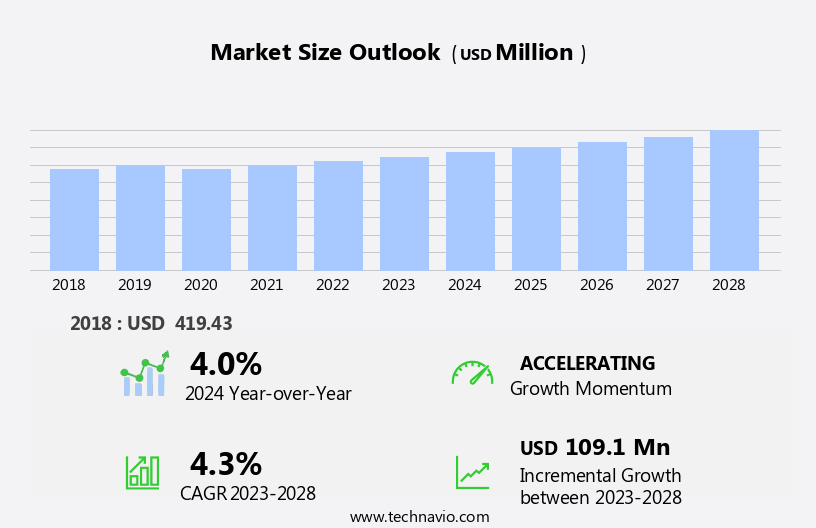
The polysulfide rubber market size is forecast to increase by USD 109.1 million at a CAGR of 4.3% between 2023 and 2028.
- Polysulfide rubber is witnessing significant growth in various end-use industries due to its superior properties, such as high thermal stability, excellent resistance to weathering, and high electrical insulation. One of the key driving factors for the market is the increasing demand from industries such as sealants.
- Polysulfide rubber's ability to form a strong bond with various substrates makes it an ideal choice for sealant applications. Furthermore, its use in modeling clays is another emerging trend, as it provides excellent flexibility and durability. However, the market faces challenges from alternative materials, such as silicone and butyl rubber, which offer similar properties but may be more cost-effective.
- To stay competitive, market players must focus on product innovation and cost optimization to cater to the evolving needs of consumers. Polysulfide rubber's versatility and unique properties make it a valuable addition to various industries, presenting significant growth opportunities for market participants.
What will be the Size of the Polysulfide Rubber Market During the Forecast Period?
- The Polysulfide Rubber (PSR) market encompasses the production and application of synthetic rubber derived through the polycondensation of dihalides with aliphatic compounds, such as ethylene dichloride and propyl dichloride. This versatile material exists in various forms, including solid, liquid, and aqueous dispersion, and is renowned for its thermosetting characteristics. PSR's applications span across numerous industries, including construction projects, the petrochemical industry, and transportation. In construction, it serves as a vital component in sealants, adhesives, and protective coatings. In the petrochemical industry, it is utilized in various applications due to its chemical compositions and resistance to Volatile Organic Compounds (VOCs).
- Furthermore, PSR plays a significant role In the production of paints and coatings, lithium-sulfur batteries, and high-performance cathodes. Its use in specialty chemicals, building and construction, and industrial processing continues to grow, driven by digital initiatives and the increasing demand for sustainable, high-performance materials. The market dynamics for PSR are influenced by factors such as raw material prices, technological advancements, and regulatory requirements. The ongoing research and development In the field aim to improve the material's properties and expand its applications, making it a dynamic and evolving market.
How is this Polysulfide Rubber Industry segmented and which is the largest segment?
The polysulfide rubber industry research report provides comprehensive data (region-wise segment analysis), with forecasts and estimates in "USD million" for the period 2024-2028, as well as historical data from 2018-2022 for the following segments.
- Application
- Automotive
- Aerospace
- Electronics and electricals
- Construction
- Others
- Type
- Liquid
- Solid
- Geography
- APAC
- China
- India
- North America
- Canada
- US
- Europe
- Germany
- South America
- Middle East and Africa
- APAC
By Application Insights
- The automotive segment is estimated to witness significant growth during the forecast period.
Polysulfide rubber (PSR), a type of synthetic rubber, is widely used in various industries due to its unique properties and benefits. PSR is produced through the polycondensation process of dihalides and aliphatic compounds, such as ethylene dichloride and propyl dichloride. This process results in both solid and liquid forms, as well as aqueous dispersions and lattice forms, catering to diverse application requirements. PSR is known for its soft, stretchy, and long-lasting characteristics, making it suitable for use in molds, casting, wax, gypsum plasters, and various other applications. Its resistance to solvents, oils, fuels, sunlight, gas impermeability, and moisture impermeability make it an ideal choice for numerous industries, including construction, sealant, adhesive, and insulated glass.
PSR's high thermal stability and resistance to various environmental factors make it a popular choice in industries such as transportation, industrial processing, specialty chemicals, and building and construction. Its thermosetting characteristics make it an essential component in construction projects, petrochemical industry, and protective coatings. Moreover, PSR is used in lithium-sulfur batteries as a high-performance cathode material, as well as In the production of liquid and solid polysulfide elastomers. Its environmental sustainability is a significant advantage, as it naturally emits volatile organic compounds (VOCs) during production, making it a more eco-friendly alternative to some traditional materials. In summary, polysulfide rubber is a versatile and valuable material in various industries, offering unique properties and benefits that cater to diverse application requirements. Its use in automotive, construction, petrochemical, and energy storage industries, among others, highlights its importance and potential for future growth.
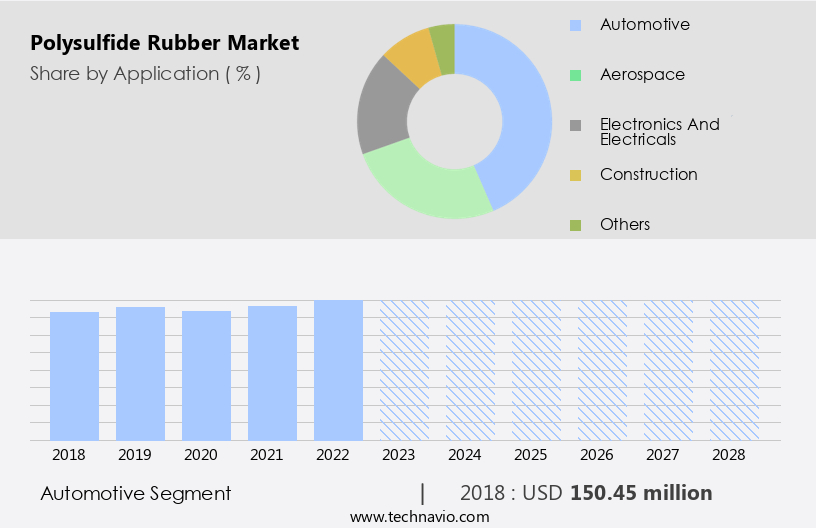
Get a glance at the Polysulfide Rubber Industry report of share of various segments Request Free Sample
The Automotive segment was valued at USD 150.45 million in 2018 and showed a gradual increase during the forecast period.
Regional Analysis
- APAC is estimated to contribute 41% to the growth of the global market during the forecast period.
Technavio's analysts have elaborately explained the regional trends and drivers that shape the market during the forecast period.
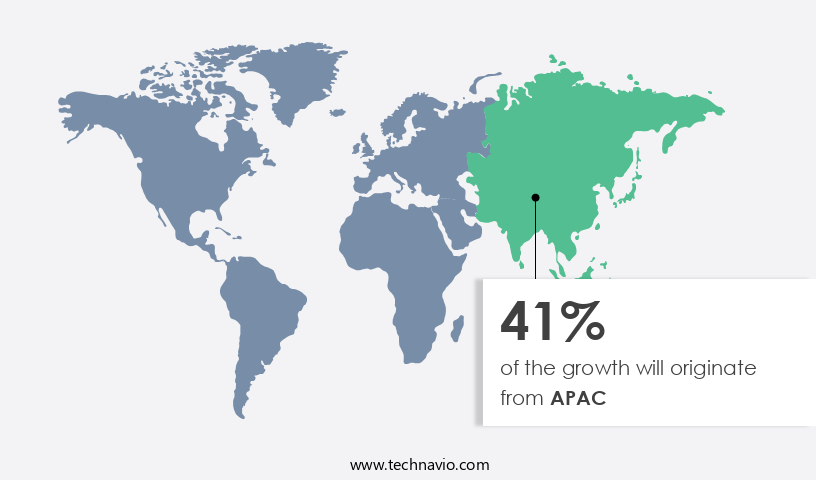
For more insights on the market share of various regions, Request Free Sample
The polysulfide rubber (PSR) market In the Asia-Pacific region experiences substantial growth due to increased investments and advancements, particularly withIn the automotive sector. Notable investments include Renault-Nissan's plan to invest between USD600-700 million In their Chennai facility by 2024, and Mercedes Benz's USD360.14 million investment in Maharashtra, both aimed at enhancing manufacturing capabilities and production expansion. Additionally, Tata Motors Group has signed an MoU with the Tamil Nadu government to explore vehicle manufacturing, with a proposed investment of USD1,081 million. Polysulfide rubber, a type of synthetic rubber, is produced through polycondensation using dihalides and aliphatic compounds such as ethylene dichloride and propyl dichloride.
It exists in various forms, including solid, liquid, aqueous dispersion, lattice, and is known for its soft, stretchy, long-lasting properties. Polysulfide rubber offers resistance to solvents, oils, fuels, sunlight, and is gas and moisture impermeable, making it suitable for applications in construction, sealant, adhesive, insulated glass, and industrial processing. Key industries include transportation, petrochemical, building and construction, protective coatings, and specialty chemicals. Polysulfide rubber's thermosetting characteristics make it ideal for use in construction projects, chemical compositions, and digital initiatives such as lithium-sulfur batteries and high-performance cathodes. The market for polysulfide rubber continues to expand, driven by its versatility, durability, and environmental sustainability, as it naturally emits volatile organic compounds.
Market Dynamics
Our researchers analyzed the data with 2023 as the base year, along with the key drivers, trends, and challenges. A holistic analysis of drivers will help companies refine their marketing strategies to gain a competitive advantage.
What are the key market drivers leading to the rise In the adoption of Polysulfide Rubber Industry?
Demand from sealants market is the key driver of the market.
- Polysulfide rubber (PSR), a type of synthetic rubber, is experiencing significant growth in various industries due to its unique properties. PSR is produced through polycondensation using dihalides and aliphatic compounds, resulting in solid, liquid form, or aqueous dispersion. Its soft and stretchy nature, combined with long-lasting durability, makes it ideal for molds, casting, and other applications. PSR's resistance to solvents, oils, fuels, sunlight, and gas and moisture impermeability, make it a preferred choice for industries such as transportation, industrial processing, and specialty chemicals. In construction, PSR is used as washers, gaskets, diaphragms, coatings, paints, and ink. In marine and aircraft applications, it provides excellent resistance to harsh environments.
- The petrochemical industry utilizes PSR in insulated glass, sealant, adhesive, and solid fuel applications. Its thermosetting characteristics make it suitable for infrastructure management and building and construction projects. PSR's chemical compositions are also used in digital initiatives like lithium-sulfur batteries, high-performance cathodes, and liquid polysulfide elastomers. Environmental sustainability is a growing concern, and PSR's low volatile organic compound (VOC) emissions make it an attractive alternative to traditional sealants and adhesives. The versatility and durability of PSR continue to drive its demand in various industries, ensuring its role as a vital player In the market.
What are the market trends shaping the Polysulfide Rubber Industry?
Application of polysulfide rubber in modeling clays is the upcoming market trend.
- Polysulfide rubber (PSR), a type of synthetic rubber, is renowned for its unique properties in various industries. Its production involves polycondensation of dihalides with aliphatic compounds, such as ethylene dichloride and propyl dichloride. Polysulfide rubber is available in both solid and liquid forms, as well as an aqueous dispersion, and can take on lattice form when cured. PSR is known for its soft and stretchy texture, making it an ideal choice for molds and casting applications. In the field of art, it is particularly valued for its compatibility with sulfur-bearing modeling clays, eliminating the need for sealing or releasing agents.
- Once cured, it provides gas and moisture impermeability, ensuring excellent storage stability. Polysulfide rubber's resistance to solvents, oils, fuels, sunlight, and other environmental factors makes it a popular choice in various industries. It is widely used In the production of washers, gaskets, diaphragms, coatings, paints, and inks. In the marine and aircraft industries, it is used for insulated glass, construction, and sealant and adhesive applications. Moreover, polysulfide rubber's thermosetting characteristics make it suitable for use in solid fuel and infrastructure management. Its high performance in petrochemical applications, as well as its role in digital initiatives like lithium-sulfur batteries and high-performance cathodes, underscores its importance in specialty chemicals.
- Polysulfide rubber's environmental sustainability is a significant consideration, with efforts to minimize volatile organic compounds (VOC) emissions in its production and use. Its versatility, durability, and long-lasting properties continue to drive its demand in various industries.
What challenges does the Polysulfide Rubber Industry face during its growth?
Threat from alternative materials is a key challenge affecting the industry growth.
- Polysulfide rubber (PSR), a type of synthetic rubber, is produced through the polycondensation process of dihalides and aliphatic compounds. Traditionally available in both solid and liquid forms, as well as an aqueous dispersion and lattice form, PSR is known for its soft, stretchy, and long-lasting properties. It is widely used in various industries, including molds and casting, construction, and industrial processing, due to its resistance to solvents, oils, fuels, sunlight, gas impermeability, and moisture impermeability. However, the market is currently facing challenges due to the emergence of alternative materials. High-performance elastomers like 3C Polymer Sealant have gained popularity due to their superior UV stability, non-hazardous nature, and solvent-free composition.
- These advantages have led to their adoption in various applications, such as window and door frames, expansion joints in brickwork, and insulated glass. Moreover, the shift towards environmental sustainability and the reduction of volatile organic compounds (VOC) emissions has further impacted the market. As a result, the demand for polysulfide elastomers in paints and coatings, sealants, adhesives, transportation, and petrochemical applications has decreased. However, polysulfide rubber continues to play a significant role in infrastructure management, particularly In thermosetting characteristics for construction projects and specialty chemicals. In conclusion, the market is undergoing significant changes due to the availability of alternative materials and the shift towards environmental sustainability.
- While polysulfide rubber remains a valuable resource in various industries, its market share is being challenged by high-performance elastomers that offer superior properties and eco-friendly compositions. Nevertheless, polysulfide rubber's unique characteristics, such as its resistance to various environmental factors and long-lasting properties, make it an essential component in specific applications, including insulated glass, construction, and industrial processing.
Exclusive Customer Landscape
The polysulfide rubber market forecasting report includes the adoption lifecycle of the market, covering from the innovator's stage to the laggard's stage. It focuses on adoption rates in different regions based on penetration. Furthermore, the polysulfide rubber market report also includes key purchase criteria and drivers of price sensitivity to help companies evaluate and develop their market growth analysis strategies.
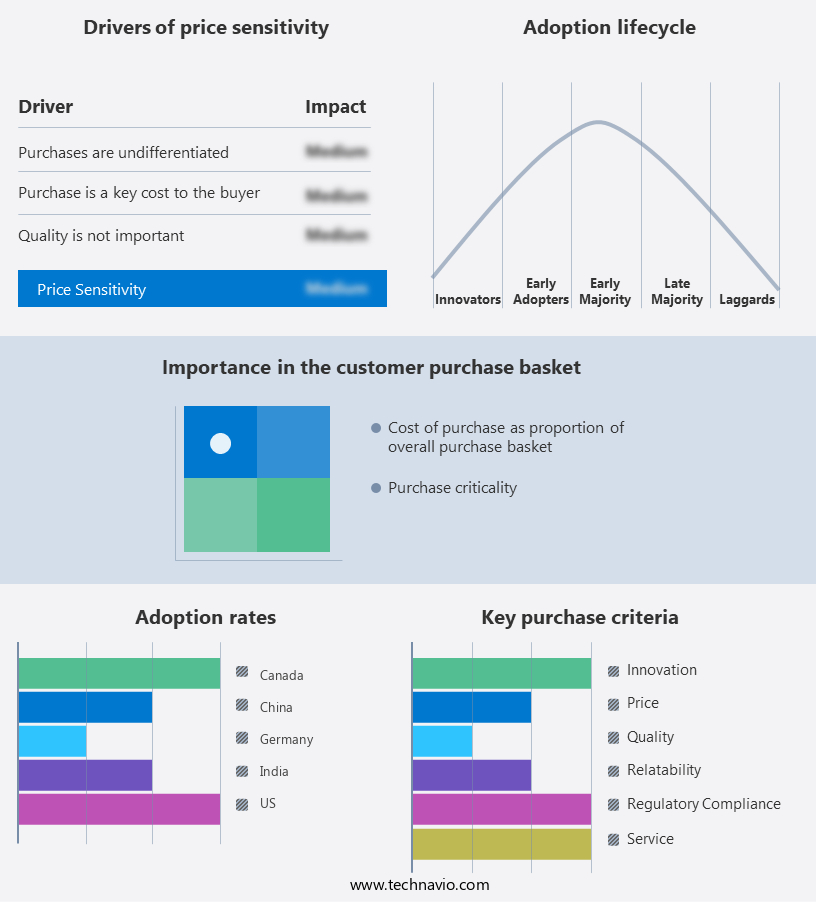
Customer Landscape
Key Companies & Market Insights
Companies are implementing various strategies, such as strategic alliances, polysulfide rubber market forecast, partnerships, mergers and acquisitions, geographical expansion, and product/service launches, to enhance their presence In the industry.
The industry research and growth report includes detailed analyses of the competitive landscape of the market and information about key companies, including:
- Arkema SA
- Fosroc International Ltd.
- Nouryon
- Perma Flex Mold Co. Inc.
- Sinochem Group Co. Ltd.
- Smooth On Inc.
Qualitative and quantitative analysis of companies has been conducted to help clients understand the wider business environment as well as the strengths and weaknesses of key industry players. Data is qualitatively analyzed to categorize companies as pure play, category-focused, industry-focused, and diversified; it is quantitatively analyzed to categorize companies as dominant, leading, strong, tentative, and weak.
Research Analyst Overview
Polysulfide rubber (PSR), a type of synthetic rubber, is produced through the polycondensation of dihalides and aliphatic compounds. The process involves the reaction of ethylene dichloride and propyl dichloride, resulting In the formation of polysulfide chains. This rubber can exist in various forms, including solid, liquid, and aqueous dispersion. The unique properties of PSR make it a valuable material in numerous industries. Its soft and stretchy nature makes it an excellent choice for molds and casting applications. In the construction sector, it is used In the production of gypsum plasters and as a sealant and adhesive. PSR's resistance to solvents, oils, fuels, sunlight, and gas and moisture impermeability make it an ideal material for use in various industries, including marine, aircraft, insulated glass, and infrastructure management.
The thermosetting characteristics of PSR make it suitable for use in construction projects and petrochemical industry applications. Its high resistance to volatile organic compounds (VOCs) makes it an excellent choice for use in paints and coatings, sealants, and adhesives. In the transportation sector, PSR is used In the production of specialty chemicals, industrial processing, and lithium-sulfur batteries for high-performance cathodes. The chemical compositions of PSR make it an essential material in various industries. In the transportation sector, it is used In the production of liquid polysulfide elastomers and solid polysulfide elastomers. These elastomers have found extensive use In the production of washers, gaskets, diaphragms, and coatings.
The use of PSR in various industries is driven by its environmental sustainability. Its resistance to degradation and long-lasting properties make it an attractive alternative to traditional materials. Additionally, the ongoing digital initiatives in various industries are driving the demand for PSR In the production of high-performance materials. In conclusion, polysulfide rubber is a versatile material with unique properties that make it an essential component in various industries. Its resistance to various environmental factors, thermosetting characteristics, and long-lasting properties make it an attractive alternative to traditional materials. The ongoing digital initiatives in various industries are expected to drive the demand for PSR In the production of high-performance materials.
|
Market Scope |
|
|
Report Coverage |
Details |
|
Page number |
189 |
|
Base year |
2023 |
|
Historic period |
2018-2022 |
|
Forecast period |
2024-2028 |
|
Growth momentum & CAGR |
Accelerate at a CAGR of 4.3% |
|
Market growth 2024-2028 |
USD 109.1 million |
|
Market structure |
Concentrated |
|
YoY growth 2023-2024(%) |
4.0 |
|
Key countries |
US, China, India, Germany, and Canada |
|
Competitive landscape |
Leading Companies, Market Positioning of Companies, Competitive Strategies, and Industry Risks |
What are the Key Data Covered in this Polysulfide Rubber Market Research and Growth Report?
- CAGR of the Polysulfide Rubber industry during the forecast period
- Detailed information on factors that will drive the growth and forecasting between 2024 and 2028
- Precise estimation of the size of the market and its contribution of the industry in focus to the parent market
- Accurate predictions about upcoming growth and trends and changes in consumer behaviour
- Growth of the market across APAC, North America, Europe, South America, and Middle East and Africa
- Thorough analysis of the market's competitive landscape and detailed information about companies
- Comprehensive analysis of factors that will challenge the polysulfide rubber market growth of industry companies
We can help! Our analysts can customize this polysulfide rubber market research report to meet your requirements.
 RIA -
RIA - 
