
Residential HVAC Market Analysis, Size, and Forecast 2026-2030: APAC (China, Japan, and India), Europe (Germany, UK, and France), North America (US, Canada, and Mexico), Middle East and Africa (Saudi Arabia, UAE, and South Africa), South America (Brazil, Argentina, and Chile), and Rest of World (ROW)

Residential HVAC Market Analysis, Size, and Forecast 2026-2030:
APAC (China, Japan, and India), Europe (Germany, UK, and France), North America (US, Canada, and Mexico), Middle East and Africa (Saudi Arabia, UAE, and South Africa), South America (Brazil, Argentina, and Chile), and Rest of World (ROW)

Published: Oct 2026 298 Pages SKU: IRTNTR44872

Market Overview at a Glance

$50.78 B
Market Opportunity
8.5%
CAGR 2025 - 2030
48.8%
APAC Growth
$63.32 B
HVAC equipment segment 2024

Residential Hvac Market Size 2026-2030

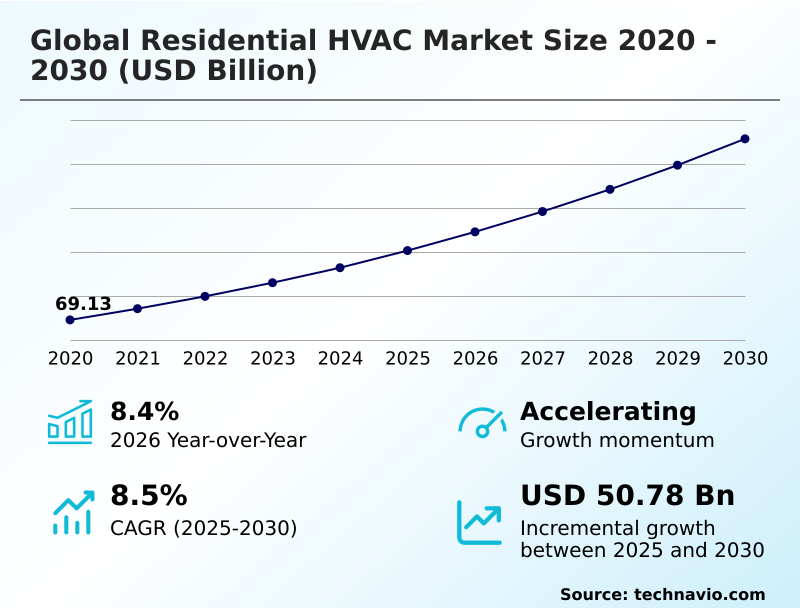
The residential hvac market size is valued to increase by USD 50.78 billion, at a CAGR of 8.5% from 2025 to 2030. Transition toward environmentally friendly refrigerants and sustainability standards will drive the residential hvac market.

Major Market Trends & Insights

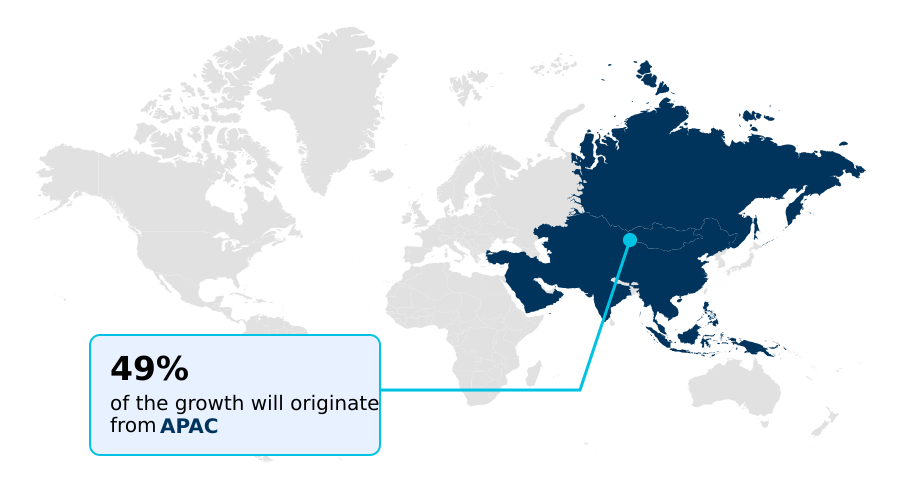
  • APAC dominated the market and accounted for a 48.8% growth during the forecast period.
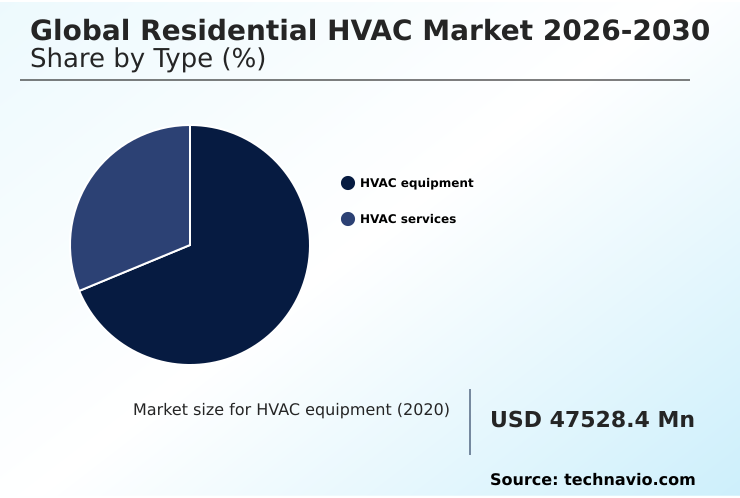
  • By Type - HVAC equipment segment was valued at USD 63.32 billion in 2024
  • By Product - Air conditioning system segment accounted for the largest market revenue share in 2024

Market Size & Forecast

  • Market Opportunities: USD 82.29 billion
  • Market Future Opportunities: USD 50.78 billion
  • CAGR from 2025 to 2030 : 8.5%

Market Summary

  • The Residential HVAC Market demonstrates a critical transition toward electrification and intelligent automation, driven by escalating environmental mandates. A primary driver of this evolution is the accelerated adoption of advanced refrigerants, which compels original equipment manufacturers to heavily invest in redesigning internal thermal architectures.
  • For instance, updating manufacturing facilities to safely handle mildly flammable cooling agents allows companies to align with new compliance standards, subsequently reducing their product carbon footprint by up to 40%. However, this operational pivot introduces severe challenges, most notably the high financial burden of retooling supply chains and training a specialized workforce in predictive diagnostics.
  • The complexity of these new systems frequently increases the initial capital expenditure required for end-users, slowing the replacement cycle in price-sensitive demographics. Connecting climate systems directly to utility grid frameworks enhances overall grid stability and minimizes peak energy draw. Ultimately, integrating smart thermostats and automated energy platforms cements intelligent climate control as a modern infrastructure necessity.

What will be the Size of the Residential Hvac Market during the forecast period?
Get Key Insights on Market Forecast (PDF) Get Free Sample

How is the Residential Hvac Market Segmented?

The residential hvac industry research report provides comprehensive data (region-wise segment analysis), with forecasts and estimates in "USD million" for the period 2026-2030, as well as historical data from 2020-2024 for the following segments.

  • Type
    • HVAC equipment
    • HVAC services
  • Product
    • Air conditioning system
    • Heating system
    • Ventilating system
  • Service
    • Retrofit/replacement
    • New construction
  • Geography
    • APAC
      • China
      • Japan
      • India
      • South Korea
      • Australia
      • Indonesia
    • Europe
      • Germany
      • UK
      • France
      • Italy
      • Spain
      • The Netherlands
    • North America
      • US
      • Canada
      • Mexico
    • Middle East and Africa
      • Saudi Arabia
      • UAE
      • South Africa
      • Israel
      • Turkey
    • South America
      • Brazil
      • Argentina
      • Chile

By Type Insights

The hvac equipment segment is estimated to witness significant growth during the forecast period.

The hardware infrastructure defining the Residential HVAC sector is fundamentally shifting toward low global warming potential refrigerant adoption and high-efficiency operations. Driven by stringent mandates, the engineering of units now prioritizes advanced thermal management architecture and precise fluid dynamics innovation.

Manufacturers are transitioning to mildly flammable cooling agent formulations, necessitating completely redesigned variable speed compressor mechanisms. This equipment modernization directly impacts energy consumption monitoring, allowing households to reduce peak power draw by 15% compared to legacy fixed-speed units.

The integration of inverter driven technology enhances the residential thermal envelope, ensuring compliance with strict zero emission building standard frameworks.

As automated energy management capabilities merge seamlessly with hardware, the baseline operational efficiency of these systems significantly lowers utility expenditures and optimizes climate regulation.
Get Free Sample

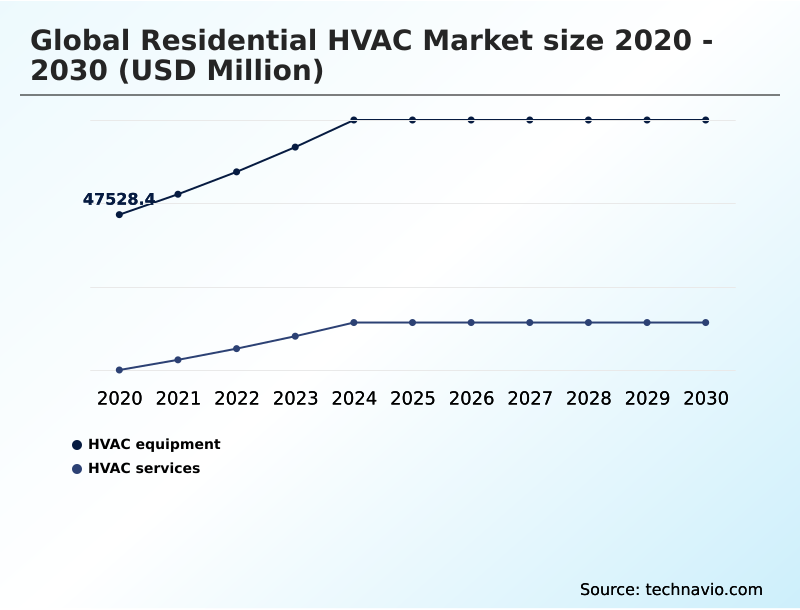
The HVAC equipment segment was valued at USD 63.32 billion in 2024 and showed a gradual increase during the forecast period.
Get Free Sample

Regional Analysis

APAC is estimated to contribute 48.8% to the growth of the global market during the forecast period.Technavio’s analysts have elaborately explained the regional trends and drivers that shape the market during the forecast period.
See How Residential Hvac Market Demand is Rising in APAC Get Free Sample

Regional dynamics within the Residential HVAC market highlight a stark contrast between APAC and Europe, driven by distinct policy frameworks and climate demands.

Europe leads the transition toward residential building stock decarbonization, where aggressive subsidies for air to water heat pump installations have reduced reliance on fossil fuel heating by 35% in targeted urban zones.

Furthermore, European supply chains emphasize compressor sound reduction and hybrid heating solution integration, improving acoustic compliance by 25% in high-density housing.

Conversely, the APAC region prioritizes high capacity heating capability and cooling solutions, achieving a 20% higher penetration rate of ductless mini split system technology compared to European markets.

The rapid expansion of centralized climate control and district cooling network infrastructure in APAC effectively addresses extreme temperature volatility.

APAC manufacturers heavily scale variable refrigerant flow infrastructure alongside multi split vrf system deployments, utilizing precise compressor motor variation to optimize performance in high-rise residential applications.

Market Dynamics

Our researchers analyzed the data with 2025 as the base year, along with the key drivers, trends, and challenges. A holistic analysis of drivers will help companies refine their marketing strategies to gain a competitive advantage.

  • As environmental regulations reshape product development, the Residential HVAC Market is prioritizing sophisticated operational planning to accommodate rapid technological shifts. The industry's low global warming potential transition demands rigorous supply chain realignment, as manufacturers source specialized components engineered for mildly flammable refrigerants.
  • This pivot has proven crucial; companies proactively adapting their procurement strategies experience a nearly 25% faster time-to-market for compliant systems compared to those relying on legacy supply networks. Furthermore, heat pump cold climate performance has become a major differentiator, prompting significant research and development investments to ensure reliable operation in sub-zero environments without relying on auxiliary electric resistance heating.
  • Concurrently, the push for residential indoor air quality improvement has led to the widespread adoption of advanced filtration and ventilation technologies within standard units, directly influencing consumer purchasing decisions.
  • To maximize operational efficiency and reduce energy waste, vendors are emphasizing variable speed compressor energy efficiency, which allows systems to modulate output precisely based on real-time thermal loads rather than operating on binary cycles.
  • This mechanical enhancement is seamlessly managed through smart home ecosystem climate integration, giving users granular control over their environments while allowing utility providers to balance grid demand. Ultimately, these intersecting advancements require robust compliance and distribution frameworks, ensuring that next-generation climate control solutions meet escalating end-user performance expectations.
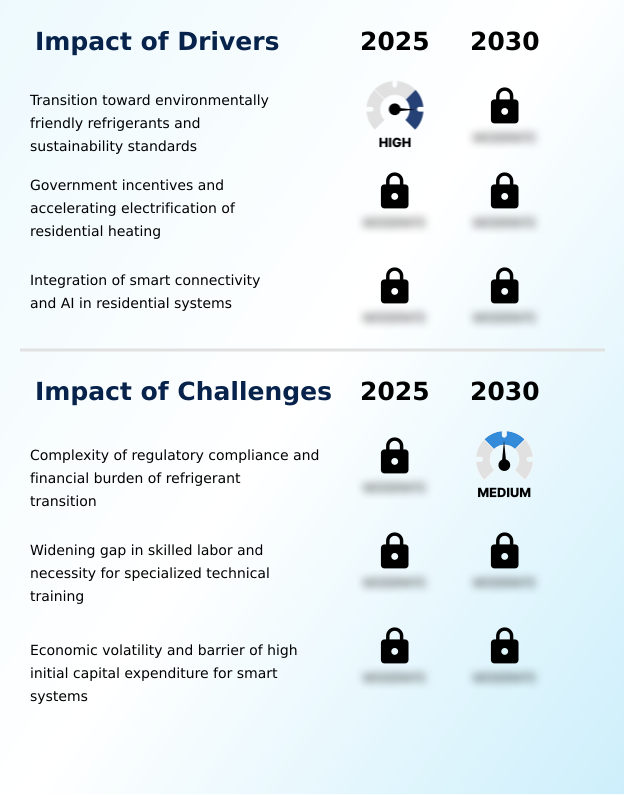
What are the key market drivers leading to the rise in the adoption of Residential Hvac Industry?

  • The primary driver of market expansion is the accelerated transition toward environmentally friendly refrigerants alongside the strict enforcement of sustainability standards.

  • The primary driver propelling the Residential HVAC market is the stringent legislative mandate enforcing a hydrofluorocarbon phasedown across major economies.
  • This regulatory shift compells manufacturers to rapidly overhaul refrigerant supply chain logistics, necessitating the adoption of carbon dioxide natural refrigerant solutions. Consequently, the deployment of advanced geothermal heat exchange and aerothermal technology integration has surged.
  • This mechanical evolution directly impacts operational efficiency, cutting residential carbon footprints by over 30% while ensuring reliable sub zero temperature operation.
  • Furthermore, the integration of high efficiency gas furnace systems with residential solar photovoltaic integration has accelerated the replacement of older units.
  • This electrification driver enhances thermodynamic property management through redesigned heat exchanger component structures, fundamentally restructuring product development priorities toward high-efficiency, sustainable climate control solutions and lowering household energy use by 25%.

What are the market trends shaping the Residential Hvac Industry?

  • The strategic transition toward low global warming potential refrigerants and strict regulatory compliance represents a defining market trend.

  • A dominant trend reshaping the Residential HVAC market is the accelerated integration of adaptive learning algorithm technology into core hardware. Driven by the necessity to curb peak grid demand, manufacturers are equipping units with smart thermostat integration and mobile application control to autonomously modulate temperature settings.
  • This shift fundamentally alters consumer interaction, as automated adjustments utilizing an occupancy pattern sensor have improved daily energy efficiency by 22%. The rising demand for sophisticated indoor air quality control has propelled the installation of heat recovery ventilator systems, minimizing thermal loss during air exchange.
  • Implementing these digital synergies alongside robust thermal leakage analysis optimizes the sustainable cooling infrastructure, reducing component wear and maintenance costs by 18% via remote diagnostic service platforms. This strategic alignment with demand response program participation allows utility networks to stabilize during extreme weather events.

What challenges does the Residential Hvac Industry face during its growth?

  • Market expansion faces significant constraints due to the inherent complexity of regulatory compliance and the substantial financial burden associated with the ongoing refrigerant transition.

  • The most significant challenge confronting the Residential HVAC market is the operational burden of integrating complex mechanical features with smart grid connectivity amidst supply chain volatility. The mandatory inclusion of advanced energy recovery ventilator units and sophisticated pm2.5 filtration system modules requires massive retooling of manufacturing lines.
  • This pivot has increased initial capital expenditure, temporarily elevating end-user product costs by 18% compared to legacy systems. Furthermore, a severe shortage of technicians trained in deploying predictive maintenance algorithm diagnostics and configuring ultraviolet germicidal irradiation components severely limits deployment speeds. This labor gap extends average installation downtime by 25%.
  • Additionally, manufacturing highly durable units requiring specialized corrosion resistant coating for coastal applications, or developing viable evaporative cooling alternative options for arid climates, strains R&D budgets and stalls widespread adoption in emerging markets.

Exclusive Technavio Analysis on Customer Landscape

The residential hvac market forecasting report includes the adoption lifecycle of the market, covering from the innovator’s stage to the laggard’s stage. It focuses on adoption rates in different regions based on penetration. Furthermore, the residential hvac market report also includes key purchase criteria and drivers of price sensitivity to help companies evaluate and develop their market growth analysis strategies.
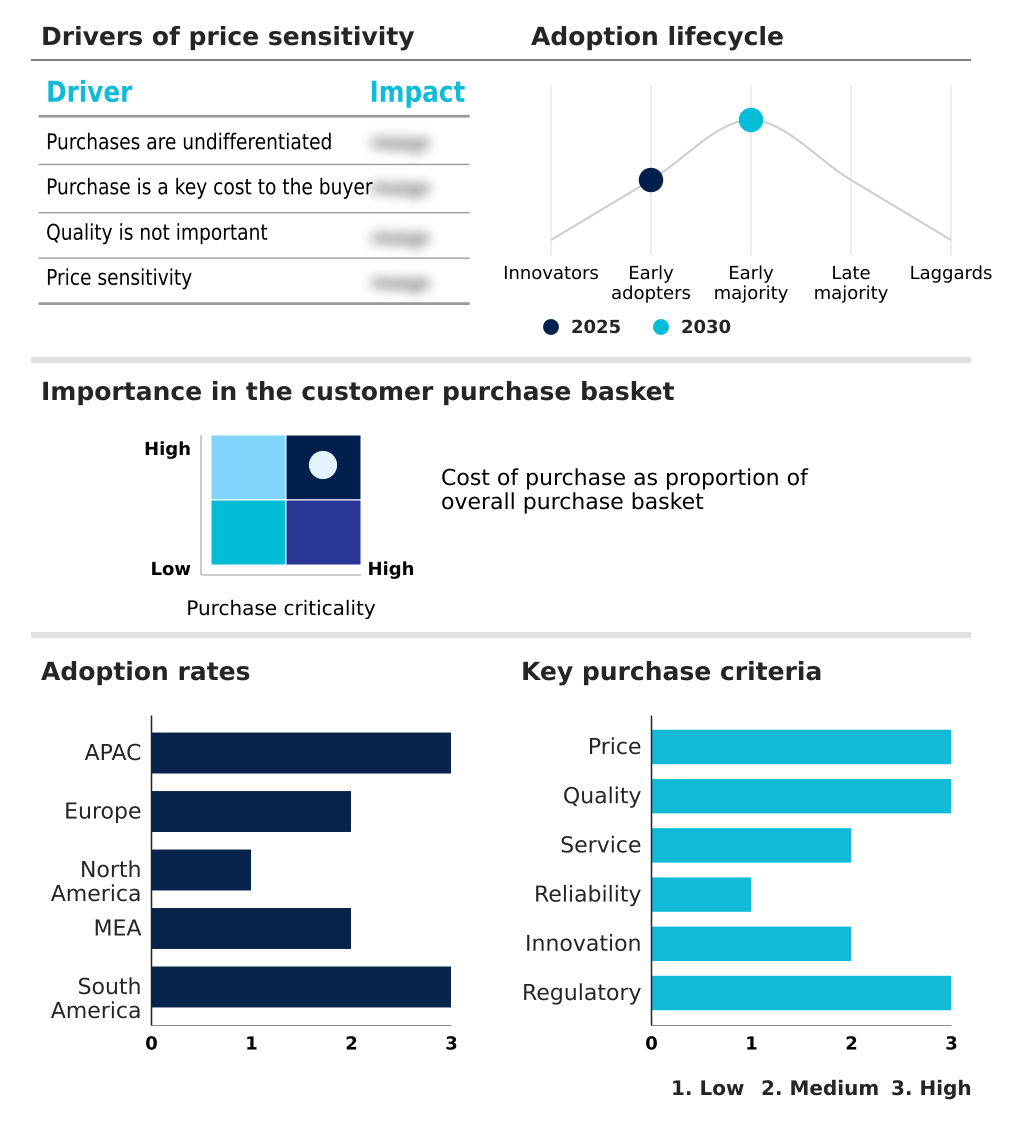
Customer Landscape of Residential Hvac Industry

Competitive Landscape

Companies are implementing various strategies, such as strategic alliances, residential hvac market forecast, partnerships, mergers and acquisitions, geographical expansion, and product/service launches, to enhance their presence in the industry.

Ariston Holding NV - The entity provides high-efficiency thermal comfort solutions, focusing on advanced heat pumps, condensing boilers, and specialized heating elements tailored for sustainable residential climate control applications.

The industry research and growth report includes detailed analyses of the competitive landscape of the market and information about key companies, including:

  • Ariston Holding NV
  • BDR Thermea Group
  • Carrier Global Corp.
  • Daikin Industries Ltd.
  • Fujitsu General Ltd
  • Gree Electric Appliances Inc.
  • Haier Smart Home Co. Ltd.
  • Johnson Controls International
  • LG Electronics Inc.
  • Midea Group Co. Ltd.
  • Mitsubishi Electric Corp.
  • Nordyne LLC
  • Paloma Co. Ltd.
  • Panasonic Holdings Corp.
  • Rheem Manufacturing Co.
  • Robert Bosch GmbH
  • Samsung Electronics Co. Ltd.
  • Trane Technologies plc
  • Wolf GmbH

Qualitative and quantitative analysis of companies has been conducted to help clients understand the wider business environment as well as the strengths and weaknesses of key industry players. Data is qualitatively analyzed to categorize companies as pure play, category-focused, industry-focused, and diversified; it is quantitatively analyzed to categorize companies as dominant, leading, strong, tentative, and weak.

Recent Development and News in Residential hvac market

  • In the Electrical Components and Equipment industry, the rapid deployment of advanced smart grid communication nodes has enabled bidirectional data exchange between utilities and domestic appliances, directly impacting Residential HVAC demand by facilitating automated demand response participation and reducing peak load grid strain by up to 15%.
  • The acceleration of high-voltage direct current inverter production mandates has necessitated the development of highly compatible power modules, transforming how heat pumps operate and lowering household dependency on traditional fossil fuels by nearly 30%.
  • Stringent raw material sourcing regulations surrounding copper and aluminum extraction have forced a shift toward advanced alloy heat exchanger designs, elevating production costs for high efficiency gas furnaces by 12% while ensuring better thermodynamic stability.
  • The widespread adoption of AI-based predictive maintenance software across industrial manufacturing lines has trickled down into consumer electronics, equipping multi-split VRF installations with remote diagnostic capabilities that improve fault detection accuracy by 22%.

Dive into Technavio’s robust research methodology, blending expert interviews, extensive data synthesis, and validated models for unparalleled Residential Hvac Market insights. See full methodology.

Market Scope
Page number 298
Base year 2025
Historic period 2020-2024
Forecast period 2026-2030
Growth momentum & CAGR Accelerate at a CAGR of 8.5%
Market growth 2026-2030 USD 50779.2 million
Market structure Fragmented
YoY growth 2025-2026(%) 8.4%
Key countries China, Japan, India, South Korea, Australia, Indonesia, Germany, UK, France, Italy, Spain, The Netherlands, US, Canada, Mexico, Saudi Arabia, UAE, South Africa, Israel, Turkey, Brazil, Argentina and Chile
Competitive landscape Leading Companies, Market Positioning of Companies, Competitive Strategies, and Industry Risks

Request Free Sample

Research Analyst Overview

  • The continuous evolution of the Residential HVAC Market is characterized by a fundamental shift toward digital intelligence and electrified heating architectures. Regulatory pressures targeting carbon emissions have accelerated the integration of geothermal heat exchange and multi split vrf system technologies, forcing manufacturers to recalibrate their product strategies.
  • A critical boardroom-level focus is the deployment of predictive maintenance algorithm capabilities, which directly impacts post-sale service models and customer retention. By leveraging connected diagnostics, service providers have achieved a 30% reduction in unnecessary technician dispatch events, significantly optimizing operational resource allocation.
  • Furthermore, the mandatory incorporation of energy recovery ventilator modules addresses tightening indoor air quality control requirements while maintaining thermal efficiency. The transition to carbon dioxide natural refrigerant solutions demands highly specialized compressor motor variation, altering the cost structure and procurement strategies of major equipment producers.
  • As systems become more complex, these integrations transition from optional upgrades to baseline necessities, profoundly influencing how residential climate hardware is engineered and deployed across dense urban infrastructures.

What are the Key Data Covered in this Residential Hvac Market Research and Growth Report?

  • What is the expected growth of the Residential Hvac Market between 2026 and 2030?

    • USD 50.78 billion, at a CAGR of 8.5%

  • What segmentation does the market report cover?

    • The report is segmented by Type (HVAC equipment, and HVAC services), Product (Air conditioning system, Heating system, and Ventilating system), Service (Retrofit/replacement, and New construction) and Geography (APAC, Europe, North America, Middle East and Africa, South America)

  • Which regions are analyzed in the report?

    • APAC, Europe, North America, Middle East and Africa and South America

  • What are the key growth drivers and market challenges?

    • Transition toward environmentally friendly refrigerants and sustainability standards, Complexity of regulatory compliance and financial burden of refrigerant transition

  • Who are the major players in the Residential Hvac Market?

    • Ariston Holding NV, BDR Thermea Group, Carrier Global Corp., Daikin Industries Ltd., Fujitsu General Ltd, Gree Electric Appliances Inc., Haier Smart Home Co. Ltd., Johnson Controls International, LG Electronics Inc., Midea Group Co. Ltd., Mitsubishi Electric Corp., Nordyne LLC, Paloma Co. Ltd., Panasonic Holdings Corp., Rheem Manufacturing Co., Robert Bosch GmbH, Samsung Electronics Co. Ltd., Trane Technologies plc and Wolf GmbH

Market Research Insights

  • The Residential HVAC Market is rapidly evolving through the implementation of smart grid connectivity and automated energy management protocols. By integrating remote diagnostic service capabilities, facility managers and homeowners have reduced unscheduled equipment downtime by 28%.
  • Additionally, the shift toward sustainable cooling infrastructure has increased the efficiency of thermal leakage analysis, allowing for a 15% reduction in overall energy consumption monitoring costs. Utilizing advanced sensor arrays further ensures that systems only operate when necessary, extending hardware lifespans by up to 20%.
  • These advancements optimize the residential thermal envelope, delivering measurable operational efficiency and strict alignment with emerging environmental compliance standards.

We can help! Our analysts can customize this residential hvac market research report to meet your requirements.

Get in touch

1. Executive Summary

1.1 Market overview

Executive Summary - Chart on Market Overview
Executive Summary - Data Table on Market Overview
Executive Summary - Chart on Global Market Characteristics
Executive Summary - Chart on Market by Geography
Executive Summary - Chart on Market Segmentation by Type
Executive Summary - Chart on Market Segmentation by Product
Executive Summary - Chart on Market Segmentation by Service
Executive Summary - Chart on Incremental Growth
Executive Summary - Data Table on Incremental Growth
Executive Summary - Chart on Company Market Positioning

2. Technavio Analysis

2.1 Analysis of price sensitivity, lifecycle, customer purchase basket, adoption rates, and purchase criteria

2.2 Criticality of inputs and Factors of differentiation

Chart on Overview on criticality of inputs and factors of differentiation

2.3 Factors of disruption

Chart on Overview on factors of disruption

2.4 Impact of drivers and challenges

Chart on Impact of drivers and challenges in 2025 and 2030

3. Market Landscape

3.1 Market ecosystem

Chart on Parent Market
Data Table on - Parent Market

3.2 Market characteristics

Chart on Market characteristics analysis

3.3 Value chain analysis

Chart on Value chain analysis

4. Market Sizing

4.1 Market definition

Data Table on Offerings of companies included in the market definition

4.2 Market segment analysis

Market segments

4.3 Market size 2025

4.4 Market outlook: Forecast for 2025-2030

Chart on Global - Market size and forecast 2025-2030 ($ million)
Data Table on Global - Market size and forecast 2025-2030 ($ million)
Chart on Global Market: Year-over-year growth 2025-2030 (%)
Data Table on Global Market: Year-over-year growth 2025-2030 (%)

5. Historic Market Size

5.1 Global Residential HVAC Market 2020 - 2024

Historic Market Size - Data Table on Global Residential HVAC Market 2020 - 2024 ($ million)

5.2 Type segment analysis 2020 - 2024

Historic Market Size - Type Segment 2020 - 2024 ($ million)

5.3 Product segment analysis 2020 - 2024

Historic Market Size - Product Segment 2020 - 2024 ($ million)

5.4 Service segment analysis 2020 - 2024

Historic Market Size - Service Segment 2020 - 2024 ($ million)

5.5 Geography segment analysis 2020 - 2024

Historic Market Size - Geography Segment 2020 - 2024 ($ million)

5.6 Country segment analysis 2020 - 2024

Historic Market Size - Country Segment 2020 - 2024 ($ million)

6. Qualitative Analysis

6.1 Impact of AI on global residential HVAC market

6.2 Impact of geopolitical conflicts on global residential HVAC market

7. Five Forces Analysis

7.1 Five forces summary

Five forces analysis - Comparison between 2025 and 2030

7.2 Bargaining power of buyers

Bargaining power of buyers - Impact of key factors 2025 and 2030

7.3 Bargaining power of suppliers

Bargaining power of suppliers - Impact of key factors in 2025 and 2030

7.4 Threat of new entrants

Threat of new entrants - Impact of key factors in 2025 and 2030

7.5 Threat of substitutes

Threat of substitutes - Impact of key factors in 2025 and 2030

7.6 Threat of rivalry

Threat of rivalry - Impact of key factors in 2025 and 2030

7.7 Market condition

Chart on Market condition - Five forces 2025 and 2030

8. Market Segmentation by Type

8.1 Market segments

Chart on Type - Market share 2025-2030 (%)
Data Table on Type - Market share 2025-2030 (%)

8.2 Comparison by Type

Chart on Comparison by Type
Data Table on Comparison by Type

8.3 HVAC equipment - Market size and forecast 2025-2030

Chart on HVAC equipment - Market size and forecast 2025-2030 ($ million)
Data Table on HVAC equipment - Market size and forecast 2025-2030 ($ million)
Chart on HVAC equipment - Year-over-year growth 2025-2030 (%)
Data Table on HVAC equipment - Year-over-year growth 2025-2030 (%)

8.4 HVAC services - Market size and forecast 2025-2030

Chart on HVAC services - Market size and forecast 2025-2030 ($ million)
Data Table on HVAC services - Market size and forecast 2025-2030 ($ million)
Chart on HVAC services - Year-over-year growth 2025-2030 (%)
Data Table on HVAC services - Year-over-year growth 2025-2030 (%)

8.5 Market opportunity by Type

Market opportunity by Type ($ million)
Data Table on Market opportunity by Type ($ million)

9. Market Segmentation by Product

9.1 Market segments

Chart on Product - Market share 2025-2030 (%)
Data Table on Product - Market share 2025-2030 (%)

9.2 Comparison by Product

Chart on Comparison by Product
Data Table on Comparison by Product

9.3 Air conditioning system - Market size and forecast 2025-2030

Chart on Air conditioning system - Market size and forecast 2025-2030 ($ million)
Data Table on Air conditioning system - Market size and forecast 2025-2030 ($ million)
Chart on Air conditioning system - Year-over-year growth 2025-2030 (%)
Data Table on Air conditioning system - Year-over-year growth 2025-2030 (%)

9.4 Heating system - Market size and forecast 2025-2030

Chart on Heating system - Market size and forecast 2025-2030 ($ million)
Data Table on Heating system - Market size and forecast 2025-2030 ($ million)
Chart on Heating system - Year-over-year growth 2025-2030 (%)
Data Table on Heating system - Year-over-year growth 2025-2030 (%)

9.5 Ventilating system - Market size and forecast 2025-2030

Chart on Ventilating system - Market size and forecast 2025-2030 ($ million)
Data Table on Ventilating system - Market size and forecast 2025-2030 ($ million)
Chart on Ventilating system - Year-over-year growth 2025-2030 (%)
Data Table on Ventilating system - Year-over-year growth 2025-2030 (%)

9.6 Market opportunity by Product

Market opportunity by Product ($ million)
Data Table on Market opportunity by Product ($ million)

10. Market Segmentation by Service

10.1 Market segments

Chart on Service - Market share 2025-2030 (%)
Data Table on Service - Market share 2025-2030 (%)

10.2 Comparison by Service

Chart on Comparison by Service
Data Table on Comparison by Service

10.3 Retrofit/replacement - Market size and forecast 2025-2030

Chart on Retrofit/replacement - Market size and forecast 2025-2030 ($ million)
Data Table on Retrofit/replacement - Market size and forecast 2025-2030 ($ million)
Chart on Retrofit/replacement - Year-over-year growth 2025-2030 (%)
Data Table on Retrofit/replacement - Year-over-year growth 2025-2030 (%)

10.4 New construction - Market size and forecast 2025-2030

Chart on New construction - Market size and forecast 2025-2030 ($ million)
Data Table on New construction - Market size and forecast 2025-2030 ($ million)
Chart on New construction - Year-over-year growth 2025-2030 (%)
Data Table on New construction - Year-over-year growth 2025-2030 (%)

10.5 Market opportunity by Service

Market opportunity by Service ($ million)
Data Table on Market opportunity by Service ($ million)

11. Customer Landscape

11.1 Customer landscape overview

Analysis of price sensitivity, lifecycle, customer purchase basket, adoption rates, and purchase criteria

12. Geographic Landscape

12.1 Geographic segmentation

Chart on Market share by geography 2025-2030 (%)
Data Table on Market share by geography 2025-2030 (%)

12.2 Geographic comparison

Chart on Geographic comparison
Data Table on Geographic comparison

12.3 APAC - Market size and forecast 2025-2030

Chart on APAC - Market size and forecast 2025-2030 ($ million)
Data Table on APAC - Market size and forecast 2025-2030 ($ million)
Chart on APAC - Year-over-year growth 2025-2030 (%)
Data Table on APAC - Year-over-year growth 2025-2030 (%)
Chart on Regional Comparison - APAC
Data Table on Regional Comparison - APAC

12.3.1 China - Market size and forecast 2025-2030

Chart on China - Market size and forecast 2025-2030 ($ million)
Data Table on China - Market size and forecast 2025-2030 ($ million)
Chart on China - Year-over-year growth 2025-2030 (%)
Data Table on China - Year-over-year growth 2025-2030 (%)

12.3.2 Japan - Market size and forecast 2025-2030

Chart on Japan - Market size and forecast 2025-2030 ($ million)
Data Table on Japan - Market size and forecast 2025-2030 ($ million)
Chart on Japan - Year-over-year growth 2025-2030 (%)
Data Table on Japan - Year-over-year growth 2025-2030 (%)

12.3.3 India - Market size and forecast 2025-2030

Chart on India - Market size and forecast 2025-2030 ($ million)
Data Table on India - Market size and forecast 2025-2030 ($ million)
Chart on India - Year-over-year growth 2025-2030 (%)
Data Table on India - Year-over-year growth 2025-2030 (%)

12.3.4 South Korea - Market size and forecast 2025-2030

Chart on South Korea - Market size and forecast 2025-2030 ($ million)
Data Table on South Korea - Market size and forecast 2025-2030 ($ million)
Chart on South Korea - Year-over-year growth 2025-2030 (%)
Data Table on South Korea - Year-over-year growth 2025-2030 (%)

12.3.5 Australia - Market size and forecast 2025-2030

Chart on Australia - Market size and forecast 2025-2030 ($ million)
Data Table on Australia - Market size and forecast 2025-2030 ($ million)
Chart on Australia - Year-over-year growth 2025-2030 (%)
Data Table on Australia - Year-over-year growth 2025-2030 (%)

12.3.6 Indonesia - Market size and forecast 2025-2030

Chart on Indonesia - Market size and forecast 2025-2030 ($ million)
Data Table on Indonesia - Market size and forecast 2025-2030 ($ million)
Chart on Indonesia - Year-over-year growth 2025-2030 (%)
Data Table on Indonesia - Year-over-year growth 2025-2030 (%)

12.4 Europe - Market size and forecast 2025-2030

Chart on Europe - Market size and forecast 2025-2030 ($ million)
Data Table on Europe - Market size and forecast 2025-2030 ($ million)
Chart on Europe - Year-over-year growth 2025-2030 (%)
Data Table on Europe - Year-over-year growth 2025-2030 (%)
Chart on Regional Comparison - Europe
Data Table on Regional Comparison - Europe

12.4.1 Germany - Market size and forecast 2025-2030

Chart on Germany - Market size and forecast 2025-2030 ($ million)
Data Table on Germany - Market size and forecast 2025-2030 ($ million)
Chart on Germany - Year-over-year growth 2025-2030 (%)
Data Table on Germany - Year-over-year growth 2025-2030 (%)

12.4.2 UK - Market size and forecast 2025-2030

Chart on UK - Market size and forecast 2025-2030 ($ million)
Data Table on UK - Market size and forecast 2025-2030 ($ million)
Chart on UK - Year-over-year growth 2025-2030 (%)
Data Table on UK - Year-over-year growth 2025-2030 (%)

12.4.3 France - Market size and forecast 2025-2030

Chart on France - Market size and forecast 2025-2030 ($ million)
Data Table on France - Market size and forecast 2025-2030 ($ million)
Chart on France - Year-over-year growth 2025-2030 (%)
Data Table on France - Year-over-year growth 2025-2030 (%)

12.4.4 Italy - Market size and forecast 2025-2030

Chart on Italy - Market size and forecast 2025-2030 ($ million)
Data Table on Italy - Market size and forecast 2025-2030 ($ million)
Chart on Italy - Year-over-year growth 2025-2030 (%)
Data Table on Italy - Year-over-year growth 2025-2030 (%)

12.4.5 Spain - Market size and forecast 2025-2030

Chart on Spain - Market size and forecast 2025-2030 ($ million)
Data Table on Spain - Market size and forecast 2025-2030 ($ million)
Chart on Spain - Year-over-year growth 2025-2030 (%)
Data Table on Spain - Year-over-year growth 2025-2030 (%)

12.4.6 The Netherlands - Market size and forecast 2025-2030

Chart on The Netherlands - Market size and forecast 2025-2030 ($ million)
Data Table on The Netherlands - Market size and forecast 2025-2030 ($ million)
Chart on The Netherlands - Year-over-year growth 2025-2030 (%)
Data Table on The Netherlands - Year-over-year growth 2025-2030 (%)

12.5 North America - Market size and forecast 2025-2030

Chart on North America - Market size and forecast 2025-2030 ($ million)
Data Table on North America - Market size and forecast 2025-2030 ($ million)
Chart on North America - Year-over-year growth 2025-2030 (%)
Data Table on North America - Year-over-year growth 2025-2030 (%)
Chart on Regional Comparison - North America
Data Table on Regional Comparison - North America

12.5.1 US - Market size and forecast 2025-2030

Chart on US - Market size and forecast 2025-2030 ($ million)
Data Table on US - Market size and forecast 2025-2030 ($ million)
Chart on US - Year-over-year growth 2025-2030 (%)
Data Table on US - Year-over-year growth 2025-2030 (%)

12.5.2 Canada - Market size and forecast 2025-2030

Chart on Canada - Market size and forecast 2025-2030 ($ million)
Data Table on Canada - Market size and forecast 2025-2030 ($ million)
Chart on Canada - Year-over-year growth 2025-2030 (%)
Data Table on Canada - Year-over-year growth 2025-2030 (%)

12.5.3 Mexico - Market size and forecast 2025-2030

Chart on Mexico - Market size and forecast 2025-2030 ($ million)
Data Table on Mexico - Market size and forecast 2025-2030 ($ million)
Chart on Mexico - Year-over-year growth 2025-2030 (%)
Data Table on Mexico - Year-over-year growth 2025-2030 (%)

12.6 Middle East and Africa - Market size and forecast 2025-2030

Chart on Middle East and Africa - Market size and forecast 2025-2030 ($ million)
Data Table on Middle East and Africa - Market size and forecast 2025-2030 ($ million)
Chart on Middle East and Africa - Year-over-year growth 2025-2030 (%)
Data Table on Middle East and Africa - Year-over-year growth 2025-2030 (%)
Chart on Regional Comparison - Middle East and Africa
Data Table on Regional Comparison - Middle East and Africa

12.6.1 Saudi Arabia - Market size and forecast 2025-2030

Chart on Saudi Arabia - Market size and forecast 2025-2030 ($ million)
Data Table on Saudi Arabia - Market size and forecast 2025-2030 ($ million)
Chart on Saudi Arabia - Year-over-year growth 2025-2030 (%)
Data Table on Saudi Arabia - Year-over-year growth 2025-2030 (%)

12.6.2 UAE - Market size and forecast 2025-2030

Chart on UAE - Market size and forecast 2025-2030 ($ million)
Data Table on UAE - Market size and forecast 2025-2030 ($ million)
Chart on UAE - Year-over-year growth 2025-2030 (%)
Data Table on UAE - Year-over-year growth 2025-2030 (%)

12.6.3 South Africa - Market size and forecast 2025-2030

Chart on South Africa - Market size and forecast 2025-2030 ($ million)
Data Table on South Africa - Market size and forecast 2025-2030 ($ million)
Chart on South Africa - Year-over-year growth 2025-2030 (%)
Data Table on South Africa - Year-over-year growth 2025-2030 (%)

12.6.4 Israel - Market size and forecast 2025-2030

Chart on Israel - Market size and forecast 2025-2030 ($ million)
Data Table on Israel - Market size and forecast 2025-2030 ($ million)
Chart on Israel - Year-over-year growth 2025-2030 (%)
Data Table on Israel - Year-over-year growth 2025-2030 (%)

12.6.5 Turkey - Market size and forecast 2025-2030

Chart on Turkey - Market size and forecast 2025-2030 ($ million)
Data Table on Turkey - Market size and forecast 2025-2030 ($ million)
Chart on Turkey - Year-over-year growth 2025-2030 (%)
Data Table on Turkey - Year-over-year growth 2025-2030 (%)

12.7 South America - Market size and forecast 2025-2030

Chart on South America - Market size and forecast 2025-2030 ($ million)
Data Table on South America - Market size and forecast 2025-2030 ($ million)
Chart on South America - Year-over-year growth 2025-2030 (%)
Data Table on South America - Year-over-year growth 2025-2030 (%)
Chart on Regional Comparison - South America
Data Table on Regional Comparison - South America

12.7.1 Brazil - Market size and forecast 2025-2030

Chart on Brazil - Market size and forecast 2025-2030 ($ million)
Data Table on Brazil - Market size and forecast 2025-2030 ($ million)
Chart on Brazil - Year-over-year growth 2025-2030 (%)
Data Table on Brazil - Year-over-year growth 2025-2030 (%)

12.7.2 Argentina - Market size and forecast 2025-2030

Chart on Argentina - Market size and forecast 2025-2030 ($ million)
Data Table on Argentina - Market size and forecast 2025-2030 ($ million)
Chart on Argentina - Year-over-year growth 2025-2030 (%)
Data Table on Argentina - Year-over-year growth 2025-2030 (%)

12.7.3 Chile - Market size and forecast 2025-2030

Chart on Chile - Market size and forecast 2025-2030 ($ million)
Data Table on Chile - Market size and forecast 2025-2030 ($ million)
Chart on Chile - Year-over-year growth 2025-2030 (%)
Data Table on Chile - Year-over-year growth 2025-2030 (%)

12.8 Market opportunity by geography

Market opportunity by geography ($ million)
Data Tables on Market opportunity by geography ($ million)

13. Drivers, Challenges, and Opportunity

13.1 Market drivers

Transition toward environmentally friendly refrigerants and sustainability standards
Government incentives and accelerating electrification of residential heating
Integration of smart connectivity and AI in residential systems

13.2 Market challenges

Complexity of regulatory compliance and financial burden of refrigerant transition
Widening gap in skilled labor and necessity for specialized technical training
Economic volatility and barrier of high initial capital expenditure for smart systems

13.3 Impact of drivers and challenges

Impact of drivers and challenges in 2025 and 2030

13.4 Market opportunities

Strategic transition to low global warming potential refrigerants and regulatory compliance
Acceleration of home electrification and high efficiency heat pump adoption
Digital transformation through smart home ecosystems and AI

14. Competitive Landscape

14.1 Overview

14.2

Overview on criticality of inputs and factors of differentiation

14.3 Landscape disruption

Overview on factors of disruption

14.4 Industry risks

Impact of key risks on business

15. Competitive Analysis

15.1 Companies profiled

Companies covered

15.2 Company ranking index

15.3 Market positioning of companies

Matrix on companies position and classification

15.4 Ariston Holding NV

Ariston Holding NV - Overview
Ariston Holding NV - Business segments
Ariston Holding NV - Key offerings
Ariston Holding NV - Segment focus
SWOT

15.5 Carrier Global Corp.

Carrier Global Corp. - Overview
Carrier Global Corp. - Business segments
Carrier Global Corp. - Key news
Carrier Global Corp. - Key offerings
Carrier Global Corp. - Segment focus
SWOT

15.6 Daikin Industries Ltd.

Daikin Industries Ltd. - Overview
Daikin Industries Ltd. - Business segments
Daikin Industries Ltd. - Key offerings
Daikin Industries Ltd. - Segment focus
SWOT

15.7 Fujitsu General Ltd

Fujitsu General Ltd - Overview
Fujitsu General Ltd - Product / Service
Fujitsu General Ltd - Key offerings
SWOT

15.8 Gree Electric Appliances Inc.

Gree Electric Appliances Inc. - Overview
Gree Electric Appliances Inc. - Product / Service
Gree Electric Appliances Inc. - Key offerings
SWOT

15.9 Haier Smart Home Co. Ltd.

Haier Smart Home Co. Ltd. - Overview
Haier Smart Home Co. Ltd. - Business segments
Haier Smart Home Co. Ltd. - Key offerings
Haier Smart Home Co. Ltd. - Segment focus
SWOT

15.10 Johnson Controls International

Johnson Controls International - Overview
Johnson Controls International - Business segments
Johnson Controls International - Key news
Johnson Controls International - Key offerings
Johnson Controls International - Segment focus
SWOT

15.11 LG Electronics Inc.

LG Electronics Inc. - Overview
LG Electronics Inc. - Business segments
LG Electronics Inc. - Key offerings
LG Electronics Inc. - Segment focus
SWOT

15.12 Midea Group Co. Ltd.

Midea Group Co. Ltd. - Overview
Midea Group Co. Ltd. - Business segments
Midea Group Co. Ltd. - Key offerings
Midea Group Co. Ltd. - Segment focus
SWOT

15.13 Mitsubishi Electric Corp.

Mitsubishi Electric Corp. - Overview
Mitsubishi Electric Corp. - Business segments
Mitsubishi Electric Corp. - Key offerings
Mitsubishi Electric Corp. - Segment focus
SWOT

15.14 Panasonic Holdings Corp.

Panasonic Holdings Corp. - Overview
Panasonic Holdings Corp. - Business segments
Panasonic Holdings Corp. - Key news
Panasonic Holdings Corp. - Key offerings
Panasonic Holdings Corp. - Segment focus
SWOT

15.15 Robert Bosch GmbH

Robert Bosch GmbH - Overview
Robert Bosch GmbH - Product / Service
Robert Bosch GmbH - Key offerings
SWOT

15.16 Samsung Electronics Co. Ltd.

Samsung Electronics Co. Ltd. - Overview
Samsung Electronics Co. Ltd. - Business segments
Samsung Electronics Co. Ltd. - Key news
Samsung Electronics Co. Ltd. - Key offerings
Samsung Electronics Co. Ltd. - Segment focus
SWOT

15.17 Trane Technologies plc

Trane Technologies plc - Overview
Trane Technologies plc - Business segments
Trane Technologies plc - Key news
Trane Technologies plc - Key offerings
Trane Technologies plc - Segment focus
SWOT

15.18 Wolf GmbH

Wolf GmbH - Overview
Wolf GmbH - Product / Service
Wolf GmbH - Key offerings
SWOT

16. Appendix

16.1 Scope of the report

Market definition
Objectives
Notes and caveats

16.2 Inclusions and exclusions checklist

Inclusions checklist
Exclusions checklist

16.3 Currency conversion rates for US$

16.4 Research methodology

16.5 Data procurement

Information sources

16.6 Data validation

16.7 Validation techniques employed for market sizing

16.8 Data synthesis

16.9 360 degree market analysis

16.10 List of abbreviations

Research Methodology

Technavio presents a detailed picture of the market by way of study, synthesis, and summation of data from multiple sources. The analysts have presented the various facets of the market with a particular focus on identifying the key industry influencers. The data thus presented is comprehensive, reliable, and the result of extensive research, both primary and secondary.

INFORMATION SOURCES

Primary sources

  • Manufacturers and suppliers
  • Channel partners
  • Industry experts
  • Strategic decision makers

Secondary sources

  • Industry journals and periodicals
  • Government data
  • Financial reports of key industry players
  • Historical data
  • Press releases

DATA ANALYSIS

Data Synthesis

  • Collation of data
  • Estimation of key figures
  • Analysis of derived insights

Data Validation

  • Triangulation with data models
  • Reference against proprietary databases
  • Corroboration with industry experts

REPORT WRITING

Qualitative

  • Market drivers
  • Market challenges
  • Market trends
  • Five forces analysis

Quantitative

  • Market size and forecast
  • Market segmentation
  • Geographical insights
  • Competitive landscape

Interested in this report?

Get your sample now to see our research methodology and insights!

Download Now

Frequently Asked Questions

Residential Hvac market growth will increase by USD 50779.2 million during 2026-2030.

The Residential Hvac market is expected to grow at a CAGR of 8.5% during 2026-2030.

Residential Hvac market is segmented by Type (HVAC equipment, HVAC services) Product (Air conditioning system, Heating system, Ventilating system) Service (Retrofit/replacement, New construction)

Ariston Holding NV, BDR Thermea Group, Carrier Global Corp., Daikin Industries Ltd., Fujitsu General Ltd, Gree Electric Appliances Inc., Haier Smart Home Co. Ltd., Johnson Controls International, LG Electronics Inc., Midea Group Co. Ltd., Mitsubishi Electric Corp., Nordyne LLC, Paloma Co. Ltd., Panasonic Holdings Corp., Rheem Manufacturing Co., Robert Bosch GmbH, Samsung Electronics Co. Ltd., Trane Technologies plc, Wolf GmbH are a few of the key vendors in the Residential Hvac market.

APAC will register the highest growth rate of 48.8% among the other regions. Therefore, the Residential Hvac market in APAC is expected to garner significant business opportunities for the vendors during the forecast period.

China, Japan, India, South Korea, Australia, Indonesia, Germany, UK, France, Italy, Spain, The Netherlands, US, Canada, Mexico, Saudi Arabia, UAE, South Africa, Israel, Turkey, Brazil, Argentina, Chile

  • Transition toward environmentally friendly refrigerants and sustainability standards is the driving factor this market.

The Residential Hvac market vendors should focus on grabbing business opportunities from the Type segment as it accounted for the largest market share in the base year.
RIA - Research AI Assistant
Ask RIA
