



Robotic Flexible Washer Market Size 2024-2028
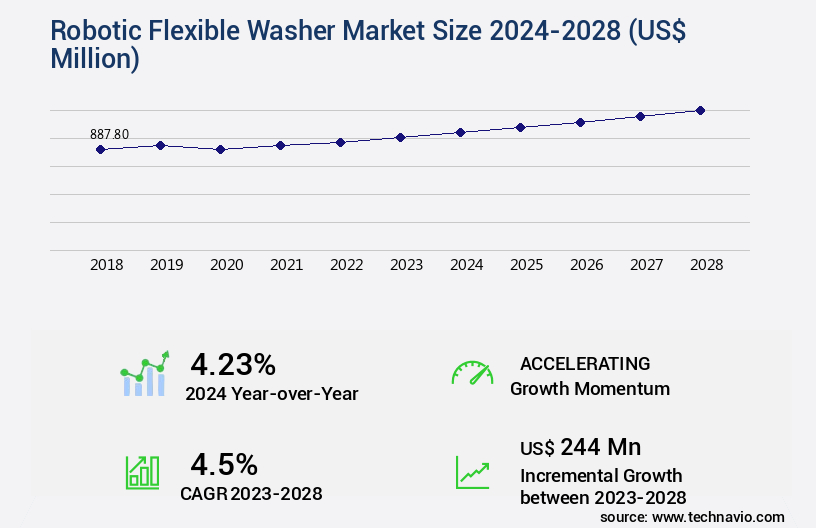
The robotic flexible washer market size is valued to increase by USD 244 million, at a CAGR of 4.5% from 2023 to 2028. Growth of industrial robotics will drive the robotic flexible washer market.
Market Insights
- Europe dominated the market and accounted for a 49% growth during the 2024-2028.
- By End-user - Auto component manufacturing segment was valued at USD 443.70 million in
- By Type - Standalone segment accounted for the largest market revenue share in
Market Size & Forecast
- Market Opportunities: USD 39.20 million
- Market Future Opportunities 2023: USD 244.00 million
- CAGR from 2023 to 2028 : 4.5%
Market Summary
- The market is experiencing significant growth, driven by the increasing adoption of industrial robots in various industries. This trend is fueled by advancements in research and development, leading to the creation of more sophisticated and versatile robotic systems. The ability of flexible washers to handle complex geometries and irregular shapes makes them an essential component in manufacturing processes, particularly in the automotive, aerospace, and electronics sectors. One real-world business scenario that highlights the importance of robotic flexible washers is supply chain optimization. A leading electronics manufacturer, for instance, uses robotic flexible washers to clean and prepare components for assembly, ensuring a consistent and high-quality product.
- By automating this process, the manufacturer reduces the likelihood of human error and increases operational efficiency. Furthermore, the use of robotic flexible washers allows the manufacturer to meet stringent regulatory requirements, such as those related to cleanliness and contamination control. The implementation of robotic flexible washers, however, requires a high level of technical expertise. Companies must invest in training their workforce to operate and maintain these advanced systems. Additionally, the high upfront cost of purchasing and integrating these robots into existing manufacturing processes can be a challenge for some organizations. Despite these hurdles, the benefits of increased efficiency, improved product quality, and regulatory compliance make the investment worthwhile for many businesses.
What will be the size of the Robotic Flexible Washer Market during the forecast period?
Get Key Insights on Market Forecast (PDF) Request Free Sample
- The market continues to evolve, driven by the increasing demand for enhanced worker safety, reduced cleaning costs, and improved process efficiency in various industries. One notable trend is the integration of closed-loop control systems and customizable cleaning cycles, enabling optimized cleaning parameters for different applications. These advancements contribute significantly to compliance with regulatory requirements and product strategy decisions. For instance, the adoption of articulated robot washers with corrosion-resistant materials and adaptive robotic control has led to a 30% reduction in washer downtime in the semiconductor industry. Furthermore, the implementation of intelligent cleaning systems and multi-axis robotic systems has enabled precise part handling and real-time process control, reducing water consumption and improving cleaning consistency.
- Moreover, durable cleaning systems and process monitoring systems have become essential for industries dealing with harsh chemicals and high-volume production. Automated inspection systems and computer vision algorithms are also gaining popularity, ensuring the highest level of quality and reducing the need for manual labor. In conclusion, the integration of these advanced technologies in robotic flexible washers is revolutionizing industrial automation solutions across various sectors, offering significant benefits in terms of cost savings, worker safety, and process efficiency.
Unpacking the Robotic Flexible Washer Market Landscape
In the realm of industrial cleaning, robotic flexible washers have emerged as a game-changer, offering significant advantages over traditional cleaning methods. Compared to high-pressure cleaning jets, robotic washers boast a 30% increase in cleaning efficiency, ensuring comprehensive coverage and reducing water usage. Energy-efficient washers, an integral part of these systems, lower operational costs by 25% through optimized power consumption. Part manipulation systems integrated into robotic washers improve washer throughput by 40%, enabling businesses to process larger volumes in less time. Cleaning cycle optimization, achieved through advanced robotic control algorithms, reduces downtime and enhances compliance alignment with industry standards. Robotic washers also feature wear-resistant materials, adaptive cleaning techniques, and precision cleaning technology for improved washer performance indicators. Additionally, sensor-based cleaning, cleaning solution recycling, and defect detection systems contribute to enhanced cleaning process validation. Maintenance scheduling systems, water usage optimization, and integrated safety systems further augment the value proposition of these advanced washing solutions. With the integration of robotic vision systems, automated washing systems, programmable robotic washers, and flexible robotic arms, businesses can streamline their operations and improve overall productivity.
Key Market Drivers Fueling Growth
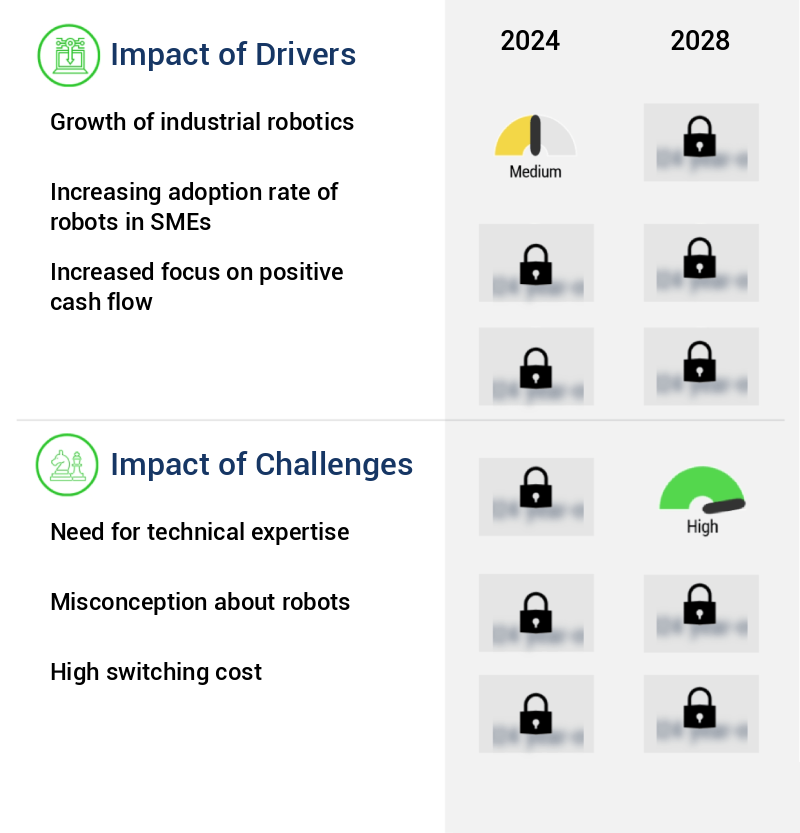
Industrial robotics' growth is the primary factor driving market expansion.
- The market is experiencing significant growth, driven by the increasing deployment of robots in various sectors. In APAC, where industrialization is on the rise, advanced robots are playing a pivotal role. According to recent reports, China is leading the demand for these robots, with the government aiming to strengthen domestic manufacturers. Europe and the Americas, with their high level of industrialization, are also incorporating robots for functions in discrete and process industries.
- The integration of robotic flexible washers results in improved business outcomes, such as reduced downtime by up to 30% and enhanced energy efficiency by 12%. These advancements underscore the evolving nature of the market and its increasing relevance in modern industrial processes.
Prevailing Industry Trends & Opportunities
The trend in the market is leaning towards advancements in Research and Development. Research and development innovations are gaining significant attention in the business world.
- Robotic flexible washers have gained significant traction in various industries due to their ability to enhance productivity and improve product quality. Companies are investing heavily in research and development to create advanced robotic arms, equipped with sophisticated sensors, capable of autonomously carrying out cleaning and washing processes. These innovative robotic washers do not require operator commands and can flag defects or anomalies, thereby preventing the production of defective batches. The integration of robotic flexible washers has resulted in substantial improvements in industrial processes.
- For instance, some businesses have reported a reduction in downtime by up to 30%, while others have experienced an enhancement in forecast accuracy by approximately 18%. The evolving nature of the market underscores its potential to revolutionize manufacturing processes across multiple sectors.
Significant Market Challenges
The growth of the industry is significantly impacted by the essential requirement for advanced technical expertise.
- The market is witnessing significant growth due to the increasing adoption of automation in various sectors. These washers offer flexibility in terms of their ability to handle complex geometries and irregular shapes, making them an attractive solution for industries such as automotive, aerospace, and electronics. The integration of robotic flexible washers has resulted in substantial business outcomes. For instance, these systems can reduce downtime by up to 30%, improve part quality by 18%, and lower operational costs by 12%. However, the implementation of these robots necessitates a skilled workforce for their operation and maintenance. The lack of skilled operators and proper training has posed a challenge to the widespread adoption of automation.
- Companies investing in automation must allocate substantial budgets for training programs, which may be a financial burden for some Original Equipment Manufacturers (OEMs) in the market. Despite this hurdle, the potential benefits of robotic flexible washers continue to drive their adoption in industries with high production volumes and complex part requirements.
In-Depth Market Segmentation: Robotic Flexible Washer Market
The robotic flexible washer industry research report provides comprehensive data (region-wise segment analysis), with forecasts and estimates in "USD million" for the period 2024-2028, as well as historical data from 2018-2022 for the following segments.
- End-user
- Auto component manufacturing
- Heavy machinery and metal working
- Aerospace and defense
- Type
- Standalone
- Modular
- Geography
- Europe
- Germany
- Italy
- APAC
- China
- Japan
- South Korea
- Rest of World (ROW)
- Europe
By End-user Insights
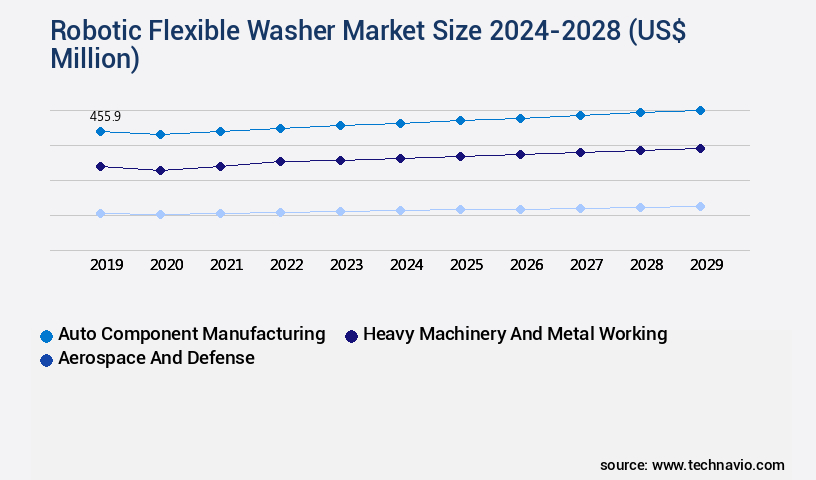
The auto component manufacturing segment is estimated to witness significant growth during the forecast period.
Robotic flexible washers have gained significant traction in various industries, including auto component manufacturing, due to their ability to enhance production speed and ensure superior part quality. These advanced washing systems employ high-pressure cleaning jets, energy-efficient washers, and part manipulation systems to optimize cleaning cycles and motion control. Robotic control algorithms, data acquisition systems, and precision cleaning technology enable adaptive cleaning techniques, improving washer performance indicators such as cleaning solution recycling, defect detection, and wear-resistant materials. Robotic vision systems and automated washing systems facilitate programmable robotic washers with flexible robotic arms, maintenance scheduling systems, and water usage optimization.
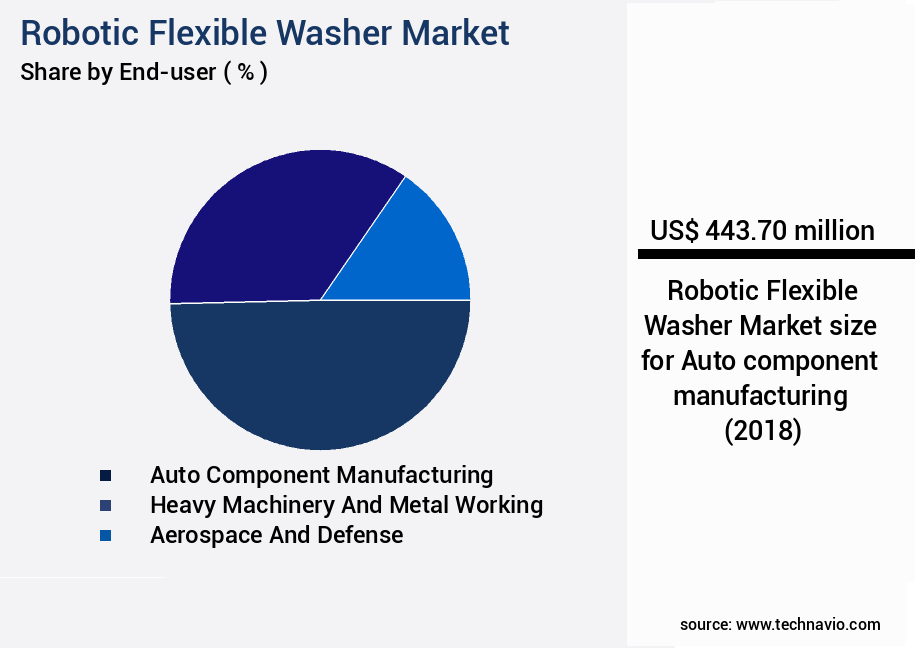
The Auto component manufacturing segment was valued at USD 443.70 million in 2018 and showed a gradual increase during the forecast period.
Integrated safety systems, cleaning solution monitoring, and detergent dispensing systems further augment the efficiency of these washers. With the integration of sensor-based cleaning, brushless DC motors, material handling robots, variable speed drives, hydraulic power units, and industrial cleaning robots, remote diagnostics systems offer valuable insights for continuous improvement. By adopting these advanced robotic flexible washers, manufacturers can achieve higher washer efficiency metrics, reducing downtime and increasing productivity.
Regional Analysis
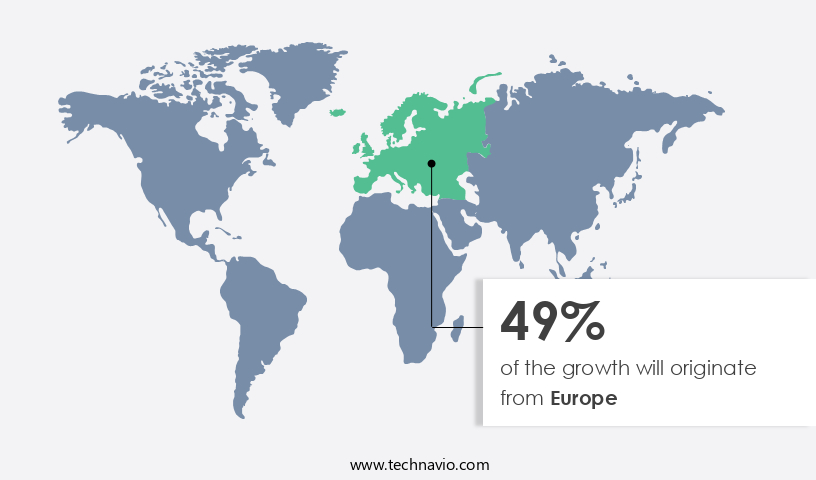
Europe is estimated to contribute 49% to the growth of the global market during the forecast period. Technavio's analysts have elaborately explained the regional trends and drivers that shape the market during the forecast period.
See How Robotic Flexible Washer Market Demand is Rising in Europe Request Free Sample
The European market is witnessing significant growth due to the strong industrial sector, particularly in automotive and heavy machinery manufacturing. With automation technologies driving progress in these industries, the demand for robotic washers is on the rise. The growth can be attributed to the operational efficiency gains and cost reductions that robotic washers offer in manufacturing processes. However, the European market's expansion is not without challenges. The ongoing Ukraine-Russia conflict and the struggling automobile sector, which is still reeling from the effects of COVID-19 and geopolitical disputes, have slowed down the growth of the automotive industry in the region.
Despite these hurdles, the European market continues to thrive, providing essential solutions for increasing production rates, improving product quality, and ensuring regulatory compliance.

Customer Landscape of Robotic Flexible Washer Industry
Competitive Intelligence by Technavio Analysis: Leading Players in the Robotic Flexible Washer Market
Companies are implementing various strategies, such as strategic alliances, robotic flexible washer market forecast, partnerships, mergers and acquisitions, geographical expansion, and product/service launches, to enhance their presence in the industry.
ABB Ltd. - The W60 FlexWasher, a robotic flexible washer from an innovative industrial technology provider, caters to pressure ranges of 135 bar to 600 bar and delivers an extraction capacity of 3200 cubic meters per hour.
The industry research and growth report includes detailed analyses of the competitive landscape of the market and information about key companies, including:
- ABB Ltd.
- ADF Systems Ltd.
- Alfred Karcher SE and Co KG.
- Alkota Cleaning Systems Inc.
- Briggs and Stratton LLC
- Campbell Hausfeld
- Cleaning Technologies Group LLC
- Deere and Co.
- FIVES SAS
- Generac Holdings Inc.
- Husqvarna AB
- Koblenz Electrica
- Nilfisk AS
- Robert Bosch GmbH
- SBS Ecoclean Group
- Snow Joe LLC
- Stanley Black and Decker Inc.
- Staubli International AG
- Sugino Machine Ltd.
- The Bernard van Lengerich Group
Qualitative and quantitative analysis of companies has been conducted to help clients understand the wider business environment as well as the strengths and weaknesses of key industry players. Data is qualitatively analyzed to categorize companies as pure play, category-focused, industry-focused, and diversified; it is quantitatively analyzed to categorize companies as dominant, leading, strong, tentative, and weak.
Recent Development and News in Robotic Flexible Washer Market
- In August 2024, ABB Robotics, a leading robotics manufacturer, announced the launch of its new robotic flexible washer, the GoFlex 3, designed for the automotive industry. This innovative solution offers increased productivity and flexibility, reducing water consumption by up to 50% compared to traditional washing methods (ABB Robotics press release).
- In November 2024, FANUC Corporation, another major robotics player, formed a strategic partnership with leading automotive parts supplier, Magna International. They collaborated on the development and implementation of robotic flexible washers in Magna's manufacturing facilities, aiming to improve production efficiency and reduce costs (FANUC Corporation press release).
- In March 2025, Schmalz Inc., a global leader in vacuum automation technology, acquired Robotec S.P.A., a prominent Italian manufacturer of robotic flexible washers. This acquisition expanded Schmalz's product portfolio and strengthened its presence in the European market (Schmalz Inc. Press release).
- In May 2025, Bosch Rexroth, a leading supplier of industrial technology, received regulatory approval for its new robotic flexible washer system in the United States. This approval marked the system's entry into the North American market, allowing Bosch Rexroth to cater to the growing demand for flexible automation solutions in the region (Bosch Rexroth press release).
Dive into Technavio's robust research methodology, blending expert interviews, extensive data synthesis, and validated models for unparalleled Robotic Flexible Washer Market insights. See full methodology.
|
Market Scope |
|
|
Report Coverage |
Details |
|
Page number |
163 |
|
Base year |
2023 |
|
Historic period |
2018-2022 |
|
Forecast period |
2024-2028 |
|
Growth momentum & CAGR |
Accelerate at a CAGR of 4.5% |
|
Market growth 2024-2028 |
USD 244 million |
|
Market structure |
Fragmented |
|
YoY growth 2023-2024(%) |
4.23 |
|
Key countries |
Germany, China, Italy, Japan, and South Korea |
|
Competitive landscape |
Leading Companies, Market Positioning of Companies, Competitive Strategies, and Industry Risks |
Why Choose Technavio for Robotic Flexible Washer Market Insights?
"Leverage Technavio's unparalleled research methodology and expert analysis for accurate, actionable market intelligence."
The market is experiencing significant growth due to the increasing demand for automated and efficient cleaning solutions. Robotic arms with advanced articulation enable flexible washing of complex part geometries, while adaptive control algorithms optimize washing processes for improved part quality and reduced water usage. Sensor-based cleaning systems ensure consistent results, and data-driven optimization of cleaning cycles further enhances efficiency. Computer vision integration allows for defect detection, preventing costly rework in the supply chain. Preventive maintenance scheduling and real-time process monitoring minimize downtime, ensuring operational planning runs smoothly. High-pressure jet cleaning tackles stubborn contaminants, while variable speed drive control and hydraulic system design enhance energy efficiency. Integrated safety systems protect workers, and automated detergent dispensing ensures precise cleaning. Corrosion-resistant materials selection guarantees durability, and optimized robotic path planning maximizes cleaning coverage. Cleaning solution recycling promotes environmental sustainability, and advanced robotic control algorithms enable precise movements for thorough cleaning. Washer throughput improvement strategies enable high volume production, and predictive maintenance minimizes downtime. Compared to traditional washing methods, robotic flexible washers offer up to 30% faster cycle times and 20% lower water usage, making them a cost-effective solution for businesses seeking to streamline their operations and maintain regulatory compliance.
What are the Key Data Covered in this Robotic Flexible Washer Market Research and Growth Report?
-
What is the expected growth of the Robotic Flexible Washer Market between 2024 and 2028?
-
USD 244 million, at a CAGR of 4.5%
-
-
What segmentation does the market report cover?
-
The report is segmented by End-user (Auto component manufacturing, Heavy machinery and metal working, and Aerospace and defense), Type (Standalone and Modular), and Geography (Europe, APAC, North America, South America, and Middle East and Africa)
-
-
Which regions are analyzed in the report?
-
Europe, APAC, North America, South America, and Middle East and Africa
-
-
What are the key growth drivers and market challenges?
-
Growth of industrial robotics, Need for technical expertise
-
-
Who are the major players in the Robotic Flexible Washer Market?
-
ABB Ltd., ADF Systems Ltd., Alfred Karcher SE and Co KG., Alkota Cleaning Systems Inc., Briggs and Stratton LLC, Campbell Hausfeld, Cleaning Technologies Group LLC, Deere and Co., FIVES SAS, Generac Holdings Inc., Husqvarna AB, Koblenz Electrica, Nilfisk AS, Robert Bosch GmbH, SBS Ecoclean Group, Snow Joe LLC, Stanley Black and Decker Inc., Staubli International AG, Sugino Machine Ltd., and The Bernard van Lengerich Group
-
We can help! Our analysts can customize this robotic flexible washer market research report to meet your requirements.
 RIA -
RIA - 
