

Robotic Prosthetics Market Analysis US - US - Size and Forecast 2024-2028

Robotic Prosthetics Market Analysis US - US - Size and Forecast 2024-2028

Published: Jul 2024 116 Pages SKU: IRTNTR73201

Market Overview at a Glance

$84.2 Mn
Market Opportunity
8.09%
CAGR
7.34
YoY growth 2023-2024(%)

US Robotic Prosthetics Market Size 2024-2028 

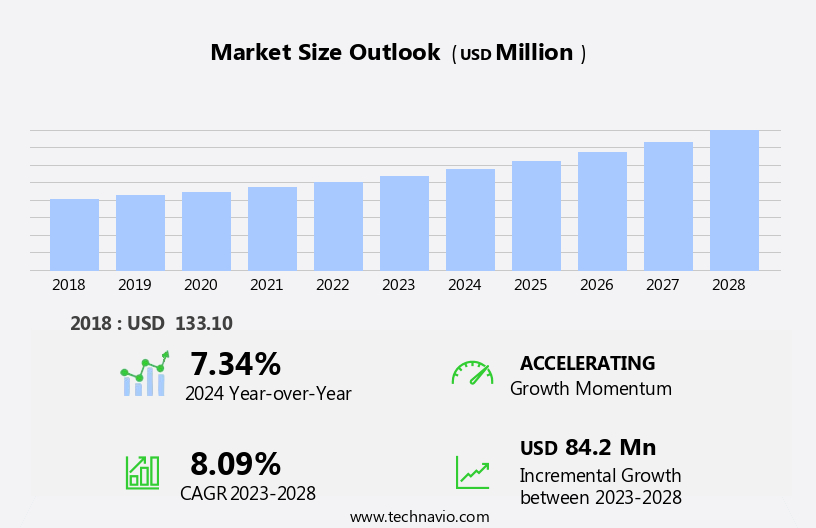
The US robotic prosthetics market size is forecast to increase by USD 84.2 million, at a CAGR of 8.09% between 2023 and 2028.

  • The Robotic Prosthetics Market in the US is witnessing significant growth, driven by the expanding target population and the relentless pursuit to restore personal mobility and independence for amputees. The market is fueled by an increasing number of technological advances and Research and Development activities, which continue to revolutionize the field of prosthetics. However, the high cost of prosthetic solutionsremains a formidable challenge, limiting accessibility for many potential users. Companies seeking to capitalize on market opportunities must navigate this financial barrier by exploring cost-effective solutions, collaborations, and innovative business models.
  • Additionally, staying abreast of the latest technological developments and regulatory landscape is crucial for maintaining a competitive edge. The robust growth potential in this market is underpinned by the unmet needs of the growing amputee population and the ongoing technological innovations, offering ample opportunities for companies to make a meaningful impact.

What will be the size of the US Robotic Prosthetics Market during the forecast period?
Robotic Prosthetics Market in US Size

Explore in-depth regional segment analysis with market size data - historical 2018-2022 and forecasts 2024-2028 - in the full report.  
 Request Free Sample

  • The robotic prosthetics market in the US is witnessing significant advancements, particularly in the areas of upper and lower limb prosthetics. Personalized prosthetic fitting, achieved through gait analysis algorithms and muscle activation patterns, is becoming increasingly important for enhancing patient comfort and functionality. Neural interface technology and haptic feedback systems are revolutionizing the field, enabling more natural interaction between the user and the prosthetic limb. Advanced prosthetic materials, such as biocompatible coatings and wearable sensor networks, are improving prosthetic durability and enabling more precise prosthetic limb alignment. Robotic hand dexterity and robotic arm design are also seeing improvements through actuator control systems and prosthetic joint articulation.
  • Kinematic analysis software and biomechanical modeling are essential tools for optimizing control algorithm design and surgical implantation techniques. Prosthetic rehabilitation protocols are being enhanced through user feedback mechanisms, motion capture technology, and EMG signal amplification. Prosthetic weight distribution and wearable sensor networks are crucial for understanding the user's needs and preferences. Prosthetic socket design and prosthetic durability testing are ongoing areas of research to ensure optimal performance and user satisfaction. Haptic feedback systems and prosthetic power sources are also gaining attention, with a focus on creating more energy-efficient and user-friendly solutions. The market is expected to continue evolving, driven by technological innovations and growing demand for advanced prosthetic solutions.

How is this market segmented?

The market research report provides comprehensive data (region-wise segment analysis), with forecasts and estimates in "USD million" for the period 2024-2028, as well as historical data from 2018-2022 for the following segments.

  • End-user
    • Orthotic and prosthetic clinics
    • Hospitals
    • Specialty orthopedic centers
  • Product
    • Lower limb robotic prosthetics
    • Upper limb robotic prosthetics
  • Geography
    • North America
      • US

By End-user Insights

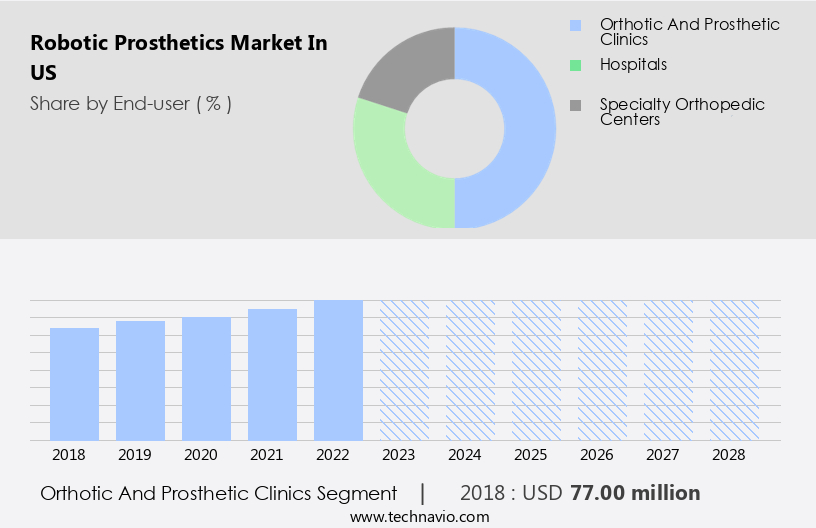
The orthotic and prosthetic clinics segment is estimated to witness significant growth during the forecast period.

In the realm of orthotic and prosthetic solutions, advanced technologies are revolutionizing the industry to enhance functionality and patient comfort. Biocompatible coatings ensure the durability and longevity of prosthetics, while haptic feedback systems provide a more natural sensation for users. Prosthetic power sources have evolved to include lightweight, rechargeable batteries, and bio-integrated sensors enable real-time monitoring of patient movement and vital signs. Myoelectric signal processing and pattern recognition software facilitate intuitive control, and gait analysis algorithms optimize walking patterns. Actuator control systems enable precise joint articulation, and wearable sensor networks provide continuous data for prosthetic rehabilitation protocols.

Robotic hand dexterity and personalized prosthetic fitting have improved, allowing for greater functionality and comfort. Surgical implantation techniques, such as osseointegration, have advanced to provide more stable and secure attachments. Advanced prosthetic materials, including lightweight alloys and high-strength polymers, have reduced the weight of prosthetics, making them easier to use. Control algorithm optimization and neural interface technology have enabled more natural and intuitive control, while user feedback mechanisms provide real-time adjustments for improved performance. Prosthetic joint articulation has been enhanced through kinematic analysis software and motion capture technology, resulting in more fluid and lifelike movements.

In the realm of upper and lower limb prosthetics, robotic arm design and socket design have advanced to provide greater functionality and comfort, while prosthetic limb alignment and rehabilitation protocols have been optimized to improve patient outcomes.
Robotic Prosthetics Market in US Size

Download Free Sample Report

The Orthotic and prosthetic clinics segment was valued at  USD 77.00 million in 2018 and showed a gradual increase during the forecast period.

Market Dynamics

Our researchers analyzed the data with 2023 as the base year, along with the key drivers, trends, and challenges. A holistic analysis of drivers will help companies refine their marketing strategies to gain a competitive advantage.

What are the US Robotic Prosthetics Market drivers leading to the rise in adoption of the Industry?

  • The market's expansion is primarily fueled by the increasing target population and the focus on enabling mobility and independence for amputees. 
  • The demand for robotic prosthetics in the US is driven by the rising number of individuals requiring artificial limbs due to various reasons. Trauma cases and accidents are significant contributors, as well as the increasing prevalence of diabetes and congenital diseases. Each year, approximately 1,500 babies are born with upper limb reductions, and 750 babies are born with lower limb reductions in the US. This equates to four out of 10,000 babies born with upper limb reductions and two out of 10,000 babies born with lower limb reductions.
  • The advancement of technology has led to the development of kinematic analysis software, enabling more precise and personalized prosthetic solutions. 

What are the US Robotic Prosthetics Market trends shaping the Industry?

  • The trend in the market is characterized by an escalating number of technological advances and Research and Development activities. This upward trajectory in innovation is a mandatory and significant aspect of modern business dynamics.
  • Robotic prosthetics have advanced significantly, offering amputees improved mobility and reduced risk of falls. Powered prostheses, driven by innovations such as lithium-ion batteries, brushless electric motors with rare earth magnets, miniaturized sensors integrated into semiconductor chips, and low-power computer chips, replicate natural limb movements. These technological advancements are the result of extensive research and development efforts. Biocompatible coatings ensure a harmonious interaction between the prosthetic and the body, while haptic feedback systems provide a sense of touch. Prosthetic power sources and bio-integrated sensors, along with myoelectric signal processing, contribute to the overall functionality and durability of these devices.
  • Prosthetic durability testing and socket design, with a focus on weight distribution, further enhance the user experience. These advancements continue to transform the lives of amputees, enabling them to navigate various terrains with greater ease and confidence.

How does US Robotic Prosthetics Market face challenges during its growth?

  • The high cost of prosthetics poses a significant challenge to the growth of the prosthetics industry. This issue, which is a major concern for both manufacturers and patients, limits the accessibility and affordability of advanced prosthetic technologies. 
  • Robotic prosthetics offer advanced functionality and improved user experience compared to conventional prosthetics, yet their higher cost is a significant barrier to adoption. The average price of conventional prosthetics ranges from USD 9,500 to USD 11,500, while advanced myoelectric and microprocessor-controlled (MPC) prosthetics can cost between USD 35,000 and USD 55,000. For instance, the Genium X3 knee, a high-end MPC knee developed by Ottobock, retails around USD 120,000. Similarly, the Michelangelo electronic hand costs approximately USD 60,000. These costs, coupled with insufficient reimbursements, hinder the widespread adoption of robotic prosthetics.
  • To address this challenge, ongoing research focuses on enhancing prosthetic rehabilitation protocols, improving actuator control systems, and developing gait analysis algorithms. Additionally, patient comfort features, wearable sensor networks, and upper limb prosthetics with surgical implantation techniques are under investigation to make robotic prosthetics more accessible and affordable.

Exclusive US Robotic Prosthetics Market Customer Landscape

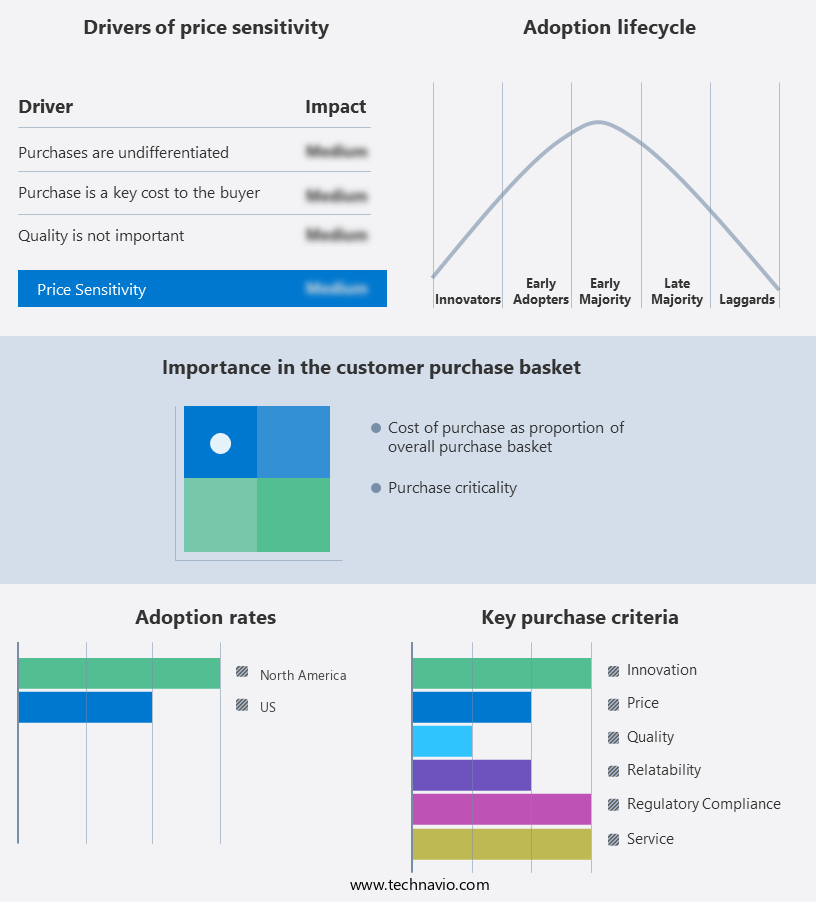
The market forecasting report includes the adoption lifecycle of the market, covering from the innovator's stage to the laggard's stage. It focuses on adoption rates in different regions based on penetration. Furthermore, the report also includes key purchase criteria and drivers of price sensitivity to help companies evaluate and develop their market growth analysis strategies.
Robotic Prosthetics Market in US Share by Geography

 Customer Landscape

Key Companies & Market Insights

Companies are implementing various strategies, such as strategic alliances, market forecast partnerships, mergers and acquisitions, geographical expansion, and product/service launches, to enhance their presence in the market.

The market research and growth report includes detailed analyses of the competitive landscape of the market and information about key companies, including:

  • Aether Biomedical sp. z o.o.
  • Blatchford Ltd.
  • Click Medical LLC
  • DEKA Research and Development Corp.
  • Fillauer LLC
  • Hanger Inc
  • HDT Global
  • Mobius Bionics LLC
  • Ossur hf
  • Ottobock SE and Co. KGaA
  • Steeper Inc.
  • Trulife

Qualitative and quantitative analysis of companies has been conducted to help clients understand the wider business environment as well as the strengths and weaknesses of key market players. Data is qualitatively analyzed to categorize companies as pure play, category-focused, industry-focused, and diversified; it is quantitatively analyzed to categorize companies as dominant, leading, strong, tentative, and weak.

Recent Development and News in Robotic Prosthetics Market In US

  • In January 2024, Boston Scientific Corporation, a leading medical device company, announced the FDA approval of its new REAL Hand Solution robotic prosthetic system. This advanced technology offers improved grip control and dexterity for amputees (Boston Scientific Corporation Press Release, 2024).
  • In March 2024, Medtronic plc and Google's Life Sciences division, Verily, entered into a strategic partnership to develop advanced robotic prosthetic limbs. This collaboration aimed to combine Medtronic's expertise in prosthetics with Verily's knowledge in sensor technology and data analytics (Medtronic Press Release, 2024).
  • In April 2025, Ossur, a leading provider of prosthetic solutions, raised USD100 million in a Series C funding round. This investment will be used to expand its research and development capabilities, particularly in robotic prosthetics (BusinessWire, 2025).
  • In May 2025, the Food and Drug Administration (FDA) granted clearance to Hanger, Inc. For its new myoelectric prosthetic system, the Touch Bionics i-Limb Quantum Revolution. This advanced robotic prosthetic hand offers increased functionality and customization for amputees (Hanger, Inc. Press Release, 2025).

Research Analyst Overview

The robotic prosthetics market in the US continues to evolve, driven by advancements in technology and growing demand for more functional and comfortable solutions. Prosthetic rehabilitation protocols are being refined through the integration of actuator control systems, gait analysis algorithms, and patient comfort features. Seamless integration of wearable sensor networks and upper limb prosthetics enables improved muscle activation patterns and biomechanical modeling. Surgical implantation techniques, such as osseointegration process and personalized prosthetic fitting, are gaining popularity for their ability to enhance durability and patient satisfaction. Advanced prosthetic materials, like biocompatible coatings and lightweight alloys, are being used to enhance the durability and aesthetics of prosthetic limbs.

Robotic hand dexterity is being enhanced through the use of haptic feedback systems and pattern recognition software. Prosthetic power sources, such as rechargeable batteries and fuel cells, are being optimized for improved efficiency and longevity. The ongoing development of control algorithm optimization, neural interface technology, and prosthetic joint articulation is enabling more natural and intuitive prosthetic limb control. Motion capture technology and kinematic analysis software are being used to improve the alignment and functionality of both upper and lower limb prosthetics. The evolving nature of the market is also reflected in the emergence of new applications across various sectors, including military, healthcare, and sports.

The continuous unfolding of market activities and evolving patterns underscores the importance of staying abreast of the latest developments in robotic prosthetics technology.

Dive into Technavio's robust research methodology, blending expert interviews, extensive data synthesis, and validated models for unparalleled Robotic Prosthetics Market in US insights. See full methodology.

Market Scope

Report Coverage

Details

Page number

116

Base year

2023

Historic period

2018-2022

Forecast period

2024-2028

Growth momentum & CAGR

Accelerate at a CAGR of 8.09%

Market growth 2024-2028

USD 84.2 million

Market structure

Concentrated

YoY growth 2023-2024(%)

7.34

Competitive landscape

Leading Companies, Market Positioning of Companies, Competitive Strategies, and Industry Risks

Request Free Sample

What are the Key Data Covered in this Market Research Report?

  • CAGR of the market during the forecast period
  • Detailed information on factors that will drive the market growth and forecasting between 2024 and 2028
  • Precise estimation of the size of the market  and its contribution of the market in focus to the parent market
  • Accurate predictions about upcoming market growth and trends and changes in consumer behaviour
  • Growth of the market across US
  • Thorough analysis of the market's competitive landscape and detailed information about companies
  • Comprehensive analysis of factors that will challenge the growth of market companies

We can help! Our analysts can customize this market research report to meet your requirements Get in touch

1 Executive Summary

  • 1.1 Market overview
    • Executive Summary - Chart on Market Overview
    • Executive Summary - Data Table on Market Overview
    • Executive Summary - Chart on Country Market Characteristics
    • Executive Summary - Chart on Market Segmentation by End-user
    • Executive Summary - Chart on Market Segmentation by Product
    • Executive Summary - Chart on Company Market Positioning

2 Market Landscape

  • 2.1 Market ecosystem
    • Parent Market
    • Data Table on - Parent Market
  • 2.2 Market characteristics
    • Market characteristics analysis
  • 2.3 Value chain analysis
    • Value Chain Analysis

3 Market Sizing

  • 3.1 Market definition
    • Offerings of companies included in the market definition
  • 3.2 Market segment analysis
    • Market segments
  • 3.3 Market size 2023
    • 3.4 Market outlook: Forecast for 2023-2028
      • Chart on US - Market size and forecast 2023-2028 ($ million)
      • Data Table on US - Market size and forecast 2023-2028 ($ million)
      • Chart on US: Year-over-year growth 2023-2028 (%)
      • Data Table on US: Year-over-year growth 2023-2028 (%)

    4 Historic Market Size

    • 4.1 Robotic Prosthetics Market in US 2018 - 2022
      • Historic Market Size - Data Table on Robotic Prosthetics Market in US 2018 - 2022 ($ million)
    • 4.2 End-user segment analysis 2018 - 2022
      • Historic Market Size - End-user Segment 2018 - 2022 ($ million)
    • 4.3 Product segment analysis 2018 - 2022
      • Historic Market Size - Product Segment 2018 - 2022 ($ million)

    5 Five Forces Analysis

    • 5.1 Five forces summary
      • Five forces analysis - Comparison between 2023 and 2028
    • 5.2 Bargaining power of buyers
      • Bargaining power of buyers - Impact of key factors 2023 and 2028
    • 5.3 Bargaining power of suppliers
      • Bargaining power of suppliers - Impact of key factors in 2023 and 2028
    • 5.4 Threat of new entrants
      • Threat of new entrants - Impact of key factors in 2023 and 2028
    • 5.5 Threat of substitutes
      • Threat of substitutes - Impact of key factors in 2023 and 2028
    • 5.6 Threat of rivalry
      • Threat of rivalry - Impact of key factors in 2023 and 2028
    • 5.7 Market condition
      • Chart on Market condition - Five forces 2023 and 2028

    6 Market Segmentation by End-user

    • 6.1 Market segments
      • Chart on End-user - Market share 2023-2028 (%)
      • Data Table on End-user - Market share 2023-2028 (%)
    • 6.2 Comparison by End-user
      • Chart on Comparison by End-user
      • Data Table on Comparison by End-user
    • 6.3 Orthotic and prosthetic clinics - Market size and forecast 2023-2028
      • Chart on Orthotic and prosthetic clinics - Market size and forecast 2023-2028 ($ million)
      • Data Table on Orthotic and prosthetic clinics - Market size and forecast 2023-2028 ($ million)
      • Chart on Orthotic and prosthetic clinics - Year-over-year growth 2023-2028 (%)
      • Data Table on Orthotic and prosthetic clinics - Year-over-year growth 2023-2028 (%)
    • 6.4 Hospitals - Market size and forecast 2023-2028
      • Chart on Hospitals - Market size and forecast 2023-2028 ($ million)
      • Data Table on Hospitals - Market size and forecast 2023-2028 ($ million)
      • Chart on Hospitals - Year-over-year growth 2023-2028 (%)
      • Data Table on Hospitals - Year-over-year growth 2023-2028 (%)
    • 6.5 Specialty orthopedic centers - Market size and forecast 2023-2028
      • Chart on Specialty orthopedic centers - Market size and forecast 2023-2028 ($ million)
      • Data Table on Specialty orthopedic centers - Market size and forecast 2023-2028 ($ million)
      • Chart on Specialty orthopedic centers - Year-over-year growth 2023-2028 (%)
      • Data Table on Specialty orthopedic centers - Year-over-year growth 2023-2028 (%)
    • 6.6 Market opportunity by End-user
      • Market opportunity by End-user ($ million)
      • Data Table on Market opportunity by End-user ($ million)

    7 Market Segmentation by Product

    • 7.1 Market segments
      • Chart on Product - Market share 2023-2028 (%)
      • Data Table on Product - Market share 2023-2028 (%)
    • 7.2 Comparison by Product
      • Chart on Comparison by Product
      • Data Table on Comparison by Product
    • 7.3 Lower limb robotic prosthetics - Market size and forecast 2023-2028
      • Chart on Lower limb robotic prosthetics - Market size and forecast 2023-2028 ($ million)
      • Data Table on Lower limb robotic prosthetics - Market size and forecast 2023-2028 ($ million)
      • Chart on Lower limb robotic prosthetics - Year-over-year growth 2023-2028 (%)
      • Data Table on Lower limb robotic prosthetics - Year-over-year growth 2023-2028 (%)
    • 7.4 Upper limb robotic prosthetics - Market size and forecast 2023-2028
      • Chart on Upper limb robotic prosthetics - Market size and forecast 2023-2028 ($ million)
      • Data Table on Upper limb robotic prosthetics - Market size and forecast 2023-2028 ($ million)
      • Chart on Upper limb robotic prosthetics - Year-over-year growth 2023-2028 (%)
      • Data Table on Upper limb robotic prosthetics - Year-over-year growth 2023-2028 (%)
    • 7.5 Market opportunity by Product
      • Market opportunity by Product ($ million)
      • Data Table on Market opportunity by Product ($ million)

    8 Customer Landscape

    • 8.1 Customer landscape overview
      • Analysis of price sensitivity, lifecycle, customer purchase basket, adoption rates, and purchase criteria

    9 Drivers, Challenges, and Opportunity/Restraints

    • 9.1 Market drivers
      • 9.2 Market challenges
        • 9.3 Impact of drivers and challenges
          • Impact of drivers and challenges in 2023 and 2028
        • 9.4 Market opportunities/restraints

          10 Competitive Landscape

          • 10.1 Overview
            • 10.2 Competitive Landscape
              • Overview on criticality of inputs and factors of differentiation
            • 10.3 Landscape disruption
              • Overview on factors of disruption
            • 10.4 Industry risks
              • Impact of key risks on business

            11 Competitive Analysis

            • 11.1 Companies profiled
              • Companies covered
            • 11.2 Market positioning of companies
              • Matrix on companies position and classification
            • 11.3 Aether Biomedical sp. z o.o.
              • Aether Biomedical sp. z o.o. - Overview
              • Aether Biomedical sp. z o.o. - Product / Service
              • Aether Biomedical sp. z o.o. - Key offerings
            • 11.4 Blatchford Ltd.
              • Blatchford Ltd. - Overview
              • Blatchford Ltd. - Product / Service
              • Blatchford Ltd. - Key offerings
            • 11.5 Click Medical LLC
              • Click Medical LLC - Overview
              • Click Medical LLC - Product / Service
              • Click Medical LLC - Key offerings
            • 11.6 DEKA Research and Development Corp.
              • DEKA Research and Development Corp. - Overview
              • DEKA Research and Development Corp. - Product / Service
              • DEKA Research and Development Corp. - Key offerings
            • 11.7 Fillauer LLC
              • Fillauer LLC - Overview
              • Fillauer LLC - Product / Service
              • Fillauer LLC - Key offerings
            • 11.8 Hanger Inc
              • Hanger Inc - Overview
              • Hanger Inc - Product / Service
              • Hanger Inc - Key news
              • Hanger Inc - Key offerings
            • 11.9 HDT Global
              • HDT Global - Overview
              • HDT Global - Product / Service
              • HDT Global - Key offerings
            • 11.10 Mobius Bionics LLC
              • Mobius Bionics LLC - Overview
              • Mobius Bionics LLC - Product / Service
              • Mobius Bionics LLC - Key offerings
            • 11.11 Ossur hf
              • Ossur hf - Overview
              • Ossur hf - Business segments
              • Ossur hf - Key offerings
              • Ossur hf - Segment focus
            • 11.12 Ottobock SE and Co. KGaA
              • Ottobock SE and Co. KGaA - Overview
              • Ottobock SE and Co. KGaA - Product / Service
              • Ottobock SE and Co. KGaA - Key offerings
            • 11.13 Steeper Inc.
              • Steeper Inc. - Overview
              • Steeper Inc. - Product / Service
              • Steeper Inc. - Key offerings
            • 11.14 Trulife
              • Trulife - Overview
              • Trulife - Product / Service
              • Trulife - Key offerings

            12 Appendix

            • 12.1 Scope of the report
              • 12.2 Inclusions and exclusions checklist
                • Inclusions checklist
                • Exclusions checklist
              • 12.3 Currency conversion rates for US$
                • Currency conversion rates for US$
              • 12.4 Research methodology
                • Research methodology
              • 12.5 Data procurement
                • Information sources
              • 12.6 Data validation
                • Data validation
              • 12.7 Validation techniques employed for market sizing
                • Validation techniques employed for market sizing
              • 12.8 Data synthesis
                • Data synthesis
              • 360 degree market analysis
                • 360 degree market analysis
              • 12.10 List of abbreviations
                • List of abbreviations

              Research Methodology

              Technavio presents a detailed picture of the market by way of study, synthesis, and summation of data from multiple sources. The analysts have presented the various facets of the market with a particular focus on identifying the key industry influencers. The data thus presented is comprehensive, reliable, and the result of extensive research, both primary and secondary.

              INFORMATION SOURCES

              Primary sources

              • Manufacturers and suppliers
              • Channel partners
              • Industry experts
              • Strategic decision makers

              Secondary sources

              • Industry journals and periodicals
              • Government data
              • Financial reports of key industry players
              • Historical data
              • Press releases

              DATA ANALYSIS

              Data Synthesis

              • Collation of data
              • Estimation of key figures
              • Analysis of derived insights

              Data Validation

              • Triangulation with data models
              • Reference against proprietary databases
              • Corroboration with industry experts

              REPORT WRITING

              Qualitative

              • Market drivers
              • Market challenges
              • Market trends
              • Five forces analysis

              Quantitative

              • Market size and forecast
              • Market segmentation
              • Geographical insights
              • Competitive landscape

              Interested in this report?

              Get your sample now to see our research methodology and insights!

              Download Now

              Frequently Asked Questions

              Robotic Prostheticsin US market growth will increase by $ 84.2 mn during 2024-2028 .

              The Robotic Prostheticsin US market is expected to grow at a CAGR of 8.09% during 2024-2028 .

              Robotic Prostheticsin US market is segmented by End-user( Orthotic and prosthetic clinics, Hospitals, Specialty orthopedic centers) Product( Lower limb robotic prosthetics, Upper limb robotic prosthetics)

              Aether Biomedical sp. z o.o., Blatchford Ltd., Click Medical LLC, DEKA Research and Development Corp., Fillauer LLC, Hanger Inc, HDT Global, Mobius Bionics LLC, Ossur hf, Ottobock SE and Co. KGaA, Steeper Inc., Trulife are a few of the key vendors in the Robotic Prostheticsin US market.

              North America will register the highest growth rate of 100% among the other regions. Therefore, the Robotic Prostheticsin US market in North America is expected to garner significant business opportunities for the vendors during the forecast period.

              US

              • Growing target population and focus on restoring mobility and independence of amputeesThe number of people who require artificial limbs is increasing significantly in the US. This is due to the increasing number of trauma cases and accidents and the growing prevalence of diabetes and congenital diseases. People lose body parts is the driving factor this market.
              • such as upper or lower limbs is the driving factor this market.
              • due to accidents is the driving factor this market.
              • trauma is the driving factor this market.
              • or chronic diabetes. According to the CDC is the driving factor this market.
              • in the US is the driving factor this market.
              • each year is the driving factor this market.
              • about 1 is the driving factor this market.
              • 500 babies are born with upper limb reductions is the driving factor this market.
              • and about 750 babies are born with lower limb reductions. Each year is the driving factor this market.
              • about four out of 10 is the driving factor this market.
              • 000 babies have upper limb reductions is the driving factor this market.
              • and about two out of 10 is the driving factor this market.
              • 000 babies have lower limb reductions. Some babies have both upper and lower limb reductions. The number of amputation surgeries is increasing. This is due to the growth of the geriatric population and the increasing prevalence of diabetes is the driving factor this market.
              • cardiovascular diseases (CVDs) is the driving factor this market.
              • and obesity. In the US is the driving factor this market.
              • around 0.65% of people have lost their limbs is the driving factor this market.
              • out of which vascular diseases is the driving factor this market.
              • including diabetes and peripheral arterial disease (PAD) is the driving factor this market.
              • were the major reasons for limb loss is the driving factor this market.
              • followed by trauma and cancer. The number of sports injuries is also increasing. According to the CDC is the driving factor this market.
              • around 3.2 million people have sports and recreation injuries each year. Hence is the driving factor this market.
              • the growing target population and focus on restoring the mobility and independence of amputees will drive the growth of the robotic prosthetics market in US during the forecast period. is the driving factor this market.

              The Robotic Prostheticsin US market vendors should focus on grabbing business opportunities from the Orthotic and prosthetic clinics segment as it accounted for the largest market share in the base year.
