


Single-ply Membranes Market Size 2026-2030
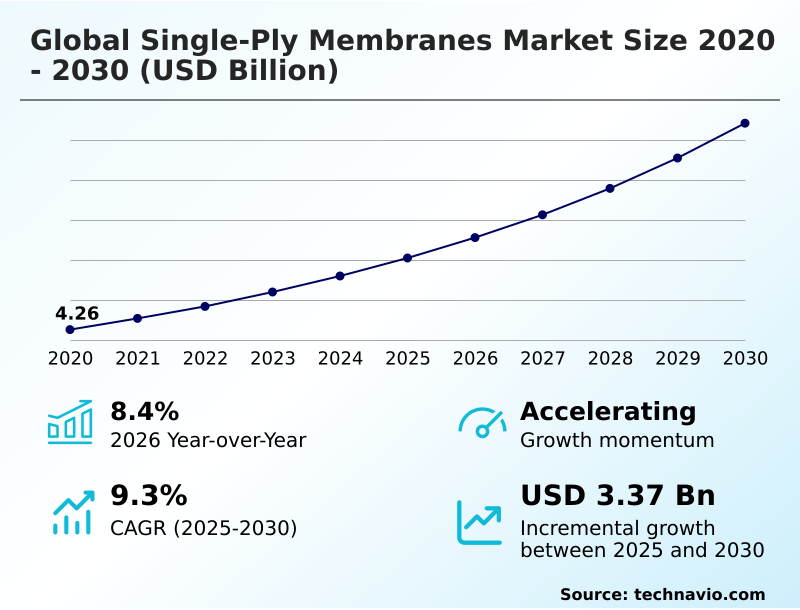
The Single-ply Membranes Market size was valued at USD 6.05 billion in 2025, growing at a CAGR of 9.3% during the forecast period 2026-2030.
Major Market Trends & Insights
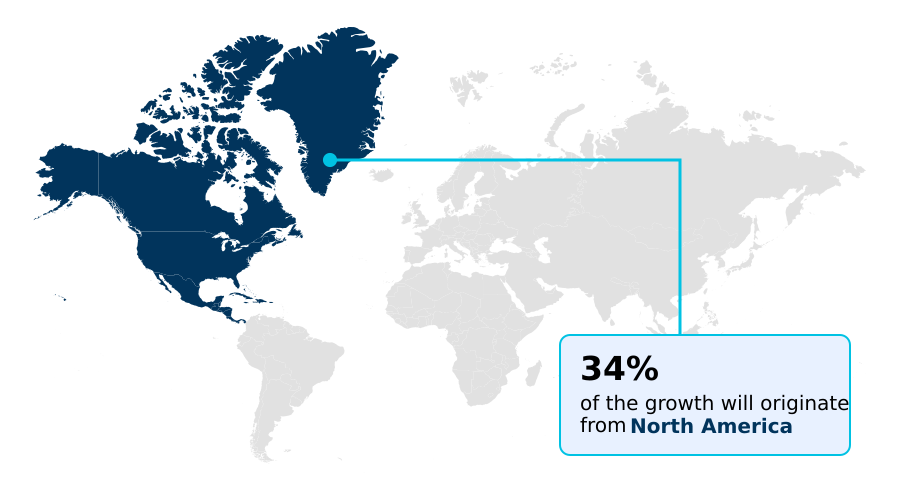
- North America dominated the market and accounted for a 34.4% growth during the forecast period.
- By Type - Thermoplastic membrane segment was valued at USD 3.73 billion in 2024
- By End-user - Residential segment accounted for the largest market revenue share in 2024
Market Size & Forecast
- Historic Market Opportunities 2020-2024: USD 5.15 billion
- Market Future Opportunities 2025-2030: USD 3.37 billion
- CAGR from 2025 to 2030 : 9.3%
Market Summary
- The single-ply membranes market is characterized by consistent expansion, with thermoplastic membranes capturing market share from thermoset alternatives at a ratio of nearly 2:1 in new commercial projects. A typical business scenario involves a large-scale logistics operator selecting a white thermoplastic polyolefin roof to reduce warehouse cooling costs by up to 15% annually, leveraging its high solar reflectance.
- The primary market driver is the enforcement of stringent building energy codes, which mandate high-performance building envelope protection to achieve sustainability targets. However, this growth is constrained by a significant challenge: a persistent shortage of certified installers.
- This lack of skilled labor can lead to improper installation, which compromises waterproofing integrity and diminishes the long-term performance benefits of these advanced roofing systems, increasing lifecycle costs and potential for structural damage.
What will be the Size of the Single-ply Membranes Market during the forecast period?
Get Key Insights on Market Forecast (PDF) Request Free Sample
How is the Single-ply Membranes Market Segmented?
The single-ply membranes industry research report provides comprehensive data (region-wise segment analysis), with forecasts and analysis for the period 2026-2030, as well as historical data from 2020-2024 for the following segments.
- Type
- Thermoplastic membrane
- Thermoset membrane
- End-user
- Residential
- Commercial
- Industrial
- Application
- Roofing
- Waterproofing
- Landscape
- Building envelopes
- Geography
- North America
- US
- Canada
- Mexico
- Europe
- UK
- Germany
- France
- APAC
- China
- India
- Japan
- South America
- Brazil
- Argentina
- Middle East and Africa
- UAE
- Saudi Arabia
- South Africa
- Rest of World (ROW)
- North America
How is the Single-ply Membranes Market Segmented by Type?
The thermoplastic membrane segment is estimated to witness significant growth during the forecast period.
The thermoplastic membrane segment, constituting over 65% of market applications, is defined by materials like thermoplastic polyolefin and polyvinyl chloride roofing.
These products offer a 15% higher solar reflectance index on average compared to many thermoset alternatives, a key factor in their selection for low-slope roofing systems.
The use of heat-welded seams creates a seamless, durable barrier, enhancing waterproofing integrity and long-term performance.
This technology, combined with a high thermal emittance value, is crucial for projects seeking green building certification, as it directly contributes to reduced energy consumption for cooling.
The adaptability to both mechanical fastening systems and adhesive bonding techniques further solidifies its dominance in modern construction.
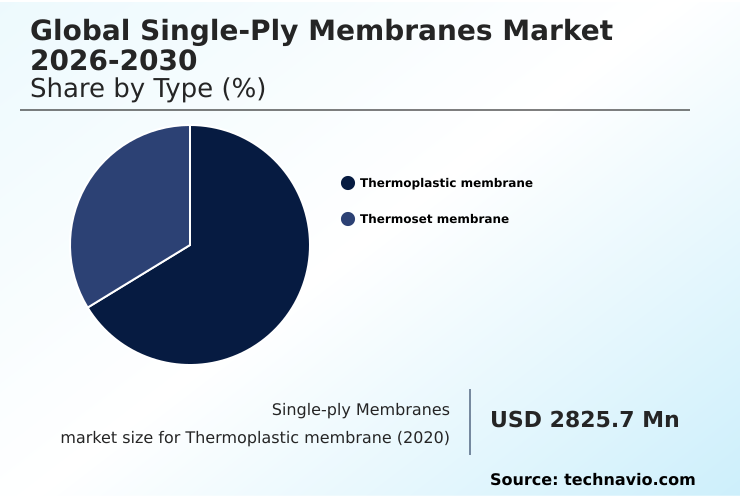
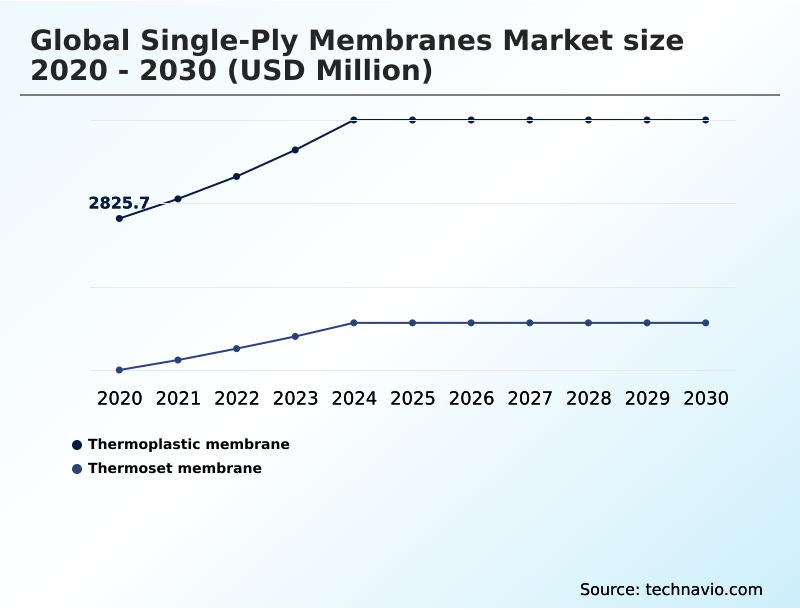
The Thermoplastic membrane segment was valued at USD 3.73 billion in 2024 and showed a gradual increase during the forecast period.
How demand for the Single-ply Membranes market is rising in the leading region?
North America is estimated to contribute 34.4% to the growth of the global market during the forecast period.Technavio’s analysts have elaborately explained the regional trends and drivers that shape the market during the forecast period.
See How Single-ply Membranes Market demand is rising in North America Request Free Sample
The geographic distribution of the single-ply membranes market reveals distinct regional dynamics, with North America accounting for over 34% of global demand, while APAC is projected to be the fastest-growing region with a 10.1% growth rate.
North America's mature market is driven by building retrofit projects and stringent energy efficiency codes, particularly in the US, which represents more than 85% of the region's sales.
In contrast, APAC's expansion is fueled by new construction standards for industrial facility roofing and commercial roofing applications in rapidly urbanizing economies like China and India.
This divergence influences supply chain strategies; North American operations prioritize lifecycle cost analysis and weather resilience, while APAC focuses on scaling production to meet high-volume demand for new builds, reflecting different stages of market development and climate change adaptation priorities.
What are the key Drivers, Trends, and Challenges in the Single-ply Membranes Market?
Our researchers analyzed the data with 2025 as the base year, along with the key drivers, trends, and challenges. A holistic analysis of drivers will help companies refine their marketing strategies to gain a competitive advantage.
- Selecting the optimal roofing system requires careful evaluation of material performance and long-term value, making the tpo vs pvc roofing cost comparison a critical starting point for many projects. While TPO often presents a lower initial investment, PVC's inherent chemical resistance may offer superior lifecycle returns in specific industrial environments.
- The epdm roofing membrane life expectancy, often exceeding 30 years with proper maintenance, makes it a benchmark for durability in the thermoset category, representing a 25% longer typical service life than some alternative flat roof coverings.
- For building owners planning for future upgrades, identifying the best single-ply membrane for solar panels is essential; lightweight, highly reflective membranes that can withstand constant foot traffic and additional loads are preferred. Proper execution is paramount, and detailed single-ply membrane installation details, including seam welding techniques and fastener patterns, determine the ultimate success of the roof.
- When considering a waterproofing membrane for concrete roof structures, flexibility and adhesion are key performance indicators. Ultimately, the benefits of reflective roofing membranes, which can reduce peak cooling energy demand by up to 15%, provide a compelling financial and environmental incentive that influences decisions across all material types and applications.
What are the key market drivers leading to the rise in the adoption of Single-ply Membranes Industry?
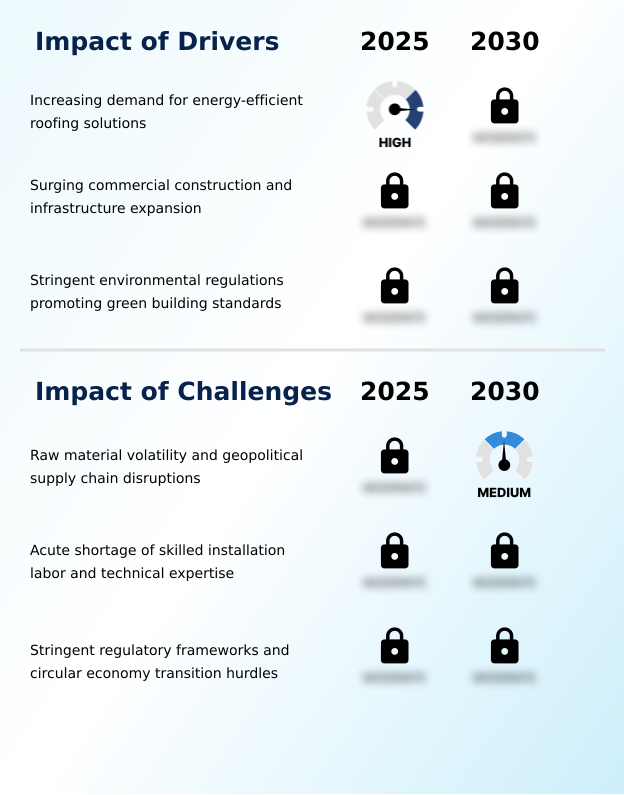
- The increasing demand for energy-efficient roofing solutions is a key driver for market growth, spurred by rising energy costs and stringent building regulations.
- Increasingly stringent energy efficiency codes are a primary driver for the single-ply membranes market, compelling builders to adopt high-performance building envelope protection.
- Many municipal regulations now mandate a minimum solar reflectance index of 78 for new low-slope commercial roofs, a standard that materials like TPO and PVC readily meet.
- This focus on sustainable building materials is a direct result of government and corporate initiatives aimed at achieving net-zero building design, which can reduce a structure's cooling costs by 10-15% annually.
- The ability of these membranes to seamlessly support solar panel integration further enhances their value proposition, making them integral to obtaining green building certification and meeting modern construction standards.
What are the market trends shaping the Single-ply Membranes Industry?
- A push for energy-efficient commercial structures is an influential market trend, driving the adoption of advanced roofing materials that improve thermal performance and reduce operational costs.
- A primary trend in the single-ply membranes market is the accelerating shift toward prefabricated roofing systems, a direct response to persistent skilled labor shortages and the demand for accelerated installation times. This method, which involves factory-controlled assembly, can reduce on-site labor requirements by up to 40% compared to traditional built-up roofing, ensuring higher quality control and less material waste.
- This trend aligns with the growing adoption of cool roof technology, particularly in dense urban areas, to mitigate the urban heat island effect. Highly reflective, lightweight roofing solutions can lower rooftop surface temperatures by over 50 degrees Fahrenheit, significantly reducing a building’s energy consumption for air conditioning and supporting sustainability goals.
What challenges does the Single-ply Membranes Industry face during its growth?
- Raw material price volatility, coupled with geopolitical supply chain disruptions, presents a key challenge to the industry's growth and profitability.
- Persistent raw material price volatility remains a significant challenge, with fluctuations in petrochemical feedstocks causing polymer costs to swing by over 20% in a single quarter. This instability directly impacts project profitability, making it difficult for contractors to provide fixed-price bids and potentially increasing final costs by 5-8% if not properly managed.
- This supply chain disruption forces manufacturers to focus on improving puncture resistance ratings and chemical exposure resistance to justify premium pricing. The challenge is compounded by the ongoing skilled labor shortage, where a lack of trained professionals can lead to improper installation, undermining the material's lifecycle cost analysis and long-term value proposition for building owners.
Exclusive Technavio Analysis on Customer Landscape
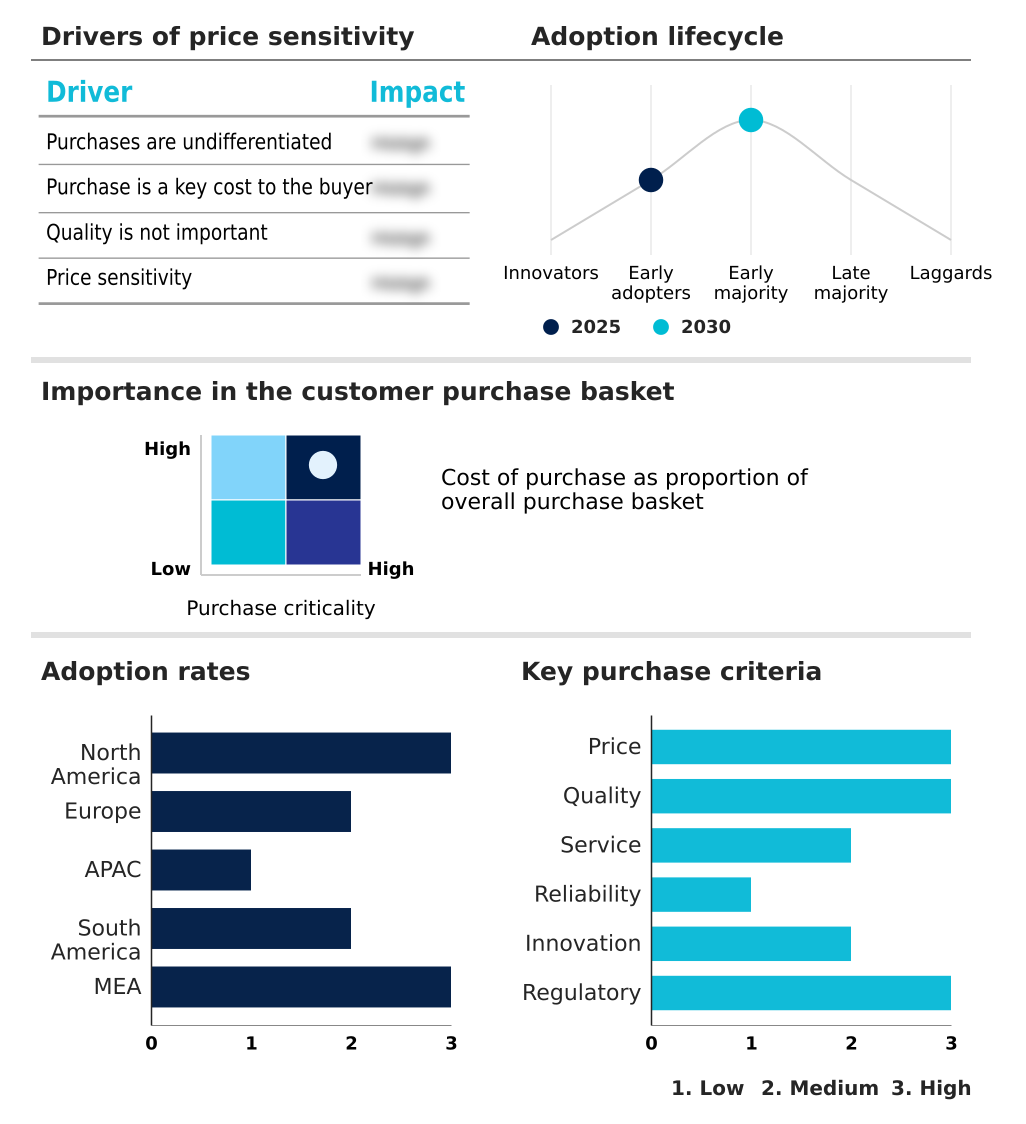
The single-ply membranes market forecasting report includes the adoption lifecycle of the market, covering from the innovator’s stage to the laggard’s stage. It focuses on adoption rates in different regions based on penetration. Furthermore, the single-ply membranes market report also includes key purchase criteria and drivers of price sensitivity to help companies evaluate and develop their market growth analysis strategies.
Customer Landscape of Single-ply Membranes Industry
Competitive Landscape
Companies are implementing various strategies, such as strategic alliances, single-ply membranes market forecast, partnerships, mergers and acquisitions, geographical expansion, and product/service launches, to enhance their presence in the industry.
Axter Ltd. - Analyst research indicates a focus on high-performance single-ply membranes engineered for durability, weather resistance, and enhanced energy efficiency in commercial roofing systems.
The industry research and growth report includes detailed analyses of the competitive landscape of the market and information about key companies, including:
- Axter Ltd.
- Bailey UK
- Baker Roofing Co.
- BMI Group Holdings UK Ltd.
- Carlisle SynTec Systems
- Carney Roofing Co.
- Dow Chemical Co.
- Duro Last Inc.
- Eagle Insulations Ltd
- Fatra UK Ltd.
- Flex Membrane International
- GAF Materials LLC
- Godfrey Roofing Inc.
- Holcim Elevate
- IKO Industries Ltd.
- Johns Manville Corp.
- Kingspan Group
- Owens Corning
- Sika AG
- Siplast
Qualitative and quantitative analysis of companies has been conducted to help clients understand the wider business environment as well as the strengths and weaknesses of key industry players. Data is qualitatively analyzed to categorize companies as pure play, category-focused, industry-focused, and diversified; it is quantitatively analyzed to categorize companies as dominant, leading, strong, tentative, and weak.
Market Intelligence Radar: High-Impact Developments & Growth Signals
- In the Building Products industry, tightening energy efficiency codes for new constructions, which can mandate up to a 15% improvement in thermal performance, directly increase demand for high-performance TPO and PVC single-ply membranes that offer a high solar reflectance index.
- A persistent skilled labor shortage has accelerated the adoption of prefabricated roofing systems and mechanically fastened single-ply membranes, which can reduce on-site installation time by up to 30% compared to traditional multi-ply systems, impacting project timelines and costs.
- A growing emphasis on circular economy principles is prompting manufacturers of single-ply membranes to develop products with higher recycled content and establish end-of-life recycling programs, influencing material selection for sustainable building material goals.
- Significant volatility in the price of petrochemical feedstocks, which can fluctuate by over 20% in a single quarter, directly impacts the production costs and pricing strategies for thermoplastic single-ply membranes, creating challenges for supply chain stability and long-term project bidding.
Dive into Technavio’s robust research methodology, blending expert interviews, extensive data synthesis, and validated models for unparalleled Single-ply Membranes Market insights. See full methodology.
| Market Scope | |
|---|---|
| Page number | 289 |
| Base year | 2025 |
| Historic period | 2020-2024 |
| Forecast period | 2026-2030 |
| Growth momentum & CAGR | Accelerate at a CAGR of 9.3% |
| Market growth 2026-2030 | USD 3369.5 million |
| Market structure | Fragmented |
| YoY growth 2025-2026(%) | 8.4% |
| Key countries | US, Canada, Mexico, UK, Germany, France, Italy, Spain, The Netherlands, China, India, Japan, South Korea, Australia, Indonesia, Brazil, Argentina, Chile, UAE, Saudi Arabia, Qatar, South Africa and Egypt |
| Competitive landscape | Leading Companies, Market Positioning of Companies, Competitive Strategies, and Industry Risks |
Research Analyst Overview
- The single-ply membranes market ecosystem functions through a series of interconnected relationships, beginning with suppliers of petrochemical-based raw materials who provide polymers to manufacturers. These manufacturers, who capture approximately 40% of the value chain's cost structure, innovate in advanced polymer chemistry to produce membranes with specific performance attributes.
- Their products are then sold through distribution channels to roofing contractors, who must adhere to installation standards often governed by regulatory compliance frameworks. End-users, primarily commercial and industrial building owners, drive demand based on factors like energy efficiency and lifecycle cost analysis.
- The successful adoption of these systems, which can improve a building's thermal performance by over 20%, depends on the coordinated efforts of all stakeholders, from material science R&D to the skilled labor performing the final installation.
What are the Key Data Covered in this Single-ply Membranes Market Research and Growth Report?
-
What is the expected growth of the Single-ply Membranes Market between 2026 and 2030?
-
The Single-ply Membranes Market is expected to grow by USD 3.37 billion during 2026-2030, registering a CAGR of 9.3%. Year-over-year growth in 2026 is estimated at 8.4%%. This acceleration is shaped by increasing demand for energy-efficient roofing solutions, which is intensifying demand across multiple end-use verticals covered in the report.
-
-
What segmentation does the market report cover?
-
The report is segmented by Type (Thermoplastic membrane, and Thermoset membrane), End-user (Residential, Commercial, and Industrial), Application (Roofing, Waterproofing, Landscape, and Building envelopes) and Geography (North America, Europe, APAC, South America, Middle East and Africa). Among these, the Thermoplastic membrane segment is estimated to witness significant growth during the forecast period, driven by rising adoption across key application areas. Each segment includes detailed qualitative and quantitative analysis, along with historical data from 2020-2024 and forecasts through 2030 with year-over-year growth rates.
-
-
Which regions are analyzed in the report?
-
The report covers North America, Europe, APAC, South America and Middle East and Africa. North America is estimated to contribute 34.4% to market growth during the forecast period. Country-level analysis includes US, Canada, Mexico, UK, Germany, France, Italy, Spain, The Netherlands, China, India, Japan, South Korea, Australia, Indonesia, Brazil, Argentina, Chile, UAE, Saudi Arabia, Qatar, South Africa and Egypt, with dedicated market size tables and year-over-year growth for each.
-
-
What are the key growth drivers and market challenges?
-
The primary driver is increasing demand for energy-efficient roofing solutions, which is accelerating investment and industry demand. The main challenge is raw material volatility and geopolitical supply chain disruptions, creating operational barriers for key market participants. The report quantifies the impact of each driver and challenge across 2026 and 2030 with comparative analysis.
-
-
Who are the major players in the Single-ply Membranes Market?
-
Key vendors include Axter Ltd., Bailey UK, Baker Roofing Co., BMI Group Holdings UK Ltd., Carlisle SynTec Systems, Carney Roofing Co., Dow Chemical Co., Duro Last Inc., Eagle Insulations Ltd, Fatra UK Ltd., Flex Membrane International, GAF Materials LLC, Godfrey Roofing Inc., Holcim Elevate, IKO Industries Ltd., Johns Manville Corp., Kingspan Group, Owens Corning, Sika AG and Siplast. The report provides qualitative and quantitative analysis categorizing companies as dominant, leading, strong, tentative, and weak based on their market positioning. Company profiles include business segment analysis, SWOT assessment, key offerings, and recent strategic developments.
-
Market Research Insights
- The competitive landscape for single-ply membranes is densely populated, with over 20 major vendors driving innovation and vying for market share. Key players such as Sika AG and Carlisle SynTec Systems are focusing on enhancing material properties and sustainability.
- For instance, recent developments in advanced polymer chemistry have yielded membranes that improve thermal efficiency by up to 15% compared to legacy systems. This innovation directly addresses market demand for materials that contribute to green building certifications like LEED. These companies are actively launching products with improved puncture resistance ratings and fire retardancy ratings.
- However, the entire industry faces the persistent challenge of raw material price volatility. This forces vendors to balance innovation investment with a need to manage fluctuating input costs, which can impact profitability and pricing stability for end-users.
We can help! Our analysts can customize this single-ply membranes market research report to meet your requirements.
 RIA -
RIA - 
