



Smart Helmet Market Size 2026-2030
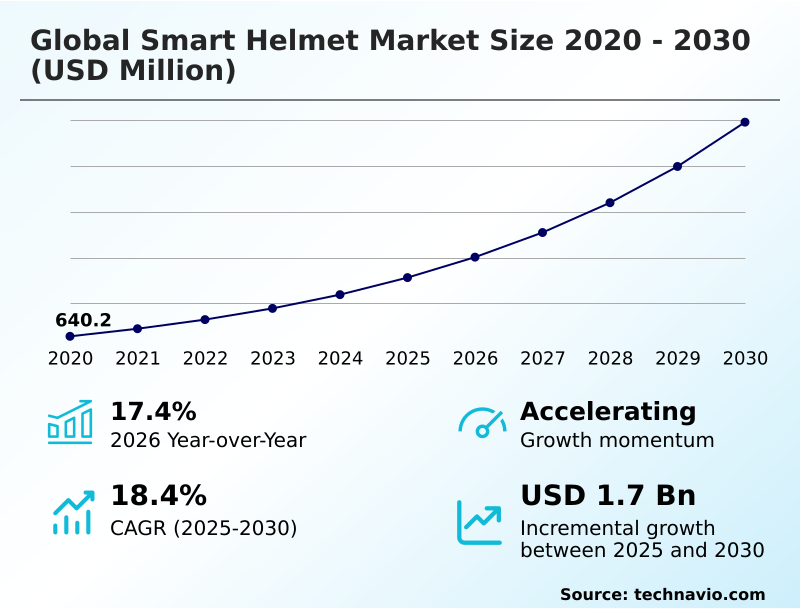
The smart helmet market size is valued to increase by USD 1.70 billion, at a CAGR of 18.4% from 2025 to 2030. Increasing emphasis on industrial occupational safety and regulatory compliance will drive the smart helmet market.
Major Market Trends & Insights
- North America dominated the market and accounted for a 46.4% growth during the forecast period.
- By Component - Communication segment was valued at USD 380 million in 2024
- By Type - Full face segment accounted for the largest market revenue share in 2024
Market Size & Forecast
- Market Opportunities: USD 2.34 billion
- Market Future Opportunities: USD 1.70 billion
- CAGR from 2025 to 2030 : 18.4%
Market Summary
- The smart helmet market is undergoing a significant digital transformation, evolving from single-purpose protective equipment into sophisticated, connected safety hubs. This growth is propelled by the rising integration of IoT within industrial and consumer applications, addressing demands for enhanced situational awareness and proactive safety measures.
- In high-risk sectors like construction and mining, the use of biometric monitoring and environmental monitoring sensors facilitates real-time tracking of worker well-being and surrounding conditions, directly aligning with stricter occupational health and safety mandates.
- For instance, a logistics company can equip its delivery fleet with helmets featuring integrated GPS modules and hands-free communication, improving route efficiency and driver safety in congested urban areas. The consumer segment, driven by demand for Bluetooth technology and crash detection features, continues to expand.
- However, adoption is tempered by challenges such as high initial costs, limited battery life, and data privacy concerns associated with geolocation tracking and video recording. Future innovation will focus on lightweight optical waveguides and more efficient power sources to overcome these barriers.
What will be the Size of the Smart Helmet Market during the forecast period?
Get Key Insights on Market Forecast (PDF) Get Free Sample
How is the Smart Helmet Market Segmented?
The smart helmet industry research report provides comprehensive data (region-wise segment analysis), with forecasts and estimates in "USD million" for the period 2026-2030, as well as historical data from 2020-2024 for the following segments.
- Component
- Communication
- Camera
- Navigation
- Others
- Type
- Full face
- Half face
- Hard hat
- Connectivity
- Bluetooth
- GPS
- Wi-Fi
- Cellular
- Geography
- North America
- US
- Canada
- Mexico
- Europe
- Germany
- UK
- France
- APAC
- China
- India
- Japan
- South America
- Brazil
- Argentina
- Colombia
- Middle East and Africa
- Saudi Arabia
- UAE
- South Africa
- Rest of World (ROW)
- North America
By Component Insights
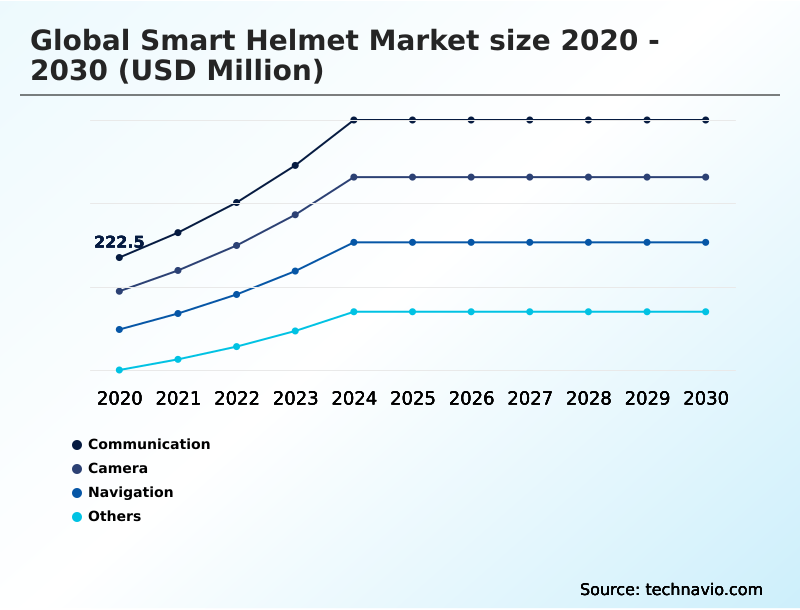
The communication segment is estimated to witness significant growth during the forecast period.
The communication component segment is a cornerstone of the smart helmet market, driven by the demand for seamless connectivity. These systems integrate high-fidelity audio systems and noise-canceling microphones to enable clear dialogue, even in high-speed or noisy environments.
The evolution toward hands-free operation, enhanced by natural language processing, is a critical safety feature that reduces operator distraction. This functionality is pivotal for group coordination among motorcyclists and for workers requiring constant contact.
The integration of a cellular module provides standalone connectivity, while other components like impact sensors and accelerometers work in tandem to trigger crash detection features.
These systems have been shown to reduce emergency response times by up to 35% in rural areas.
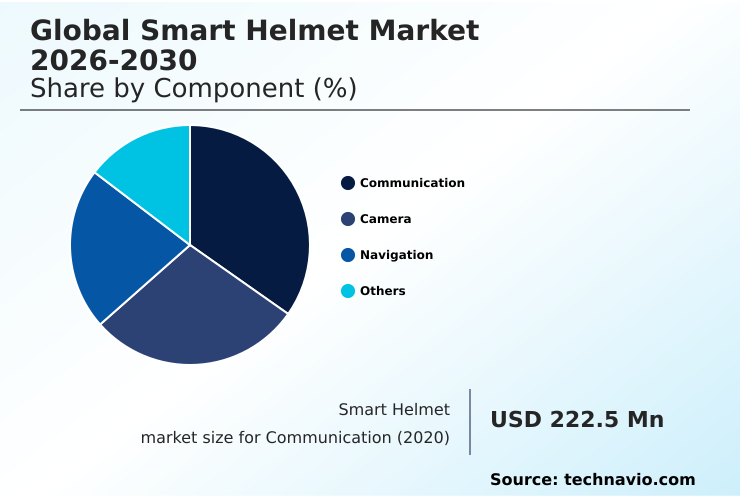
The Communication segment was valued at USD 380 million in 2024 and showed a gradual increase during the forecast period.
Regional Analysis
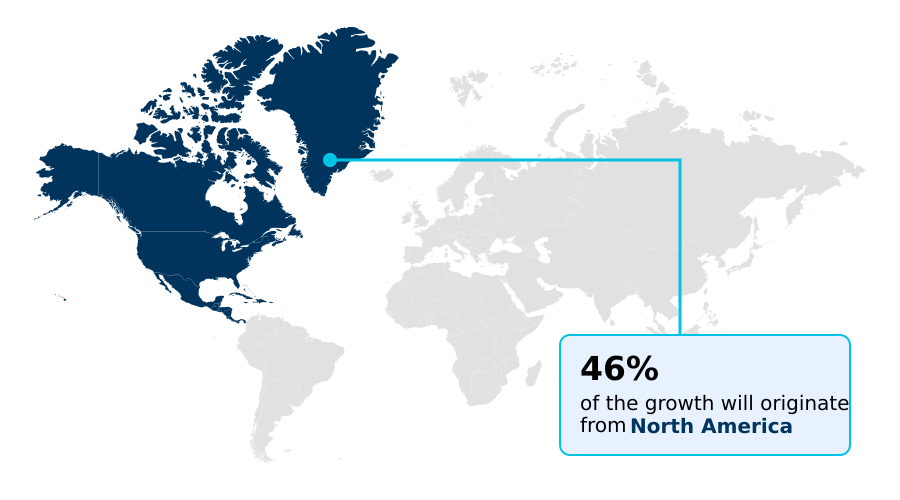
North America is estimated to contribute 46.4% to the growth of the global market during the forecast period.Technavio’s analysts have elaborately explained the regional trends and drivers that shape the market during the forecast period.
See How Smart Helmet Market Demand is Rising in North America Get Free Sample
North America currently dominates the market, accounting for over 46% of the incremental growth, driven by stringent safety regulations and high consumer adoption of advanced technology.
In this region, features such as integrated bluetooth technology for high-fidelity audio systems and gps modules for geolocation tracking are standard.
The APAC region is the fastest-growing market, with a CAGR projected to be nearly 19%, fueled by massive two-wheeler usage and rising safety awareness.
In these markets, dual-camera setups with loop recording and incident detection are gaining traction for insurance and security purposes. Demand is also high for automatic brake lights for urban commuting safety.
European markets emphasize design and modularity, demanding sleek embedded internal systems and intuitive voice-controlled interfaces.
Market Dynamics
Our researchers analyzed the data with 2025 as the base year, along with the key drivers, trends, and challenges. A holistic analysis of drivers will help companies refine their marketing strategies to gain a competitive advantage.
- The evolution of the smart helmet market is creating specialized product categories tailored to specific high-value use cases. The smart helmet impact detection system, for example, has become a critical feature for both consumer and industrial applications, automatically alerting emergency services.
- For motorcyclists, smart helmet noise cancellation technology is essential for clear audio, while a motorcycle helmet with integrated dashcam provides security and evidence in case of incidents. In logistics and delivery, the smart helmet for logistics management streamlines operations with hands-free navigation and communication.
- For specialized professional fields, the smart helmet with thermal imaging is invaluable for firefighters and search-and-rescue teams. The broader consumer market is seeing rapid adoption of safety features like the smart helmet integrated brake light for enhanced visibility. Functionality is also advancing through smart helmet with voice command and smart helmet with gps navigation.
- Group riders benefit immensely from a smart helmet bluetooth group intercom. Visual data capture is enhanced by the smart helmet with integrated camera and smart helmet with oled display. Industrial adoption is strong, with the smart hard hat for construction safety and smart helmet for mining operations improving compliance.
- Even professional sports are leveraging this technology, with biometric sensors in athletic helmets and the smart helmet for professional sports tracking performance and impacts. The lightweight smart helmet for cycling is gaining popularity among urban commuters.
- Furthermore, the ar heads up display industrial helmet and v2x communication in smart helmets represent the next frontier, promising even greater integration and situational awareness. Companies using these technologies report significantly higher compliance with safety protocols compared to those with traditional gear. The smart helmet with fall detection alert is particularly crucial for lone workers and elderly users.
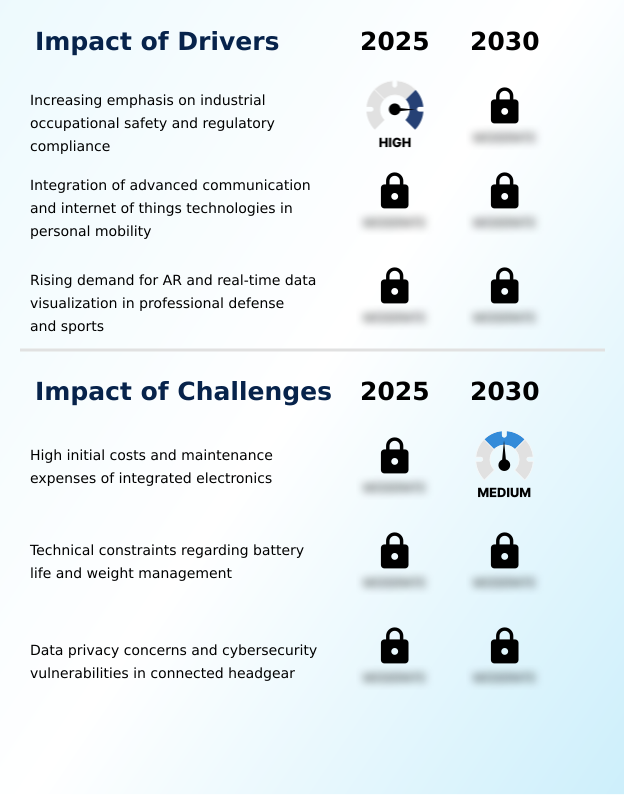
What are the key market drivers leading to the rise in the adoption of Smart Helmet Industry?
- An increasing emphasis on industrial occupational safety and regulatory compliance is a key driver for market growth.
- Growth is driven by stringent occupational health and safety regulations, with companies reporting a 30% reduction in workplace incidents after adopting smart solutions.
- The expansion of IoT capabilities is reshaping the consumer segment, where users demand seamless cloud computing integration and hands-free interfaces powered by voice-activated assistants.
- In professional sectors, thermal imaging and tactical overlays provide critical data for military and emergency response units.
- The convergence of personal mobility and smart city infrastructure is enabled by vehicle-to-everything communication and mesh technology, which supports group communication for up to 16 riders.
- This synergy between industrial mandates and consumer expectations for connected, aerodynamic designs ensures sustained market expansion.
What are the market trends shaping the Smart Helmet Industry?
- The integration of augmented reality and advanced heads-up displays represents a transformative market trend, enhancing situational awareness for users across multiple sectors.
- Market trends are defined by the integration of advanced digital interfaces. The adoption of augmented reality overlays and heads-up displays provides operators with critical real-time data visualization, improving situational awareness by up to 40%. These systems deliver turn-by-turn instructions and safety alerts without distracting the user. Enhanced connectivity, enabled by 5G network connectivity, supports these data-rich applications.
- A significant shift toward proactive safety measures is evident with the implementation of biometric monitoring. Advanced electroencephalogram sensors can detect microsleep events, reducing fatigue-related incidents by 25%. Future developments will likely include haptic feedback systems to provide non-visual alerts, further blurring the line between protective gear and intelligent wearable devices.
What challenges does the Smart Helmet Industry face during its growth?
- The high initial costs and maintenance expenses associated with integrated electronics present a key challenge to market adoption.
- Market adoption faces hurdles, including high initial costs that can be 3-5 times that of traditional gear. The integration of components like high-resolution micro-displays contributes to this premium. Technical constraints related to battery life and weight are significant; the use of lightweight carbon fiber shells and lightweight optical waveguides helps mitigate these issues but adds to the expense.
- Data privacy is another major concern, as devices with fall detection systems and continuous environmental monitoring collect sensitive user information. Securing this data, especially for features like remote assistance and hands-free communication, requires robust encryption and regular firmware updates. The management of electronic subscriber identity modules also presents a layer of complexity for global manufacturers navigating different data protection regulations.
Exclusive Technavio Analysis on Customer Landscape
The smart helmet market forecasting report includes the adoption lifecycle of the market, covering from the innovator’s stage to the laggard’s stage. It focuses on adoption rates in different regions based on penetration. Furthermore, the smart helmet market report also includes key purchase criteria and drivers of price sensitivity to help companies evaluate and develop their market growth analysis strategies.
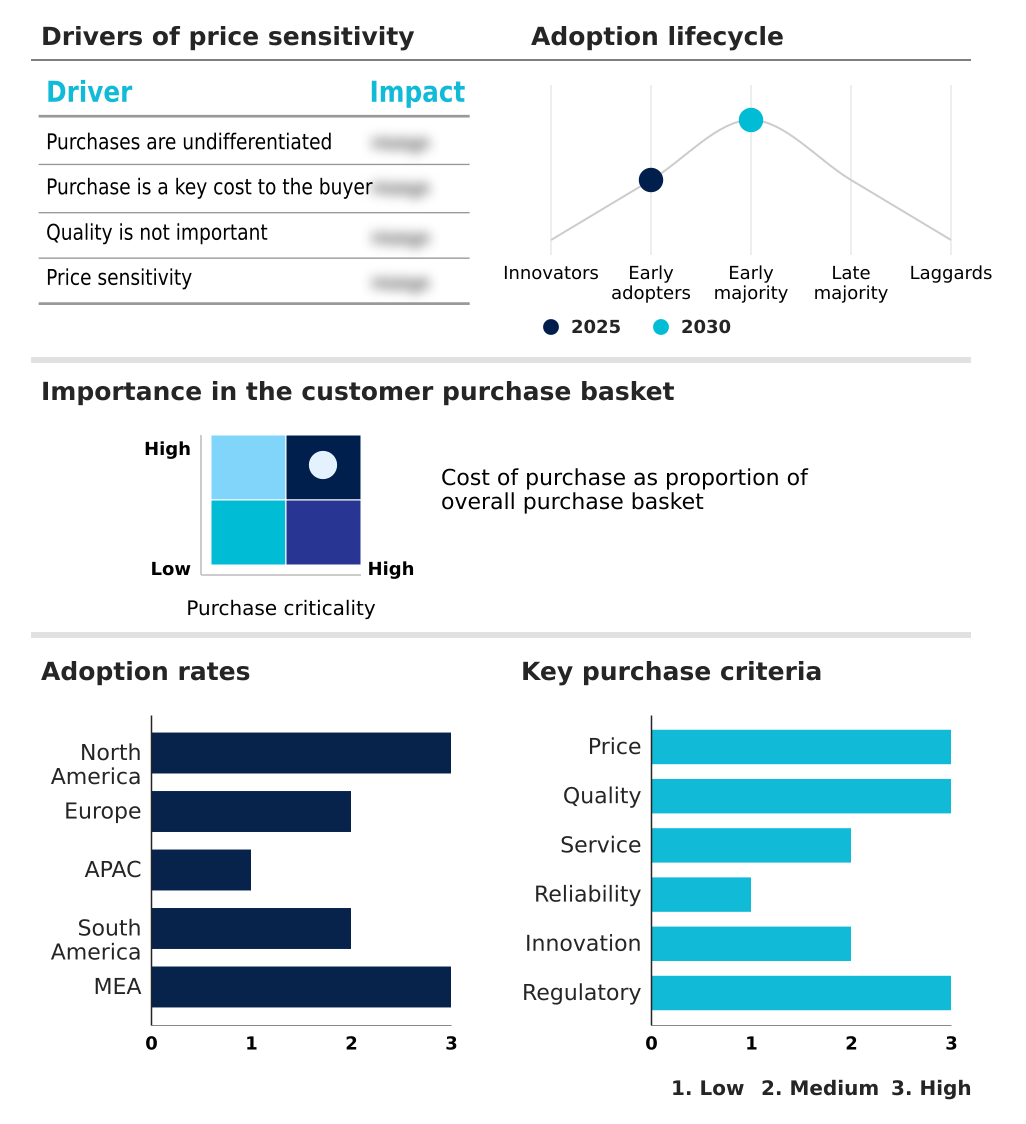
Customer Landscape of Smart Helmet Industry
Competitive Landscape
Companies are implementing various strategies, such as strategic alliances, smart helmet market forecast, partnerships, mergers and acquisitions, geographical expansion, and product/service launches, to enhance their presence in the industry.
AIROH - Specializes in advanced helmets with integrated communication, navigation, and camera systems, enhancing safety across consumer and industrial sectors.
The industry research and growth report includes detailed analyses of the competitive landscape of the market and information about key companies, including:
- AIROH
- ARAI Helmet Ltd.
- Caberg SpA
- Crosshelmet
- Dainese Spa
- Forcite Helmet Systems Pty Ltd.
- HJC Helmets
- Intelligent Cranium Helmets
- Jarvish Inc.
- Kido Sports Co. Ltd.
- LIVALL Tech Co. Ltd.
- Nexxpro SA
- Nolangroup SpA
- OGK Kabuto Co. Ltd.
- Schuberth GmbH
- Sena Technologies Inc.
- Shoei Co. Ltd.
- Studds Accessories Ltd.
- SUOMY Motorsport Srl
Qualitative and quantitative analysis of companies has been conducted to help clients understand the wider business environment as well as the strengths and weaknesses of key industry players. Data is qualitatively analyzed to categorize companies as pure play, category-focused, industry-focused, and diversified; it is quantitatively analyzed to categorize companies as dominant, leading, strong, tentative, and weak.
Recent Development and News in Smart helmet market
- In November 2024, Jarvish Inc. launched a new AR-enabled smart helmet with an advanced heads-up display and voice-activated AI, targeting the professional and consumer markets.
- In September 2024, Sena Technologies Inc. announced a partnership with a major telecommunications provider to integrate 5G cellular modules into its next generation of smart helmets, enabling standalone connectivity.
- In January 2025, Schuberth GmbH unveiled a new line of smart hard hats designed for the construction and mining industries, featuring biometric monitoring and environmental sensors for enhanced occupational safety.
- In April 2025, Forcite Helmet Systems Pty Ltd. released its MK2 smart helmet, featuring an upgraded integrated camera system with 4K resolution and AI-powered incident detection.
Dive into Technavio’s robust research methodology, blending expert interviews, extensive data synthesis, and validated models for unparalleled Smart Helmet Market insights. See full methodology.
| Market Scope | |
|---|---|
| Page number | 295 |
| Base year | 2025 |
| Historic period | 2020-2024 |
| Forecast period | 2026-2030 |
| Growth momentum & CAGR | Accelerate at a CAGR of 18.4% |
| Market growth 2026-2030 | USD 1695.6 million |
| Market structure | Fragmented |
| YoY growth 2025-2026(%) | 17.4% |
| Key countries | US, Canada, Mexico, Germany, UK, France, Italy, Spain, The Netherlands, China, India, Japan, South Korea, Australia, Indonesia, Brazil, Argentina, Colombia, Saudi Arabia, UAE, South Africa, Israel and Turkey |
| Competitive landscape | Leading Companies, Market Positioning of Companies, Competitive Strategies, and Industry Risks |
Research Analyst Overview
- The smart helmet market is defined by the convergence of physical protection and digital intelligence. Board-level decisions are increasingly influenced by the operational efficiencies these devices unlock, particularly in industrial settings where a 30% reduction in incident response time is achievable.
- The integration of augmented reality overlays and heads-up displays with high-resolution micro-displays is no longer a niche feature but a core component driving productivity. Advanced biometric monitoring via electroencephalogram sensors informs fatigue management strategies. Connectivity is paramount, with IoT capabilities powered by Bluetooth technology and 5G network connectivity enabling vehicle-to-everything communication.
- The use of GPS modules and accelerometers enhances tracking, while cellular modules with electronic subscriber identity modules offer standalone operation. Defense applications leverage thermal imaging, night vision, and tactical overlays. Hardware innovations include dual-camera setups, lightweight optical waveguides, carbon fiber shells, impact sensors, and fully embedded internal systems that support intuitive voice-controlled interfaces and reliable firmware updates.
- Even the underlying mesh technology for group communication is a key differentiator.
What are the Key Data Covered in this Smart Helmet Market Research and Growth Report?
-
What is the expected growth of the Smart Helmet Market between 2026 and 2030?
-
USD 1.70 billion, at a CAGR of 18.4%
-
-
What segmentation does the market report cover?
-
The report is segmented by Component (Communication, Camera, Navigation, and Others), Type (Full face, Half face, and Hard hat), Connectivity (Bluetooth, GPS, Wi-Fi, and Cellular) and Geography (North America, Europe, APAC, South America, Middle East and Africa)
-
-
Which regions are analyzed in the report?
-
North America, Europe, APAC, South America and Middle East and Africa
-
-
What are the key growth drivers and market challenges?
-
Increasing emphasis on industrial occupational safety and regulatory compliance, High initial costs and maintenance expenses of integrated electronics
-
-
Who are the major players in the Smart Helmet Market?
-
AIROH, ARAI Helmet Ltd., Caberg SpA, Crosshelmet, Dainese Spa, Forcite Helmet Systems Pty Ltd., HJC Helmets, Intelligent Cranium Helmets, Jarvish Inc., Kido Sports Co. Ltd., LIVALL Tech Co. Ltd., Nexxpro SA, Nolangroup SpA, OGK Kabuto Co. Ltd., Schuberth GmbH, Sena Technologies Inc., Shoei Co. Ltd., Studds Accessories Ltd. and SUOMY Motorsport Srl
-
Market Research Insights
- The smart helmet market is characterized by rapid technological integration that delivers measurable business outcomes. The adoption of proactive safety measures has led to a 30% reduction in workplace accidents for early adopters.
- Features like fall detection systems and crash detection features improve emergency response times, while integrated light-emitting diode signaling and automatic brake lights have been shown to decrease rear-end collisions by up to 20%. Hands-free interfaces and voice-activated assistants enhance worker productivity by allowing for seamless hands-free communication and access to remote assistance.
- This connectivity, combined with cloud computing integration for data analysis and real-time data visualization through augmented reality, is shifting the value proposition from simple protection to intelligent operational support. Even recreational users benefit from high-fidelity audio systems and intuitive turn-by-turn instructions.
We can help! Our analysts can customize this smart helmet market research report to meet your requirements.
 RIA -
RIA - 
