



Smart Pills Drug Delivery Market Size 2024-2028
The smart pills drug delivery market size is forecast to increase by USD 5.45 billion at a CAGR of 20.62% between 2023 and 2028.
- The market is witnessing significant growth due to several key trends. The rising prevalence of chronic diseases is driving market growth as these conditions require continuous monitoring and medication adherence. Patients prefer minimally invasive surgeries and treatments, leading to an increased demand for advanced drug delivery systems. Strict government regulations related to drugs ensure patient safety and boost market growth. However, challenges such as high development costs and complex regulatory approvals may hinder market expansion. Overall, the market is expected to experience robust growth In the coming years due to these trends and the potential benefits offered by smart pills technology.
What will be the Size of the Smart Pills Drug Delivery Market During the Forecast Period?
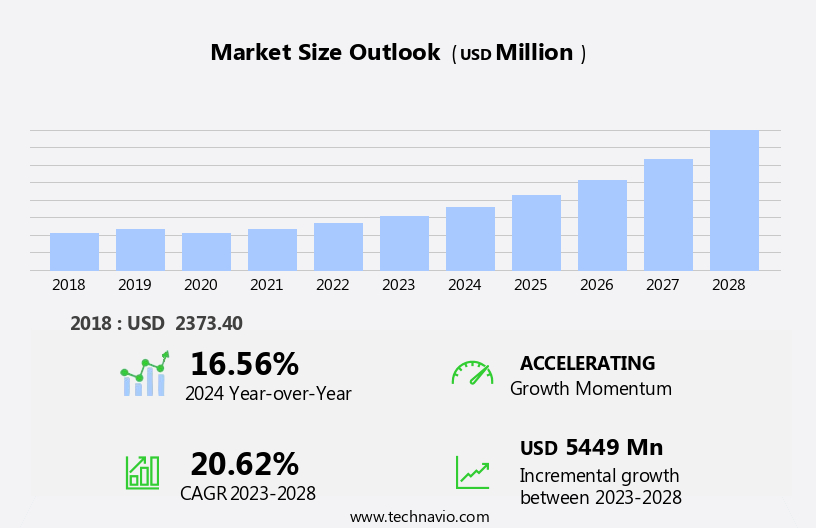
- The market represents a significant evolution in oral therapies, addressing challenges associated with traditional dosage forms such as treatment adherence, bioavailability, and patient compliance. This market encompasses innovative solutions for the delivery of biologics, including proteins and peptides, which face physiological barriers In the gastrointestinal tract due to digestion of food, low permeability, and transit time. Oral drug delivery systems employ various formulation strategies, including buccal cavity and esophageal approaches, to bypass physical barriers and enhance absorption. Macroscale devices, such as swallowable capsules and tablets, are designed with considerations for swallowability, physical characteristics, and transit time to ensure optimal delivery.
- The focus on improving the bioavailability of macromolecules and addressing the unique challenges of oral administration continues to drive growth in this market.
How is this Smart Pills Drug Delivery Industry segmented and which is the largest segment?
The smart pills drug delivery industry research report provides comprehensive data (region-wise segment analysis), with forecasts and estimates in "USD million" for the period 2024-2028, as well as historical data from 2018-2022 for the following segments.
- Application
- Capsule endoscopy
- Drug delivery
- Patient monitoring
- Geography
- North America
- US
- Europe
- Germany
- UK
- France
- Asia
- Japan
- Rest of World (ROW)
- North America
By Application Insights
- The capsule endoscopy segment is estimated to witness significant growth during the forecast period.
Smart pills, a type of advanced oral drug delivery system, are gaining popularity due to their ability to improve treatment adherence and enhance the bioavailability of drugs, particularly for traditional dosage forms such as powders and small drug compounds. These innovative pills utilize various formulation strategies, including 3D-printed capsules and gastrointestinal patches, to overcome physical barriers In the GI tract, such as mucus interfaces, tight junctions, and the mucin layer. By addressing the physiological aspects of the GI tract, including digestion of food, transit time, and the presence of digestive enzymes and bile salts, smart pills enable prolonged residence time and enhanced absorption of oral therapies, including biologics, proteins, and peptides.
Personalized medicine and site-specific targeting are also key benefits of this technology, as it allows for controlled release and enhanced absorption of drugs, leading to improved systemic effects. Ongoing research focuses on developing novel millimeter-scale devices, such as capsules and tablets, with enhanced drug loading capacity, mucus adhesion, and penetration abilities. These advancements are expected to revolutionize the oral drug delivery market, particularly In the areas of remote patient monitoring and telemedicine.
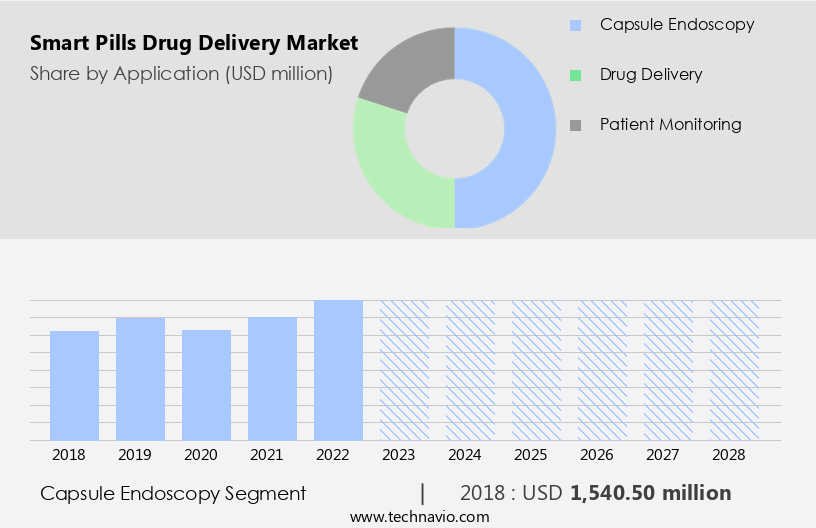
Get a glance at the Smart Pills Drug Delivery Industry report of share of various segments Request Free Sample
The Capsule endoscopy segment was valued at USD 1.54 billion in 2018 and showed a gradual increase during the forecast period.
Regional Analysis
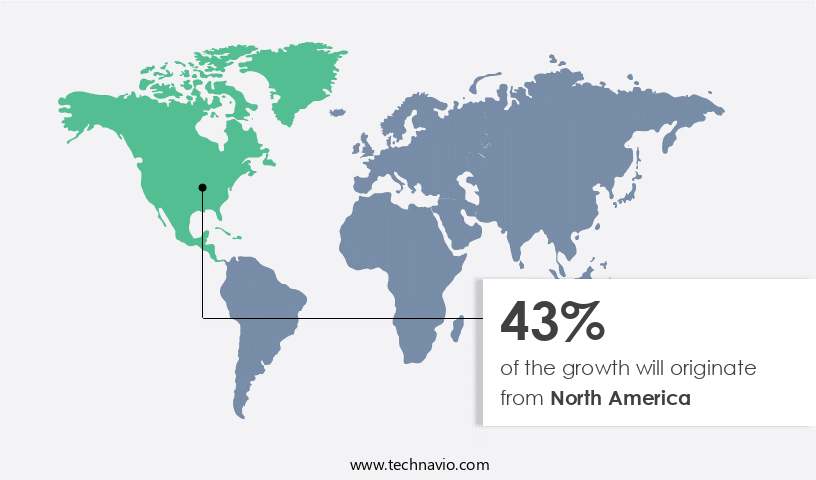
- North America is estimated to contribute 43% to the growth of the global market during the forecast period.
Technavio’s analysts have elaborately explained the regional trends and drivers that shape the market during the forecast period.
For more insights on the market share of various regions, Request Free Sample
The North American market for smart pills drug delivery is projected to expand due to high technology adoption, rising prevalence of chronic conditions like cancer, diabetes, and lifestyle disorders such as obesity, GERD, and gastric ulcers. The region's substantial disposable income and advanced technology penetration have led to significant R&D investments in this field. Smart pills, which offer controlled release and enhanced absorption, are gaining traction in treating various health issues. These pills utilize advanced formulation strategies, including 3D-printed capsules, mucus interfacing, and gastrointestinal patches, to optimize bioavailability and patient compliance. Oral therapies, including powdered tablets and capsules, are being developed with improved mucus adhesion, penetration abilities, and drug loading capacity.
The physiological aspects of the gastrointestinal tract, including the buccal cavity, esophagus, and transit time, are being considered In the design of these delivery systems. The market's growth is further driven by the development of novel millimeter-scale devices and personalized medicine approaches for small drug compounds, such as proteins and peptides.
Market Dynamics
Our smart pills drug delivery market researchers analyzed the data with 2023 as the base year, along with the key drivers, trends, and challenges. A holistic analysis of drivers will help companies refine their marketing strategies to gain a competitive advantage.
What are the key market drivers leading to the rise In the adoption of Smart Pills Drug Delivery Industry?
Rising prevalence of chronic diseases is the key driver of the market.
- The market is experiencing significant growth due to the increasing demand for innovative drug delivery systems to address the challenges associated with chronic diseases. Traditional dosage forms, such as oral therapies, face limitations in bioavailability and treatment adherence. To improve drug efficacy, researchers are focusing on the delivery of biologics using advanced formulation strategies, including 3D-printed capsules and personalized medicine. Bio-physiological factors, such as the GI tract's mucus interfacing, physical barriers, and digestive enzymes, can limit the efficacy of oral drug delivery. To overcome these challenges, novel drug delivery systems, such as gastrointestinal patches, epithelium injections, and buccal cavities, are being explored.
- These systems aim to enhance absorption, prolong residence time, and improve penetration abilities. The design of drug delivery strategies involves understanding the physiological aspects of the GI tract, including the digestion of food, mucosal layer, intercellular tight junctions, and large intestine. Factors such as mucus adhesion, permeability, and drug loading capacity are critical In the development of effective drug delivery systems. Smart pills, controlled release, and enhanced absorption techniques are gaining popularity in pharmaceutics to achieve site-specific targeting and improve the bioavailability of macromolecules, such as proteins and peptides. Novel millimeter-scale devices are being developed to address the physical characteristics and swallowability of traditional capsules and tablets.
- Despite the advancements, challenges remain In the development stage, including clinical trials and regulatory approvals. However, the potential systemic effects of these innovative drug delivery systems make them a promising area of research for the treatment of various chronic diseases.
What are the market trends shaping the Smart Pills Drug Delivery Industry?
Increased patient preference for minimally invasive surgeries is the upcoming market trend.
- The market encompasses innovative drug delivery systems designed to improve treatment adherence and enhance the bioavailability of various therapeutics, particularly for oral administrations of small drug compounds and biologics. Traditional dosage forms, such as capsules and tablets, face challenges with issues like mucus interfacing, physical barriers, and transit time In the gastrointestinal (GI) tract. To address these challenges, researchers and pharmaceutical companies are exploring novel formulation strategies, including 3D-printed capsules, gastrointestinal patches, epithelium injections, and mucus-penetrating formulations. These advanced drug delivery systems focus on optimizing the physiological aspects of the GI tract, including the buccal cavity, esophagus, and large intestine, to ensure proper absorption and systemic effect.
- The development of personalized medicine and site-specific targeting has gained significant attention In the pharmaceutical industry. Advanced drug delivery systems, such as smart pills, offer controlled release, enhanced absorption, and prolonged residence time, which are crucial for the bioavailability of macromolecules like proteins and peptides. Moreover, the increasing prevalence of chronic diseases among the elderly population necessitates the need for advanced drug delivery systems that can overcome the physical barriers In the GI tract and ensure optimal drug delivery. These systems can improve patient compliance and treatment outcomes, ultimately leading to better health outcomes and reduced healthcare costs.
- Innovative drug delivery technologies include macroscale devices, such as capsules and tablets, with optimized physical characteristics, drug loading capacity, and potency. Novel millimeter-scale devices, like mucus-adhesive capsules and permeability-enhancing formulations, are also gaining popularity due to their ability to penetrate the epithelial lining barrier and improve drug bioavailability. Preclinical and clinical studies are underway to evaluate the efficacy and safety of these advanced drug delivery systems for various therapeutic applications. As the market for smart pills continues to grow, it is expected to revolutionize the pharmaceutical industry by offering minimally invasive, targeted, and personalized drug delivery solutions.
What challenges does the Smart Pills Drug Delivery Industry face during its growth?
Stringent government regulations related to drugs is a key challenge affecting the industry growth.
- The market encompasses innovative approaches to improve Treatment Adherence and enhance the Bioavailability of various therapeutics, including Traditional dosage forms such as oral therapies and biologics. Formulation strategies like 3D-printed capsules, powdered tablets, and personalized medicine are gaining traction to address the challenges of Mucus interfacing and Physical barriers In the GI tract. Understanding the physiological aspects of the GI tract, including Digestion of food, the role of digestive enzymes, and Bile salts, is crucial in designing effective Drug Delivery strategies. Techniques like lumen-release of drugs, buccal cavity, esophagus, and sublingual administration can offer Prolonged residence time and enhanced absorption.
- The epithelium injections, mucosal layer, intercellular tight junctions, and large intestine are critical factors affecting the Permeability of drugs. Bioavailability of macromolecules like Proteins and Peptides can be improved using site-specific targeting and novel millimeter-scale devices. Regulatory agencies meticulously evaluate drug-related data, focusing on safety, efficacy, pharmacological data, pharmacodynamic effects, and drug interactions. Failure to meet these criteria may result in a Complete Response Letter (CRL) or rejection, necessitating additional clinical trials and increased R&D expenditure. In summary, the market is driven by the need to address the challenges of Treatment Adherence, Bioavailability, and Drug Delivery in various therapeutic areas.
- Innovative formulation strategies, delivery systems, and regulatory considerations are shaping the future of this market.
Exclusive Customer Landscape
The smart pills drug delivery market forecasting report includes the adoption lifecycle of the market, covering from the innovator’s stage to the laggard’s stage. It focuses on adoption rates in different regions based on penetration. Furthermore, the smart pills drug delivery market report also includes key purchase criteria and drivers of price sensitivity to help companies evaluate and develop their market growth analysis strategies.
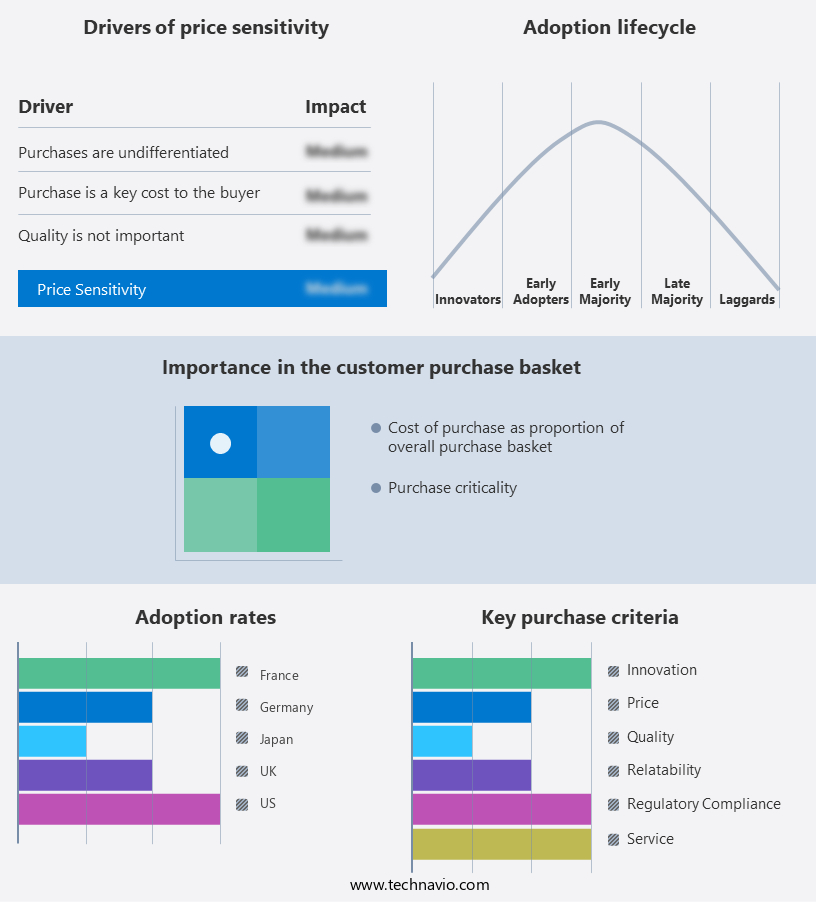
Customer Landscape
Key Companies & Market Insights
Companies are implementing various strategies, such as strategic alliances, smart pills drug delivery market forecast, partnerships, mergers and acquisitions, geographical expansion, and product/service launches, to enhance their presence In the industry.
AnX Robotics - The market encompasses advanced technologies enabling controlled and targeted medication release withIn the gastrointestinal tract. CapsoCam Plus, an innovative solution in this domain, offers comprehensive imaging capabilities in capsule endoscopy. This cutting-edge technology facilitates real-time monitoring of the small intestine, enhancing diagnostic accuracy and patient care. With its non-invasive approach, CapsoCam Plus addresses the limitations of traditional endoscopic procedures, offering a more comfortable experience for patients. The system's advanced imaging capabilities enable the detection of various gastrointestinal conditions, including inflammatory bowel diseases, ulcers, and tumors. By combining medication delivery with diagnostic imaging, CapsoCam Plus sets new standards In the field of smart pills, offering a more efficient and effective solution for healthcare providers and patients alike.
The industry research and growth report includes detailed analyses of the competitive landscape of the market and information about key companies, including:
- AnX Robotics
- CapsoVision Inc.
- Check-Cap Ltd.
- etectRx
- General Electric Co.
- HQ Inc.
- Insulet Corp.
- IntroMedic Co. Ltd.
- Jinshan Science and Technology Group Co. Ltd.
- Koninklijke Philips N.V.
- Medtronic Plc
- Olympus Europa SE and Co. KG
- Otsuka Holdings Co. Ltd.
- RF Co. Ltd.
- Shenzhen Zifu Medical Technology Co. Ltd.ÃÂ
Qualitative and quantitative analysis of companies has been conducted to help clients understand the wider business environment as well as the strengths and weaknesses of key industry players. Data is qualitatively analyzed to categorize companies as pure play, category-focused, industry-focused, and diversified; it is quantitatively analyzed to categorize companies as dominant, leading, strong, tentative, and weak.
Research Analyst Overview
The market encompasses innovative approaches to administering medications, focusing on improving treatment adherence and enhancing the bioavailability of various therapeutic agents. This field is characterized by the exploration of advanced delivery systems, particularly for biologics and oral therapies. The challenge of ensuring patient compliance in traditional dosage forms is a significant issue in healthcare. Oral therapies, which account for a large portion of prescription medications, face numerous barriers In the gastrointestinal (GI) tract. These include the mucus interfacing, epithelial lining barrier, and the presence of digestive enzymes and bile salts. To address these challenges, researchers are investigating various formulation strategies for oral drug delivery.
These include the use of 3D-printed capsules, personalized medicine, and novel millimeter-scale devices. The design of these delivery systems focuses on enhancing the drug's residence time In the target area, improving penetration abilities, and increasing mucus adhesion. The buccal cavity and sublingual administration are alternative routes for drug delivery, offering advantages such as prolonged residence time and enhanced absorption. Transit time through the esophagus and stomach plays a crucial role in drug bioavailability. The small intestine, with its crypts, microvilli structures, and mucosal layer, is the primary site for nutrient absorption and an attractive target for drug delivery. The large intestine, while not typically considered for drug delivery, is gaining attention due to the presence of bacterial enzymes and the potential for site-specific targeting.
The physical barriers, including tight junctions and mucin, are being studied to develop strategies for improving drug delivery across the epithelial lining barrier. The development of smart pills, which employ controlled release and enhanced absorption techniques, is a promising area in pharmaceutics. These devices aim to provide systemic effects while minimizing side effects and improving patient compliance. Preclinical and clinical studies are ongoing to evaluate the safety and efficacy of these innovative drug delivery systems. In summary, the market is driven by the need to address the challenges associated with traditional dosage forms, particularly In the context of oral therapies.
The focus is on developing advanced delivery systems that improve treatment adherence, enhance bioavailability, and overcome the physical barriers In the GI tract. Ongoing research and development efforts are exploring various techniques and devices, from macroscale to millimeter-scale, to revolutionize the way medications are delivered and absorbed In the body.
|
Smart Pills Drug Delivery Market Scope |
|
|
Report Coverage |
Details |
|
Page number |
135 |
|
Base year |
2023 |
|
Historic period |
2018-2022 |
|
Forecast period |
2024-2028 |
|
Growth momentum & CAGR |
Accelerate at a CAGR of 20.62% |
|
Market growth 2024-2028 |
USD 5449 million |
|
Market structure |
Fragmented |
|
YoY growth 2023-2024(%) |
16.56 |
|
Key countries |
US, UK, Japan, Germany, and France |
|
Competitive landscape |
Leading Companies, Market Positioning of Companies, Competitive Strategies, and Industry Risks |
What are the Key Data Covered in this Smart Pills Drug Delivery Market Research and Growth Report?
- CAGR of the Smart Pills Drug Delivery industry during the forecast period
- Detailed information on factors that will drive the Smart Pills Drug Delivery growth and forecasting between 2024 and 2028
- Precise estimation of the size of the market and its contribution of the industry in focus to the parent market
- Accurate predictions about upcoming growth and trends and changes in consumer behaviour
- Growth of the market across North America, Europe, Asia, and Rest of World (ROW)
- Thorough analysis of the market’s competitive landscape and detailed information about companies
- Comprehensive analysis of factors that will challenge the smart pills drug delivery market growth of industry companies
We can help! Our analysts can customize this smart pills drug delivery market research report to meet your requirements.
 RIA -
RIA - 
