


Snowmobile Market Size 2026-2030
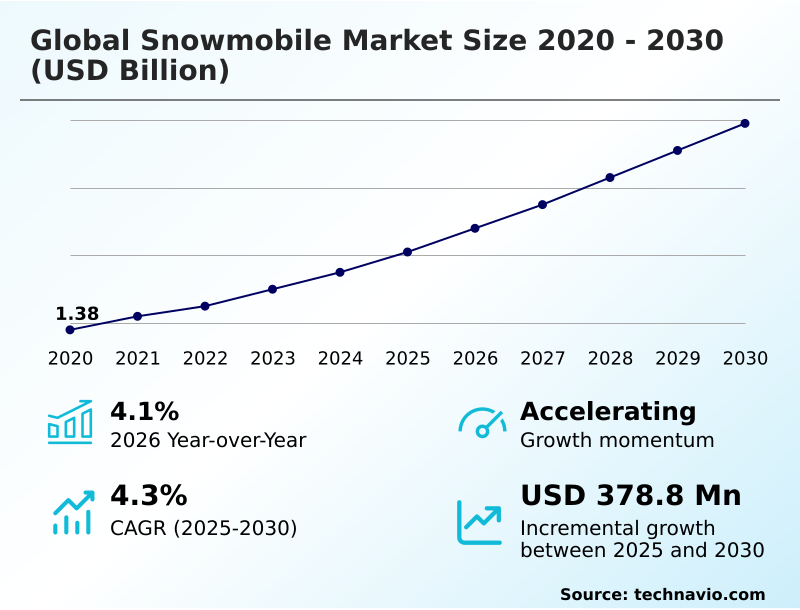
The Snowmobile Market size was valued at USD 1.61 billion in 2025, growing at a CAGR of 4.3% during the forecast period 2026-2030.
Major Market Trends & Insights
- North America dominated the market and accounted for a 43.2% growth during the forecast period.
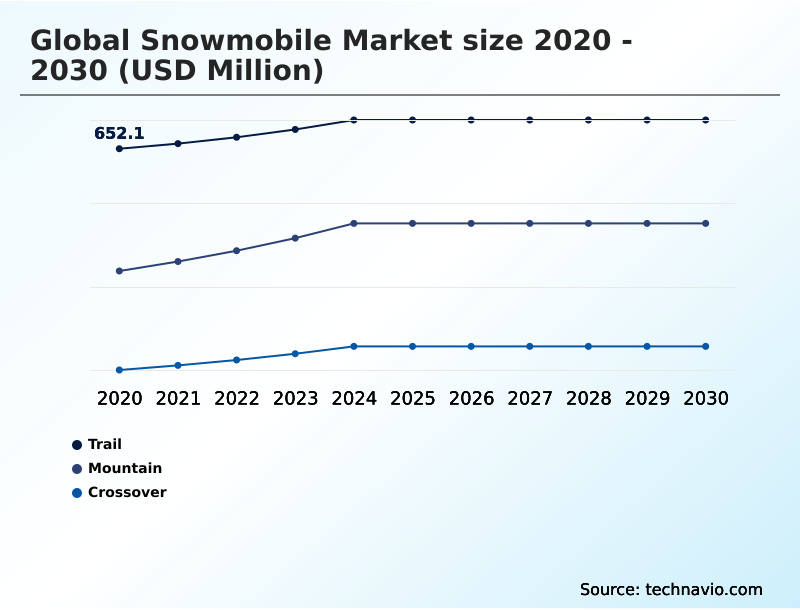
- By Type - Trail segment was valued at USD 700 million in 2024
- By Application - Recreation segment accounted for the largest market revenue share in 2024
Market Size & Forecast
- Historic Market Opportunities 2020-2024: USD 608.2 million
- Market Future Opportunities 2025-2030: USD 378.8 million
- CAGR from 2025 to 2030 : 4.3%
Market Summary
- The snowmobile market is characterized by a high degree of regional concentration, with over 82% of all units sold annually in the United States and Canada. This geographic focus heavily influences OEM supply chain strategies, where manufacturers optimize logistics for North American dealership networks to manage seasonal inventory surges and provide robust aftermarket support.
- A key driver is the expansion of winter tourism, which has increased demand for rental fleets by over 15% in certain resort areas, pushing innovation in durable, user-friendly utility snowmobiles. Conversely, the industry faces the significant challenge of climate change, as shortening winters threaten the viability of the sport by reducing the operational season.
- The high cost of ownership, exacerbated by inflation, also acts as a restraint, making it difficult to attract younger demographics and creating a reliance on an established, aging consumer base.
What will be the Size of the Snowmobile Market during the forecast period?
Get Key Insights on Market Forecast (PDF) Request Free Sample
How is the Snowmobile Market Segmented?
The snowmobile industry research report provides comprehensive data (region-wise segment analysis), with forecasts and analysis for the period 2026-2030, as well as historical data from 2020-2024 for the following segments.
- Type
- Trail
- Mountain
- Crossover
- Application
- Recreation
- Utility
- Engine capacity
- 2-stroke
- 4-stroke
- Geography
- North America
- US
- Canada
- Mexico
- Europe
- Germany
- France
- Italy
- APAC
- Japan
- South Korea
- China
- South America
- Brazil
- Argentina
- Colombia
- Middle East and Africa
- Saudi Arabia
- Turkey
- UAE
- Rest of World (ROW)
- North America
How is the Snowmobile Market Segmented by Type?
The trail segment is estimated to witness significant growth during the forecast period.
The trail snowmobile segment, a cornerstone of the market, captures over 45% of total sales, driven by an extensive network of groomed trails in North America and Europe.
These machines are engineered for stability and rider comfort, featuring advanced semi-active suspension systems that can reduce rider fatigue by up to 25% on long-distance excursions.
The focus on this segment is on handling precision for packed surfaces, utilizing shorter lug tracks and cleaner-burning four-stroke engines to comply with noise and emission standards near populated areas.
Development is geared toward ergonomic improvements and the integration of digital displays for navigation, which supports the significant economic impact of trail riding tourism and appeals to a broad demographic seeking reliable, high-performance recreational sleds.
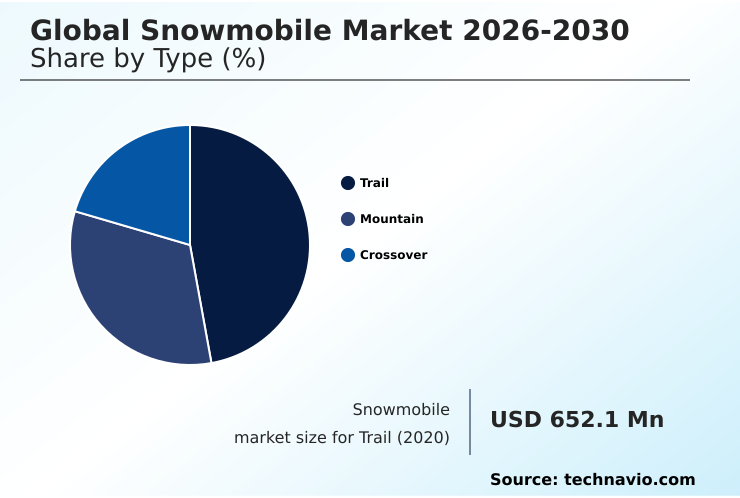
The Trail segment was valued at USD 700 million in 2024 and showed a gradual increase during the forecast period.
How demand for the Snowmobile market is rising in the leading region?
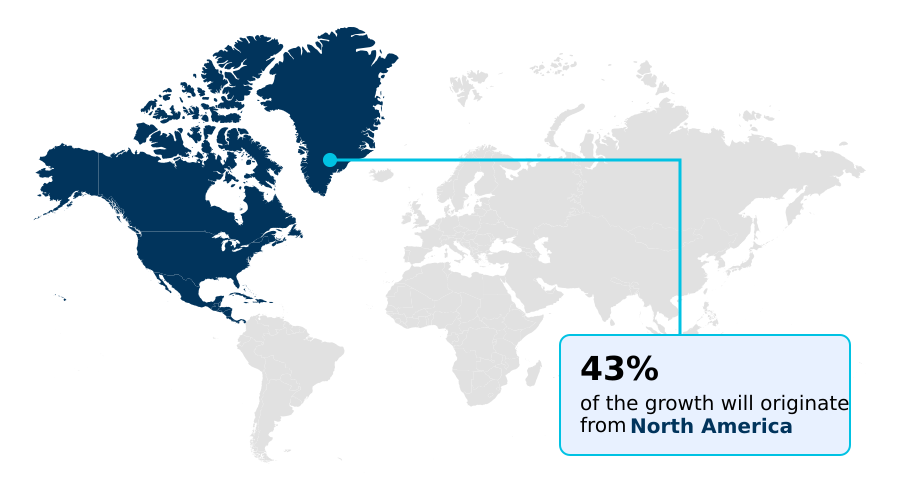
North America is estimated to contribute 43.2% to the growth of the global market during the forecast period.Technavio’s analysts have elaborately explained the regional trends and drivers that shape the market during the forecast period.
See How Snowmobile Market demand is rising in North America Request Free Sample
The geographic landscape of the global snowmobile market is heavily concentrated in North America, which accounts for over 43% of the market opportunity, a share more than 12% larger than that of Europe.
This dominance is driven by the United States and Canada, which together represent more than 80% of annual unit sales, supported by extensive groomed trail networks and a robust dealership network for aftermarket support.
In contrast, the European market, led by Nordic countries, is more focused on utility applications like reindeer herding and forestry management, leading to a demand for four-stroke engines that are up to 20% more fuel-efficient than their two-stroke counterparts.
The APAC market, while smaller, is the fastest-growing region, with a CAGR of 5.5% being driven by government-led winter tourism initiatives in China. This regional variance in the winter tourism economy requires distinct go-to-market strategies.
What are the key Drivers, Trends, and Challenges in the Snowmobile Market?
Our researchers analyzed the data with 2025 as the base year, along with the key drivers, trends, and challenges. A holistic analysis of drivers will help companies refine their marketing strategies to gain a competitive advantage.
- Strategic decisions within the snowmobile industry are increasingly shaped by nuanced consumer demands, moving beyond simple performance metrics. Prospective buyers frequently research the best snowmobile for deep powder riding, highlighting the importance of specialized mountain snowmobile models with high power-to-weight ratios.
- The query 'electric snowmobile range in cold' points to a critical adoption barrier for electric powertrains, where current battery technology offers up to 30% less range in sub-zero temperatures compared to traditional internal combustion engines. This performance gap influences purchasing decisions, especially for backcountry riders.
- Furthermore, analysis of search queries like 'snowmobile utility vehicle towing capacity' reveals a strong commercial and prosumer market segment where functionality outweighs recreational features; these utility snowmobile models often boast towing capacities exceeding 1,500 pounds.
- Understanding 'crossover vs trail snowmobile differences' is vital for manufacturers, as the crossover snowmobile segment is the fastest-growing, appealing to buyers who want a single, versatile machine.
- Finally, 'snowmobile maintenance for longevity' is a key concern reflecting the high cost of ownership, pushing aftermarket support providers to offer service packages that can extend vehicle life by over five years, thereby influencing brand loyalty and total cost of ownership calculations.
What are the key market drivers leading to the rise in the adoption of Snowmobile Industry?
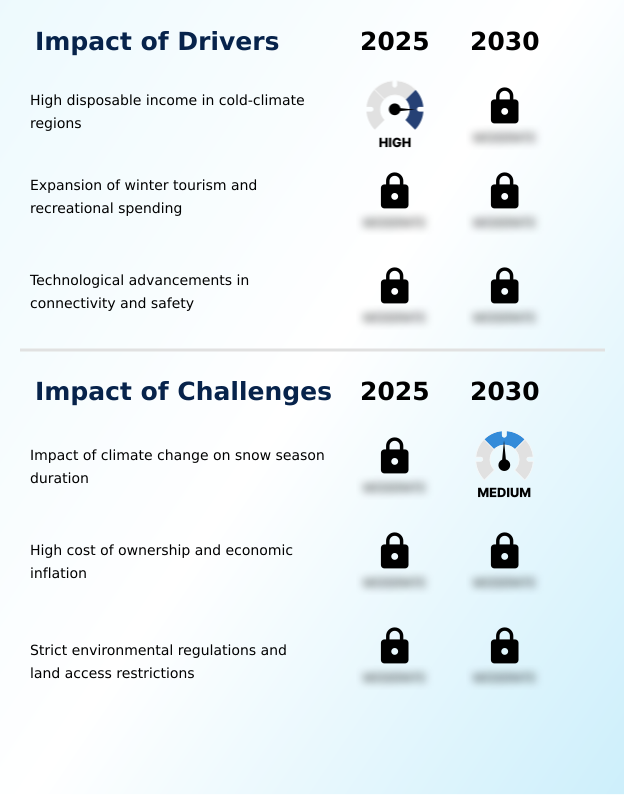
- High disposable income levels within cold-climate regions are a primary driver, enabling greater consumer investment in high-cost recreational vehicles and related winter lifestyle activities.
- Robust demand in the snowmobile market is significantly driven by the expansion of winter tourism and recreational spending, which has led to a 15% increase in guided tour offerings in key North American and Nordic regions.
- This growth in the winter experiential travel economy provides a crucial entry point for new riders through rental programs, often leading to future ownership. Another major driver is the continuous integration of advanced technology.
- The inclusion of features like ride-command systems and semi-active suspension has been shown to increase rider endurance by up to 25%, allowing for longer excursions.
- This technological push stimulates replacement demand and attracts tech-savvy consumers, allowing manufacturers to maintain premium pricing in a competitive powersports supply chain.
What are the market trends shaping the Snowmobile Industry?
- The market is undergoing a significant transition toward electrification and sustainable powertrains, a shift driven by stringent environmental regulations and growing consumer demand for eco-friendly recreational options.
- A primary trend reshaping the snowmobile industry is the surge in demand for crossover and multi-utility vehicles, which now outpace sales growth of specialized models by nearly 10%. This consumer preference is driven by a desire for versatile machines capable of handling both groomed trail networks and deep powder riding.
- This trend is coupled with the rapid integration of smart rider-assist systems, with over 60% of new high-end models featuring large digital displays with GPS navigation and vehicle-to-vehicle communication. This technology enhances safety in remote backcountry terrain. The most transformative trend, however, is the move toward electrification.
- Driven by environmental regulations and a demand for noise pollution reduction, manufacturers are developing electric powertrain models that offer silent operation and instant torque, appealing to a new segment of eco-conscious consumers.
What challenges does the Snowmobile Industry face during its growth?
- The impact of climate change on the duration and predictability of the snow season presents a significant challenge to industry growth by limiting the operational window for snowmobiling.
- The most significant challenge for the snowmobile market is the impact of unpredictable winter weather patterns, which can shorten the riding season by up to 30% in some regions, creating inventory surpluses for the dealership network. This environmental volatility directly correlates with sales figures.
- A second major challenge is the high cost of ownership, which, when combined with ancillary expenses, creates a substantial financial barrier. This economic pressure disproportionately affects younger demographics, with the average age of a snowmobile owner being over 45 years.
- Stricter environmental regulations and land access restrictions also constrain the market, as trail closures limit the areas available for legal riding, thereby diminishing the value proposition of owning a snowmobile and affecting the winter tourism economy.
Exclusive Technavio Analysis on Customer Landscape
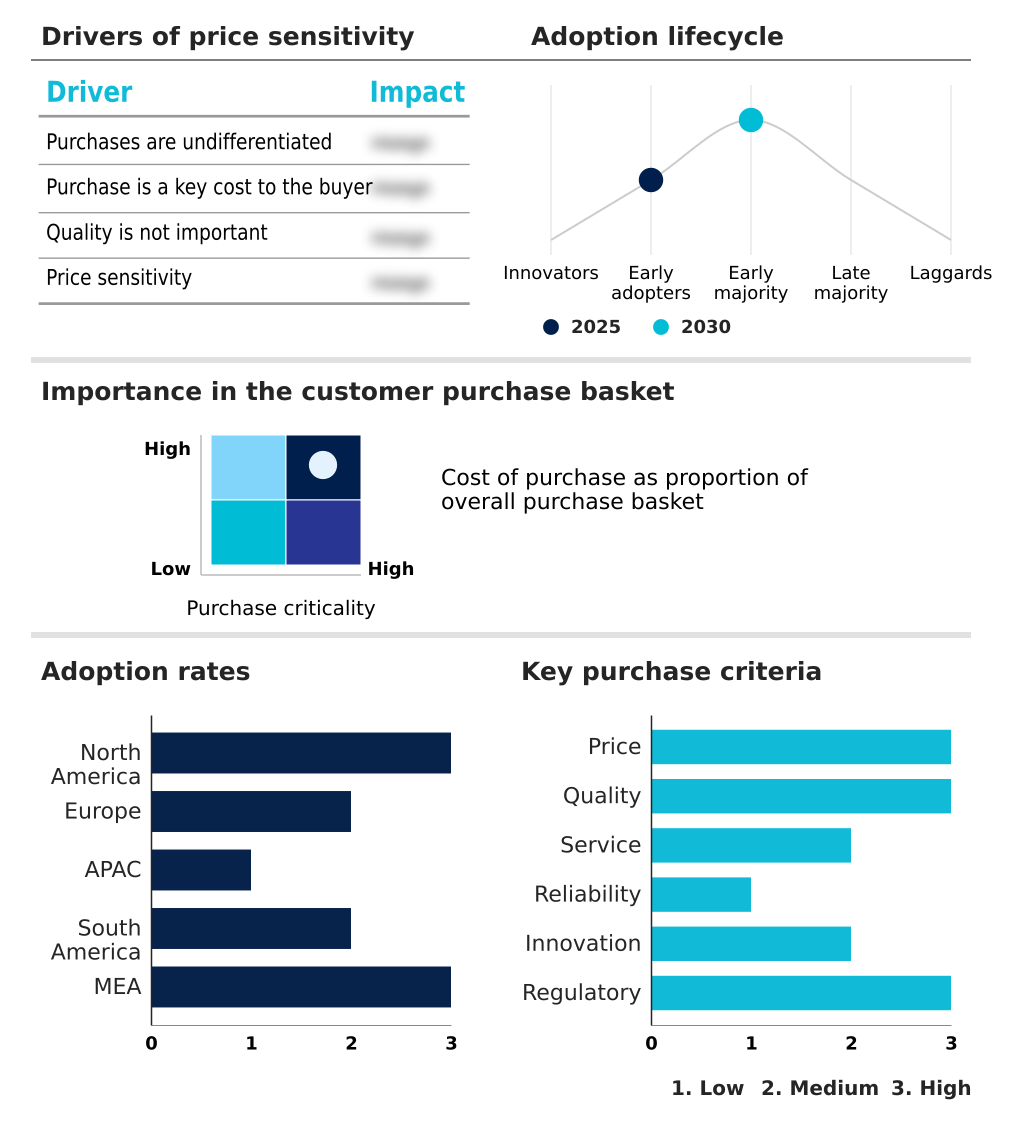
The snowmobile market forecasting report includes the adoption lifecycle of the market, covering from the innovator’s stage to the laggard’s stage. It focuses on adoption rates in different regions based on penetration. Furthermore, the snowmobile market report also includes key purchase criteria and drivers of price sensitivity to help companies evaluate and develop their market growth analysis strategies.
Customer Landscape of Snowmobile Industry
Competitive Landscape
Companies are implementing various strategies, such as strategic alliances, snowmobile market forecast, partnerships, mergers and acquisitions, geographical expansion, and product/service launches, to enhance their presence in the industry.
Alpina Snowmobiles - The company’s portfolio is distinguished by its comprehensive snowmobile lineup, offering specialized platforms for every terrain from deep snow to touring and utility applications.
The industry research and growth report includes detailed analyses of the competitive landscape of the market and information about key companies, including:
- Alpina Snowmobiles
- Bombardier Recreational Products Inc.
- Polaris Inc.
- Textron Inc.
- Vidde Mobility
Qualitative and quantitative analysis of companies has been conducted to help clients understand the wider business environment as well as the strengths and weaknesses of key industry players. Data is qualitatively analyzed to categorize companies as pure play, category-focused, industry-focused, and diversified; it is quantitatively analyzed to categorize companies as dominant, leading, strong, tentative, and weak.
Market Intelligence Radar: High-Impact Developments & Growth Signals
- In the Leisure Products industry, a significant increase in dual-income households has boosted discretionary spending on high-cost recreational items, directly fueling demand for new and technologically advanced snowmobiles.
- A growing consumer preference for experiential travel and outdoor adventures has amplified the winter tourism economy, prompting ski resorts and lodges to expand their snowmobile rental fleets and guided tour offerings.
- The imposition of new trade barriers and tariffs has disrupted the powersports supply chain, increasing the cost of raw materials and imported components, which in turn elevates the final price of snowmobiles for consumers.
- Heightened environmental awareness and stricter regulatory compliances regarding noise and emissions are compelling manufacturers to accelerate R&D in electric powertrains and cleaner four-stroke engine technology.
Dive into Technavio’s robust research methodology, blending expert interviews, extensive data synthesis, and validated models for unparalleled Snowmobile Market insights. See full methodology.
| Market Scope | |
|---|---|
| Page number | 260 |
| Base year | 2025 |
| Historic period | 2020-2024 |
| Forecast period | 2026-2030 |
| Growth momentum & CAGR | Accelerate at a CAGR of 4.3% |
| Market growth 2026-2030 | USD 378.8 million |
| Market structure | Concentrated |
| YoY growth 2025-2026(%) | 4.1% |
| Key countries | US, Canada, Mexico, Germany, France, Italy, UK, Spain, The Netherlands, Japan, South Korea, China, Australia, India, Indonesia, Brazil, Argentina, Colombia, Saudi Arabia, Turkey, UAE, South Africa and Israel |
| Competitive landscape | Leading Companies, Market Positioning of Companies, Competitive Strategies, and Industry Risks |
Research Analyst Overview
- The snowmobile market ecosystem is a specialized value chain where a few key OEMs command over 90% of the market share. These manufacturers rely on a global network of suppliers for critical inputs like high-performance engines, semi-active suspension systems, and increasingly, semiconductor-based telematics. The shift toward electric powertrain technology is introducing new players from the battery sector.
- Distribution is handled through a highly seasonal dealership network, which also provides vital aftermarket support. End-users are segmented into recreational riders, who drive demand for high-performance recreational sleds, and commercial operators in sectors like the winter tourism economy.
- Regulatory bodies influence product design through emissions standards, mandating the use of four-stroke engines that now account for nearly 35% of new sales in certain regions.
What are the Key Data Covered in this Snowmobile Market Research and Growth Report?
-
What is the expected growth of the Snowmobile Market between 2026 and 2030?
-
The Snowmobile Market is expected to grow by USD 378.8 million during 2026-2030, registering a CAGR of 4.3%. Year-over-year growth in 2026 is estimated at 4.1%%. This acceleration is shaped by high disposable income in cold-climate regions, which is intensifying demand across multiple end-use verticals covered in the report.
-
-
What segmentation does the market report cover?
-
The report is segmented by Type (Trail, Mountain, and Crossover), Application (Recreation, and Utility), Engine Capacity (2-stroke, and 4-stroke) and Geography (North America, Europe, APAC, South America, Middle East and Africa). Among these, the Trail segment is estimated to witness significant growth during the forecast period, driven by rising adoption across key application areas. Each segment includes detailed qualitative and quantitative analysis, along with historical data from 2020-2024 and forecasts through 2030 with year-over-year growth rates.
-
-
Which regions are analyzed in the report?
-
The report covers North America, Europe, APAC, South America and Middle East and Africa. North America is estimated to contribute 43.2% to market growth during the forecast period. Country-level analysis includes US, Canada, Mexico, Germany, France, Italy, UK, Spain, The Netherlands, Japan, South Korea, China, Australia, India, Indonesia, Brazil, Argentina, Colombia, Saudi Arabia, Turkey, UAE, South Africa and Israel, with dedicated market size tables and year-over-year growth for each.
-
-
What are the key growth drivers and market challenges?
-
The primary driver is high disposable income in cold-climate regions, which is accelerating investment and industry demand. The main challenge is impact of climate change on snow season duration, creating operational barriers for key market participants. The report quantifies the impact of each driver and challenge across 2026 and 2030 with comparative analysis.
-
-
Who are the major players in the Snowmobile Market?
-
Key vendors include Alpina Snowmobiles, Bombardier Recreational Products Inc., Polaris Inc., Textron Inc. and Vidde Mobility. The report provides qualitative and quantitative analysis categorizing companies as dominant, leading, strong, tentative, and weak based on their market positioning. Company profiles include business segment analysis, SWOT assessment, key offerings, and recent strategic developments.
-
Market Research Insights
- The competitive landscape of the snowmobile market is highly consolidated, with the top three players accounting for over 90% of global sales. Key vendors such as Bombardier Recreational Products Inc. (BRP) and Polaris Inc. continue to drive innovation, focusing on high-performance engine technology and integrated digital displays.
- For instance, BRP has refined its chassis platforms, while Polaris has emphasized rider-assist systems, which have improved backcountry safety by up to 20% with real-time group tracking features. Textron Inc.’s Arctic Cat brand is streamlining its product line around its Catalyst platform to engage its core enthusiast base.
- A notable development is the strategic exit of Yamaha from the market, a move expected to redistribute market share among the remaining incumbents. These companies are adapting to the challenge of land access restrictions by developing quieter, low-emission vehicles and engaging in advocacy for shared-use land policies.
We can help! Our analysts can customize this snowmobile market research report to meet your requirements.
 RIA -
RIA - 
