



Timing Devices Market Size 2026-2030
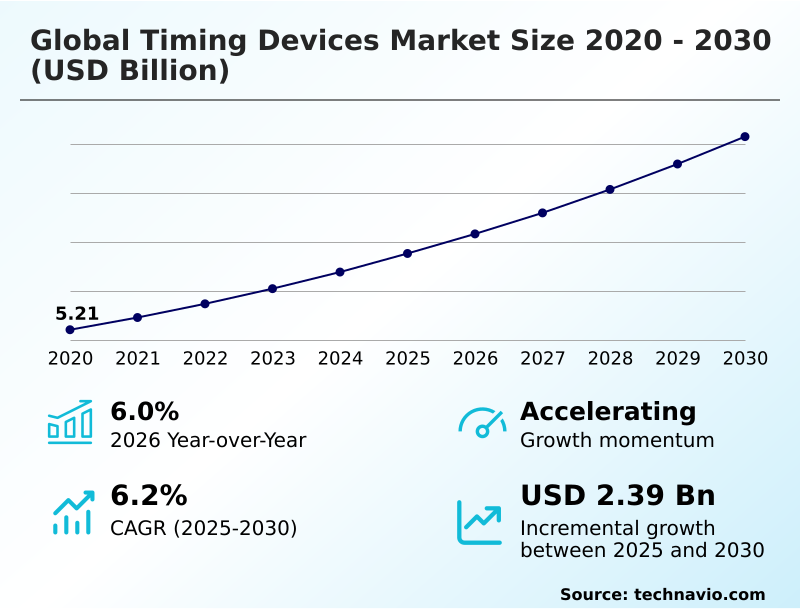
The timing devices market size is valued to increase by USD 2.39 billion, at a CAGR of 6.2% from 2025 to 2030. Deployment of fifth-generation network infrastructure will drive the timing devices market.
Major Market Trends & Insights
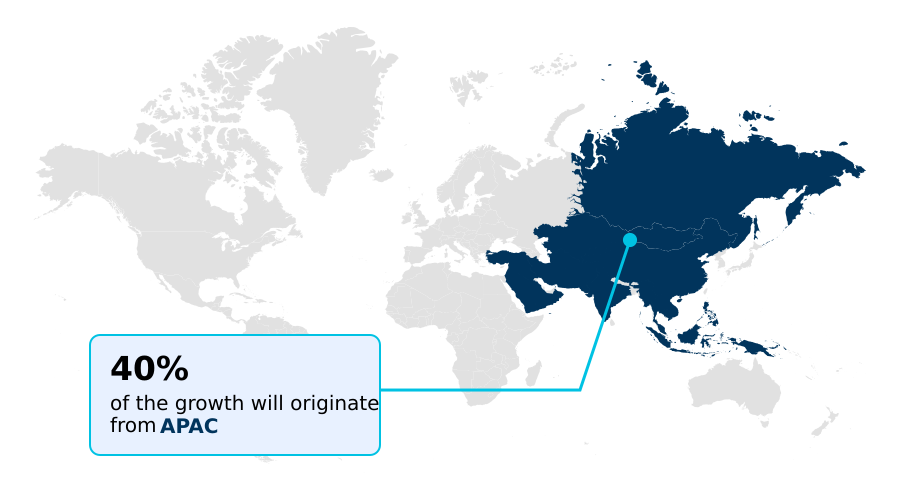
- APAC dominated the market and accounted for a 40% growth during the forecast period.
- By End-user - Consumer electronics segment was valued at USD 1.61 billion in 2024
- By Type - Oscillators segment accounted for the largest market revenue share in 2024
Market Size & Forecast
- Market Opportunities: USD 3.95 billion
- Market Future Opportunities: USD 2.39 billion
- CAGR from 2025 to 2030 : 6.2%
Market Summary
- The timing devices market is fundamental to the electronics industry, providing the essential clock signals for digital systems. This market is evolving from supplying simple components to delivering critical system-level solutions that enable advanced applications.
- A key driver is the rollout of 5G infrastructure, where high-performance timing solutions and precision time protocol are necessary for managing network synchronization with nanosecond accuracy. Concurrently, the automotive sector's shift toward advanced driver-assistance systems (ADAS) creates immense demand for automotive-grade timing devices to ensure the precise synchronization of sensor data, a failure of which could compromise safety.
- For instance, an automotive OEM must implement low-jitter clock signals to ensure sensor fusion algorithms operate flawlessly, which depends on the reliability of MEMS resonator technology and oven controlled crystal oscillators. Trends include the adoption of micro-electro-mechanical systems for their durability and the development of chip-scale atomic clocks for resilient timing in GPS-denied environments.
- However, challenges like achieving frequency stability under thermal stress and complexities in system-on-chip architectures persist, driving innovation in areas like temperature compensated crystal oscillators and modular timing architectures to maintain performance.
What will be the Size of the Timing Devices Market during the forecast period?
Get Key Insights on Market Forecast (PDF) Get Free Sample
How is the Timing Devices Market Segmented?
The timing devices industry research report provides comprehensive data (region-wise segment analysis), with forecasts and estimates in "USD million" for the period 2026-2030, as well as historical data from 2020-2024 for the following segments.
- End-user
- Consumer electronics
- IT and telecom
- Automotive
- Aerospace and defense
- Others
- Type
- Oscillators
- Resonators
- Clock generators
- Clock buffers
- Jitter attenuators
- Material
- Crystal
- Silicon
- Ceramic
- Geography
- APAC
- China
- Japan
- South Korea
- North America
- US
- Canada
- Mexico
- Europe
- Germany
- UK
- France
- South America
- Brazil
- Argentina
- Middle East and Africa
- Saudi Arabia
- UAE
- South Africa
- Rest of World (ROW)
- APAC
By End-user Insights
The consumer electronics segment is estimated to witness significant growth during the forecast period.
The consumer electronics segment is a primary demand center for the global timing devices market 2026-2030, driven by the continuous need for miniaturization and high-performance in portable electronics.
In this sector, components like quartz crystal resonators and MEMS resonators are essential for managing processor clocking and wireless communication protocols.
The industry's push toward sleeker designs necessitates ultra-compact parts, where the adoption of chip-scale packaging has enabled a 20% reduction in board space for some applications.
As devices integrate more features, the demand for low-power timing solutions that support extended battery life remains critical.
The use of piezoelectric materials ensures stable oscillation, while advanced manufacturing for synthetic quartz crystal supports high-volume production, meeting the sector's rigorous demands for both cost and performance.
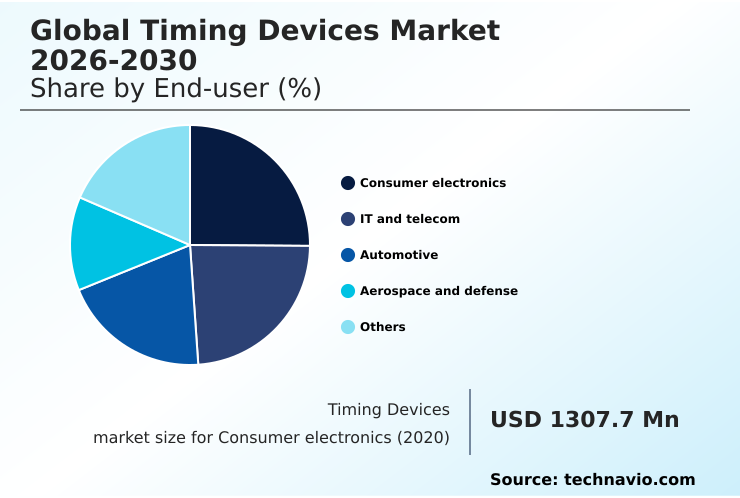
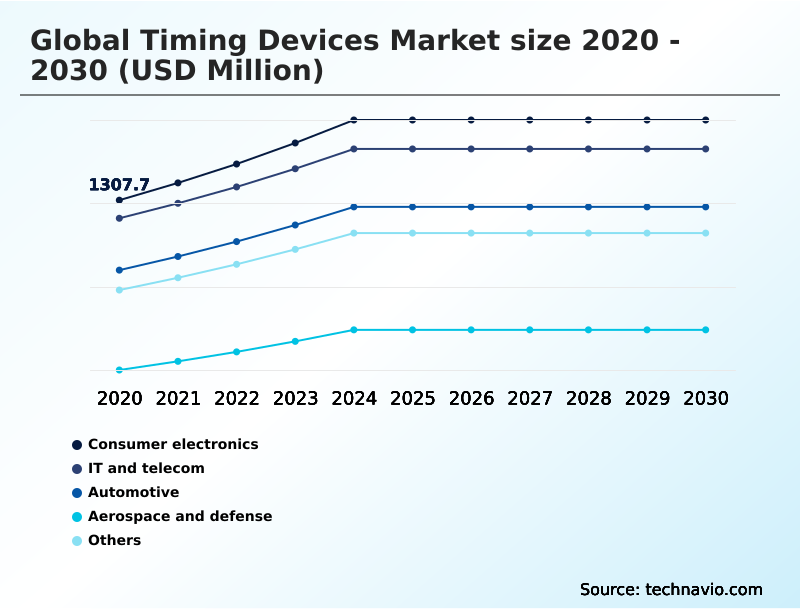
The Consumer electronics segment was valued at USD 1.61 billion in 2024 and showed a gradual increase during the forecast period.
Regional Analysis
APAC is estimated to contribute 40% to the growth of the global market during the forecast period.Technavio’s analysts have elaborately explained the regional trends and drivers that shape the market during the forecast period.
See How Timing Devices Market Demand is Rising in APAC Get Free Sample
The geographic landscape of the global timing devices market 2026-2030 is led by APAC, which functions as both the primary manufacturing hub and the largest consumption base, contributing approximately 40% of the market's incremental growth.
This dominance is driven by high-volume production of consumer electronics and the aggressive rollout of 5G telecommunications infrastructure.
North America follows, accounting for nearly 30% of growth, distinguished by its innovation in high-end solutions like silicon-based timing and MEMS timing for data centers and aerospace.
Europe’s market is characterized by stringent requirements from its automotive and industrial sectors, prioritizing durability and precision in components like TCXOs.
Advanced crystal processing and oscillator manufacturing are concentrated in these key regions, defining global supply chain dynamics and technological advancements.
Market Dynamics
Our researchers analyzed the data with 2025 as the base year, along with the key drivers, trends, and challenges. A holistic analysis of drivers will help companies refine their marketing strategies to gain a competitive advantage.
- Strategic decision-making in the global timing devices market 2026-2030 is increasingly complex, influenced by a web of technical and operational factors. A central concern is achieving frequency stability in electronics, which directly impacts the reliability of high-speed data transmission.
- This is where the debate over MEMS vs quartz oscillator reliability becomes critical, especially for applications like automotive ADAS sensor synchronization, where nanosecond precision is non-negotiable. The expansion of next-generation networks intensifies this focus, making timing solutions for 5G infrastructure a primary growth area.
- Here, the role of TCXO in network synchronization is crucial for maintaining signal integrity, as the impact of jitter on high-speed data can severely degrade performance. Concurrently, designers grapple with SoC timing integration challenges, weighing the benefits of integration against the performance of discrete components for critical functions.
- The supply chain for these devices is also under scrutiny, with supply chain risks for quartz crystals prompting a strategic evaluation of alternatives. Organizations that diversify their sourcing to include MEMS-based options can mitigate lead time uncertainty by over 50% compared to a single-source strategy for quartz.
- Understanding the nuances between crystal vs silicon timing devices, clock tree synthesis techniques, and the requirements for high stability crystal oscillators is vital. Moreover, addressing timing requirements for IoT devices, the specifics of MEMS oscillator reliability, and the performance of oven controlled crystal oscillators are key to navigating this landscape.
- Effective management of timing in embedded systems, from RF timing solutions to clock buffer design considerations and jitter attenuation methods, is essential for success.
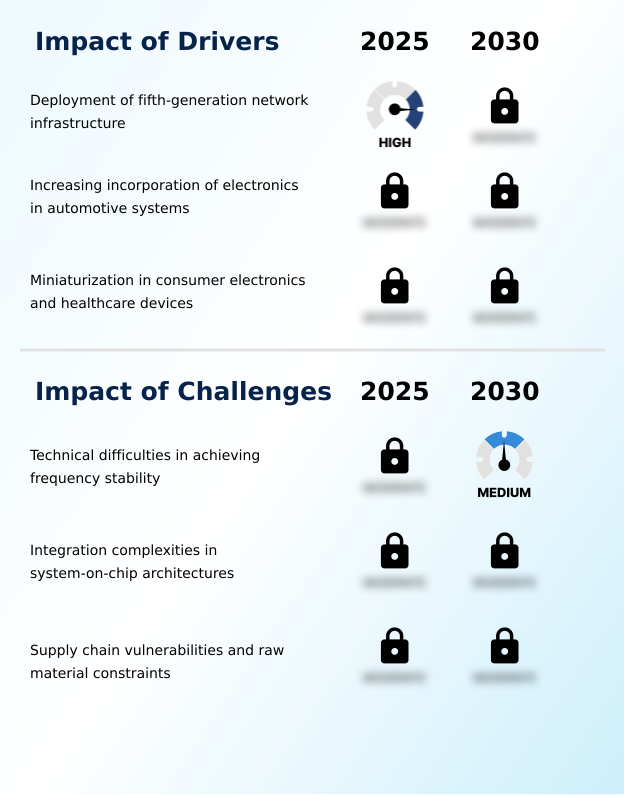
What are the key market drivers leading to the rise in the adoption of Timing Devices Industry?
- The deployment of fifth-generation network infrastructure is a key driver accelerating the demand for high-performance timing devices.
- Market growth is primarily driven by the deployment of 5G network infrastructure, which demands ultra-low jitter and high frequency stability.
- This rollout necessitates a 50% tighter synchronization tolerance compared to 4G networks, fueling demand for high-performance timing devices like crystal oscillators and TCXOs.
- Concurrently, the increasing electronics content in automotive systems, which has grown by over 35% in premium vehicles in the last five years, acts as a major catalyst.
- Advanced driver-assistance systems and autonomous technologies require precise synchronization of sensor data, dependent on automotive-grade MEMS oscillators and low jitter clocks.
- The relentless miniaturization in consumer electronics, coupled with the expansion of the Internet of Things, also drives demand for compact, low-power crystal units and MEMS-based timing solutions to extend battery life in portable devices.
What are the market trends shaping the Timing Devices Industry?
- The rapid adoption of micro-electro-mechanical systems technology represents a significant upcoming trend. This shift is reshaping the landscape for frequency control components.
- Key trends are reshaping the global timing devices market 2026-2030, led by the shift from quartz to micro-electro-mechanical systems technology. This transition is driven by the superior durability and manufacturing scalability of MEMS oscillators, which exhibit up to 20 times better reliability against shock compared to traditional quartz components. Another significant development is the commercialization of chip-scale atomic clocks.
- These advanced timing modules extend holdover accuracy by over 100-fold compared to OCXOs, providing resilient timing in GPS-denied environments. Furthermore, the move toward modular and system-in-package architectures, integrating components like high-frequency crystal oscillators, shortens signal paths and improves signal integrity.
- This approach streamlines design and enhances reliability by co-packaging timing elements with processors, a critical advancement for high-density electronics and addressing challenges like quartz crystal supply chain vulnerabilities.
What challenges does the Timing Devices Industry face during its growth?
- Technical difficulties in achieving and maintaining frequency stability across diverse operating conditions present a key challenge affecting industry growth.
- Persistent challenges in the global timing devices market 2026-2030 revolve around technical limitations and operational hurdles. Achieving frequency stability under harsh environmental conditions remains a primary concern, as thermal fluctuations can degrade performance. The push for miniaturization further complicates this, as smaller quartz blanks can exhibit lower Q-factors.
- Integrating a high-quality timing source directly onto a System-on-Chip (SoC) is also difficult, with on-chip substrate noise capable of increasing clock jitter by up to 40%. This often forces designers to retain discrete components. Additionally, the market faces supply chain vulnerabilities.
- Lead times for specialized ceramic packages for high-precision crystal oscillators can fluctuate by over 200% during demand surges, creating significant production bottlenecks for electronics manufacturers and highlighting the need for clock distribution network resilience.
Exclusive Technavio Analysis on Customer Landscape
The timing devices market forecasting report includes the adoption lifecycle of the market, covering from the innovator’s stage to the laggard’s stage. It focuses on adoption rates in different regions based on penetration. Furthermore, the timing devices market report also includes key purchase criteria and drivers of price sensitivity to help companies evaluate and develop their market growth analysis strategies.
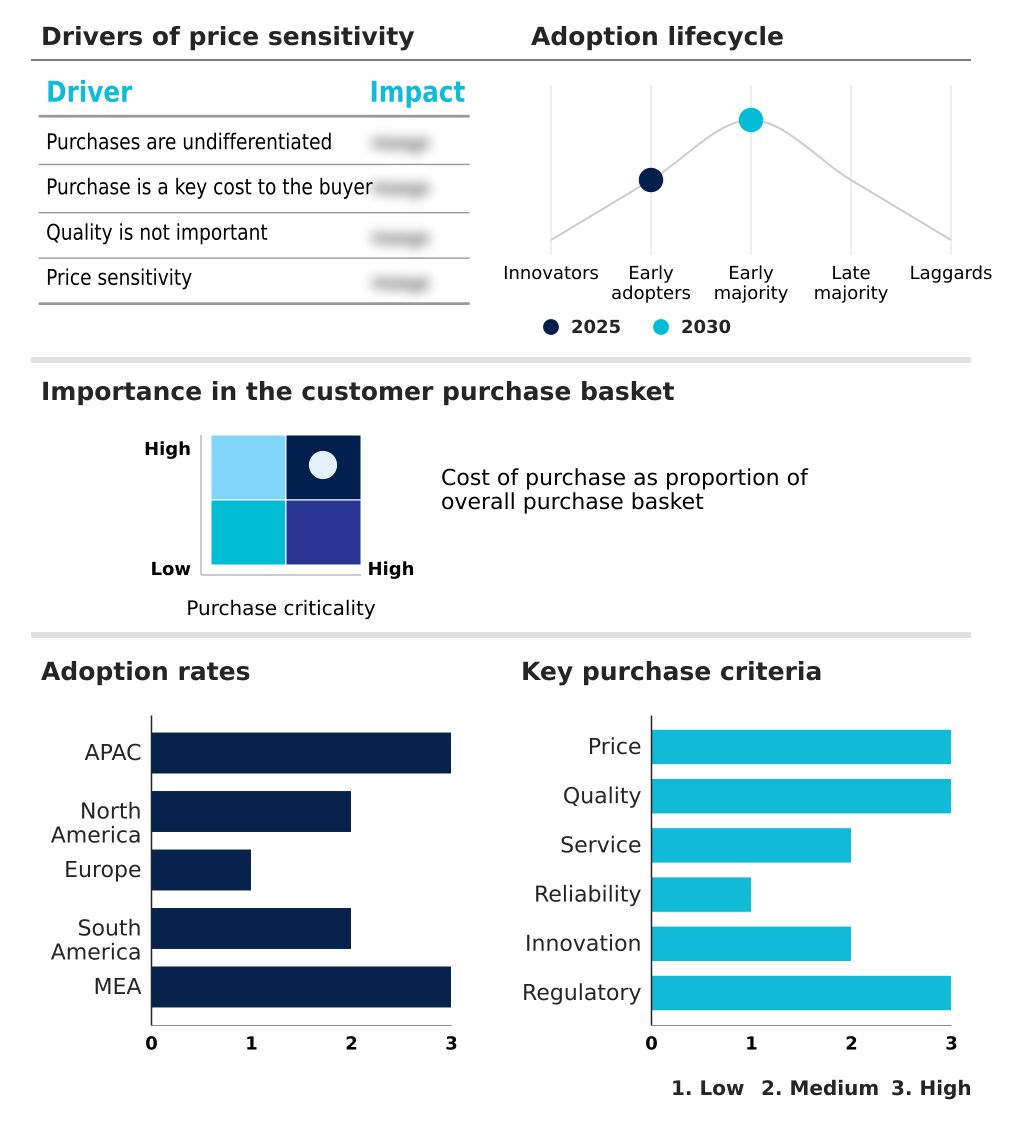
Customer Landscape of Timing Devices Industry
Competitive Landscape
Companies are implementing various strategies, such as strategic alliances, timing devices market forecast, partnerships, mergers and acquisitions, geographical expansion, and product/service launches, to enhance their presence in the industry.
Abracon LLC - Offerings include a comprehensive portfolio of frequency control products, from passive components to advanced timing solutions, designed to meet diverse electronic system requirements across multiple industries.
The industry research and growth report includes detailed analyses of the competitive landscape of the market and information about key companies, including:
- Abracon LLC
- Asahi Kasei Corp.
- CTS Corp.
- IQD Frequency Products Ltd.
- Kyocera Corp.
- Microchip Technology Inc.
- Murata Manufacturing Co. Ltd.
- Nihon Dempa Kogyo Ltd.
- Rakon Ltd.
- Renesas Electronics Corp.
- Seiko Holdings Corp.
- Silicon Laboratories Inc.
- STMicroelectronics NV
- Texas Instruments Inc.
- Tokyo Kikai Seisakusho Ltd.
- Toshiba Corp.
- TXC Corp.
Qualitative and quantitative analysis of companies has been conducted to help clients understand the wider business environment as well as the strengths and weaknesses of key industry players. Data is qualitatively analyzed to categorize companies as pure play, category-focused, industry-focused, and diversified; it is quantitatively analyzed to categorize companies as dominant, leading, strong, tentative, and weak.
Recent Development and News in Timing devices market
- In August, 2024, Petrobras announced significant investments in digital twin technology and remote monitoring for its offshore platforms, inherently driving demand for industrial-grade precision timing devices.
- In October, 2024, Seiko Epson Corporation announced the expansion of its differential output crystal oscillator lineup, specifically targeting the high-speed networking and data center equipment industry.
- In January, 2025, SiTime Corporation launched the SiT5977 Super-TCXO, a MEMS-based oscillator designed to improve synchronization for 800G network connectivity and AI compute nodes.
- In March, 2025, Aramco Digital and Intel announced a collaboration to establish the first Open RAN development center in Saudi Arabia, accelerating the need for precision timing solutions in industrial 5G networks.
Dive into Technavio’s robust research methodology, blending expert interviews, extensive data synthesis, and validated models for unparalleled Timing Devices Market insights. See full methodology.
| Market Scope | |
|---|---|
| Page number | 314 |
| Base year | 2025 |
| Historic period | 2020-2024 |
| Forecast period | 2026-2030 |
| Growth momentum & CAGR | Accelerate at a CAGR of 6.2% |
| Market growth 2026-2030 | USD 2394.6 million |
| Market structure | Fragmented |
| YoY growth 2025-2026(%) | 6.0% |
| Key countries | China, Japan, South Korea, India, Taiwan, Indonesia, US, Canada, Mexico, Germany, UK, France, Italy, The Netherlands, Spain, Brazil, Argentina, Chile, Saudi Arabia, UAE, South Africa, Israel and Turkey |
| Competitive landscape | Leading Companies, Market Positioning of Companies, Competitive Strategies, and Industry Risks |
Research Analyst Overview
- The timing devices market is undergoing a significant transformation, moving beyond its role as a supplier of discrete components to becoming an enabler of complex, high-performance systems. The evolution is driven by the stringent requirements of applications like 5G telecommunications, the Internet of Things (IoT), and advanced driver-assistance systems.
- Core technologies such as quartz crystal technology and micro-electro-mechanical systems (MEMS) are at the forefront of this shift. While piezoelectric effect-based devices remain dominant, MEMS resonator technology offers superior resilience and integration capabilities. This trend directly influences boardroom strategy, particularly in supply chain and inventory management.
- For instance, the programmability of MEMS oscillators allows manufacturers to reduce inventory SKUs by up to 90%. Innovations in oven controlled crystal oscillators and temperature compensated crystal oscillators are pushing the boundaries of frequency stability. Simultaneously, advancements in chip-scale atomic clocks and system-in-package designs are addressing the need for resilient timing and miniaturization.
- However, managing phase noise, jitter, and the complexities of system-on-chip architectures remains a persistent challenge, driving continuous development in resonators, clock generators, clock buffers, and jitter attenuators.
What are the Key Data Covered in this Timing Devices Market Research and Growth Report?
-
What is the expected growth of the Timing Devices Market between 2026 and 2030?
-
USD 2.39 billion, at a CAGR of 6.2%
-
-
What segmentation does the market report cover?
-
The report is segmented by End-user (Consumer electronics, IT and telecom, Automotive, Aerospace and defense, and Others), Type (Oscillators, Resonators, Clock generators, Clock buffers, and Jitter attenuators), Material (Crystal, Silicon, and Ceramic) and Geography (APAC, North America, Europe, South America, Middle East and Africa)
-
-
Which regions are analyzed in the report?
-
APAC, North America, Europe, South America and Middle East and Africa
-
-
What are the key growth drivers and market challenges?
-
Deployment of fifth-generation network infrastructure, Technical difficulties in achieving frequency stability
-
-
Who are the major players in the Timing Devices Market?
-
Abracon LLC, Asahi Kasei Corp., CTS Corp., IQD Frequency Products Ltd., Kyocera Corp., Microchip Technology Inc., Murata Manufacturing Co. Ltd., Nihon Dempa Kogyo Ltd., Rakon Ltd., Renesas Electronics Corp., Seiko Holdings Corp., Silicon Laboratories Inc., STMicroelectronics NV, Texas Instruments Inc., Tokyo Kikai Seisakusho Ltd., Toshiba Corp. and TXC Corp.
-
Market Research Insights
- The dynamics of the global timing devices market 2026-2030 are shaped by a push for higher performance and integration. The adoption of high-Q-factor resonators has improved signal purity in communication systems by up to 30%, a critical factor for high-speed data transfer.
- In parallel, the shift toward modular timing architectures is accelerating product development cycles, with some firms reporting a 20% faster time-to-market. These advancements are driven by the need for low-power timing solutions in the expanding IoT landscape and high-precision timing for applications requiring resilient timing sources.
- Furthermore, the development of high-performance timing solutions for data centers has demonstrated a 15% reduction in synchronization-related errors, reinforcing the move toward more integrated and robust designs.
We can help! Our analysts can customize this timing devices market research report to meet your requirements.
 RIA -
RIA - 
