
Vehicle To Grid Chargers Market Analysis, Size, and Forecast 2026-2030: North America (US, Canada, and Mexico), Europe (Germany, UK, and France), APAC (China, Japan, and South Korea), South America (Brazil, Argentina, and Chile), Middle East and Africa (UAE, Saudi Arabia, and South Africa), and Rest of World (ROW)

Vehicle To Grid Chargers Market Analysis, Size, and Forecast 2026-2030:
North America (US, Canada, and Mexico), Europe (Germany, UK, and France), APAC (China, Japan, and South Korea), South America (Brazil, Argentina, and Chile), Middle East and Africa (UAE, Saudi Arabia, and South Africa), and Rest of World (ROW)

Published: Oct 2026 296 Pages SKU: IRTNTR74199

Market Overview at a Glance

$8.68 B
Market Opportunity
25.9%
CAGR 2025 - 2030
37.4%
Europe Growth
$2.97 B
Residential chargers segment 2024

Vehicle To Grid Chargers Market Size 2026-2030

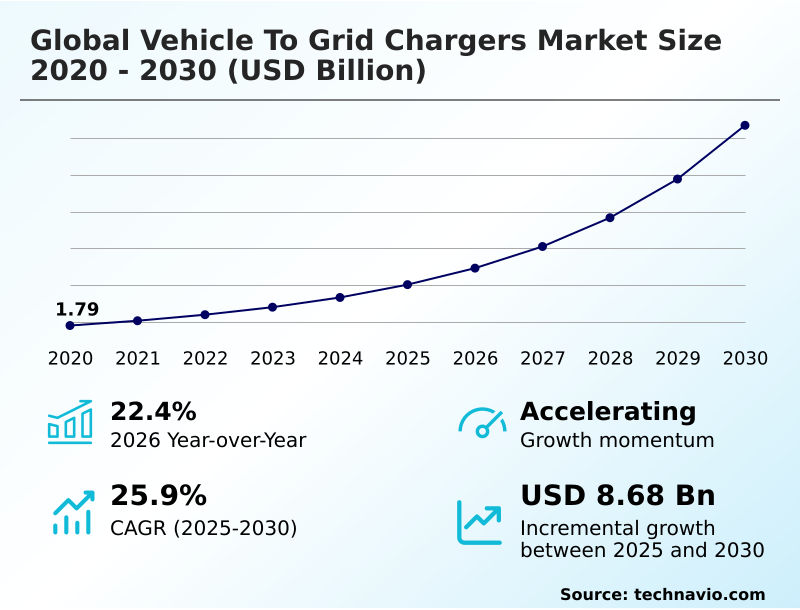
The vehicle to grid chargers market size is valued to increase by USD 8.68 billion, at a CAGR of 25.9% from 2025 to 2030. Rising global adoption electric vehicles expands available mobile battery storage capacity will drive the vehicle to grid chargers market.

Major Market Trends & Insights

  • Europe dominated the market and accounted for a 37.4% growth during the forecast period.
  • By End-user - Residential chargers segment was valued at USD 2.97 billion in 2024
  • By Product Type - Wired segment accounted for the largest market revenue share in 2024

Market Size & Forecast

  • Market Opportunities: USD 10.92 billion
  • Market Future Opportunities: USD 8.68 billion
  • CAGR from 2025 to 2030 : 25.9%

Market Summary

  • The Vehicle To Grid Chargers market is undergoing a rapid structural transformation as decentralized energy storage becomes critical for modern power infrastructure. Bidirectional energy systems are shifting traditional transportation assets into highly responsive power reserves capable of balancing volatile electrical grids.
  • In corporate logistics, large-scale delivery fleets utilize aggregated charging terminals to manage daily duty cycles while automatically discharging excess battery power to mitigate utility demand charges, improving overall energy cost efficiency by over 22%.
  • A primary driver propelling this expansion is the massive influx of battery electric vehicles, which provide an unprecedented volume of idle storage capacity necessary to stabilize intermittent renewable generation. Conversely, the high initial capital outlay required for specialized utility-grade metering and physical panel retrofitting continues to challenge widespread residential adoption.
  • Advanced semiconductor integration fundamentally improves round-trip conversion efficiency across both commercial and consumer applications. Coordinated regulatory frameworks and uniform communication protocols are essential to overcoming technical fragmentation and ensuring seamless bidirectional synchronization.

What will be the Size of the Vehicle To Grid Chargers Market during the forecast period?
Get Key Insights on Market Forecast (PDF) Get Free Sample

How is the Vehicle To Grid Chargers Market Segmented?

The vehicle to grid chargers industry research report provides comprehensive data (region-wise segment analysis), with forecasts and estimates in "USD million" for the period 2026-2030, as well as historical data from 2020-2024 for the following segments.

  • End-user
    • Residential chargers
    • Commercial chargers
  • Product type
    • Wired
    • Wireless
  • Type
    • AC charging
    • DC charging
    • Hybrid
  • Geography
    • North America
      • US
      • Canada
      • Mexico
    • Europe
      • Germany
      • UK
      • France
      • Italy
      • Spain
      • The Netherlands
    • APAC
      • China
      • Japan
      • South Korea
      • India
      • Australia
      • Indonesia
    • South America
      • Brazil
      • Argentina
      • Chile
    • Middle East and Africa
      • UAE
      • Saudi Arabia
      • South Africa
      • Israel
      • Turkey

By End-user Insights

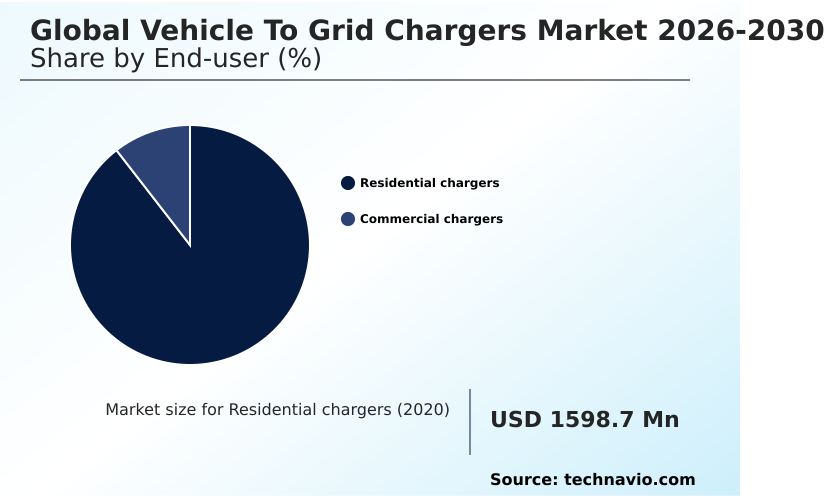
The residential chargers segment is estimated to witness significant growth during the forecast period.

The residential chargers segment within the Vehicle To Grid Chargers ecosystem empowers homeowners to utilize mobile battery assets dynamically.

These systems rely on advanced gallium nitride architectures and high-efficiency microinverter technology to facilitate continuous energy transfers between vehicles and electrical panels. By integrating time of use pricing and cloud hosted operations, residential networks intelligently optimize localized power consumption.

Implementations of these technologies have demonstrated that precise frequency regulation algorithms can reduce household utility expenditures by up to 15%. This measurable cost reduction accelerates the deployment of vehicle to home power configurations, ensuring resilience during grid failures.

Whether utilizing traditional galvanic connection interfaces or emerging inductive electromagnetic fields for non-contact power transfer, modern residential segmentation highlights a continuous operational shift toward automated, decentralized grid support mechanisms that maximize household energy efficiency.
Get Free Sample

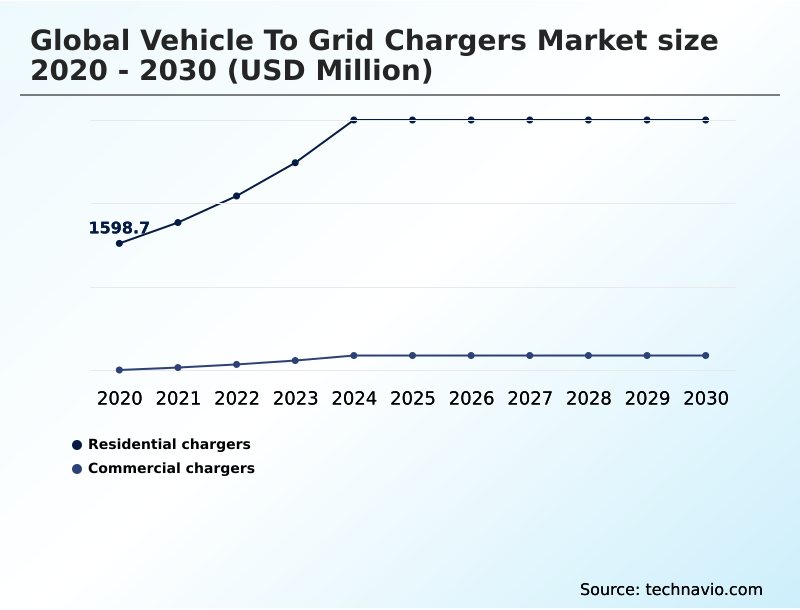
The Residential chargers segment was valued at USD 2.97 billion in 2024 and showed a gradual increase during the forecast period.
Get Free Sample

Regional Analysis

Europe is estimated to contribute 37.4% to the growth of the global market during the forecast period.Technavio’s analysts have elaborately explained the regional trends and drivers that shape the market during the forecast period.
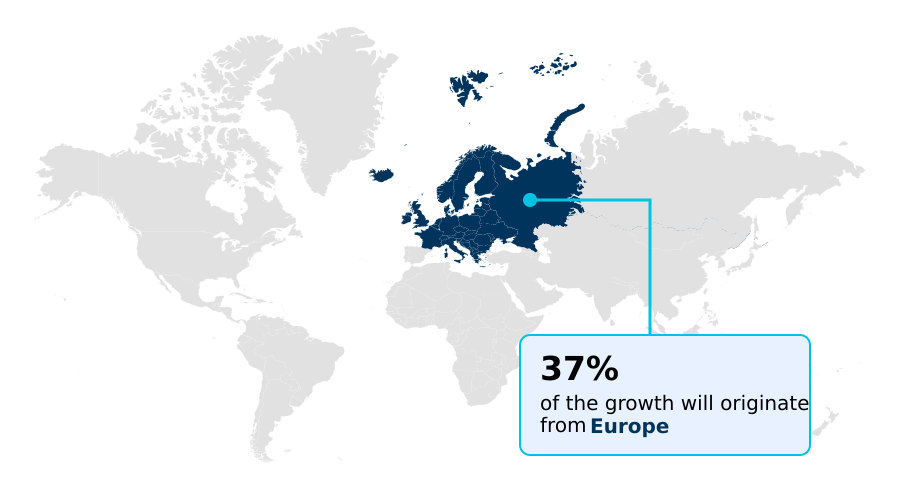
See How Vehicle To Grid Chargers Market Demand is Rising in Europe Get Free Sample

The geographic landscape of the Vehicle To Grid Chargers sector reveals distinct adoption pathways between Europe and North America based on regulatory structures.

Europe maintains a highly mature environment driven by stringent carbon neutrality timelines, where the elimination of duplicate utility taxation has boosted energy trading platforms participation by 40%.

This legal clarity accelerates the deployment of residential demand response systems utilizing bidirectional power electronics in urban centers.

In contrast, North America prioritizes heavy-duty direct current fast charging deployments to support extensive logistics networks, achieving a 20% higher operational efficiency gain in commercial peak management.

While European nations utilize widespread grid load balancing to offset renewable fluctuations, North American operators focus on localized microgrid aggregation projects to strengthen decentralized power networks.

These divergent strategies highlight how regional compliance directly drives energy vulnerability reduction and secures critical grid stabilization services.

Market Dynamics

Our researchers analyzed the data with 2025 as the base year, along with the key drivers, trends, and challenges. A holistic analysis of drivers will help companies refine their marketing strategies to gain a competitive advantage.

  • The ongoing evolution of the Vehicle To Grid Chargers landscape requires precise engineering to handle massive energy transfers efficiently. Manufacturers are heavily investing in silicon carbide power electronics integration to drastically reduce thermal waste and physical footprints compared to legacy components.
  • This architectural shift enables bidirectional alternating current direct current inverters to operate at elevated switching frequencies, achieving conversion efficiencies that surpass traditional systems by over 12%. Consequently, organizations engaging in commercial fleet depot peak shaving can deploy smaller, highly reliable hardware units to optimize their supply chain logistics.
  • Furthermore, the expansion of residential smart home energy management empowers consumers to capitalize on time of use dynamic utility tariffs, automatically discharging stored electricity when local demand peaks. This localized flexibility is crucial for vehicle to home backup power capabilities during severe blackouts.
  • To ensure absolute safety, utility interconnection safety disconnect switches are mandated across new installations to prevent hazardous islanding. As nations rapidly scale intermittent renewable energy storage absorption, operators rely on distributed energy resources grid stabilization to maintain voltage balance. The commercialization of dynamic frequency regulation ancillary services allows virtual power plant aggregator scalability to reach unprecedented levels.
  • Meanwhile, experimental inductive electromagnetic field wireless transmission prototypes are proving viability for autonomous fleets, and standardized smart grid protocol interoperability frameworks are finally unifying fragmented software networks. Additionally, sophisticated gallium nitride based microinverters efficiency enhancements and rigorous high voltage lithium ion battery cycling monitoring ensure that mobile energy assets remain protected during continuous grid support operations.
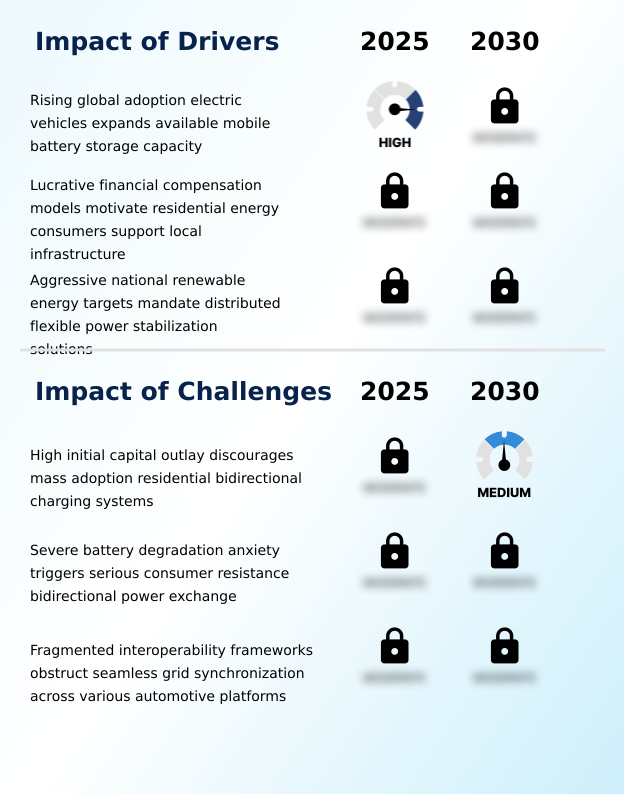
What are the key market drivers leading to the rise in the adoption of Vehicle To Grid Chargers Industry?

  • The rising global adoption of electric vehicles significantly expands the available mobile battery storage capacity, serving as the foundational driver for bidirectional infrastructure expansion.

  • The unprecedented surge in global electric vehicle adoption acts as the primary catalyst expanding the Vehicle To Grid Chargers market.
  • As millions of battery-powered vehicles deploy, they generate a massive reservoir of distributed storage assets that regional transmission organizations desperately need to balance intermittent renewable energy generation.
  • This structural shift allows utilities to defer capital-heavy stationary construction, lowering regional infrastructure deployment costs by up to 25%. Furthermore, integrating advanced telematics frameworks and alternating current inverters encourages consumers to support local power networks via wholesale electricity markets.
  • By utilizing bidirectional hardware to execute targeted peak shaving operations at a commercial fleet depot, operators have achieved a 15% improvement in demand charge mitigation.
  • These verifiable economic returns, coupled with strict adherence to electrical safety standards, establish distributed energy resources as highly profitable mechanisms for stabilizing the grid.

What are the market trends shaping the Vehicle To Grid Chargers Industry?

  • Automotive manufacturers are increasingly launching fully integrated, commercialized solutions that seamlessly bundle bidirectional vehicles with dynamic utility tariffs. This comprehensive approach simplifies the consumer purchasing journey and accelerates the deployment of intelligent energy ecosystems.

  • The transition toward fully integrated solutions is redefining the Vehicle To Grid Chargers ecosystem. Automotive manufacturers are increasingly bundling bidirectional hardware with dynamic electricity tariffs to eliminate purchasing friction and streamline smart grid protocols synchronization. This deployment strategy reduces system configuration downtime by 30%, allowing users to activate grid support functionalities immediately.
  • By incorporating advanced silicon carbide semiconductors into these bundled power conversion systems, manufacturers have enhanced power density and improved thermal energy dissipation by 18% compared to standard modules. This technological upgrade prevents severe heat buildup during operations, extending hardware lifespans significantly and boosting overall power transfer efficiency.
  • The seamless alignment of vehicles and the broader energy management ecosystem empowers consumers to engage safely in ancillary grid balancing. Consequently, this optimized approach yields a 15% increase in automated network slice participation across modernized smart energy management platforms.

What challenges does the Vehicle To Grid Chargers Industry face during its growth?

  • The high initial capital outlay associated with complex installations and specialized hardware significantly discourages the mass adoption of residential bidirectional charging systems.

  • Substantial initial capital requirements and complex installation prerequisites severely restrict the mass-market scalability of the Vehicle To Grid Chargers landscape. Deploying certified bidirectional infrastructure demands strict adherence to utility interconnection requirements, specialized metering, and robust circuit protection engines to prevent hazardous feedback during electrical distribution outages.
  • Integrating mandatory islanding prevention switches and advanced safety hardware elevates overall hardware retrofitting costs, which slows adoption rates across residential real estate by an estimated 15% compared to standard chargers. Additionally, persistent consumer anxiety regarding high voltage lithium ion battery degradation creates major behavioral resistance.
  • Vehicle owners frequently restrict grid access during continuous bidirectional cycling operations to preserve driving range, reducing the aggregate capacity available for virtual power plant aggregation programs by nearly 20%. Without unified interoperability, inadequate battery degradation monitoring causes a 12% drop in successful grid synchronization during peak events.

Exclusive Technavio Analysis on Customer Landscape

The vehicle to grid chargers market forecasting report includes the adoption lifecycle of the market, covering from the innovator’s stage to the laggard’s stage. It focuses on adoption rates in different regions based on penetration. Furthermore, the vehicle to grid chargers market report also includes key purchase criteria and drivers of price sensitivity to help companies evaluate and develop their market growth analysis strategies.
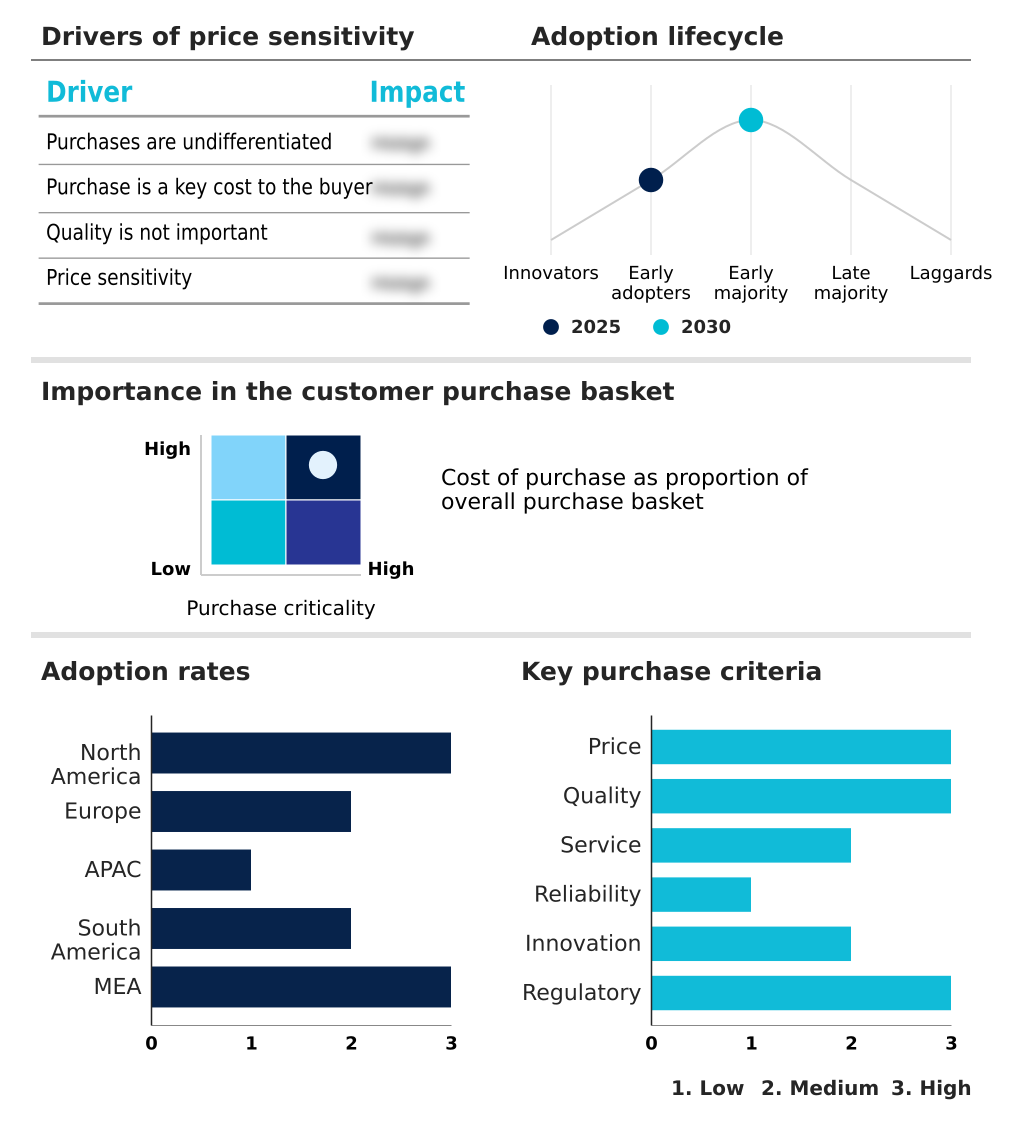
Customer Landscape of Vehicle To Grid Chargers Industry

Competitive Landscape

Companies are implementing various strategies, such as strategic alliances, vehicle to grid chargers market forecast, partnerships, mergers and acquisitions, geographical expansion, and product/service launches, to enhance their presence in the industry.

ABB Ltd. - The system delivers advanced bidirectional charging hardware that seamlessly integrates with utility networks, enabling efficient energy transfer for decentralized power stabilization and localized demand response management.

The industry research and growth report includes detailed analyses of the competitive landscape of the market and information about key companies, including:

  • ABB Ltd.
  • Blink Charging Co.
  • BorgWarner Inc.
  • ChargePoint Holdings Inc.
  • Circontrol S.A.
  • Delta Electronics Inc.
  • Eaton Corp. Plc
  • Emporia Energy Inc.
  • Enel Spa
  • Enel X Way S.r.l.
  • Fermata LLC
  • Hitachi Energy India Ltd.
  • IES Synergy
  • Ingeteam Corp. SA
  • Kempower Oyj
  • Nuvve Holding Corp.
  • Siemens AG
  • The Mobility House GmbH
  • Vestel Mobility
  • Wallbox NV

Qualitative and quantitative analysis of companies has been conducted to help clients understand the wider business environment as well as the strengths and weaknesses of key industry players. Data is qualitatively analyzed to categorize companies as pure play, category-focused, industry-focused, and diversified; it is quantitatively analyzed to categorize companies as dominant, leading, strong, tentative, and weak.

Recent Development and News in Vehicle to grid chargers market

  • In the Automotive Parts and Equipment industry, the rapid transition toward manufacturing high-density lithium-ion battery systems has increased mobile storage capacity, directly impacting Vehicle To Grid Chargers demand by requiring advanced bidirectional power electronics to manage large-scale energy transfer safely.
  • The widespread standardization of the ISO 15118-20 communication protocol across modern electric vehicle architectures has resolved historic multi-platform interoperability issues, accelerating the deployment of commercial fleet depot infrastructure and expanding virtual power plant capabilities by ensuring seamless software handshakes.
  • Regulatory mandates targeting carbon neutrality have forced component manufacturers to replace legacy insulated-gate bipolar transistors with advanced wide-bandgap semiconductors, enhancing thermal dissipation and improving overall power transfer efficiency for direct current fast charging terminals by over 18%.
  • The integration of non-contact inductive charging pads into next-generation vehicle chassis designs has eliminated physical connection wear, fostering new market opportunities for hands-free ancillary grid balancing systems and enabling automated ride-hailing fleets to participate in regional transmission networks without human intervention.

Dive into Technavio’s robust research methodology, blending expert interviews, extensive data synthesis, and validated models for unparalleled Vehicle To Grid Chargers Market insights. See full methodology.

Market Scope
Page number 296
Base year 2025
Historic period 2020-2024
Forecast period 2026-2030
Growth momentum & CAGR Accelerate at a CAGR of 25.9%
Market growth 2026-2030 USD 8682.6 million
Market structure Fragmented
YoY growth 2025-2026(%) 22.4%
Key countries US, Canada, Mexico, Germany, UK, France, Italy, Spain, The Netherlands, China, Japan, South Korea, India, Australia, Indonesia, Brazil, Argentina, Chile, UAE, Saudi Arabia, South Africa, Israel and Turkey
Competitive landscape Leading Companies, Market Positioning of Companies, Competitive Strategies, and Industry Risks

Request Free Sample

Research Analyst Overview

  • The continuous evolution of the Vehicle To Grid Chargers sector is fundamentally altering how modern utility networks manage peak load volatility and decentralized power distribution. The accelerated adoption of wide-bandgap architectures within charging hardware represents a major strategic shift for enterprise procurement boards, directly influencing infrastructure budgeting and long-term product lifecycle planning.
  • By utilizing these advanced materials, facility managers have achieved a 22% reduction in energy dissipation during intensive bidirectional power transfers. High-performance microinverter modules are systematically replacing outdated conversion systems, enabling smoother integration into complex commercial environments. Fleet operators actively utilize automated frequency algorithms to monetize idle battery capacity, transforming transportation overhead into a dynamic revenue stream.
  • The widespread implementation of standardized physical connection interfaces ensures robust electrical safety and maximum transmission reliability during heavy operational cycles. Robust telematics software allows energy aggregators to coordinate thousands of isolated vehicles simultaneously without risking localized transformer overloads. Continuous battery health monitoring remains critical to preserving vehicle residual value while executing continuous grid stabilization operations.

What are the Key Data Covered in this Vehicle To Grid Chargers Market Research and Growth Report?

  • What is the expected growth of the Vehicle To Grid Chargers Market between 2026 and 2030?

    • USD 8.68 billion, at a CAGR of 25.9%

  • What segmentation does the market report cover?

    • The report is segmented by End-user (Residential chargers, and Commercial chargers), Product Type (Wired, and Wireless), Type (AC charging, DC charging, and Hybrid) and Geography (North America, Europe, APAC, South America, Middle East and Africa)

  • Which regions are analyzed in the report?

    • North America, Europe, APAC, South America and Middle East and Africa

  • What are the key growth drivers and market challenges?

    • Rising global adoption electric vehicles expands available mobile battery storage capacity, High initial capital outlay discourages mass adoption residential bidirectional charging systems

  • Who are the major players in the Vehicle To Grid Chargers Market?

    • ABB Ltd., Blink Charging Co., BorgWarner Inc., ChargePoint Holdings Inc., Circontrol S.A., Delta Electronics Inc., Eaton Corp. Plc, Emporia Energy Inc., Enel Spa, Enel X Way S.r.l., Fermata LLC, Hitachi Energy India Ltd., IES Synergy, Ingeteam Corp. SA, Kempower Oyj, Nuvve Holding Corp., Siemens AG, The Mobility House GmbH, Vestel Mobility and Wallbox NV

Market Research Insights

  • The Vehicle To Grid Chargers market relies on advanced hardware to convert parked automotive fleets into valuable distributed storage assets. The integration of time of use tariff structures incentivizes users to optimize charging cycles, resulting in a 25% reduction in peak load electricity costs.
  • Commercial operators leveraging advanced energy trading software have reported a 15% improvement in overall utility cost mitigation. By adhering to standardized grid protocols, bidirectional networks seamlessly execute load balancing during critical electrical shortages. These coordinated deployments drastically lower energy vulnerability barriers for municipal transit agencies.
  • Modern infrastructure upgrades utilizing automated cloud systems ensure continuous performance monitoring, directly driving a 30% increase in power transfer efficiency compared to legacy unidirectional charging setups.

We can help! Our analysts can customize this vehicle to grid chargers market research report to meet your requirements.

Get in touch

1. Executive Summary

1.1 Market overview

Executive Summary - Chart on Market Overview
Executive Summary - Data Table on Market Overview
Executive Summary - Chart on Global Market Characteristics
Executive Summary - Chart on Market by Geography
Executive Summary - Chart on Market Segmentation by End-user
Executive Summary - Chart on Market Segmentation by Product Type
Executive Summary - Chart on Market Segmentation by Type
Executive Summary - Chart on Incremental Growth
Executive Summary - Data Table on Incremental Growth
Executive Summary - Chart on Company Market Positioning

2. Technavio Analysis

2.1 Analysis of price sensitivity, lifecycle, customer purchase basket, adoption rates, and purchase criteria

2.2 Criticality of inputs and Factors of differentiation

Chart on Overview on criticality of inputs and factors of differentiation

2.3 Factors of disruption

Chart on Overview on factors of disruption

2.4 Impact of drivers and challenges

Chart on Impact of drivers and challenges in 2025 and 2030

3. Market Landscape

3.1 Market ecosystem

Chart on Parent Market
Data Table on - Parent Market

3.2 Market characteristics

Chart on Market characteristics analysis

3.3 Value chain analysis

Chart on Value chain analysis

4. Market Sizing

4.1 Market definition

Data Table on Offerings of companies included in the market definition

4.2 Market segment analysis

Market segments

4.3 Market size 2025

4.4 Market outlook: Forecast for 2025-2030

Chart on Global - Market size and forecast 2025-2030 ($ million)
Data Table on Global - Market size and forecast 2025-2030 ($ million)
Chart on Global Market: Year-over-year growth 2025-2030 (%)
Data Table on Global Market: Year-over-year growth 2025-2030 (%)

5. Historic Market Size

5.1 Global Vehicle To Grid Chargers Market 2020 - 2024

Historic Market Size - Data Table on Global Vehicle To Grid Chargers Market 2020 - 2024 ($ million)

5.2 End-user segment analysis 2020 - 2024

Historic Market Size - End-user Segment 2020 - 2024 ($ million)

5.3 Product Type segment analysis 2020 - 2024

Historic Market Size - Product Type Segment 2020 - 2024 ($ million)

5.4 Type segment analysis 2020 - 2024

Historic Market Size - Type Segment 2020 - 2024 ($ million)

5.5 Geography segment analysis 2020 - 2024

Historic Market Size - Geography Segment 2020 - 2024 ($ million)

5.6 Country segment analysis 2020 - 2024

Historic Market Size - Country Segment 2020 - 2024 ($ million)

6. Qualitative Analysis

6.1 Impact of AI on global vehicle to grid chargers market

6.2 Impact of geopolitical conflicts on global vehicle to grid chargers market

7. Five Forces Analysis

7.1 Five forces summary

Five forces analysis - Comparison between 2025 and 2030

7.2 Bargaining power of buyers

Bargaining power of buyers - Impact of key factors 2025 and 2030

7.3 Bargaining power of suppliers

Bargaining power of suppliers - Impact of key factors in 2025 and 2030

7.4 Threat of new entrants

Threat of new entrants - Impact of key factors in 2025 and 2030

7.5 Threat of substitutes

Threat of substitutes - Impact of key factors in 2025 and 2030

7.6 Threat of rivalry

Threat of rivalry - Impact of key factors in 2025 and 2030

7.7 Market condition

Chart on Market condition - Five forces 2025 and 2030

8. Market Segmentation by End-user

8.1 Market segments

Chart on End-user - Market share 2025-2030 (%)
Data Table on End-user - Market share 2025-2030 (%)

8.2 Comparison by End-user

Chart on Comparison by End-user
Data Table on Comparison by End-user

8.3 Residential chargers - Market size and forecast 2025-2030

Chart on Residential chargers - Market size and forecast 2025-2030 ($ million)
Data Table on Residential chargers - Market size and forecast 2025-2030 ($ million)
Chart on Residential chargers - Year-over-year growth 2025-2030 (%)
Data Table on Residential chargers - Year-over-year growth 2025-2030 (%)

8.4 Commercial chargers - Market size and forecast 2025-2030

Chart on Commercial chargers - Market size and forecast 2025-2030 ($ million)
Data Table on Commercial chargers - Market size and forecast 2025-2030 ($ million)
Chart on Commercial chargers - Year-over-year growth 2025-2030 (%)
Data Table on Commercial chargers - Year-over-year growth 2025-2030 (%)

8.5 Market opportunity by End-user

Market opportunity by End-user ($ million)
Data Table on Market opportunity by End-user ($ million)

9. Market Segmentation by Product Type

9.1 Market segments

Chart on Product Type - Market share 2025-2030 (%)
Data Table on Product Type - Market share 2025-2030 (%)

9.2 Comparison by Product Type

Chart on Comparison by Product Type
Data Table on Comparison by Product Type

9.3 Wired - Market size and forecast 2025-2030

Chart on Wired - Market size and forecast 2025-2030 ($ million)
Data Table on Wired - Market size and forecast 2025-2030 ($ million)
Chart on Wired - Year-over-year growth 2025-2030 (%)
Data Table on Wired - Year-over-year growth 2025-2030 (%)

9.4 Wireless - Market size and forecast 2025-2030

Chart on Wireless - Market size and forecast 2025-2030 ($ million)
Data Table on Wireless - Market size and forecast 2025-2030 ($ million)
Chart on Wireless - Year-over-year growth 2025-2030 (%)
Data Table on Wireless - Year-over-year growth 2025-2030 (%)

9.5 Market opportunity by Product Type

Market opportunity by Product Type ($ million)
Data Table on Market opportunity by Product Type ($ million)

10. Market Segmentation by Type

10.1 Market segments

Chart on Type - Market share 2025-2030 (%)
Data Table on Type - Market share 2025-2030 (%)

10.2 Comparison by Type

Chart on Comparison by Type
Data Table on Comparison by Type

10.3 AC charging - Market size and forecast 2025-2030

Chart on AC charging - Market size and forecast 2025-2030 ($ million)
Data Table on AC charging - Market size and forecast 2025-2030 ($ million)
Chart on AC charging - Year-over-year growth 2025-2030 (%)
Data Table on AC charging - Year-over-year growth 2025-2030 (%)

10.4 DC charging - Market size and forecast 2025-2030

Chart on DC charging - Market size and forecast 2025-2030 ($ million)
Data Table on DC charging - Market size and forecast 2025-2030 ($ million)
Chart on DC charging - Year-over-year growth 2025-2030 (%)
Data Table on DC charging - Year-over-year growth 2025-2030 (%)

10.5 Hybrid - Market size and forecast 2025-2030

Chart on Hybrid - Market size and forecast 2025-2030 ($ million)
Data Table on Hybrid - Market size and forecast 2025-2030 ($ million)
Chart on Hybrid - Year-over-year growth 2025-2030 (%)
Data Table on Hybrid - Year-over-year growth 2025-2030 (%)

10.6 Market opportunity by Type

Market opportunity by Type ($ million)
Data Table on Market opportunity by Type ($ million)

11. Customer Landscape

11.1 Customer landscape overview

Analysis of price sensitivity, lifecycle, customer purchase basket, adoption rates, and purchase criteria

12. Geographic Landscape

12.1 Geographic segmentation

Chart on Market share by geography 2025-2030 (%)
Data Table on Market share by geography 2025-2030 (%)

12.2 Geographic comparison

Chart on Geographic comparison
Data Table on Geographic comparison

12.3 North America - Market size and forecast 2025-2030

Chart on North America - Market size and forecast 2025-2030 ($ million)
Data Table on North America - Market size and forecast 2025-2030 ($ million)
Chart on North America - Year-over-year growth 2025-2030 (%)
Data Table on North America - Year-over-year growth 2025-2030 (%)
Chart on Regional Comparison - North America
Data Table on Regional Comparison - North America

12.3.1 US - Market size and forecast 2025-2030

Chart on US - Market size and forecast 2025-2030 ($ million)
Data Table on US - Market size and forecast 2025-2030 ($ million)
Chart on US - Year-over-year growth 2025-2030 (%)
Data Table on US - Year-over-year growth 2025-2030 (%)

12.3.2 Canada - Market size and forecast 2025-2030

Chart on Canada - Market size and forecast 2025-2030 ($ million)
Data Table on Canada - Market size and forecast 2025-2030 ($ million)
Chart on Canada - Year-over-year growth 2025-2030 (%)
Data Table on Canada - Year-over-year growth 2025-2030 (%)

12.3.3 Mexico - Market size and forecast 2025-2030

Chart on Mexico - Market size and forecast 2025-2030 ($ million)
Data Table on Mexico - Market size and forecast 2025-2030 ($ million)
Chart on Mexico - Year-over-year growth 2025-2030 (%)
Data Table on Mexico - Year-over-year growth 2025-2030 (%)

12.4 Europe - Market size and forecast 2025-2030

Chart on Europe - Market size and forecast 2025-2030 ($ million)
Data Table on Europe - Market size and forecast 2025-2030 ($ million)
Chart on Europe - Year-over-year growth 2025-2030 (%)
Data Table on Europe - Year-over-year growth 2025-2030 (%)
Chart on Regional Comparison - Europe
Data Table on Regional Comparison - Europe

12.4.1 Germany - Market size and forecast 2025-2030

Chart on Germany - Market size and forecast 2025-2030 ($ million)
Data Table on Germany - Market size and forecast 2025-2030 ($ million)
Chart on Germany - Year-over-year growth 2025-2030 (%)
Data Table on Germany - Year-over-year growth 2025-2030 (%)

12.4.2 UK - Market size and forecast 2025-2030

Chart on UK - Market size and forecast 2025-2030 ($ million)
Data Table on UK - Market size and forecast 2025-2030 ($ million)
Chart on UK - Year-over-year growth 2025-2030 (%)
Data Table on UK - Year-over-year growth 2025-2030 (%)

12.4.3 France - Market size and forecast 2025-2030

Chart on France - Market size and forecast 2025-2030 ($ million)
Data Table on France - Market size and forecast 2025-2030 ($ million)
Chart on France - Year-over-year growth 2025-2030 (%)
Data Table on France - Year-over-year growth 2025-2030 (%)

12.4.4 Italy - Market size and forecast 2025-2030

Chart on Italy - Market size and forecast 2025-2030 ($ million)
Data Table on Italy - Market size and forecast 2025-2030 ($ million)
Chart on Italy - Year-over-year growth 2025-2030 (%)
Data Table on Italy - Year-over-year growth 2025-2030 (%)

12.4.5 Spain - Market size and forecast 2025-2030

Chart on Spain - Market size and forecast 2025-2030 ($ million)
Data Table on Spain - Market size and forecast 2025-2030 ($ million)
Chart on Spain - Year-over-year growth 2025-2030 (%)
Data Table on Spain - Year-over-year growth 2025-2030 (%)

12.4.6 The Netherlands - Market size and forecast 2025-2030

Chart on The Netherlands - Market size and forecast 2025-2030 ($ million)
Data Table on The Netherlands - Market size and forecast 2025-2030 ($ million)
Chart on The Netherlands - Year-over-year growth 2025-2030 (%)
Data Table on The Netherlands - Year-over-year growth 2025-2030 (%)

12.5 APAC - Market size and forecast 2025-2030

Chart on APAC - Market size and forecast 2025-2030 ($ million)
Data Table on APAC - Market size and forecast 2025-2030 ($ million)
Chart on APAC - Year-over-year growth 2025-2030 (%)
Data Table on APAC - Year-over-year growth 2025-2030 (%)
Chart on Regional Comparison - APAC
Data Table on Regional Comparison - APAC

12.5.1 China - Market size and forecast 2025-2030

Chart on China - Market size and forecast 2025-2030 ($ million)
Data Table on China - Market size and forecast 2025-2030 ($ million)
Chart on China - Year-over-year growth 2025-2030 (%)
Data Table on China - Year-over-year growth 2025-2030 (%)

12.5.2 Japan - Market size and forecast 2025-2030

Chart on Japan - Market size and forecast 2025-2030 ($ million)
Data Table on Japan - Market size and forecast 2025-2030 ($ million)
Chart on Japan - Year-over-year growth 2025-2030 (%)
Data Table on Japan - Year-over-year growth 2025-2030 (%)

12.5.3 South Korea - Market size and forecast 2025-2030

Chart on South Korea - Market size and forecast 2025-2030 ($ million)
Data Table on South Korea - Market size and forecast 2025-2030 ($ million)
Chart on South Korea - Year-over-year growth 2025-2030 (%)
Data Table on South Korea - Year-over-year growth 2025-2030 (%)

12.5.4 India - Market size and forecast 2025-2030

Chart on India - Market size and forecast 2025-2030 ($ million)
Data Table on India - Market size and forecast 2025-2030 ($ million)
Chart on India - Year-over-year growth 2025-2030 (%)
Data Table on India - Year-over-year growth 2025-2030 (%)

12.5.5 Australia - Market size and forecast 2025-2030

Chart on Australia - Market size and forecast 2025-2030 ($ million)
Data Table on Australia - Market size and forecast 2025-2030 ($ million)
Chart on Australia - Year-over-year growth 2025-2030 (%)
Data Table on Australia - Year-over-year growth 2025-2030 (%)

12.5.6 Indonesia - Market size and forecast 2025-2030

Chart on Indonesia - Market size and forecast 2025-2030 ($ million)
Data Table on Indonesia - Market size and forecast 2025-2030 ($ million)
Chart on Indonesia - Year-over-year growth 2025-2030 (%)
Data Table on Indonesia - Year-over-year growth 2025-2030 (%)

12.6 South America - Market size and forecast 2025-2030

Chart on South America - Market size and forecast 2025-2030 ($ million)
Data Table on South America - Market size and forecast 2025-2030 ($ million)
Chart on South America - Year-over-year growth 2025-2030 (%)
Data Table on South America - Year-over-year growth 2025-2030 (%)
Chart on Regional Comparison - South America
Data Table on Regional Comparison - South America

12.6.1 Brazil - Market size and forecast 2025-2030

Chart on Brazil - Market size and forecast 2025-2030 ($ million)
Data Table on Brazil - Market size and forecast 2025-2030 ($ million)
Chart on Brazil - Year-over-year growth 2025-2030 (%)
Data Table on Brazil - Year-over-year growth 2025-2030 (%)

12.6.2 Argentina - Market size and forecast 2025-2030

Chart on Argentina - Market size and forecast 2025-2030 ($ million)
Data Table on Argentina - Market size and forecast 2025-2030 ($ million)
Chart on Argentina - Year-over-year growth 2025-2030 (%)
Data Table on Argentina - Year-over-year growth 2025-2030 (%)

12.6.3 Chile - Market size and forecast 2025-2030

Chart on Chile - Market size and forecast 2025-2030 ($ million)
Data Table on Chile - Market size and forecast 2025-2030 ($ million)
Chart on Chile - Year-over-year growth 2025-2030 (%)
Data Table on Chile - Year-over-year growth 2025-2030 (%)

12.7 Middle East and Africa - Market size and forecast 2025-2030

Chart on Middle East and Africa - Market size and forecast 2025-2030 ($ million)
Data Table on Middle East and Africa - Market size and forecast 2025-2030 ($ million)
Chart on Middle East and Africa - Year-over-year growth 2025-2030 (%)
Data Table on Middle East and Africa - Year-over-year growth 2025-2030 (%)
Chart on Regional Comparison - Middle East and Africa
Data Table on Regional Comparison - Middle East and Africa

12.7.1 UAE - Market size and forecast 2025-2030

Chart on UAE - Market size and forecast 2025-2030 ($ million)
Data Table on UAE - Market size and forecast 2025-2030 ($ million)
Chart on UAE - Year-over-year growth 2025-2030 (%)
Data Table on UAE - Year-over-year growth 2025-2030 (%)

12.7.2 Saudi Arabia - Market size and forecast 2025-2030

Chart on Saudi Arabia - Market size and forecast 2025-2030 ($ million)
Data Table on Saudi Arabia - Market size and forecast 2025-2030 ($ million)
Chart on Saudi Arabia - Year-over-year growth 2025-2030 (%)
Data Table on Saudi Arabia - Year-over-year growth 2025-2030 (%)

12.7.3 South Africa - Market size and forecast 2025-2030

Chart on South Africa - Market size and forecast 2025-2030 ($ million)
Data Table on South Africa - Market size and forecast 2025-2030 ($ million)
Chart on South Africa - Year-over-year growth 2025-2030 (%)
Data Table on South Africa - Year-over-year growth 2025-2030 (%)

12.7.4 Israel - Market size and forecast 2025-2030

Chart on Israel - Market size and forecast 2025-2030 ($ million)
Data Table on Israel - Market size and forecast 2025-2030 ($ million)
Chart on Israel - Year-over-year growth 2025-2030 (%)
Data Table on Israel - Year-over-year growth 2025-2030 (%)

12.7.5 Turkey - Market size and forecast 2025-2030

Chart on Turkey - Market size and forecast 2025-2030 ($ million)
Data Table on Turkey - Market size and forecast 2025-2030 ($ million)
Chart on Turkey - Year-over-year growth 2025-2030 (%)
Data Table on Turkey - Year-over-year growth 2025-2030 (%)

12.8 Market opportunity by geography

Market opportunity by geography ($ million)
Data Tables on Market opportunity by geography ($ million)

13. Drivers, Challenges, and Opportunity

13.1 Market drivers

Rising global adoption electric vehicles expands available mobile battery storage capacity
Lucrative financial compensation models motivate residential energy consumers support local infrastructure
Aggressive national renewable energy targets mandate distributed flexible power stabilization solutions

13.2 Market challenges

High initial capital outlay discourages mass adoption residential bidirectional charging systems
Severe battery degradation anxiety triggers serious consumer resistance bidirectional power exchange
Fragmented interoperability frameworks obstruct seamless grid synchronization across various automotive platforms

13.3 Impact of drivers and challenges

Impact of drivers and challenges in 2025 and 2030

13.4 Market opportunities

Automotive manufacturers launch fully integrated commercialized solutions bundling dynamic tariffs vehicles
Widespread integration advanced silicon carbide inverters minimizes thermal energy dissipation efficiency
Legislative reforms eradicate double taxation levies distributed energy storage infrastructure integration

14. Competitive Landscape

14.1 Overview

14.2

Overview on criticality of inputs and factors of differentiation

14.3 Landscape disruption

Overview on factors of disruption

14.4 Industry risks

Impact of key risks on business

15. Competitive Analysis

15.1 Companies profiled

Companies covered

15.2 Company ranking index

15.3 Market positioning of companies

Matrix on companies position and classification

15.4 ABB Ltd.

ABB Ltd. - Overview
ABB Ltd. - Business segments
ABB Ltd. - Key news
ABB Ltd. - Key offerings
ABB Ltd. - Segment focus
SWOT

15.5 Blink Charging Co.

Blink Charging Co. - Overview
Blink Charging Co. - Product / Service
Blink Charging Co. - Key news
Blink Charging Co. - Key offerings
SWOT

15.6 BorgWarner Inc.

BorgWarner Inc. - Overview
BorgWarner Inc. - Business segments
BorgWarner Inc. - Key offerings
BorgWarner Inc. - Segment focus
SWOT

15.7 ChargePoint Holdings Inc.

ChargePoint Holdings Inc. - Overview
ChargePoint Holdings Inc. - Business segments
ChargePoint Holdings Inc. - Key news
ChargePoint Holdings Inc. - Key offerings
ChargePoint Holdings Inc. - Segment focus
SWOT

15.8 Delta Electronics Inc.

Delta Electronics Inc. - Overview
Delta Electronics Inc. - Business segments
Delta Electronics Inc. - Key offerings
Delta Electronics Inc. - Segment focus
SWOT

15.9 Eaton Corp. Plc

Eaton Corp. Plc - Overview
Eaton Corp. Plc - Business segments
Eaton Corp. Plc - Key news
Eaton Corp. Plc - Key offerings
Eaton Corp. Plc - Segment focus
SWOT

15.10 Emporia Energy Inc.

Emporia Energy Inc. - Overview
Emporia Energy Inc. - Product / Service
Emporia Energy Inc. - Key offerings
SWOT

15.11 Enel Spa

Enel Spa - Overview
Enel Spa - Business segments
Enel Spa - Key offerings
Enel Spa - Segment focus
SWOT

15.12 Enel X Way S.r.l.

Enel X Way S.r.l. - Overview
Enel X Way S.r.l. - Product / Service
Enel X Way S.r.l. - Key offerings
SWOT

15.13 Hitachi Energy India Ltd.

Hitachi Energy India Ltd. - Overview
Hitachi Energy India Ltd. - Product / Service
Hitachi Energy India Ltd. - Key offerings
SWOT

15.14 IES Synergy

IES Synergy - Overview
IES Synergy - Product / Service
IES Synergy - Key offerings
SWOT

15.15 Ingeteam Corp. SA

Ingeteam Corp. SA - Overview
Ingeteam Corp. SA - Product / Service
Ingeteam Corp. SA - Key offerings
SWOT

15.16 Kempower Oyj

Kempower Oyj - Overview
Kempower Oyj - Product / Service
Kempower Oyj - Key offerings
SWOT

15.17 Siemens AG

Siemens AG - Overview
Siemens AG - Business segments
Siemens AG - Key news
Siemens AG - Key offerings
Siemens AG - Segment focus
SWOT

15.18 Wallbox NV

Wallbox NV - Overview
Wallbox NV - Business segments
Wallbox NV - Key offerings
Wallbox NV - Segment focus
SWOT

16. Appendix

16.1 Scope of the report

Market definition
Objectives
Notes and caveats

16.2 Inclusions and exclusions checklist

Inclusions checklist
Exclusions checklist

16.3 Currency conversion rates for US$

16.4 Research methodology

16.5 Data procurement

Information sources

16.6 Data validation

16.7 Validation techniques employed for market sizing

16.8 Data synthesis

16.9 360 degree market analysis

16.10 List of abbreviations

Research Methodology

Technavio presents a detailed picture of the market by way of study, synthesis, and summation of data from multiple sources. The analysts have presented the various facets of the market with a particular focus on identifying the key industry influencers. The data thus presented is comprehensive, reliable, and the result of extensive research, both primary and secondary.

INFORMATION SOURCES

Primary sources

  • Manufacturers and suppliers
  • Channel partners
  • Industry experts
  • Strategic decision makers

Secondary sources

  • Industry journals and periodicals
  • Government data
  • Financial reports of key industry players
  • Historical data
  • Press releases

DATA ANALYSIS

Data Synthesis

  • Collation of data
  • Estimation of key figures
  • Analysis of derived insights

Data Validation

  • Triangulation with data models
  • Reference against proprietary databases
  • Corroboration with industry experts

REPORT WRITING

Qualitative

  • Market drivers
  • Market challenges
  • Market trends
  • Five forces analysis

Quantitative

  • Market size and forecast
  • Market segmentation
  • Geographical insights
  • Competitive landscape

Interested in this report?

Get your sample now to see our research methodology and insights!

Download Now

Frequently Asked Questions

Vehicle To Grid Chargers market growth will increase by USD 8682.6 million during 2026-2030.

The Vehicle To Grid Chargers market is expected to grow at a CAGR of 25.9% during 2026-2030.

Vehicle To Grid Chargers market is segmented by End-user (Residential chargers, Commercial chargers) Product type (Wired, Wireless) Type (AC charging, DC charging, Hybrid)

ABB Ltd., Blink Charging Co., BorgWarner Inc., ChargePoint Holdings Inc., Circontrol S.A., Delta Electronics Inc., Eaton Corp. Plc, Emporia Energy Inc., Enel Spa, Enel X Way S.r.l., Fermata LLC, Hitachi Energy India Ltd., IES Synergy, Ingeteam Corp. SA, Kempower Oyj, Nuvve Holding Corp., Siemens AG, The Mobility House GmbH, Vestel Mobility, Wallbox NV are a few of the key vendors in the Vehicle To Grid Chargers market.

Europe will register the highest growth rate of 37.4% among the other regions. Therefore, the Vehicle To Grid Chargers market in Europe is expected to garner significant business opportunities for the vendors during the forecast period.

US, Canada, Mexico, Germany, UK, France, Italy, Spain, The Netherlands, China, Japan, South Korea, India, Australia, Indonesia, Brazil, Argentina, Chile, UAE, Saudi Arabia, South Africa, Israel, Turkey

  • Rising global adoption electric vehicles expands available mobile battery storage capacity is the driving factor this market.

The Vehicle To Grid Chargers market vendors should focus on grabbing business opportunities from the End-user segment as it accounted for the largest market share in the base year.
RIA - Research AI Assistant
Ask RIA