



Voice Assistant Application Market Size 2025-2029
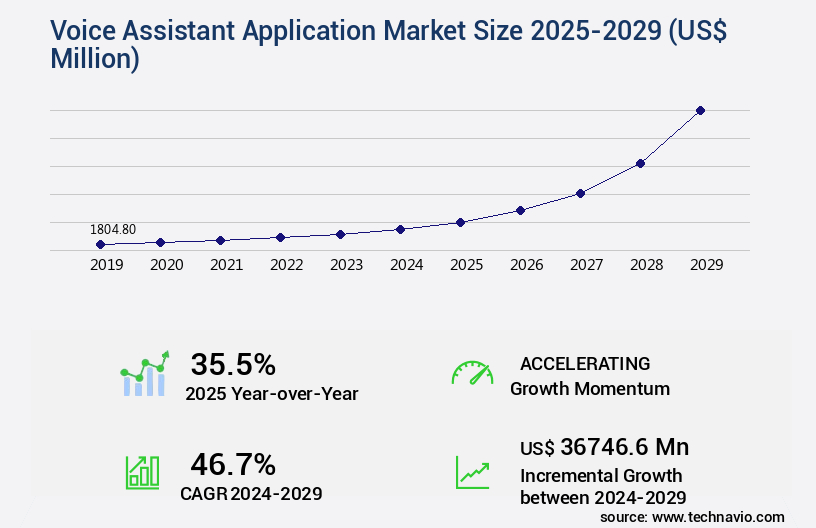
The voice assistant application market size is valued to increase USD 36.75 billion, at a CAGR of 46.7% from 2024 to 2029. Digital transformation will drive the voice assistant application market.
Major Market Trends & Insights
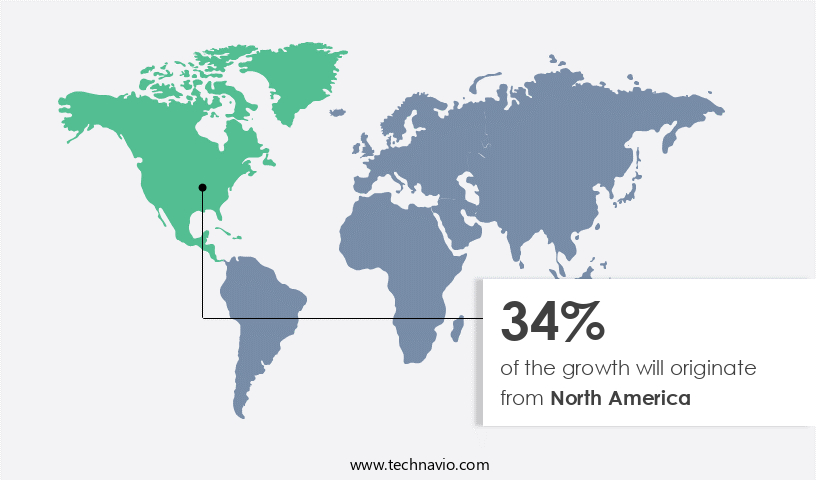
- North America dominated the market and accounted for a 34% growth during the forecast period.
- By Application - Individual users segment was valued at USD 873.00 billion in 2023
- By Deployment - Cloud segment accounted for the largest market revenue share in 2023
Market Size & Forecast
- Market Opportunities: USD 2.00 million
- Market Future Opportunities: USD 36746.60 million
- CAGR from 2024 to 2029 : 46.7%
Market Summary
- The market represents a dynamic and rapidly evolving industry, driven by the integration of core technologies such as natural language processing, machine learning, and speech recognition. Applications of voice assistants span various sectors, including home automation, customer service, and healthcare, among others. According to recent market data, the voice assistant market is experiencing significant growth, with an estimated 30% of US households expected to own a smart speaker by 2024. However, the market is not without challenges. Data privacy and security concerns associated with voice assistant applications continue to be a major concern for consumers and regulators alike.
- Despite these challenges, the voice assistant market presents numerous opportunities, particularly in the context of the growing demand for smart homes and the development of smart cities. Digital transformation is a key driver, as businesses seek to enhance customer experiences and streamline operations through voice-enabled solutions.
What will be the Size of the Voice Assistant Application Market during the forecast period?
Get Key Insights on Market Forecast (PDF) Request Free Sample
How is the Voice Assistant Application Market Segmented ?
The voice assistant application industry research report provides comprehensive data (region-wise segment analysis), with forecasts and estimates in "USD million" for the period 2025-2029, as well as historical data from 2019-2023 for the following segments.
- Application
- Individual users
- SMEs
- Large enterprises
- Deployment
- Cloud
- On-premise
- Technology
- Speech recognition
- Text-to-speech
- Natural language processing
- End-user
- IT and telecom
- Retail and E-commerce
- BFSI
- Healthcare
- Others
- Geography
- North America
- US
- Canada
- Europe
- France
- Germany
- Italy
- UK
- APAC
- China
- India
- Japan
- South Korea
- Rest of World (ROW)
- North America
By Application Insights
The individual users segment is estimated to witness significant growth during the forecast period.
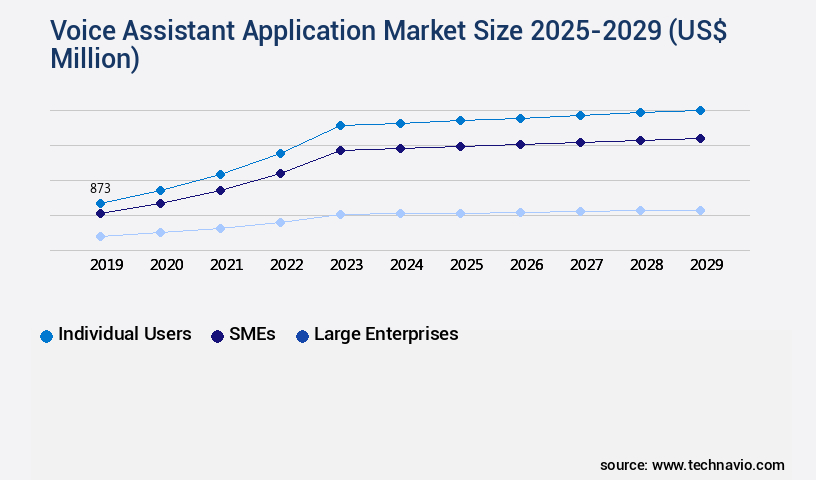
Voice assistant applications have seen significant growth in recent years, with individual users leading the charge. This segment is projected to expand at a brisk pace, fueled by the increasing adoption of smartphones and smart-connected devices. The proliferation of digital content platforms, such as over-the-top (OTT) services, and the rising popularity of online gaming among individuals are key drivers for this growth. Advanced features in smartphones and PCs, like speech-to-text and voice commands for gaming, are enticing users to adopt sophisticated voice assistant application software and services. Moreover, the integration of deep learning algorithms, natural language processing, and conversational AI in voice assistant applications has revolutionized user interface design.
These technologies enable more accurate speech recognition, intent recognition, and personalization features, making voice assistants an indispensable tool for users. Furthermore, multi-modal interaction, location services, and proactive assistance are becoming increasingly popular, adding to the functionality and value of voice assistants. The market for voice assistant applications is also witnessing advancements in model training, API integration, and platform scalability. Neural networks and machine learning models are being employed to enhance the overall performance and efficiency of voice assistants. Additionally, security protocols, cloud infrastructure, and dialogue management are being prioritized to ensure user privacy and data protection. Voice assistant applications are also expanding their capabilities beyond music playback and information retrieval.
They now offer news updates, weather forecasts, calendar integration, task automation, reminder setting, and even smart home integration. As the market continues to evolve, we can expect further advancements in voice synthesis, translation services, search functionality, contextual awareness, and task automation. The future looks bright for the market, with industry experts predicting a substantial expansion. According to recent estimates, the market is poised to grow by approximately 25% in the next year, and around 30% in the following year. The integration of voice assistants in IoT devices, the increasing adoption of voice-activated devices in various industries, and the continuous advancements in voice recognition technology are expected to contribute to this growth.
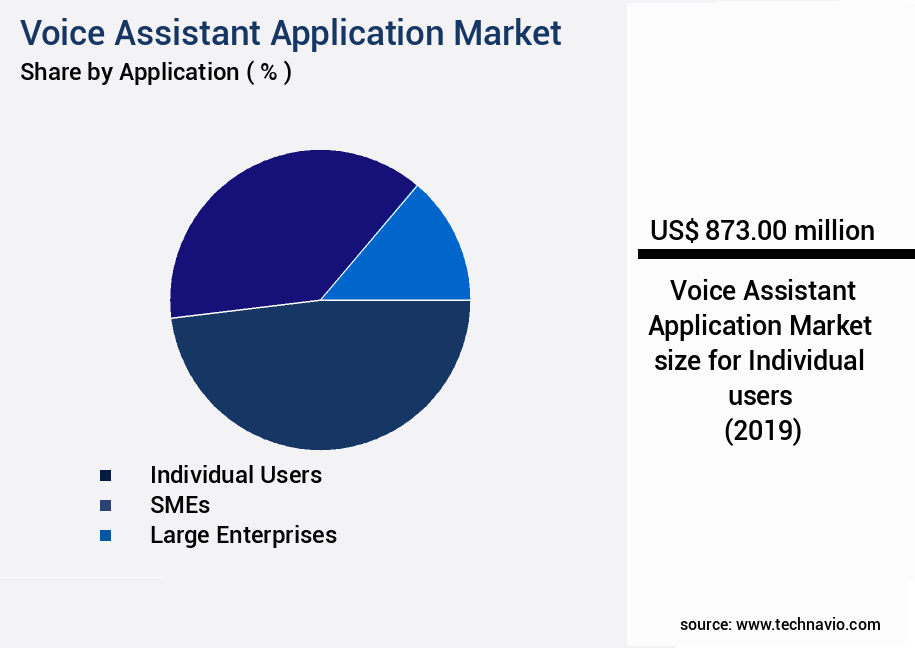
The Individual users segment was valued at USD 873.00 billion in 2019 and showed a gradual increase during the forecast period.
In conclusion, the market is a dynamic and evolving space, with ongoing advancements in technology and increasing user adoption driving its growth. From individual users to businesses, voice assistants are becoming an essential tool for managing daily tasks, accessing information, and enhancing productivity. The future holds immense potential for this market, with numerous opportunities for innovation and expansion.
Regional Analysis
North America is estimated to contribute 34% to the growth of the global market during the forecast period. Technavio's analysts have elaborately explained the regional trends and drivers that shape the market during the forecast period.
See How Voice Assistant Application Market Demand is Rising in North America Request Free Sample
The market in the US and Canada is experiencing significant growth, with these countries being the major revenue contributors in the region. End-user industries, including automotive, retail, healthcare, media and entertainment, hospitality, and BFSI, are increasingly adopting voice assistant applications to enhance their business operations and gain a competitive edge. Individual users are also embracing voice assistant technology for their homes. Key drivers for market expansion include the adoption of vehicle-to-everything (V2X) communication systems and advanced technologies like 5G, as well as the growing production of autonomous vehicles.
This market's continuous evolution reflects the increasing importance of voice technology in streamlining processes and improving overall efficiency.
Market Dynamics
Our researchers analyzed the data with 2024 as the base year, along with the key drivers, trends, and challenges. A holistic analysis of drivers will help companies refine their marketing strategies to gain a competitive advantage.
The market is experiencing significant growth as businesses and consumers increasingly adopt contextual understanding in their voice assistants for more efficient and personalized interactions. Multi-lingual support and proactive assistance features are becoming essential implementations, enabling seamless communication across languages and cultures. Voice assistant integration with smart home devices is another key trend, enhancing user convenience and streamlining daily tasks. Improving speech recognition accuracy models and designing intuitive voice user interfaces are critical focus areas for developers, ensuring user engagement and satisfaction. Building robust dialogue management systems is essential to handle complex queries and errors gracefully, maintaining a positive user experience.
Measuring user engagement and implementing personalization strategies are also vital for voice assistant applications, as users demand more tailored interactions. Advanced speech recognition techniques and natural language understanding are essential for handling complex tasks, optimizing performance, and resource constraints. Developing voice assistants for specific hardware platforms and creating engaging personalities are also essential components of successful voice assistant applications. Accessibility features are increasingly important to cater to diverse user needs, ensuring a more inclusive user experience. According to market information, adoption rates for voice assistants in the consumer segment are significantly higher than in the enterprise sector. Over 80% of new voice assistant developments focus on consumer applications, indicating a clear market trend towards mass adoption.
This trend is driven by the growing availability of affordable voice assistant devices and increasing consumer familiarity with the technology. Despite this dominance, the enterprise sector still holds substantial potential for growth, as businesses seek to improve operational efficiency and enhance customer service through voice assistant integration.
The voice assistant application market is experiencing rapid growth, driven by advancements in natural language processing, edge computing, and user-centric design. A critical area of innovation is contextual understanding in voice assistants, which enables systems to maintain coherent conversations, interpret user intent across multiple interactions, and respond appropriately based on situational context. This level of intelligence significantly enhances usability and trust.
As global adoption increases, multi-lingual support voice assistants have become essential, allowing users to interact in their preferred languages and dialects. This not only improves accessibility but also expands market reach for developers and device manufacturers.
To go beyond reactive commands, companies are now focusing on proactive assistance features implementation. These features allow voice assistants to anticipate user needs—such as reminders, traffic updates, or energy-saving suggestions—based on behavioral patterns and contextual data.
One of the most important growth areas is voice assistant integration with smart home devices. From lighting and thermostats to security systems and kitchen appliances, seamless interoperability with smart home ecosystems is reshaping daily living and boosting consumer reliance on voice-driven interfaces.
Understanding user interaction patterns is key to continuous improvement. As such, measuring user engagement virtual assistants provides insights into feature usage, drop-off points, and satisfaction levels, enabling teams to refine voice applications and prioritize future development.
Personalization strategies voice assistant applications are becoming increasingly sophisticated. By leveraging user preferences, history, and contextual cues, voice assistants can deliver tailored responses, suggest relevant content, and create more human-like interactions.
Equally important is handling user errors gracefully voice interfaces. Whether through gentle corrections, alternative suggestions, or fallback mechanisms, designing for error tolerance ensures smoother user experiences and reduces frustration, particularly in noisy environments or with complex queries.
As the voice assistant application market continues to mature, success will depend on blending advanced technology with user-centered design principles to create intuitive, inclusive, and proactive digital experiences.
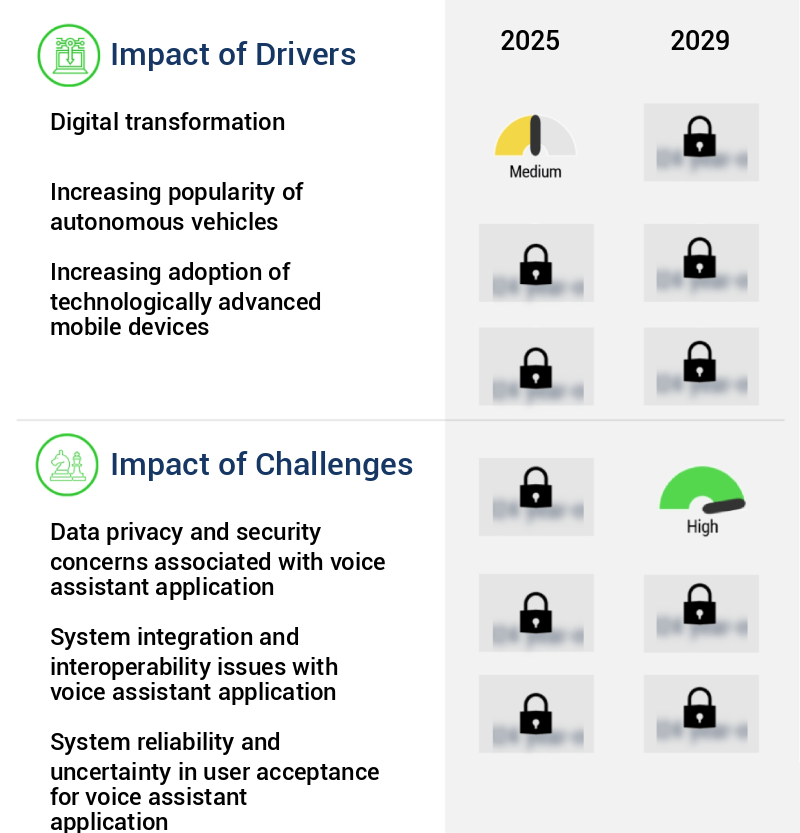
What are the key market drivers leading to the rise in the adoption of Voice Assistant Application Industry?
- Digital transformation serves as the primary catalyst for market growth, driving businesses to adapt and innovate through the integration of advanced technologies.
- The market experiences significant expansion across sectors, including Internet services, telecommunication, BFSI, healthcare, and media and entertainment. In the telecommunication industry, the integration of 4G and 5G technology fosters increased user connectivity to high-speed Internet. Advanced Internet technologies, such as high-speed broadband and VoIP services on mobile phones, alter user preferences for Internet services and accelerate technology adoption. Voice assistants offer various features, including text messaging, free calling, video conferencing, and television on mobile devices.
- This market's growth is a result of digital transformation and the integration of advanced technologies in various industries.
What are the market trends shaping the Voice Assistant Application Industry?
- The increasing demand for smart homes and the development of smart cities represent a significant market trend in the contemporary landscape of technology.
- The smart home market is experiencing significant growth as consumers prioritize convenience with electronic devices. Voice assistant applications are increasingly used in home appliances, responding to human commands. The smart home concept holds the highest penetration in North America and Europe, with developing economies in APAC also embracing it. For instance, Godrej Interio, a subsidiary of Godrej Industries Ltd., is developing connected homes in India, anticipating gradual adoption. Amazon Alexa, Amazon's intelligent personal assistant, facilitates voice-enabled control of smart home devices, underscoring the market's dynamism.
- The North American and European markets lead in smart home adoption, while APAC markets are gaining traction. The adoption rate in India is expected to increase, though it may take some time to reach significant levels. This shift towards smart homes reflects the evolving needs and preferences of consumers, with technology playing a pivotal role in enhancing convenience and efficiency.
What challenges does the Voice Assistant Application Industry face during its growth?
- The voice assistant industry faces significant growth challenges due to the increasing importance of ensuring data privacy and security in the context of voice applications.
- Voice assistant applications have gained significant traction in various sectors, offering convenience and efficiency. However, data privacy and security concerns pose a major challenge in their adoption. With voice assistants connected to the Internet and reliant on private and public networks, they are susceptible to cyber threats. In many regions, network security in high-security zones is a concern due to potential risks to national security. The increasing data sharing over networks has led to cybersecurity and data breach issues. Traditional cybersecurity measures focused on securing a limited number of connected devices. However, the Internet of Things (IoT) revolution is expected to bring about a convergence of physical and virtual worlds, amplifying security concerns.
- According to recent studies, voice assistant usage over mobile and cloud networks has seen a substantial increase, highlighting the need for robust cybersecurity measures. It is crucial for organizations and individuals to prioritize data privacy and security to mitigate risks associated with voice assistant applications.
Exclusive Technavio Analysis on Customer Landscape
The voice assistant application market forecasting report includes the adoption lifecycle of the market, covering from the innovator's stage to the laggard's stage. It focuses on adoption rates in different regions based on penetration. Furthermore, the voice assistant application market report also includes key purchase criteria and drivers of price sensitivity to help companies evaluate and develop their market growth analysis strategies.
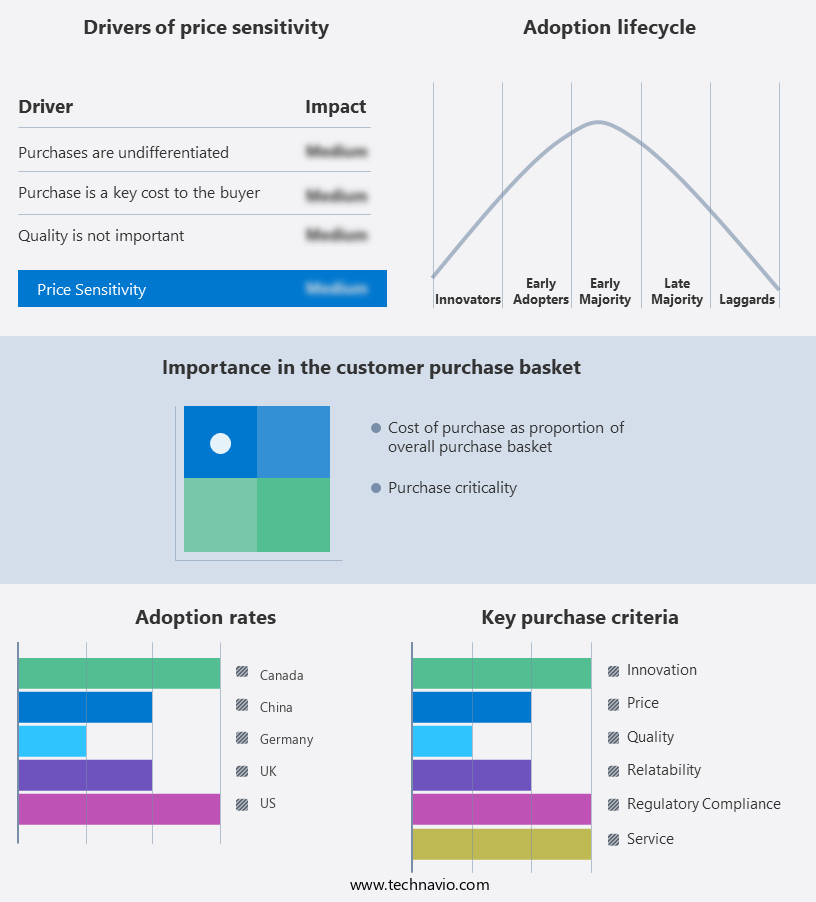
Customer Landscape of Voice Assistant Application Industry
Competitive Landscape
Companies are implementing various strategies, such as strategic alliances, voice assistant application market forecast, partnerships, mergers and acquisitions, geographical expansion, and product/service launches, to enhance their presence in the industry.
Alibaba Group Holding Ltd. - This company specializes in voice assistant applications, including AliGenie.
The industry research and growth report includes detailed analyses of the competitive landscape of the market and information about key companies, including:
- Alibaba Group Holding Ltd.
- Amazon.com Inc.
- Apple Inc.
- Artificial Solutions International AB
- Baidu Inc.
- Google LLC
- Huawei Technologies Co. Ltd.
- International Business Machines Corp.
- Microsoft Corp.
- Oracle Corp.
- Orbita Inc.
- Robin Labs
- RoboBot Studio
- Salesforce Inc.
- Samsung Electronics Co. Ltd.
- SAP SE
- SoundHound AI Inc.
- Verbio Technologies SL
- Voiceflow Inc.
- Xiaomi Inc.
Qualitative and quantitative analysis of companies has been conducted to help clients understand the wider business environment as well as the strengths and weaknesses of key industry players. Data is qualitatively analyzed to categorize companies as pure play, category-focused, industry-focused, and diversified; it is quantitatively analyzed to categorize companies as dominant, leading, strong, tentative, and weak.
Recent Development and News in Voice Assistant Application Market
- In January 2024, Amazon's Alexa announced the integration of advanced language processing capabilities, enabling it to understand and respond to complex queries more accurately (Amazon press release).
- In March 2024, Google and Samsung signed a multi-year partnership to make Google's voice assistant, Google Assistant, the default option on Samsung smart TVs (Google and Samsung press releases).
- In April 2025, Apple secured a strategic investment of USD 200 million in its voice assistant, Siri, from South Korean tech giant, SK Hynix, to enhance its AI capabilities and expand its market presence (Apple Investor Relations and SK Hynix press releases).
- In May 2025, Microsoft's Cortana voice assistant gained significant traction by partnering with Ford Motor Company to integrate Cortana into Ford's SYNC 4 system, offering in-car voice control and personalized experiences for drivers (Ford and Microsoft press releases).
Dive into Technavio's robust research methodology, blending expert interviews, extensive data synthesis, and validated models for unparalleled Voice Assistant Application Market insights. See full methodology.
|
Market Scope |
|
|
Report Coverage |
Details |
|
Page number |
246 |
|
Base year |
2024 |
|
Historic period |
2019-2023 |
|
Forecast period |
2025-2029 |
|
Growth momentum & CAGR |
Accelerate at a CAGR of 46.7% |
|
Market growth 2025-2029 |
USD 36746.6 million |
|
Market structure |
Fragmented |
|
YoY growth 2024-2025(%) |
35.5 |
|
Key countries |
US, Canada, UK, France, Italy, China, Germany, Japan, India, and South Korea |
|
Competitive landscape |
Leading Companies, Market Positioning of Companies, Competitive Strategies, and Industry Risks |
Research Analyst Overview
- The market is a dynamic and evolving landscape, shaped by continuous advancements in technology and user preferences. Deep learning algorithms have become a cornerstone of voice assistant development, enabling more accurate speech recognition and natural language processing. User interface design plays a crucial role in enhancing user experience, with a focus on intuitive interaction and seamless integration of various features. Privacy considerations are increasingly important, as users demand transparency and control over their data. Model training and API integration are essential components of voice assistant development, allowing for the continuous improvement of performance and functionality.
- Music playback, news updates, and weather forecasts are popular features, catering to users' diverse needs. Neural networks and conversational AI enable more sophisticated dialogue management, enabling proactive assistance and contextual awareness. Multi-modal interaction, location services, and smart home integration further expand the capabilities of voice assistants, enhancing their utility and convenience. Personalization features, such as reminder setting and task automation, are key differentiators, allowing voice assistants to cater to individual user preferences. Security protocols and cloud infrastructure ensure the reliability and privacy of user data. Voice synthesis, intent recognition, and search functionality are essential components, enabling users to interact with their voice assistants in a natural and intuitive way.
- Platform scalability and IoT device control are critical for accommodating the growing demand for voice assistant services across various industries and applications. The market for voice assistants is highly competitive, with ongoing innovation and development in areas such as machine learning models, dialogue management, and translation services. The integration of these advanced technologies enables voice assistants to provide more accurate and personalized experiences, setting the stage for future growth and expansion.
What are the Key Data Covered in this Voice Assistant Application Market Research and Growth Report?
-
What is the expected growth of the Voice Assistant Application Market between 2025 and 2029?
-
USD 36.75 billion, at a CAGR of 46.7%
-
-
What segmentation does the market report cover?
-
The report is segmented by Application (Individual users, SMEs, and Large enterprises), Deployment (Cloud and On-premise), Technology (Speech recognition, Text-to-speech, and Natural language processing), End-user (IT and telecom, Retail and E-commerce, BFSI, Healthcare, and Others), and Geography (North America, Europe, APAC, Middle East and Africa, and South America)
-
-
Which regions are analyzed in the report?
-
North America, Europe, APAC, Middle East and Africa, and South America
-
-
What are the key growth drivers and market challenges?
-
Digital transformation, Data privacy and security concerns associated with voice assistant application
-
-
Who are the major players in the Voice Assistant Application Market?
-
Alibaba Group Holding Ltd., Amazon.com Inc., Apple Inc., Artificial Solutions International AB, Baidu Inc., Google LLC, Huawei Technologies Co. Ltd., International Business Machines Corp., Microsoft Corp., Oracle Corp., Orbita Inc., Robin Labs, RoboBot Studio, Salesforce Inc., Samsung Electronics Co. Ltd., SAP SE, SoundHound AI Inc., Verbio Technologies SL, Voiceflow Inc., and Xiaomi Inc.
-
Market Research Insights
- The market continues to evolve, with AI-powered assistants becoming an integral part of user experience design in various sectors. According to recent estimates, the global market for voice assistants is projected to reach USD 66.7 billion by 2027. Smart speaker compatibility is a key feature driving this growth, enabling users to access virtual assistants through various devices. In terms of functionality, AI-powered assistants employ advanced technologies like turn-taking management, knowledge graphs, fallback mechanisms, conversational commerce, and mobile app integration to deliver seamless user experiences. For instance, error handling and custom skill development allow for more personalized interactions, while platform SDKs and deployment strategies facilitate efficient implementation.
- Context management, semantic parsing, entity recognition, natural language understanding, sentiment analysis, dialogue flow design, wearable device support, performance benchmarking, voice user interface, developer tools, voice search optimization, response generation, and human-computer interaction are essential components that contribute to the overall effectiveness of these assistants. The market's continuous evolution is evident in the increasing adoption of these advanced features, ensuring a more engaging and productive user experience.
We can help! Our analysts can customize this voice assistant application market research report to meet your requirements.
 RIA -
RIA - 
