


Ai-powered Website Builder Market Size 2025-2029
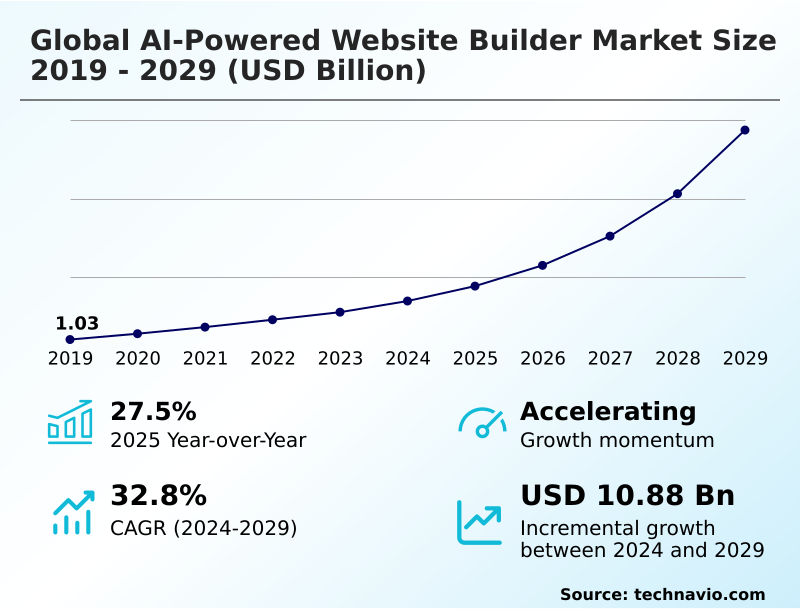
The ai-powered website builder market size is valued to increase by USD 10.88 billion, at a CAGR of 32.8% from 2024 to 2029. Democratization of web development and accelerated digitalization of SMEs will drive the ai-powered website builder market.
Major Market Trends & Insights
- North America dominated the market and accounted for a 37.2% growth during the forecast period.
- By Component - Software segment was valued at USD 2.01 billion in 2023
- By Deployment - Cloud-based segment accounted for the largest market revenue share in 2023
Market Size & Forecast
- Market Opportunities: USD 13.32 billion
- Market Future Opportunities: USD 10.88 billion
- CAGR from 2024 to 2029 : 32.8%
Market Summary
- The ai-powered website builder market is rapidly evolving, driven by the convergence of no-code development and advanced machine learning algorithms. Platforms are moving beyond simple drag-and-drop interfaces to offer intelligent design assistance powered by generative design principles, enabling users to create sophisticated sites through conversational ui.
- This democratization of web development is a primary catalyst, allowing small businesses to establish a professional ai for digital presence without significant technical expertise.
- For example, a small e-commerce business can now use an ai website creator with e-commerce integration to not only build an online store but also leverage ai content generation for product descriptions and ai-powered analytics for sales insights, achieving a level of operational efficiency previously reserved for larger enterprises.
- Key trends include the integration of large language models for hyper-personalized content and ai-driven optimization for performance. However, challenges persist around ensuring brand identity alignment and navigating the complexities of data privacy with ai-powered tools for ui mockups.
- The market for AI-Powered Website Builder is thus characterized by a push towards comprehensive, intelligent business hubs that automate everything from initial design to ongoing marketing automation.
What will be the Size of the Ai-powered Website Builder Market during the forecast period?
Get Key Insights on Market Forecast (PDF) Get Free Sample
How is the Ai-powered Website Builder Market Segmented?
The ai-powered website builder industry research report provides comprehensive data (region-wise segment analysis), with forecasts and estimates in "USD million" for the period 2025-2029, as well as historical data from 2019-2023 for the following segments.
- Component
- Software
- Services
- Deployment
- Cloud-based
- Hybrid
- On-premises
- End-user
- SMEs
- Individuals
- Large enterprise
- Geography
- North America
- US
- Canada
- Mexico
- APAC
- China
- Japan
- India
- Europe
- Germany
- UK
- France
- South America
- Brazil
- Argentina
- Colombia
- Middle East and Africa
- Saudi Arabia
- UAE
- South Africa
- Rest of World (ROW)
- North America
By Component Insights
The software segment is estimated to witness significant growth during the forecast period.
The software component is the core of the market, delivered as a SaaS-based intelligent website platform. These solutions leverage machine learning algorithms and generative design principles for automated web design and content automation for websites.
An ai website creator offers no-code development, allowing users to build sites with intelligent design assistance and responsive ai design. The software's value is enhanced by embedded ai-driven optimization tools, including automated seo and ai-powered analytics, which provide actionable data-driven insights.
For instance, businesses using integrated seo automation tools have reported an average 15% improvement in organic search ranking within the first six months. This approach integrates website creation with ongoing ai marketing integration for sustained performance.
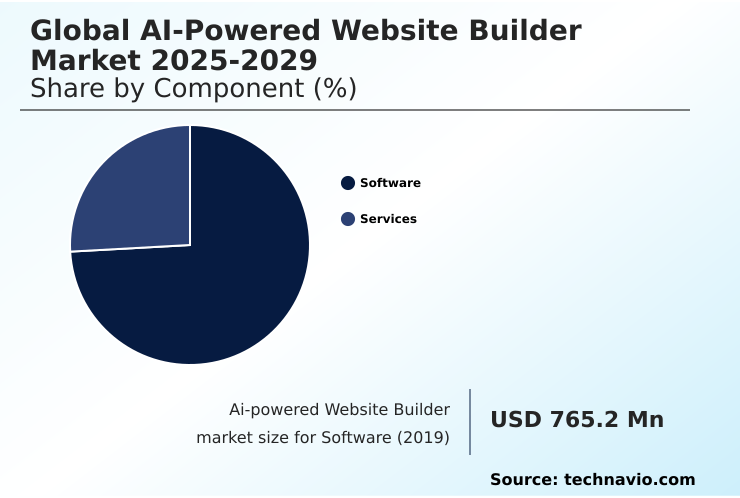
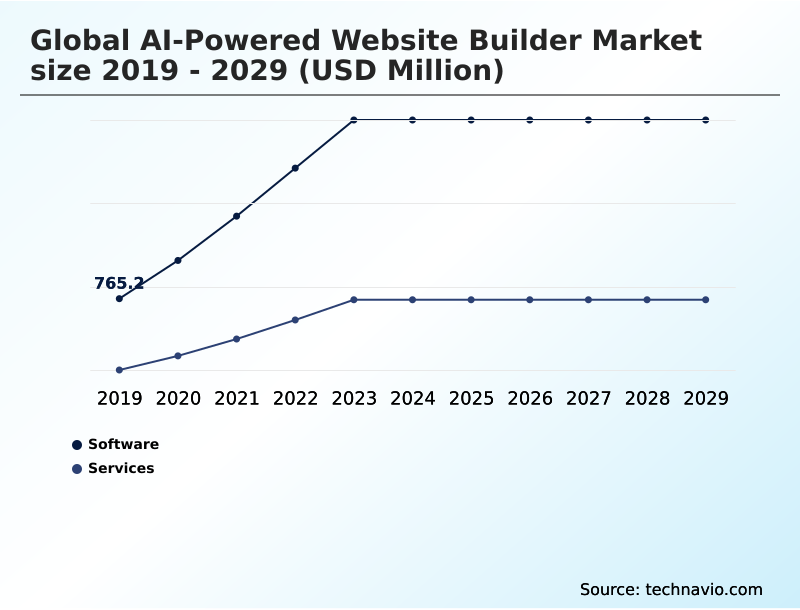
The Software segment was valued at USD 2.01 billion in 2023 and showed a gradual increase during the forecast period.
Regional Analysis
North America is estimated to contribute 37.2% to the growth of the global market during the forecast period.Technavio’s analysts have elaborately explained the regional trends and drivers that shape the market during the forecast period.
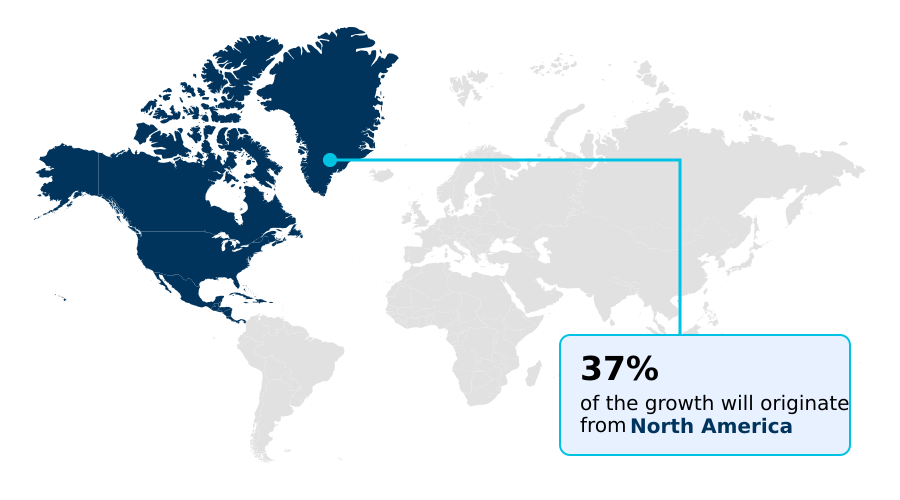
See How Ai-powered Website Builder Market Demand is Rising in North America Get Free Sample
North America remains the dominant region, commanding 37.2% of the incremental growth, driven by early adoption and a high concentration of market leaders.
However, the APAC region is the fastest-growing market, projected to expand at a CAGR of 35.0%, fueled by the rapid digitalization of SMEs.
This growth is facilitated by ai-powered landing pages and no-code ai site builder platforms that cater to a mobile-first user base.
Firms in APAC are reporting up to a 30% reduction in digital marketing spend by leveraging tools for automated marketing copy and ai-driven email marketing.
Europe is also a significant market, with a strong emphasis on data privacy and the need for platforms with robust ai website builder security features.
The ai for digital presence is becoming a global standard, with providers focusing on hyper-personalization and automated customer segmentation to meet diverse regional demands, making website prototyping with ai a key competitive advantage.
Market Dynamics
Our researchers analyzed the data with 2024 as the base year, along with the key drivers, trends, and challenges. A holistic analysis of drivers will help companies refine their marketing strategies to gain a competitive advantage.
- Businesses evaluating their digital strategy often face the ai website builder vs traditional cms dilemma. While traditional systems offer deep control, the benefits of ai in web development are compelling, especially for resource-constrained teams. For those asking how to create a website with ai prompts, the process has become remarkably intuitive through conversational ai for website development.
- An ai-powered website design for small business can be generated in minutes, a significant improvement over manual methods that could take weeks. This efficiency is critical for an ai website builder for e-commerce stores, where speed to market is essential. Key considerations include understanding the cost of ai-powered website builders, which varies based on feature depth.
- Businesses are leveraging the best ai tools for website content creation and automating seo with ai website builders to enhance visibility. Integrating crm with an ai-built website enables seamless ai website builder with marketing automation, while generative ai for responsive web design ensures a flawless experience across devices.
- For creative professionals, building a portfolio website using ai is simpler than ever, and developers can use ai-powered tools for ui mockups for rapid prototyping. Ultimately, platforms offer ai tools for optimizing website performance and provide ai-driven analytics for website traffic, while addressing concerns around ai website builder security features and creating unique brand identity with ai.
- This shift is even prompting consideration for migrating from wordpress to ai builder to leverage a unified no-code ai platform for web applications and improve using ai for personalized user experiences.
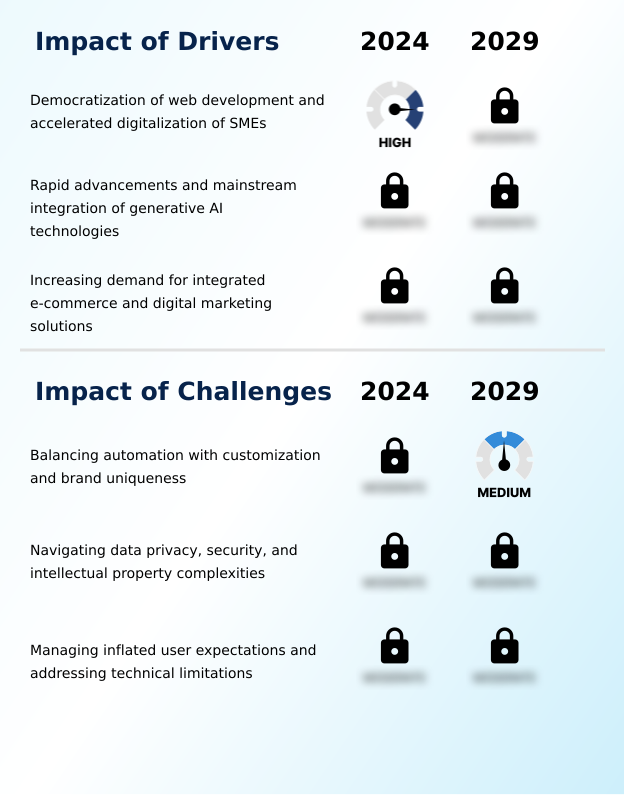
What are the key market drivers leading to the rise in the adoption of Ai-powered Website Builder Industry?
- The market is primarily driven by the democratization of web development, which dismantles technical barriers and empowers small to medium-sized enterprises through accelerated digitalization.
- Market expansion is primarily fueled by the democratization of web development, empowering SMEs with accessible ai for small business websites.
- The use of an ai visual editor and drag-and-drop ai builder platforms has significantly lowered technical barriers, reducing website development time by an average of 70% compared to traditional methods.
- The mainstream integration of generative ai for responsive web design is another critical driver. Advanced large language models now power ai-assisted copywriting and automated marketing copy, allowing entrepreneurs to produce professional content without external help.
- This content automation for websites is coupled with a rising demand for integrated solutions, where ai marketing integration and intelligent crm solutions are bundled, creating a unified ai for digital presence that drives both efficiency and growth.
What are the market trends shaping the Ai-powered Website Builder Industry?
- A defining market trend is the industry's shift from template-based customization toward fully conversational interfaces that enable hyper-personalized website generation.
- The market is increasingly shaped by hyper-personalization, with a distinct move towards conversational website design. Modern platforms leverage a conversational ui to enable personalized website generation, where user inputs directly inform a unique automated design. This trend is underpinned by ai-assisted brand identity tools, allowing businesses to maintain brand consistency with over 95% accuracy.
- Another key trend is the consolidation of functionalities into an intelligent business management hub. The intelligent website platform now includes ai-powered chatbots and tools for ai-driven conversion optimization, with businesses reporting up to a 20% increase in lead capture.
- This holistic approach, integrating ai-driven text generation with performance analytics, transforms the website into a central operational tool, shifting from a simple online brochure to a dynamic business engine.
What challenges does the Ai-powered Website Builder Industry face during its growth?
- A key industry challenge lies in balancing the efficiency of automated website generation with the critical need for deep customization and unique brand differentiation.
- A primary challenge is maintaining brand identity alignment amidst the rise of ai-powered website templates. While automated brand building offers efficiency, it risks creating generic digital presences that fail to stand out, a concern for over 40% of branding professionals.
- Additionally, the reliance on natural language processing for ai content generation introduces complexities around data privacy and intellectual property, as the legal ownership of AI-created assets remains ambiguous. This is compounded by the technical limitations of current visual design tools, which may produce design hallucinations or user experience flaws.
- Managing user expectations is also crucial; platforms must be transparent about the need for prompt engineering to achieve desired results, as poorly formulated prompts can lead to a 50% decrease in output quality and user satisfaction.
Exclusive Technavio Analysis on Customer Landscape
The ai-powered website builder market forecasting report includes the adoption lifecycle of the market, covering from the innovator’s stage to the laggard’s stage. It focuses on adoption rates in different regions based on penetration. Furthermore, the ai-powered website builder market report also includes key purchase criteria and drivers of price sensitivity to help companies evaluate and develop their market growth analysis strategies.
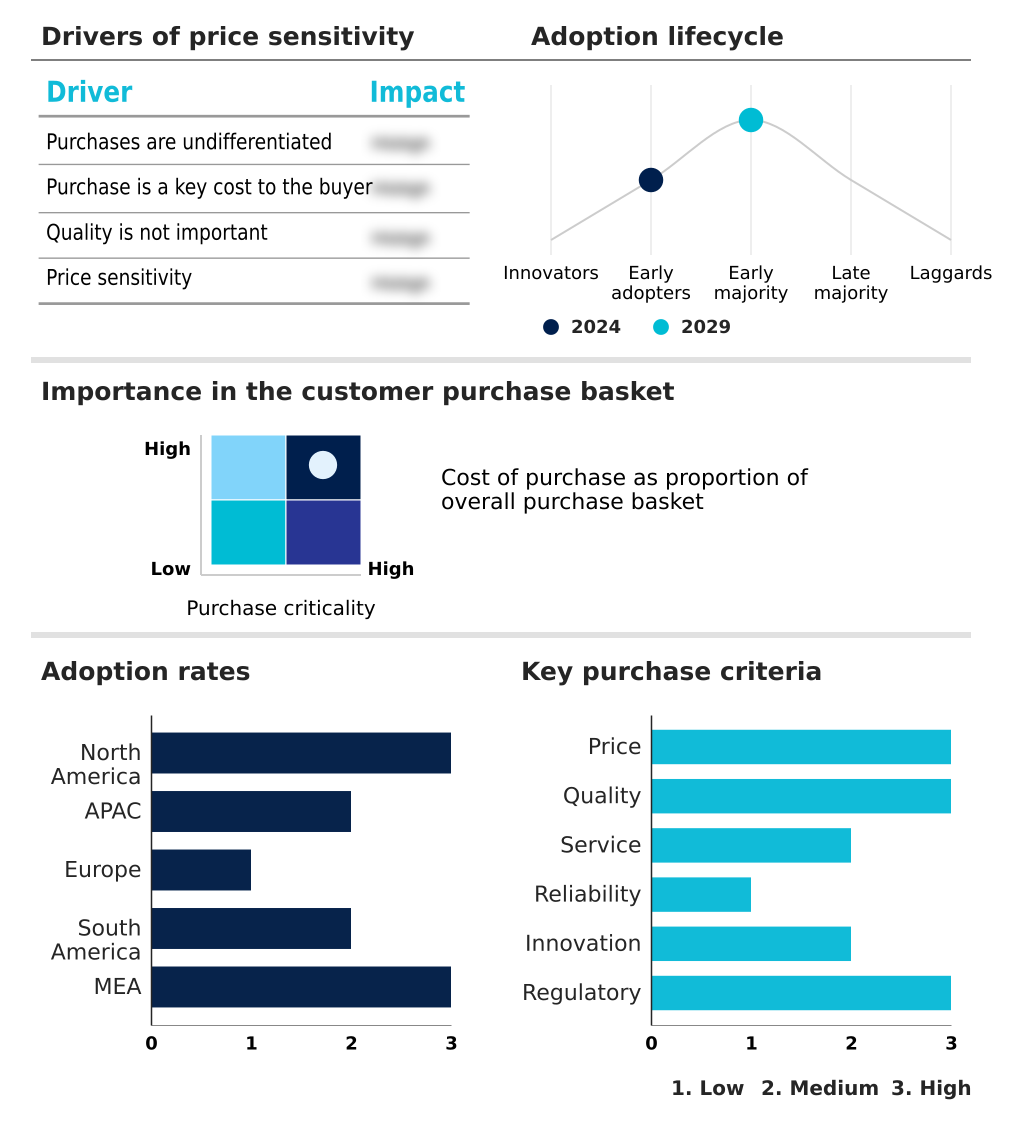
Customer Landscape of Ai-powered Website Builder Industry
Competitive Landscape
Companies are implementing various strategies, such as strategic alliances, ai-powered website builder market forecast, partnerships, mergers and acquisitions, geographical expansion, and product/service launches, to enhance their presence in the industry.
10Web - Offerings center on an AI-powered platform for instant creation, hosting, and management of WordPress websites, streamlining the development lifecycle for professional users.
The industry research and growth report includes detailed analyses of the competitive landscape of the market and information about key companies, including:
- 10Web
- Appy Pie LLC
- B12
- Brizy
- Durable
- Elegant Themes Inc.
- Framer
- GetResponse Sp zoo
- GoDaddy Inc.
- Hostinger International Ltd.
- Jimdo
- Shopify Inc.
- Squarespace Inc.
- TeleportHQ
- Uizard Technologies
- Wix.com Inc.
- WordPress
Qualitative and quantitative analysis of companies has been conducted to help clients understand the wider business environment as well as the strengths and weaknesses of key industry players. Data is qualitatively analyzed to categorize companies as pure play, category-focused, industry-focused, and diversified; it is quantitatively analyzed to categorize companies as dominant, leading, strong, tentative, and weak.
Recent Development and News in Ai-powered website builder market
- In March 2025, Wix.com Inc. launched its advanced 'Brandverse AI' suite, enabling enterprises to generate entire ecosystems of on-brand digital assets, including websites, social media content, and email campaigns from a single prompt, as detailed in their Q1 investor briefing.
- In January 2025, GoDaddy Inc. announced the completion of its acquisition of 'CodeGenius AI,' a startup specializing in AI-powered code generation for custom web applications, for an undisclosed sum, aiming to enhance its offerings for professional developers.
- In November 2024, Shopify Inc. revealed a strategic partnership with a leading AI research lab to integrate next-generation multimodal AI into its 'Sidekick' assistant, allowing merchants to generate product videos and 3D models from text descriptions, according to a company press release.
- In September 2024, Hostinger International Ltd. officially launched its new data center and fully localized AI website builder platform in Brazil, targeting the region's rapidly growing SME market with tailored features and local payment integrations.
Dive into Technavio’s robust research methodology, blending expert interviews, extensive data synthesis, and validated models for unparalleled Ai-powered Website Builder Market insights. See full methodology.
| Market Scope | |
|---|---|
| Page number | 283 |
| Base year | 2024 |
| Historic period | 2019-2023 |
| Forecast period | 2025-2029 |
| Growth momentum & CAGR | Accelerate at a CAGR of 32.8% |
| Market growth 2025-2029 | USD 10880.3 million |
| Market structure | Fragmented |
| YoY growth 2024-2025(%) | 27.5% |
| Key countries | US, Canada, Mexico, China, Japan, India, Australia, South Korea, Indonesia, Germany, UK, France, The Netherlands, Italy, Spain, Brazil, Argentina, Colombia, Saudi Arabia, UAE, South Africa, Israel and Turkey |
| Competitive landscape | Leading Companies, Market Positioning of Companies, Competitive Strategies, and Industry Risks |
Research Analyst Overview
- The market is defined by a rapid evolution from static tools to dynamic ecosystems powered by machine learning algorithms and generative design principles. The integration of large language models and diffusion models facilitates advanced ai content generation and ai-driven text generation, enabling a high degree of hyper-personalization.
- Platforms now offer end-to-end content creation, from ai-powered logo maker tools to generative visual media. This technological shift allows users to leverage intelligent design assistance for creating sites with optimal information architecture and user experience (ux). For small businesses, automating routine content updates with these tools can free up nearly 25% of their marketing time.
- The core value lies in ai-driven optimization, encompassing everything from automated seo and automated image optimization to predictive a/b testing. This is achieved through prompt engineering via a conversational ui, ensuring strong brand identity alignment.
- With built-in e-commerce integration, crm integration, and marketing automation, these platforms provide data-driven insights and predictive analytics, transforming them into essential business intelligence engines that deliver holistic business insights and support automated customer segmentation and ai-driven email marketing.
What are the Key Data Covered in this Ai-powered Website Builder Market Research and Growth Report?
-
What is the expected growth of the Ai-powered Website Builder Market between 2025 and 2029?
-
USD 10.88 billion, at a CAGR of 32.8%
-
-
What segmentation does the market report cover?
-
The report is segmented by Component (Software, Services), Deployment (Cloud-based, Hybrid, On-premises), End-user (SMEs, Individuals, Large enterprises) and Geography (North America, APAC, Europe, South America, Middle East and Africa)
-
-
Which regions are analyzed in the report?
-
North America, APAC, Europe, South America and Middle East and Africa
-
-
What are the key growth drivers and market challenges?
-
Democratization of web development and accelerated digitalization of SMEs, Balancing automation with customization and brand uniqueness
-
-
Who are the major players in the Ai-powered Website Builder Market?
-
10Web, Appy Pie LLC, B12, Brizy, Durable, Elegant Themes Inc., Framer, GetResponse Sp zoo, GoDaddy Inc., Hostinger International Ltd., Jimdo, Shopify Inc., Squarespace Inc., TeleportHQ, Uizard Technologies, Wix.com Inc. and WordPress
-
Market Research Insights
- The market's dynamism is fueled by the rapid adoption of the generative website builder as a core ai business tool. These platforms provide more than just automated web design; they function as an intelligent website platform for automated brand building.
- Businesses leveraging these solutions report significant efficiency gains, with some achieving a 40% faster time-to-market for digital campaigns by using content automation for websites. The move toward conversational website design and personalized website generation is transforming the user experience.
- By integrating intelligent crm solutions and ai-assisted copywriting, companies can enhance customer engagement, with early adopters seeing up to a 15% improvement in lead conversion rates through ai-powered ux optimization. The availability of an ai analytics dashboard further empowers users with actionable insights, solidifying the role of ai for small business websites as a competitive necessity.
We can help! Our analysts can customize this ai-powered website builder market research report to meet your requirements.
 RIA -
RIA - 
