
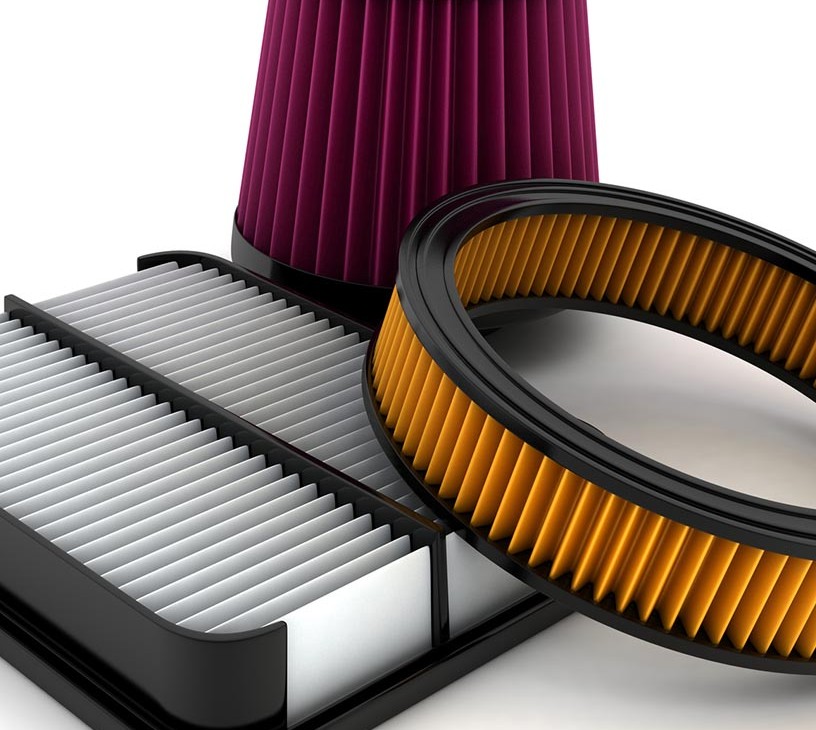


Air Cleaner Filters Market Size 2026-2030
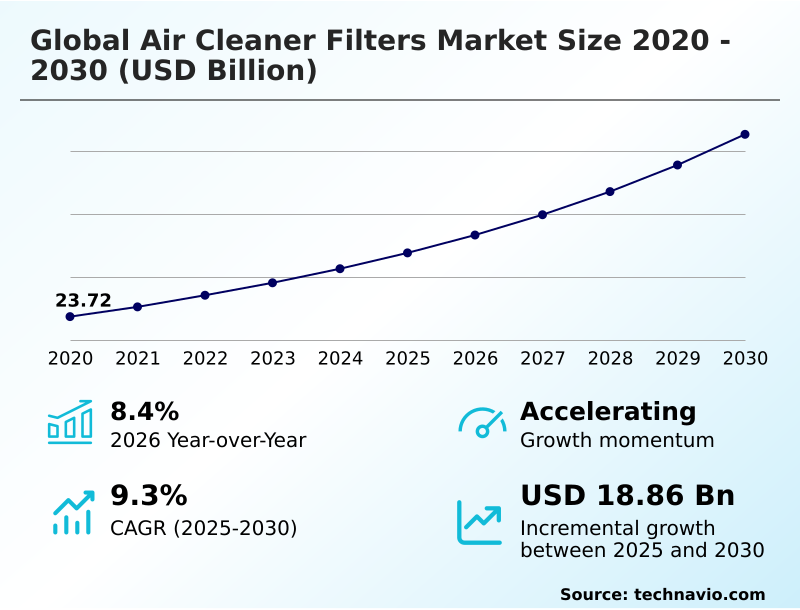
The air cleaner filters market size is valued to increase by USD 18.86 billion, at a CAGR of 9.3% from 2025 to 2030. Implementation of stringent environmental regulations and indoor air quality standards will drive the air cleaner filters market.
Major Market Trends & Insights
- APAC dominated the market and accounted for a 58.9% growth during the forecast period.
- By End-user - HVAC segment was valued at USD 19.32 billion in 2024
- By Distribution Channel - Offline segment accounted for the largest market revenue share in 2024
Market Size & Forecast
- Market Opportunities: USD 29.00 billion
- Market Future Opportunities: USD 18.86 billion
- CAGR from 2025 to 2030 : 9.3%
Market Summary
- The air cleaner filters market is shaped by a convergence of regulatory pressures, health-driven consumer demand, and technological evolution. Stringent indoor air quality standards and mandates from governmental bodies create a resilient demand cycle, compelling commercial and industrial facilities to adopt high-performance filter arrays, including specialized media such as activated carbon and HEPA filters.
- This is particularly critical in scenarios like pharmaceutical manufacturing, where maintaining a contaminant-free environment with certified filter media is non-negotiable for product integrity and compliance. Concurrently, the proliferation of smart filtration systems integrated with IoT and AI introduces predictive maintenance capabilities, optimizing energy use and filter lifespan.
- These data-driven platforms can forecast filter saturation and automate procurement, a significant advancement over traditional time-based replacement schedules. However, the market grapples with the proliferation of counterfeit filters, which compromise both air quality and equipment longevity, creating a trust deficit that legitimate manufacturers must address through consumer education and robust supply chain verification.
What will be the Size of the Air Cleaner Filters Market during the forecast period?
Get Key Insights on Market Forecast (PDF) Get Free Sample
How is the Air Cleaner Filters Market Segmented?
The air cleaner filters industry research report provides comprehensive data (region-wise segment analysis), with forecasts and estimates in "USD million" for the period 2026-2030, as well as historical data from 2020-2024 for the following segments.
- End-user
- HVAC
- Industrial
- Automotive
- Others
- Distribution channel
- Offline
- Online
- Type
- HEPA filters
- Baghouse filters
- Cartridge filters
- Dust collectors
- Others
- Geography
- APAC
- China
- Japan
- India
- Europe
- Germany
- UK
- France
- North America
- US
- Canada
- Mexico
- Middle East and Africa
- Saudi Arabia
- UAE
- South Africa
- South America
- Brazil
- Argentina
- Rest of World (ROW)
- APAC
By End-user Insights
The hvac segment is estimated to witness significant growth during the forecast period.
The HVAC segment is foundational, driven by the dual need to protect mechanical components and improve indoor air quality.
Heightened health awareness is compelling a shift toward high-efficiency particulate air filtration and advanced media like electrostatic precipitators capable of capturing microscopic contaminants.
Systems utilizing ULPA filters are now achieving a 99.999% capture rate for the most penetrating particle sizes, a key metric for cleanroom-equivalent air. This trend, coupled with stringent building codes, creates a stable replacement market.
Consequently, demand is consistent for solutions offering a low pressure drop and improved airflow resistance, driven by health trends that mandate superior mechanical interception and filtration efficiency.
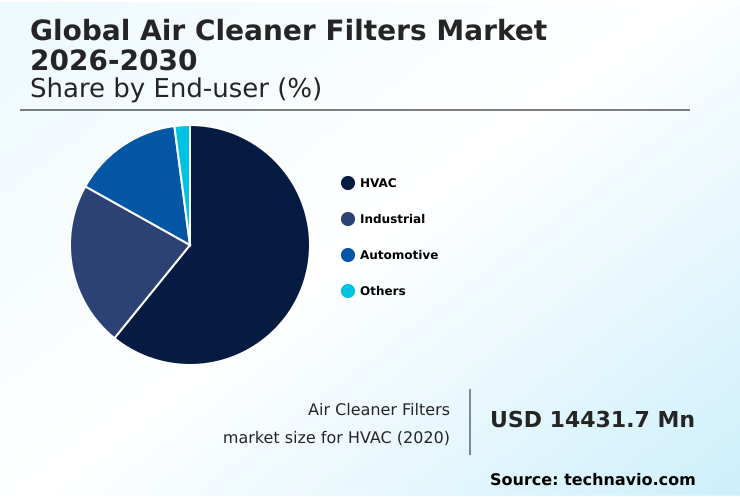
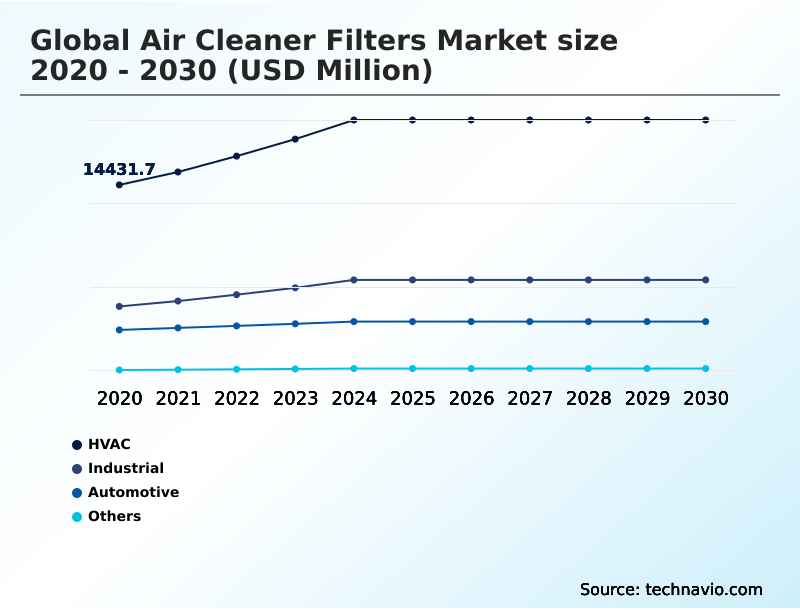
The HVAC segment was valued at USD 19.32 billion in 2024 and showed a gradual increase during the forecast period.
Regional Analysis
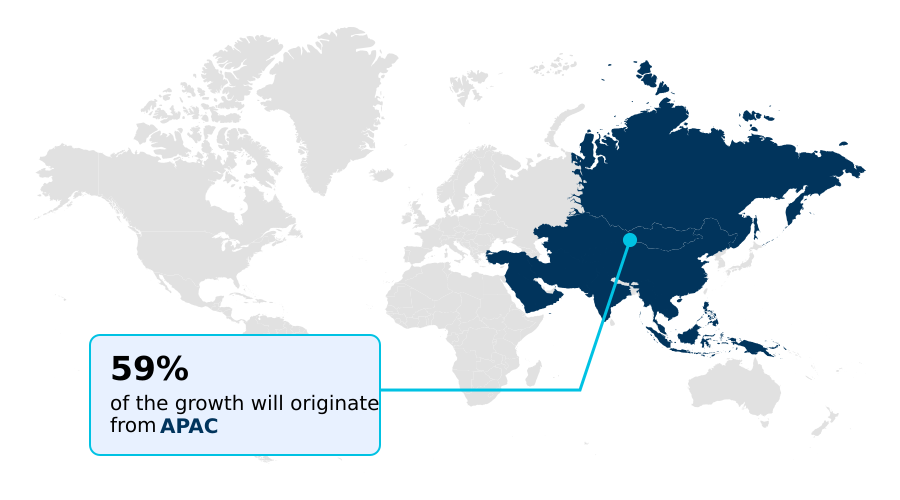
APAC is estimated to contribute 58.9% to the growth of the global market during the forecast period.Technavio’s analysts have elaborately explained the regional trends and drivers that shape the market during the forecast period.
See How Air Cleaner Filters Market Demand is Rising in APAC Get Free Sample
The geographic landscape is dominated by APAC, which accounts for over 58% of the market's incremental growth, fueled by rapid industrialization and acute air quality challenges.
In this region, government mandates and expanding manufacturing hubs for electronics, requiring ultra-clean environments with specialized filter media, drive significant demand.
In contrast, the mature markets of North America and Europe, which contribute a combined 32% of growth, are characterized by a focus on retrofitting existing infrastructure with high-performance filter arrays and smart filtration systems.
Regulatory frameworks in these regions mandate the use of certified filter media in public buildings to mitigate fine particulate matter, with systems using pleated media designs reducing energy consumption by up to 10%.
Market Dynamics
Our researchers analyzed the data with 2025 as the base year, along with the key drivers, trends, and challenges. A holistic analysis of drivers will help companies refine their marketing strategies to gain a competitive advantage.
- The market is witnessing a decisive shift toward specialized and high-value filtration strategies. The integration of IoT for predictive maintenance in air cleaner filters is becoming standard in new commercial builds, moving beyond simple timers. This is complemented by the growing specification of high-efficiency particulate air filtration media in residential and healthcare settings, a direct response to heightened health awareness.
- In industrial contexts, the use of cartridge filters for metalworking dust collection is expanding due to their efficiency and smaller footprint compared to older technologies. Simultaneously, the strategic pivot toward sustainable and biodegradable filter materials is gaining momentum, driven by corporate ESG goals and circular economy directives.
- The development of ULPA filtration media for semiconductor fabrication cleanrooms continues to push the boundaries of air purity, while the application of activated carbon filters for VOC removal in offices is now a key consideration for workplace wellness programs.
- This trend is further supported by the design of pleated media filters with low airflow resistance, which can reduce HVAC energy consumption by a notable margin over less advanced alternatives, illustrating a market-wide move toward holistic performance that balances efficiency, sustainability, and operational cost.
What are the key market drivers leading to the rise in the adoption of Air Cleaner Filters Industry?
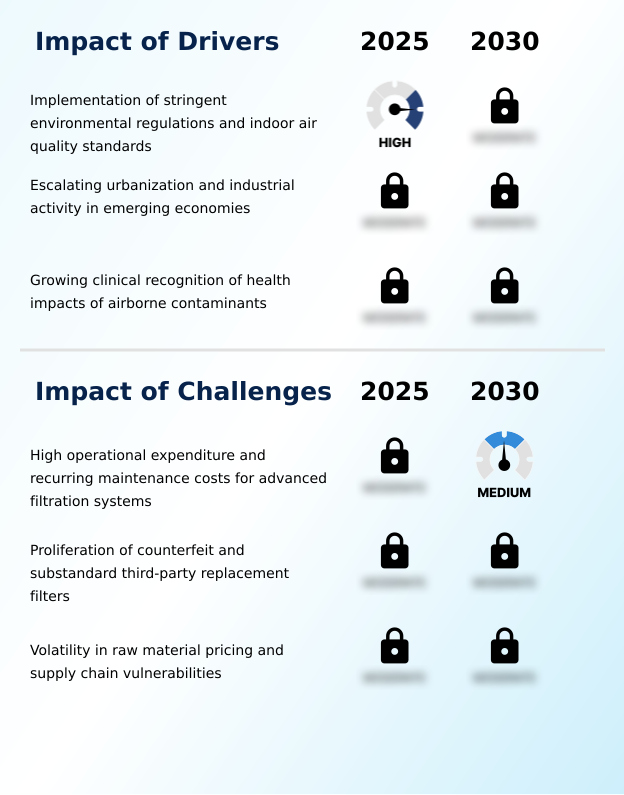
- The implementation of stringent environmental regulations and indoor air quality standards serves as a key driver for market growth.
- Stringent environmental regulations and a growing clinical recognition of the health impacts of airborne contaminants are primary market drivers.
- Governmental mandates in North America and Europe, requiring certified filter media in commercial and industrial settings, create a resilient demand for high-performance filter arrays.
- This regulatory push has accelerated the adoption of premium filtration, with facilities upgrading to systems that can mitigate fine particulate matter by over 99%.
- Escalating urbanization, particularly in APAC, further fuels growth, as new infrastructure projects incorporate advanced HVAC systems from the outset. This structural expansion ensures a long-term trajectory for solutions addressing both health-centric consumer demands and industrial compliance needs.
What are the market trends shaping the Air Cleaner Filters Industry?
- The proliferation of Internet of Things integration and artificial intelligence for predictive maintenance is an emerging market trend. This technological shift enables real-time monitoring and optimized filter performance.
- The market is transforming through the integration of IoT and AI, enabling predictive maintenance and real-time air quality management. Smart filtration systems with embedded sensor technology can now analyze filter saturation and particulate matter levels, optimizing performance and reducing energy consumption by up to 20% in commercial buildings.
- This shift to data-driven filtration is supported by AI algorithms that forecast replacement needs, eliminating wasteful, time-based schedules. The trend is especially prominent in smart home ecosystems, where connected devices provide users with detailed analytics.
- This focus on intelligent air management is compelling manufacturers to innovate with advanced solutions like cartridge filters and baghouse filters that support digital diagnostics and align with sustainable building goals.
What challenges does the Air Cleaner Filters Industry face during its growth?
- High operational expenditure and recurring maintenance costs associated with advanced filtration systems present a key challenge to industry growth.
- Significant operational expenditure and the prevalence of counterfeit products are primary market challenges. The recurring cost of replacing high-performance filter media, such as nanofiber filter media, can be prohibitive, with maintenance expenses in some industrial settings accounting for up to 30% of the system's total lifecycle cost.
- This financial pressure often leads to the extended use of saturated filters, which compromises filtration efficiency and increases energy consumption. Furthermore, the proliferation of counterfeit filters, which often fail to meet performance standards for mechanical interception, erodes consumer trust and can cause equipment damage. This situation creates significant price erosion and brand dilution for legitimate manufacturers.
Exclusive Technavio Analysis on Customer Landscape
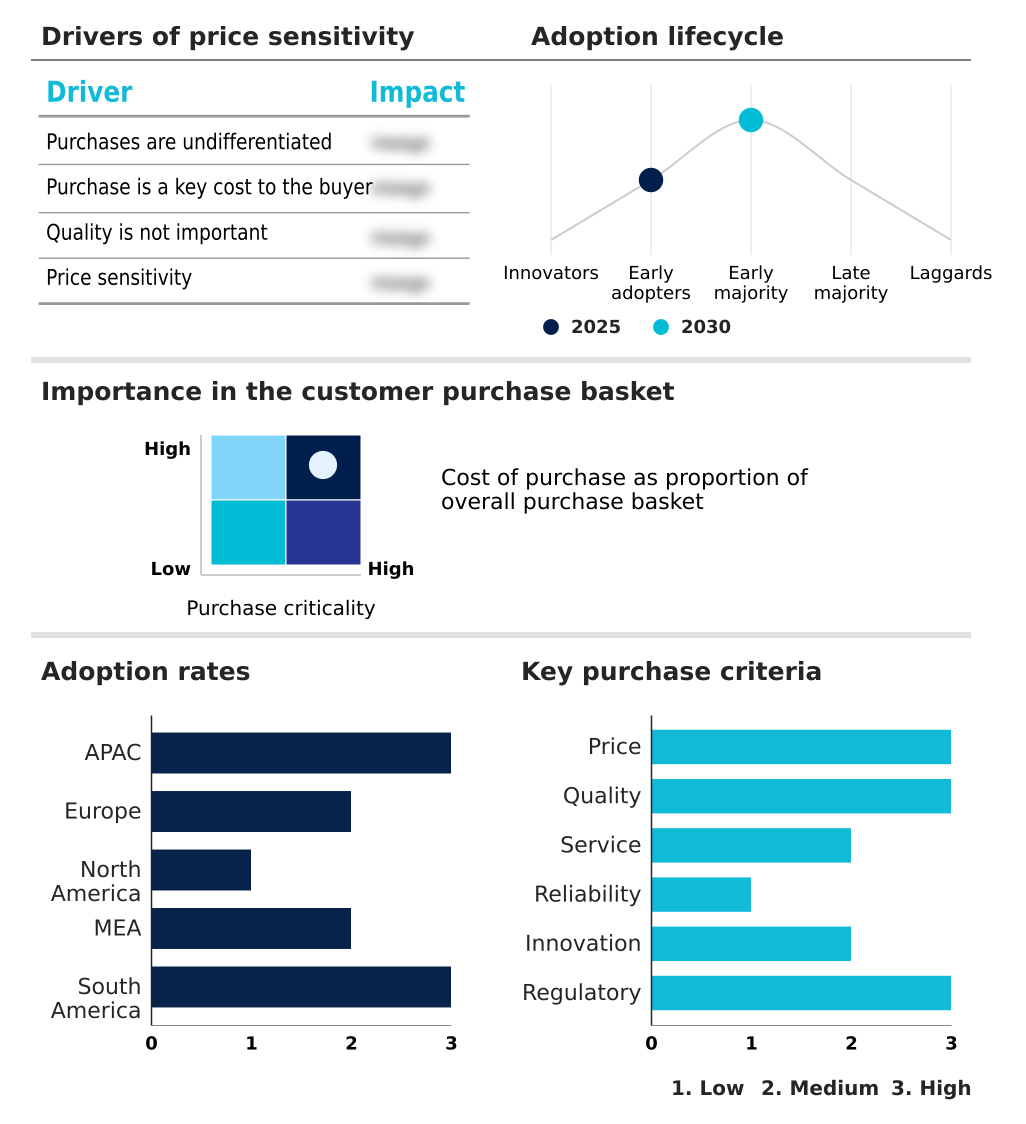
The air cleaner filters market forecasting report includes the adoption lifecycle of the market, covering from the innovator’s stage to the laggard’s stage. It focuses on adoption rates in different regions based on penetration. Furthermore, the air cleaner filters market report also includes key purchase criteria and drivers of price sensitivity to help companies evaluate and develop their market growth analysis strategies.
Customer Landscape of Air Cleaner Filters Industry
Competitive Landscape
Companies are implementing various strategies, such as strategic alliances, air cleaner filters market forecast, partnerships, mergers and acquisitions, geographical expansion, and product/service launches, to enhance their presence in the industry.
3M Co. - Offerings include comprehensive air filtration solutions designed to remove and control airborne particulates and gaseous contaminants across residential, commercial, and industrial applications.
The industry research and growth report includes detailed analyses of the competitive landscape of the market and information about key companies, including:
- 3M Co.
- American Air Filter Co. Inc.
- Arovast Corp.
- Blueair AB
- Camfil AB
- Carrier Global Corp.
- Coway Co. Ltd.
- Donaldson Co. Inc.
- Dyson Ltd.
- Honeywell International Inc.
- IQAir AG
- Koninklijke Philips NV
- Lennox International Inc.
- MANN HUMMEL International GmbH
- Mativ Holdings Inc.
- Pall Corp.
- Panasonic Holdings Corp.
- Parker Hannifin Corp.
- Trane Technologies plc
- Xiaomi Corp.
Qualitative and quantitative analysis of companies has been conducted to help clients understand the wider business environment as well as the strengths and weaknesses of key industry players. Data is qualitatively analyzed to categorize companies as pure play, category-focused, industry-focused, and diversified; it is quantitatively analyzed to categorize companies as dominant, leading, strong, tentative, and weak.
Recent Development and News in Air cleaner filters market
- In January 2025, Rensa Filtration acquired Air Filtration Co., Inc., a specialized manufacturer for the paint and finishing industry, to expand its product portfolio and geographic reach into California and Iowa.
- In February 2025, Johnson Controls announced a strategic partnership with a Silicon Valley technology firm to launch a new line of AI-integrated commercial air handling units featuring advanced sensor technology for dynamic performance optimization.
- In March 2025, Panasonic launched its AtmosAI series, a next-generation air purification system for residential and commercial markets that uses AI and laser particle sensors for predictive filtration.
- In April 2025, Coway Co. Ltd. launched its Airmega ProX line of residential air purifiers, featuring proprietary HyperCaptive filtration technology designed to deactivate certain viruses and bacteria on contact.
Dive into Technavio’s robust research methodology, blending expert interviews, extensive data synthesis, and validated models for unparalleled Air Cleaner Filters Market insights. See full methodology.
| Market Scope | |
|---|---|
| Page number | 308 |
| Base year | 2025 |
| Historic period | 2020-2024 |
| Forecast period | 2026-2030 |
| Growth momentum & CAGR | Accelerate at a CAGR of 9.3% |
| Market growth 2026-2030 | USD 18859.2 million |
| Market structure | Fragmented |
| YoY growth 2025-2026(%) | 8.4% |
| Key countries | China, Japan, India, South Korea, Australia, Indonesia, Germany, UK, France, Italy, Spain, The Netherlands, US, Canada, Mexico, Saudi Arabia, UAE, South Africa, Israel, Turkey, Brazil, Argentina and Chile |
| Competitive landscape | Leading Companies, Market Positioning of Companies, Competitive Strategies, and Industry Risks |
Research Analyst Overview
- The market is undergoing a significant transformation defined by technological advancement and a heightened focus on health and sustainability. Demand is no longer solely about basic mechanical interception; it has evolved to require sophisticated solutions like HEPA filters, ULPA filters, baghouse filters, and advanced electrostatic precipitators.
- This shift is compelling a boardroom-level re-evaluation of capital expenditure, as investment in smart filtration systems with embedded sensor technology is now a strategic imperative. The use of nanofiber filter media and certified filter media is critical for meeting stringent indoor air quality standards.
- For instance, advanced pleated media designs have demonstrated a 25% longer operational lifespan compared to traditional media, impacting both maintenance budgets and sustainability metrics. The adoption of AI algorithms and activated carbon filters is pivotal for managing complex airborne contaminants, while innovations in washable filter frames and media address growing environmental concerns.
- This evolution necessitates a strategic pivot for manufacturers toward offering high-performance, data-driven, and sustainable filtration solutions.
What are the Key Data Covered in this Air Cleaner Filters Market Research and Growth Report?
-
What is the expected growth of the Air Cleaner Filters Market between 2026 and 2030?
-
USD 18.86 billion, at a CAGR of 9.3%
-
-
What segmentation does the market report cover?
-
The report is segmented by End-user (HVAC, Industrial, Automotive, and Others), Distribution Channel (Offline, and Online), Type (HEPA filters, Baghouse filters, Cartridge filters, Dust collectors, and Others) and Geography (APAC, Europe, North America, Middle East and Africa, South America)
-
-
Which regions are analyzed in the report?
-
APAC, Europe, North America, Middle East and Africa and South America
-
-
What are the key growth drivers and market challenges?
-
Implementation of stringent environmental regulations and indoor air quality standards, High operational expenditure and recurring maintenance costs for advanced filtration systems
-
-
Who are the major players in the Air Cleaner Filters Market?
-
3M Co., American Air Filter Co. Inc., Arovast Corp., Blueair AB, Camfil AB, Carrier Global Corp., Coway Co. Ltd., Donaldson Co. Inc., Dyson Ltd., Honeywell International Inc., IQAir AG, Koninklijke Philips NV, Lennox International Inc., MANN HUMMEL International GmbH, Mativ Holdings Inc., Pall Corp., Panasonic Holdings Corp., Parker Hannifin Corp., Trane Technologies plc and Xiaomi Corp.
-
Market Research Insights
- Market dynamics are increasingly influenced by a focus on verifiable performance metrics and sustainability. For instance, facilities adopting filtration systems with predictive maintenance capabilities have reported energy savings of up to 15% compared to those with fixed replacement schedules.
- The shift towards circular economy initiatives is evident, as advanced systems now feature washable filter frames and media, reducing landfill waste by over 40% in some applications. This transition is driven by a heightened awareness of the health impacts of airborne contaminants like volatile organic compounds and fine particulate matter.
- As a result, the market sees a divergence, with premium segments prioritizing data-driven filtration and a lower total cost of ownership, while price-sensitive segments still face challenges from the high operational expenditure of advanced systems.
We can help! Our analysts can customize this air cleaner filters market research report to meet your requirements.
 RIA -
RIA - 
