

Automotive Power Management Ic Market Size 2026-2030
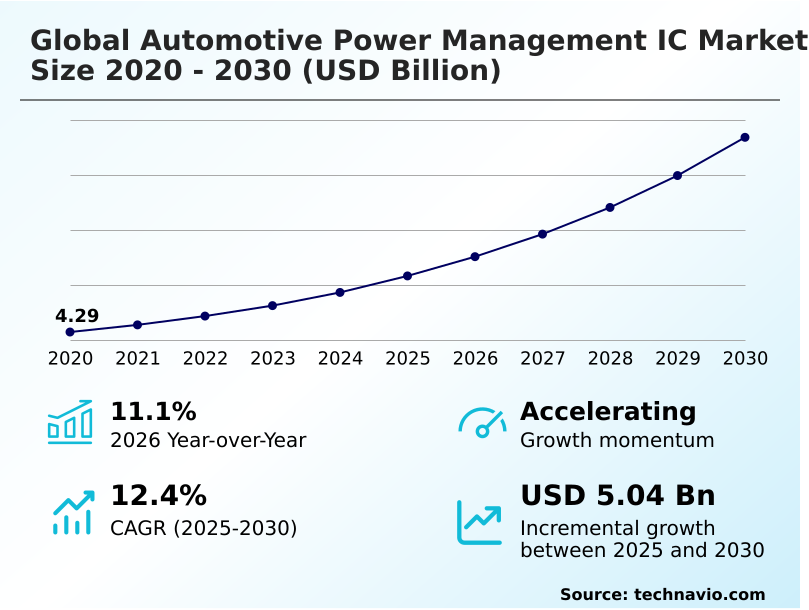
The automotive power management ic market size is valued to increase by USD 5.04 billion, at a CAGR of 12.4% from 2025 to 2030. Accelerating adoption of EVs and high voltage powertrain electrification will drive the automotive power management ic market.
Major Market Trends & Insights
- APAC dominated the market and accounted for a 57% growth during the forecast period.
- By Product Type - Voltage regulators segment was valued at USD 1.93 billion in 2024
- By Application - EV battery and lighting segment accounted for the largest market revenue share in 2024
Market Size & Forecast
- Market Opportunities: USD 7.08 billion
- Market Future Opportunities: USD 5.04 billion
- CAGR from 2025 to 2030 : 12.4%
Market Summary
- The Automotive Power Management IC Market undergoes rapid structural transformation driven by the electrification of vehicle powertrains and the integration of software-defined vehicle architectures. As original equipment manufacturers scale the production of heavy-duty commercial fleets and electric passenger cars, the requirement for robust power conversion systems intensifies.
- A critical driver for this sector is the transition to advanced powertrains, which forces the integration of high-density power management units to regulate multi-rail voltage systems efficiently. For example, optimizing localized power distribution through smart zonal control modules has reduced automotive wiring harness weight by over 12%, significantly improving vehicle energy efficiency and extending driving range.
- High heat generation degrades silicon longevity, requiring advanced thermal packaging strategies that increase manufacturing complexity. By deploying gallium nitride power modules and predictive state-of-health estimation within high-voltage battery enclosures, supply chain integrators achieve stricter compliance with safety mandates, ensuring that mission-critical braking and steering systems maintain uninterrupted power during transient load fluctuations.
What will be the Size of the Automotive Power Management Ic Market during the forecast period?
Get Key Insights on Market Forecast (PDF) Get Free Sample
How is the Automotive Power Management Ic Market Segmented?
The automotive power management ic industry research report provides comprehensive data (region-wise segment analysis), with forecasts and estimates in "USD million" for the period 2026-2030, as well as historical data from 2020-2024 for the following segments.
- Product type
- Voltage regulators
- Integrated PMICs
- Power switches and load switches
- Battery management ICs
- Application
- EV battery and lighting
- Powertrain systems
- ADAS and safety systems
- Body electronics
- Infotainment systems
- Vehicle type
- Passenger cars
- Commercial vehicles
- Geography
- APAC
- China
- Japan
- India
- South Korea
- Indonesia
- Australia
- Europe
- UK
- Germany
- France
- Spain
- Italy
- The Netherlands
- North America
- US
- Mexico
- Canada
- South America
- Brazil
- Argentina
- Colombia
- Middle East and Africa
- Saudi Arabia
- South Africa
- Israel
- Turkey
- UAE
- APAC
By Product Type Insights
The voltage regulators segment is estimated to witness significant growth during the forecast period.
Voltage regulator topologies continuously adapt to support the escalating energy demands of zero-emission transportation frameworks. Modern electrical architectures require precise conversion of unstable battery outputs into clean direct current supply rails, mitigating severe load transients.
The integration of low dropout linear regulators effectively suppresses noise for sensitive sensors, improving signal clarity by over 20%.
Conversely, the deployment of buck-boost converter configurations utilizing advanced pulse-width modulation techniques handles high-current loads, enabling thermal efficiency gains of nearly 15% across localized control modules.
By replacing traditional electromechanical relays with smart multi-channel direct current switching components, automotive engineering teams optimize space for regenerative braking power capture systems.
Furthermore, the inclusion of isolated gate drivers ensures uninterrupted power delivery, while advanced predictive state-of-health estimation logic prevents catastrophic battery failures. This segmentation highlights how specialized regulation components directly enhance electrical resilience.
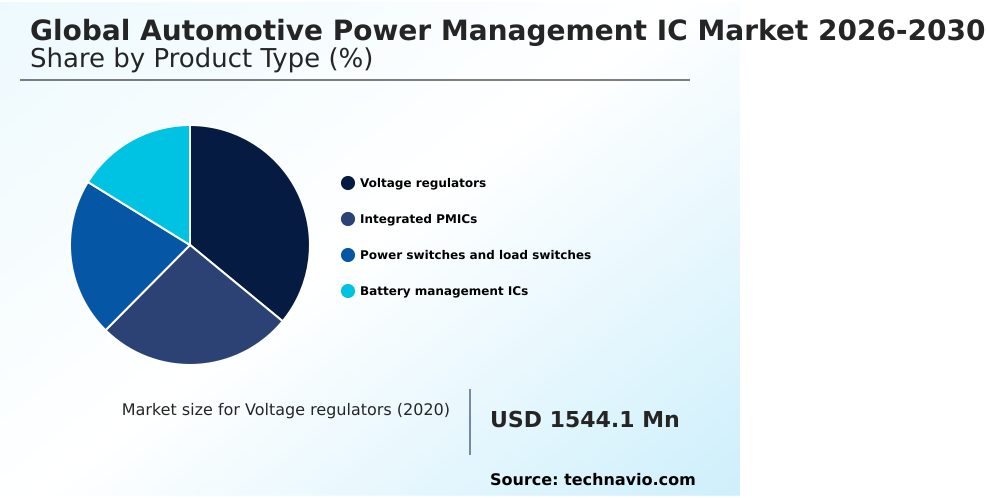
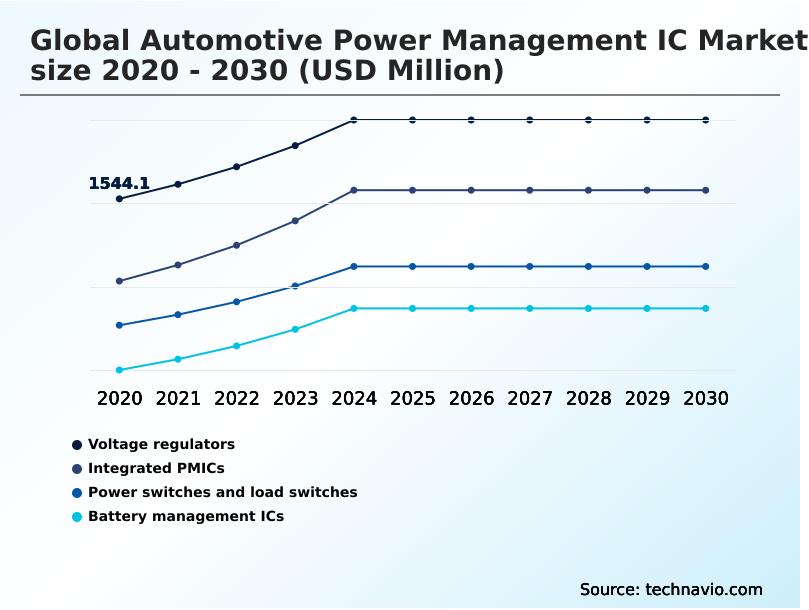
The Voltage regulators segment was valued at USD 1.93 billion in 2024 and showed a gradual increase during the forecast period.
Regional Analysis
APAC is estimated to contribute 57% to the growth of the global market during the forecast period.Technavio’s analysts have elaborately explained the regional trends and drivers that shape the market during the forecast period.

See How Automotive Power Management Ic Market Demand is Rising in APAC Get Free Sample
Geographic variations in automotive production heavily influence the deployment of specialized electrical regulation technologies.
The APAC region demonstrates aggressive adoption of bidirectional power conversion systems, achieving a 25% faster integration rate for localized battery monitoring units compared to European manufacturing hubs.
In contrast, the Europe region prioritizes strict functional safety compliance, increasing the deployment of advanced overvoltage detection mechanisms within steer-by-wire controller nodes by over 30%. This regulatory focus ensures that critical electronic braking subsystems operate flawlessly under severe thermal stress.
Furthermore, North American engineering centers accelerate the testing of vehicle-to-everything communication modules, demanding highly reliable galvanically isolated communications to prevent signal interference.
By adapting supply chain sourcing to favor localized semiconductor foundries, regional automakers successfully mitigate production delays, reducing power component lead times by up to 18% and optimizing overall manufacturing efficiency.
Market Dynamics
Our researchers analyzed the data with 2025 as the base year, along with the key drivers, trends, and challenges. A holistic analysis of drivers will help companies refine their marketing strategies to gain a competitive advantage.
- The architectural evolution of modern vehicles demands highly sophisticated energy distribution strategies to support continuous technological advancements. Automotive original equipment manufacturers are fundamentally restructuring internal electrical networks, prioritizing smart cockpit power rail management to handle the intense processing loads generated by multiple high-definition displays and interactive user interfaces.
- By consolidating decentralized power circuits, engineering teams achieve a notable 20% reduction in thermal bottlenecks compared to legacy distributed wiring setups, thereby optimizing electronic control unit reliability. Concurrently, the transition toward electrified propulsion systems necessitates rigorous high voltage battery pack isolation to protect sensitive low-voltage passenger components from catastrophic power surges.
- This physical and electrical separation is essential for maintaining operational integrity under severe environmental stress. Furthermore, the expansion of automated driving capabilities requires precise autonomous sensor suite voltage regulation to ensure radar and lidar systems receive clean, uninterrupted power free from electromagnetic interference.
- To comply with strict international regulatory standards, manufacturers aggressively implement redundant fail-safe power sequencing protocols that seamlessly isolate faulted circuits without interrupting critical vehicle mobility functions. The integration of automotive functional safety compliant switching devices replaces traditional mechanical relays, allowing for instantaneous fault detection and active current monitoring.
- By refining these intelligent power architectures, automotive suppliers significantly reduce total vehicle weight, streamline assembly line logistics, and enhance overall platform energy conservation, establishing a highly resilient foundation for next-generation transportation solutions.
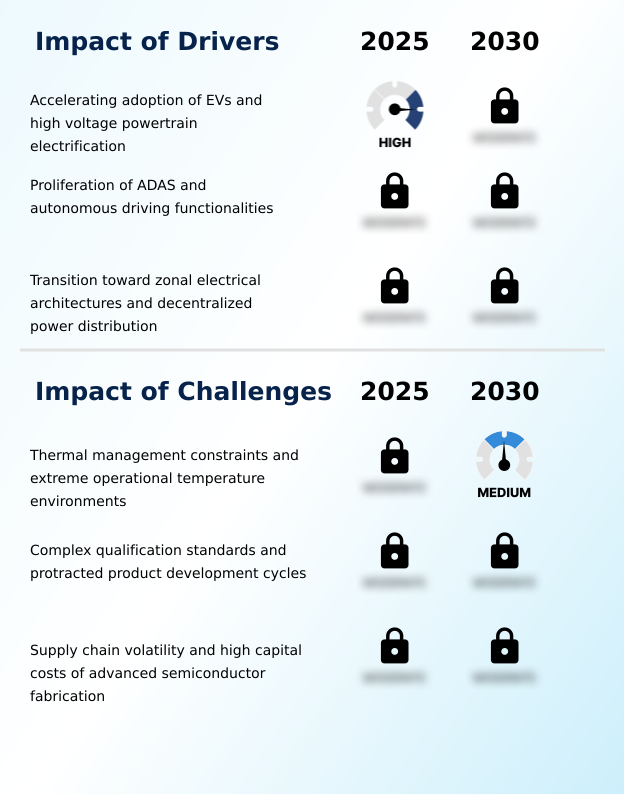
What are the key market drivers leading to the rise in the adoption of Automotive Power Management Ic Industry?
- The accelerating adoption of electric vehicles and high-voltage powertrain electrification serves as a primary driver propelling the integration of highly sophisticated energy conversion architectures.
- The aggressive expansion of electric vehicle manufacturing mandates highly resilient electrical infrastructures capable of enduring extreme mechanical stress.
- Operating within wide temperature envelope operations forces component designers to utilize advanced packaging substrates that enhance thermal dissipation, extending component lifecycles by over 25%.
- Concurrently, the shift toward decentralized power distribution networks requires sophisticated silicon capable of executing localized load control without constant central processing oversight.
- By utilizing precise current sensing mechanisms, intelligent electronic control units mitigate sudden voltage spikes caused by rapid load dump events, improving total system safety margins by 20%.
- Incorporating complex built-in self-test capabilities alongside extreme vibrational stress resistance empowers vehicle diagnostic networks to detect micro-faults instantaneously. These integrated diagnostic features streamline onboard fast-charging protocols, directly reducing dealership service times and enhancing end-user vehicle reliability across demanding environments.
What are the market trends shaping the Automotive Power Management Ic Industry?
- The rapid expansion of smart cockpit and digital in-vehicle infotainment systems is reshaping modern vehicle interiors into immersive environments. This trend necessitates advanced power regulation to manage complex thermal and electrical loads effectively.
- The proliferation of digital instrument cluster displays and sensor-heavy driving systems fundamentally restructures onboard energy distribution topologies. Modern multi-core system-on-chip architectures demand fast transient response parameters to maintain operational stability during sudden computational load spikes, ensuring uninterrupted video rendering.
- The integration of fault-tolerant hardware topologies enables a 30% reduction in critical system downtime by rapidly isolating short circuits before they affect adjacent modules. Furthermore, advanced electromagnetic interference suppression techniques ensure clean power delivery, improving wireless signal integrity by nearly 18% in dense urban environments.
- To prevent battery drain during parking modes, engineering teams prioritize power components that maintain ultra-low standby current. The inclusion of embedded windowed watchdog timers actively monitors system health, allowing automated diagnostic routines to reset frozen processors seamlessly. This dynamic power optimization directly impacts manufacturer warranty costs by lowering electronic module failure rates.
What challenges does the Automotive Power Management Ic Industry face during its growth?
- Thermal management constraints and extreme operational temperature environments pose significant reliability challenges that limit the efficiency of high-density automotive electronic components.
- Managing extreme localized heat dissipation within compact electronic housings presents a formidable structural limitation for next-generation vehicle architectures. High switching frequencies within the high-voltage traction inverter generate severe heat, making localized thermal concentration mitigation essential, as unmanaged heat degrades surrounding silicon efficiency by up to 15%.
- The stringent requirements of the automotive safety integrity level mandate flawless execution of automated safety diagnostic reporting, complicating circuit board designs and extending product qualification cycles. Implementing accurate differential voltage measurements across fluctuating temperature extremes requires costly precision calibration, thereby increasing overall bill-of-materials expenses for gallium nitride power modules.
- Moreover, coordinating dynamic load shedding strategies through smart high-side power switches involves intricate software integration that frequently delays vehicle launch timelines by several months. Overcoming these barriers necessitates substantial capital investments in advanced silicon carbide substrate materials, squeezing operational profit margins for semiconductor suppliers.
Exclusive Technavio Analysis on Customer Landscape
The automotive power management ic market forecasting report includes the adoption lifecycle of the market, covering from the innovator’s stage to the laggard’s stage. It focuses on adoption rates in different regions based on penetration. Furthermore, the automotive power management ic market report also includes key purchase criteria and drivers of price sensitivity to help companies evaluate and develop their market growth analysis strategies.
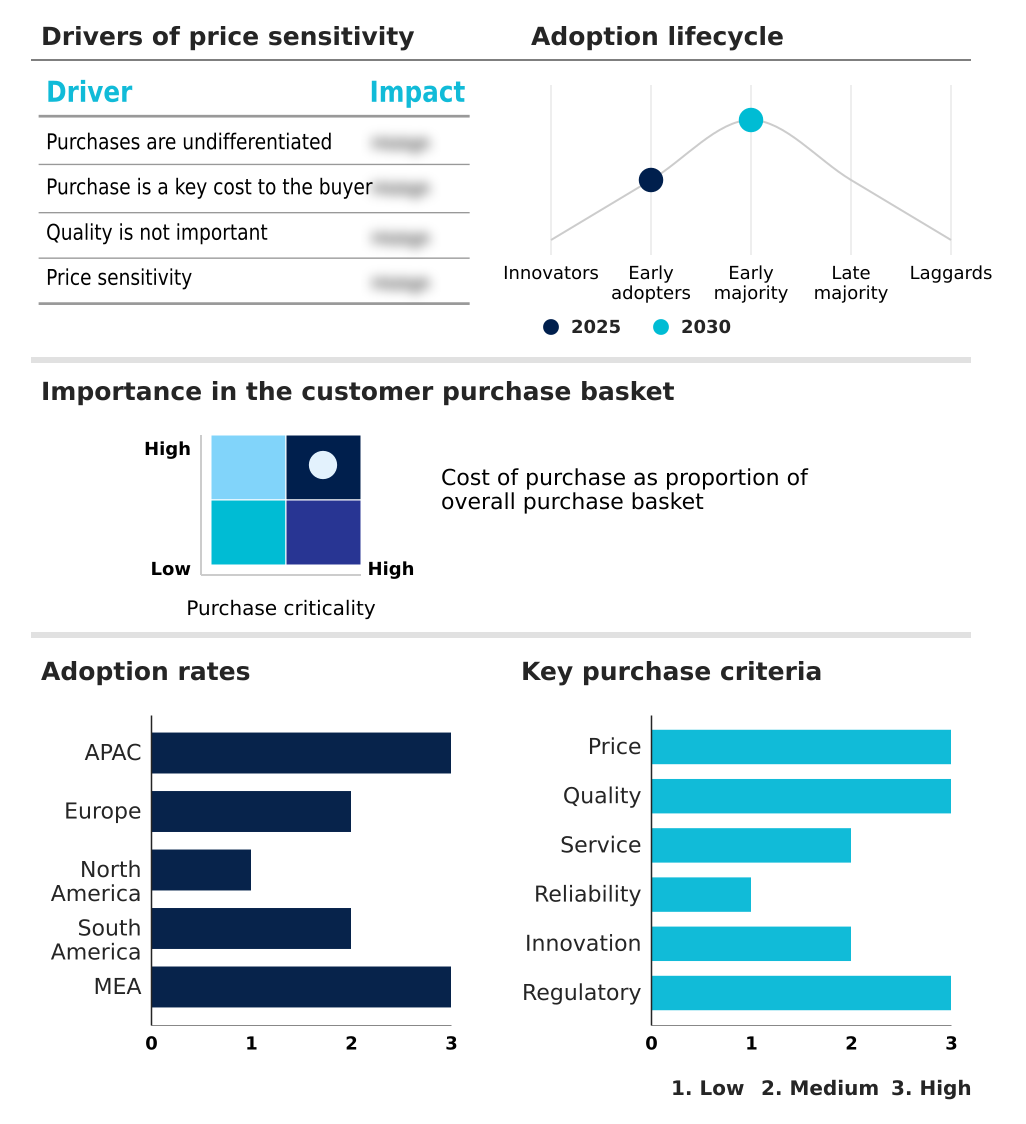
Customer Landscape of Automotive Power Management Ic Industry
Competitive Landscape
Companies are implementing various strategies, such as strategic alliances, automotive power management ic market forecast, partnerships, mergers and acquisitions, geographical expansion, and product/service launches, to enhance their presence in the industry.
ABLIC Inc. - The portfolio encompasses automotive analog semiconductors, advanced sensors, dedicated integrated circuits, and precision timer components engineered to enhance vehicular control, safety monitoring, and electrical efficiency.
The industry research and growth report includes detailed analyses of the competitive landscape of the market and information about key companies, including:
- ABLIC Inc.
- Alpha and Omega Semiconductor
- ams OSRAM AG
- Analog Devices Inc.
- Diodes Inc.
- Infineon Technologies AG
- Littelfuse Inc.
- Microchip Technology Inc.
- Monolithic Power Systems Inc.
- Nisshinbo Micro Devices Inc.
- NXP Semiconductors NV
- ON Semiconductor Corp.
- Power Integrations Inc.
- Renesas Electronics Corp.
- ROHM Co. Ltd.
- Samsung Electronics Co. Ltd.
- Skyworks Solutions Inc.
- STMicroelectronics NV
- Toshiba Corp.
- Vishay Intertechnology Inc.
Qualitative and quantitative analysis of companies has been conducted to help clients understand the wider business environment as well as the strengths and weaknesses of key industry players. Data is qualitatively analyzed to categorize companies as pure play, category-focused, industry-focused, and diversified; it is quantitatively analyzed to categorize companies as dominant, leading, strong, tentative, and weak.
Recent Development and News in Automotive power management ic market
- In the semiconductor industry, the rapid adoption of wide bandgap materials like silicon carbide established new thermal efficiency benchmarks, directly impacting Automotive Power Management IC demand by requiring advanced gate drivers capable of managing higher switching frequencies without overheating.
- Stringent functional safety mandates under the ISO 26262 standard compelled tier-one suppliers to integrate redundant safety checks directly onto silicon substrates, pulling demand for specialized Automotive Power Management IC components featuring built-in self-test diagnostics.
- The structural migration from decentralized electronic control units toward centralized domain architectures consolidated localized power routing, thereby accelerating the deployment of intelligent multi-rail Automotive Power Management IC designed to handle dynamic load shedding.
- Geopolitical shifts in raw wafer sourcing prompted major foundries to localize production nodes across the North America region, reducing supply chain bottlenecks and stabilizing the availability of high-voltage Automotive Power Management IC for zero-emission vehicle platforms.
Dive into Technavio’s robust research methodology, blending expert interviews, extensive data synthesis, and validated models for unparalleled Automotive Power Management Ic Market insights. See full methodology.
| Market Scope | |
|---|---|
| Page number | 321 |
| Base year | 2025 |
| Historic period | 2020-2024 |
| Forecast period | 2026-2030 |
| Growth momentum & CAGR | Accelerate at a CAGR of 12.4% |
| Market growth 2026-2030 | USD 5038.5 million |
| Market structure | Fragmented |
| YoY growth 2025-2026(%) | 11.1% |
| Key countries | China, Japan, India, South Korea, Indonesia, Australia, UK, Germany, France, Spain, Italy, The Netherlands, US, Mexico, Canada, Brazil, Argentina, Colombia, Saudi Arabia, South Africa, Israel, Turkey and UAE |
| Competitive landscape | Leading Companies, Market Positioning of Companies, Competitive Strategies, and Industry Risks |
Research Analyst Overview
- The continuous modernization of vehicular electrical architecture heavily relies on the strategic integration of sophisticated energy regulation devices. Boardroom executives increasingly prioritize wide bandgap semiconductor integration to satisfy rigorous carbon emission regulations while maximizing electric propulsion efficiency.
- By deploying advanced algorithms within centralized body domain controllers, automotive manufacturers have achieved a 22% improvement in energy conservation during prolonged vehicle idle states. This architectural shift significantly extends battery lifespan and reduces auxiliary power depletion. Furthermore, the transition toward intelligent power switches allows for the elimination of heavy electromechanical fuses, contributing directly to streamlined assembly operations and weight reduction.
- To ensure mission-critical reliability, modern vehicle platforms incorporate redundant power routing systems that isolate electrical faults within milliseconds. The utilization of robust control components enhances transient load response capabilities, allowing critical sensors to maintain continuous operation during severe voltage drops.
- These technological enhancements enable supply chain strategists to standardize component procurement across multiple vehicle lines, optimizing manufacturing costs and elevating overall platform safety compliance.
What are the Key Data Covered in this Automotive Power Management Ic Market Research and Growth Report?
-
What is the expected growth of the Automotive Power Management Ic Market between 2026 and 2030?
-
USD 5.04 billion, at a CAGR of 12.4%
-
-
What segmentation does the market report cover?
-
The report is segmented by Product Type (Voltage regulators, Integrated PMICs, Power switches and load switches, and Battery management ICs), Application (EV battery and lighting, Powertrain systems, ADAS and safety systems, Body electronics, and Infotainment systems), Vehicle Type (Passenger cars, and Commercial vehicles) and Geography (APAC, Europe, North America, South America, Middle East and Africa)
-
-
Which regions are analyzed in the report?
-
APAC, Europe, North America, South America and Middle East and Africa
-
-
What are the key growth drivers and market challenges?
-
Accelerating adoption of EVs and high voltage powertrain electrification, Thermal management constraints and extreme operational temperature environments
-
-
Who are the major players in the Automotive Power Management Ic Market?
-
ABLIC Inc., Alpha and Omega Semiconductor, ams OSRAM AG, Analog Devices Inc., Diodes Inc., Infineon Technologies AG, Littelfuse Inc., Microchip Technology Inc., Monolithic Power Systems Inc., Nisshinbo Micro Devices Inc., NXP Semiconductors NV, ON Semiconductor Corp., Power Integrations Inc., Renesas Electronics Corp., ROHM Co. Ltd., Samsung Electronics Co. Ltd., Skyworks Solutions Inc., STMicroelectronics NV, Toshiba Corp. and Vishay Intertechnology Inc.
-
Market Research Insights
- The evolution of modern mobility platforms fundamentally alters automotive power distribution strategies across the entire supply chain. Transitioning to advanced driver assistance processing units demands ultra-stable voltage regulation, driving a 15% improvement in fault-isolation speeds during critical safety events. As engineering teams embed thermal shutdown signaling into power controllers, the diagnostic accuracy of module health increases substantially.
- The integration of silicon carbide substrate materials enables robust solid-state semiconductor solutions that handle intense electrical loads without compromising spatial constraints. Furthermore, implementing dynamic voltage scaling techniques reduces overall circuit thermal output by nearly 20%, significantly lowering material costs and improving assembly line throughput.
- These structural enhancements directly support strict functional safety compliance, enabling original equipment manufacturers to minimize unexpected vehicle downtime.
We can help! Our analysts can customize this automotive power management ic market research report to meet your requirements.
 RIA -