
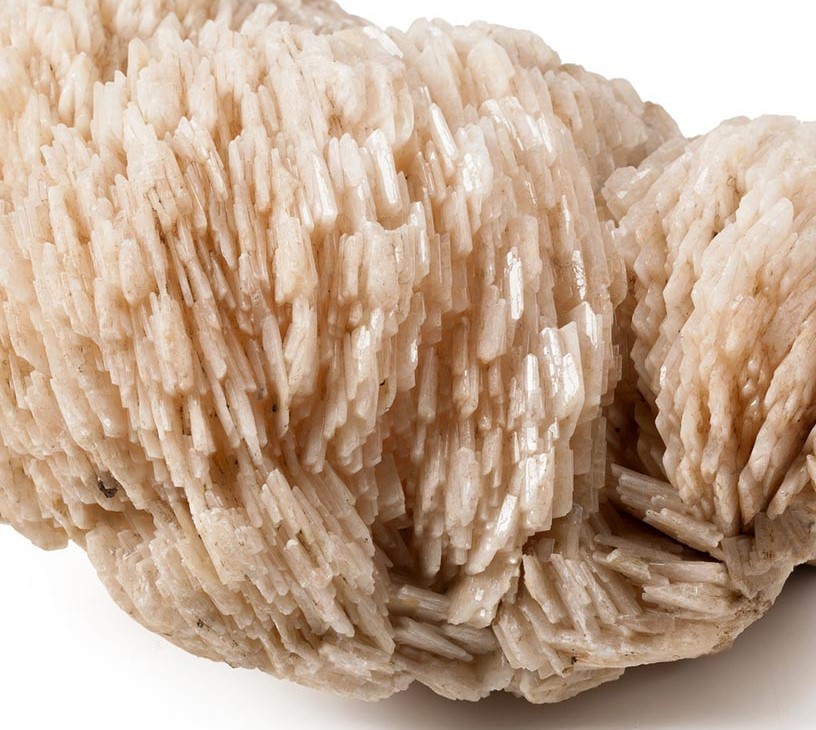


Barite Market Size 2026-2030
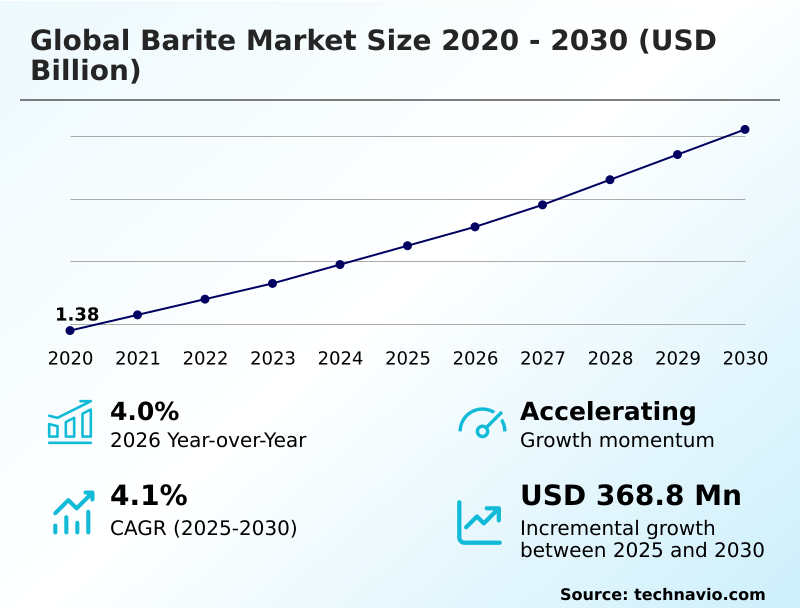
The barite market size is valued to increase by USD 368.8 million, at a CAGR of 4.1% from 2025 to 2030. Increasing demand for oil and gas drilling operations will drive the barite market.
Major Market Trends & Insights
- APAC dominated the market and accounted for a 59.9% growth during the forecast period.
- By Type - Powder segment was valued at USD 1.28 billion in 2024
- By End-user - Drilling mud segment accounted for the largest market revenue share in 2024
Market Size & Forecast
- Market Opportunities: USD 634.4 million
- Market Future Opportunities: USD 368.8 million
- CAGR from 2025 to 2030 : 4.1%
Market Summary
- The barite market is defined by its critical role as a non-substitutable weighting agent in the upstream energy sector. The mineral’s primary function in formation pressure control, a necessity that intensifies as exploration moves into high-pressure environments, requiring high-density drilling fluids.
- This core demand for energy exploration materials is supplemented by a diverse range of industrial mineral applications where barite is valued as a functional filler additive due to its chemical inertness property. A key trend is the industry's pivot toward a circular economy in mining, with a focus on spent drilling mud recycling.
- For instance, an operator can implement a closed-loop fluid model, which uses solids control technology to recover api grade barite, reducing the need for virgin material. However, the market faces challenges from fluctuating drilling rig activity, which directly impacts demand, and stringent environmental compliance in mining.
- The market's reliance on a concentrated mineral processing capacity creates supply chain vulnerabilities tied to maritime logistics and geopolitical trade tensions.
What will be the Size of the Barite Market during the forecast period?
Get Key Insights on Market Forecast (PDF) Get Free Sample
How is the Barite Market Segmented?
The barite industry research report provides comprehensive data (region-wise segment analysis), with forecasts and estimates in "USD million" for the period 2026-2030, as well as historical data from 2020-2024 for the following segments.
- Type
- Powder
- Lumps
- End-user
- Drilling mud
- Chemical manufacturing
- Paints and coatings
- Others
- Grade type
- Type 1
- Type 2
- Type 3
- Type 4
- Geography
- APAC
- China
- India
- Japan
- North America
- US
- Canada
- Mexico
- Europe
- Germany
- UK
- France
- Middle East and Africa
- Saudi Arabia
- UAE
- South Africa
- South America
- Brazil
- Argentina
- Rest of World (ROW)
- APAC
By Type Insights
The powder segment is estimated to witness significant growth during the forecast period.
The powder segment dominates the market, serving as a primary upstream energy sector material for ensuring wellbore stability and integrity.
Its application as a key component in energy exploration materials is expanding with advancements in solids control technology and centrifugation systems. These technologies facilitate spent drilling mud recycling, creating a closed-loop fluid model that reduces waste.
The push for sustainability has increased the use of recycled drilling mud, with some operations recovering up to 80% of the mineral content. Beyond energy, the segment supplies crucial chemical manufacturing inputs for industrial mineral applications.
The designation of barite as a critical minerals list component, alongside growing demand for synthetic barium sulfate, further diversifies the segment's growth trajectory.
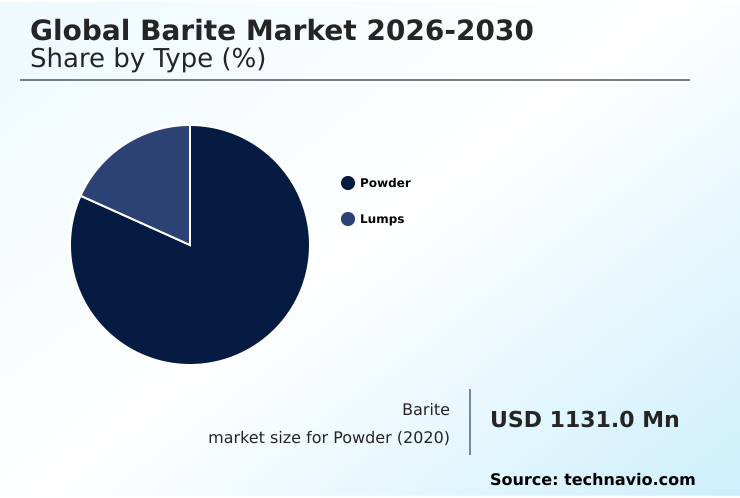
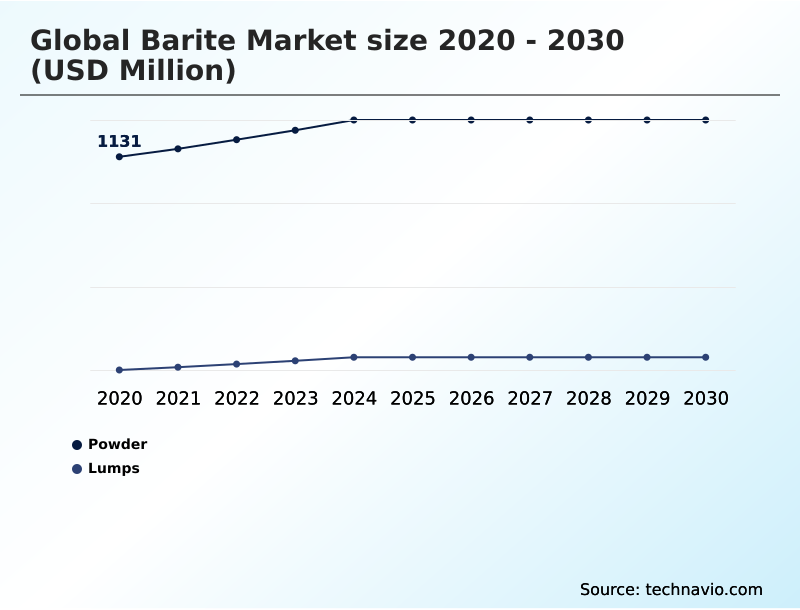
The Powder segment was valued at USD 1.28 billion in 2024 and showed a gradual increase during the forecast period.
Regional Analysis
APAC is estimated to contribute 59.9% to the growth of the global market during the forecast period.Technavio’s analysts have elaborately explained the regional trends and drivers that shape the market during the forecast period.
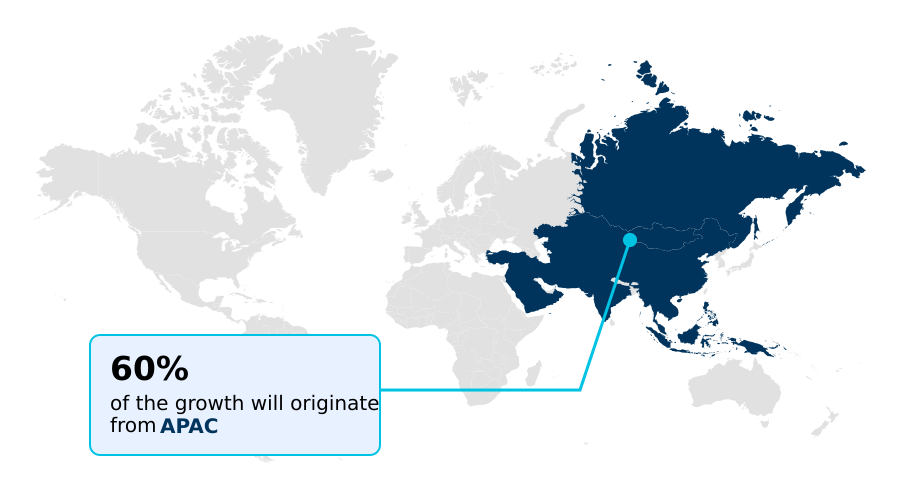
See How Barite Market Demand is Rising in APAC Get Free Sample
The geographic landscape is characterized by concentrated production hubs serving global demand for high-density drilling fluids used in formation pressure control.
Regions with advanced processing capabilities produce micronized barite powder and other high-purity mineral grades essential for controlling drilling mud rheology. These regions have seen a 5.4% uptick in industrial applications.
Beyond drilling, demand is growing for its use as an architectural coatings additive and in sound-dampening insulation.
The mineral's chemical inertness property makes it ideal for specialized applications like radiation shielding concrete for nuclear power facility shielding and in gastrointestinal diagnostics.
Investment in the beneficiation of low-grade ore is expanding, aiming to increase the supply of high-density aggregates and sound-dampening material to meet diverse industrial needs worldwide.
Market Dynamics
Our researchers analyzed the data with 2025 as the base year, along with the key drivers, trends, and challenges. A holistic analysis of drivers will help companies refine their marketing strategies to gain a competitive advantage.
- Strategic decision-making in the barite market is increasingly influenced by specific end-use requirements and supply chain dynamics. The use of barite in high-temperature drilling fluids is non-negotiable for deepwater oil drilling, where controlling wellbore pressure is paramount. Here, the quality specifications for drilling barite are exceptionally strict, often demanding specific api grade barite to ensure performance.
- In contrast, using barite for radiation shielding in medical and nuclear facilities relies on its density. As a functional filler, barite for automotive sound dampening and in plastics leverages its weight and inertness. Its application in paints and coatings provides opacity and durability, while its use in chemical manufacturing depends on purity.
- The growing practice of recycling barite from drilling mud reflects a shift toward sustainability and cost control. This approach has proven more efficient than sourcing from new mines, reducing logistical dependencies by over 50% in some onshore operations.
- Comparing barite versus alternative weighting agents is a constant analysis for operators, factoring in cost, availability, and the environmental impact of barite mining. The expansion of barite in unconventional shale drilling and the emerging use of barite for geothermal drilling fluids are broadening the mineral's application profile.
- Finally, understanding the beneficiation process for barite ore is crucial for evaluating supply quality and addressing barite supply chain logistics challenges.
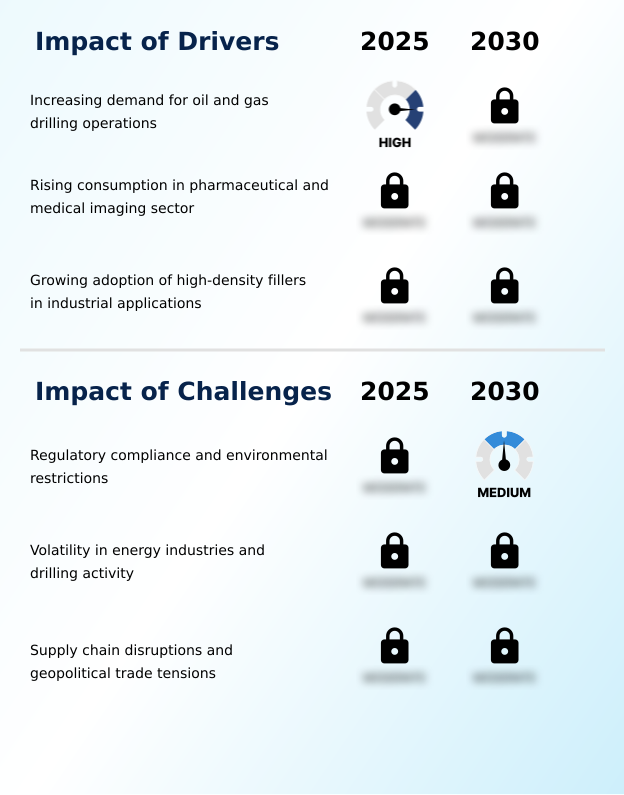
What are the key market drivers leading to the rise in the adoption of Barite Industry?
- The increasing demand for oil and gas drilling operations, particularly in deepwater and unconventional reserves, serves as a key driver for market growth.
- The primary driver remains the use of barite as a drilling fluid weighting agent, valued for being a high specific gravity mineral essential for hydrostatic pressure management.
- Renewed investment in deepwater drilling campaigns and sustained shale gas production require vast quantities of api grade barite for blowout prevention and to ensure wellbore integrity. These operations can improve drilling fluid density by up to 40% in high-pressure zones.
- Beyond energy, the market is driven by healthcare applications, where a specific barium sulfate formulation acts as a radiopaque contrast agent in medical imaging contrast procedures, which have seen a 5% increase in annual volume.
- Additionally, its role as a versatile industrial filler additive in manufacturing continues to expand, providing a stable secondary demand driver.
What are the market trends shaping the Barite Industry?
- The increasing complexity of deepwater and ultra-deepwater energy exploration is a primary trend shaping the market. This shift necessitates advanced materials to manage challenging drilling environments.
- Market trends are increasingly shaped by the adoption of circular economy in mining principles, focusing on the recovery of materials from spent fluids. Innovations in solids control systems enable the reuse of barite that meets api specification 13a, reducing waste by as much as 80%.
- Concurrently, demand is growing for the mineral's unique properties like gamma ray absorption and x-ray absorption shielding, making it vital for radiation protection materials in new oncological facility construction. In industrial sectors, barite serves as a functional extender in coatings and a low oil absorption filler.
- Its use in automotive friction materials and as heavy-weight aggregates highlights its versatility beyond the energy sector, although geopolitical trade tensions are compelling companies toward greater supply chain diversification.
What challenges does the Barite Industry face during its growth?
- Stringent regulatory compliance standards and environmental restrictions on exploration and mining activities present a key challenge affecting industry growth.
- Market challenges are tied to fluctuating drilling rig activity and complex maritime logistics, which impact the supply of this deepwater exploration mineral. As a critical subsea drilling component and offshore well control agent, its role as a non-substitutable weighting agent creates supply pressures.
- For oilfield service companies, ensuring consistent drilling fluid composition for unconventional gas drilling and HPHT drilling is a constant challenge. Stricter environmental compliance in mining is increasing operational costs, while limited mineral processing capacity in certain regions requires companies to rely on strategic mineral stockpiling.
- Even in specialty sectors, producing pharmaceutical-grade barium sulfate consistently presents technical and regulatory hurdles, with compliance adding 15-20% to production costs.
Exclusive Technavio Analysis on Customer Landscape
The barite market forecasting report includes the adoption lifecycle of the market, covering from the innovator’s stage to the laggard’s stage. It focuses on adoption rates in different regions based on penetration. Furthermore, the barite market report also includes key purchase criteria and drivers of price sensitivity to help companies evaluate and develop their market growth analysis strategies.
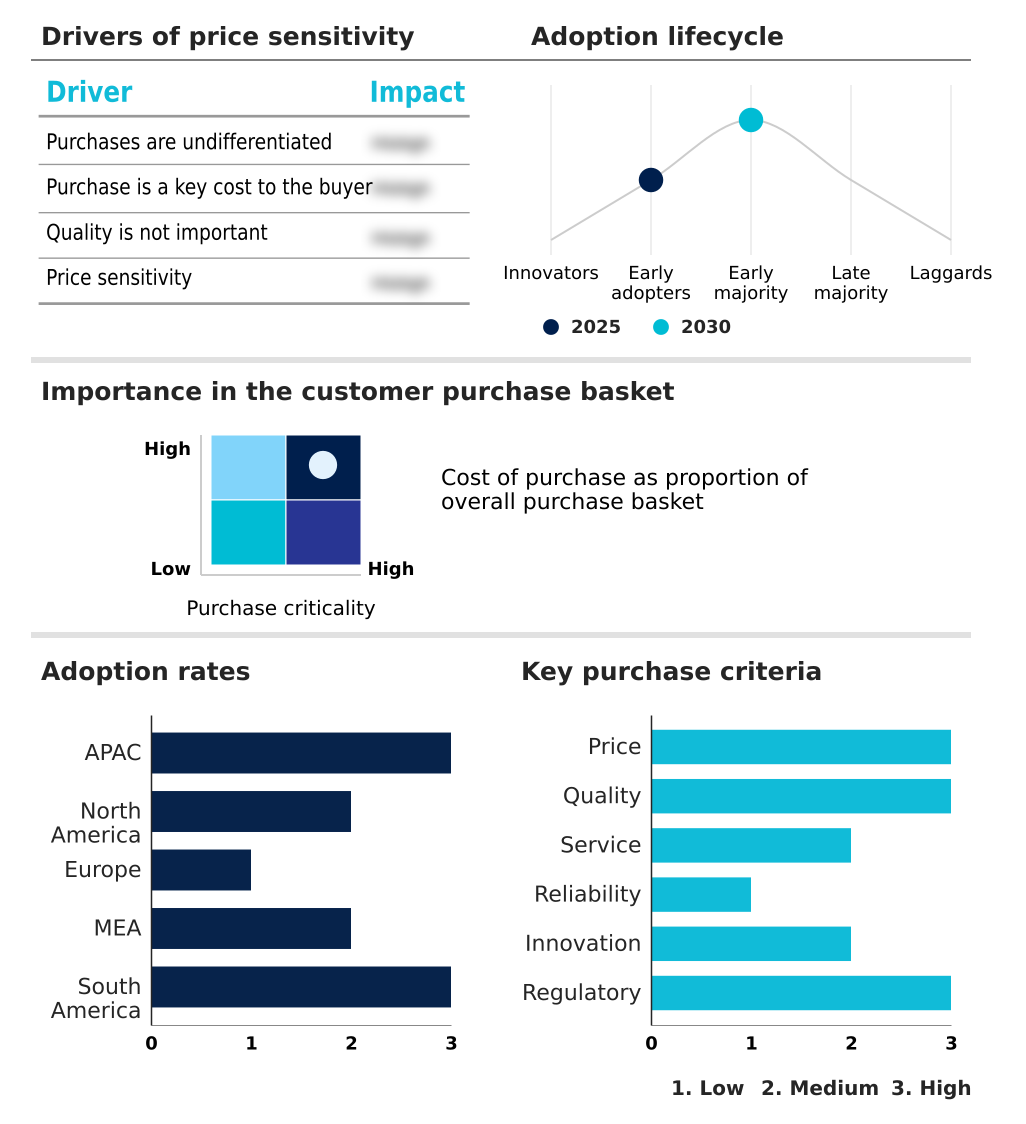
Customer Landscape of Barite Industry
Competitive Landscape
Companies are implementing various strategies, such as strategic alliances, barite market forecast, partnerships, mergers and acquisitions, geographical expansion, and product/service launches, to enhance their presence in the industry.
ADO Mining - Specializing in the provision of barite aggregates and ground industrial minerals, the portfolio supports diverse applications requiring specific density and composition.
The industry research and growth report includes detailed analyses of the competitive landscape of the market and information about key companies, including:
- ADO Mining
- Akrochem Corp.
- Arvind Minerals
- Ashapura Microns LLP
- China zhashui heqi barite mining
- CIMBAR RESOURCES INC.
- Gimpex Pvt Ltd
- Ishtar Company LLC
- J and H Minerals Pvt. Ltd.
- JAM GROUP CO
- Polaris mining
- PVS Global Trade Pvt. Ltd.
- RUA GROUP
- Sachtleben Minerals GmbH and Co
- SCR Sibelco NV
- Sinobarite Industrials Ltd.
- SNDB
- Trimex Group
- Vishnu Chemicals Ltd.
- Yingfengyuan Industrial Group
Qualitative and quantitative analysis of companies has been conducted to help clients understand the wider business environment as well as the strengths and weaknesses of key industry players. Data is qualitatively analyzed to categorize companies as pure play, category-focused, industry-focused, and diversified; it is quantitatively analyzed to categorize companies as dominant, leading, strong, tentative, and weak.
Recent Development and News in Barite market
- In August 2024, the Oil and Natural Gas Corp. Ltd. (ONGC) initiated a major deepwater project in the Krishna Godavari Basin, significantly increasing regional demand for API-grade barite.
- In January 2025, SLB launched a new drilling fluid recycling facility in the Permian Basin to recover and reuse barite from spent drilling muds in active operations.
- In March 2025, Cimbar Performance Minerals formed a strategic partnership with ChemSpec Canada to enhance the distribution of its performance minerals, including barium sulfate, throughout the Canadian market.
- In May 2025, TotalEnergies' GranMorgu project in Suriname achieved a key construction milestone, signaling an upcoming intensive drilling phase requiring substantial volumes of high-performance drilling fluids.
Dive into Technavio’s robust research methodology, blending expert interviews, extensive data synthesis, and validated models for unparalleled Barite Market insights. See full methodology.
| Market Scope | |
|---|---|
| Page number | 296 |
| Base year | 2025 |
| Historic period | 2020-2024 |
| Forecast period | 2026-2030 |
| Growth momentum & CAGR | Accelerate at a CAGR of 4.1% |
| Market growth 2026-2030 | USD 368.8 million |
| Market structure | Fragmented |
| YoY growth 2025-2026(%) | 4.0% |
| Key countries | China, India, Japan, South Korea, Australia, Indonesia, US, Canada, Mexico, Germany, UK, France, Italy, Spain, The Netherlands, Saudi Arabia, UAE, South Africa, Turkey, Israel, Brazil, Argentina and Chile |
| Competitive landscape | Leading Companies, Market Positioning of Companies, Competitive Strategies, and Industry Risks |
Research Analyst Overview
- The market is anchored by barite's function as a drilling fluid weighting agent, a high specific gravity mineral essential for hydrostatic pressure management and formation pressure control. Its role as a non-substitutable weighting agent is critical for ensuring wellbore stability in high-pressure high-temperature (HPHT) drilling.
- A key trend impacting boardroom strategy is supply chain resilience, leading to investment in the beneficiation of low-grade ore, which has improved yields from secondary sources by over 20%. Beyond its use as a deepwater exploration mineral, industrial applications for micronized barite powder are expanding.
- It serves as an industrial filler additive, a sound-dampening material, and is used in radiation shielding concrete. The mineral’s chemical inertness property also supports the creation of pharmaceutical-grade barium sulfate from a specific barium sulfate formulation, which acts as a radiopaque contrast agent.
- As an unconventional gas drilling agent and key subsea drilling component, its strategic value as a critical minerals list component is undeniable.
What are the Key Data Covered in this Barite Market Research and Growth Report?
-
What is the expected growth of the Barite Market between 2026 and 2030?
-
USD 368.8 million, at a CAGR of 4.1%
-
-
What segmentation does the market report cover?
-
The report is segmented by Type (Powder, and Lumps), End-user (Drilling mud, Chemical manufacturing, Paints and coatings, and Others), Grade Type (Type 1, Type 2, Type 3, and Type 4) and Geography (APAC, North America, Europe, Middle East and Africa, South America)
-
-
Which regions are analyzed in the report?
-
APAC, North America, Europe, Middle East and Africa and South America
-
-
What are the key growth drivers and market challenges?
-
Increasing demand for oil and gas drilling operations, Regulatory compliance and environmental restrictions
-
-
Who are the major players in the Barite Market?
-
ADO Mining, Akrochem Corp., Arvind Minerals, Ashapura Microns LLP, China zhashui heqi barite mining, CIMBAR RESOURCES INC., Gimpex Pvt Ltd, Ishtar Company LLC, J and H Minerals Pvt. Ltd., JAM GROUP CO, Polaris mining, PVS Global Trade Pvt. Ltd., RUA GROUP, Sachtleben Minerals GmbH and Co, SCR Sibelco NV, Sinobarite Industrials Ltd., SNDB, Trimex Group, Vishnu Chemicals Ltd. and Yingfengyuan Industrial Group
-
Market Research Insights
- The market is shaped by demand from the upstream energy sector for materials that ensure wellbore integrity during deepwater drilling campaigns. The adoption of advanced solids control systems has enabled operators to increase drilling fluid recovery by up to 80%, a significant factor in managing costs.
- Beyond energy, growth is supported by demand for high-purity mineral grades in chemical manufacturing and for sound-dampening insulation in industrial applications. Architectural coatings that incorporate barite see a 15% improvement in durability. The diversification into radiation protection materials for oncological facility construction provides a stable, non-cyclical demand stream.
- However, supply chain diversification remains a strategic priority, as reliance on a few production centers introduces risks related to maritime logistics and geopolitical trade tensions, impacting the availability of key energy exploration materials.
We can help! Our analysts can customize this barite market research report to meet your requirements.
 RIA -
RIA - 
