


Black Truffles Market Size 2026-2030
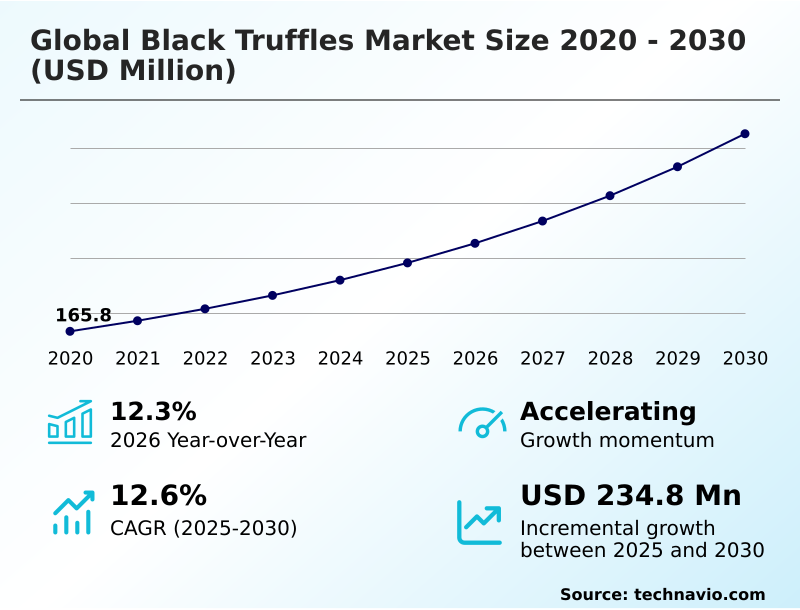
The black truffles market size is valued to increase by USD 234.8 million, at a CAGR of 12.6% from 2025 to 2030. Expansion of luxury hospitality and fine dining sectors will drive the black truffles market.
Major Market Trends & Insights
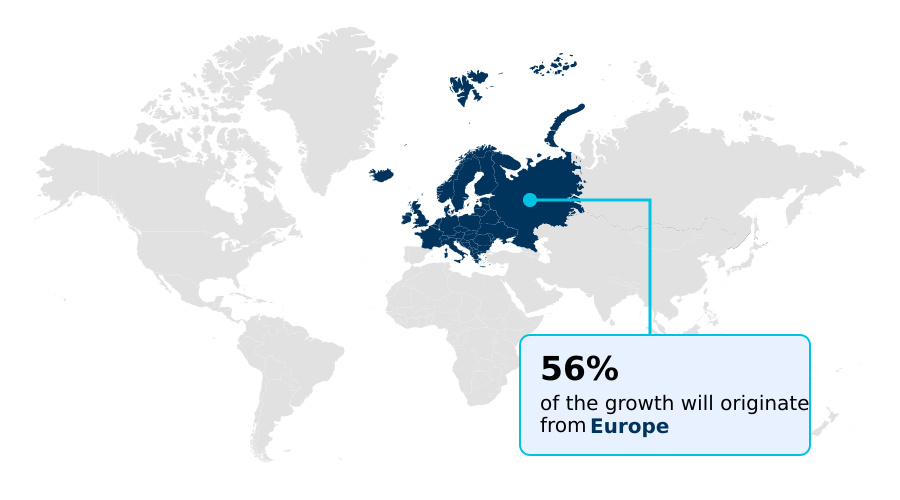
- Europe dominated the market and accounted for a 55.7% growth during the forecast period.
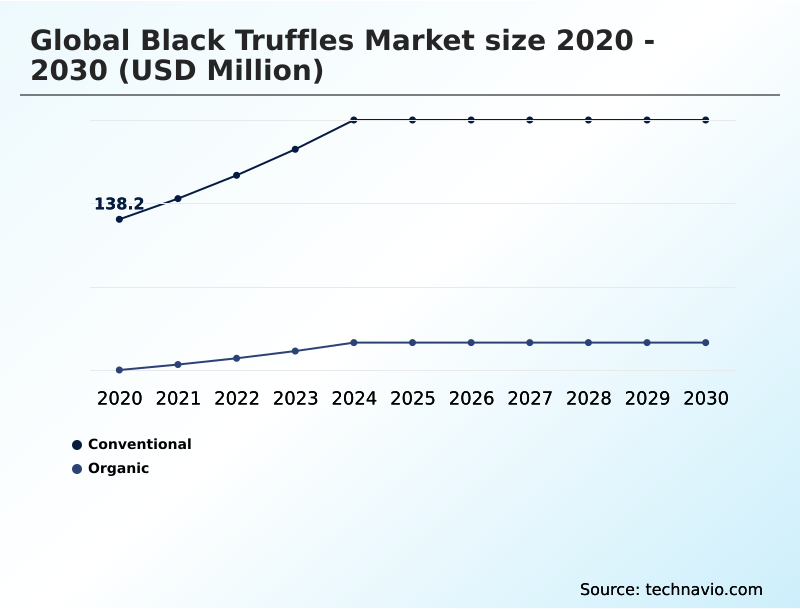
- By Type - Conventional segment was valued at USD 211.1 million in 2024
- By Distribution Channel - Offline segment accounted for the largest market revenue share in 2024
Market Size & Forecast
- Market Opportunities: USD 359.2 million
- Market Future Opportunities: USD 234.8 million
- CAGR from 2025 to 2030 : 12.6%
Market Summary
- The black truffles market is undergoing a significant transformation, moving from a reliance on traditional wild truffle foraging to systematic, science-driven truffle cultivation technology. This evolution is propelled by advancements in mycorrhizal inoculation and soil inoculation techniques, which have enabled the establishment of productive truffle orchard management systems globally.
- While demand from fine dining establishments remains a core driver, a major trend is the expansion into premium consumer goods, with an increasing variety of truffle-infused products available.
- However, this growth is met with challenges, including the need for robust cold chain logistics to preserve the delicate fungal aroma profile and the persistent issue of product adulteration with synthetic truffle oil. To counter this, businesses are adopting digital traceability tools to provide provenance verification.
- A leading distributor, for instance, could implement a blockchain-based system to track each tuber melanosporum from harvest to table, ensuring authenticity certification and securing contracts with high-end hospitality groups that prioritize quality and transparency in their luxury culinary ingredient sourcing.
What will be the Size of the Black Truffles Market during the forecast period?
Get Key Insights on Market Forecast (PDF) Get Free Sample
How is the Black Truffles Market Segmented?
The black truffles industry research report provides comprehensive data (region-wise segment analysis), with forecasts and estimates in "USD million" for the period 2026-2030, as well as historical data from 2020-2024 for the following segments.
- Type
- Conventional
- Organic
- Distribution channel
- Offline
- Online
- End-user
- Restaurants and hotels
- Food manufacturers
- Residential
- Specialty gourmet brands
- Cosmetics brands
- Geography
- Europe
- Spain
- France
- Italy
- North America
- US
- Canada
- Mexico
- APAC
- China
- Japan
- Australia
- South America
- Brazil
- Argentina
- Colombia
- Middle East and Africa
- UAE
- Saudi Arabia
- South Africa
- Rest of World (ROW)
- Europe
By Type Insights
The conventional segment is estimated to witness significant growth during the forecast period.
The conventional segment underpins the black truffles market, encompassing both wild truffle foraging and managed plantations that operate without formal organic certification.
This category is defined by the application of standard horticultural interventions, such as mineral fertilizers and targeted sustainable irrigation, to optimize host tree symbiosis and ensure consistent yields.
Conventional truffle orchard management benefits from established supply chains and dictates baseline pricing for the global trade.
This segment provides the necessary volume to support not only the fine dining establishments demanding fresh fungi but also the industrial production of truffle derivatives.
It accounts for the substantial majority of the industry, with European producers alone contributing over 60% of the total market volume.
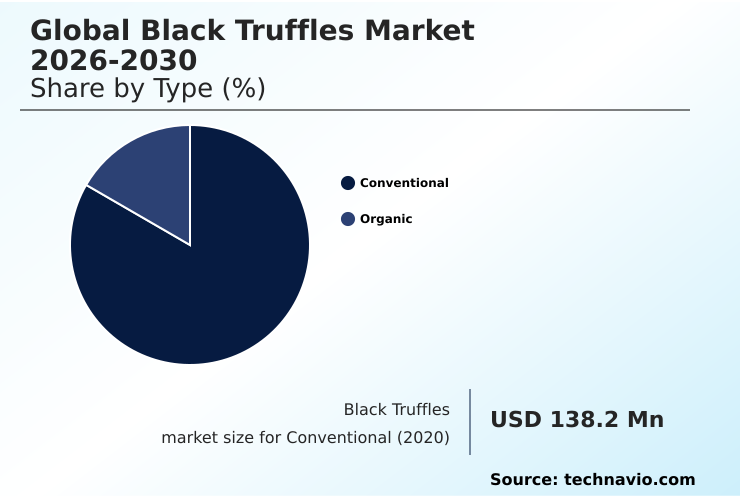
The Conventional segment was valued at USD 211.1 million in 2024 and showed a gradual increase during the forecast period.
Regional Analysis
Europe is estimated to contribute 55.7% to the growth of the global market during the forecast period.Technavio’s analysts have elaborately explained the regional trends and drivers that shape the market during the forecast period.
See How Black Truffles Market Demand is Rising in Europe Get Free Sample
The geographic landscape is evolving beyond its European origins, with regional production hubs in the Southern Hemisphere fundamentally altering the market.
While Europe maintains its status due to deep gastronomic heritage, Australia and South America have become key sources for counter-seasonal supply, enabling year-round availability.
These regions, which now supply fresh truffles for up to five months of the year, leverage truffle cultivation technology to serve high-growth consumption markets in North America and APAC.
For instance, producers using sustainable irrigation and geographic information systems for site selection report yield stabilities 20% higher than those relying on traditional methods in climate-stressed regions.
This global diversification is essential for meeting hospitality industry demand and supporting the growth of this high-value agricultural crop.
Market Dynamics
Our researchers analyzed the data with 2025 as the base year, along with the key drivers, trends, and challenges. A holistic analysis of drivers will help companies refine their marketing strategies to gain a competitive advantage.
- Addressing how to verify black truffle authenticity has become a central issue, driving the use of blockchain for truffle traceability and highlighting the critical differences between Perigord and Chinese truffles. The impact of climate change on truffle harvests is pushing the industry to consider the future of black truffle foraging vs cultivation, accelerating technological advancements in mycology.
- This has led to expanding black truffle production in Australia, a key development among the growth drivers for the Global Black Truffles Market 2026-2030. The role of black truffles in luxury hospitality continues to fuel demand, while market trends for truffle-infused products are creating new revenue streams.
- However, these opportunities are accompanied by challenges in the black truffle supply chain, particularly the key challenges of fresh truffle logistics, which are being addressed through direct-to-consumer sales of fresh truffles. Supply chains leveraging advanced traceability now achieve delivery success rates for fresh products that are twice as high as conventional methods.
- The debate over organic vs conventional black truffle cultivation continues, especially as the synthetic truffle oil impact on market perceptions remains a concern. As firms explore integrating truffles into mass-market goods and even as a luxury skincare ingredient, the economic impact of truffle cultivation grows, presenting significant black truffle market opportunities in APAC.
What are the key market drivers leading to the rise in the adoption of Black Truffles Industry?
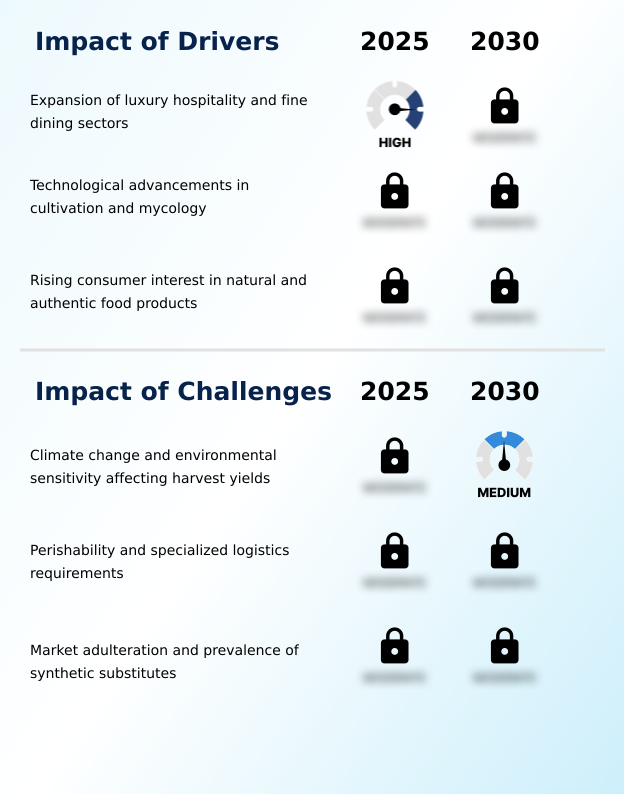
- The sustained expansion of the luxury hospitality sector and the increasing number of fine dining establishments worldwide is a major driver for the global black truffles market.
- Demand from fine dining establishments and the broader hospitality industry remains a primary driver, with the tuber melanosporum solidifying its place in the gourmet food sector.
- Restaurants featuring fresh truffles on their menus have reported an average check increase of up to 25%.
- This sustained interest fuels advancements in truffle cultivation technology, where the success rate of mycorrhizal inoculation on saplings has improved by over 50% in the last decade.
- The growing clean label food trend also acts as a significant catalyst, aligning with the truffle's natural flavor profile and gastronomic heritage.
- This consumer preference for authenticity supports the growth of both fresh fungi and high-quality artisanal truffle butter, pushing the market forward.
What are the market trends shaping the Black Truffles Industry?
- A prominent market trend is the strategic integration of truffle flavors into a wide array of mass-market premium consumer goods, expanding the product's reach beyond luxury dining.
- Key trends are reshaping market access and product applications, driven by digital transformation and consumer demand for year-round availability. The rise of direct-to-consumer e-commerce and luxury food e-commerce platforms is pivotal, with some channels reporting a 30% year-over-year increase in residential customer orders.
- This shift is supported by food provenance technology, as the use of blockchain in food supply chains can reduce verification times by up to 70%. This trend complements the growth of counter-seasonal supply from new regions.
- Furthermore, the industry is seeing culinary ingredient innovation extend beyond the kitchen, with bioactive compounds in food leading to the development of luxury skincare ingredients, reflecting a broader premiumization of food trend and an expansion in gourmet retail.
What challenges does the Black Truffles Industry face during its growth?
- A primary challenge for the industry is the impact of climate change and environmental sensitivity on harvest yields, creating supply volatility.
- The market faces significant operational and integrity challenges, primarily from product adulteration and logistical complexities. The prevalence of synthetic truffle oil containing 2,4-dithiapentane distorts consumer taste perception and necessitates advanced food fraud detection methods. In some retail channels, these synthetics account for an estimated 80% of products labeled 'truffle oil'.
- Furthermore, specialized logistics requirements are critical, as spoilage rates in the supply chain can reach 20% without proper cold chain logistics. These issues are compounded by the need for climate-resilient agriculture to ensure supply stability. Addressing these challenges requires investment in authenticity certification and transparent supply chains to protect the value of authentic tuber indicum and other premium varieties.
Exclusive Technavio Analysis on Customer Landscape
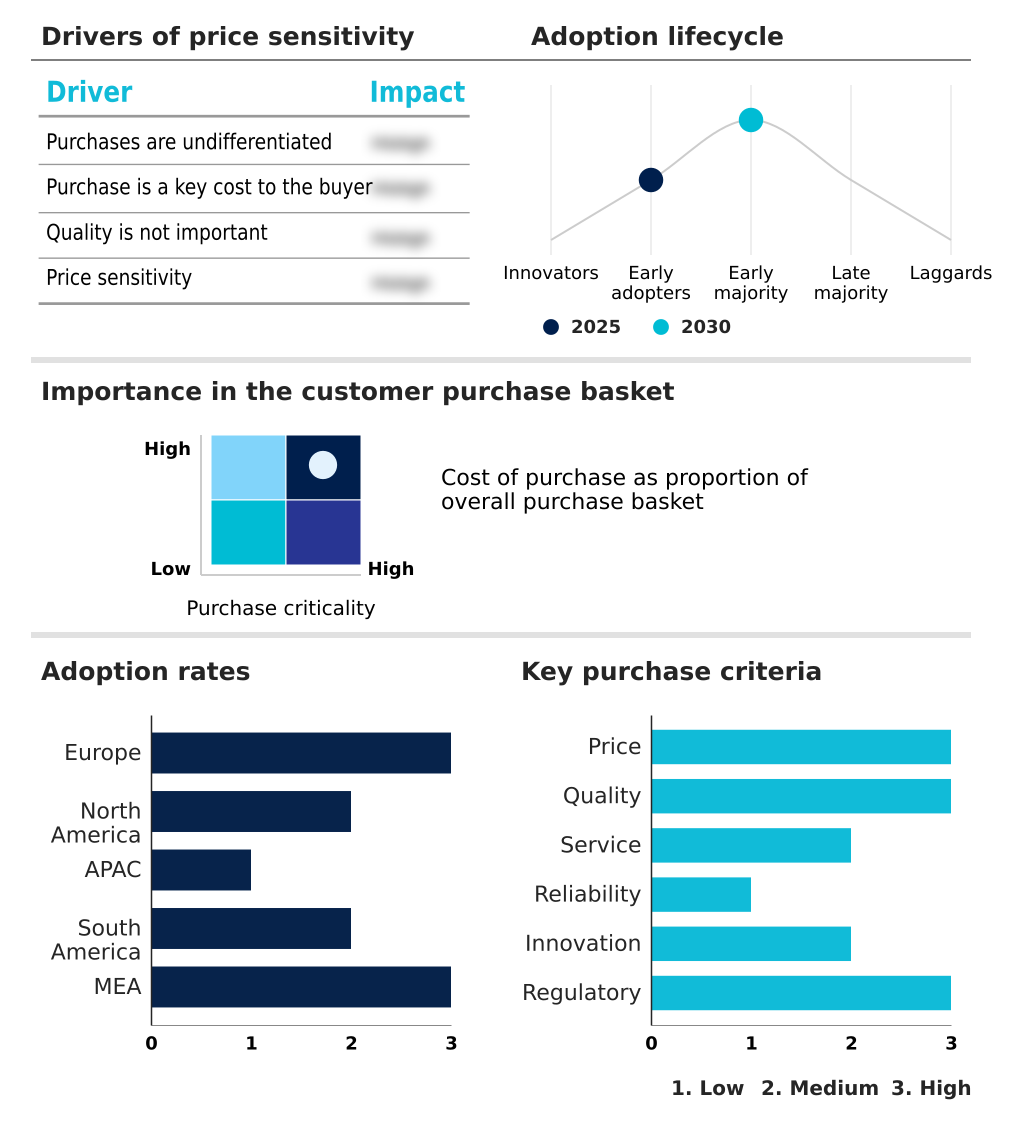
The black truffles market forecasting report includes the adoption lifecycle of the market, covering from the innovator’s stage to the laggard’s stage. It focuses on adoption rates in different regions based on penetration. Furthermore, the black truffles market report also includes key purchase criteria and drivers of price sensitivity to help companies evaluate and develop their market growth analysis strategies.
Customer Landscape of Black Truffles Industry
Competitive Landscape
Companies are implementing various strategies, such as strategic alliances, black truffles market forecast, partnerships, mergers and acquisitions, geographical expansion, and product/service launches, to enhance their presence in the industry.
Angellozzi Tartuficoltura - A key portfolio includes fresh and processed black truffles, with premium selections strategically targeting the global foodservice and restaurant sectors.
The industry research and growth report includes detailed analyses of the competitive landscape of the market and information about key companies, including:
- Angellozzi Tartuficoltura
- Appennino Food Group SpA
- Arotz Foods SA
- Australian Truffle Traders
- Balde Tartufi
- Borde
- Fortunati Antonio SRL
- Giammarino Tartufi
- La Rustichella Tartufi
- Longino and Cardenal SpA
- Mikuni Wild Harvest
- PLANTIN SAS
- Regalis Foods
- Sabatino Italia Srl
- Savini Tartufi
- Stefania Calugi Srl
- Stonebarn
- Tartufi Morra Srl
- Truffle Hill
- Urbani Tartufi Srl
Qualitative and quantitative analysis of companies has been conducted to help clients understand the wider business environment as well as the strengths and weaknesses of key industry players. Data is qualitatively analyzed to categorize companies as pure play, category-focused, industry-focused, and diversified; it is quantitatively analyzed to categorize companies as dominant, leading, strong, tentative, and weak.
Recent Development and News in Black truffles market
- In November 2024, Laumont expanded its partnership with La Liste to enhance supply chain resilience for premium European black truffles into major North American culinary hubs.
- In January 2025, Urbani Tartufi Srl and Sabatino Italia Srl leveraged the Gulfood platform to establish new trade pathways within the Middle Eastern luxury hospitality sector.
- In March 2025, Australian Truffle Traders expanded its offerings to include infected hazelnut and oak trees, enabling commercial clients to establish their own truffieres.
- In May 2025, La Rustichella Tartufi launched a new line of black truffle pâtés and flavored salts aimed at the retail and horeca channels, expanding its portfolio of luxury truffle-based products.
Dive into Technavio’s robust research methodology, blending expert interviews, extensive data synthesis, and validated models for unparalleled Black Truffles Market insights. See full methodology.
| Market Scope | |
|---|---|
| Page number | 295 |
| Base year | 2025 |
| Historic period | 2020-2024 |
| Forecast period | 2026-2030 |
| Growth momentum & CAGR | Accelerate at a CAGR of 12.6% |
| Market growth 2026-2030 | USD 234.8 million |
| Market structure | Fragmented |
| YoY growth 2025-2026(%) | 12.3% |
| Key countries | Spain, France, Italy, Germany, UK, The Netherlands, US, Canada, Mexico, China, Japan, Australia, South Korea, India, Indonesia, Brazil, Argentina, Colombia, UAE, Saudi Arabia, South Africa, Egypt and Turkey |
| Competitive landscape | Leading Companies, Market Positioning of Companies, Competitive Strategies, and Industry Risks |
Research Analyst Overview
- The market is defined by the transition from traditional wild truffle foraging to systematic truffle orchard management centered on the ectomycorrhizal fungus, Tuber melanosporum. This shift is driven by truffle cultivation technology, including advanced mycorrhizal inoculation and soil inoculation techniques that optimize host tree symbiosis.
- While the luxury culinary ingredient remains a staple in the gourmet food sector and fine dining establishments, the industry is expanding through a diverse range of truffle-infused products, truffle derivatives, and truffle-based condiments. Addressing product adulteration from synthetic truffle oil, which contains 2,4-dithiapentane, is a primary focus, necessitating robust provenance verification.
- For boardroom consideration, investing in mycology research and the genetic mapping of fungi is critical for differentiation. Firms that implement rigorous truffle grading standards and authenticity checks see their rejection rates from hospitality clients fall by over 50%.
- The supply chain depends on sophisticated cold chain logistics to preserve the unique fungal aroma profile and organoleptic properties of the Perigord black truffle, supported by digital traceability tools for shelf-stable formats and direct-to-consumer e-commerce, ensuring a counter-seasonal supply.
What are the Key Data Covered in this Black Truffles Market Research and Growth Report?
-
What is the expected growth of the Black Truffles Market between 2026 and 2030?
-
USD 234.8 million, at a CAGR of 12.6%
-
-
What segmentation does the market report cover?
-
The report is segmented by Type (Conventional, and Organic), Distribution Channel (Offline, and Online), End-user (Restaurants and hotels, Food manufacturers, Residential, Specialty gourmet brands, and Cosmetics brands) and Geography (Europe, North America, APAC, South America, Middle East and Africa)
-
-
Which regions are analyzed in the report?
-
Europe, North America, APAC, South America and Middle East and Africa
-
-
What are the key growth drivers and market challenges?
-
Expansion of luxury hospitality and fine dining sectors, Climate change and environmental sensitivity affecting harvest yields
-
-
Who are the major players in the Black Truffles Market?
-
Angellozzi Tartuficoltura, Appennino Food Group SpA, Arotz Foods SA, Australian Truffle Traders, Balde Tartufi, Borde, Fortunati Antonio SRL, Giammarino Tartufi, La Rustichella Tartufi, Longino and Cardenal SpA, Mikuni Wild Harvest, PLANTIN SAS, Regalis Foods, Sabatino Italia Srl, Savini Tartufi, Stefania Calugi Srl, Stonebarn, Tartufi Morra Srl, Truffle Hill and Urbani Tartufi Srl
-
Market Research Insights
- Market dynamics are shifting as the industry matures from seasonal luxury to a more accessible year-round commodity, driven by culinary ingredient innovation and the premiumization of food. The rise of luxury food e-commerce platforms has democratized access, with some direct-to-consumer models reducing supply chain spoilage by up to 15% compared to traditional multi-broker channels.
- In response to climate pressures, investments in climate-resilient agriculture and advanced cultivation are critical. Simultaneously, the adoption of food provenance technology has improved authenticity verification rates by over 40%, boosting consumer confidence and supporting gourmet retail expansion.
- This focus on technology and direct sales is enabling year-round truffle menus and expanding the product's reach into new segments like in-home gourmet cooking and artisanal food production.
We can help! Our analysts can customize this black truffles market research report to meet your requirements.
 RIA -
RIA - 
