


Coaxial Cables Market Size 2024-2028
The coaxial cables market size is forecast to increase by USD 2.98 billion at a CAGR of 4.68% between 2023 and 2028.
What will be the Size of the Coaxial Cables Market During the Forecast Period?

How is this Coaxial Cables Industry segmented and which is the largest segment?
The coaxial cables industry research report provides comprehensive data (region-wise segment analysis), with forecasts and estimates in "USD million" for the period 2024-2028, as well as historical data from 2018-2022 for the following segments.
- End-user
- Telecommunication
- Transportation and military
- CATV providers
- Others
- Application
- Video distribution
- Internet data transfer
- Radio frequency transfer
- Geography
- APAC
- China
- Japan
- South Korea
- Europe
- Germany
- North America
- US
- Middle East and Africa
- South America
- APAC
By End-user Insights
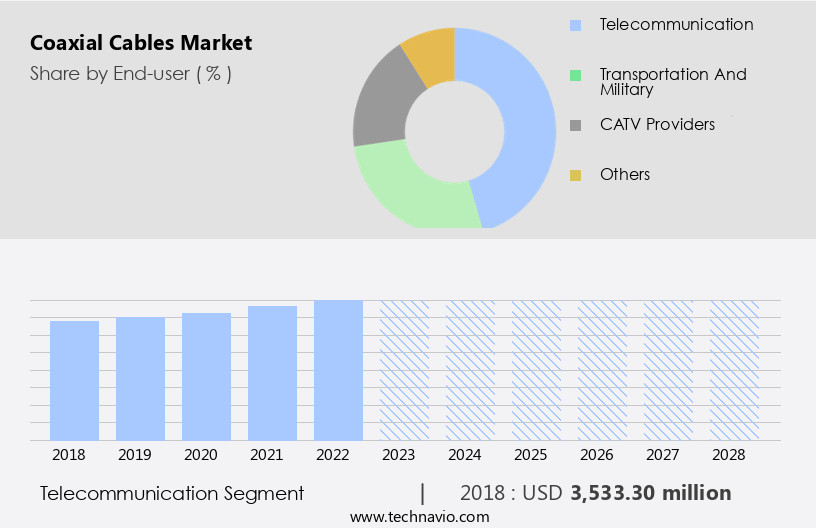
The telecommunication segment is estimated to witness significant growth during the forecast period. Coaxial cables are essential components in telecommunications infrastructure, facilitating interference-free signal transmission for high-speed data and voice communications. They are widely used in telecom equipment, including telephone switching stations, exchanges, mobile communications towers, and satellite transmitters. The expanding telecommunications market, driven by the increasing number of mobile and wireless consumers and the emergence of next-generation technologies, presents significant growth opportunities for the market. Developing economies in Asia Pacific and the Middle East and Africa are particularly noteworthy, as operators aim to expand their network coverage. Coaxial cables are also utilized in wired telephony services and various industries such as cable television, Internet, military and aerospace, automobile, marine, and broadcasting.
The superior performing substitutes, including fiber optic cables, face competition from coaxial cables due to their cost-effectiveness and ease of installation. Future prospects for coaxial cables are promising, with increasing Internet user bases and the need for reliable data transfer, particularly in smart urban areas. Decision-makers In the telecommunications industry, system integrators, Internet service providers, and television industries are key players In the market. Government spending on infrastructure development and tax rebates also contribute to the market's growth. Coaxial cables employ a metal wire as the inner conductor, an insulating layer, and a tabular conducting shield to protect against electromagnetic interference.
Coaxial cables support both analog and digital signals, including Internet data transfer, radio frequency transfer, and video distribution. Variations in cable types include triaxial and radiating, catering to diverse applications. Future estimations indicate continued growth In the market, with potential applications in various industries and advancements in technology.
Get a glance at the market report of various segments Request Free Sample
The Telecommunication segment was valued at USD 3.53 billion in 2018 and showed a gradual increase during the forecast period.
Regional Analysis
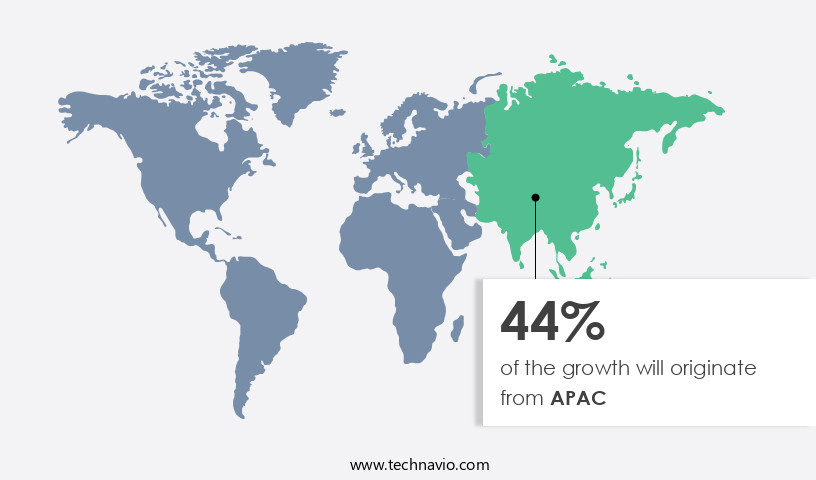
APAC is estimated to contribute 44% to the growth of the global market during the forecast period. Technavio’s analysts have elaborately explained the regional trends and drivers that shape the market during the forecast period.
For more insights on the market size of various regions, Request Free Sample
Coaxial cables hold a significant market share In the global communications industry, particularly in APAC, which is the largest market due to increasing demand from economies like China and Japan. The digitization of CATV networks, expansion of mobile telecommunication networks, and replacement of slow DSL Internet with high-speed cable networks are major growth drivers. With the escalating usage of mobile phones in countries like China and India, and the projected growth in Indonesia, the demand for coaxial cables is expected to surge. These cables offer reliable data transfer, including Internet and video distribution, and are used extensively In the television cable sector, as well as In the military and aerospace industries.
Coaxial cables provide superior signal quality for digital signals and are a cost-effective alternative to fiber optic cables. However, they are susceptible to interference and may not offer the same level of bandwidth as fiber optic cables. Despite this, coaxial cables remain a popular choice due to their cost-effectiveness and ease of installation. Decision makers In the hard-line cable sector, including system integrators and Internet service providers, continue to invest in coaxial cables for their reliability and versatility.
Market Dynamics
Our researchers analyzed the data with 2023 as the base year, along with the key drivers, trends, and challenges. A holistic analysis of drivers will help companies refine their marketing strategies to gain a competitive advantage.
What are the key market drivers leading to the rise In the adoption of Coaxial Cables Industry?
- Adoption of cables for broadband Internet access is the key driver of the market.Coaxial cables play a pivotal role in providing high-speed data connectivity, especially for Internet access. The expanding Internet user base and the necessity for reliable data transfer have fueled the market's growth. Public spending on infrastructure development in smart urban areas is another significant factor driving the market. Coaxial cables are widely used In the hard-line cable sector, including the television cable industry, for signal quality transmission of digital signals, radio frequency transfer, and video distribution. However, the increasing adoption of fiber optic cables as superior performing substitutes may hinder market growth. Fiber optic cables offer advantages such as higher bandwidth, longer transmission distances, and improved performance.
Despite this, coaxial cables remain popular due to their cost-effectiveness and ease of installation. The cable type, which includes variations like triaxial cable and radiating cables, finds applications in industries like aerospace and defense, telephone service providers, and system integrators. Trade barriers and FDI policies may pose challenges to market expansion. Future prospects for coaxial cables remain promising, with potential applications in automobile and marine industries.
What are the market trends shaping the Coaxial Cables market?
- Growing investment In the aerospace sector is the upcoming market trend.Coaxial cables are essential components in various industries, including aerospace and defense, due to their ability to provide reliable data transfer and interference-free radio frequency transfer. In the aerospace sector, coaxial cables ensure the smooth functioning of radio communication equipment in aircraft by isolating radio signals from other electronic components. The safety and efficiency of aircraft depend on the uninterrupted communication between the aircraft and air traffic control (ATC), making coaxial cables indispensable. The cable's inner conductor, insulating layer, and tabular conducting shield protect digital signals from interference, ensuring superior performance. The hardline cable sector, including the television cable industry, is another significant user of coaxial cables.
Coaxial cables provide broadband internet access and high-speed data connectivity to millions of internet subscribers. Public spending on infrastructure development and tax rebates for fiber internet connections have driven the growth of the coaxial cable market. Coaxial cables face competition from fiber optic cables, which offer superior performing substitutes for high-speed data transfer. However, the cost of installation and the existing infrastructure make coaxial cables a cost-effective alternative for many applications. The cable type's versatility extends to other industries, including automobile, marine, and military and aerospace. Coaxial cables' ability to support both analog and digital signals and radio frequency transfer makes them a preferred choice for various applications.
Future estimations suggest that the coaxial cable market will continue to grow, driven by the increasing internet user base and the need for reliable data transfer. Decision-makers In the system integrator, Internet service provider, and cable television industries should consider the benefits of coaxial cables when making infrastructure investments.
What challenges does the Coaxial Cables Industry face during its growth?
- Declining CATV subscriber base in several countries is a key challenge affecting the industry growth.Coaxial cables have been a staple in providing high-speed data connectivity for various applications, including Internet access and television distribution. However, the cable television industry has experienced a decline in subscribers as consumers shift towards streaming services and IPTV-based platforms. These subscription video-on-demand (SVoD) services, such as Netflix, Hulu, and Amazon Prime Video, offer monthly access to a vast library of shows at a lower cost than traditional cable TV subscriptions. Coaxial cables consist of an inner conductor, insulating layer, and a tabular conducting shield that protects the signal from interference. The cable type, also known as hardline, is widely used due to its reliability and ability to support both digital signals and analog signals for various applications, including Internet data transfer, radio frequency transfer, and video distribution.
The hard-line cable sector, which includes coaxial cables, faces competition from superior performing substitutes like fiber optic cables. However, the cost of installation for fiber internet connections remains higher than coaxial cables, making the latter a more cost-effective option for many Internet service providers and system integrators. Coaxial cables are also used extensively In the military and aerospace industries for reliable data transfer and radio frequency transfer. The automobile and marine industries also utilize coaxial cables for various applications, including video distribution and telephone service. Public spending on infrastructure development in smart urban areas and tax rebates for broadband internet access may contribute to the future prospects of the coaxial cable market.
Decision-makers In the cable industry must consider the trade barriers and FDI policies when expanding their businesses in different economies. In conclusion, the coaxial cable market continues to play a significant role in providing high-speed data connectivity for various applications, including Internet access and television distribution. Despite competition from fiber optic cables and the decline in television subscribers, the cost-effective nature and versatility of coaxial cables make them a valuable asset in various industries.
Exclusive Customer Landscape
The coaxial cables market forecasting report includes the adoption lifecycle of the market, covering from the innovator’s stage to the laggard’s stage. It focuses on adoption rates in different regions based on penetration. Furthermore, the coaxial cables market report also includes key purchase criteria and drivers of price sensitivity to help companies evaluate and develop their market growth analysis strategies.

Customer Landscape
Key Companies & Market Insights
Companies are implementing various strategies, such as strategic alliances, coaxial cables market forecast, partnerships, mergers and acquisitions, geographical expansion, and product/service launches, to enhance their presence In the industry.
Alpha Wire Inc. - Coaxial cables are a vital component in various industries, including telecommunications and broadcasting. The company specializes in providing comprehensive coaxial solutions, encompassing cable assemblies and harnesses, cable management products, and backplane interconnect systems. These offerings cater to diverse applications, ensuring optimal performance and reliability. The company's extensive product portfolio is designed to meet the evolving needs of its clients, fostering innovation and driving growth In the market.
The industry research and growth report includes detailed analyses of the competitive landscape of the market and information about key companies, including:
- Alpha Wire Inc.
- Amphenol Corp.
- Belden Inc.
- Coleman Wires and Cables
- CommScope Holding Co. Inc.
- Habia Cable AB
- Hengxin Technology Ltd.
- HUBER SUHNER AG
- Infinite Electronics Inc.
- Infinite Electronics International Inc.
- Kingsignal Technology Co. Ltd.
- Leoni AG
- LS Cable and System Ltd.
- Prysmian Spa
- Southwire Co. LLC
- Sumitomo Electric Industries Ltd.
- TE Connectivity Ltd.
- Trigiant Group Ltd.
- W. L. Gore and Associates Inc.
- Zhuhai Hansen Technology Co. Ltd.
Qualitative and quantitative analysis of companies has been conducted to help clients understand the wider business environment as well as the strengths and weaknesses of key industry players. Data is qualitatively analyzed to categorize companies as pure play, category-focused, industry-focused, and diversified; it is quantitatively analyzed to categorize companies as dominant, leading, strong, tentative, and weak.
Research Analyst Overview
Coaxial cables have been a cornerstone of high-speed data connectivity for several decades, playing a pivotal role in various industries and applications. This type of cable design, which consists of a central conductor, insulating layer, and tabular conducting shield, has been instrumental in delivering reliable data transfer for various applications. The demand for coaxial cables has been driven by the growth of the internet user base and the need for superior performing substitutes to fiber optic cables in specific applications. The public sector's investment in smart urban areas has been a significant factor In the expansion of the coaxial cable market.
Coaxial cables have been extensively used In the television cable sector due to their ability to support radio frequency (RF) transfer and deliver high-quality signal. However, the emergence of fiber internet connections has led to increased competition, with fiber optic cables offering higher bandwidth and lower latency. Despite the competition, coaxial cables continue to hold their ground in certain applications due to their cost-effectiveness and ease of installation. The cost of installation for coaxial cables is generally lower than that of fiber optic cables, making them an attractive option for internet service providers and system integrators. The hard-line cable sector, including the cable television industry, has been a significant consumer of coaxial cables.
The industry's reliance on coaxial cables for signal distribution and interference mitigation has been a key factor In the market's growth. Coaxial cables have also found applications in various industries beyond telecommunications. For instance, they have been used In the military and aerospace sectors due to their ability to support analog signals and their resistance to electromagnetic interference. The automobile and marine industries have also adopted coaxial cables for various applications, including video distribution and telephone service. The variations in cable types, including triaxial cables, have enabled coaxial cables to cater to diverse application requirements. Looking ahead, the future prospects for the coaxial cable market are promising, with increasing demand for reliable data transfer and internet data transfer expected to drive growth.
Decision-makers In the industry are focusing on improving signal quality and reducing interference to meet the evolving needs of consumers and businesses. Trade barriers and FDI policies remain key challenges for the coaxial cable market, with regulations and tariffs impacting the competitiveness of different players. However, ongoing research and development efforts are expected to lead to innovations that will address these challenges and drive growth In the market. In conclusion, the coaxial cable market continues to be an essential component of the high-speed data connectivity landscape, with applications spanning various industries and applications. The market's growth is driven by the need for reliable data transfer and the cost-effectiveness and ease of installation of coaxial cables.
Looking ahead, the market is expected to continue to evolve, with a focus on improving signal quality and addressing trade barriers and FDI policies.
|
Market Scope |
|
|
Report Coverage |
Details |
|
Page number |
178 |
|
Base year |
2023 |
|
Historic period |
2018-2022 |
|
Forecast period |
2024-2028 |
|
Growth momentum & CAGR |
Accelerate at a CAGR of 4.68% |
|
Market growth 2024-2028 |
USD 2975.7 million |
|
Market structure |
Fragmented |
|
YoY growth 2023-2024(%) |
4.39 |
|
Key countries |
China, US, Japan, Germany, and South Korea |
|
Competitive landscape |
Leading Companies, Market Positioning of Companies, Competitive Strategies, and Industry Risks |
What are the Key Data Covered in this Coaxial Cables Market Research and Growth Report?
- CAGR of the Coaxial Cables industry during the forecast period
- Detailed information on factors that will drive the growth and forecasting between 2024 and 2028
- Precise estimation of the size of the market and its contribution of the industry in focus to the parent market
- Accurate predictions about upcoming growth and trends and changes in consumer behaviour
- Growth of the market across APAC, Europe, North America, Middle East and Africa, and South America
- Thorough analysis of the market’s competitive landscape and detailed information about companies
- Comprehensive analysis of factors that will challenge the coaxial cables market growth of industry companies
We can help! Our analysts can customize this coaxial cables market research report to meet your requirements.