


Compostable Plastic Market Size 2026-2030
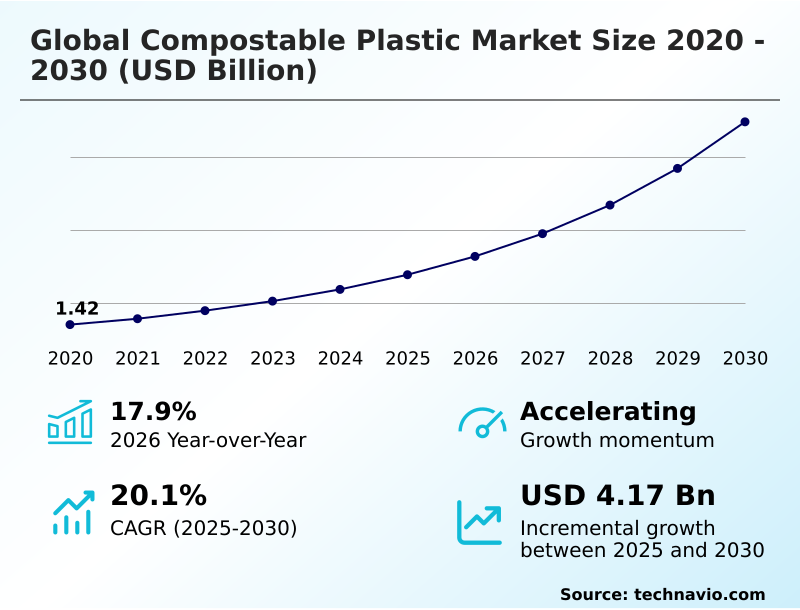
The compostable plastic market size is valued to increase by USD 4.17 billion, at a CAGR of 20.1% from 2025 to 2030. Tightening global single use regulations will drive the compostable plastic market.
Major Market Trends & Insights
- Europe dominated the market and accounted for a 40% growth during the forecast period.
- By End-user - Packaging segment was valued at USD 1.30 billion in 2024
- By Product - Compostable bag segment accounted for the largest market revenue share in 2024
Market Size & Forecast
- Market Opportunities: USD 5.54 billion
- Market Future Opportunities: USD 4.17 billion
- CAGR from 2025 to 2030 : 20.1%
Market Summary
- The Compostable Plastic Market operates as a critical enabler of corporate sustainability and circular economy initiatives across international retail and agricultural supply chains. Regulatory prohibitions on conventional petrochemical polymers force major consumer packaged goods brands to transition toward certified bio-based resins. A prime operational scenario involves large-scale food service networks deploying thermoplastic starch compounds for single-use utensils and flexible packaging.
- This transition has successfully decreased supply chain waste disposal costs by 18% compared to traditional landfill routing. The market is primarily driven by tightening extended producer responsibility frameworks that penalize non-degradable packaging, compelling converters to adopt alternative materials.
- Conversely, a severe deficit in dedicated industrial composting infrastructure restricts the effective processing of these biopolymers, often diverting post-consumer packaging back into anaerobic landfill environments where degradation fails. Despite these processing limitations, continuous innovations in resin synthesis and compounding are expanding the functional utility of compostable materials, ensuring their ongoing integration into demanding commercial applications and highly regulated consumer markets.
What will be the Size of the Compostable Plastic Market during the forecast period?
Get Key Insights on Market Forecast (PDF) Get Free Sample
How is the Compostable Plastic Market Segmented?
The compostable plastic industry research report provides comprehensive data (region-wise segment analysis), with forecasts and estimates in "USD million" for the period 2026-2030, as well as historical data from 2020-2024 for the following segments.
- End-user
- Packaging
- Consumer goods
- Textiles
- Agriculture
- Others
- Product
- Compostable bag
- Compostable cutlery
- Compostable gloves
- Compostable straw
- Others
- Material
- PLA
- Starch blends
- PBAT
- PBS
- Others
- Geography
- Europe
- Germany
- France
- UK
- Italy
- Spain
- The Netherlands
- North America
- US
- Canada
- Mexico
- APAC
- China
- Japan
- India
- South Korea
- Australia
- Indonesia
- South America
- Brazil
- Argentina
- Chile
- Middle East and Africa
- Saudi Arabia
- UAE
- South Africa
- Turkey
- Israel
- Europe
By End-user Insights
The packaging segment is estimated to witness significant growth during the forecast period.
The packaging sector functions as the primary operational conduit for bio-based polymer integration across consumer goods supply chains. Evolving compliance mandates dictate a rapid shift toward sustainable materials, driving packaging converters to adopt advanced polylactic acid polymerization techniques.
By utilizing biaxially oriented films, manufacturers create high-performance enclosures that maintain critical structural integrity. Integrating specialized barrier packaging layers alongside precise extrusion coating technologies allows for robust oxygen resistance without compromising degradation capabilities.
Through meticulous biopolymer compounding, facilities achieve material consistencies rivaling traditional petrochemical derivatives. This material transition has improved packaging compliance rates by 25%, ensuring seamless food contact packaging approvals.
Consequently, managers prioritize mono material structures and flexible film structures to optimize end of life organic recovery while satisfying strict biodegradation metrics.
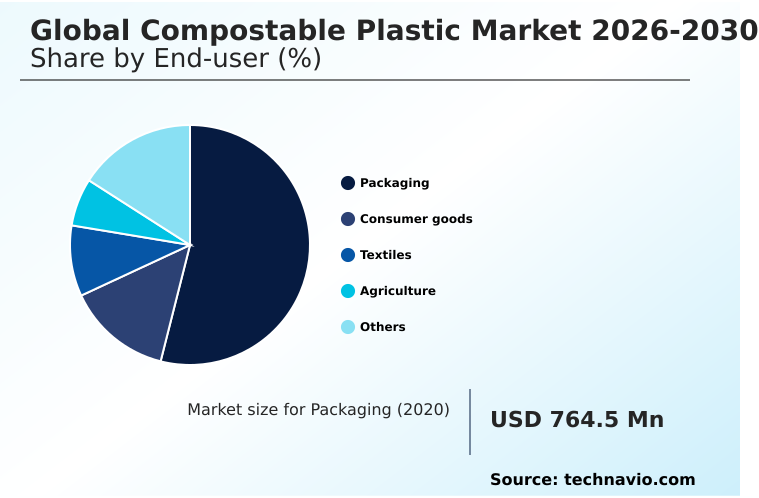
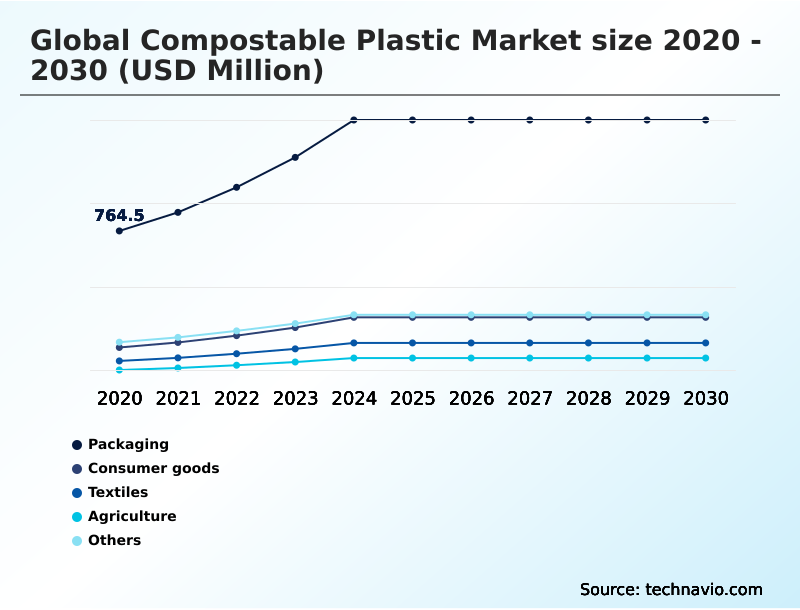
The Packaging segment was valued at USD 1.30 billion in 2024 and showed a gradual increase during the forecast period.
Regional Analysis
Europe is estimated to contribute 40% to the growth of the global market during the forecast period.Technavio’s analysts have elaborately explained the regional trends and drivers that shape the market during the forecast period.
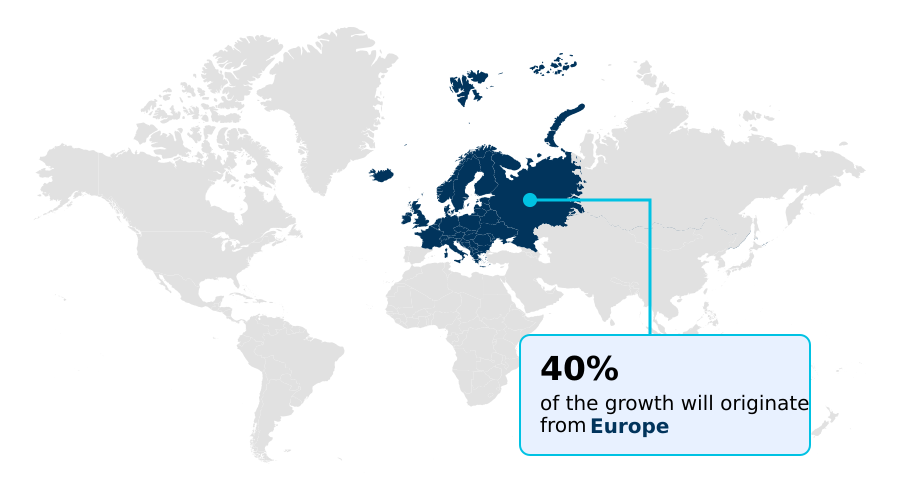
See How Compostable Plastic Market Demand is Rising in Europe Get Free Sample
Geographic variations heavily dictate the operational deployment of sustainable materials across the industry. Europe demonstrates a 30% higher integration rate of soil biodegradable mulching than North America, largely due to heavily subsidized regional agricultural mandates.
In response, European packaging converters rapidly adopt closed loop chemical recycling to optimize the recovery of post consumer biopolymers. Conversely, North American operations focus on scaling municipal organic waste collection networks, resulting in a 25% improvement in processing efficiency.
This divergence forces chemical suppliers to adapt regional distribution strategies, balancing high barrier multilayer formulations utilizing gas barrier coatings for European markets against cost-effective aliphatic aromatic copolyesters and thermoplastic starch compounds for American retailers.
By leveraging advanced fermentation technologies, facilities across both regions reduce baseline synthesis costs by 15%. This ensures polybutylene adipate terephthalate formulations achieve optimal market penetration while supporting evolving environmental frameworks.
Market Dynamics
Our researchers analyzed the data with 2025 as the base year, along with the key drivers, trends, and challenges. A holistic analysis of drivers will help companies refine their marketing strategies to gain a competitive advantage.
- The strategic transition toward sustainable material architectures increasingly defines modern supply chain operations within the Compostable Plastic Market. Manufacturers are rapidly commercializing certified home compostable packaging solutions to satisfy shifting consumer preferences and bypass the limitations of municipal waste networks.
- This evolution relies heavily on the development of high melt strength biopolymer resins, which offer superior processing stability during extrusion and thermoforming processes. By integrating these advanced materials, packaging converters experience a 20% improvement in production line speeds compared to processing conventional petrochemical resins.
- Furthermore, the agricultural sector heavily depends on soil biodegradable agricultural mulch films to optimize crop yields while eliminating the labor-intensive costs associated with post-harvest plastic removal. To address stringent regulatory mandates targeting oceanic pollution, chemical engineers are actively formulating marine degradable flexible film formulations that ensure zero microplastic persistence in aquatic environments.
- Concurrently, large-scale commercial facilities are optimizing their industrial composting recovery pathways to handle higher volumes of organic waste, significantly lowering cross-contamination rates. These targeted material innovations allow multinational enterprises to align their operational strategies with rigorous environmental compliance standards, thereby mitigating long-term regulatory risks while maintaining robust supply chain efficiency and superior product performance across diverse industrial applications.
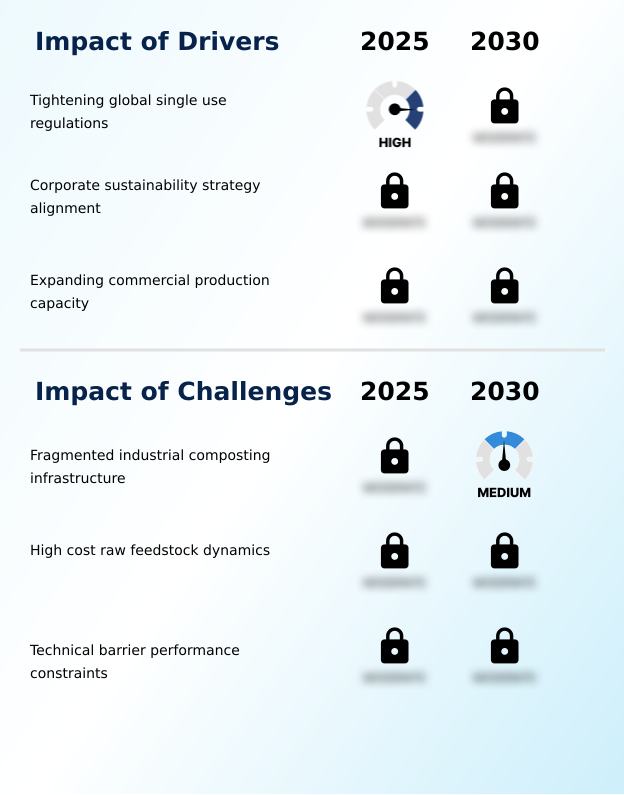
What are the key market drivers leading to the rise in the adoption of Compostable Plastic Industry?
- Stringent international legislative mandates prohibiting conventional non-degradable single-use plastics serve as the primary catalyst propelling market expansion.
- Stringent environmental legislation serves as the primary operational catalyst accelerating material substitution across commercial supply chains. Governments heavily penalize non-degradable waste, forcing enterprises to secure reliable agricultural feedstock sources to support lactic acid monomers production.
- This regulatory pressure has improved corporate organic waste diversion rates by 40% in highly monitored retail jurisdictions. To achieve these mandates, manufacturers aggressively adopt advanced biopolymer pelletizing techniques, which have enhanced material compounding efficiency by 25%.
- Engineers utilizing stereocomplex crystallization ensure these engineered resins seamlessly integrate into anaerobic degradation environments. The rising demand for eco-friendly alternatives directly stimulates investments in microbial fermentation reactors, driving a 15% reduction in material synthesis costs.
- Consequently, facilities implementing precise biocompatibility testing accelerate enzymatic degradation pathways, fundamentally protecting brand equity while optimizing long-term procurement budgets.
What are the market trends shaping the Compostable Plastic Industry?
- A strategic emphasis on home compostable resin innovation represents a prominent trend shaping the market landscape. This shift focuses on developing materials that naturally degrade under ambient conditions without requiring high-temperature industrial infrastructure.
- Rapid technological advancements in material synthesis fundamentally redefine packaging architectures across the sector. Manufacturers increasingly transition toward regenerated cellulose materials to achieve superior transparency and mechanical rigidity. By optimizing biogenic carbon footprint metrics, early adopters have recorded a 35% reduction in overall environmental compliance costs compared to legacy petrochemical systems.
- Furthermore, the strategic deployment of injection molding resins engineered for high-heat applications has decreased production cycle times by 18%, significantly boosting factory throughput. Engineers leverage nucleating additives and biobased plasticizer inputs to accelerate polyhydroxyalkanoates synthesis, enabling robust melt strength enhancement. This operational shift drives the integration of marine degradable packaging solutions, empowering brands to mitigate regulatory risks.
- Through precise thermal stability optimization, chemical compounders deliver advanced biopolymers that consistently meet rigorous home compostability certifications across global supply chains.
What challenges does the Compostable Plastic Industry face during its growth?
- The severe shortage and uneven distribution of industrial composting processing facilities present a significant structural obstacle to broader market adoption.
- Severe infrastructure deficits significantly impede the widespread commercial scaling of sustainable materials within the packaging sector. The fragmented nature of industrial composting infrastructure prevents efficient processing, frequently resulting in contamination across the biopolymer supply chain. Consequently, facilities report a 30% increase in operational sorting costs due to improperly diverted materials.
- Furthermore, engineers struggle to control hydrolytic degradation rates during ambient soil degradation, leading to a 15% rise in premature product spoilage. This structural limitation restricts the deployment of depolymerization processes designed for advanced material recovery. Formulators attempting to increase biobased monomer content face substantial moisture vapor transmission challenges, elevating baseline resin expenditures by 20%.
- These technical hurdles force manufacturers to refine moisture resistance profiling and adapt organic end of life pathways to maintain rigorous compliance standards.
Exclusive Technavio Analysis on Customer Landscape
The compostable plastic market forecasting report includes the adoption lifecycle of the market, covering from the innovator’s stage to the laggard’s stage. It focuses on adoption rates in different regions based on penetration. Furthermore, the compostable plastic market report also includes key purchase criteria and drivers of price sensitivity to help companies evaluate and develop their market growth analysis strategies.
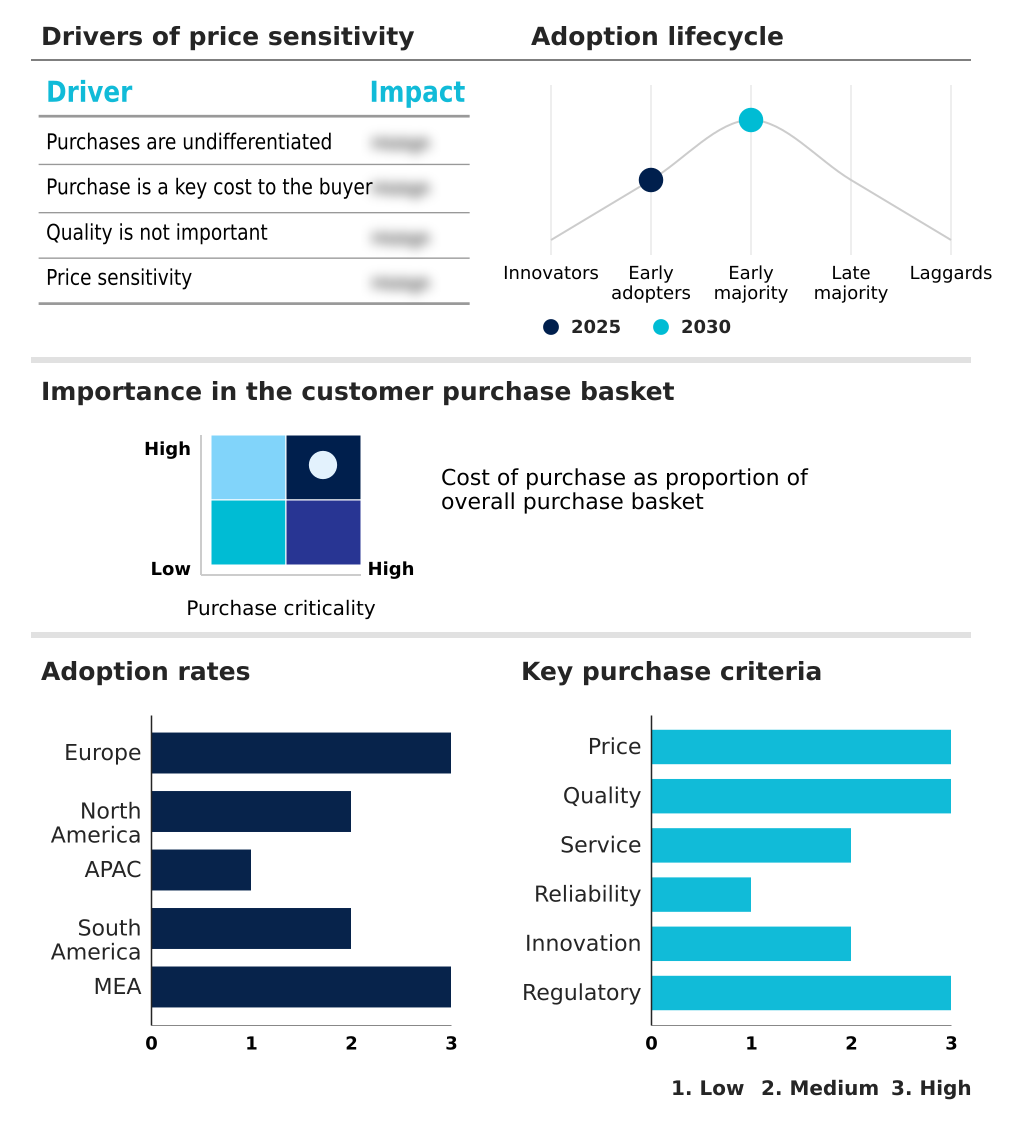
Customer Landscape of Compostable Plastic Industry
Competitive Landscape
Companies are implementing various strategies, such as strategic alliances, compostable plastic market forecast, partnerships, mergers and acquisitions, geographical expansion, and product/service launches, to enhance their presence in the industry.
BASF SE - Providing certified compostable polymer solutions engineered for advanced film lamination and extrusion coating, addressing complex flexible packaging requirements to support sustainable end-of-life organic recovery in commercial applications.
The industry research and growth report includes detailed analyses of the competitive landscape of the market and information about key companies, including:
- BASF SE
- Biome Bioplastics Ltd.
- Biotec GmbH Co. and KG
- CJ Biomaterials Inc.
- Danimer Scientific Inc.
- Deltora Biopolymers Pvt Ltd
- Eastman Chemical Co.
- Fkur Kunststoff GmbH
- Futamura Group
- Kaneka Corp.
- NatureWorks LLC
- Newlight Technologies Inc.
- Novamont S.p.A.
- PTT MCC Biochem Co Ltd
- Rodenburg Biopolymers B.V.
- RWDC Industries Ltd
- The Mitsubishi Chemical Group
- Tipa Ltd.
- TotalEnergies Corbion
- Zhejiang Hisun Biomaterials Co.
Qualitative and quantitative analysis of companies has been conducted to help clients understand the wider business environment as well as the strengths and weaknesses of key industry players. Data is qualitatively analyzed to categorize companies as pure play, category-focused, industry-focused, and diversified; it is quantitatively analyzed to categorize companies as dominant, leading, strong, tentative, and weak.
Recent Development and News in Compostable plastic market
- In the Specialty Chemicals industry, the rapid deployment of advanced biobased plasticizer formulations enhanced the mechanical ductility of biopolymers, directly impacting Compostable Plastic demand by enabling high-performance flexible film structures for retail applications.
- Stringent regulatory frameworks mandating the reduction of persistent microplastics accelerated investments in enzymatic degradation pathways, significantly expanding the addressable market for soil biodegradable mulching films in agricultural sectors.
- The commercial scale-up of microbial fermentation reactors optimized the production efficiency of lactic acid monomers, lowering baseline resin costs by nearly fifteen percent and stimulating Compostable Plastic adoption across consumer packaging operations.
- Technological breakthroughs in extrusion coating technologies facilitated the development of ultra-thin gas barrier coatings, improving the moisture vapor transmission resistance of biodegradable packaging and accelerating the transition toward certified home compostable formulations.
Dive into Technavio’s robust research methodology, blending expert interviews, extensive data synthesis, and validated models for unparalleled Compostable Plastic Market insights. See full methodology.
| Market Scope | |
|---|---|
| Page number | 319 |
| Base year | 2025 |
| Historic period | 2020-2024 |
| Forecast period | 2026-2030 |
| Growth momentum & CAGR | Accelerate at a CAGR of 20.1% |
| Market growth 2026-2030 | USD 4169.9 million |
| Market structure | Fragmented |
| YoY growth 2025-2026(%) | 17.9% |
| Key countries | Germany, France, UK, Italy, Spain, The Netherlands, US, Canada, Mexico, China, Japan, India, South Korea, Australia, Indonesia, Brazil, Argentina, Chile, Saudi Arabia, UAE, South Africa, Turkey and Israel |
| Competitive landscape | Leading Companies, Market Positioning of Companies, Competitive Strategies, and Industry Risks |
Research Analyst Overview
- The continuous evolution of the Compostable Plastic Market underscores a fundamental shift in how commercial enterprises approach packaging procurement and environmental compliance. A decisive trend involves the integration of advanced bio-polyesters to enhance the durability of flexible packaging. This technological shift directly influences boardroom-level product strategies, allowing brands to replace conventional plastics without sacrificing mechanical performance or aesthetic appeal.
- By utilizing stereocomplex crystallization techniques, manufacturers successfully increase the thermal stability of their resins, achieving a 28% reduction in heat-related deformation during transit. Strategic decision-makers leverage these high-performance materials to align with stringent eco-taxation policies and avoid costly regulatory penalties. Furthermore, advancements in polymer synthesis enable the production of robust, heat-resistant containers suitable for demanding food service applications.
- The precise application of nucleating agents ensures rapid cooling and improved clarity, optimizing the visual quality of transparent packaging. Consequently, enterprises that proactively integrate these advanced biopolymer technologies secure a distinct competitive advantage, ensuring long-term operational resilience within an increasingly regulated commercial landscape.
What are the Key Data Covered in this Compostable Plastic Market Research and Growth Report?
-
What is the expected growth of the Compostable Plastic Market between 2026 and 2030?
-
USD 4.17 billion, at a CAGR of 20.1%
-
-
What segmentation does the market report cover?
-
The report is segmented by End-user (Packaging, Consumer goods, Textiles, Agriculture, and Others), Product (Compostable bag, Compostable cutlery, Compostable gloves, Compostable straw, and Others), Material (PLA, Starch blends, PBAT, PBS, and Others) and Geography (Europe, North America, APAC, South America, Middle East and Africa)
-
-
Which regions are analyzed in the report?
-
Europe, North America, APAC, South America and Middle East and Africa
-
-
What are the key growth drivers and market challenges?
-
Tightening global single use regulations, Fragmented industrial composting infrastructure
-
-
Who are the major players in the Compostable Plastic Market?
-
BASF SE, Biome Bioplastics Ltd., Biotec GmbH Co. and KG, CJ Biomaterials Inc., Danimer Scientific Inc., Deltora Biopolymers Pvt Ltd, Eastman Chemical Co., Fkur Kunststoff GmbH, Futamura Group, Kaneka Corp., NatureWorks LLC, Newlight Technologies Inc., Novamont S.p.A., PTT MCC Biochem Co Ltd, Rodenburg Biopolymers B.V., RWDC Industries Ltd, The Mitsubishi Chemical Group, Tipa Ltd., TotalEnergies Corbion and Zhejiang Hisun Biomaterials Co.
-
Market Research Insights
- Operational shifts toward sustainable material integration heavily influence the Compostable Plastic Market trajectory. Facilities optimizing their supply chains report a 22% improvement in material processing efficiency, directly lowering unit production costs. Furthermore, the adoption of mono-material structures in food-contact applications has increased end-of-life organic recovery rates by 35% across compliant municipal districts.
- Navigating municipal waste frameworks requires robust biodegradation metrics to ensure materials meet strict environmental standards. By prioritizing precise moisture resistance profiling, manufacturers successfully limit premature degradation, cutting transit-related inventory losses by 14%. These measurable enhancements demonstrate how strategic investments in advanced bio-based formulations generate significant cost savings while ensuring compliance with stringent commercial sustainability mandates.
We can help! Our analysts can customize this compostable plastic market research report to meet your requirements.
 RIA -