


Cryogenic PPE Market Analysis APAC, Europe, North America, Middle East and Africa, South America - China, US, Russian Federation, Japan, Canada - Size and Forecast 2024-2028

Cryogenic PPE Market Analysis APAC, Europe, North America, Middle East and Africa, South America - China, US, Russian Federation, Japan, Canada - Size and Forecast 2024-2028

Published: Oct 2024 179 Pages SKU: IRTNTR46688

Market Overview at a Glance

$524.6 Mn
Market Opportunity
7.1%
CAGR
6.4
YoY growth 2023-2024(%)

Cryogenic PPE Market Size 2024-2028

The cryogenic PPE market size is forecast to increase by USD 524.6 million, at a CAGR of 7.1% between 2023 and 2028.

  • The market is experiencing significant growth due to expanding applications in healthcare and life sciences. The increasing demand for cryopreservation techniques in medical research and biobanking is driving market expansion. Furthermore, advancements in research and development and technological innovations are broadening the scope of cryogenics, offering new opportunities for market participants. However, the market faces challenges from the uncertainties associated with low Crude Oil prices. The oil and gas industry is a major consumer of cryogenic equipment, and price volatility in this sector can impact demand.
  • To capitalize on market opportunities and navigate challenges effectively, companies must stay abreast of technological advancements and adapt to evolving market dynamics. Strategic partnerships, collaborations, and investments in R&D can help businesses innovate and differentiate themselves in the competitive landscape.

What will be the Size of the Cryogenic PPE Market during the forecast period?
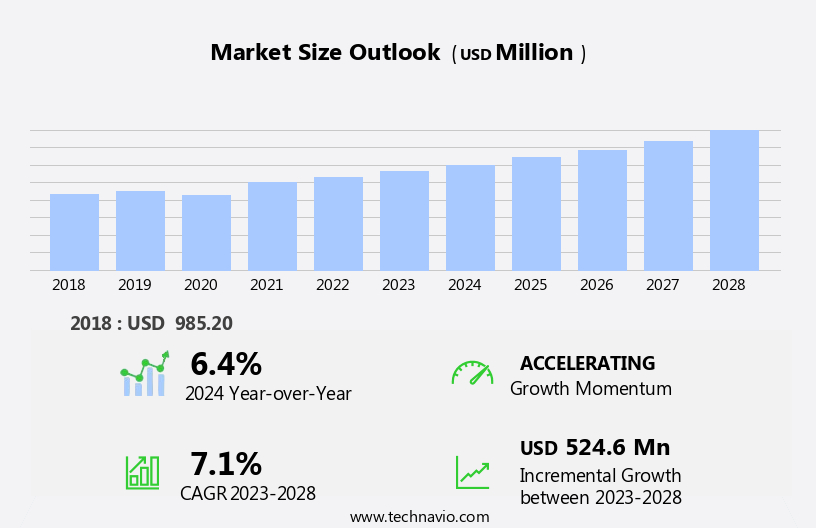
Cryogenic PPE Market Size

Explore in-depth regional segment analysis with market size data - historical 2018-2022 and forecasts 2024-2028 - in the full report.  
Request Free Sample

The market is characterized by its continuous evolution and dynamic nature, with ongoing advancements and applications across various sectors. Cryogenic head protection, drying, freezing, and material handling are integral components of this market, with a focus on ensuring safety and efficiency in cryogenic processes. Cryogenic certification, engineering, and assembly play crucial roles in the production and implementation of cryogenic equipment. Cryogenic hand protection, boots, piping, suits, and apparel are essential components of cryogenic PPE, each designed to provide specific levels of thermal resistance, chemical resistance, and flexibility. The development of cryogenic performance standards and safety regulations has led to the creation of advanced materials and technologies, such as tear-resistant fabrics and insulation, which are critical in protecting personnel and equipment.

Cryogenic processing, testing, and maintenance are ongoing activities in the market, ensuring the optimal performance of cryogenic equipment and the safe handling of cryogenic materials. Cryogenic risk assessment and emergency response plans are also essential components of the market, as the handling of cryogenic substances presents unique hazards. The industrial, scientific research, medical, and logistics sectors are among those that utilize cryogenic technologies, with each sector requiring specialized cryogenic equipment and PPE. The market for cryogenic PPE is expected to continue growing as new applications and technologies emerge, driven by the need for efficient and safe cryogenic processes.

How is this Cryogenic PPE Industry segmented?

The cryogenic PPE industry research report provides comprehensive data (region-wise segment analysis), with forecasts and estimates in "USD million" for the period 2024-2028, as well as historical data from 2018-2022 for the following segments.

  • End-user
    • Hand protection
    • Protective clothing
    • Head eye and ear protection
    • Others
  • Geography
    • North America
      • US
      • Canada
    • APAC
      • China
      • Japan
    • Rest of World (ROW)

By End-user Insights

The hand protection segment is estimated to witness significant growth during the forecast period.

The market encompasses a range of protective equipment and materials designed for use in extremely low temperatures. Key components include cryogenic head protection, hand protection, boots, suits, and apparel, which offer cryogenic chemical resistance, tear resistance, and insulation. Cryogenic pumps, assembly, engineering, and repair services are essential for the production and maintenance of cryogenic equipment. Cryogenic processing applications span various industries, including oil and gas, scientific research, medical, and food preservation. In the oil and gas sector, cryogenic technology is integral to natural gas storage, transportation, and processing. Cryogenic air separation and distillation are crucial processes in the industry, with cryogenic equipment used for LNG storage and transportation.

Cryogenic materials, such as cryogenic piping and vessels, require high durability and thermal resistance. Cryogenic testing, maintenance, and compliance are essential for ensuring safety and optimal performance. Cryogenic hazards, including frostbite and asphyxiation, necessitate stringent safety standards and regulations. Cryogenic PPE and equipment are also used in scientific research, medical applications, and emergency response situations. Cryogenic dewar flasks, for instance, are used for cryogenic storage and preservation of biological samples. Cryogenic fabrics, gloves, and face shields offer flexibility, abrasion resistance, and puncture resistance. The market for cryogenic PPE and equipment is driven by the increasing demand for cryogenic processing in various industries.

The growing importance of natural gas as an energy source and the expanding use of cryogenic technology in scientific research and medical applications are significant factors contributing to the market's growth. Cryogenic recycling and disposal are also gaining importance as sustainable solutions for reducing waste and minimizing environmental impact.
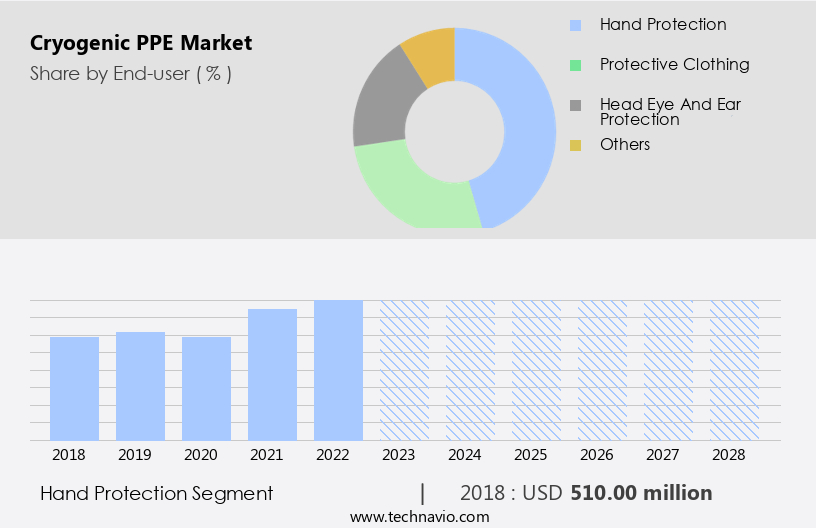
Cryogenic PPE Market Size

Request Free Sample

The Hand protection segment was valued at USD 510.00 million in 2018 and showed a gradual increase during the forecast period.

Regional Analysis

APAC is estimated to contribute 54% to the growth of the global market during the forecast period. Technavio's analysts have elaborately explained the regional trends and drivers that shape the market during the forecast period.
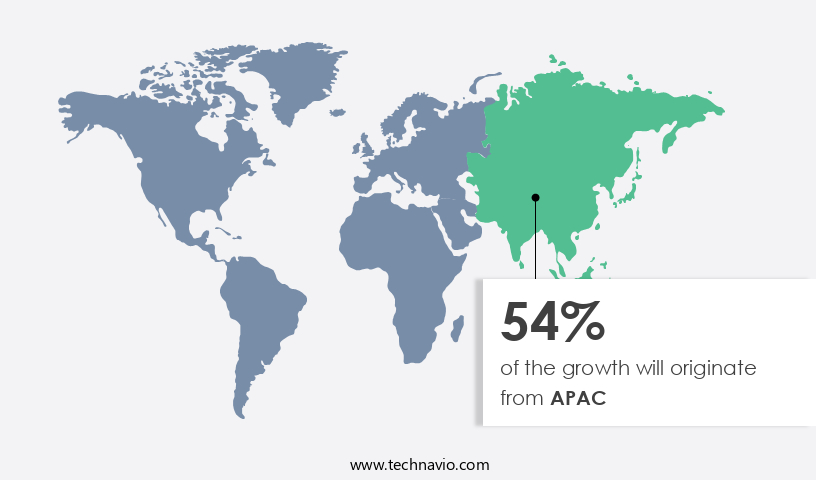
Cryogenic PPE Market Share by Geography

 Request Free Sample

The market encompasses a range of protective equipment designed for use in extremely low temperatures. Key components include head protection, hand protection, boots, suits, gloves, and apparel, all engineered with cryogenic chemical resistance, tear resistance, and thermal resistance. Cryogenic pumps, assembly, and engineering are essential for manufacturing and processing these materials. Cryogenic certification ensures safety standards are met, while maintenance and repair services are crucial for prolonging the life of these assets. Cryogenic drying and freezing processes are integral to various industries, including oil and gas, energy, chemical, healthcare, and food, which drive demand for cryogenic PPE. APAC is the largest market for cryogenic PPE, primarily due to its extensive use in the oil and gas industry and the burgeoning LNG trade.

Countries like China, South Korea, Japan, Taiwan, and India are significant contributors to the regional market growth, driven by the demands from their respective energy, chemical, healthcare, and food industries. Cryogenic materials, such as insulation, vessels, and dewar flasks, are essential for cryogenic processing, storage, and transportation. Cryogenic testing, risk assessment, and compliance with safety standards are crucial aspects of the market. Cryogenic emergency response, medical applications, and scientific research also contribute to the market's evolution. Flexibility, abrasion resistance, and insulation are essential properties for cryogenic PPE, ensuring the safety and efficiency of handling, assembly, and maintenance. Cryogenic hazards, such as frostbite and asphyxiation, necessitate the development of advanced cryogenic fabrics, puncture resistance, and valves.

In conclusion, the market is witnessing significant growth due to the increasing demand from various industries, particularly in APAC. The market's dynamics are driven by the need for advanced protective equipment, stringent safety standards, and the expanding applications in diverse industries.

Market Dynamics

Our researchers analyzed the data with 2023 as the base year, along with the key drivers, trends, and challenges. A holistic analysis of drivers will help companies refine their marketing strategies to gain a competitive advantage.

What are the key market drivers leading to the rise in the adoption of Cryogenic PPE Industry?

  • The significant growth in applications within healthcare and life sciences sectors is the primary catalyst driving market expansion. 
  • The life sciences sector, which includes regenerative medicines, vaccinations, immunotherapy, and biopharmaceuticals, is experiencing significant growth due to technological advances and innovations. A key requirement for many applications in this sector is the use of cryogenic temperatures for storage, preservation, and treatment. For instance, in chimeric antigen receptor (CAR) T-cell therapy, T-cells are collected from patients, genetically engineered, and then infused back into the body to fight cancer. The production of these CAR-T cells necessitates cryogenic temperature control during storage and transport. Cryogenic PPE, including gloves, foot protection, and suits, plays a crucial role in ensuring safety and compliance during the handling of cryogenic substances.
  • These protective equipment items must offer cryogenic puncture resistance, water resistance, and durability to protect against the extreme cold and potential hazards. Cryogenic valves are also essential for controlling the flow of cryogenic gases and liquids, ensuring temperature control during transport and storage. Cryogenic logistics, which involves the transportation and handling of cryogenic substances, is a critical aspect of the industry. Regulations governing the use and handling of cryogenic substances are stringent to ensure safety and compliance. Cryogenic food preservation is another application where cryogenic temperature control is essential to maintain the quality and freshness of food products.
  • Overall, the market is expected to grow due to the increasing demand for cryogenic solutions in various industries, including life sciences, food, and industrial applications.

What are the market trends shaping the Cryogenic PPE Industry?

  • Cryogenics, an intriguing field of science, is witnessing significant growth due to increased research and development (R&D) and technological advances. These innovations are expanding the scope of cryogenics, making it a noteworthy market trend.
  • Cryogenic technology has experienced significant advancements in recent years, expanding its reach across various industries, including medical, industrial, energy, and food processing. The growing research and development investment in this field have led to an increased workforce dedicated to cryogenic applications, thereby driving the demand for cryogenic PPE. Technological innovations, such as cryogenic drying and freezing, have revolutionized industries like food processing, preserving perishable goods and increasing their shelf life. In the industrial sector, cryogenic pumps and engineering solutions have enhanced productivity and efficiency. Meanwhile, cryogenic hand protection, boots, and suits ensure the safety of workers handling cryogenic materials.
  • The chemical resistance properties of cryogenic materials are crucial for PPE manufacturers, ensuring the protection of workers from potential hazards. The increasing use of cryogenic technology in hydrofracturing for oil and gas production has contributed to the market's growth. However, environmental concerns associated with hydrofracturing may impact the industry's future. Cryogenic engineering and assembly processes require precision and attention to detail, making it essential to have high-quality PPE. The demand for cryogenic PPE is expected to continue growing as industries continue to explore the potential of cryogenic technology.

What challenges does the Cryogenic PPE Industry face during its growth?

  • The uncertainty surrounding the impact of low crude oil prices on industry growth represents a significant challenge for the sector. 
  • The market is driven by the increasing demand for cryogenic processing in various industrial applications. Cryogenic processing involves the use of extremely low temperatures to preserve, cool, or modify materials, resulting in improved product quality and efficiency. This process is extensively used in industries such as food and beverage, pharmaceuticals, and chemical manufacturing. Cryogenic PPE, including face shields and respirators, is essential to ensure the safety of workers involved in these processes. These PPE products are designed to provide cryogenic tear resistance, thermal resistance, and protection against cryogenic temperatures. Cryogenic performance standards and safety regulations mandate regular cryogenic maintenance and repair to ensure the effectiveness of the PPE.
  • Cryogenic dewar flasks, used for storing and transporting cryogenic liquids, are also a significant part of the market. The demand for these flasks is driven by the increasing use of cryogenic storage in various industries. Cryogenic risk assessment is crucial to ensure the safe handling and storage of these flasks. The market for cryogenic PPE is expected to grow due to the increasing demand for cryogenic processing and the need for safety and compliance with regulatory standards.

Exclusive Customer Landscape

The cryogenic PPE market forecasting report includes the adoption lifecycle of the market, covering from the innovator's stage to the laggard's stage. It focuses on adoption rates in different regions based on penetration. Furthermore, the cryogenic PPE market report also includes key purchase criteria and drivers of price sensitivity to help companies evaluate and develop their market growth analysis strategies.
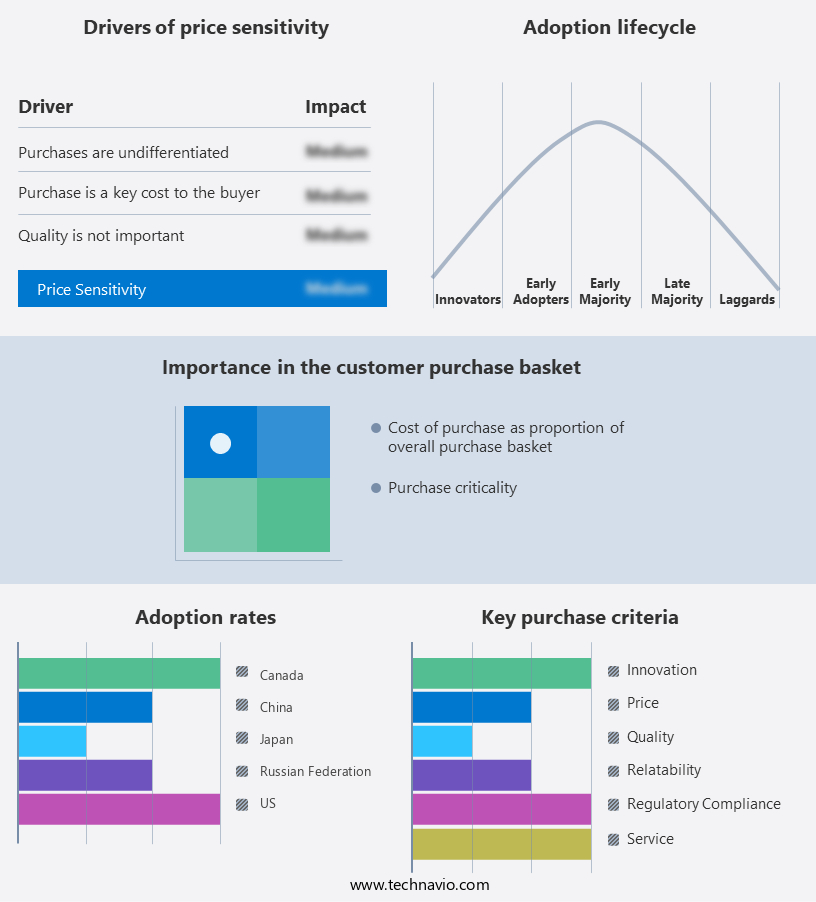
Cryogenic PPE Market Share by Geography

 Customer Landscape

Key Companies & Market Insights

Companies are implementing various strategies, such as strategic alliances, cryogenic ppe market forecast, partnerships, mergers and acquisitions, geographical expansion, and product/service launches, to enhance their presence in the industry.

Air Liquide - The company specializes in providing a comprehensive selection of cryogenic PPE, including the AlphaTec 62 400, AlphaTec LIGHT Type TR, and AlphaTec FLASH Type T. 

The industry research and growth report includes detailed analyses of the competitive landscape of the market and information about key companies, including:

  • Air Liquide
  • Ansell Ltd.
  • Avantor Inc.
  • Bunzl Plc
  • Dragerwerk AG and Co. KGaA
  • Essex Industries Inc.
  • FLOWTRONIX Ltd.
  • Garbmann Ltd.
  • Goldfreeze Ltd.
  • Hazchem Safety Ltd
  • Honeywell International Inc.
  • Kora Srl
  • Linde Plc
  • Mallcom India Ltd.
  • National Safety Apparel Inc.
  • Newell Brands Inc.
  • Ted Pella Inc.
  • Tempshield LLC
  • Udyogi International Pvt. Ltd.
  • Wessington Cryogenics

Qualitative and quantitative analysis of companies has been conducted to help clients understand the wider business environment as well as the strengths and weaknesses of key industry players. Data is qualitatively analyzed to categorize companies as pure play, category-focused, industry-focused, and diversified; it is quantitatively analyzed to categorize companies as dominant, leading, strong, tentative, and weak.

Recent Development and News in Cryogenic PPE Market

  • In January 2023, DuPont announced the launch of its new cryogenic PPE suit, Tyvek Arctic Coverall 8000, designed for extreme cold environments. This innovative product incorporates advanced insulation technology and moisture management features, making it a significant addition to the DuPont portfolio (DuPont Press Release, 2023).
  • In March 2024, 3M and Air Liquide, a leading industrial gases company, formed a strategic partnership to develop and commercialize advanced cryogenic PPE solutions. This collaboration aims to combine 3M's expertise in PPE and Air Liquide's knowledge in cryogenic technologies, creating enhanced safety solutions for industries like oil and gas, healthcare, and research (3M Press Release, 2024).
  • In July 2024, Cryomech, a leading cryogenic equipment manufacturer, raised USD15 million in a Series B funding round led by New Enterprise Associates. The investment will be used to expand Cryomech's product portfolio, enhance its R&D capabilities, and expand its global reach (Crunchbase, 2024).

Research Analyst Overview

  • The market encompasses a diverse range of applications, from cryogenic biopreservation and cryogenic instrumentation to cryogenic aerospace and nanotechnology. Key components of this market include cryogenic cooling systems utilizing liquid helium, oxygen, nitrogen, argon, and other cryogenic fluids. Cryogenic automation and robotics play a crucial role in handling and processing these fluids, while sensors and temperature monitoring systems ensure safe and efficient operations. Cryogenic instrumentation finds applications in various industries, such as cryogenic chromatography and spectroscopy, enabling advanced analytical techniques. In the healthcare sector, cryogenic cryosurgery and cryotherapy are used for medical treatments, while cryogenic biobanking preserves biological samples for research and therapeutic purposes.
  • The aerospace industry relies on cryogenic propulsion and energy storage for rocket engines and satellites, while cryogenic heating is essential for maintaining low temperatures in space. Cryogenic quantum computing and superconductivity are driving innovation in the technology sector, pushing the boundaries of computing power and electrical efficiency. Cryogenic gases, including helium, oxygen, nitrogen, and argon, are integral to numerous applications, from industrial processes to scientific research. The market for cryogenic sensors, automation, and temperature monitoring continues to grow, driven by the increasing demand for precise temperature control and efficient operations.

Dive into Technavio's robust research methodology, blending expert interviews, extensive data synthesis, and validated models for unparalleled Cryogenic PPE Market insights. See full methodology.

Market Scope

Report Coverage

Details

Page number

179

Base year

2023

Historic period

2018-2022

Forecast period

2024-2028

Growth momentum & CAGR

Accelerate at a CAGR of 7.1%

Market growth 2024-2028

USD 524.6 million

Market structure

Fragmented

YoY growth 2023-2024(%)

6.4

Key countries

China, US, Russian Federation, Japan, and Canada

Competitive landscape

Leading Companies, Market Positioning of Companies, Competitive Strategies, and Industry Risks

Request Free Sample

What are the Key Data Covered in this Cryogenic PPE Market Research and Growth Report?

  • CAGR of the Cryogenic PPE industry during the forecast period
  • Detailed information on factors that will drive the growth and forecasting between 2024 and 2028
  • Precise estimation of the size of the market and its contribution of the industry in focus to the parent market
  • Accurate predictions about upcoming growth and trends and changes in consumer behaviour
  • Growth of the market across APAC, Europe, North America, Middle East and Africa, and South America
  • Thorough analysis of the market's competitive landscape and detailed information about companies
  • Comprehensive analysis of factors that will challenge the cryogenic ppe market growth of industry companies

We can help! Our analysts can customize this cryogenic ppe market research report to meet your requirements.

Get in touch

1 Executive Summary

  • 1.1 Market overview
    • Executive Summary - Chart on Market Overview
    • Executive Summary - Data Table on Market Overview
    • Executive Summary - Chart on Global Market Characteristics
    • Executive Summary - Chart on Market by Geography
    • Executive Summary - Chart on Market Segmentation by Product
    • Executive Summary - Chart on Market Segmentation by End-user
    • Executive Summary - Chart on Incremental Growth
    • Executive Summary - Data Table on Incremental Growth
    • Executive Summary - Chart on Company Market Positioning

2 Market Landscape

  • 2.1 Market ecosystem
    • Parent Market
    • Data Table on - Parent Market
  • 2.2 Market characteristics
    • Market characteristics analysis
  • 2.3 Value chain analysis
    • Value Chain Analysis

3 Market Sizing

  • 3.1 Market definition
    • Offerings of companies included in the market definition
  • 3.2 Market segment analysis
    • Market segments
  • 3.3 Market size 2023
    • 3.4 Market outlook: Forecast for 2023-2028
      • Chart on Global - Market size and forecast 2023-2028 ($ million)
      • Data Table on Global - Market size and forecast 2023-2028 ($ million)
      • Chart on Global Market: Year-over-year growth 2023-2028 (%)
      • Data Table on Global Market: Year-over-year growth 2023-2028 (%)

    4 Historic Market Size

    • 4.1 Global Cryogenic PPE Market 2018 - 2022
      • Historic Market Size - Data Table on Global Cryogenic PPE Market 2018 - 2022 ($ million)
    • 4.2 Product segment analysis 2018 - 2022
      • Historic Market Size - Product Segment 2018 - 2022 ($ million)
    • 4.3 End-user segment analysis 2018 - 2022
      • Historic Market Size - End-user Segment 2018 - 2022 ($ million)
    • 4.4 Geography segment analysis 2018 - 2022
      • Historic Market Size - Geography Segment 2018 - 2022 ($ million)
    • 4.5 Country segment analysis 2018 - 2022
      • Historic Market Size - Country Segment 2018 - 2022 ($ million)

    5 Five Forces Analysis

    • 5.1 Five forces summary
      • Five forces analysis - Comparison between 2023 and 2028
    • 5.2 Bargaining power of buyers
      • Bargaining power of buyers - Impact of key factors 2023 and 2028
    • 5.3 Bargaining power of suppliers
      • Bargaining power of suppliers - Impact of key factors in 2023 and 2028
    • 5.4 Threat of new entrants
      • Threat of new entrants - Impact of key factors in 2023 and 2028
    • 5.5 Threat of substitutes
      • Threat of substitutes - Impact of key factors in 2023 and 2028
    • 5.6 Threat of rivalry
      • Threat of rivalry - Impact of key factors in 2023 and 2028
    • 5.7 Market condition
      • Chart on Market condition - Five forces 2023 and 2028

    6 Market Segmentation by Product

    • 6.1 Market segments
      • Chart on Product - Market share 2023-2028 (%)
      • Data Table on Product - Market share 2023-2028 (%)
    • 6.2 Comparison by Product
      • Chart on Comparison by Product
      • Data Table on Comparison by Product
    • 6.3 Hand protection - Market size and forecast 2023-2028
      • Chart on Hand protection - Market size and forecast 2023-2028 ($ million)
      • Data Table on Hand protection - Market size and forecast 2023-2028 ($ million)
      • Chart on Hand protection - Year-over-year growth 2023-2028 (%)
      • Data Table on Hand protection - Year-over-year growth 2023-2028 (%)
    • 6.4 Protective clothing - Market size and forecast 2023-2028
      • Chart on Protective clothing - Market size and forecast 2023-2028 ($ million)
      • Data Table on Protective clothing - Market size and forecast 2023-2028 ($ million)
      • Chart on Protective clothing - Year-over-year growth 2023-2028 (%)
      • Data Table on Protective clothing - Year-over-year growth 2023-2028 (%)
    • 6.5 Head eye and ear protection - Market size and forecast 2023-2028
      • Chart on Head eye and ear protection - Market size and forecast 2023-2028 ($ million)
      • Data Table on Head eye and ear protection - Market size and forecast 2023-2028 ($ million)
      • Chart on Head eye and ear protection - Year-over-year growth 2023-2028 (%)
      • Data Table on Head eye and ear protection - Year-over-year growth 2023-2028 (%)
    • 6.6 Others - Market size and forecast 2023-2028
      • Chart on Others - Market size and forecast 2023-2028 ($ million)
      • Data Table on Others - Market size and forecast 2023-2028 ($ million)
      • Chart on Others - Year-over-year growth 2023-2028 (%)
      • Data Table on Others - Year-over-year growth 2023-2028 (%)
    • 6.7 Market opportunity by Product
      • Market opportunity by Product ($ million)
      • Data Table on Market opportunity by Product ($ million)

    7 Market Segmentation by End-user

    • 7.1 Market segments
      • Chart on End-user - Market share 2023-2028 (%)
      • Data Table on End-user - Market share 2023-2028 (%)
    • 7.2 Comparison by End-user
      • Chart on Comparison by End-user
      • Data Table on Comparison by End-user
    • 7.3 Oil and gas - Market size and forecast 2023-2028
      • Chart on Oil and gas - Market size and forecast 2023-2028 ($ million)
      • Data Table on Oil and gas - Market size and forecast 2023-2028 ($ million)
      • Chart on Oil and gas - Year-over-year growth 2023-2028 (%)
      • Data Table on Oil and gas - Year-over-year growth 2023-2028 (%)
    • 7.4 Energy - Market size and forecast 2023-2028
      • Chart on Energy - Market size and forecast 2023-2028 ($ million)
      • Data Table on Energy - Market size and forecast 2023-2028 ($ million)
      • Chart on Energy - Year-over-year growth 2023-2028 (%)
      • Data Table on Energy - Year-over-year growth 2023-2028 (%)
    • 7.5 Metallurgy - Market size and forecast 2023-2028
      • Chart on Metallurgy - Market size and forecast 2023-2028 ($ million)
      • Data Table on Metallurgy - Market size and forecast 2023-2028 ($ million)
      • Chart on Metallurgy - Year-over-year growth 2023-2028 (%)
      • Data Table on Metallurgy - Year-over-year growth 2023-2028 (%)
    • 7.6 Electronics - Market size and forecast 2023-2028
      • Chart on Electronics - Market size and forecast 2023-2028 ($ million)
      • Data Table on Electronics - Market size and forecast 2023-2028 ($ million)
      • Chart on Electronics - Year-over-year growth 2023-2028 (%)
      • Data Table on Electronics - Year-over-year growth 2023-2028 (%)
    • 7.7 Others - Market size and forecast 2023-2028
      • Chart on Others - Market size and forecast 2023-2028 ($ million)
      • Data Table on Others - Market size and forecast 2023-2028 ($ million)
      • Chart on Others - Year-over-year growth 2023-2028 (%)
      • Data Table on Others - Year-over-year growth 2023-2028 (%)
    • 7.8 Market opportunity by End-user
      • Market opportunity by End-user ($ million)
      • Data Table on Market opportunity by End-user ($ million)

    8 Customer Landscape

    • 8.1 Customer landscape overview
      • Analysis of price sensitivity, lifecycle, customer purchase basket, adoption rates, and purchase criteria

    9 Geographic Landscape

    • 9.1 Geographic segmentation
      • Chart on Market share by geography 2023-2028 (%)
      • Data Table on Market share by geography 2023-2028 (%)
    • 9.2 Geographic comparison
      • Chart on Geographic comparison
      • Data Table on Geographic comparison
    • 9.3 APAC - Market size and forecast 2023-2028
      • Chart on APAC - Market size and forecast 2023-2028 ($ million)
      • Data Table on APAC - Market size and forecast 2023-2028 ($ million)
      • Chart on APAC - Year-over-year growth 2023-2028 (%)
      • Data Table on APAC - Year-over-year growth 2023-2028 (%)
    • 9.4 Europe - Market size and forecast 2023-2028
      • Chart on Europe - Market size and forecast 2023-2028 ($ million)
      • Data Table on Europe - Market size and forecast 2023-2028 ($ million)
      • Chart on Europe - Year-over-year growth 2023-2028 (%)
      • Data Table on Europe - Year-over-year growth 2023-2028 (%)
    • 9.5 North America - Market size and forecast 2023-2028
      • Chart on North America - Market size and forecast 2023-2028 ($ million)
      • Data Table on North America - Market size and forecast 2023-2028 ($ million)
      • Chart on North America - Year-over-year growth 2023-2028 (%)
      • Data Table on North America - Year-over-year growth 2023-2028 (%)
    • 9.6 Middle East and Africa - Market size and forecast 2023-2028
      • Chart on Middle East and Africa - Market size and forecast 2023-2028 ($ million)
      • Data Table on Middle East and Africa - Market size and forecast 2023-2028 ($ million)
      • Chart on Middle East and Africa - Year-over-year growth 2023-2028 (%)
      • Data Table on Middle East and Africa - Year-over-year growth 2023-2028 (%)
    • 9.7 South America - Market size and forecast 2023-2028
      • Chart on South America - Market size and forecast 2023-2028 ($ million)
      • Data Table on South America - Market size and forecast 2023-2028 ($ million)
      • Chart on South America - Year-over-year growth 2023-2028 (%)
      • Data Table on South America - Year-over-year growth 2023-2028 (%)
    • 9.8 China - Market size and forecast 2023-2028
      • Chart on China - Market size and forecast 2023-2028 ($ million)
      • Data Table on China - Market size and forecast 2023-2028 ($ million)
      • Chart on China - Year-over-year growth 2023-2028 (%)
      • Data Table on China - Year-over-year growth 2023-2028 (%)
    • 9.9 US - Market size and forecast 2023-2028
      • Chart on US - Market size and forecast 2023-2028 ($ million)
      • Data Table on US - Market size and forecast 2023-2028 ($ million)
      • Chart on US - Year-over-year growth 2023-2028 (%)
      • Data Table on US - Year-over-year growth 2023-2028 (%)
    • 9.10 Russian Federation - Market size and forecast 2023-2028
      • Chart on Russian Federation - Market size and forecast 2023-2028 ($ million)
      • Data Table on Russian Federation - Market size and forecast 2023-2028 ($ million)
      • Chart on Russian Federation - Year-over-year growth 2023-2028 (%)
      • Data Table on Russian Federation - Year-over-year growth 2023-2028 (%)
    • 9.11 Japan - Market size and forecast 2023-2028
      • Chart on Japan - Market size and forecast 2023-2028 ($ million)
      • Data Table on Japan - Market size and forecast 2023-2028 ($ million)
      • Chart on Japan - Year-over-year growth 2023-2028 (%)
      • Data Table on Japan - Year-over-year growth 2023-2028 (%)
    • 9.12 Canada - Market size and forecast 2023-2028
      • Chart on Canada - Market size and forecast 2023-2028 ($ million)
      • Data Table on Canada - Market size and forecast 2023-2028 ($ million)
      • Chart on Canada - Year-over-year growth 2023-2028 (%)
      • Data Table on Canada - Year-over-year growth 2023-2028 (%)
    • 9.13 Market opportunity by geography
      • Market opportunity by geography ($ million)
      • Data Tables on Market opportunity by geography ($ million)

    10 Drivers, Challenges, and Opportunity/Restraints

    • 10.1 Market drivers
      • 10.2 Market challenges
        • 10.3 Impact of drivers and challenges
          • Impact of drivers and challenges in 2023 and 2028
        • 10.4 Market opportunities/restraints

          11 Competitive Landscape

          • 11.1 Overview
            • 11.2 Competitive Landscape
              • Overview on criticality of inputs and factors of differentiation
            • 11.3 Landscape disruption
              • Overview on factors of disruption
            • 11.4 Industry risks
              • Impact of key risks on business

            12 Competitive Analysis

            • 12.1 Companies profiled
              • Companies covered
            • 12.2 Market positioning of companies
              • Matrix on companies position and classification
            • 12.3 Ansell Ltd.
              • Ansell Ltd. - Overview
              • Ansell Ltd. - Business segments
              • Ansell Ltd. - Key news
              • Ansell Ltd. - Key offerings
              • Ansell Ltd. - Segment focus
            • 12.4 Bunzl Plc
              • Bunzl Plc - Overview
              • Bunzl Plc - Business segments
              • Bunzl Plc - Key news
              • Bunzl Plc - Key offerings
              • Bunzl Plc - Segment focus
            • 12.5 Dragerwerk AG and Co. KGaA
              • Dragerwerk AG and Co. KGaA - Overview
              • Dragerwerk AG and Co. KGaA - Business segments
              • Dragerwerk AG and Co. KGaA - Key news
              • Dragerwerk AG and Co. KGaA - Key offerings
              • Dragerwerk AG and Co. KGaA - Segment focus
            • 12.6 Essex Industries Inc.
              • Essex Industries Inc. - Overview
              • Essex Industries Inc. - Product / Service
              • Essex Industries Inc. - Key offerings
            • 12.7 Hazchem Safety Ltd
              • Hazchem Safety Ltd - Overview
              • Hazchem Safety Ltd - Product / Service
              • Hazchem Safety Ltd - Key offerings
            • 12.8 Honeywell International Inc.
              • Honeywell International Inc. - Overview
              • Honeywell International Inc. - Business segments
              • Honeywell International Inc. - Key news
              • Honeywell International Inc. - Key offerings
              • Honeywell International Inc. - Segment focus
            • 12.9 Linde Plc
              • Linde Plc - Overview
              • Linde Plc - Business segments
              • Linde Plc - Key news
              • Linde Plc - Key offerings
              • Linde Plc - Segment focus
            • 12.10 National Safety Apparel Inc.
              • National Safety Apparel Inc. - Overview
              • National Safety Apparel Inc. - Product / Service
              • National Safety Apparel Inc. - Key news
              • National Safety Apparel Inc. - Key offerings
            • 12.11 Ted Pella Inc.
              • Ted Pella Inc. - Overview
              • Ted Pella Inc. - Product / Service
              • Ted Pella Inc. - Key offerings
            • 12.12 Tempshield LLC
              • Tempshield LLC - Overview
              • Tempshield LLC - Product / Service
              • Tempshield LLC - Key offerings

            13 Appendix

            • 13.1 Scope of the report
              • 13.2 Inclusions and exclusions checklist
                • Inclusions checklist
                • Exclusions checklist
              • 13.3 Currency conversion rates for US$
                • Currency conversion rates for US$
              • 13.4 Research methodology
                • Research methodology
              • 13.5 Data procurement
                • Information sources
              • 13.6 Data validation
                • Data validation
              • 13.7 Validation techniques employed for market sizing
                • Validation techniques employed for market sizing
              • 13.8 Data synthesis
                • Data synthesis
              • 13.9 360 degree market analysis
                • 360 degree market analysis
              • 13.10 List of abbreviations
                • List of abbreviations

              Research Methodology

              Technavio presents a detailed picture of the market by way of study, synthesis, and summation of data from multiple sources. The analysts have presented the various facets of the market with a particular focus on identifying the key industry influencers. The data thus presented is comprehensive, reliable, and the result of extensive research, both primary and secondary.

              INFORMATION SOURCES

              Primary sources

              • Manufacturers and suppliers
              • Channel partners
              • Industry experts
              • Strategic decision makers

              Secondary sources

              • Industry journals and periodicals
              • Government data
              • Financial reports of key industry players
              • Historical data
              • Press releases

              DATA ANALYSIS

              Data Synthesis

              • Collation of data
              • Estimation of key figures
              • Analysis of derived insights

              Data Validation

              • Triangulation with data models
              • Reference against proprietary databases
              • Corroboration with industry experts

              REPORT WRITING

              Qualitative

              • Market drivers
              • Market challenges
              • Market trends
              • Five forces analysis

              Quantitative

              • Market size and forecast
              • Market segmentation
              • Geographical insights
              • Competitive landscape

              Interested in this report?

              Get your sample now to see our research methodology and insights!

              Download Now

              Frequently Asked Questions

              Cryogenic PPE market growth will increase by $ 524.6 mn during 2024-2028.

              The Cryogenic PPE market is expected to grow at a CAGR of 7.1% during 2024-2028.

              Cryogenic PPE market is segmented by End-user( Hand protection, Protective clothing, Head eye and ear protection, Others, Others)

              Air Liquide, Ansell Ltd., Avantor Inc., Bunzl Plc, Dragerwerk AG and Co. KGaA, Essex Industries Inc., FLOWTRONIX Ltd., Garbmann Ltd., Goldfreeze Ltd., Hazchem Safety Ltd, Honeywell International Inc., Kora Srl, Linde Plc, Mallcom India Ltd., National Safety Apparel Inc., Newell Brands Inc., Ted Pella Inc., Tempshield LLC, Udyogi International Pvt. Ltd., Wessington Cryogenics are a few of the key vendors in the Cryogenic PPE market.

              APAC will register the highest growth rate of 54% among the other regions. Therefore, the Cryogenic PPE market in APAC is expected to garner significant business opportunities for the vendors during the forecast period.

              China, US, Russian Federation, Japan, Canada

              • Growing applications in healthcare and life sciencesTechnological advances and the rapid pace of innovations in areas such as regenerative medicines is the driving factor this market.
              • vaccinations is the driving factor this market.
              • immunotherapy is the driving factor this market.
              • and biopharmaceuticals is the driving factor this market.
              • are paving the way for the growth of the life sciences sector. The above-mentioned life science areas require cryogenic temperatures for storage is the driving factor this market.
              • preservation is the driving factor this market.
              • and treatment applications. For instance is the driving factor this market.
              • in immunotherapies is the driving factor this market.
              • such as chimeric antigen receptor (CAR) T-cell therapy is the driving factor this market.
              • T-cells are collected from the blood of patients. These T-cells are then genetically engineered to produce special receptors on their surface is the driving factor this market.
              • known as chimeric antigen receptors. These CAR-T cells proliferate to billions in number before being infused into the patient. The T-cells then multiply in the patient body and kill the cancer cells with the guidance of an engineered receptor. Cryogenic equipment plays a crucial role in the storage and activation of CAR-T cells. Cryogenic freezers are used for the biological storage of bone marrow is the driving factor this market.
              • stem cells is the driving factor this market.
              • cord blood is the driving factor this market.
              • human tissues is the driving factor this market.
              • and other highly sensitive pharmaceutical and biological applications. The expanding application of life science areas is cultivating an increased demand for cryogenic PPE. The fact that healthcare is the driving factor this market.
              • of which life science forms an essential part is the driving factor this market.
              • is a highly regulated sector adds to the demand for cryogenic PPE is the driving factor this market.
              • with growing cryogenic applications in life sciences. The demand for industrial gases is high in the healthcare sector. The main gases used in the healthcare industry are oxygen is the driving factor this market.
              • liquid oxygen is the driving factor this market.
              • nitrogen is the driving factor this market.
              • LN? is the driving factor this market.
              • nitrous oxide is the driving factor this market.
              • laser mixes is the driving factor this market.
              • specialty gases is the driving factor this market.
              • compressed air is the driving factor this market.
              • and helium. Liquid nitrogen is used during transplant procedures in blood bank storage units and for cryogenic storage of body organs. Oxygen used in the medical industry must be highly pure (i.e. is the driving factor this market.
              • 99.5%) is the driving factor this market.
              • and this level of purity can only be achieved by cryogenic air separation. CO? is used in the medical industry for endoscopic tests. Argon is used for procedures that require a high degree of sterilization as it provides a germ-free environment. Ethylene oxide is an alkylating agent that damages the deoxyribonucleic acid (DNA) of microorganisms is the driving factor this market.
              • stopping their reproduction. It is used for sterilization in the medical industry. Nitrogen oxides are a group of gases that are composed of nitrogen and oxygen. Nitrous oxide (N2O) is a greenhouse gas (GHG) that contributes to climate change and is used for treating premature babies that have respiratory failure. It is also used for adults during dental treatments. With the economies of developing countries growing faster than developed countries is the driving factor this market.
              • the former is expected to set up more research facilities and institutes during the forecast period. The upsurge in the number of research and testing facilities is the driving factor this market.
              • particularly in the field of pharmaceutical and biotechnology is the driving factor this market.
              • will lead to a rise in demand for the freezing of biotechnology products is the driving factor this market.
              • such as vaccines. Thus is the driving factor this market.
              • the growth of the healthcare industry will drive the demand for cryogenic gases is the driving factor this market.
              • which is the driving factor this market.
              • in turn is the driving factor this market.
              • will fuel the growth of the global cryogenic PPE market during the forecast period. is the driving factor this market.

              The Cryogenic PPE market vendors should focus on grabbing business opportunities from the Hand protection segment as it accounted for the largest market share in the base year.
