

US - Elevator and Escalator Market by Product, Service and Application - Forecast and Analysis 2024-2028

US - Elevator and Escalator Market by Product, Service and Application - Forecast and Analysis 2024-2028

Published: Feb 2024 155 Pages SKU: IRTNTR43634

Market Overview at a Glance

$2.82 B
Market Opportunity
6.36%
CAGR
5.44
YoY growth 2023-2024(%)

US Elevator and Escalator Market Size 2024-2028

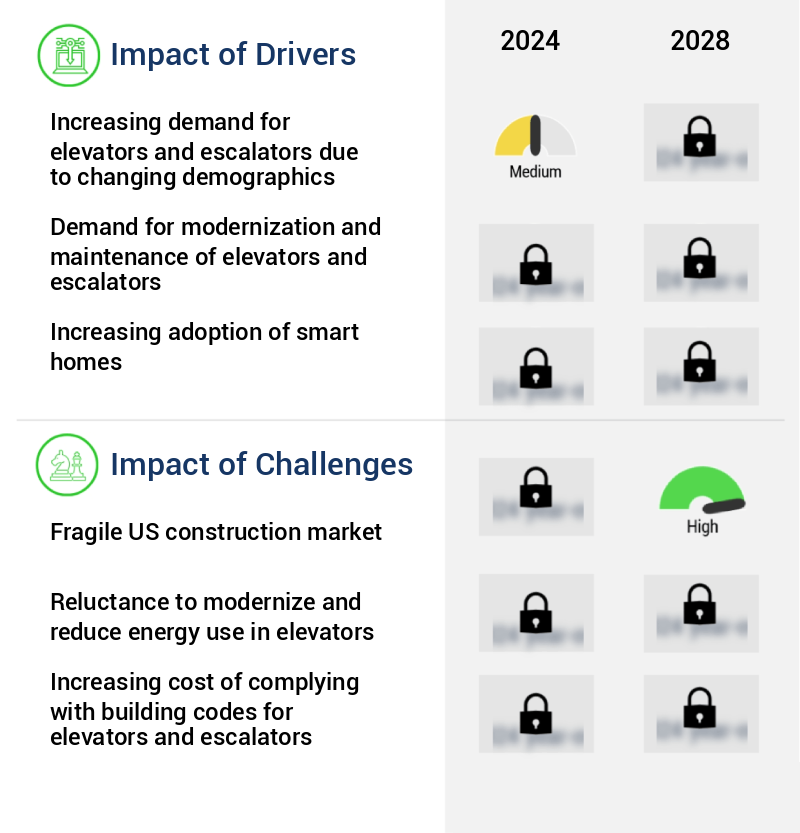
The US elevator and escalator market size is valued to increase USD 2.82 billion, at a CAGR of 6.36% from 2023 to 2028. Increasing demand for elevators and escalators due to changing demographics will drive the US elevator and escalator market.

Major Market Trends & Insights

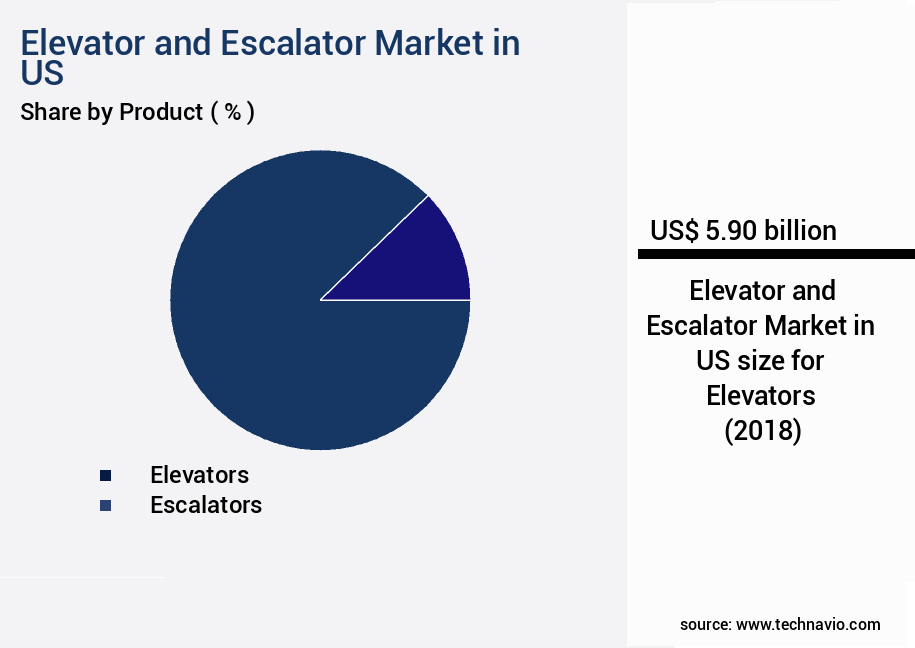
  • By Product - Elevators segment was valued at USD 5.90 billion in 2022
  • By Service - New installations segment accounted for the largest market revenue share in 2022

Market Size & Forecast

  • Market Opportunities: USD 57.72 billion
  • Market Future Opportunities: USD 2.82 billion
  • CAGR from 2023 to 2028 : 6.36%

Market Summary

  • The Elevator and Escalator Market in the US is a dynamic and continually evolving industry, driven by advancements in core technologies and applications. With increasing demand for vertical transportation solutions due to changing demographics and urbanization, the market is witnessing significant growth. Notably, the rise of smart elevators, featuring advanced features like energy efficiency, automatic door systems, and real-time monitoring, is gaining traction. However, the fragile US construction market poses a challenge, as economic fluctuations can impact market growth. According to a recent report, the smart elevator market in the US is projected to reach a 30% market share by 2025, underscoring the potential for innovation and growth in this sector.
  • The regulatory landscape, including safety standards and energy efficiency regulations, also plays a crucial role in shaping the market.

What will be the Size of the US Elevator and Escalator Market during the forecast period?
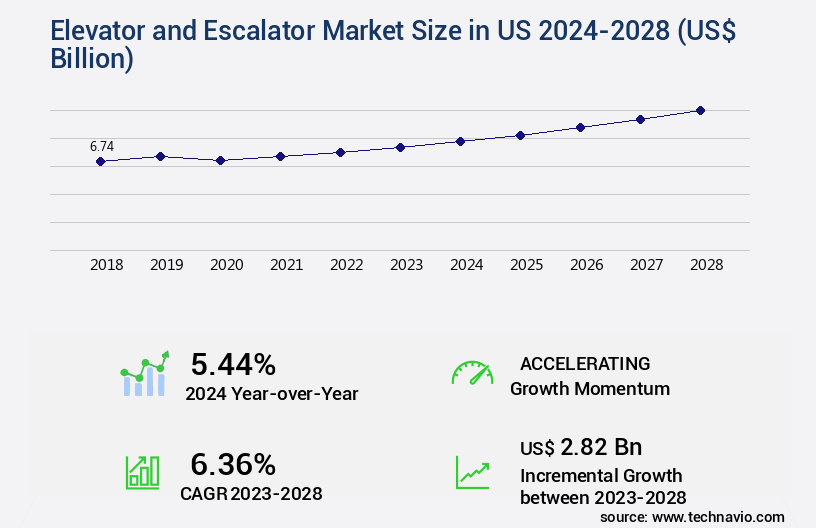
Elevator and Escalator Market in US Size

Get Key Insights on Market Forecast (PDF) Request Free Sample

How is the Elevator and Escalator in US Market Segmented and what are the key trends of market segmentation?

The elevator and escalator in US industry research report provides comprehensive data (region-wise segment analysis), with forecasts and estimates in "USD billion" for the period 2024-2028, as well as historical data from 2018-2022 for the following segments.

  • Product
    • Elevators
    • Escalators
  • Service
    • New installations
    • Maintenance
    • Modernization
  • Application
    • Commercial
    • Residential
    • Industrial
  • Geography
    • North America
      • US

By Product Insights

The elevators segment is estimated to witness significant growth during the forecast period.

The Elevator and Escalator Market in the US is characterized by continuous evolution and ongoing activities. New installations, including units and services, account for a significant portion of revenue generation. In low-rise buildings below 35 meters, hydraulic elevator systems are prevalent due to their cost-effectiveness for maintenance. Mid-size buildings, between 35 and 100 meters, utilize both Machine Room Less (MRL) and traction elevator technologies. Traction elevators are favored for their superior performance, while MRL elevators are preferred in space-constrained environments. High-rise buildings, over 100 meters, primarily employ gearless traction elevators for their fast speeds and are often skyscrapers that implement destination dispatch technologies.

Modernization projects, including elevator inspection, capacity upgrades, component replacement, and automation, are essential for maintaining elevator reliability and safety. Key aspects of modernization include elevator control systems, emergency stops, escalator speed, step chains, and escalator drive systems. Elevator efficiency, passenger capacity, and accessibility are also crucial considerations, with safety features and handrail systems ensuring user experience and compliance with safety codes. Regular maintenance, including inspections and preventative measures, are essential for ensuring escalator and elevator functionality and longevity.
Elevator and Escalator Market in US Size

Request Free Sample

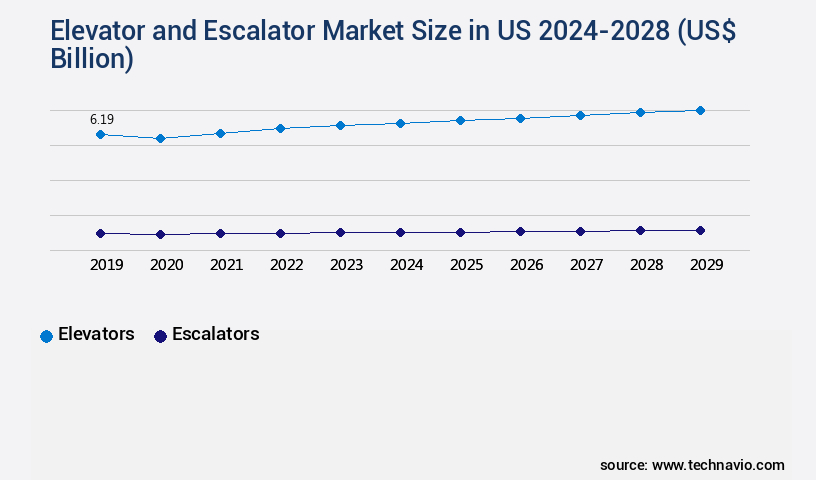
The Elevators segment was valued at USD 5.90 billion in 2018 and showed a gradual increase during the forecast period.
Elevator and Escalator Market in US Size

Request Free Sample

Market Dynamics

Our researchers analyzed the data with 2023 as the base year, along with the key drivers, trends, and challenges. A holistic analysis of drivers will help companies refine their marketing strategies to gain a competitive advantage.

The elevator and escalator market in the US is a significant sector within the building infrastructure industry, encompassing various aspects such as elevator hoistway construction requirements, escalator handrail drive system maintenance, and elevator control system programming techniques. This market is characterized by a constant focus on ensuring safety, efficiency, and reliability, with escalator safety audit procedures compliance and elevator emergency power backup systems being crucial elements. Elevator modernization plays a pivotal role in enhancing building efficiency, with escalator passenger flow optimization strategies and elevator preventative maintenance schedules being essential components. Escalator component failure analysis and escalator step replacement processes are integral parts of the maintenance regimen, while elevator door closing mechanisms and handrail tension adjustment ensure smooth operation.

Elevator system diagnostics and escalator step material testing enable early identification and resolution of potential issues, contributing to the overall market growth. Elevator capacity planning and escalator energy-saving technologies are key trends, with more than 60% of new installations incorporating energy-efficient features. The market landscape is competitive, with a minority of players accounting for a significant share, particularly in the high-end elevator and escalator system upgrades segment. The escalator industry witnesses a high number of component replacement projects, with elevator traction machine replacement being a common requirement. In comparison to escalators, elevator modernization projects account for a larger market share, with an estimated 65% of the total projects in the US involving elevator upgrades. This trend is driven by the growing demand for energy efficiency, improved safety features, and enhanced passenger experience.
Elevator and Escalator Market in US Size

What are the key market drivers leading to the rise in the adoption of Elevator and Escalator in US Industry?

  • The escalating demand for elevators and escalators, driven by demographic shifts, serves as the primary market growth catalyst. 
  • Urbanization, a significant global trend, is fueling the demand for elevators and escalators in the US market. The shift towards urban living, with Millennials leading the charge, is driving the need for advanced infrastructure in urban areas. According to the US Census Bureau, the urbanization rate was projected to be 0.96% between 2020 and 2025. By 2023, approximately 83.3% of the US urban population resided in urban areas.
  • As urban populations expand, there is a pressing need to enhance infrastructure to accommodate the growing population. This demand for improved infrastructure is expected to propel the growth of the elevators and escalators market in the US throughout the forecast period.

What are the market trends shaping the Elevator and Escalator in US Industry?

  • The rise of smart elevators represents a significant market trend in the building industry. Advanced technologies, such as automation and artificial intelligence, are increasingly being integrated into elevator systems to enhance efficiency and user experience.
  • Elevators and escalators in the US are increasingly being integrated with cognitive analytics, transforming their roles beyond mere transportation. These smart systems enable real-time monitoring of elevator and escalator performance across various locations. Sensors are utilized to collect data on these machines' operational efficiency, identifying potential issues before they escalate and minimizing downtime. End-users can harness this data to personalize user experiences and optimize maintenance schedules.
  • By predicting technical issues in real-time, businesses can proactively address maintenance needs and enhance overall operational efficiency. This data-driven approach to elevator and escalator management offers significant benefits, ensuring seamless transportation and improved productivity in various sectors.

What challenges does the Elevator and Escalator in US Industry face during its growth?

  • The fragile US construction market poses a significant challenge to the industry's growth trajectory. 
  • The US elevator and escalator market is significantly influenced by the construction sector, particularly in the development of high-rise buildings and commercial complexes. This market's dynamics, however, are subject to various factors, including economic fluctuations, regulatory changes, and natural disasters. For instance, the economic downturns, such as the one experienced in 2008, led to a decrease in new construction projects and subsequently affected the demand for elevators and escalators. Conversely, the adoption of advanced technologies, like energy-efficient systems and smart building integration, has driven growth in the sector.
  • In 2022, the US experienced substantial damage from natural disasters, with Hurricane Ian and the Western and Central Drought/Heat Wave causing approximately 73.0% and 13.5% of the total damage, respectively. These events underscore the importance of resilient infrastructure, further emphasizing the role of elevators and escalators in ensuring accessibility and safety in buildings.

Exclusive Customer Landscape

The US elevator and escalator market forecasting report includes the adoption lifecycle of the market, covering from the innovator's stage to the laggard's stage. It focuses on adoption rates in different regions based on penetration. Furthermore, the US elevator and escalator market report also includes key purchase criteria and drivers of price sensitivity to help companies evaluate and develop their market growth analysis strategies.
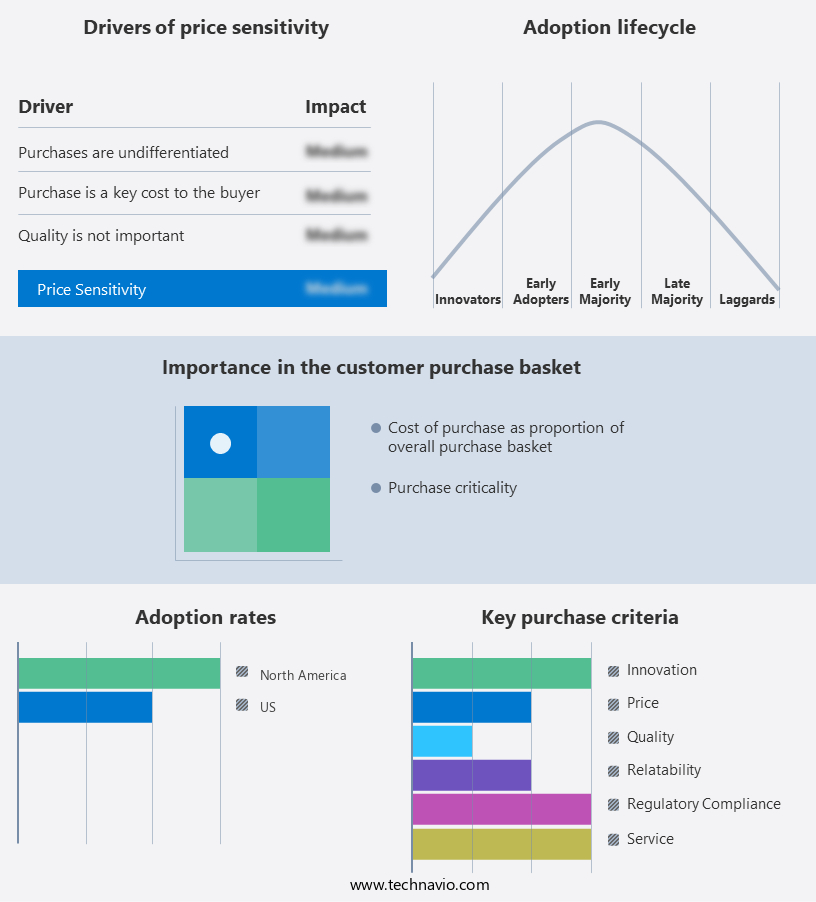
Elevator and Escalator Market in US Share by Geography

 Customer Landscape of Elevator and Escalator in US Industry

Competitive Landscape & Market Insights

Companies are implementing various strategies, such as strategic alliances, US elevator and escalator market forecast, partnerships, mergers and acquisitions, geographical expansion, and product/service launches, to enhance their presence in the industry.

AVT Beckett - This company specializes in the production and supply of various elevator models, including Low MRL, Mid MRL, and Mid rise elevators. These elevators cater to diverse building requirements, ensuring efficient vertical transportation solutions. With a focus on innovation and quality, the company's offerings prioritize energy efficiency, safety, and user experience.

The industry research and growth report includes detailed analyses of the competitive landscape of the market and information about key companies, including:

  • AVT Beckett
  • Colley Elevator Co.
  • Delfar Elevator Co Ltd
  • Delta Electronics Inc.
  • Doppelmayr Seilbahnen GmbH
  • Fuji Electric Co. Ltd.
  • Fujitec Co. Ltd.
  • Hitachi Ltd.
  • Hyundai Elevator Co. Ltd.
  • K. A. Schmersal Holding GmbH and Co. KG
  • KONE Corp.
  • Mitsubishi Electric Corp.
  • Otis Worldwide Corp.
  • Prysmian Spa
  • Savaria Corp.
  • Schindler Holding Ltd.
  • thyssenkrupp AG
  • Toshiba Corp.
  • Weidmuller Interface GmbH and Co. KG
  • WITTUR HOLDING GmbH

Qualitative and quantitative analysis of companies has been conducted to help clients understand the wider business environment as well as the strengths and weaknesses of key industry players. Data is qualitatively analyzed to categorize companies as pure play, category-focused, industry-focused, and diversified; it is quantitatively analyzed to categorize companies as dominant, leading, strong, tentative, and weak.

Recent Development and News in Elevator And Escalator Market In US

  • In January 2024, ThyssenKrupp AG, a leading elevator and escalator manufacturer, announced the launch of its new MULTI elevator system in the US market. This innovative product offers customizable, flexible, and energy-efficient vertical transportation solutions (ThyssenKrupp AG press release, January 10, 2024).
  • In March 2024, Otis Worldwide Corporation, another major player in the industry, entered into a strategic partnership with Microsoft to digitize and modernize its elevator and escalator maintenance services using Microsoft Azure and IoT technologies (Otis Worldwide Corporation press release, March 15, 2024).
  • In May 2024, KONE Corporation, a global leader in the elevator and escalator industry, completed the acquisition of Interserv, a US-based service provider, to expand its maintenance and modernization services in the North American market (KONE Corporation press release, May 3, 2024).
  • In January 2025, the US Department of Energy announced new regulations requiring all new commercial buildings to install energy-efficient elevators and escalators, starting from 2027 (US Department of Energy press release, January 12, 2025). This regulatory change is expected to drive significant demand for energy-efficient solutions in the US elevator and escalator market.

Dive into Technavio's robust research methodology, blending expert interviews, extensive data synthesis, and validated models for unparalleled US Elevator and Escalator Market insights. See full methodology.

Market Scope

Report Coverage

Details

Page number

155

Base year

2023

Historic period

2018-2022

Forecast period

2024-2028

Growth momentum & CAGR

Accelerate at a CAGR of 6.36%

Market growth 2024-2028

USD 2.82 billion

Market structure

Fragmented

YoY growth 2023-2024(%)

5.44

Key countries

US and North America

Competitive landscape

Leading Companies, Market Positioning of Companies, Competitive Strategies, and Industry Risks

Request Free Sample

Research Analyst Overview

  • In the dynamic and evolving elevator and escalator market in the US, various components and systems continue to gain significance. One notable area of focus is escalator monitoring systems, which utilize advanced sensors and analytics to optimize performance and enhance safety. These systems can provide real-time data on escalator speed, passenger capacity, and energy efficiency, among other metrics. Another area of interest is elevator door mechanisms, which have seen improvements in safety and efficiency through the adoption of automatic sliding doors and destination dispatch systems. Elevator control systems have also undergone modernization, with the integration of automation and artificial intelligence for optimized traffic flow and reduced wait times.
  • Escalator energy efficiency is a critical concern, with drive systems and step chains being key areas of innovation. Elevator modernization projects often involve the replacement of hydraulic systems with more energy-efficient alternatives, such as machine room-less elevators. Elevator capacity and efficiency have also been enhanced through the use of hoisting systems and traction designs. Elevator inspection and maintenance are essential for ensuring reliability and safety. Modernization costs can be offset by the long-term savings from improved efficiency and reduced maintenance requirements. Elevator emergency stops and safety features, such as handrail systems and braking systems, have seen significant advancements to minimize accidents and enhance passenger experience.
  • Elevator dispatch algorithms and preventative maintenance strategies have become essential for optimizing elevator traffic flow and minimizing downtime. Component replacement and refurbishment are also common practices in the industry, ensuring that aging infrastructure remains functional and compliant with safety codes. Overall, the elevator and escalator market in the US continues to evolve, with a focus on energy efficiency, safety, and passenger experience. Innovations in escalator monitoring systems, elevator control systems, and elevator door mechanisms are driving growth and shaping the future of this dynamic industry.

What are the Key Data Covered in this US Elevator and Escalator Market Research and Growth Report?

  • What is the expected growth of the US Elevator and Escalator Market between 2024 and 2028?

    • USD 2.82 billion, at a CAGR of 6.36%

  • What segmentation does the market report cover?

    • The report segmented by Product (Elevators and Escalators), Service (New installations, Maintenance, and Modernization), Application (Commercial, Residential, and Industrial), and Geography (North America)

  • Which regions are analyzed in the report?

    • US

  • What are the key growth drivers and market challenges?

    • Increasing demand for elevators and escalators due to changing demographics, Fragile US construction market

  • Who are the major players in the Elevator and Escalator Market in US?

    • Key Companies AVT Beckett, Colley Elevator Co., Delfar Elevator Co Ltd, Delta Electronics Inc., Doppelmayr Seilbahnen GmbH, Fuji Electric Co. Ltd., Fujitec Co. Ltd., Hitachi Ltd., Hyundai Elevator Co. Ltd., K. A. Schmersal Holding GmbH and Co. KG, KONE Corp., Mitsubishi Electric Corp., Otis Worldwide Corp., Prysmian Spa, Savaria Corp., Schindler Holding Ltd., thyssenkrupp AG, Toshiba Corp., Weidmuller Interface GmbH and Co. KG, and WITTUR HOLDING GmbH

Market Research Insights

  • The elevator and escalator market in the US is a dynamic and complex industry, characterized by continuous innovation and strict regulatory compliance. With over 900,000 elevators and 35,000 escalators in operation, these vertical transportation systems facilitate daily commuting and commercial activities in various sectors. Elevator modernization is a significant trend, with approximately 30,000 units undergoing upgrades each year. Elevator weight capacity ranges from 1,500 to 100,000 pounds, while escalator step height typically varies between 4 and 8 inches. Safety compliance with building codes is paramount, with regular inspections ensuring adherence to regulations. Elevator speed regulation is crucial for efficient traffic energy management, with speeds ranging from 0.15 to 30 miles per hour.
  • Elevator rope lifespan can reach up to 20 years, while escalator repair costs can range from USD1,000 to USD10,000 per incident, depending on the issue. Elevator motor efficiency and passenger comfort are essential performance metrics, driving the demand for energy-efficient technologies and advanced control systems.

We can help! Our analysts can customize this US elevator and escalator market research report to meet your requirements.

Get in touch

1 Executive Summary

  • 1.1 Market overview
    • Exhibit 01: Executive Summary – Chart on Market Overview
    • Exhibit 02: Executive Summary – Data Table on Market Overview
    • Exhibit 03: Executive Summary – Chart on Country Market Characteristics
    • Exhibit 04: Executive Summary – Chart on Market Segmentation by Product
    • Exhibit 05: Executive Summary – Chart on Market Segmentation by Service
    • Exhibit 06: Executive Summary – Chart on Market Segmentation by Application
    • Exhibit 07: Executive Summary – Chart on Vendor Market Positioning

2 Market Landscape

  • 2.1 Market ecosystem
    • Exhibit 08: Parent market
    • Exhibit 09: Market Characteristics

3 Market Sizing

  • 3.1 Market definition
    • Exhibit 10: Offerings of vendors included in the market definition
  • 3.2 Market segment analysis
    • Exhibit 11: Market segments
  • 3.3 Market size 2023
    • 3.4 Market outlook: Forecast for 2023-2028
      • Exhibit 12: Chart on US - Market size and forecast 2023-2028 ($ billion)
      • Exhibit 13: Data Table on US - Market size and forecast 2023-2028 ($ billion)
      • Exhibit 14: Chart on US: Year-over-year growth 2023-2028 (%)
      • Exhibit 15: Data Table on US: Year-over-year growth 2023-2028 (%)

    4 Historic Market Size

    • 4.1 Elevator and escalator market in US 2018 - 2022
      • Exhibit 16: Historic Market Size – Data Table on elevator and escalator market in US 2018 - 2022 ($ billion)
    • 4.2 Product Segment Analysis 2018 - 2022
      • Exhibit 17: Historic Market Size – Product Segment 2018 - 2022 ($ billion)
    • 4.3 Service Segment Analysis 2018 - 2022
      • Exhibit 18: Historic Market Size – Service Segment 2018 - 2022 ($ billion)
    • 4.4 Application Segment Analysis 2018 - 2022
      • Exhibit 19: Historic Market Size – Application Segment 2018 - 2022 ($ billion)

    5 Five Forces Analysis

    • 5.1 Five forces summary
      • Exhibit 20: Five forces analysis - Comparison between 2023 and 2028
    • 5.2 Bargaining power of buyers
      • Exhibit 21: Chart on Bargaining power of buyers – Impact of key factors 2023 and 2028
    • 5.3 Bargaining power of suppliers
      • Exhibit 22: Bargaining power of suppliers – Impact of key factors in 2023 and 2028
    • 5.4 Threat of new entrants
      • Exhibit 23: Threat of new entrants – Impact of key factors in 2023 and 2028
    • 5.5 Threat of substitutes
      • Exhibit 24: Threat of substitutes – Impact of key factors in 2023 and 2028
    • 5.6 Threat of rivalry
      • Exhibit 25: Threat of rivalry – Impact of key factors in 2023 and 2028
    • 5.7 Market condition
      • Exhibit 26: Chart on Market condition - Five forces 2023 and 2028

    6 Market Segmentation by Product

    • 6.1 Market segments
      • Exhibit 27: Chart on Product - Market share 2023-2028 (%)
      • Exhibit 28: Data Table on Product - Market share 2023-2028 (%)
    • 6.2 Comparison by Product
      • Exhibit 29: Chart on Comparison by Product
      • Exhibit 30: Data Table on Comparison by Product
    • 6.3 Elevators - Market size and forecast 2023-2028
      • Exhibit 31: Chart on Elevators - Market size and forecast 2023-2028 ($ billion)
      • Exhibit 32: Data Table on Elevators - Market size and forecast 2023-2028 ($ billion)
      • Exhibit 33: Chart on Elevators - Year-over-year growth 2023-2028 (%)
      • Exhibit 34: Data Table on Elevators - Year-over-year growth 2023-2028 (%)
    • 6.4 Escalators - Market size and forecast 2023-2028
      • Exhibit 35: Chart on Escalators - Market size and forecast 2023-2028 ($ billion)
      • Exhibit 36: Data Table on Escalators - Market size and forecast 2023-2028 ($ billion)
      • Exhibit 37: Chart on Escalators - Year-over-year growth 2023-2028 (%)
      • Exhibit 38: Data Table on Escalators - Year-over-year growth 2023-2028 (%)
    • 6.5 Market opportunity by Product
      • Exhibit 39: Market opportunity by Product ($ billion)
      • Exhibit 40: Data Table on Market opportunity by Product ($ billion)

    7 Market Segmentation by Service

    • 7.1 Market segments
      • Exhibit 41: Chart on Service - Market share 2023-2028 (%)
      • Exhibit 42: Data Table on Service - Market share 2023-2028 (%)
    • 7.2 Comparison by Service
      • Exhibit 43: Chart on Comparison by Service
      • Exhibit 44: Data Table on Comparison by Service
    • 7.3 New installations - Market size and forecast 2023-2028
      • Exhibit 45: Chart on New installations - Market size and forecast 2023-2028 ($ billion)
      • Exhibit 46: Data Table on New installations - Market size and forecast 2023-2028 ($ billion)
      • Exhibit 47: Chart on New installations - Year-over-year growth 2023-2028 (%)
      • Exhibit 48: Data Table on New installations - Year-over-year growth 2023-2028 (%)
    • 7.4 Maintenance - Market size and forecast 2023-2028
      • Exhibit 49: Chart on Maintenance - Market size and forecast 2023-2028 ($ billion)
      • Exhibit 50: Data Table on Maintenance - Market size and forecast 2023-2028 ($ billion)
      • Exhibit 51: Chart on Maintenance - Year-over-year growth 2023-2028 (%)
      • Exhibit 52: Data Table on Maintenance - Year-over-year growth 2023-2028 (%)
    • 7.5 Modernization - Market size and forecast 2023-2028
      • Exhibit 53: Chart on Modernization - Market size and forecast 2023-2028 ($ billion)
      • Exhibit 54: Data Table on Modernization - Market size and forecast 2023-2028 ($ billion)
      • Exhibit 55: Chart on Modernization - Year-over-year growth 2023-2028 (%)
      • Exhibit 56: Data Table on Modernization - Year-over-year growth 2023-2028 (%)
    • 7.6 Market opportunity by Service
      • Exhibit 57: Market opportunity by Service ($ billion)
      • Exhibit 58: Data Table on Market opportunity by Service ($ billion)

    8 Market Segmentation by Application

    • 8.1 Market segments
      • Exhibit 59: Chart on Application - Market share 2023-2028 (%)
      • Exhibit 60: Data Table on Application - Market share 2023-2028 (%)
    • 8.2 Comparison by Application
      • Exhibit 61: Chart on Comparison by Application
      • Exhibit 62: Data Table on Comparison by Application
    • 8.3 Commercial - Market size and forecast 2023-2028
      • Exhibit 63: Chart on Commercial - Market size and forecast 2023-2028 ($ billion)
      • Exhibit 64: Data Table on Commercial - Market size and forecast 2023-2028 ($ billion)
      • Exhibit 65: Chart on Commercial - Year-over-year growth 2023-2028 (%)
      • Exhibit 66: Data Table on Commercial - Year-over-year growth 2023-2028 (%)
    • 8.4 Residential - Market size and forecast 2023-2028
      • Exhibit 67: Chart on Residential - Market size and forecast 2023-2028 ($ billion)
      • Exhibit 68: Data Table on Residential - Market size and forecast 2023-2028 ($ billion)
      • Exhibit 69: Chart on Residential - Year-over-year growth 2023-2028 (%)
      • Exhibit 70: Data Table on Residential - Year-over-year growth 2023-2028 (%)
    • 8.5 Industrial - Market size and forecast 2023-2028
      • Exhibit 71: Chart on Industrial - Market size and forecast 2023-2028 ($ billion)
      • Exhibit 72: Data Table on Industrial - Market size and forecast 2023-2028 ($ billion)
      • Exhibit 73: Chart on Industrial - Year-over-year growth 2023-2028 (%)
      • Exhibit 74: Data Table on Industrial - Year-over-year growth 2023-2028 (%)
    • 8.6 Market opportunity by Application
      • Exhibit 75: Market opportunity by Application ($ billion)
      • Exhibit 76: Data Table on Market opportunity by Application ($ billion)

    9 Customer Landscape

    • 9.1 Customer landscape overview
      • Exhibit 77: Analysis of price sensitivity, lifecycle, customer purchase basket, adoption rates, and purchase criteria

    10 Drivers, Challenges, and Trends

    • 10.1 Market drivers
      • 10.2 Market challenges
        • 10.3 Impact of drivers and challenges
          • Exhibit 78: Impact of drivers and challenges in 2023 and 2028
        • 10.4 Market trends

          11 Vendor Landscape

          • 11.1 Overview
            • 11.2 Vendor landscape
              • Exhibit 79: Overview on Criticality of inputs and Factors of differentiation
            • 11.3 Landscape disruption
              • Exhibit 80: Overview on factors of disruption
            • 11.4 Industry risks
              • Exhibit 81: Impact of key risks on business

            12 Vendor Analysis

            • 12.1 Vendors covered
              • Exhibit 82: Vendors covered
            • 12.2 Market positioning of vendors
              • Exhibit 83: Matrix on vendor position and classification
            • 12.3 AVT Beckett
              • Exhibit 84: AVT Beckett - Overview
              • Exhibit 85: AVT Beckett - Product / Service
              • Exhibit 86: AVT Beckett - Key offerings
            • 12.4 Colley Elevator Co.
              • Exhibit 87: Colley Elevator Co. - Overview
              • Exhibit 88: Colley Elevator Co. - Product / Service
              • Exhibit 89: Colley Elevator Co. - Key offerings
            • 12.5 Delta Electronics Inc.
              • Exhibit 90: Delta Electronics Inc. - Overview
              • Exhibit 91: Delta Electronics Inc. - Business segments
              • Exhibit 92: Delta Electronics Inc. - Key offerings
              • Exhibit 93: Delta Electronics Inc. - Segment focus
            • 12.6 Fujitec Co. Ltd.
              • Exhibit 94: Fujitec Co. Ltd. - Overview
              • Exhibit 95: Fujitec Co. Ltd. - Business segments
              • Exhibit 96: Fujitec Co. Ltd. - Key offerings
              • Exhibit 97: Fujitec Co. Ltd. - Segment focus
            • 12.7 Hitachi Ltd.
              • Exhibit 98: Hitachi Ltd. - Overview
              • Exhibit 99: Hitachi Ltd. - Business segments
              • Exhibit 100: Hitachi Ltd. - Key news
              • Exhibit 101: Hitachi Ltd. - Key offerings
              • Exhibit 102: Hitachi Ltd. - Segment focus
            • 12.8 Hyundai Elevator Co. Ltd.
              • Exhibit 103: Hyundai Elevator Co. Ltd. - Overview
              • Exhibit 104: Hyundai Elevator Co. Ltd. - Product / Service
              • Exhibit 105: Hyundai Elevator Co. Ltd. - Key offerings
            • 12.9 KONE Corp.
              • Exhibit 106: KONE Corp. - Overview
              • Exhibit 107: KONE Corp. - Product / Service
              • Exhibit 108: KONE Corp. - Key news
              • Exhibit 109: KONE Corp. - Key offerings
            • 12.10 Mitsubishi Electric Corp.
              • Exhibit 110: Mitsubishi Electric Corp. - Overview
              • Exhibit 111: Mitsubishi Electric Corp. - Business segments
              • Exhibit 112: Mitsubishi Electric Corp. - Key news
              • Exhibit 113: Mitsubishi Electric Corp. - Key offerings
              • Exhibit 114: Mitsubishi Electric Corp. - Segment focus
            • 12.11 Otis Worldwide Corp.
              • Exhibit 115: Otis Worldwide Corp. - Overview
              • Exhibit 116: Otis Worldwide Corp. - Business segments
              • Exhibit 117: Otis Worldwide Corp. - Key news
              • Exhibit 118: Otis Worldwide Corp. - Key offerings
              • Exhibit 119: Otis Worldwide Corp. - Segment focus
            • 12.12 Prysmian Spa
              • Exhibit 120: Prysmian Spa - Overview
              • Exhibit 121: Prysmian Spa - Business segments
              • Exhibit 122: Prysmian Spa - Key offerings
              • Exhibit 123: Prysmian Spa - Segment focus
            • 12.13 Savaria Corp.
              • Exhibit 124: Savaria Corp. - Overview
              • Exhibit 125: Savaria Corp. - Business segments
              • Exhibit 126: Savaria Corp. - Key offerings
              • Exhibit 127: Savaria Corp. - Segment focus
            • 12.14 Schindler Holding Ltd.
              • Exhibit 128: Schindler Holding Ltd. - Overview
              • Exhibit 129: Schindler Holding Ltd. - Product / Service
              • Exhibit 130: Schindler Holding Ltd. - Key news
              • Exhibit 131: Schindler Holding Ltd. - Key offerings
            • 12.15 thyssenkrupp AG
              • Exhibit 132: thyssenkrupp AG - Overview
              • Exhibit 133: thyssenkrupp AG - Business segments
              • Exhibit 134: thyssenkrupp AG - Key offerings
              • Exhibit 135: thyssenkrupp AG - Segment focus
            • 12.16 Toshiba Corp.
              • Exhibit 136: Toshiba Corp. - Overview
              • Exhibit 137: Toshiba Corp. - Business segments
              • Exhibit 138: Toshiba Corp. - Key news
              • Exhibit 139: Toshiba Corp. - Key offerings
              • Exhibit 140: Toshiba Corp. - Segment focus
            • 12.17 Weidmuller Interface GmbH and Co. KG
              • Exhibit 141: Weidmuller Interface GmbH and Co. KG - Overview
              • Exhibit 142: Weidmuller Interface GmbH and Co. KG - Product / Service
              • Exhibit 143: Weidmuller Interface GmbH and Co. KG - Key offerings

            13 Appendix

            • 13.1 Scope of the report
              • 13.2 Inclusions and exclusions checklist
                • Exhibit 144: Inclusions checklist
                • Exhibit 145: Exclusions checklist
              • 13.3 Currency conversion rates for US$
                • Exhibit 146: Currency conversion rates for US$
              • 13.4 Research methodology
                • Exhibit 147: Research methodology
                • Exhibit 148: Validation techniques employed for market sizing
                • Exhibit 149: Information sources
              • 13.5 List of abbreviations
                • Exhibit 150: List of abbreviations

              Research Methodology

              Technavio presents a detailed picture of the market by way of study, synthesis, and summation of data from multiple sources. The analysts have presented the various facets of the market with a particular focus on identifying the key industry influencers. The data thus presented is comprehensive, reliable, and the result of extensive research, both primary and secondary.

              INFORMATION SOURCES

              Primary sources

              • Manufacturers and suppliers
              • Channel partners
              • Industry experts
              • Strategic decision makers

              Secondary sources

              • Industry journals and periodicals
              • Government data
              • Financial reports of key industry players
              • Historical data
              • Press releases

              DATA ANALYSIS

              Data Synthesis

              • Collation of data
              • Estimation of key figures
              • Analysis of derived insights

              Data Validation

              • Triangulation with data models
              • Reference against proprietary databases
              • Corroboration with industry experts

              REPORT WRITING

              Qualitative

              • Market drivers
              • Market challenges
              • Market trends
              • Five forces analysis

              Quantitative

              • Market size and forecast
              • Market segmentation
              • Geographical insights
              • Competitive landscape

              Interested in this report?

              Get your sample now to see our research methodology and insights!

              Download Now

              Frequently Asked Questions

              Elevator and Escalatorin US market growth will increase by $ 2.82 bn during 2024-2028 .

              The Elevator and Escalatorin US market is expected to grow at a CAGR of 6.36% during 2024-2028 .

              Elevator and Escalatorin US market is segmented by Product( Elevators, Escalators) Service( New installations, Maintenance, Modernization, Algeria, APAC) Application( Commercial, Residential, Industrial, Algeria, APAC)

              AVT Beckett, Colley Elevator Co., Delfar Elevator Co Ltd, Delta Electronics Inc., Doppelmayr Seilbahnen GmbH, Fuji Electric Co. Ltd., Fujitec Co. Ltd., Hitachi Ltd., Hyundai Elevator Co. Ltd., K. A. Schmersal Holding GmbH and Co. KG, KONE Corp., Mitsubishi Electric Corp., Otis Worldwide Corp., Prysmian Spa, Savaria Corp., Schindler Holding Ltd., thyssenkrupp AG, Toshiba Corp., Weidmuller Interface GmbH and Co. KG, WITTUR HOLDING GmbH are a few of the key vendors in the Elevator and Escalatorin US market.

              North America will register the highest growth rate of 100% among the other regions. Therefore, the Elevator and Escalatorin US market in North America is expected to garner significant business opportunities for the vendors during the forecast period.

              US, North America

              • Increasing demand for elevators and escalators due to changing demographicsRapid urbanization Urbanization is one of the key drivers pushing new sales of elevators and escalators is the driving factor this market.
              • as modern urban infrastructure requires the extensive use of elevators and escalators. The key driver of urbanization is the ever-changing lifestyle of the people is the driving factor this market.
              • as many Millennials are moving to urban centers in search of better opportunities. The rate of urbanization in the US was estimated to be 0.96% during 2020-2025 and in 2023 is the driving factor this market.
              • 83.3% of the total urban population in the US lived in urban areas. As the total population in urban centers grows is the driving factor this market.
              • the infrastructure should improve to handle the needs of the additional population is the driving factor this market.
              • which is the driving factor this market.
              • in turn is the driving factor this market.
              • will boost the growth of the elevators and escalators market in US during the forecast period. Rising geriatric population The US will encounter significant growth in its geriatric population or those over the age of 65 years. It is anticipated that the country will see an approximately 4% increase in the population belonging to the age group of over 65 years. Older people often require a vertical transportation system for mobility. According to the 2021 American Community Survey is the driving factor this market.
              • there were 55 is the driving factor this market.
              • 892 is the driving factor this market.
              • 014 people aged 65 years and older living in the US is the driving factor this market.
              • accounting for 16.8% of the overall population of 331 is the driving factor this market.
              • 893 is the driving factor this market.
              • 745 in the country. Hence is the driving factor this market.
              • the expanding geriatric population will drive the growth of the elevator and escalator market in US during the forecast period. Increasing number of skyscrapers The increasing demand for luxury living from wealthy foreigners and the increasing inclination of young couples and retired people to live in apartments and skip homeownership have spurred the market demand for skyscrapers. At present is the driving factor this market.
              • New York alone has 238 skyscrapers is the driving factor this market.
              • and it is considered to have the second-highest number of skyscrapers worldwide after Hong Kong. Thus is the driving factor this market.
              • the increasing demand for elevators and escalators due to changing demographics like rapid urbanization and the rising geriatric population is the driving factor this market.
              • which are leading to a rise in the number of skyscrapers is the driving factor this market.
              • will drive the growth of the elevator and escalator market in US during the forecast period. is the driving factor this market.

              The Elevator and Escalatorin US market vendors should focus on grabbing business opportunities from the Elevators segment as it accounted for the largest market share in the base year.
