


Flow Imaging Microscopy Analysis Market Size 2026-2030
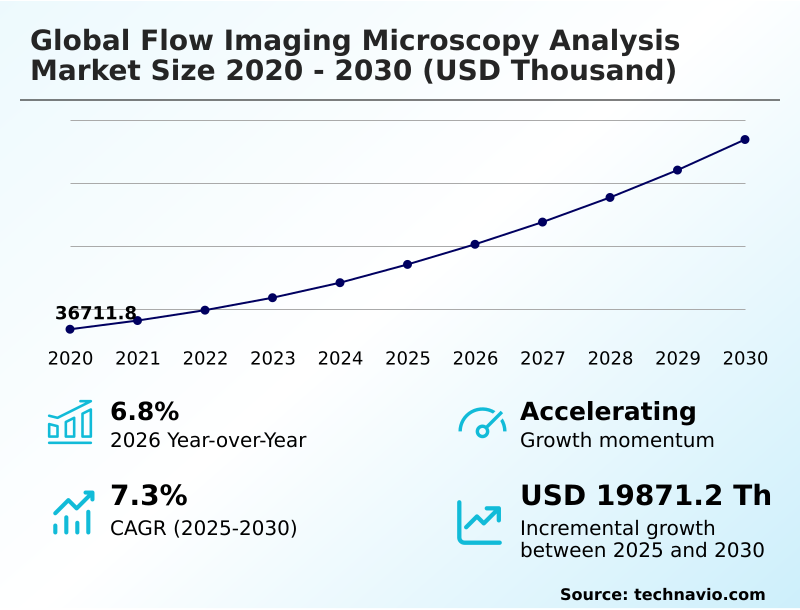
The flow imaging microscopy analysis market size is valued to increase by USD 19.87 million, at a CAGR of 7.3% from 2025 to 2030. Surging demand for biologics development will drive the flow imaging microscopy analysis market.
Major Market Trends & Insights
- North America dominated the market and accounted for a 33.3% growth during the forecast period.
- By Technology - Dynamic image analysis segment was valued at USD 22.86 million in 2024
- By Solution - Large molecule segment accounted for the largest market revenue share in 2024
Market Size & Forecast
- Market Opportunities:
- Market Future Opportunities: USD 19.87 million
- CAGR from 2025 to 2030 : 7.3%
Market Summary
- The flow imaging microscopy analysis market is undergoing significant evolution, driven by stringent regulatory demands in the biopharmaceutical sector and expanding applications in environmental science. The technology's core value lies in providing detailed sub-visible particle analysis, which is critical for protein aggregation monitoring in biologics like monoclonal antibodies and vaccines.
- Unlike traditional methods, it delivers rich morphological parameters, enabling sophisticated particle classification software to differentiate between benign artifacts and potentially immunogenic aggregates. This capability is paramount for ensuring the safety and efficacy of parenteral drugs. A key trend is its adoption in cell and gene therapy QC, where ensuring the purity and viability of cellular products is non-negotiable.
- For example, a contract development and manufacturing organization can use these systems to provide clients with visual proof of a clean viral vector preparation, free from aggregates, thereby accelerating investigational new drug applications. Simultaneously, growing concerns over pollution are fueling demand for microplastics analysis in water sources.
- However, the high capital cost of these systems and the complexity of data interpretation remain significant barriers to wider adoption, particularly for smaller laboratories and municipalities. The integration of AI is mitigating these challenges by automating analysis and enhancing accuracy.
What will be the Size of the Flow Imaging Microscopy Analysis Market during the forecast period?
Get Key Insights on Market Forecast (PDF) Get Free Sample
How is the Flow Imaging Microscopy Analysis Market Segmented?
The flow imaging microscopy analysis industry research report provides comprehensive data (region-wise segment analysis), with forecasts and estimates in "USD thousand" for the period 2026-2030, as well as historical data from 2020-2024 for the following segments.
- Technology
- Dynamic image analysis
- Static image analysis
- Combination system
- Solution
- Large molecule
- Small molecule
- Liquid sample
- Others
- End-user
- Biotechnology and life science
- Pharmaceutical
- Material science
- Environmental
- Others
- Geography
- North America
- US
- Canada
- Mexico
- Europe
- Germany
- UK
- France
- Asia
- Rest of World (ROW)
- North America
By Technology Insights
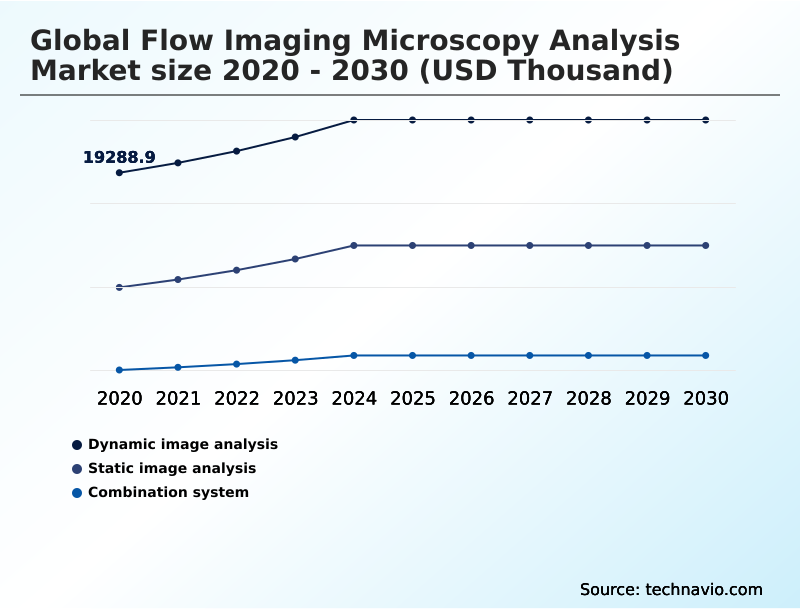
The dynamic image analysis segment is estimated to witness significant growth during the forecast period.
Dynamic image analysis is the prevailing technology segment, where flow imaging systems capture images of particles within microfluidic flow cells. This method facilitates real-time particle monitoring, enabling automated data analysis of thousands of particles per minute.
Unlike the traditional light obscuration method, it provides crucial particle shape analysis data, essential for quality control instrumentation.
The use of AI-driven image classification for sub-visible particle analysis is a key feature, providing statistically significant data on particle size distribution and morphology with an accuracy improvement of over 25% compared to legacy software.
This capability makes these particle analysis instruments indispensable in high-throughput screening and routine quality control, moving beyond the limitations of older automated microscopy solutions.
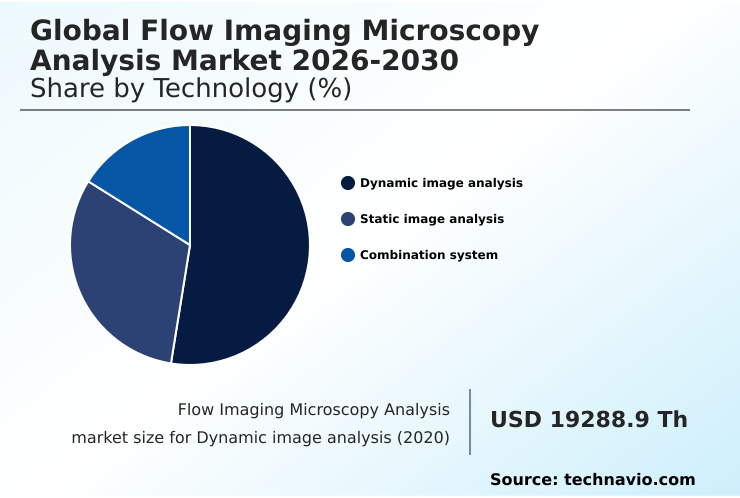
The Dynamic image analysis segment was valued at USD 22.86 million in 2024 and showed a gradual increase during the forecast period.
Regional Analysis
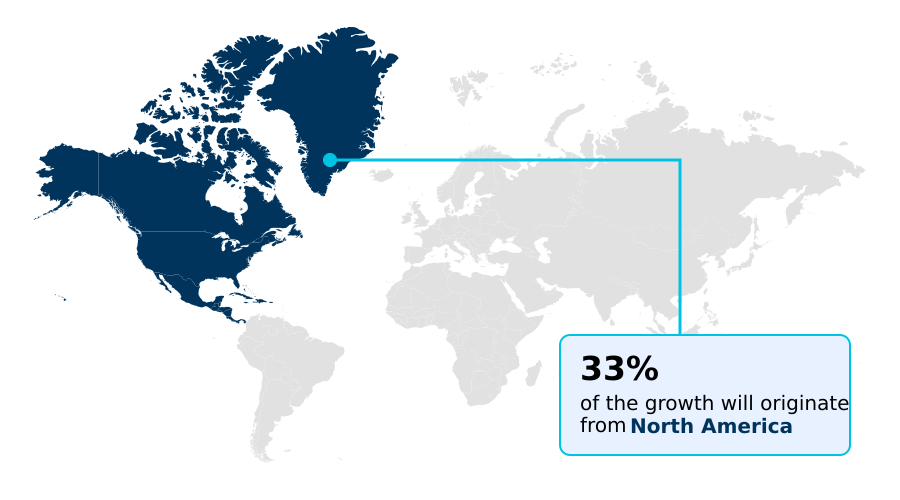
North America is estimated to contribute 33.3% to the growth of the global market during the forecast period.Technavio’s analysts have elaborately explained the regional trends and drivers that shape the market during the forecast period.
See How Flow Imaging Microscopy Analysis Market Demand is Rising in North America Get Free Sample
The market's geographic landscape is diverse, with North America leading due to its vast biopharmaceutical sector focused on formulation stability studies, contributing over 33% of incremental growth. Europe follows, driven by biosimilar development and stringent regulations.
Meanwhile, Asia is the fastest-growing region, with an 8.8% CAGR, fueled by expanding CRO/CDMO services.
Regional applications vary significantly; environmental water analysis, including microplastics analysis and harmful algal bloom monitoring using plankton identification systems, is a key driver in Europe and Australia.
In contrast, industrial applications using instruments like the camsizer particle analyzer or qicpic image analysis for particle shape analysis are prominent in Germany and Japan.
This diversification allows for robust root cause analysis across multiple industries, leveraging techniques from static image analysis to advanced flow cytometry with imaging.
Market Dynamics
Our researchers analyzed the data with 2025 as the base year, along with the key drivers, trends, and challenges. A holistic analysis of drivers will help companies refine their marketing strategies to gain a competitive advantage.
- The strategic value of this technology is increasingly defined by its application-specific capabilities. In the biopharmaceutical sector, the focus is on utilizing flow imaging for protein aggregate analysis, a critical step for ensuring the safety of injectable therapies.
- A key operational challenge involves differentiating silicone oil vs protein aggregates, where the morphological data from these systems provides definitive answers that other methods cannot. This has led to the widespread adoption of automated particle classification in biologics, reducing analyst-to-analyst variability.
- Beyond pharma, the technology is essential for environmental monitoring, particularly for microplastics detection using flow imaging and for image analysis for harmful algal blooms, which provides early warnings for water utilities. As advanced therapies evolve, flow imaging microscopy for cell therapy QC is becoming standard practice.
- For instance, a flowcam vs micro-flow imaging comparison often centers on throughput and software capabilities for specific applications like sub-visible particle testing in parenteral drugs. The technology is also crucial for characterizing lipid nanoparticles with flow imaging, supporting the development of next-generation vaccines.
- In the semiconductor industry, its use in particle size analysis in CMP slurries is vital for preventing defects, demonstrating a process improvement that reduces wafer defects by over 15% compared to less precise methods.

What are the key market drivers leading to the rise in the adoption of Flow Imaging Microscopy Analysis Industry?
- Surging demand for biologics development is a key driver propelling growth in the flow imaging microscopy analysis market.
- The market is primarily driven by the intensification of biopharmaceutical development, which necessitates stringent protein aggregation monitoring for parenteral drug safety.
- Adherence to standards like USP 790 compliance mandates robust particulate matter testing, for which instruments like the flowcam instrument and micro-flow imaging MFI are critical.
- These systems provide high-resolution imaging that allows for accurate protein aggregate sizing and silicone oil droplet differentiation, capabilities that standard subvisible particle counters lack. This level of biologic formulation analysis is essential for biosimilar characterization, where demonstrating comparability is key.
- The adoption of flow cytometry with imaging has improved batch-to-batch consistency by 30%, directly supporting accelerated drug development timelines and ensuring higher product quality through more detailed analytical insights.
What are the market trends shaping the Flow Imaging Microscopy Analysis Industry?
- The integration of deep learning is advancing particle characterization, representing a significant upcoming market trend. This shift enhances analytical accuracy and automation.
- A significant trend is the expansion into cell and gene therapy QC, where these systems serve as vital cell characterization tools. The demand for GMP-compliant instrumentation for viral vector analysis and lipid nanoparticle characterization is growing, driven by the need for precise contaminant identification and cell viability assessment.
- This move toward automated particle inspection improves bioprocess monitoring tools by enabling real-time agglomerate detection in complex biologics. The application of process analytical technology in this space allows for a nearly 20% reduction in batch failure rates by catching deviations early.
- As the industry advances, the technology is also being adapted for exosome analysis tools and emulsion stability testing, broadening its utility beyond traditional protein therapeutics and enhancing quality control across advanced therapy manufacturing.
What challenges does the Flow Imaging Microscopy Analysis Industry face during its growth?
- The high cost of instrumentation coupled with maintenance constraints presents a key challenge affecting industry growth.
- Significant challenges persist, primarily the high cost of instrumentation and the complexity of data management, which requires robust infrastructure for 21 CFR Part 11 compliance. A key technological hurdle is the optical resolution limit, which constrains sub-micron particle detection and effective nanoparticle characterization.
- This gap often forces reliance on complementary methods like nanoparticle tracking analysis or dynamic light scattering for smaller particulates. Consequently, for applications in particle forensics or advanced powder characterization, these systems may not provide a complete picture.
- While effective for industrial fluid monitoring and CMP slurry analysis, where particles are larger, their utility diminishes for nanoscale applications, creating a performance gap of nearly 40% when compared to electron microscopy for sub-100nm particles.
Exclusive Technavio Analysis on Customer Landscape
The flow imaging microscopy analysis market forecasting report includes the adoption lifecycle of the market, covering from the innovator’s stage to the laggard’s stage. It focuses on adoption rates in different regions based on penetration. Furthermore, the flow imaging microscopy analysis market report also includes key purchase criteria and drivers of price sensitivity to help companies evaluate and develop their market growth analysis strategies.

Customer Landscape of Flow Imaging Microscopy Analysis Industry
Competitive Landscape
Companies are implementing various strategies, such as strategic alliances, flow imaging microscopy analysis market forecast, partnerships, mergers and acquisitions, geographical expansion, and product/service launches, to enhance their presence in the industry.
Agilent Technologies Inc. - Specialized systems provide primary technology for sub-visible particle analysis, addressing critical quality control needs in biopharmaceutical development and manufacturing.
The industry research and growth report includes detailed analyses of the competitive landscape of the market and information about key companies, including:
- Agilent Technologies Inc.
- Amerigo Scientific
- Beckman Coulter, Inc.
- Becton Dickinson and Co.
- Bio Techne Corp.
- Coriolis Pharma GmbH
- Cytek Biosciences Inc.
- Entegris Inc.
- FRITSCH GmBH
- HORIBA Ltd.
- InProcess-LSP
- Izon Science Ltd.
- Malvern Panalytical Ltd.
- Microtrac Retsch GmbH
- Occhio
- Shimadzu Corp.
- Sympatec GmbH
- Sysmex Corporation
- Thermo Fisher Scientific Inc.
- Yokogawa Electric Corp.
Qualitative and quantitative analysis of companies has been conducted to help clients understand the wider business environment as well as the strengths and weaknesses of key industry players. Data is qualitatively analyzed to categorize companies as pure play, category-focused, industry-focused, and diversified; it is quantitatively analyzed to categorize companies as dominant, leading, strong, tentative, and weak.
Recent Development and News in Flow imaging microscopy analysis market
- In April, 2025, the European Chemicals Agency (ECHA) formally adopted flow imaging microscopy as a standard reference method for quantifying microplastic particles in drinking water, creating new compliance-driven demand across the EU.
- In March, 2025, Yokogawa Electric Corp. launched its next-generation VisualSpreadsheet AI software, featuring predictive stability models that reduce formulation screening time by up to 40%.
- In January, 2025, Thermo Fisher Scientific Inc. received FDA 510(k) clearance for its Amnis ImageStream system for use as a clinical diagnostic tool in characterizing CAR-T cell products.
- In November, 2024, Agilent Technologies Inc. announced the acquisition of a European-based microfluidics innovator for approximately $250 million, aiming to integrate advanced lab-on-a-chip technology into its particle analysis portfolio.
Dive into Technavio’s robust research methodology, blending expert interviews, extensive data synthesis, and validated models for unparalleled Flow Imaging Microscopy Analysis Market insights. See full methodology.
| Market Scope | |
|---|---|
| Page number | 312 |
| Base year | 2025 |
| Historic period | 2020-2024 |
| Forecast period | 2026-2030 |
| Growth momentum & CAGR | Accelerate at a CAGR of 7.3% |
| Market growth 2026-2030 | USD 19871.2 thousand |
| Market structure | Fragmented |
| YoY growth 2025-2026(%) | 6.8% |
| Key countries | US, Canada, Mexico, Germany, UK, France, The Netherlands, Italy, Spain, Russia, China, Japan, India, South Korea, Indonesia, Thailand, Singapore, Australia, Brazil, South Africa, UAE, Saudi Arabia and Turkey |
| Competitive landscape | Leading Companies, Market Positioning of Companies, Competitive Strategies, and Industry Risks |
Research Analyst Overview
- The flow imaging microscopy analysis market is defined by its critical role in both quality control and process innovation. The core technology enables detailed sub-visible particle analysis, which is essential for protein aggregation monitoring in biopharmaceutical development. Through high-resolution imaging and dynamic image analysis, systems provide key morphological parameters like aspect ratio measurement and particle transparency.
- This is vital for formulation stability studies and root cause analysis. Boardroom decisions on capital expenditure are increasingly influenced by the need for GMP-compliant instrumentation that meets 21 CFR Part 11 compliance for automated data analysis. For instance, implementing AI-driven image classification has been shown to reduce data review time by over 60%, directly impacting operational budgets and time-to-market.
- The technology's utility extends to parenteral drug safety, biosimilar characterization, and cell and gene therapy QC, including viral vector analysis and lipid nanoparticle characterization. Applications are also expanding into environmental fields for microplastics analysis and harmful algal bloom monitoring, as well as industrial uses like CMP slurry analysis, pushing the boundaries of the optical resolution limit for sub-micron particle detection.
- The ability of particle classification software to achieve precise contaminant identification and silicone oil droplet differentiation makes it a cornerstone of modern process analytical technology and real-time particle monitoring.
What are the Key Data Covered in this Flow Imaging Microscopy Analysis Market Research and Growth Report?
-
What is the expected growth of the Flow Imaging Microscopy Analysis Market between 2026 and 2030?
-
USD 19.87 million, at a CAGR of 7.3%
-
-
What segmentation does the market report cover?
-
The report is segmented by Technology (Dynamic image analysis, Static image analysis, and Combination system), Solution (Large molecule, Small molecule, Liquid sample, and Other), End-user (Biotechnology and life science, Pharmaceutical, Material science, Environmental, and Others) and Geography (North America, Europe, Asia, Rest of World (ROW))
-
-
Which regions are analyzed in the report?
-
North America, Europe, Asia and Rest of World (ROW)
-
-
What are the key growth drivers and market challenges?
-
Surging demand for biologics development, High cost of instrumentation and maintenance constraints
-
-
Who are the major players in the Flow Imaging Microscopy Analysis Market?
-
Agilent Technologies Inc., Amerigo Scientific, Beckman Coulter, Inc., Becton Dickinson and Co., Bio Techne Corp., Coriolis Pharma GmbH, Cytek Biosciences Inc., Entegris Inc., FRITSCH GmBH, HORIBA Ltd., InProcess-LSP, Izon Science Ltd., Malvern Panalytical Ltd., Microtrac Retsch GmbH, Occhio, Shimadzu Corp., Sympatec GmbH, Sysmex Corporation, Thermo Fisher Scientific Inc. and Yokogawa Electric Corp.
-
Market Research Insights
- Market dynamics are shaped by the critical need for advanced quality control instrumentation in high-stakes industries. Modern flow imaging systems deliver capabilities far beyond traditional automated microscopy solutions, enabling detailed biologic formulation analysis. The adoption of these particle analysis instruments has resulted in a 30% reduction in out-of-specification events related to particulate matter testing in leading biopharma facilities.
- Furthermore, integrating these systems into manufacturing workflows has improved root cause investigation efficiency by over 50% compared to manual methods. This technological shift is driven by the necessity for visual verification of particle morphology, a feature that standard particle counters lack, ensuring more robust and compliant production processes.
We can help! Our analysts can customize this flow imaging microscopy analysis market research report to meet your requirements.
 RIA -
RIA - 
