
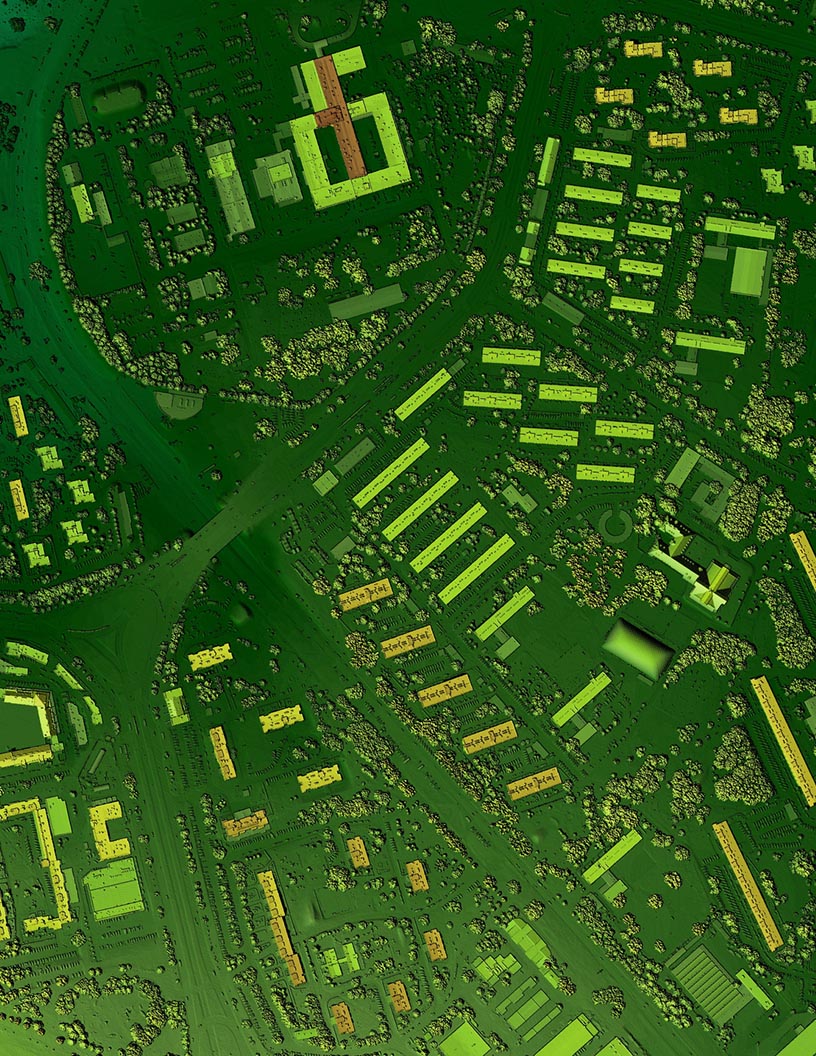


Geographic Information System Analytics Market Size 2024-2028
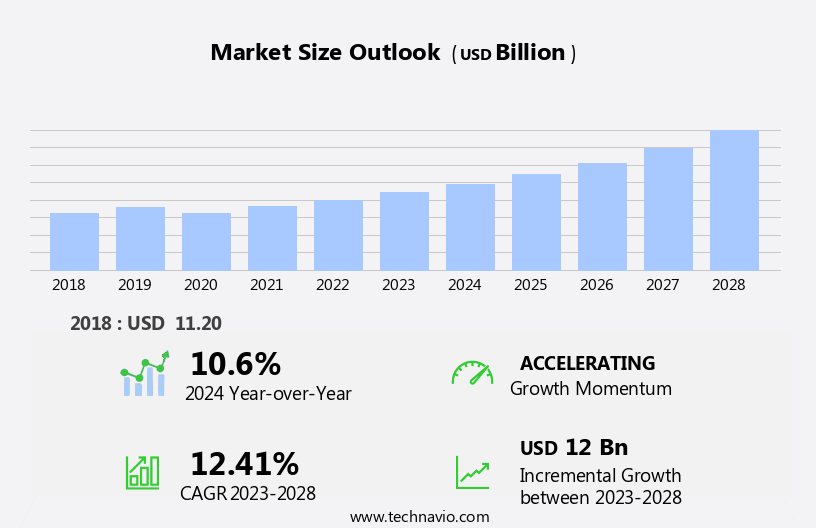
The geographic information system analytics market size is forecast to increase by USD 12 billion at a CAGR of 12.41% between 2023 and 2028.
- The GIS Analytics Market analysis is experiencing significant growth, driven by the increasing need for efficient land management and emerging methods in data collection and generation. The defense industry's reliance on geospatial technology for situational awareness and real-time location monitoring is a major factor fueling market expansion. Additionally, the oil and gas industry's adoption of GIS for resource exploration and management is a key trend. Building Information Modeling (BIM) and smart city initiatives are also contributing to market growth, as they require multiple layered maps for effective planning and implementation. The Internet of Things (IoT) and Software as a Service (SaaS) are transforming GIS analytics by enabling real-time data processing and analysis.
- Augmented reality is another emerging trend, as it enhances the user experience and provides valuable insights through visual overlays. Overall, heavy investments are required for setting up GIS stations and accessing data sources, making this a promising market for technology innovators and investors alike.
What will be the Size of the GIS Analytics Market during the forecast period?
- The geographic information system analytics market encompasses various industries, including government sectors, agriculture, and infrastructure development. Smart city projects, building information modeling, and infrastructure development are key areas driving market growth. Spatial data plays a crucial role in sectors such as transportation, mining, and oil and gas. Cloud technology is transforming GIS analytics by enabling real-time data access and analysis. Startups are disrupting traditional GIS markets with innovative location-based services and smart city planning solutions. Infrastructure development in sectors like construction and green buildings relies on modern GIS solutions for efficient planning and management. Smart utilities and telematics navigation are also leveraging GIS analytics for improved operational efficiency.
- GIS technology is essential for zoning and land use management, enabling data-driven decision-making. Smart public works and urban planning projects utilize mapping and geospatial technology for effective implementation. Surveying is another sector that benefits from advanced GIS solutions. Overall, the GIS analytics market is evolving, with a focus on providing actionable insights to businesses and organizations.
How is this Geographic Information System Analytics Industry segmented?
The geographic information system analytics industry research report provides comprehensive data (region-wise segment analysis), with forecasts and estimates in "USD billion" for the period 2024-2028, as well as historical data from 2018-2022 for the following segments.
- End-user
- Retail and Real Estate
- Government
- Utilities
- Telecom
- Manufacturing and Automotive
- Agriculture
- Construction
- Mining
- Transportation
- Healthcare
- Defense and Intelligence
- Energy
- Education and Research
- BFSI
- Components
- Software
- Services
- Deployment Modes
- On-Premises
- Cloud-Based
- Applications
- Urban and Regional Planning
- Disaster Management
- Environmental Monitoring Asset Management
- Surveying and Mapping
- Location-Based Services
- Geospatial Business Intelligence
- Natural Resource Management
- Geography
- North America
- US
- Canada
- Europe
- France
- Germany
- UK
- APAC
- China
- India
- South Korea
- Middle East and Africa
- UAE
- South America
- Brazil
- Rest of World
- North America
By End-user Insights
The retail and real estate segment is estimated to witness significant growth during the forecast period.
The GIS analytics market analysis is witnessing significant growth due to the increasing demand for advanced technologies in various industries. In the retail sector, for instance, retailers are utilizing GIS analytics to gain a competitive edge by analyzing customer demographics and buying patterns through real-time location monitoring and multiple layered maps. The retail industry's success relies heavily on these insights for effective marketing strategies. Moreover, the defense industries are integrating GIS analytics into their operations for infrastructure development, permitting, and public safety. Building Information Modeling (BIM) and 4D GIS software are increasingly being adopted for construction project workflows, while urban planning and designing require geospatial data for smart city planning and site selection.
The oil and gas industry is leveraging satellite imaging and IoT devices for land acquisition and mining operations. In the public sector, government agencies are using GIS analytics for zoning, land use management, and smart public works. Utilities and green buildings are employing GIS analytics for smart city projects, energy management, and customer engagement. Startups and digital reality solutions providers are entering the market with innovative offerings, such as augmented reality platforms and connected data environments. These solutions enable visualizing complex data and improving project management and engineering workflows. The geospatial industry's growth is driven by the increasing demand for spatial data licensing and mapping solutions.
Cloud technology and artificial intelligence are also playing a crucial role in modern GIS solutions, offering scalability, accessibility, and advanced analytics capabilities. The GIS analytics market is experiencing substantial growth due to its applications in various industries, including retail, defense, construction, oil and gas, public sector, and utilities. The integration of advanced technologies, such as IoT devices, satellite imaging, and artificial intelligence, is fueling innovation and enhancing the market's potential.
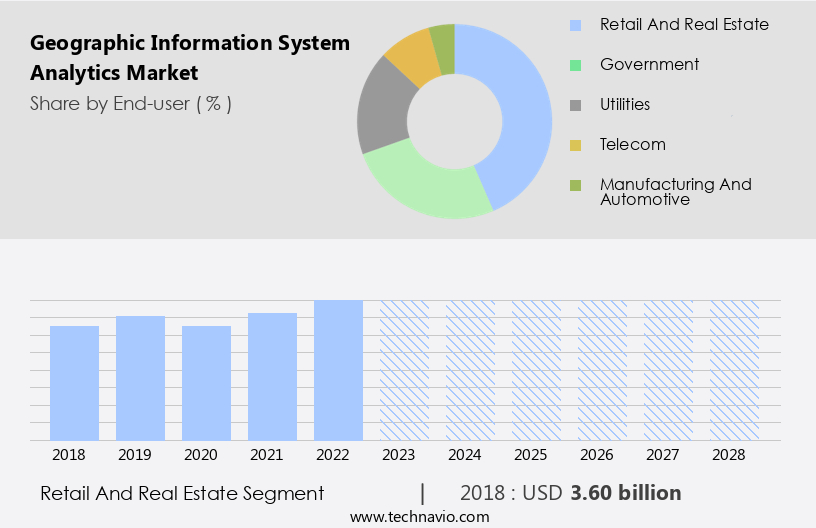
Get a glance at the market report of share of various segments Request Free Sample
The Retail and Real Estate segment was valued at USD 3.60 billion in 2018 and showed a gradual increase during the forecast period.
Regional Analysis
North America is estimated to contribute 38% to the growth of the global market during the forecast period.Technavio's analysts have elaborately explained the regional trends and drivers that shape the market during the forecast period.
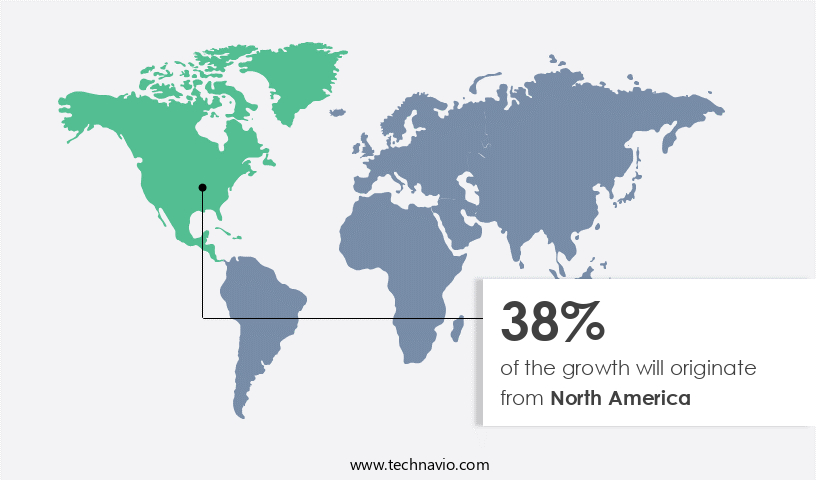
For more insights on the market size of various regions, Request Free Sample
The North American market holds a prominent position in the Geographic Information System (GIS) analytics industry, driven by the region's early adoption of GIS technologies and advanced economies leading in data generation and consumption. The expanding transportation sector in North America necessitates a high level of analytics, thereby fueling the growth of the GIS market. In addition, various industries such as defense, infrastructure development, public safety, and urban planning are increasingly utilizing GIS analytics for permitting, zoning, aerial photography, and land use management. Geospatial technology, including Building Information Modeling (BIM), 4D GIS software, and augmented reality platforms, is revolutionizing the construction industry, enabling efficient project management and visualizing complex data.
Startups and digital reality solutions are also disrupting the market with innovative offerings, integrating IoT devices, location-based services, remote sensors, and cloud technology to provide real-time insights. Moreover, the government sectors, oil and gas, utilities, agriculture, and mining industries are leveraging GIS analytics for various applications, such as site selection, smart city planning, and land acquisition. The integration of artificial intelligence, satellite imaging, and geospatial data licensing is further enhancing the capabilities of modern GIS solutions. The growth of the GIS analytics market is also influenced by the increasing focus on engineering, environmental, social, and governance (ESG) initiatives, smart city projects, and urban development programs.
Hexagon, Esri, and other key players are offering enterprise solutions, smart utilities, and connected data environments to cater to the evolving needs of various industries.
Market Dynamics
Our researchers analyzed the data with 2023 as the base year, along with the key drivers, trends, and challenges. A holistic analysis of drivers will help companies refine their marketing strategies to gain a competitive advantage.
What are the key market drivers leading to the rise in the adoption of Geographic Information System Analytics Industry?
- Need for efficient land management is the key driver of the market.
- Effective land management is essential for a country's development, especially with the increasing population and the complexity of community planning activities and rural and urban land management. Traditional systems for land management can lead to discrepancies between the latest survey results and outdated data held by governments, resulting in illegal practices such as land scams. Unauthorized occupation of unassessed land is becoming more prevalent, highlighting the need for efficient land management systems. Geographic Information System (GIS) analytics plays a crucial role in managing land information efficiently.
- It provides valuable data, including land registration details, vacant land areas, and information on mining activities. By utilizing GIS analytics, governments and organizations can ensure accurate and up-to-date land management, reducing the risk of illegal practices and ensuring transparency and accountability. GIS analytics is an essential tool for effective land management, providing valuable insights and data to support informed decision-making.
What are the market trends shaping the Geographic Information System Analytics Industry?
- Emerging methods in data collection and generation is the upcoming market trend.
- The Geographic Information System analytics market is experiencing significant advancements in data collection methods, leading to more efficient and detailed analytics. Two emerging technologies driving these developments are real-time spatiotemporal data and small satellites. Real-time spatiotemporal data, facilitated by real-time interactive GPS/GIS and mobile space-time capabilities, enables highly detailed, specific, and updated GIS features. The smallsat revolution, fueled by cost reductions from new technologies and business models, is positively impacting the remote sensing industry and GIS analytics.
- These developments contribute to the evolving landscape of GIS analytics, enhancing its capabilities and value for various industries.
What challenges does the Geographic Information System Analytics Industry face during its growth?
- Need for heavy investments for setting up GIS stations and accessing data sources is a key challenge affecting the industry growth.
- The Geographic Information System analytics market faces significant challenges due to the vast amount of data generated and the need for accurate, up-to-date information. companies invest heavily in hardware units such as data warehouses, spatial data centers, and geoportals, increasing financial burdens. Despite these investments, there is a risk of obtaining generalized, inaccurate, or outdated data during the analytics process. This necessitates expensive changes to input and field data collection. GIS analytics involves processing satellite images, topographic maps, and various geography-related data sources.
- The potential for misaligned client expectations and the complexity of handling large data volumes add to the market's challenges. As a professional assistant, it is crucial to recognize these obstacles and address them with effective strategies to ensure successful GIS analytics implementations.
Exclusive Customer Landscape
The geographic information system analytics market forecasting report includes the adoption lifecycle of the market, covering from the innovator's stage to the laggard's stage. It focuses on adoption rates in different regions based on penetration. Furthermore, the geographic information system analytics market report also includes key purchase criteria and drivers of price sensitivity to help companies evaluate and develop their market growth analysis strategies.
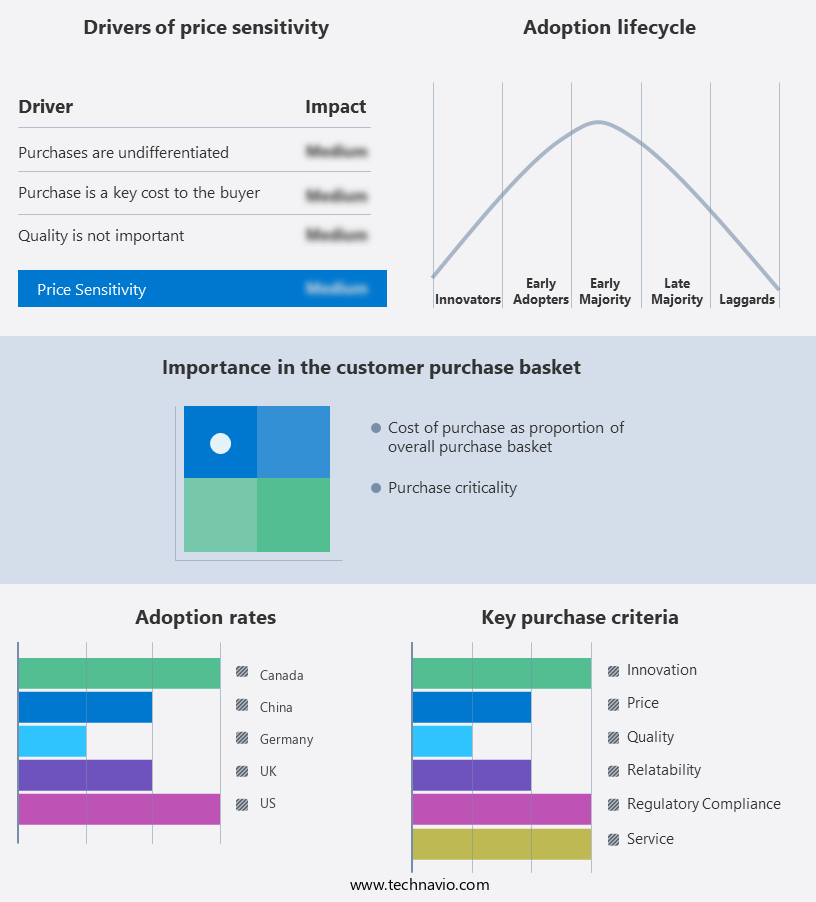
Customer Landscape
Key Companies & Market Insights
Companies are implementing various strategies, such as strategic alliances, geographic information system analytics market forecast, partnerships, mergers and acquisitions, geographical expansion, and product/service launches, to enhance their presence in the industry.
1Spatial Group Ltd - The GIS solution provider introduces OpenRoads Designer, an advanced detailed design application encompassing surveying, drainage, subsurface utilities, and roadway design. Superior to previous offerings like InRoads, GEOPAK, MX, and PowerCivil, OpenRoads Designer delivers unparalleled capabilities in a single platform. This comprehensive solution streamlines the design process, ensuring accuracy and efficiency.
The industry research and growth report includes detailed analyses of the competitive landscape of the market and information about key companies, including:
- 1Spatial Group Ltd
- Alteryx Inc.
- Autodesk Inc
- Bentley Systems Inc.
- Blackshark.ai GmbH
- Caliper Corp.
- Environics Analytics
- Esri Global Inc.
- General Electric Co.
- Hexagon AB
- Hi-target Navigation Tech Co. Ltd.
- International Business Machines Corp.
- Maxar Technologies Inc.
- OU Bamboo Group
- Pitney Bowes Inc.
- SuperMap Software Co. Ltd.
- The Sanborn Map Co. Inc.
- Topcon Positioning Systems Inc.
- Trimble Inc.
- Vista Equity Partners Management LLC
Qualitative and quantitative analysis of companies has been conducted to help clients understand the wider business environment as well as the strengths and weaknesses of key industry players. Data is qualitatively analyzed to categorize companies as pure play, category-focused, industry-focused, and diversified; it is quantitatively analyzed to categorize companies as dominant, leading, strong, tentative, and weak.
Research Analyst Overview
The geospatial industry continues to experience significant growth and innovation, driven by the increasing demand for advanced analytics and automation in various sectors. One of the key areas of focus is the integration of geographic information system (GIS) analytics in defense industries and infrastructure development. Defense organizations are leveraging GIS technology to enhance their operational capabilities, with applications ranging from situational awareness and asset management to mission planning and intelligence gathering. Building Information Modeling (BIM) and 4D GIS software are increasingly being adopted to streamline defense project workflows and improve collaboration between stakeholders. The adoption of geospatial technology is also gaining momentum in the construction sector, with startups and established players alike investing in digital reality solutions, IoT devices, and location-based services.
These technologies enable more efficient and accurate surveying, real-time monitoring of construction progress, and improved collaboration between stakeholders. Public safety and infrastructure development are other sectors that stand to benefit significantly from modern GIS solutions. Real-time data from sensors and other sources can be integrated into a connected data environment to enhance situational awareness and enable proactive response to emergencies. The oil and gas industry is another major adopter of geospatial technology, with applications ranging from site selection and permitting to pipeline monitoring and asset management. Satellite imaging and mapping are crucial for identifying potential drilling sites, assessing environmental risks, and monitoring production facilities.
In the government sector, GIS technology is being used to improve urban planning and management, with applications ranging from smart city projects and urban development programs to zoning and land use management. Geospatial data plays a critical role in informing decision-making processes and enabling more effective resource allocation. The geospatial industry is also witnessing significant innovation in areas such as augmented reality platforms, SAAS solutions, and artificial intelligence. These technologies enable more advanced analytics and visualization capabilities, enabling organizations to gain deeper insights from their geospatial data. Despite the numerous benefits of geospatial technology, there are also challenges that need to be addressed.
One of the key challenges is the availability and accessibility of high-quality geospatial data, particularly in developing countries and remote areas. Licensing and data privacy concerns are also becoming more prevalent, particularly in the context of increasing data sharing and collaboration. The geospatial industry is experiencing significant growth and innovation, driven by the increasing demand for advanced analytics and automation in various sectors. Geospatial technology is being adopted in defense industries, infrastructure development, public safety, urban planning, and the oil and gas industry, among others. However, there are also challenges that need to be addressed, particularly in the areas of data availability and accessibility, licensing, and data privacy.
Despite these challenges, the future of the geospatial industry looks bright, with significant opportunities for innovation and growth.
|
Market Scope |
|
|
Report Coverage |
Details |
|
Page number |
159 |
|
Base year |
2023 |
|
Historic period |
2018-2022 |
|
Forecast period |
2024-2028 |
|
Growth momentum & CAGR |
Accelerate at a CAGR of 12.41% |
|
Market growth 2024-2028 |
USD 12 billion |
|
Market structure |
Fragmented |
|
YoY growth 2023-2024(%) |
10.6 |
|
Key countries |
US, Canada, UK, Germany, China, India, France, South Korea, and Rest of World (ROW) |
|
Competitive landscape |
Leading Companies, Market Positioning of Companies, Competitive Strategies, and Industry Risks |
What are the Key Data Covered in this Geographic Information System Analytics Market Research and Growth Report?
- CAGR of the Geographic Information System Analytics industry during the forecast period
- Detailed information on factors that will drive the growth and forecasting between 2024 and 2028
- Precise estimation of the size of the market and its contribution of the industry in focus to the parent market
- Accurate predictions about upcoming growth and trends and changes in consumer behaviour
- Growth of the market across North America, Europe, APAC, Middle East and Africa, and South America
- Thorough analysis of the market's competitive landscape and detailed information about companies
- Comprehensive analysis of factors that will challenge the geographic information system analytics market growth of industry companies
We can help! Our analysts can customize this geographic information system analytics market research report to meet your requirements.
 RIA -
RIA - 
