


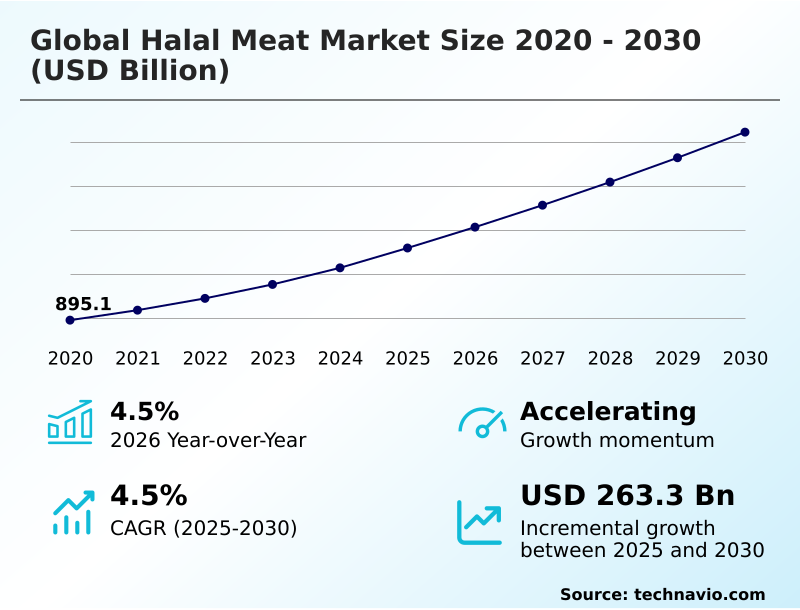
Halal Meat Market Size and Growth Forecast 2026-2030
The Halal Meat Market size was valued at USD 1059.1 billion in 2025 growing at a CAGR of 4.5% during the forecast period 2026-2030.
APAC accounts for 37.5% of incremental growth during the forecast period. The Poultry segment by Type was valued at USD 488.2 billion in 2024, while the Household consumption segment holds the largest revenue share by End-user.
The market is projected to grow by USD 427.3 billion from 2020 to 2030, with USD 263.3 billion of the growth expected during the forecast period of 2025 to 2030.
Get Key Insights on Market Forecast (PDF) Request Free Sample
Halal Meat Market Overview
The halal meat market is defined by rigorous adherence to sharia compliance, where the integrity of the supply chain is paramount. With a year-over-year growth of 4.5%, the industry is expanding beyond its traditional consumer base, driven by a perception of higher food safety protocols and ethical animal welfare standards. For instance, a large-scale beef processing facility supplying institutional catering services implements blockchain-based traceability technology to provide an immutable audit trail from farm to delivery, verifying the use of halal-certified ingredients and preventing cross-contamination. This level of transparency not only satisfies religious slaughter mandates but also appeals to a wider audience demanding verifiable food provenance. As the tayyiban principle, which encompasses wholesomeness, gains prominence, producers of processed meat products are integrating it into their quality management systems, aligning with frameworks like ISO 22000 to ensure comprehensive safety and quality from rendering process to final packaging.
Drivers, Trends, and Challenges in the Halal Meat Market
Operational decisions in the global halal meat market are increasingly influenced by the dual pressures of complex regulatory compliance and consumer demand for ethical transparency. Navigating halal meat import export regulations requires a sophisticated understanding of disparate certification standards, where a Zabiha halal vs standard halal designation can determine market access.
For instance, a European processing plant targeting the Middle Eastern market must align its dhabiha slaughter process requirements with both EU Regulation (EC) No 1099/2009 on the protection of animals at the time of killing and the specific stipulations of Gulf Accreditation Center (GAC) standards.
This necessitates significant capital investment in facility design to perfect the prevention of cross-contamination in meat processing. Firms are leveraging blockchain technology for halal traceability to provide an immutable record of the entire supply chain. This addresses key challenges in halal cold chain logistics management and simplifies halal audit trail requirements.
The operational costs of halal meat production are typically higher than conventional methods, a differential that procurement teams in halal tourism food supply chain and institutional catering halal meat procurement must factor into their budgeting.
The development of value-added halal meat product development, supported by innovations in halal meat packaging innovations, is a key strategy for offsetting these higher costs and improving margins.
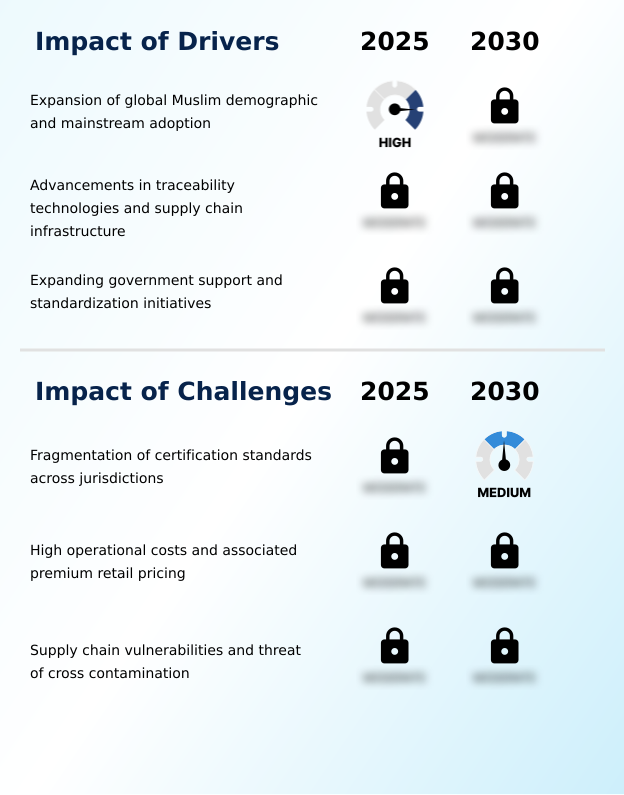
Primary Growth Driver: The market's primary driver is the dual force of an expanding global Muslim demographic and the increasing mainstream adoption of certified products by non-Muslim consumers.
The market's expansion is propelled by the growing Muslim consumer market and the mainstreaming of halal products among non-Muslims who associate them with higher quality and safety.
This dual-demand dynamic is amplified by advancements in halal supply chain management, where traceability technology like blockchain offers unprecedented transparency and halal verification.
Stakeholders are investing in dedicated cold chain logistics to ensure product integrity from farm to fork, which is crucial for both domestic distribution and halal meat export.
As governments and international bodies work toward standardizing regulations, it becomes easier for producers to achieve halal compliance across different regions, facilitating smoother global trade and reinforcing consumer trust in the halal food industry.
Emerging Market Trend: An escalating demand for value-added and ready-to-eat items marks a significant market trend. This shift is driven by consumer needs for convenience that align with strict dietary principles.
The market is shifting toward premium and convenience-oriented offerings, driven by consumer demand for products that align with both religious and modern lifestyle needs. This trend is materializing through the growing availability of value-added meat products, including pre-marinated cuts and gourmet sausages, which cater to time-constrained households.
Concurrently, there is a significant movement toward ethical and sustainable sourcing, with a rising preference for organic halal meat and grass-fed halal meat. This reflects a deeper interpretation of Islamic dietary laws, where the concept of 'tayyiban' (wholesomeness) extends to ethical animal treatment and environmental stewardship.
Halal food services, from fast-food chains to high-end restaurants, are incorporating these premium halal meat options to attract a more discerning clientele, fundamentally changing procurement strategies and menu development.
Key Industry Challenge: A key challenge limiting market growth is the fragmentation of certification standards, which creates complexity for producers operating across multiple jurisdictions.
Significant operational challenges stem from the lack of a single, universally accepted standard among global halal certification bodies, leading to increased costs and logistical hurdles. Producers often need multiple certifications for the same product to access different international markets, complicating halal compliance.
This fragmentation is particularly challenging when it comes to specific practices like dhabiha slaughter and the use of stunning methods, where interpretations of religious law vary. The necessity for strict cross-contamination prevention adds another layer of expense, requiring segregated production lines and dedicated equipment, which contributes to the premium pricing of non-stun slaughter products.
These high operational costs can limit market penetration in price-sensitive regions, acting as a constraint on widespread adoption and forcing companies to focus on niche, high-margin segments.
Explore Full Market Dynamics Analysis Request Free Sample
Halal Meat Market Segmentation
The halal meat industry research report provides comprehensive data including region-wise segment analysis, with forecasts and analysis for the period 2026-2030, as well as historical data from 2020-2024 for the following segments.
Type Segment Analysis
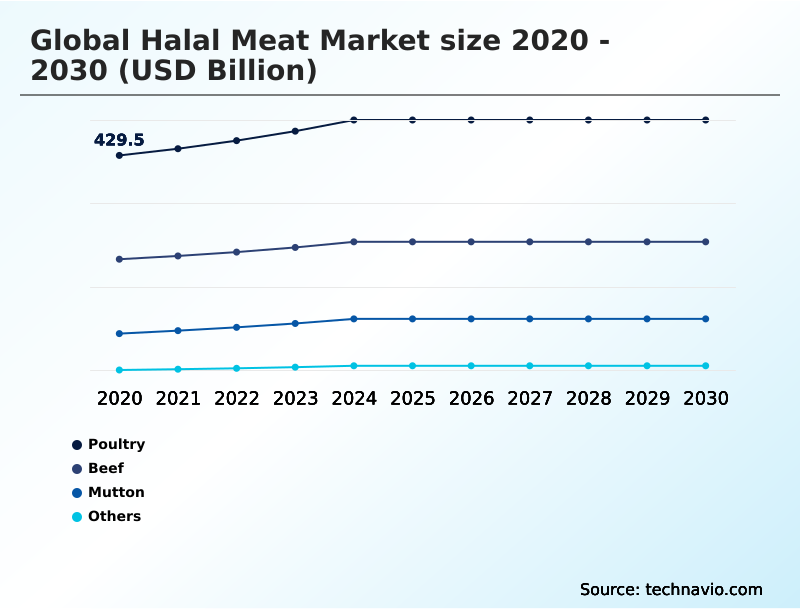
The poultry segment is estimated to witness significant growth during the forecast period.
The poultry segment, which accounts for over 48% of the total market, is driven by its widespread consumer acceptance and cost-effectiveness relative to red meats.
Demand is sustained by its central role in fast-food menus and household meals, necessitating high-volume production with strict adherence to Islamic dietary laws.
Advanced meat processing technology enables efficient carcass processing and deboning, ensuring a consistent supply of certified halal meat for both fresh retail and the manufacturing of processed meat products.
Producers are investing in facility upgrades to meet rigorous certification standards for both domestic consumption and export, ensuring that all products, from whole birds to value-added cuts, maintain supply chain integrity.
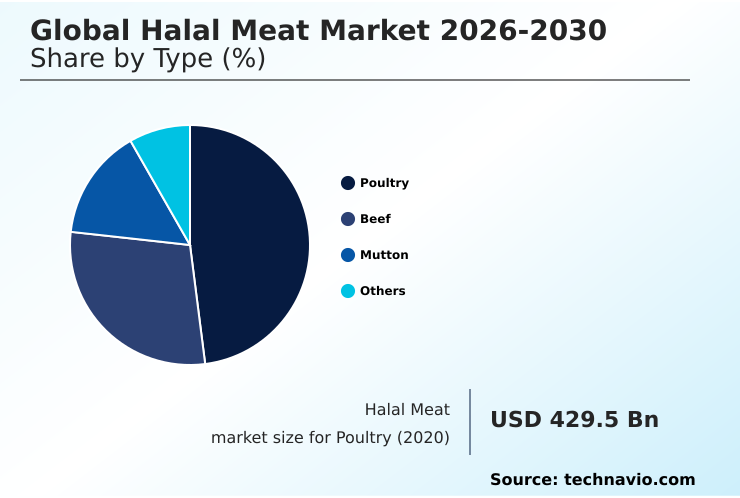
The Poultry segment was valued at USD 488.2 billion in 2024 and showed a gradual increase during the forecast period.
Halal Meat Market by Region: APAC Leads with 37.5% Growth Share
APAC is estimated to contribute 37.5% to the growth of the global market during the forecast period.
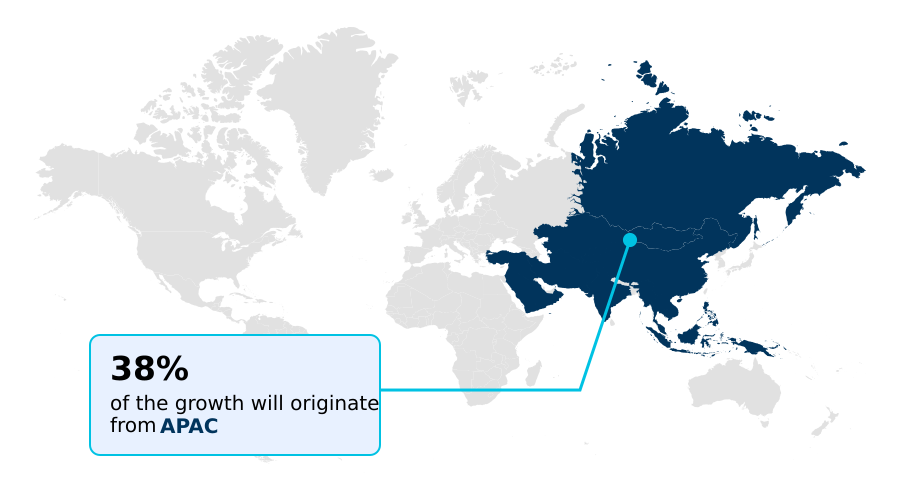
The geographic landscape is dominated by APAC, which contributes approximately 37% of the incremental growth, fueled by massive consumer populations in countries like Indonesia and robust halal meat export operations from Australia.
The Middle East and Africa follows, functioning as a critical import hub with uncompromising standards that dictate global production protocols. In these regions, maintaining supply chain integrity is a primary focus for securing trade agreements.
North America is emerging as a high-growth region, with its 5.6% CAGR driven not just by demographic shifts but also by mainstream consumer interest in premium halal meat and products perceived as healthier.
The global halal market relies on key production powerhouses in South America to meet this demand, creating a complex network of international trade where halal verification and adherence to import rules are paramount for market access.
Customer Landscape Analysis for the Halal Meat Market
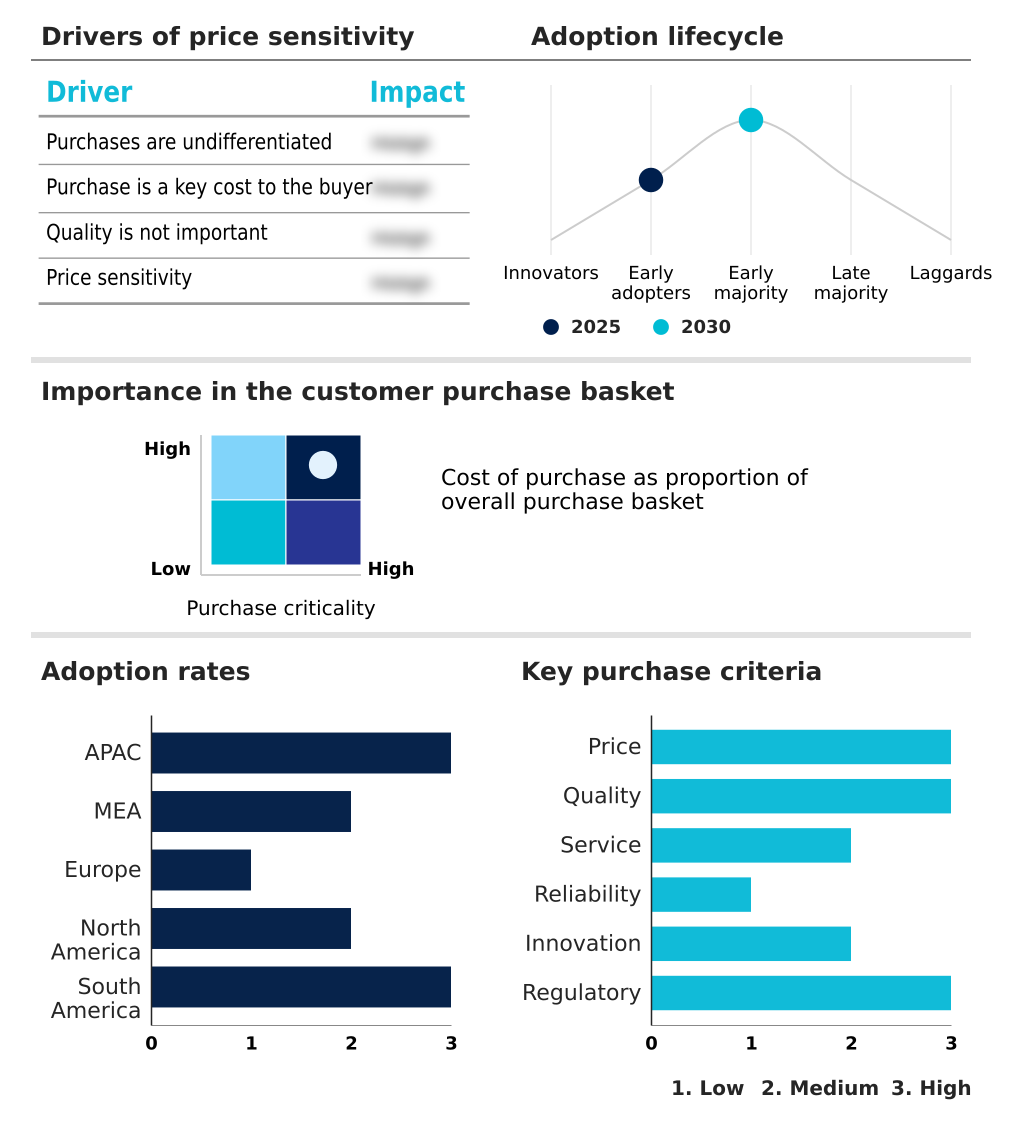
The halal meat market forecasting report includes the adoption lifecycle of the market, covering from the innovator’s stage to the laggard’s stage. It focuses on adoption rates in different regions based on penetration. Furthermore, the halal meat market report also includes key purchase criteria and drivers of price sensitivity to help companies evaluate and develop their market growth analysis strategies.
Competitive Landscape of the Halal Meat Market
Companies are implementing various strategies, such as strategic alliances, partnerships, mergers and acquisitions, geographical expansion, and product/service launches, to enhance their presence in the halal meat market industry.
Al Islami Foods - Operations are centered on the large-scale global export of certified poultry, serving as a primary supplier of compliant protein solutions to key Islamic markets.
The industry research and growth report includes detailed analyses of the competitive landscape of the market and information about key companies, including:
- Al Islami Foods
- Allanasons Pvt Ltd
- ALM Industries Ltd.
- Americana Foods Inc.
- BRF SA
- Cargill Inc.
- Charoen Pokphand Foods
- Crescent Foods
- Fletcher International Exports
- JBS S.A
- Leader Meat Packing Corp
- Mash Agro Foods Ltd
- Midamar Corp.
- Nema Food
- Ramly Food Processing
- Saffron Road
- Silver Fern Farms
- Tahira Foods Ltd.
- Tariq Halal Meats
- Thomas Foods International
Qualitative and quantitative analysis of companies has been conducted to help clients understand the wider business environment as well as the strengths and weaknesses of key industry players. Data is qualitatively analyzed to categorize companies as pure play, category-focused, industry-focused, and diversified; it is quantitatively analyzed to categorize companies as dominant, leading, strong, tentative, and weak.
Recent Developments in the Halal Meat Market
- In October 2024, Golden Acre Foods launched a new range of halal chilled meat products through Tesco, expanding its retail presence and strengthening its position in the UK halal food market.
- In November 2024, Kenya-based Quality Meat Packers (QMP), a privately owned and fully integrated frozen food company, undertook a significant international expansion, launching a new range of processed meat products targeting export markets in the Gulf region and the Democratic Republic of the Congo.
- In January 2025, Wholly Halal, a newly established Ontario-based food service provider, launched operations across the province, offering locally sourced, hand-slaughtered halal meats through direct-to-home delivery services.
- In April 2025, Ni Hsin Group entered into a heads of agreement (HOA) to acquire Hy-Fresh Group, a leading fully-integrated halal-certified poultry producer in Malaysia, to expand its food and beverage business.
Research Analyst Overview: Halal Meat Market
Boardroom-level strategy is increasingly focused on mitigating risks associated with supply chain integrity and fragmented certification. With APAC accounting for the largest share of consumption, securing access to this region requires flawless adherence to local halal certification bodies and Islamic dietary laws.
This involves more than just oversight of the dhabiha slaughter; it extends to the entire value chain, including the sourcing of halal-certified ingredients and the management of the rendering process.
For a multinational food company, a key decision involves standardizing food safety protocols across global facilities to meet a universal baseline that satisfies multiple jurisdictions, such as the Malaysian Standard MS 1500:2009. This move reduces compliance costs and streamlines the audit trail for products ranging from fresh cuts to processed meat products.
Investments in traceability technology and segregated cold chain logistics are no longer optional but essential for maintaining brand reputation and ensuring sharia compliance in a market where consumer trust is paramount.
Dive into Technavio’s robust research methodology, blending expert interviews, extensive data synthesis, and validated models for unparalleled Halal Meat Market insights. See full methodology.
| Market Scope | |
|---|---|
| Page number | 300 |
| Base year | 2025 |
| Historic period | 2020-2024 |
| Forecast period | 2026-2030 |
| Growth momentum & CAGR | Accelerate at a CAGR of 4.5% |
| Market growth 2026-2030 | USD 263.3 billion |
| Market structure | Fragmented |
| YoY growth 2025-2026(%) | 4.5% |
| Key countries | Indonesia, India, China, Australia, Japan, South Korea, Saudi Arabia, Turkey, UAE, South Africa, Israel, UK, France, Germany, Italy, Spain, The Netherlands, US, Canada, Mexico, Brazil, Argentina and Colombia |
| Competitive landscape | Leading Companies, Market Positioning of Companies, Competitive Strategies, and Industry Risks |
Halal Meat Market: Key Questions Answered in This Report
-
What is the expected growth of the Halal Meat Market between 2026 and 2030?
-
The Halal Meat Market is expected to grow by USD 263.3 billion during 2026-2030, registering a CAGR of 4.5%. Year-over-year growth in 2026 is estimated at 4.5%%. This acceleration is shaped by expansion of global muslim demographic and mainstream adoption, which is intensifying demand across multiple end-use verticals covered in the report.
-
-
What segmentation does the market report cover?
-
The report is segmented by Type (Poultry, Beef, Mutton, and Others), End-user (Household consumption, Food service industry, Hotels and restaurants, and Institutional buyers), Distribution Channel (Offline, and Online) and Geography (APAC, Middle East and Africa, Europe, North America, South America). Among these, the Poultry segment is estimated to witness significant growth during the forecast period, driven by rising adoption across key application areas. Each segment includes detailed qualitative and quantitative analysis, along with historical data from 2020-2024 and forecasts through 2030 with year-over-year growth rates.
-
-
Which regions are analyzed in the report?
-
The report covers APAC, Middle East and Africa, Europe, North America and South America. APAC is estimated to contribute 37.5% to market growth during the forecast period. Country-level analysis includes Indonesia, India, China, Australia, Japan, South Korea, Saudi Arabia, Turkey, UAE, South Africa, Israel, UK, France, Germany, Italy, Spain, The Netherlands, US, Canada, Mexico, Brazil, Argentina and Colombia, with dedicated market size tables and year-over-year growth for each.
-
-
What are the key growth drivers and market challenges?
-
The primary driver is expansion of global muslim demographic and mainstream adoption, which is accelerating investment and industry demand. The main challenge is fragmentation of certification standards across jurisdictions, creating operational barriers for key market participants. The report quantifies the impact of each driver and challenge across 2026 and 2030 with comparative analysis.
-
-
Who are the major players in the Halal Meat Market?
-
Key vendors include Al Islami Foods, Allanasons Pvt Ltd, ALM Industries Ltd., Americana Foods Inc., BRF SA, Cargill Inc., Charoen Pokphand Foods, Crescent Foods, Fletcher International Exports, JBS S.A, Leader Meat Packing Corp, Mash Agro Foods Ltd, Midamar Corp., Nema Food, Ramly Food Processing, Saffron Road, Silver Fern Farms, Tahira Foods Ltd., Tariq Halal Meats and Thomas Foods International. The report provides qualitative and quantitative analysis categorizing companies as dominant, leading, strong, tentative, and weak based on their market positioning. Company profiles include business segment analysis, SWOT assessment, key offerings, and recent strategic developments.
-
Halal Meat Market Research Insights
Market dynamics are increasingly shaped by the need for verifiable halal compliance and supply chain transparency, pushing producers toward advanced operational standards. The poultry segment's dominance over beef is not just a matter of price but also of production cycle efficiency, enabling quicker adaptation to shifting demands in the muslim consumer market.
In practice, processing plants are adopting dedicated production lines to ensure certified halal meat is handled in accordance with standards like Hazard Analysis Critical Control Point (HACCP), preventing any contact with non-compliant materials. This strict segregation is vital for halal verification and maintaining consumer trust.
This focus on ethical animal treatment and stringent processing, often exceeding general food safety regulations, provides a competitive advantage, particularly in the growing halal food services sector, where procurement decisions are based on absolute compliance and reliability.
We can help! Our analysts can customize this halal meat market research report to meet your requirements.
 RIA -
RIA - 
