


India Handbags Market Size 2026-2030
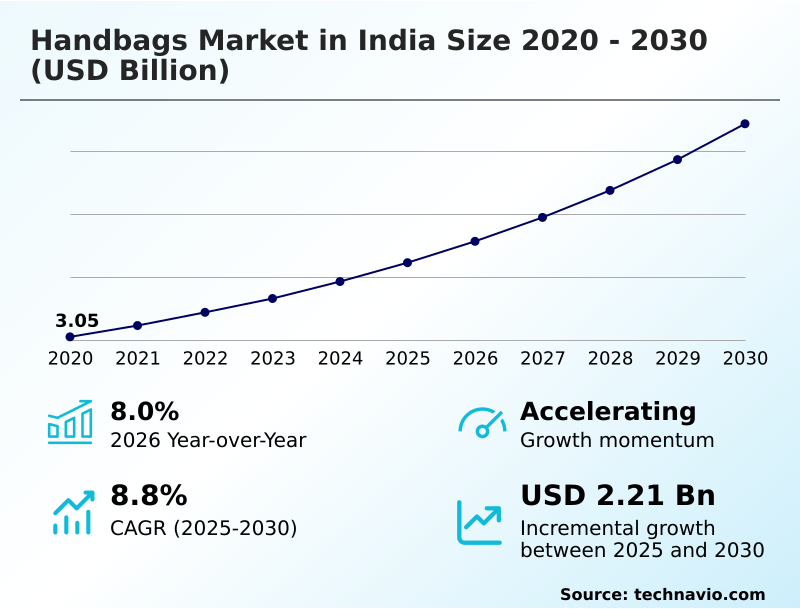
The india handbags market size is valued to increase by USD 2.21 billion, at a CAGR of 8.8% from 2025 to 2030. Inclusion of female professional demographic and evolution of functional luxury design standards will drive the india handbags market.
Major Market Trends & Insights
- By Product Type - Totes segment was valued at USD 1.28 billion in 2024
- By Distribution Channel - Offline segment accounted for the largest market revenue share in 2024
Market Size & Forecast
- Market Opportunities: USD 3.38 billion
- Market Future Opportunities: USD 2.21 billion
- CAGR from 2025 to 2030 : 8.8%
Market Summary
- The handbags market in India is undergoing a significant transformation, driven by the dual forces of a rising female professional workforce and a strong consumer shift toward ethical consumption. This evolution is reshaping product demand, moving away from purely decorative items toward accessories that offer functional luxury design and ergonomic weight distribution.
- The market is characterized by the institutionalization of sustainable material mandates, with bio-engineered materials and plant-based vegan leathers becoming key differentiators for brands. As a result, circular production methods are gaining traction, reflecting a commitment to reducing environmental impact. However, the industry grapples with the persistent challenge of counterfeit goods, which dilute brand equity.
- In response, one key business scenario involves leading brands implementing blockchain-based authentication systems. This technology provides an immutable record of a product's lifecycle, from premium raw material procurement to final sale, offering consumers verifiable proof of authenticity. This strategic investment in traceability protocols not only protects revenue but also reinforces brand heritage and consumer trust in a crowded marketplace.
- The use of RFID tagging further supports these anti-counterfeiting efforts, making it a critical component of modern brand protection.
What will be the Size of the India Handbags Market during the forecast period?
Get Key Insights on Market Forecast (PDF) Get Free Sample
How is the India Handbags Market Segmented?
The india handbags industry research report provides comprehensive data (region-wise segment analysis), with forecasts and estimates in "USD million" for the period 2026-2030, as well as historical data from 2020-2024 for the following segments.
- Product type
- Totes
- Clutches and wallets
- Shoulder bags
- Satchels and saddles
- Distribution channel
- Offline
- Online
- Type
- Leather
- Fabric
- Others
- Geography
- APAC
- India
- APAC
By Product Type Insights
The totes segment is estimated to witness significant growth during the forecast period.
The market for totes is expanding, driven by demand for functional luxury design that meets the needs of a growing professional demographic.
This shift favors sleek, utilitarian styles with features like padded laptop compartments and ergonomic weight distribution over traditional formats.
Manufacturers are incorporating sustainable material mandates, leveraging materials such as organic cotton, jute, and plant-based vegan leathers to appeal to environmentally conscious consumers.
Brands adopting automated precision cutting have reported a 15% improvement in material utilization, enhancing both sustainability and cost-efficiency.
The rise of hybrid work models has solidified the tote as an essential accessory, with direct-to-consumer platforms expanding access to branded options that emphasize durability and timeless appeal, alongside artisanal craftsmanship.
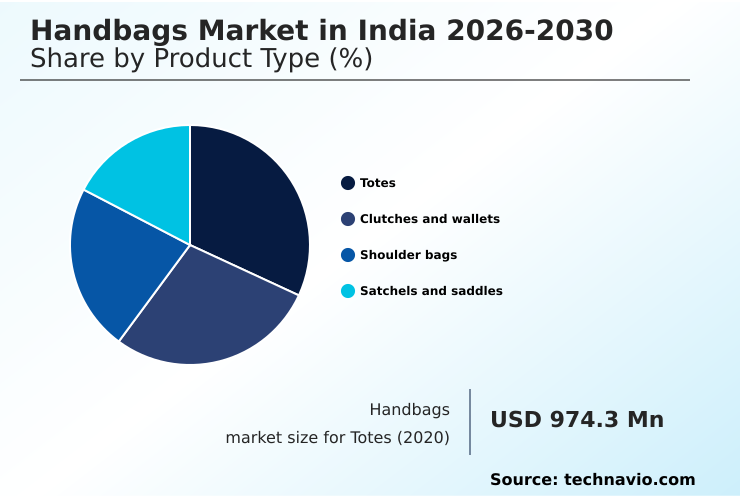
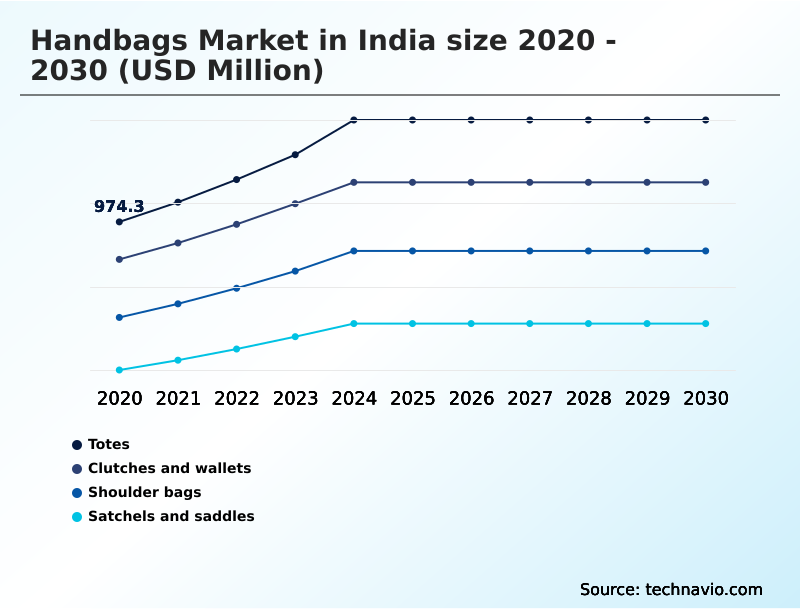
The Totes segment was valued at USD 1.28 billion in 2024 and showed a gradual increase during the forecast period.
Market Dynamics
Our researchers analyzed the data with 2025 as the base year, along with the key drivers, trends, and challenges. A holistic analysis of drivers will help companies refine their marketing strategies to gain a competitive advantage.
- The handbags market in India is at a crossroads, where vegan handbags market growth drivers are increasingly tied to sustainability and ethical production. A detailed sustainable handbag materials comparison reveals that while genuine leather offers durability, bio-engineered materials like pineapple fiber leather are gaining favor for their lower environmental impact.
- This shift is a key topic in discussions around circular economy models for accessories. The impact of D2C on handbag brands has been transformative, allowing new entrants to bypass traditional retail and build direct relationships with consumers. To compete, established players are adopting a sophisticated omnichannel retail strategy for fashion, integrating online and offline experiences.
- Success in this new paradigm hinges on supply chain transparency in leather goods, a factor that builds consumer trust and justifies premium pricing. Furthermore, the persistent threat of imitation goods makes combating counterfeit luxury goods a top priority, with brands investing in technologies like blockchain-based authentication.
- An effective strategy involves leveraging AI personalization in fashion e-commerce to offer unique value that counterfeiters cannot replicate. This is complemented by a renewed focus on functional design in professional totes, which meets the practical needs of modern consumers.
- For instance, brands that integrated transparent sourcing data into their digital platforms saw a greater increase in customer engagement rates than those that focused solely on marketing campaigns, demonstrating the rising value of authenticity. Finally, the luxury handbags resale market trends point toward a growing secondary market, reinforcing the idea of handbags as investable assets.
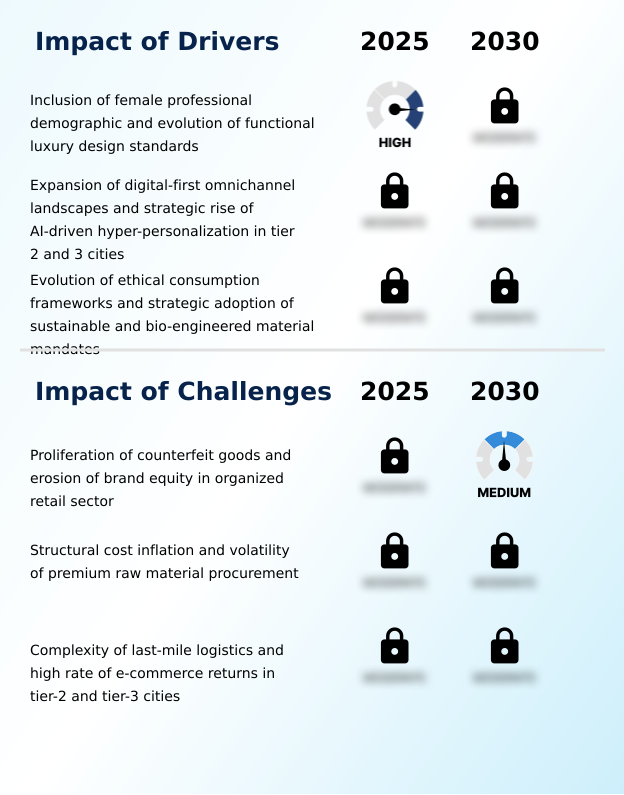
What are the key market drivers leading to the rise in the adoption of India Handbags Industry?
- The rising prominence of the female professional demographic and the concurrent evolution of functional luxury design standards are primary drivers propelling market expansion.
- Market growth is propelled by several key drivers, most notably the increasing participation of the female professional demographic. This has fueled demand for functional luxury design, where accessories must balance aesthetics with utility.
- The expansion of digital-first omnichannel landscapes is another critical driver, with AI-driven hyper-personalization and social commerce integrations enabling brands to reach a wider audience.
- E-commerce platforms now account for a significant share of sales, with accessories contributing to over 70% of transaction value on some leading fashion sites. Furthermore, the evolution of ethical consumption frameworks is driving demand for sustainable material mandates.
- Brands utilizing indigenous agricultural waste for upcycled accessories are capturing a growing market segment, with consumer preference for sustainable products increasing by over 20% in recent surveys, reinforcing omnichannel retail efficiency.
What are the market trends shaping the India Handbags Industry?
- A primary market trend is the institutionalization of sustainable materiality. This is defined by a significant proliferation of bio-based and vegan leather alternatives.
- Key market trends are reshaping the industry, led by the institutionalization of sustainable materiality and the proliferation of vegan leather alternatives. The adoption of circular production methods is a significant development, with some innovators reporting up to a 90% reduction in carbon emissions compared to traditional tanning processes.
- This move toward bio-engineered materials and cruelty-free materials, such as PETA-approved luxury options, is resonating with consumers. Another major trend is the strategic rise of premiumization, expanding into non-metro cities. This is complemented by the growth of circular fashion ecosystems and resale-as-a-service models.
- The certified secondhand luxury goods segment is seeing rapid adoption, with transaction volumes in some non-metro regions growing at nearly double the rate of primary luxury sales.
What challenges does the India Handbags Industry face during its growth?
- The proliferation of counterfeit products and the subsequent erosion of brand heritage and equity within the organized retail sector pose a significant market challenge.
- The market faces several structural challenges that constrain growth. The proliferation of counterfeit goods erodes brand heritage and necessitates costly investments in blockchain-based authentication and RFID tagging to protect intellectual property rights.
- Another significant challenge is the structural cost inflation and volatility of premium raw material procurement of premium bovine leather, where compliance with zero-liquid discharge standards can increase operational costs by up to 5%. Furthermore, the complexity of last-mile logistics in a geographically diverse market leads to high return-to-origin rates, which can exceed 25% in the e-commerce channel.
- This high rate of reverse logistics significantly impacts profitability for direct-to-consumer brands, posing a hurdle to scalable operations that focus on phygital retail.
Exclusive Technavio Analysis on Customer Landscape
The india handbags market forecasting report includes the adoption lifecycle of the market, covering from the innovator’s stage to the laggard’s stage. It focuses on adoption rates in different regions based on penetration. Furthermore, the india handbags market report also includes key purchase criteria and drivers of price sensitivity to help companies evaluate and develop their market growth analysis strategies.
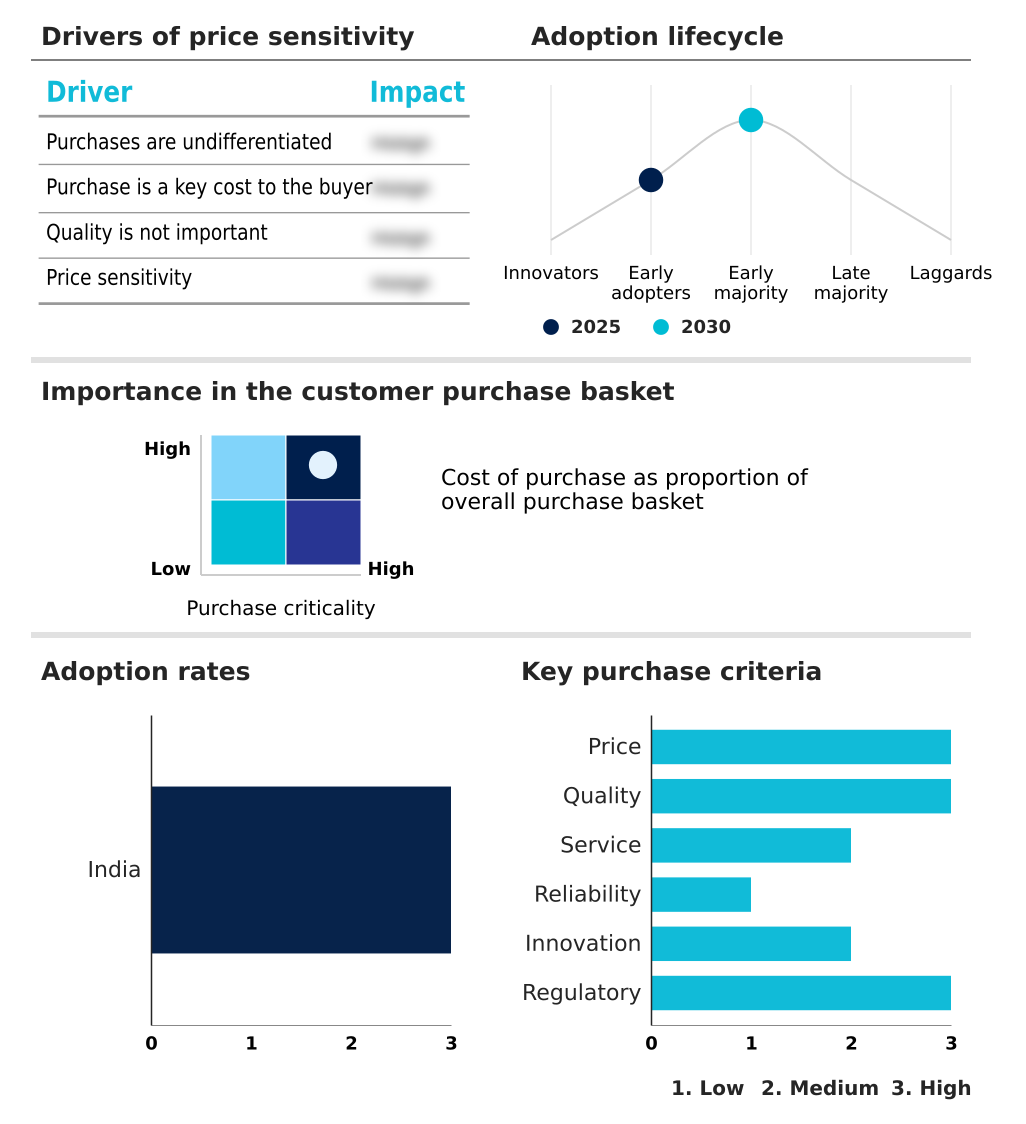
Customer Landscape of India Handbags Industry
Competitive Landscape
Companies are implementing various strategies, such as strategic alliances, india handbags market forecast, partnerships, mergers and acquisitions, geographical expansion, and product/service launches, to enhance their presence in the industry.
ALDO Group Inc. - An offering of luxury handcrafted designs combines traditional artistry with sustainable material mandates and bespoke detailing, catering to a niche clientele seeking unique, high-value accessories.
The industry research and growth report includes detailed analyses of the competitive landscape of the market and information about key companies, including:
- ALDO Group Inc.
- Aranyani
- BAGGIT
- Burberry Group Plc
- Caprese Bags
- Da Milano Leathers Pvt. Ltd.
- Deeya International
- Fossil Group Inc.
- Hennes and Mauritz AB
- Hermes International SA
- Hidesign
- Intouch Leather House Pvt. Ltd.
- Lavie
- Lino Perros
- LVMH Moet Hennessy
- Miraggio Lifestyles Pvt. Ltd.
- Odette E Retail Pvt. Ltd.
- Prada SpA
- Victorias Secret and Co.
- Zouk
Qualitative and quantitative analysis of companies has been conducted to help clients understand the wider business environment as well as the strengths and weaknesses of key industry players. Data is qualitatively analyzed to categorize companies as pure play, category-focused, industry-focused, and diversified; it is quantitatively analyzed to categorize companies as dominant, leading, strong, tentative, and weak.
Recent Development and News in India handbags market
- In March 2025, Reliance Brands Limited progressed with the national rollout of the contemporary Italian fashion label MAX and Co., following its successful debut in Mumbai, aiming to capture the style-over-trends segment of the market.
- In February 2025, FSN E-Commerce Ventures, the operator of the Nykaa platform, reported its fashion segment was nearing a critical EBITDA break-even point, driven by strong performance from its private labels and the onboarding of international luxury brands.
- In January 2025, the domestic brand Lavie strengthened its creative positioning through a strategic collaboration with designer Payal Singhal, signaling a trend of mass-premium companies using designer partnerships to enhance brand equity.
- In October 2024, Winner Nippon, a leading Indian manufacturer, announced the commissioning of a new facility in Himachal Pradesh dedicated to producing high-quality plant-based and cactus-based leather to meet rising demand for sustainable accessories.
Dive into Technavio’s robust research methodology, blending expert interviews, extensive data synthesis, and validated models for unparalleled India Handbags Market insights. See full methodology.
| Market Scope | |
|---|---|
| Page number | 184 |
| Base year | 2025 |
| Historic period | 2020-2024 |
| Forecast period | 2026-2030 |
| Growth momentum & CAGR | Accelerate at a CAGR of 8.8% |
| Market growth 2026-2030 | USD 2207.4 million |
| Market structure | Fragmented |
| YoY growth 2025-2026(%) | 8.0% |
| Key countries | India |
| Competitive landscape | Leading Companies, Market Positioning of Companies, Competitive Strategies, and Industry Risks |
Research Analyst Overview
- The market is defined by a structural shift toward sustainability and technological integration. Boardroom decisions are now centered on the adoption of sustainable material mandates and circular production methods, a strategic move to align with evolving consumer values and global regulations. This involves a transition to vegan leather alternatives and other bio-engineered materials, including plant-based vegan leathers and recycled textiles.
- To support this, manufacturing is advancing through digital manufacturing processes like automated precision cutting, which has been shown to reduce material waste by over 15% compared to traditional methods. Key operational pillars include premium raw material procurement with enhanced traceability protocols and investments in anti-counterfeiting measures such as RFID tagging and blockchain-based authentication.
- Concurrently, product development emphasizes functional luxury design, modular designs, and ergonomic weight distribution. The rise of resale-as-a-service and upcycled accessories reinforces the move toward a circular economy, while AI-driven hyper-personalization reshapes customer engagement. However, challenges like high return-to-origin rates and fast-fashion design replication persist, demanding robust and agile business strategies.
- The implementation of zero-liquid discharge systems is becoming a critical compliance factor, alongside the use of high-performance tech-fabrics.
What are the Key Data Covered in this India Handbags Market Research and Growth Report?
-
What is the expected growth of the India Handbags Market between 2026 and 2030?
-
USD 2.21 billion, at a CAGR of 8.8%
-
-
What segmentation does the market report cover?
-
The report is segmented by Product Type (Totes, Clutches and wallets, Shoulder bags, and Satchels and saddles), Distribution Channel (Offline, and Online), Type (Leather, Fabric, and Others) and Geography (APAC)
-
-
Which regions are analyzed in the report?
-
APAC
-
-
What are the key growth drivers and market challenges?
-
Inclusion of female professional demographic and evolution of functional luxury design standards, Proliferation of counterfeit goods and erosion of brand equity in organized retail sector
-
-
Who are the major players in the India Handbags Market?
-
ALDO Group Inc., Aranyani, BAGGIT, Burberry Group Plc, Caprese Bags, Da Milano Leathers Pvt. Ltd., Deeya International, Fossil Group Inc., Hennes and Mauritz AB, Hermes International SA, Hidesign, Intouch Leather House Pvt. Ltd., Lavie, Lino Perros, LVMH Moet Hennessy, Miraggio Lifestyles Pvt. Ltd., Odette E Retail Pvt. Ltd., Prada SpA, Victorias Secret and Co. and Zouk
-
Market Research Insights
- The market's dynamics are increasingly shaped by digital-first omnichannel landscapes, where social commerce integrations and AI-driven hyper-personalization are central to customer engagement. This transition leverages data analytics to predict regional fashion trends, with virtual try-on experiences enhancing the digital retail journey. While direct-to-consumer platforms thrive, they face significant operational hurdles.
- For instance, high rates of e-commerce returns, which can exceed 25% for subjective purchases like handbags, strain reverse logistics and profitability. In contrast, successful experiential retail initiatives that focus on artisanal craftsmanship and personalized service in physical stores have shown a direct correlation with improved brand loyalty, with some brands reporting a 15% increase in repeat purchases from engaged customers.
- This highlights the importance of a balanced phygital retail strategy, focusing on high-grade leather and unique offerings to improve cost-per-wear value.
We can help! Our analysts can customize this india handbags market research report to meet your requirements.
 RIA -
RIA - 
