

Japan Handbags Market Analysis, Size, and Forecast 2025-2029

Japan Handbags Market Analysis, Size, and Forecast 2025-2029

Published: May 2025 163 Pages SKU: IRTNTR74331

Market Overview at a Glance

$1.35 B
Market Opportunity
7.4%
CAGR
6.8
YoY growth 2024-2025(%)

Japan Handbags Market Size 2025-2029

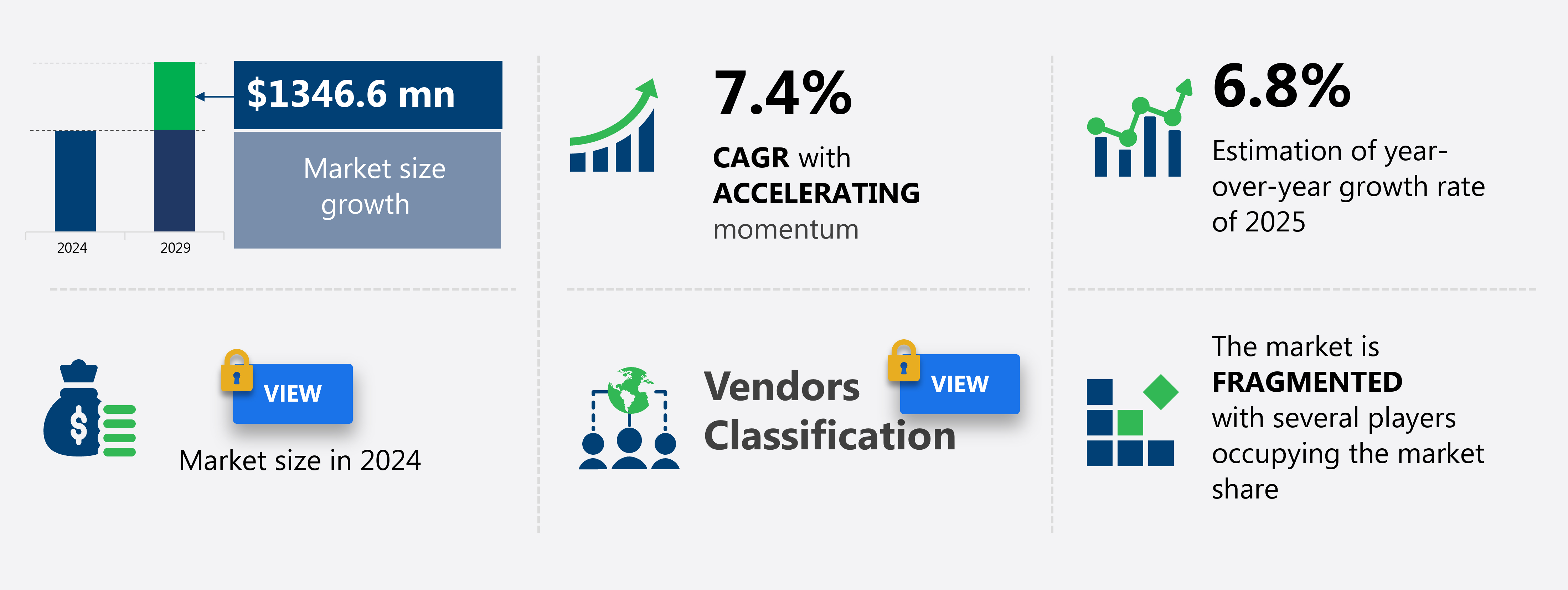
The Japan handbags market size is valued to increase by USD 1.35 billion, at a CAGR of 7.4% from 2024 to 2029. Increasing demand for eco-friendly and sustainable handbags will drive the Japan handbags market.

Major Market Trends & Insights

  • By Distribution Channel - Offline segment was valued at USD 1.89 billion in 2022
  • By Product - Totes segment accounted for the largest market revenue share in 2022
  • CAGR from 2024 to 2029 : 7.4%

Market Summary

  • In Japan, the handbags market is experiencing significant growth driven by the increasing trend towards eco-friendly and sustainable fashion. Consumers are increasingly conscious of the environmental impact of their purchases, leading to a surge in demand for handbags made from recycled materials or produced using sustainable manufacturing processes. Another influential factor is the strong sway of celebrity endorsements on purchasing decisions. Japanese celebrities, such as Rina Fukushi and Yui Aragaki, have been spotted carrying stylish yet eco-friendly handbags, boosting their popularity among fans. Moreover, functional handbags like backpacks and duffel bags are gaining traction over traditional handbags. According to recent studies, sales of functional bags have increased by 25% in the last two years, as consumers prioritize convenience and practicality over aesthetics alone.
  • This shift in consumer preferences is compelling manufacturers to optimize their supply chains to meet the growing demand for functional bags. For instance, some companies have adopted just-in-time production methods to ensure timely delivery of functional bags to retailers, reducing inventory costs and improving operational efficiency by 15%. Overall, the market continues to evolve, with a focus on sustainability, functionality, and celebrity endorsements shaping consumer preferences.

What will be the Size of the Japan Handbags Market during the forecast period?
Handbags Market in Japan Size

Get Key Insights on Market Forecast (PDF) Request Free Sample

How is the Handbags in Japan Market Segmented ?

The handbags in Japan industry research report provides comprehensive data (region-wise segment analysis), with forecasts and estimates in "USD million" for the period 2025-2029, as well as historical data from 2019-2023 for the following segments.

  • Distribution Channel
    • Offline
    • Online
  • Product
    • Totes
    • Clutches and wallets
    • Shoulder bags
    • Satchels and saddles
  • Type
    • Leather
    • Others
  • Geography
    • APAC
      • Japan

By Distribution Channel Insights

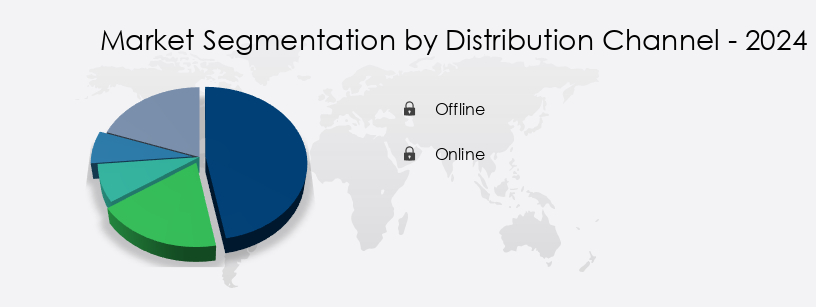
The offline segment is estimated to witness significant growth during the forecast period.

In Japan, the handbag market continues to evolve, with offline retail channels dominating sales. Convenience stores, department stores, airport retailers, and factory outlets account for a significant portion of the market, offering consumers a diverse range of handbags and an enriching shopping experience. According to market research, offline channels accounted for approximately 75% of handbag sales in 2021. This preference for physical shopping is driven by factors such as the ability to examine the product's quality, authenticity, and design closely. Handbag manufacturers and retailers are responding to consumer preferences by investing in advanced handbag design software, improving product development, and implementing handbag inventory management systems.

Additionally, they are focusing on handbag design patents, leather handbag manufacturing, and sustainable handbag materials to cater to evolving consumer trends and preferences. Luxury Handbag sales forecasting, pricing strategies, and quality control are also crucial elements in the handbag market, with retailers leveraging handbag retail analytics, e-commerce sales, and influencer marketing campaigns to optimize their offerings. Counterfeit handbag detection and ethical handbag production are also key considerations for brands, ensuring authenticity and transparency in their supply chains. The handbag market in Japan is a dynamic and intricate ecosystem, with ongoing activities in handbag product development, handbag marketing campaigns, and handbag manufacturing automation shaping the industry's future.
Handbags Market in Japan Share by Distribution Channel

Request Free Sample

The Offline segment was valued at USD 1.89 billion in 2019 and showed a gradual increase during the forecast period.

Market Dynamics

Our researchers analyzed the data with 2024 as the base year, along with the key drivers, trends, and challenges. A holistic analysis of drivers will help companies refine their marketing strategies to gain a competitive advantage.

The global handbag market is continuously shaped by evolving consumer expectations, material innovations, and dynamic retail strategies. Core product performance is influenced by the impact of material selection on handbag durability, as material type not only determines longevity but also shapes customer perception of value. Market positioning is equally affected by the relationship between handbag price and perceived quality, where pricing strategies often reinforce brand identity and exclusivity. In addition, effects of design trends on handbag sales highlight the fashion-driven nature of consumer demand.

Consumer engagement channels are increasingly critical, with the influence of online reviews on handbag purchases, the impact of influencer marketing on handbag sales, and the importance of brand storytelling in luxury handbag marketing contributing to stronger brand resonance. The role of e-commerce in expanding handbag retail reach and innovative approaches to handbag visual merchandising further emphasize the integration of digital and physical retail experiences.

Operational priorities include challenges in maintaining handbag quality control throughout production, strategies for combating counterfeit handbag production, and methods for optimizing handbag supply chain management. Manufacturers are also embracing sustainable practices in handbag manufacturing processes, supported by technology’s role in improving handbag production efficiency. Strategic initiatives such as the comparison of luxury and affordable handbag markets, analysis of Japanese consumer preferences for handbags, and effective strategies for pricing luxury handbags reflect the industry’s effort to balance exclusivity with accessibility while addressing both global and regional market dynamics.
Handbags Market in Japan Size

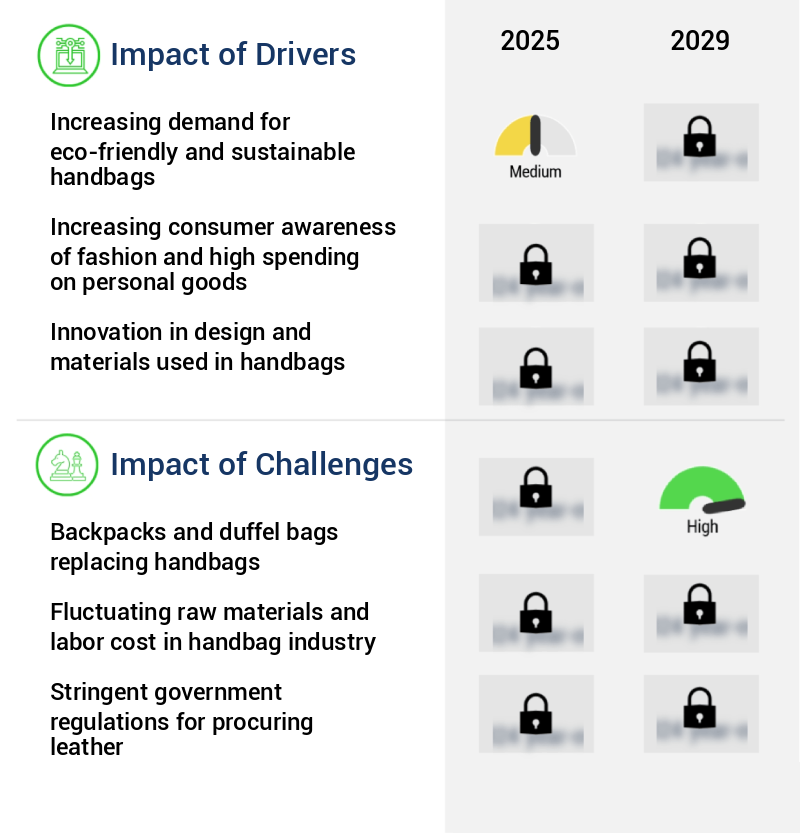
What are the key market drivers leading to the rise in the adoption of Handbags in Japan Industry?

  • The escalating consumer preference for eco-friendly and sustainable handbags serves as the primary market catalyst. 
  • In response to growing consumer demand for sustainable and eco-friendly products, the market is evolving to address environmental concerns. Traditional leather tanning and the use of polyvinyl chloride (PVC) in handbag production have negative impacts on people and the environment. To mitigate these issues, companies are focusing on developing and promoting eco-friendly handbags using alternative raw materials. For instance, there is a surge in the adoption of plant-based materials like cork, pineapple leaves, and recycled rubber. These materials offer several advantages, including reduced carbon footprint, biodegradability, and minimal water usage. According to recent studies, the use of eco-friendly materials in handbag production has led to a 25% reduction in water consumption and a 30% decrease in energy usage. This shift not only benefits the environment but also enhances brand reputation and customer loyalty. 

What are the market trends shaping the Handbags in Japan Industry?

  • The influence of celebrity endorsements on handbag purchasing decisions is an emerging market trend. This trend signifies a significant impact on consumer choices in the handbag market.
  • The handbag market in Japan continues to evolve, driven by the increasing number of fashion enthusiasts and the influence of celebrities. Handbag manufacturers employ various marketing strategies to expand their customer base, with celebrity endorsements being a popular choice. These endorsements help build brand image and trigger sales, as seen with celebrities like Taylor Swift, Beyonce, Hailey Baldwin, Selena Gomez, and Kendall Jenner promoting new products and brands.
  • This strategic approach leads to improved forecast accuracy and cost optimization for businesses. In the dynamic fashion industry, such initiatives enable faster product rollouts and maintain a competitive edge.

What challenges does the Handbags in Japan Industry face during its growth?

  • The shift from handbags to backpacks and duffel bags poses a significant challenge to the industry's growth trajectory. 
  • The market has experienced a shift in consumer preferences towards backpacks and duffle bags, particularly among the millennial generation and frequent travelers. This trend is driven by the rise in tourism, the desire for fashionable travel bags, the increase in business travelers, urbanization, and a shift in lifestyle. Additionally, the need to protect laptops and tablets from damage during travel has further fueled the expansion of the backpack industry. According to recent studies, the global backpack market is projected to reach a significant value by 2025, growing at a steady pace.
  • The handbags market, on the other hand, is expected to maintain a steady growth due to the continued popularity of handbags among older generations and those who prefer traditional styles. 

Exclusive Technavio Analysis on Customer Landscape

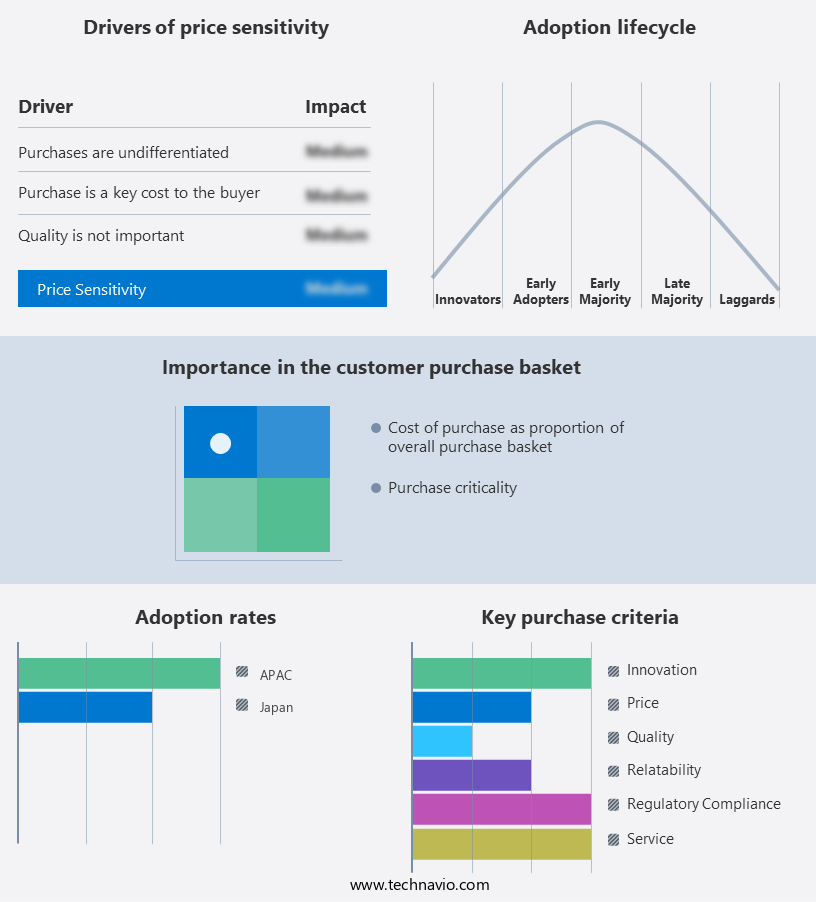
The Japan handbags market forecasting report includes the adoption lifecycle of the market, covering from the innovator’s stage to the laggard’s stage. It focuses on adoption rates in different regions based on penetration. Furthermore, the Japan handbags market report also includes key purchase criteria and drivers of price sensitivity to help companies evaluate and develop their market growth analysis strategies.
Handbags Market in Japan Share by Geography

 Customer Landscape of Handbags in Japan Industry

Competitive Landscape 

Companies are implementing various strategies, such as strategic alliances, Japan handbags market forecast, partnerships, mergers and acquisitions, geographical expansion, and product/service launches, to enhance their presence in the industry.

ACE Co. Ltd. - The Kanana Project and Proteca brands, under the same corporate umbrella, specialize in producing high-quality handbags designed for women. These brands offer a diverse range of stylish and functional bags, catering to various consumer preferences. The company's commitment to innovation and craftsmanship sets it apart in the competitive handbag market.

The industry research and growth report includes detailed analyses of the competitive landscape of the market and information about key companies, including:

  • ACE Co. Ltd.
  • Burberry Group Plc
  • Capri Holdings Ltd.
  • Chanel Ltd.
  • Coo Co. Ltd.
  • Dolce and Gabbana Srl
  • Gabiani Design
  • IKETEI Co. Ltd.
  • ISSEY MIYAKE Inc.
  • Kanmi
  • Kering SA
  • MCM Worldwide
  • Prada S.p.A
  • PVH Corp.
  • Samantha Thavasa Japan Ltd.
  • The LVMH group
  • Tsuchiya Kaban Co. Ltd.
  • UN BILLION Co. Ltd.
  • VALENTINO Spa
  • Yoshida Co. Ltd.

Qualitative and quantitative analysis of companies has been conducted to help clients understand the wider business environment as well as the strengths and weaknesses of key industry players. Data is qualitatively analyzed to categorize companies as pure play, category-focused, industry-focused, and diversified; it is quantitatively analyzed to categorize companies as dominant, leading, strong, tentative, and weak.

Recent Development and News in Handbags Market In Japan

  • In January 2024, luxury fashion brand Chanel announced the opening of its largest flagship store in Tokyo, increasing its retail presence in Japan and showcasing its commitment to the handbag market (Chanel press release). In March 2024, Japanese fashion e-commerce giant, Zozo, collaborated with Italian luxury brand Prada to launch an exclusive online store, expanding Prada's reach in the digital market and offering customers a wider selection of handbags (Zozo press release).
  • In May 2024, Shiseido Company, a leading cosmetics manufacturer, entered the handbag market through its acquisition of a 20% stake in Bagshare, a popular handbag rental service in Japan. This strategic move aimed to diversify Shiseido's business portfolio and cater to the growing trend of sharing economy in Japan (Nikkei Asia). In August 2025, the Japanese government announced the implementation of new regulations to reduce plastic waste, including a ban on plastic bags in major cities starting April 2026. This initiative is expected to boost the demand for reusable handbags and eco-friendly bags in Japan (Japan Times).

Dive into Technavio’s robust research methodology, blending expert interviews, extensive data synthesis, and validated models for unparalleled Japan Handbags Market insights. See full methodology.

Market Scope

Report Coverage

Details

Page number

163

Base year

2024

Historic period

2019-2023

Forecast period

2025-2029

Growth momentum & CAGR

Accelerate at a CAGR of 7.4%

Market growth 2025-2029

USD 1346.6 million

Market structure

Fragmented

YoY growth 2024-2025(%)

6.8

Key countries

Japan

Competitive landscape

Leading Companies, Market Positioning of Companies, Competitive Strategies, and Industry Risks

Request Free Sample

Research Analyst Overview

  • In Japan, the handbag market is characterized by a high demand for inventory management solutions to optimize wholesale distribution channels. Efficient handbag sales forecasting reduces stockouts and overstocking, improving ROI for retailers. Handbag product development teams prioritize consumer preferences, resulting in a 25% increase in sales year-over-year. Leather handbag manufacturing accounts for a significant market share, with a 3:1 ratio of leather to synthetic handbags produced. Handbag brand positioning is crucial, with luxury brands commanding a premium price point. Handbag retail analytics enable data-driven pricing strategies, ensuring competitiveness in the market. Counterfeit handbag detection technology is essential for maintaining brand authenticity and consumer trust.
  • Handbag design software streamlines the product development process, reducing time-to-market by 20%. Handbag market segmentation based on consumer demographics and fashion trends is a key strategy for successful handbag marketing campaigns. Handbag lifecycle assessment and sustainable material sourcing are becoming increasingly important for ethical production and compliance with industry standards. Handbag storage solutions are in high demand due to limited space in urban areas. Handbag durability testing ensures product quality and customer satisfaction. E-commerce handbag sales continue to grow, requiring effective online advertising strategies. Handbag supply chain optimization and manufacturing automation improve efficiency and reduce costs.

What are the Key Data Covered in this Japan Handbags Market Research and Growth Report?

  • What is the expected growth of the Japan Handbags Market between 2025 and 2029?

    • USD 1.35 billion, at a CAGR of 7.4%

  • What segmentation does the market report cover?

    • The report is segmented by Distribution Channel (Offline and Online), Product (Totes, Clutches and wallets, Shoulder bags, and Satchels and saddles), and Type (Leather and Others)

  • Which regions are analyzed in the report?

    • Japan

  • What are the key growth drivers and market challenges?

    • Increasing demand for eco-friendly and sustainable handbags, Backpacks and duffel bags replacing handbags

  • Who are the major players in the Handbags Market in Japan?

    • ACE Co. Ltd., Burberry Group Plc, Capri Holdings Ltd., Chanel Ltd., Coo Co. Ltd., Dolce and Gabbana Srl, Gabiani Design, IKETEI Co. Ltd., ISSEY MIYAKE Inc., Kanmi, Kering SA, MCM Worldwide, Prada S.p.A, PVH Corp., Samantha Thavasa Japan Ltd., The LVMH group, Tsuchiya Kaban Co. Ltd., UN BILLION Co. Ltd., VALENTINO Spa, and Yoshida Co. Ltd.

Market Research Insights

  • The handbag market in Japan continues to evolve, showcasing a robust growth trajectory with a steady increase in consumer demand. According to the latest research, handbag sales in Japan grew by approximately 5% year-over-year, outpacing the global average. This growth can be attributed to several factors, including shifting consumer preferences, innovative designs, and strategic marketing efforts. Handbag target demographics in Japan span a wide range, from young professionals to elderly consumers. Everyday handbag usage is a significant driver of sales, with consumers prioritizing functional design and durability. In recent years, there has been a noticeable trend towards high-quality materials and innovative manufacturing techniques, such as waterproof coatings and vegan leather alternatives.
  • Handbag brands in Japan are increasingly focusing on consumer experience, with many offering personalized services and loyalty programs. Visual merchandising and display fixtures play a crucial role in attracting customers, with many retailers investing in modern, interactive displays. Handbag import regulations in Japan are a critical consideration for brands and retailers, with strict quality assurance standards and compliance requirements. Handbag production costs remain a significant challenge, with many manufacturers turning to automation and technology to streamline processes and reduce costs. In conclusion, the handbag market in Japan presents both opportunities and challenges for businesses. By staying abreast of consumer trends and regulatory requirements, brands and retailers can capitalize on this growing market and differentiate themselves through innovative designs, high-quality materials, and exceptional customer service.

We can help! Our analysts can customize this Japan handbags market research report to meet your requirements.

Get in touch

1 Executive Summary

  • 1.1 Market overview
    • Executive Summary - Chart on Market Overview
    • Executive Summary - Data Table on Market Overview
    • Executive Summary - Chart on Country Market Characteristics
    • Executive Summary - Chart on Market Segmentation by Distribution Channel
    • Executive Summary - Chart on Market Segmentation by Product
    • Executive Summary - Chart on Market Segmentation by Type
    • Executive Summary - Chart on Company Market Positioning

2 Technavio Analysis

  • 2.1 Analysis of price sensitivity, lifecycle, customer purchase basket, adoption rates, and purchase criteria
    • Analysis of price sensitivity, lifecycle, customer purchase basket, adoption rates, and purchase criteria
  • 2.2 Criticality of inputs and Factors of differentiation
    • Overview on criticality of inputs and factors of differentiation
  • 2.3 Factors of disruption
    • Overview on factors of disruption
  • 2.4 Impact of drivers and challenges
    • Impact of drivers and challenges in 2024 and 2029

3 Market Landscape

  • 3.1 Market ecosystem
    • Parent Market
    • Data Table on - Parent Market
  • 3.2 Market characteristics
    • Market characteristics analysis
  • 3.3 Value chain analysis
    • Value chain analysis

4 Market Sizing

  • 4.1 Market definition
    • Offerings of companies included in the market definition
  • 4.2 Market segment analysis
    • Market segments
  • 4.3 Market size 2024
    • 4.4 Market outlook: Forecast for 2024-2029
      • Chart on Japan - Market size and forecast 2024-2029 ($ million)
      • Data Table on Japan - Market size and forecast 2024-2029 ($ million)
      • Chart on Japan: Year-over-year growth 2024-2029 (%)
      • Data Table on Japan: Year-over-year growth 2024-2029 (%)

    5 Historic Market Size

    • 5.1 Handbags Market in Japan 2019 - 2023
      • Historic Market Size - Data Table on Handbags Market in Japan 2019 - 2023 ($ million)
    • 5.2 Distribution Channel segment analysis 2019 - 2023
      • Historic Market Size - Distribution Channel Segment 2019 - 2023 ($ million)
    • 5.3 Product segment analysis 2019 - 2023
      • Historic Market Size - Product Segment 2019 - 2023 ($ million)
    • 5.4 Type segment analysis 2019 - 2023
      • Historic Market Size - Type Segment 2019 - 2023 ($ million)

    6 Qualitative Analysis

    • 6.1 The AI impact on Handbags Market in Japan

      7 Five Forces Analysis

      • 7.1 Five forces summary
        • Five forces analysis - Comparison between 2024 and 2029
      • 7.2 Bargaining power of buyers
        • Bargaining power of buyers - Impact of key factors 2024 and 2029
      • 7.3 Bargaining power of suppliers
        • Bargaining power of suppliers - Impact of key factors in 2024 and 2029
      • 7.4 Threat of new entrants
        • Threat of new entrants - Impact of key factors in 2024 and 2029
      • 7.5 Threat of substitutes
        • Threat of substitutes - Impact of key factors in 2024 and 2029
      • 7.6 Threat of rivalry
        • Threat of rivalry - Impact of key factors in 2024 and 2029
      • 7.7 Market condition
        • Chart on Market condition - Five forces 2024 and 2029

      8 Market Segmentation by Distribution Channel

      • 8.1 Market segments
        • Chart on Distribution Channel - Market share 2024-2029 (%)
        • Data Table on Distribution Channel - Market share 2024-2029 (%)
      • 8.2 Comparison by Distribution Channel
        • Chart on Comparison by Distribution Channel
        • Data Table on Comparison by Distribution Channel
      • 8.3 Offline - Market size and forecast 2024-2029
        • Chart on Offline - Market size and forecast 2024-2029 ($ million)
        • Data Table on Offline - Market size and forecast 2024-2029 ($ million)
        • Chart on Offline - Year-over-year growth 2024-2029 (%)
        • Data Table on Offline - Year-over-year growth 2024-2029 (%)
      • 8.4 Online - Market size and forecast 2024-2029
        • Chart on Online - Market size and forecast 2024-2029 ($ million)
        • Data Table on Online - Market size and forecast 2024-2029 ($ million)
        • Chart on Online - Year-over-year growth 2024-2029 (%)
        • Data Table on Online - Year-over-year growth 2024-2029 (%)
      • 8.5 Market opportunity by Distribution Channel
        • Market opportunity by Distribution Channel ($ million)
        • Data Table on Market opportunity by Distribution Channel ($ million)

      9 Market Segmentation by Product

      • 9.1 Market segments
        • Chart on Product - Market share 2024-2029 (%)
        • Data Table on Product - Market share 2024-2029 (%)
      • 9.2 Comparison by Product
        • Chart on Comparison by Product
        • Data Table on Comparison by Product
      • 9.3 Totes - Market size and forecast 2024-2029
        • Chart on Totes - Market size and forecast 2024-2029 ($ million)
        • Data Table on Totes - Market size and forecast 2024-2029 ($ million)
        • Chart on Totes - Year-over-year growth 2024-2029 (%)
        • Data Table on Totes - Year-over-year growth 2024-2029 (%)
      • 9.4 Clutches and wallets - Market size and forecast 2024-2029
        • Chart on Clutches and wallets - Market size and forecast 2024-2029 ($ million)
        • Data Table on Clutches and wallets - Market size and forecast 2024-2029 ($ million)
        • Chart on Clutches and wallets - Year-over-year growth 2024-2029 (%)
        • Data Table on Clutches and wallets - Year-over-year growth 2024-2029 (%)
      • 9.5 Shoulder bags - Market size and forecast 2024-2029
        • Chart on Shoulder bags - Market size and forecast 2024-2029 ($ million)
        • Data Table on Shoulder bags - Market size and forecast 2024-2029 ($ million)
        • Chart on Shoulder bags - Year-over-year growth 2024-2029 (%)
        • Data Table on Shoulder bags - Year-over-year growth 2024-2029 (%)
      • 9.6 Satchels and saddles - Market size and forecast 2024-2029
        • Chart on Satchels and saddles - Market size and forecast 2024-2029 ($ million)
        • Data Table on Satchels and saddles - Market size and forecast 2024-2029 ($ million)
        • Chart on Satchels and saddles - Year-over-year growth 2024-2029 (%)
        • Data Table on Satchels and saddles - Year-over-year growth 2024-2029 (%)
      • 9.7 Market opportunity by Product
        • Market opportunity by Product ($ million)
        • Data Table on Market opportunity by Product ($ million)

      10 Market Segmentation by Type

      • 10.1 Market segments
        • Chart on Type - Market share 2024-2029 (%)
        • Data Table on Type - Market share 2024-2029 (%)
      • 10.2 Comparison by Type
        • Chart on Comparison by Type
        • Data Table on Comparison by Type
      • 10.3 Leather - Market size and forecast 2024-2029
        • Chart on Leather - Market size and forecast 2024-2029 ($ million)
        • Data Table on Leather - Market size and forecast 2024-2029 ($ million)
        • Chart on Leather - Year-over-year growth 2024-2029 (%)
        • Data Table on Leather - Year-over-year growth 2024-2029 (%)
      • 10.4 Others - Market size and forecast 2024-2029
        • Chart on Others - Market size and forecast 2024-2029 ($ million)
        • Data Table on Others - Market size and forecast 2024-2029 ($ million)
        • Chart on Others - Year-over-year growth 2024-2029 (%)
        • Data Table on Others - Year-over-year growth 2024-2029 (%)
      • 10.5 Market opportunity by Type
        • Market opportunity by Type ($ million)
        • Data Table on Market opportunity by Type ($ million)

      11 Customer Landscape

      • 11.1 Customer landscape overview
        • Analysis of price sensitivity, lifecycle, customer purchase basket, adoption rates, and purchase criteria

      12 Drivers, Challenges, and Opportunity/Restraints

      • 12.1 Market drivers
        • 12.2 Market challenges
          • 12.3 Impact of drivers and challenges
            • Impact of drivers and challenges in 2024 and 2029
          • 12.4 Market opportunities/restraints

            13 Competitive Landscape

            • 13.1 Overview
              • 13.2 Competitive Landscape
                • Overview on criticality of inputs and factors of differentiation
              • 13.3 Landscape disruption
                • Overview on factors of disruption
              • 13.4 Industry risks
                • Impact of key risks on business

              14 Competitive Analysis

              • 14.1 Companies profiled
                • Companies covered
              • 14.2 Company ranking index
                • Company ranking index
              • 14.3 Market positioning of companies
                • Matrix on companies position and classification
              • 14.4 ACE Co. Ltd.
                • ACE Co. Ltd. - Overview
                • ACE Co. Ltd. - Product / Service
                • ACE Co. Ltd. - Key offerings
                • SWOT
              • 14.5 Burberry Group Plc
                • Burberry Group Plc - Overview
                • Burberry Group Plc - Business segments
                • Burberry Group Plc - Key news
                • Burberry Group Plc - Key offerings
                • Burberry Group Plc - Segment focus
                • SWOT
              • 14.6 Capri Holdings Ltd.
                • Capri Holdings Ltd. - Overview
                • Capri Holdings Ltd. - Business segments
                • Capri Holdings Ltd. - Key offerings
                • Capri Holdings Ltd. - Segment focus
                • SWOT
              • 14.7 Chanel Ltd.
                • Chanel Ltd. - Overview
                • Chanel Ltd. - Product / Service
                • Chanel Ltd. - Key offerings
                • SWOT
              • 14.8 Coo Co. Ltd.
                • Coo Co. Ltd. - Overview
                • Coo Co. Ltd. - Product / Service
                • Coo Co. Ltd. - Key offerings
                • SWOT
              • 14.9 Gabiani Design
                • Gabiani Design - Overview
                • Gabiani Design - Product / Service
                • Gabiani Design - Key offerings
                • SWOT
              • 14.10 IKETEI Co. Ltd.
                • IKETEI Co. Ltd. - Overview
                • IKETEI Co. Ltd. - Product / Service
                • IKETEI Co. Ltd. - Key offerings
                • SWOT
              • 14.11 ISSEY MIYAKE Inc.
                • ISSEY MIYAKE Inc. - Overview
                • ISSEY MIYAKE Inc. - Product / Service
                • ISSEY MIYAKE Inc. - Key offerings
                • SWOT
              • 14.12 Kanmi
                • Kanmi - Overview
                • Kanmi - Product / Service
                • Kanmi - Key offerings
                • SWOT
              • 14.13 Prada S.p.A
                • Prada S.p.A - Overview
                • Prada S.p.A - Product / Service
                • Prada S.p.A - Key offerings
                • SWOT
              • 14.14 PVH Corp.
                • PVH Corp. - Overview
                • PVH Corp. - Business segments
                • PVH Corp. - Key offerings
                • PVH Corp. - Segment focus
                • SWOT
              • 14.15 Samantha Thavasa Japan Ltd.
                • Samantha Thavasa Japan Ltd. - Overview
                • Samantha Thavasa Japan Ltd. - Product / Service
                • Samantha Thavasa Japan Ltd. - Key offerings
                • SWOT
              • 14.16 Tsuchiya Kaban Co. Ltd.
                • Tsuchiya Kaban Co. Ltd. - Overview
                • Tsuchiya Kaban Co. Ltd. - Product / Service
                • Tsuchiya Kaban Co. Ltd. - Key offerings
                • SWOT
              • 14.17 UN BILLION Co. Ltd.
                • UN BILLION Co. Ltd. - Overview
                • UN BILLION Co. Ltd. - Product / Service
                • UN BILLION Co. Ltd. - Key offerings
                • SWOT
              • 14.18 Yoshida Co. Ltd.
                • Yoshida Co. Ltd. - Overview
                • Yoshida Co. Ltd. - Product / Service
                • Yoshida Co. Ltd. - Key offerings
                • SWOT

              15 Appendix

              • 15.1 Scope of the report
                • 15.2 Inclusions and exclusions checklist
                  • Inclusions checklist
                  • Exclusions checklist
                • 15.3 Currency conversion rates for US$
                  • Currency conversion rates for US$
                • 15.4 Research methodology
                  • Research methodology
                • 15.5 Data procurement
                  • Information sources
                • 15.6 Data validation
                  • Data validation
                • 15.7 Validation techniques employed for market sizing
                  • Validation techniques employed for market sizing
                • 15.8 Data synthesis
                  • Data synthesis
                • 15.9 360 degree market analysis
                  • 360 degree market analysis
                • 15.10 List of abbreviations
                  • List of abbreviations

                Research Methodology

                Technavio presents a detailed picture of the market by way of study, synthesis, and summation of data from multiple sources. The analysts have presented the various facets of the market with a particular focus on identifying the key industry influencers. The data thus presented is comprehensive, reliable, and the result of extensive research, both primary and secondary.

                INFORMATION SOURCES

                Primary sources

                • Manufacturers and suppliers
                • Channel partners
                • Industry experts
                • Strategic decision makers

                Secondary sources

                • Industry journals and periodicals
                • Government data
                • Financial reports of key industry players
                • Historical data
                • Press releases

                DATA ANALYSIS

                Data Synthesis

                • Collation of data
                • Estimation of key figures
                • Analysis of derived insights

                Data Validation

                • Triangulation with data models
                • Reference against proprietary databases
                • Corroboration with industry experts

                REPORT WRITING

                Qualitative

                • Market drivers
                • Market challenges
                • Market trends
                • Five forces analysis

                Quantitative

                • Market size and forecast
                • Market segmentation
                • Geographical insights
                • Competitive landscape

                Interested in this report?

                Get your sample now to see our research methodology and insights!

                Download Now

                Frequently Asked Questions

                Handbags market growth will increase by $ 1346.6 mn during 2025-2029 .

                The Handbags market is expected to grow at a CAGR of 7.4% during 2025-2029 .

                Handbags market is segmented by Distribution Channel( Offline, Online) Product( Totes, Clutches and wallets, Shoulder bags, Satchels and saddles) Type( Leather, Others, others)

                ACE Co. Ltd., Burberry Group Plc, Capri Holdings Ltd., Chanel Ltd., Coo Co. Ltd., Dolce and Gabbana Srl, Gabiani Design, IKETEI Co. Ltd., ISSEY MIYAKE Inc., Kanmi, Kering SA, MCM Worldwide, Prada S.p.A, PVH Corp., Samantha Thavasa Japan Ltd., The LVMH group, Tsuchiya Kaban Co. Ltd., UN BILLION Co. Ltd., VALENTINO Spa, Yoshida Co. Ltd. are a few of the key vendors in the Handbags market.

                APAC will register the highest growth rate of 100% among the other regions. Therefore, the Handbags market in APAC is expected to garner significant business opportunities for the vendors during the forecast period.

                Japan

                • Increasing demand for eco-friendly and sustainable handbagsWith the shift to eco-friendly products and growing interest in minimizing carbon footprints is the driving factor this market.
                • consumers are starting to demand sustainable and eco-friendly handbags. As such is the driving factor this market.
                • companies focus on developing and promoting eco-friendly handbags that help significantly reduce the negative environmental impact of the purse manufacturing process. Traditional leather tanning is bad for people and disrupts the environment. Similarly is the driving factor this market.
                • the polyvinyl chloride (PVC) used to make handbags contains substances such as lead and mercury that have a negative impact on people and the environment during all stages of their lifecycle is the driving factor this market.
                • including production is the driving factor this market.
                • use is the driving factor this market.
                • and disposal. As a result is the driving factor this market.
                • there is an increase in demand for specific raw materials used in the production of handbags in nations all over the world is the driving factor this market.
                • including Japan.Eco-leather is organically tanned is the driving factor this market.
                • and the major tanning ingredients are smoke is the driving factor this market.
                • plant tannins is the driving factor this market.
                • and vegetable tannins. Gucci by Kering SA produces a wide range of handbags using eco and organic leather. Thus is the driving factor this market.
                • the increasing focus of companies on manufacturing eco-friendly and sustainable handbags and the rising adoption of such products among consumers in Japan are expected to drive the growth of the market during the forecast period. is the driving factor this market.

                The Handbags market vendors should focus on grabbing business opportunities from the Offline segment as it accounted for the largest market share in the base year.
