



Information Technology (IT) Training Market Size 2026-2030
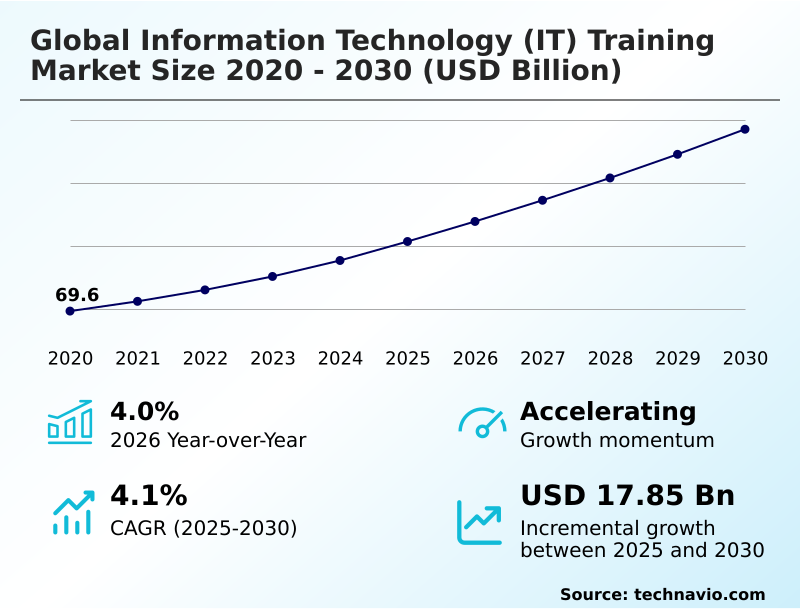
The information technology (it) training market size is valued to increase by USD 17.85 billion, at a CAGR of 4.1% from 2025 to 2030. Intensification of cybersecurity resilience and adaptive threat intelligence training will drive the information technology (it) training market.
Major Market Trends & Insights
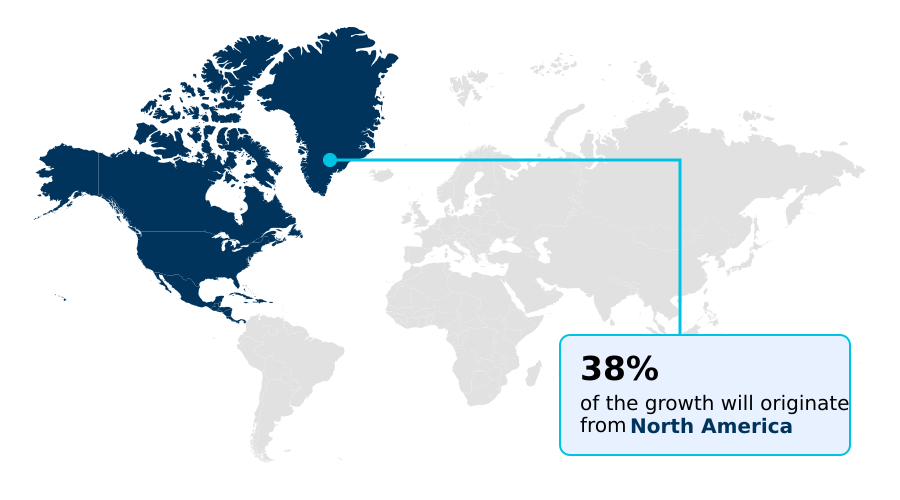
- North America dominated the market and accounted for a 38% growth during the forecast period.
- By Service - Infrastructure segment was valued at USD 26.69 billion in 2024
- By End-user - Corporate segment accounted for the largest market revenue share in 2024
Market Size & Forecast
- Market Opportunities: USD 28.93 billion
- Market Future Opportunities: USD 17.85 billion
- CAGR from 2025 to 2030 : 4.1%
Market Summary
- The Information Technology (IT) Training market has become a strategic imperative, driven by the need to bridge the skills gap created by rapid digital transformation. Organizations are moving beyond basic instruction to comprehensive upskilling programs in high-demand areas like cloud-native architecture, generative AI integration, and DevSecOps practices.
- This shift is fueled by the necessity for a workforce that can manage and secure complex, distributed systems while leveraging automation to enhance productivity. For instance, a manufacturing firm implementing an industrial IoT network requires specialized training in predictive maintenance and edge computing to reduce equipment downtime, a program that can improve operational uptime by over 20%.
- The market is characterized by a move toward adaptive learning paths and simulation-based training, enabling professionals to gain hands-on experience with emerging technologies. As cyber threats evolve, continuous training in cybersecurity resilience and zero-trust security models is no longer optional but essential for corporate risk management.
- The emphasis is on building a talent pool capable of both innovation and operational excellence in an increasingly AI-driven landscape.
What will be the Size of the Information Technology (IT) Training Market during the forecast period?
Get Key Insights on Market Forecast (PDF) Get Free Sample
How is the Information Technology (IT) Training Market Segmented?
The information technology (it) training industry research report provides comprehensive data (region-wise segment analysis), with forecasts and estimates in "USD million" for the period 2026-2030, as well as historical data from 2020-2024 for the following segments.
- Service
- Infrastructure
- Development
- Database
- Security
- Others
- End-user
- Corporate
- Schools and colleges
- Others
- Delivery mode
- Online
- Blended
- Offline
- Geography
- North America
- US
- Canada
- Mexico
- Europe
- Germany
- UK
- France
- APAC
- China
- India
- Japan
- South America
- Brazil
- Argentina
- Middle East and Africa
- UAE
- Saudi Arabia
- South Africa
- Rest of World (ROW)
- North America
By Service Insights
The infrastructure segment is estimated to witness significant growth during the forecast period.
The infrastructure segment is shaped by extensive IT infrastructure modernization as organizations navigate complex hybrid cloud environments and pursue multi-cloud environment management. This shift necessitates advanced IT infrastructure training covering AIOps, software-defined networking, and network functions virtualization to optimize performance.
A key focus is on FinOps training to manage cloud expenditures, with some firms achieving a 15% reduction in cloud waste.
Demand for cloud architecture upskilling through virtual IT labs is escalating, as evidenced by a 34% surge in roles requiring specific infrastructure certifications.
Programs also increasingly incorporate green IT training and IT compliance training to address ESG goals and regulatory demands, ensuring professionals can manage scalable systems and predictive maintenance for serverless architecture training.
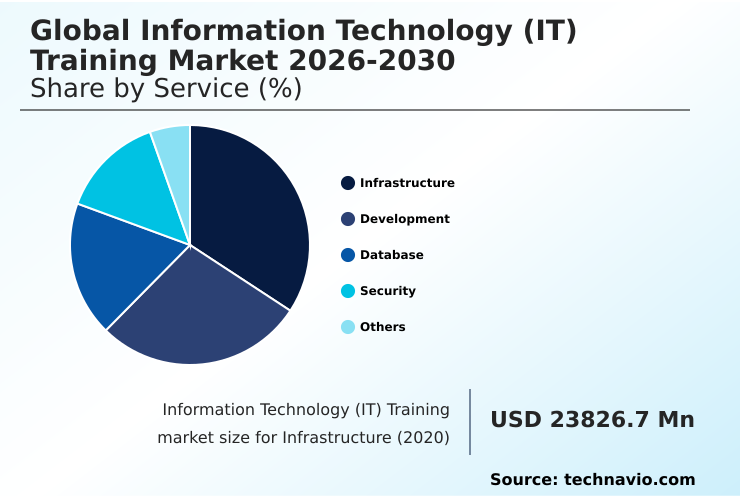
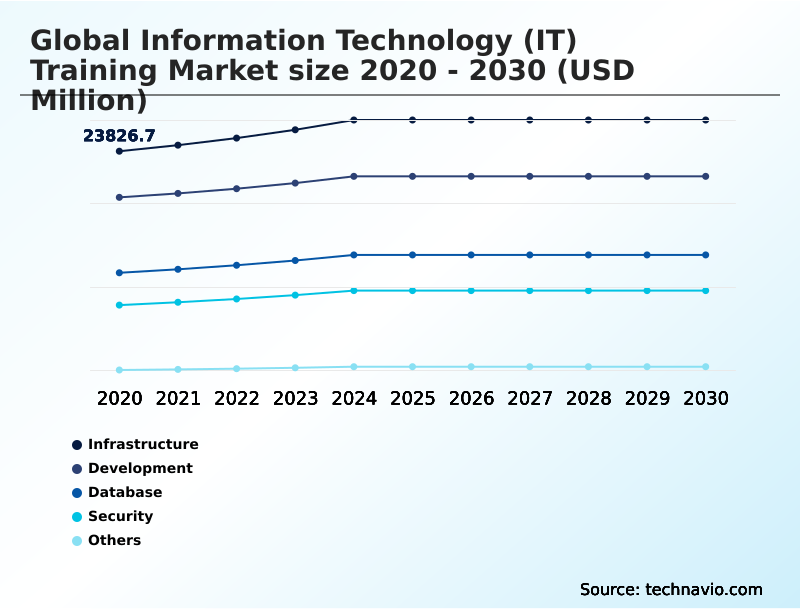
The Infrastructure segment was valued at USD 26.69 billion in 2024 and showed a gradual increase during the forecast period.
Regional Analysis
North America is estimated to contribute 38% to the growth of the global market during the forecast period.Technavio’s analysts have elaborately explained the regional trends and drivers that shape the market during the forecast period.
See How Information Technology (IT) Training Market Demand is Rising in North America Get Free Sample
Geographically, the market is led by North America, which accounts for approximately 38% of the incremental growth, driven by advanced adoption of DevSecOps practices and site reliability engineering.
In Europe, the focus on data fabric architecture and regulatory compliance has led to the widespread adoption of agile methodologies, improving project delivery times by up to 20%.
The APAC region exhibits the fastest expansion, with a high demand for full-stack development programs and enterprise software instruction to support its growing digital economy.
Across regions, there is a unified push toward mastering digital collaboration tools and implementing zero-trust security frameworks.
Training in database management courses, IT project management courses, and data engineering proficiency are universally prioritized to build a workforce capable of managing complex, data-centric business operations and secure serverless architecture training.
Market Dynamics
Our researchers analyzed the data with 2025 as the base year, along with the key drivers, trends, and challenges. A holistic analysis of drivers will help companies refine their marketing strategies to gain a competitive advantage.
- The strategic focus of corporate learning is shifting toward specialized, outcome-driven programs. Organizations are implementing IT training for hybrid cloud and FinOps training for cloud cost management to optimize spending, while training for software-defined networking and IT training for 5G transformation prepare for next-generation infrastructure. This is complemented by immersive VR for data center training, which reduces operational errors.
- In development, upskilling programs for AI fluency and developing skills for agentic systems are prioritized, alongside mastering AI-native development platform skills and empowering citizen developers through training on low-code platforms for citizen developers. On the security front, cybersecurity training for AI systems and implementing zero-trust security models are becoming standard.
- This includes compliance-focused security training, education on ethical AI governance for leaders, and enabling secure remote access technologies. Data strategy involves mastering data fabric architecture and managing decentralized data platforms. Operationally, IT service management with AI is enhancing efficiency, while agile project management certifications are in high demand.
- This pivot is supported by flexible credentialing, where blended learning for remote workforces improves completion rates by over 40% compared to online-only models, and micro-credentials for cloud architecture offer verifiable skill validation. Finally, developing green IT proficiency is an emerging priority aligning with corporate sustainability goals.
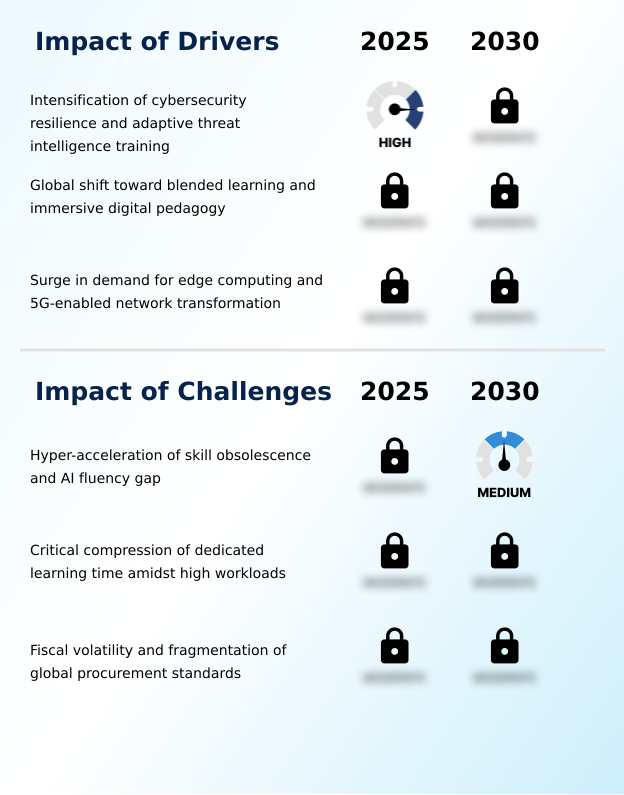
What are the key market drivers leading to the rise in the adoption of Information Technology (IT) Training Industry?
- The intensification of cybersecurity resilience, coupled with the growing necessity for adaptive threat intelligence training, serves as a key driver for market expansion.
- Market growth is driven by the urgent need for cybersecurity resilience and proficiency in adaptive threat intelligence.
- The rising complexity of cyber threats necessitates advanced cybersecurity certification programs and training in cloud security protocols and threat hunting techniques, with demand for certified professionals increasing over 30%.
- Concurrently, the transition to blended learning models and immersive digital pedagogy enhances training effectiveness, with hybrid approaches boosting engagement by 50% compared to online-only formats.
- The deployment of 5G-enabled network transformation and edge computing infrastructure creates a strong demand for specialized skills.
- The integration of generative AI across industries is accelerating the need for upskilling on AI-native development platforms and with AI-driven coding assistants, establishing new technical competency benchmarks for the modern workforce.
What are the market trends shaping the Information Technology (IT) Training Industry?
- A key market trend is the adoption of immersive spatial computing and virtual reality for technical skill simulation. This approach provides realistic, high-stakes practice scenarios without the risks of physical infrastructure.
- Key trends are reshaping skill development, with a pronounced shift toward modular, verifiable learning. The adoption of continuous skill frameworks and technical micro-credentials, often validated through digital badging and blockchain-verified certifications, is democratizing career progression. Immersive simulation-based training, leveraging spatial computing and VR for technical skill simulation, improves knowledge retention by up to 75%.
- This is complemented by the rise of low-code development and no-code platforms, which use AI-assisted builders to empower non-technical staff and accelerate application delivery by 40%. The focus is on adaptive learning paths and human-machine collaboration, where gamified assessments measure proficiency in real-world scenarios.
- This evolution ensures the workforce remains agile and capable of navigating complex technological landscapes with practical, verifiable expertise.
What challenges does the Information Technology (IT) Training Industry face during its growth?
- A primary market challenge is the hyper-acceleration of skill obsolescence, driven by the rapid evolution of generative AI and a widening AI fluency gap.
- The primary market challenge is managing hyper-accelerated skill obsolescence, with the half-life of technical skills shrinking by 45% due to the rapid evolution of generative AI. This creates a persistent AI fluency gap that traditional training models struggle to address.
- Organizations face difficulties implementing robust data governance frameworks and ensuring data sovereignty compliance for sovereign data solutions, particularly with the rise of agentic systems and cloud-native architecture. Furthermore, over 60% of employees cite a lack of time for deep-skill training as a major barrier, hindering the adoption of learning-in-the-flow-of-work solutions.
- This is compounded by a need for stronger ethical AI governance and IT leadership courses to guide strategy and protect against automated exploits, making continuous upskilling a critical but challenging priority.
Exclusive Technavio Analysis on Customer Landscape
The information technology (it) training market forecasting report includes the adoption lifecycle of the market, covering from the innovator’s stage to the laggard’s stage. It focuses on adoption rates in different regions based on penetration. Furthermore, the information technology (it) training market report also includes key purchase criteria and drivers of price sensitivity to help companies evaluate and develop their market growth analysis strategies.
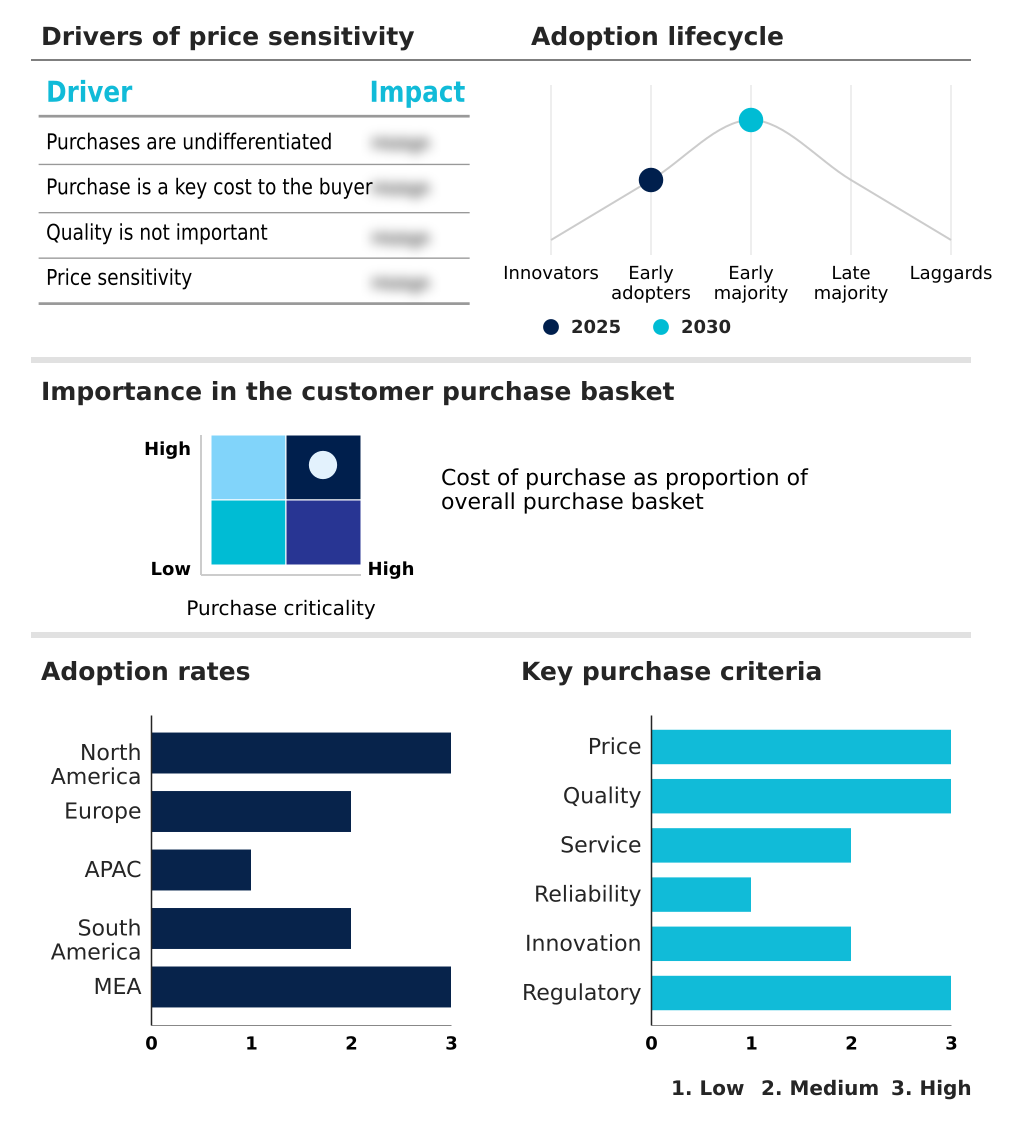
Customer Landscape of Information Technology (IT) Training Industry
Competitive Landscape
Companies are implementing various strategies, such as strategic alliances, information technology (it) training market forecast, partnerships, mergers and acquisitions, geographical expansion, and product/service launches, to enhance their presence in the industry.
Amazon Web Services Inc. - Provides certification programs focused on cloud practitioner, solutions architect, and DevOps engineering roles, delivering scalable training for low-cost cloud infrastructure platforms.
The industry research and growth report includes detailed analyses of the competitive landscape of the market and information about key companies, including:
- Amazon Web Services Inc.
- CBT Nuggets LLC
- Cisco Systems Inc.
- Dell Technologies Inc.
- Fast Lane Institute
- Firebrand Training Ltd.
- Hewlett Packard Entp Co.
- IBM Corp.
- Learning Tree International
- Microsoft Corp.
- NIIT Ltd.
- Oracle Corp.
- Pluralsight LLC
- QA Ltd.
- Red Hat Inc.
- SANS Institute
- SAP SE
- Skillsoft Corp.
- The Linux Foundation
Qualitative and quantitative analysis of companies has been conducted to help clients understand the wider business environment as well as the strengths and weaknesses of key industry players. Data is qualitatively analyzed to categorize companies as pure play, category-focused, industry-focused, and diversified; it is quantitatively analyzed to categorize companies as dominant, leading, strong, tentative, and weak.
Recent Development and News in Information technology (it) training market
- In September, 2024, Google announced a $6 billion investment to develop a state-of-the-art data center in India, a move expected to drive localized, government-led training programs for sovereign data infrastructure.
- In November, 2024, VSP Vision announced a significant expansion of its digital education platform, redesigning its curriculum to incorporate advanced technical training modules for its network of independent providers.
- In January, 2025, NIIT Learning Systems Limited completed the acquisition of SweetRush Inc., a leader in AI-enabled custom learning design, to bolster its managed training services for large enterprises.
- In February, 2025, Microsoft Corp. launched its Partner Skilling Hub to centralize role-based workshops focused on AI business solutions and Zero Trust security architectures for its global partner network.
Dive into Technavio’s robust research methodology, blending expert interviews, extensive data synthesis, and validated models for unparalleled Information Technology (IT) Training Market insights. See full methodology.
| Market Scope | |
|---|---|
| Page number | 308 |
| Base year | 2025 |
| Historic period | 2020-2024 |
| Forecast period | 2026-2030 |
| Growth momentum & CAGR | Accelerate at a CAGR of 4.1% |
| Market growth 2026-2030 | USD 17853.4 million |
| Market structure | Fragmented |
| YoY growth 2025-2026(%) | 4.0% |
| Key countries | US, Canada, Mexico, Germany, UK, France, Italy, Spain, The Netherlands, China, India, Japan, South Korea, Australia, Indonesia, Brazil, Argentina, Chile, UAE, Saudi Arabia, South Africa, Egypt and Turkey |
| Competitive landscape | Leading Companies, Market Positioning of Companies, Competitive Strategies, and Industry Risks |
Research Analyst Overview
- The market is defined by a continuous cycle of IT infrastructure modernization, compelling a strategic response in workforce development. Boardroom decisions increasingly center on FinOps training to manage escalating hybrid cloud environments spend, directly impacting profitability.
- This requires a holistic approach, starting with software-defined networking and network functions virtualization, moving through DevSecOps practices, and culminating in advanced skill sets for generative AI integration and human-machine collaboration. The demand for validated skills is intense, with roles requiring certifications in areas like cybersecurity resilience and adaptive threat intelligence surging by 34%.
- Core competencies now include cloud-native architecture, site reliability engineering, and IT service management, supported by agile methodologies. Security training has deepened to cover zero-trust security, identity and access management, AI-augmented security operations, and sovereign data solutions. Development tracks focus on low-code development, no-code platforms, and agentic systems, while infrastructure management extends to edge computing deployment, AIOps, predictive maintenance, and 5G-enabled network transformation.
- Addressing the AI fluency gap and skill obsolescence requires continuous skill frameworks and technical micro-credentials, delivered via blended learning models and immersive digital pedagogy with spatial computing and VR for technical skill simulation. This ecosystem is held together by robust data governance frameworks and digital collaboration tools, with serverless architecture training becoming a key specialization.
What are the Key Data Covered in this Information Technology (IT) Training Market Research and Growth Report?
-
What is the expected growth of the Information Technology (IT) Training Market between 2026 and 2030?
-
USD 17.85 billion, at a CAGR of 4.1%
-
-
What segmentation does the market report cover?
-
The report is segmented by Service (Infrastructure, Development, Database, Security, and Others), End-user (Corporate, Schools and colleges, and Others), Delivery Mode (Online, Blended, and Offline) and Geography (North America, Europe, APAC, South America, Middle East and Africa)
-
-
Which regions are analyzed in the report?
-
North America, Europe, APAC, South America and Middle East and Africa
-
-
What are the key growth drivers and market challenges?
-
Intensification of cybersecurity resilience and adaptive threat intelligence training, Hyper-acceleration of skill obsolescence and AI fluency gap
-
-
Who are the major players in the Information Technology (IT) Training Market?
-
Amazon Web Services Inc., CBT Nuggets LLC, Cisco Systems Inc., Dell Technologies Inc., Fast Lane Institute, Firebrand Training Ltd., Hewlett Packard Entp Co., IBM Corp., Learning Tree International, Microsoft Corp., NIIT Ltd., Oracle Corp., Pluralsight LLC, QA Ltd., Red Hat Inc., SANS Institute, SAP SE, Skillsoft Corp. and The Linux Foundation
-
Market Research Insights
- The market's momentum is sustained by corporate investment in specific skill sets, where targeted training delivers measurable outcomes. For example, firms leveraging enterprise software instruction and cloud architecture upskilling report an ROI exceeding 200% through improved system efficiency. The demand for verified technical competency is clear, with roles requiring cybersecurity certification programs seeing a 34% surge in hiring.
- Training in IT infrastructure, full-stack development programs, and database management courses are foundational, while specialized modules for IT project management courses and data engineering proficiency are critical for strategic execution.
- The rise of AI has boosted interest in AI-driven coding assistants and ethical AI governance, making continuous learning essential for maintaining a competitive edge and ensuring professionals can navigate complex technological and regulatory landscapes effectively.
We can help! Our analysts can customize this information technology (it) training market research report to meet your requirements.
 RIA -
RIA - 
