


Laser Cutting Machine Market Size 2026-2030
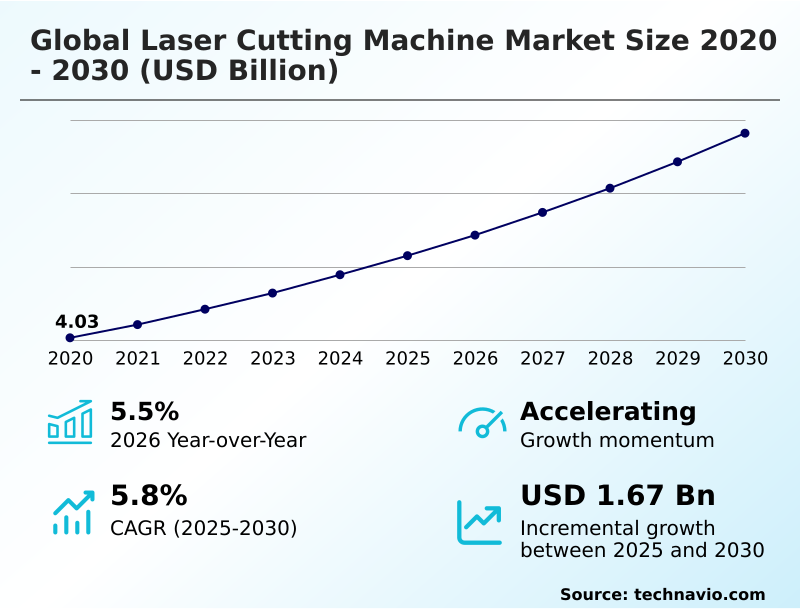
The laser cutting machine market size is valued to increase by USD 1.67 billion, at a CAGR of 5.8% from 2025 to 2030. Accelerated adoption of industrial automation and smart factory integration will drive the laser cutting machine market.
Major Market Trends & Insights
- APAC dominated the market and accounted for a 56.3% growth during the forecast period.
- By End-user - Automotive segment was valued at USD 1.24 billion in 2024
- By Product - Fiber segment accounted for the largest market revenue share in 2024
Market Size & Forecast
- Market Opportunities: USD 2.79 billion
- Market Future Opportunities: USD 1.67 billion
- CAGR from 2025 to 2030 : 5.8%
Market Summary
- The laser cutting machine market is advancing beyond simple part fabrication, driven by a confluence of technological innovation and industrial demand. Key drivers include the strategic shift toward ultra-high-power fiber laser sources, which drastically improve throughput, and the widespread adoption of industrial automation to mitigate skilled labor shortages. These systems are becoming central to smart factory ecosystems.
- Concurrently, trends like the integration of AI for autonomous process control and the use of specialized blue and green laser wavelengths for e-mobility applications are redefining manufacturing capabilities. For instance, a fabricator supplying the electric vehicle industry can now cut highly reflective copper for battery components with minimal thermal distortion, a task previously fraught with challenges.
- However, the market faces hurdles such as the substantial capital investment required for these advanced machines and persistent volatility in raw material supply chains, which can temper investment confidence and disrupt production planning.
What will be the Size of the Laser Cutting Machine Market during the forecast period?
Get Key Insights on Market Forecast (PDF) Get Free Sample
How is the Laser Cutting Machine Market Segmented?
The laser cutting machine industry research report provides comprehensive data (region-wise segment analysis), with forecasts and estimates in "USD million" for the period 2026-2030, as well as historical data from 2020-2024 for the following segments.
- End-user
- Automotive
- Aerospace and defense
- Electrical and electronics
- Industrial machinery
- Others
- Product
- Fiber
- Solid-state
- Diode
- Others
- Method
- Fusion cutting
- Flame cutting
- Sublimation cutting
- Geography
- APAC
- China
- Japan
- South Korea
- Europe
- Germany
- Italy
- UK
- North America
- US
- Canada
- Mexico
- South America
- Brazil
- Argentina
- Middle East and Africa
- UAE
- Saudi Arabia
- South Africa
- Rest of World (ROW)
- APAC
By End-user Insights
The automotive segment is estimated to witness significant growth during the forecast period.
The automotive sector is driving significant evolution in sheet metal processing, spurred by the shift to electric vehicles. This transition necessitates non-contact laser processes capable of handling lightweight materials like aluminum and high-strength steel.
The focus on e-mobility applications has created demand for high-power fiber laser systems that increase cutting speeds by up to 50%, crucial for high-volume assembly lines.
Industrial automation integration is paramount, with lights-out operation and robotic sorting arms becoming standard for continuous production. This includes new applications like the laser dicing of battery components, which demands spatter-free cutting to ensure safety and quality.
The emphasis is on creating a seamless smart factory integration workflow, moving from raw material to finished part with minimal manual intervention.
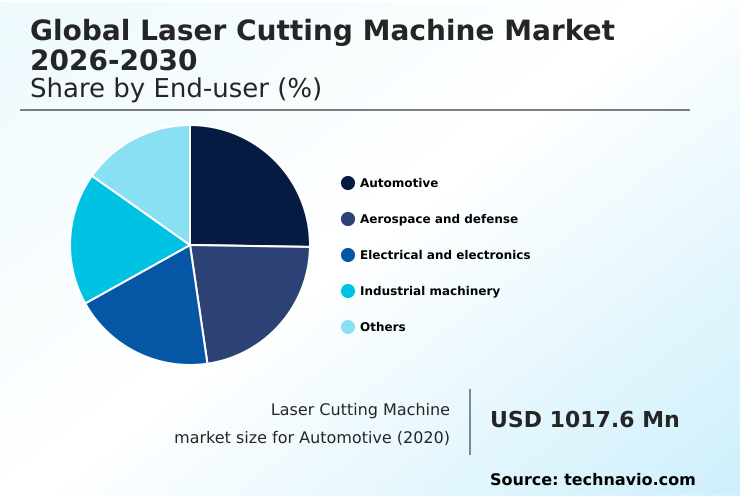
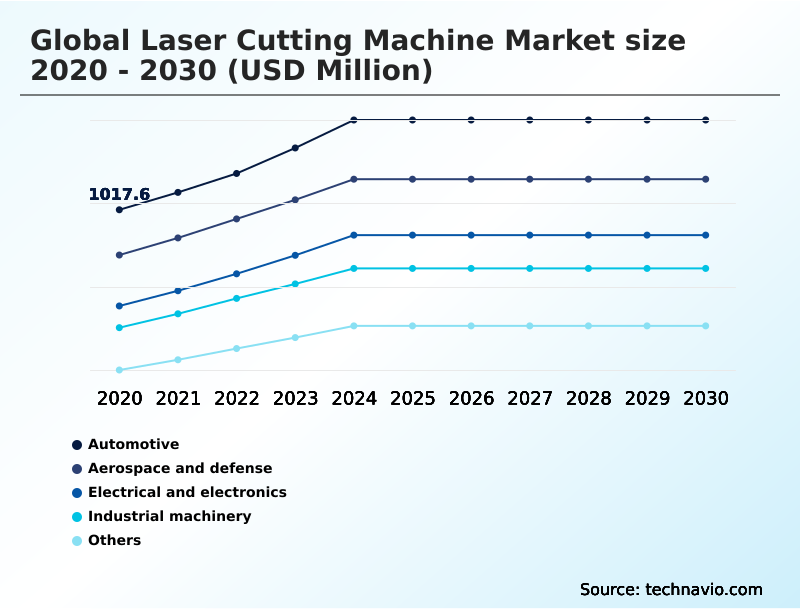
The Automotive segment was valued at USD 1.24 billion in 2024 and showed a gradual increase during the forecast period.
Regional Analysis
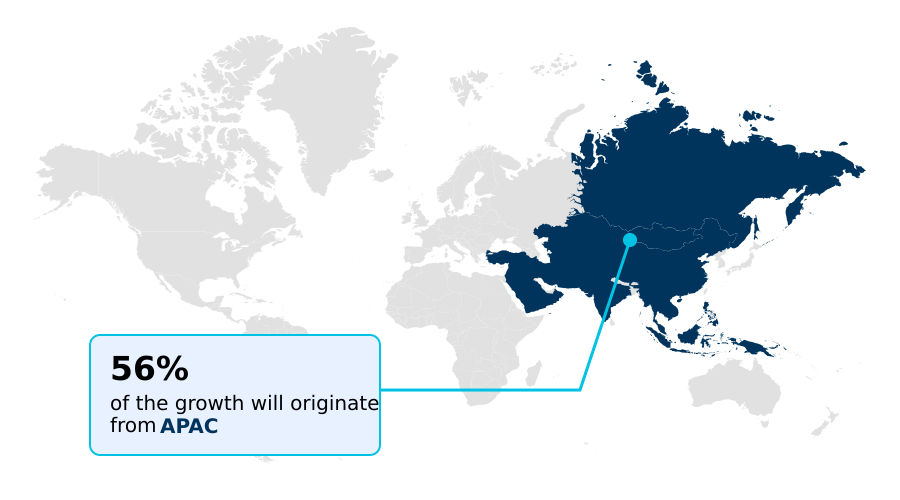
APAC is estimated to contribute 56.3% to the growth of the global market during the forecast period.Technavio’s analysts have elaborately explained the regional trends and drivers that shape the market during the forecast period.
See How Laser Cutting Machine Market Demand is Rising in APAC Get Free Sample
The geographic landscape is dominated by APAC, which commands over 56% of the market's incremental growth, driven by China’s leadership in heavy machinery fabrication and Japan’s focus on precision aerospace component manufacturing.
This region’s rapid adoption of high-power fiber laser technology and industrial automation integration contrasts with North America, which accounts for under 19% of growth but is quickly advancing due to manufacturing reshoring.
In Europe, the focus is on smart factory integration and energy efficiency to combat high operational costs. Key technologies like 3d laser cutting and direct diode laser systems are gaining traction globally.
The goal is to enhance material utilization through process intelligence and achieve lights-out production, with some automated cells increasing operational uptime by over 40%.
Market Dynamics
Our researchers analyzed the data with 2025 as the base year, along with the key drivers, trends, and challenges. A holistic analysis of drivers will help companies refine their marketing strategies to gain a competitive advantage.
- Strategic decision-making in the global laser cutting machine market 2026-2030 involves navigating a complex technological landscape. The fundamental choice often begins with evaluating a high-power fiber laser vs plasma cutting for thick plate applications, where speed and edge quality are critical trade-offs.
- For specialized sectors, the focus shifts; the rise of e-mobility necessitates a blue laser for copper cutting to enable the efficient production of components used in laser cutting for electric vehicle batteries. Automation is another key investment area, with fabricators implementing solutions for automating laser cut part sorting to create fully autonomous workflows.
- The integration of ai in laser cutting process control further enhances this by enabling real-time adjustments. Advanced capabilities like bevel cutting for weld preparation are transforming fabrication by eliminating secondary processes, which can reduce total part cycle times by more than 25%.
- Precision-driven industries require meticulous control, focusing on reducing heat-affected zone in laser cutting, especially for laser cutting of ultra-high-strength steel and components for a laser cutting machine for medical implants. At the highest end, niche applications like femtosecond laser for glass cutting are opening new industrial possibilities.
- Other notable trends include laser systems for battery recycling, automated guided vehicles in fabrication, multi-axis 3d laser cutting, laser cutting for architectural metalwork, process monitoring in laser cutting, nesting software for material savings, green lasers for copper welding, laser cutting for semiconductor singulation, modular laser cutting platforms, and high-speed nitrogen cutting processes.
What are the key market drivers leading to the rise in the adoption of Laser Cutting Machine Industry?
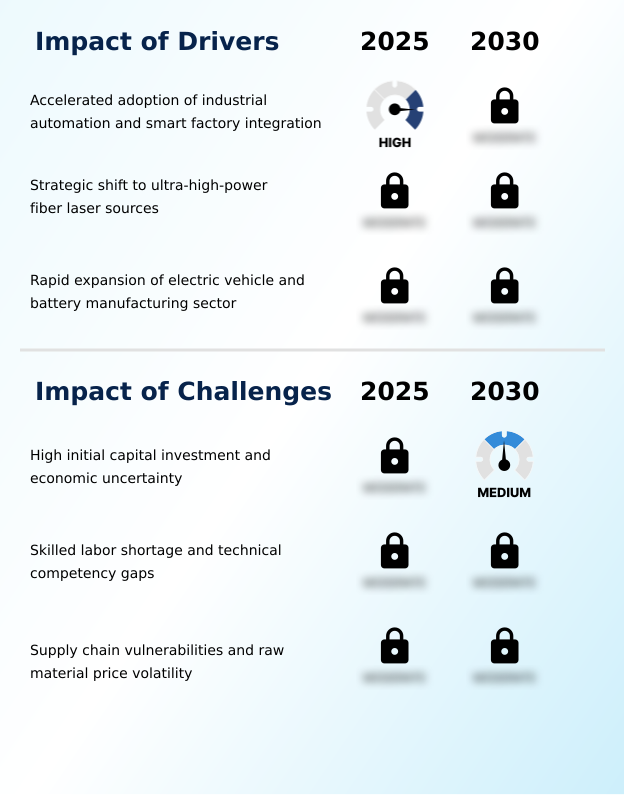
- The accelerated adoption of industrial automation and smart factory integration is a key driver for market growth.
- Market momentum is primarily driven by the push for industrial automation integration and the realization of smart factory integration.
- The adoption of lights-out manufacturing, supported by automated material handling and robotic sorting arms, addresses labor shortages and boosts operational uptime by over 30%.
- A second major driver is the wattage war, with the proliferation of high-power fiber laser sources enabling fabricators to process thick materials at speeds up to five times faster than previous generations.
- This capability is crucial for heavy machinery fabrication and structural steel fabrication.
- Finally, the boom in e-mobility applications has created immense demand for sheet metal processing of battery enclosures and motor components, dictating the industry’s technological roadmap toward specialized, high-precision systems.
What are the market trends shaping the Laser Cutting Machine Industry?
- The integration of artificial intelligence for autonomous process control is an upcoming market trend. This shift emphasizes process intelligence over raw cutting speed to enhance operational efficiency.
- A defining trend is the integration of autonomous process control through AI, enhancing process intelligence to decouple quality from operator skill. This enables dynamic adjustments for material inconsistencies, boosting first-pass yield rates by over 7%.
- The diversification into specialized wavelengths, such as green laser wavelength and blue diode laser systems, is critical for e-mobility applications, where spatter-free cutting of copper is required. Absorption rates for these materials improve by more than ten times compared to standard infrared lasers.
- Furthermore, process consolidation through hybrid manufacturing systems that incorporate bevel cutting and laser tube cutting eliminates downstream production steps. This done-in-one manufacturing approach streamlines workflows and maximizes material utilization in modern fabrication environments.
What challenges does the Laser Cutting Machine Industry face during its growth?
- High initial capital investment coupled with economic uncertainty presents a key challenge affecting industry growth.
- The market faces significant headwinds from high capital investment requirements, with financing costs increasing by over 15% in some regions due to economic uncertainty. This challenge is compounded by a persistent skilled labor shortage, making it difficult for firms to leverage the advanced capabilities of modern equipment focused on autonomous process control.
- Furthermore, supply chain volatility presents a major constraint for both aerospace component manufacturing and medical device fabrication, where lead times for critical components and raw materials have shown fluctuations of up to 40%.
- This instability impacts weld preparation timelines and makes it difficult for fabricators to maintain consistent lights-out operation, thereby restraining investment in new capacity for sheet metal processing and structural steel fabrication.
Exclusive Technavio Analysis on Customer Landscape
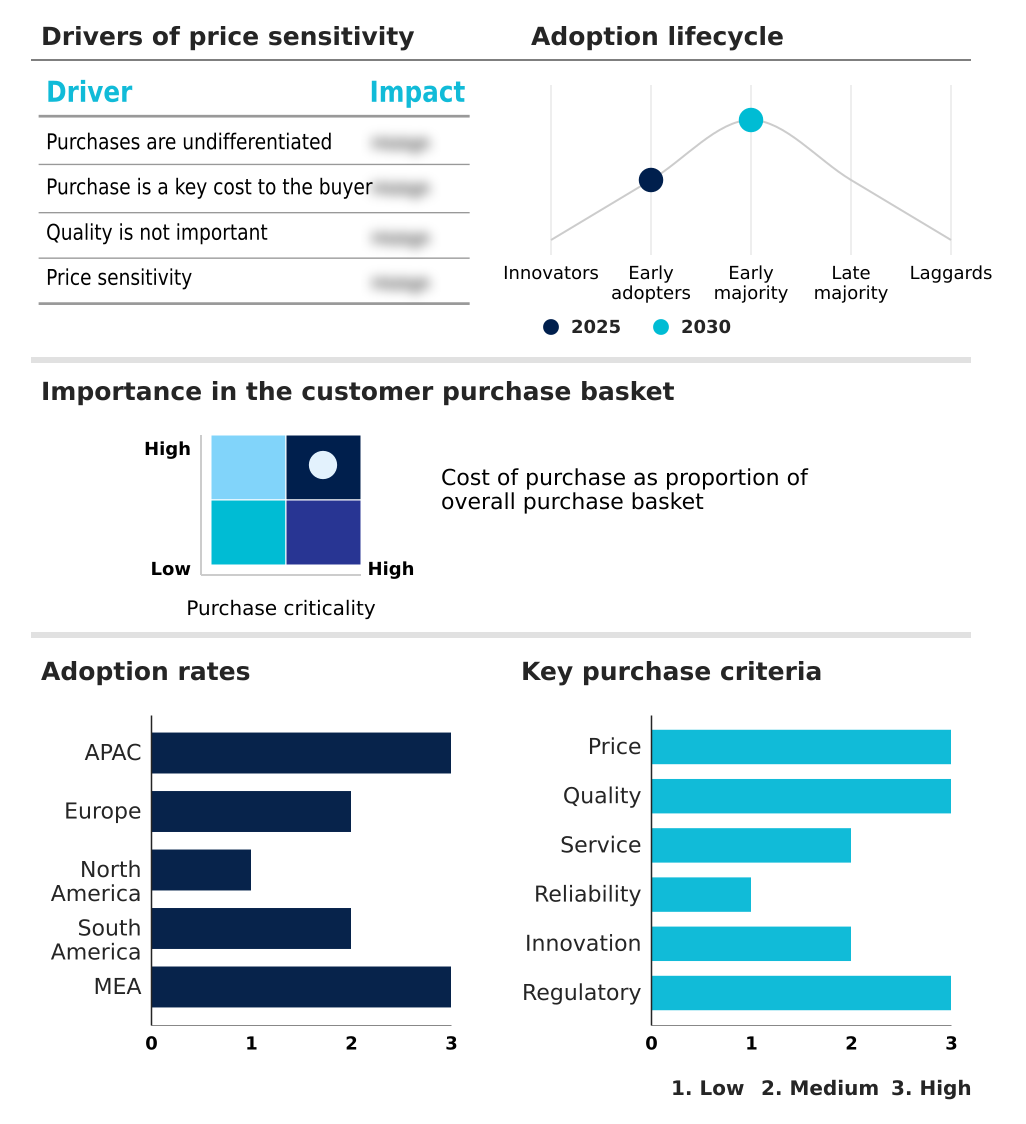
The laser cutting machine market forecasting report includes the adoption lifecycle of the market, covering from the innovator’s stage to the laggard’s stage. It focuses on adoption rates in different regions based on penetration. Furthermore, the laser cutting machine market report also includes key purchase criteria and drivers of price sensitivity to help companies evaluate and develop their market growth analysis strategies.
Customer Landscape of Laser Cutting Machine Industry
Competitive Landscape
Companies are implementing various strategies, such as strategic alliances, laser cutting machine market forecast, partnerships, mergers and acquisitions, geographical expansion, and product/service launches, to enhance their presence in the industry.
ALPHA LASER GmbH - Specialized offerings include high-precision fiber laser systems engineered for advanced metal processing, addressing complex industrial fabrication and manufacturing requirements with superior accuracy and reliability.
The industry research and growth report includes detailed analyses of the competitive landscape of the market and information about key companies, including:
- ALPHA LASER GmbH
- Amada Co. Ltd.
- Bystronic Laser AG
- El.En. S.p.A.
- Epilog Corp.
- Hans Laser Technology Co. Ltd.
- HGLaser Engineering Co. Ltd.
- IPG Photonics Corp.
- Jenoptik AG
- Koike Aronson Inc.
- Mitsubishi Electric Corp.
- Salvagnini Italia SPA
- SLTL Group
- TRUMPF SE Co. KG
- Universal Laser Systems Inc.
Qualitative and quantitative analysis of companies has been conducted to help clients understand the wider business environment as well as the strengths and weaknesses of key industry players. Data is qualitatively analyzed to categorize companies as pure play, category-focused, industry-focused, and diversified; it is quantitatively analyzed to categorize companies as dominant, leading, strong, tentative, and weak.
Recent Development and News in Laser cutting machine market
- In September 2025, Bystronic launched its ByCut 3015 system, which is equipped with a thirty-kilowatt fiber laser source to enhance processing speeds for thick materials in heavy industrial applications.
- In November 2024, Amada released the Regius 3015 AJ, featuring a twenty-six-kilowatt oscillator and advanced beam control technology designed for stable, high-speed cutting across various material thicknesses.
- In February 2025, Lantek released a new software module that utilizes historical production data and machine learning to predict and optimize nesting patterns, aiming to significantly reduce material waste.
- In May 2025, Messer Cutting Systems showcased its modular Element platform, which allows for the integration of laser cutting, plasma cutting, and machining tools on a single gantry system.
Dive into Technavio’s robust research methodology, blending expert interviews, extensive data synthesis, and validated models for unparalleled Laser Cutting Machine Market insights. See full methodology.
| Market Scope | |
|---|---|
| Page number | 303 |
| Base year | 2025 |
| Historic period | 2020-2024 |
| Forecast period | 2026-2030 |
| Growth momentum & CAGR | Accelerate at a CAGR of 5.8% |
| Market growth 2026-2030 | USD 1666.5 million |
| Market structure | Fragmented |
| YoY growth 2025-2026(%) | 5.5% |
| Key countries | China, Japan, South Korea, India, Taiwan, Indonesia, Germany, Italy, UK, France, Spain, The Netherlands, US, Canada, Mexico, Brazil, Argentina, Chile, UAE, Saudi Arabia, South Africa, Israel and Egypt |
| Competitive landscape | Leading Companies, Market Positioning of Companies, Competitive Strategies, and Industry Risks |
Research Analyst Overview
- The laser cutting machine market's evolution is defined by a shift toward process intelligence and integrated automation. The universal adoption of the fiber laser source has paved the way for a new focus on beam shaping technology and optimizing the assist gas mix to control kerf width and eliminate defects.
- Fabricators now choose between fusion cutting for clean edges and flame cutting for thick steel, while sublimation cutting, driven by ultrashort pulse laser technologies like the femtosecond laser and picosecond laser, enables cold ablation with a minimal heat-affected zone. This is crucial for delicate materials.
- Specialized sources such as the direct diode laser, disk laser, and particularly the blue diode laser and green laser wavelength, enable spatter-free cutting of reflective metals. These hardware advancements are governed by sophisticated CNC controller units running advanced nesting patterns that support lights-out manufacturing.
- In these automated environments, where automated material handling is standard, achieving high wall-plug efficiency is a primary boardroom objective, with modern systems demonstrating a 30% reduction in energy consumption over legacy equipment.
What are the Key Data Covered in this Laser Cutting Machine Market Research and Growth Report?
-
What is the expected growth of the Laser Cutting Machine Market between 2026 and 2030?
-
USD 1.67 billion, at a CAGR of 5.8%
-
-
What segmentation does the market report cover?
-
The report is segmented by End-user (Automotive, Aerospace and defense, Electrical and electronics, Industrial machinery, and Others), Product (Fiber, Solid-state, Diode, and Others), Method (Fusion cutting, Flame cutting, and Sublimation cutting) and Geography (APAC, Europe, North America, South America, Middle East and Africa)
-
-
Which regions are analyzed in the report?
-
APAC, Europe, North America, South America and Middle East and Africa
-
-
What are the key growth drivers and market challenges?
-
Accelerated adoption of industrial automation and smart factory integration, High initial capital investment and economic uncertainty
-
-
Who are the major players in the Laser Cutting Machine Market?
-
ALPHA LASER GmbH, Amada Co. Ltd., Bystronic Laser AG, El.En. S.p.A., Epilog Corp., Hans Laser Technology Co. Ltd., HGLaser Engineering Co. Ltd., IPG Photonics Corp., Jenoptik AG, Koike Aronson Inc., Mitsubishi Electric Corp., Salvagnini Italia SPA, SLTL Group, TRUMPF SE Co. KG and Universal Laser Systems Inc.
-
Market Research Insights
- The laser cutting machine market is defined by a strategic push toward autonomous process control and industrial automation integration. This is driven by the need to enhance material utilization, which can be improved by up to 15% through advanced software.
- In heavy machinery fabrication, the adoption of high-power fiber laser systems enables process consolidation, reducing downstream tasks and shortening lead times by over 25%. E-mobility applications are also a significant influence, demanding specialized solutions for non-ferrous metal processing. The competitive landscape is shaped by the wattage war and a focus on hybrid manufacturing systems that offer greater flexibility.
- This drive for efficiency and capability is redefining standards across the industry, promoting a shift toward done-in-one manufacturing philosophies.
We can help! Our analysts can customize this laser cutting machine market research report to meet your requirements.
 RIA -
RIA - 
