


Southeast Asia Lead-acid Battery Market Size 2026-2030
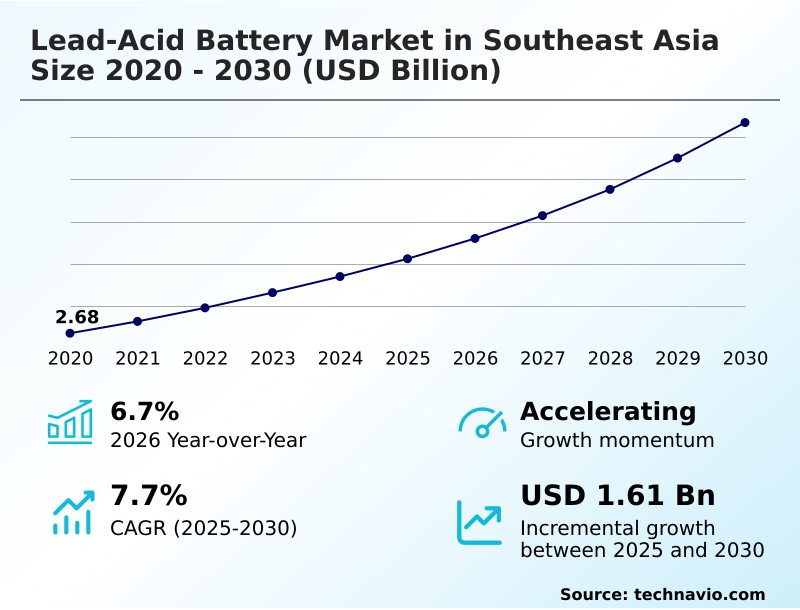
The southeast asia lead-acid battery market size is valued to increase by USD 1.61 billion, at a CAGR of 7.7% from 2025 to 2030. Significant growth in automotive industries will drive the southeast asia lead-acid battery market.
Major Market Trends & Insights
- By Type - FLA batteries segment was valued at USD 2.39 billion in 2024
- By Application - Automotive segment accounted for the largest market revenue share in 2024
Market Size & Forecast
- Market Opportunities: USD 2.49 billion
- Market Future Opportunities: USD 1.61 billion
- CAGR from 2025 to 2030 : 7.7%
Market Summary
- The Lead-Acid Battery Market in Southeast Asia is sustained by its indispensable role in the automotive and industrial sectors. The relentless expansion of vehicle manufacturing, particularly for internal combustion engine (ICE) models, ensures steady demand for starting, lighting, and ignition (SLI) batteries.
- In the industrial sphere, these batteries are the backbone of logistics, powering electric forklift fleets and providing essential backup power systems for data centers and telecommunications. A significant trend shaping the market is the adoption of decentralized power generation, where deep cycle lead-acid batteries are crucial for renewable energy storage in microgrids, especially in archipelagic nations.
- This application helps bridge energy gaps in remote areas. However, the market faces challenges from the technology's intrinsic drawbacks, including lower energy density compared to alternatives and the environmental concerns associated with lead recycling.
- A logistics firm, for instance, must balance the lower upfront cost of lead-acid motive power batteries against the higher operational efficiency and longer lifecycle of competing technologies, a decision influenced by factors like battery maintenance practices and evolving battery management systems (BMS).
- The industry's evolution is marked by innovations in advanced lead-acid chemistry, such as enhanced flooded battery (EFB) and absorbed glass mat (AGM) battery types, which cater to modern start-stop systems.
What will be the Size of the Southeast Asia Lead-acid Battery Market during the forecast period?
Get Key Insights on Market Forecast (PDF) Get Free Sample
How is the Southeast Asia Lead-acid Battery Market Segmented?
The southeast asia lead-acid battery industry research report provides comprehensive data (region-wise segment analysis), with forecasts and estimates in "USD million" for the period 2026-2030, as well as historical data from 2020-2024 for the following segments.
- Type
- FLA batteries
- VRLA batteries
- Application
- Automotive
- Industrial
- Others
- Product
- SLI
- Stationary
- Motive
- Geography
- Southeast Asia
By Type Insights
The fla batteries segment is estimated to witness significant growth during the forecast period.
The FLA batteries segment remains a cornerstone of the lead-acid battery market in Southeast Asia, providing cost-effective energy storage for a range of applications.
These flooded units, including robust traction batteries and deep cycle lead-acid batteries, are integral to industrial battery solutions and off-grid solar power systems.
Their design necessitates adherence to strict battery maintenance practices to mitigate issues like sulfation and electrolyte stratification, which can impact performance.
In many industrial settings, optimizing charging protocols has been shown to extend the operational life of these units by up to 20%, reinforcing their value proposition.
The market for FLA batteries is sustained by demand from sectors where upfront cost and proven reliability are paramount.
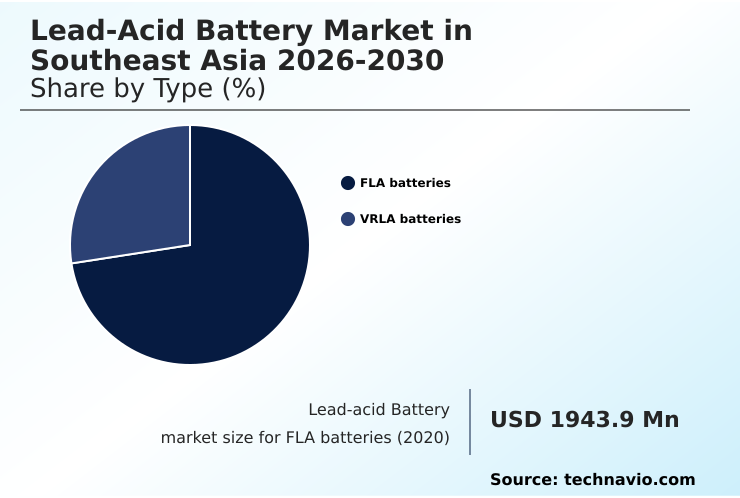
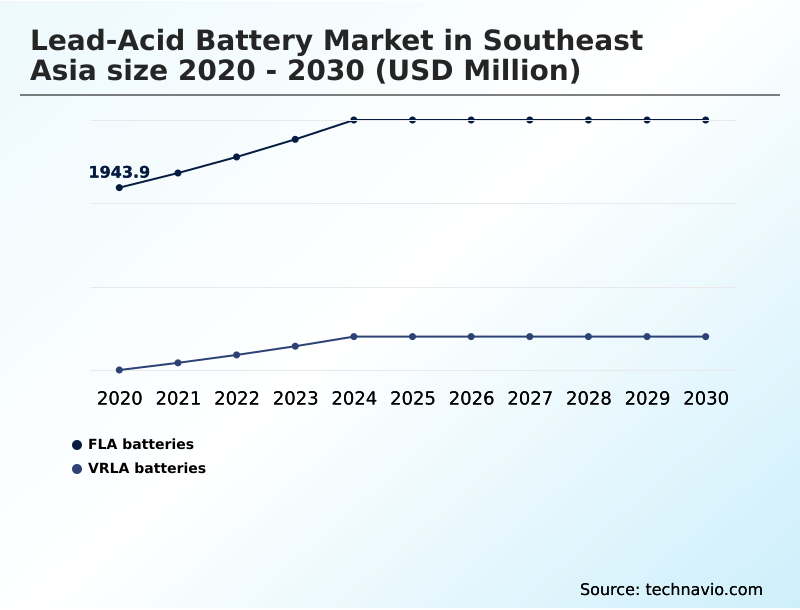
The FLA batteries segment was valued at USD 2.39 billion in 2024 and showed a gradual increase during the forecast period.
Market Dynamics
Our researchers analyzed the data with 2025 as the base year, along with the key drivers, trends, and challenges. A holistic analysis of drivers will help companies refine their marketing strategies to gain a competitive advantage.
- Decisions within the lead-acid battery market in Southeast Asia are increasingly nuanced, moving beyond simple upfront costs. The debate over the cost of lead-acid vs lithium-ion batteries is a central theme, especially for large-scale deployments.
- For many industrial users, the total cost of ownership for heavy-duty lead-acid traction batteries for forklifts remains competitive, especially when considering the lead-acid battery recycling process efficiency, which can be up to 25% more cost-effective than managing nascent lithium recycling streams.
- When selecting the best lead-acid battery for off-grid solar systems, factors like improving lead-acid battery lifespan in hot climates become critical. Here, the choice between VRLA gel battery vs AGM for deep cycle use depends on specific thermal management and cycling requirements. The demand for a maintenance-free VRLA battery for UPS applications continues to grow with digitalization.
- In automotive, lead-acid battery technology for start-stop vehicles, like EFB and AGM, is pivotal. The industry is also addressing technical hurdles like the impact of sulfation on lead-acid battery capacity through advanced battery management systems for lead-acid fleets.
- Adherence to regulations for lead-acid battery disposal and handling remains a key compliance challenge, shaping the future of lead-acid battery technology in applications from emergency lighting systems to grid stabilization.
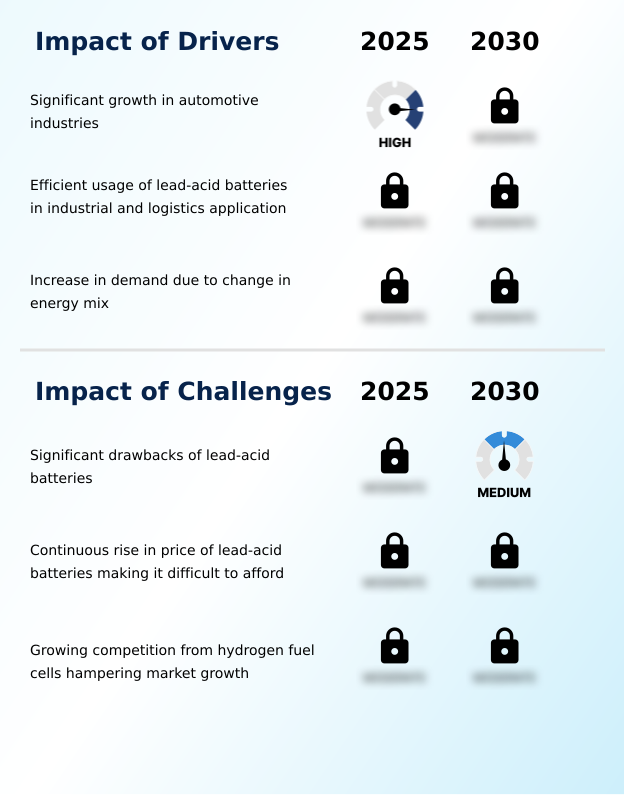
What are the key market drivers leading to the rise in the adoption of Southeast Asia Lead-acid Battery Industry?
- Significant growth in the automotive industries across key regional hubs is a primary driver for the lead-acid battery market.
- Robust growth in the automotive sector, where SLI batteries for starting, lighting, and ignition (SLI) are essential for the vast fleet of internal combustion engine (ICE) vehicles, is a primary driver.
- This segment represents over 60% of regional demand, fueled by advanced automotive battery technology. Concurrently, industrial vehicle electrification is expanding, with motive power batteries for electric forklift batteries becoming critical in logistics.
- The rapid expansion of the digital economy also fuels demand for uninterruptible power supply (UPS) units in data center UPS systems, where reliability is non-negotiable.
What are the market trends shaping the Southeast Asia Lead-acid Battery Industry?
- The shift toward decentralized power generation is an emerging market trend, driven by the adoption of microgrid solutions in remote and island communities for energy independence.
- A key trend is the shift toward decentralized power, with microgrid battery storage solutions using VRLA batteries and stationary batteries to improve energy access, achieving over 98% power uptime. This move leverages advanced lead-acid chemistry for reliable energy storage for renewables.
- In the automotive sector, the adoption of start-stop systems is driving demand for high-performance sealed lead-acid (SLA) batteries, which can reduce urban vehicle emissions by up to 8%. These energy storage systems (ESS) are also finding applications in grid stabilization, where their rapid response capabilities are critical.
What challenges does the Southeast Asia Lead-acid Battery Industry face during its growth?
- The inherent physical and chemical limitations of lead-acid batteries, such as low energy density and environmental risks, present a significant challenge to market growth.
- Significant challenges stem from the technology's inherent limitations. Low energy density means batteries require up to twice the physical space of alternatives. High ambient temperatures can reduce battery lifespan by 30%, a key issue for telecom tower batteries and marine and RV batteries.
- The limited depth of discharge (DOD) and susceptibility to damage from low state of charge (SOC) conditions necessitate sophisticated battery management systems (BMS), even in applications like golf cart batteries. While a mature battery recycling infrastructure supports lead recycling efforts, concerns over environmental impact and competition from technologies with better high-rate discharge performance persist.
Exclusive Technavio Analysis on Customer Landscape
The southeast asia lead-acid battery market forecasting report includes the adoption lifecycle of the market, covering from the innovator’s stage to the laggard’s stage. It focuses on adoption rates in different regions based on penetration. Furthermore, the southeast asia lead-acid battery market report also includes key purchase criteria and drivers of price sensitivity to help companies evaluate and develop their market growth analysis strategies.
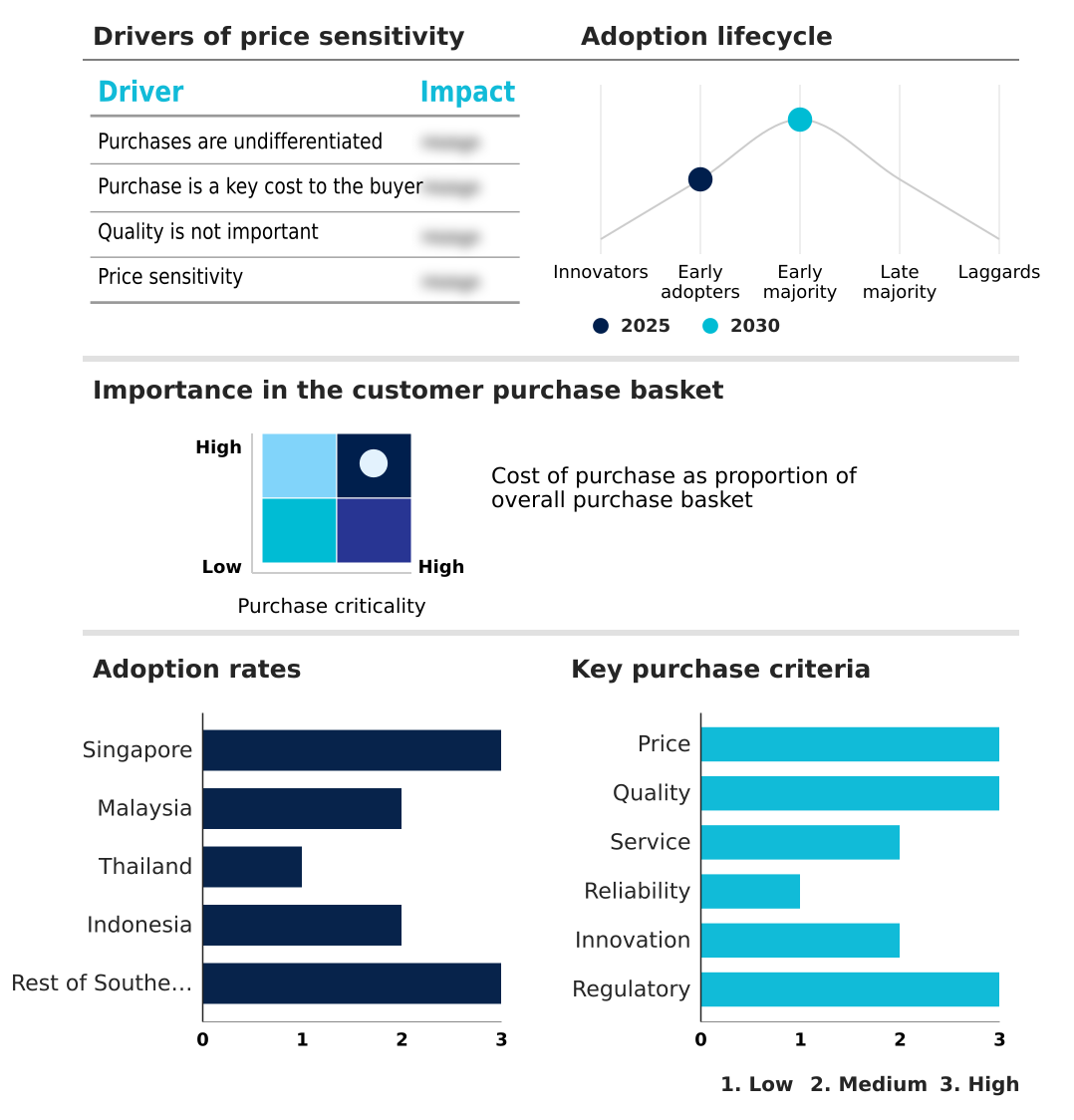
Customer Landscape of Southeast Asia Lead-acid Battery Industry
Competitive Landscape
Companies are implementing various strategies, such as strategic alliances, southeast asia lead-acid battery market forecast, partnerships, mergers and acquisitions, geographical expansion, and product/service launches, to enhance their presence in the industry.
ACE Green Recycling Inc. - Analyzes a proprietary recycling process for used lead-acid batteries, focusing on commercialization and environmental compliance within the market.
The industry research and growth report includes detailed analyses of the competitive landscape of the market and information about key companies, including:
- ACE Green Recycling Inc.
- C and D Technologies Inc.
- Century Batteries Indonesia
- Contemporary Amperex Ltd.
- East Penn Manufacture Co. Inc.
- EnerSys
- Exide Industries Ltd.
- Furukawa Electric Co. Ltd.
- Gravita India Ltd.
- GS Yuasa International Ltd.
- Hankook Tire and Technology Co
- HOPPECKE
- Johnson Controls International
- Leoch International Technology
- Panasonic Holdings Corp.
- PT. Tri Mega Baterindo
- Narada Asia Pacific Pte. Ltd
- PT New Indobatt Energy Nusantara
- PT Selatan Jadi Jaya
- PT Trimitra Baterai Prakasa
Qualitative and quantitative analysis of companies has been conducted to help clients understand the wider business environment as well as the strengths and weaknesses of key industry players. Data is qualitatively analyzed to categorize companies as pure play, category-focused, industry-focused, and diversified; it is quantitatively analyzed to categorize companies as dominant, leading, strong, tentative, and weak.
Recent Development and News in Southeast asia lead-acid battery market
- In March, 2025, GS Yuasa announced a major production expansion at its factory in Thailand, focusing on enhancing the durability of its flooded lead-acid battery range to meet increasing regional logistics industry requirements.
- In November, 2024, EnerSys showcased its latest generation of high-performance VRLA units in Jakarta, specifically designed to support the burgeoning cloud computing sector with reliable backup power solutions.
- In September, 2024, ACE Green Recycling Inc. announced the commissioning of its new recycling facility in Malaysia, utilizing its proprietary technology to process used lead-acid batteries with a high lead recovery rate.
- In January, 2025, C and D Technologies Inc. entered a strategic partnership with a leading Southeast Asian telecom provider to supply VRLA batteries for its 5G network expansion.
Dive into Technavio’s robust research methodology, blending expert interviews, extensive data synthesis, and validated models for unparalleled Southeast Asia Lead-acid Battery Market insights. See full methodology.
| Market Scope | |
|---|---|
| Page number | 208 |
| Base year | 2025 |
| Historic period | 2020-2024 |
| Forecast period | 2026-2030 |
| Growth momentum & CAGR | Accelerate at a CAGR of 7.7% |
| Market growth 2026-2030 | USD 1609.1 million |
| Market structure | Fragmented |
| YoY growth 2025-2026(%) | 6.7% |
| Key countries | Singapore, Malaysia, Thailand, Indonesia and Rest of Southeast Asia |
| Competitive landscape | Leading Companies, Market Positioning of Companies, Competitive Strategies, and Industry Risks |
Research Analyst Overview
- The lead-acid battery market in Southeast Asia maintains its relevance through continuous innovation across its core segments: SLI batteries, stationary batteries, and motive power batteries. For internal combustion engine (ICE) vehicles, the evolution from standard FLA batteries to advanced enhanced flooded battery (EFB) and absorbed glass mat (AGM) battery variants is critical for supporting start-stop systems.
- This transition is not merely technical; it directly impacts boardroom strategy, as the adoption of EFB technology has demonstrated a 5-7% improvement in fuel efficiency, aligning with emission reduction targets. In stationary applications, valve regulated lead-acid (VRLA) units are the standard for uninterruptible power supply (UPS) and energy storage systems (ESS), crucial for grid stabilization.
- The move toward a circular economy is bolstered by mature lead recycling processes. Challenges like electrolyte stratification and sulfation are being addressed with better battery management systems (BMS) that monitor state of charge (SOC) and depth of discharge (DOD), while new lead-carbon batteries offer enhanced performance.
What are the Key Data Covered in this Southeast Asia Lead-acid Battery Market Research and Growth Report?
-
What is the expected growth of the Southeast Asia Lead-acid Battery Market between 2026 and 2030?
-
USD 1.61 billion, at a CAGR of 7.7%
-
-
What segmentation does the market report cover?
-
The report is segmented by Type (FLA batteries, and VRLA batteries), Application (Automotive, Industrial, and Others), Product (SLI, Stationary, and Motive) and Geography (Southeast Asia)
-
-
Which regions are analyzed in the report?
-
Southeast Asia
-
-
What are the key growth drivers and market challenges?
-
Significant growth in automotive industries, Significant drawbacks of lead-acid batteries
-
-
Who are the major players in the Southeast Asia Lead-acid Battery Market?
-
ACE Green Recycling Inc., C and D Technologies Inc., Century Batteries Indonesia, Contemporary Amperex Ltd., East Penn Manufacture Co. Inc., EnerSys, Exide Industries Ltd., Furukawa Electric Co. Ltd., Gravita India Ltd., GS Yuasa International Ltd., Hankook Tire and Technology Co, HOPPECKE, Johnson Controls International, Leoch International Technology, Panasonic Holdings Corp., PT. Tri Mega Baterindo, Narada Asia Pacific Pte. Ltd, PT New Indobatt Energy Nusantara, PT Selatan Jadi Jaya and PT Trimitra Baterai Prakasa
-
Market Research Insights
- The lead-acid battery market in Southeast Asia is defined by its cost-effectiveness and adaptability across key sectors. In automotive battery technology, advanced lead-acid chemistry like EFB and AGM supports modern start-stop vehicles, improving fuel efficiency by up to 6% compared to conventional batteries.
- For industrial battery solutions, optimized battery charging protocols have been shown to reduce energy consumption by 15% in material handling fleets. The technology is critical for backup power systems, with data center UPS systems relying on its proven reliability.
- Demand is also strong in renewable energy storage, where it offers a pragmatic solution for microgrid battery storage, ensuring grid stability and energy access in off-grid applications.
We can help! Our analysts can customize this southeast asia lead-acid battery market research report to meet your requirements.
 RIA -
RIA - 
