


Marine Robots Market Size 2024-2028
The marine robots market size is forecast to increase by USD 4.94 billion at a CAGR of 15.6% between 2023 and 2028. The marine robot market is experiencing significant growth due to increasing concerns over marine pollution and the need for efficient surveillance, mine detection, and offshore inspections. Advancements in artificial intelligence (AI) and machine learning have led to the integration of sensor technology in marine robots, enabling them to collect and analyze data in real-time. The market is experiencing significant growth due to several key trends and factors. One of the primary drivers is the increasing investments in the unmanned surface vehicle (USV) industry, which is expected to boost the demand for marine robots. Additionally, the expanding applications of marine robots in various industries, such as oil and gas, defense, and research, is fueling market growth. Despite this, the expanding applications of marine robots in various industries, including oil and gas, defense, and research, are driving market demand.
What will be the Size of the Market During the Forecast Period?
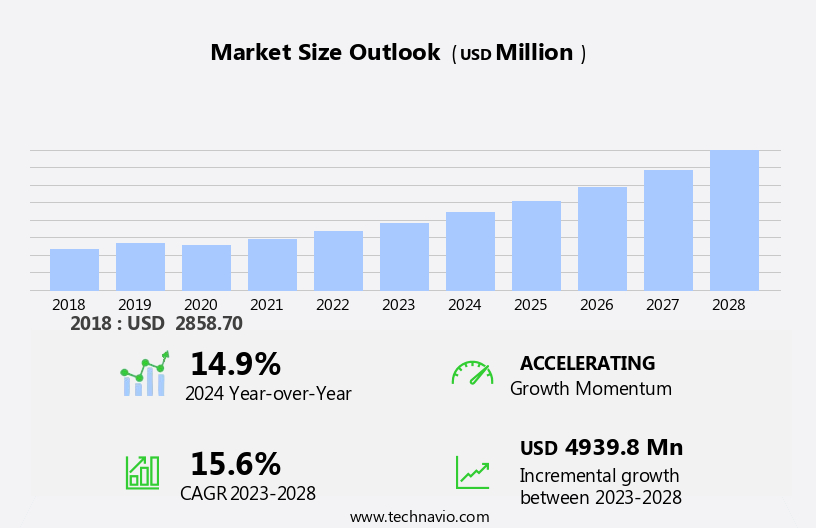
The market is witnessing significant growth due to the increasing demand for underwater surveillance, drilling, repair, and maintenance applications. These robots, also known as Unmanned Underwater Vehicles (UUVs), are used in various sectors, including defense applications, military, law enforcement, and marine research. The marine robots market is experiencing significant growth, driven by the increasing demand for unmanned underwater vehicles (UUVs) in offshore oil and gas exploration. These UUVs play a critical role in the oil and gas sector, providing efficient and cost-effective solutions for deep-water exploration, inspection, and maintenance of underwater infrastructure. Marine robots, including both heavy-weight vehicles for large-scale operations and lightweight/man-portable models for more accessible tasks, are transforming the oil and gas industry. The ability of UUVs to operate in challenging environments reduces the need for human intervention, enhancing safety and operational efficiency. As offshore exploration activities intensify, the adoption of marine robots continues to rise, offering advanced technology to support the oil and gas industry's complex needs.
Market Segmentation
The market research report provides comprehensive data (region-wise segment analysis), with forecasts and estimates in "USD million" for the period 2024-2028, as well as historical data from 2018-2022 for the following segments.
- Application
- Defense and security
- Commercial
- Scientific research
- Environmental monitoring
- Others
- Type
- Autonomous underwater vehicle
- Remotely operated vehicles
- Unmanned surface vehicles
- Hybrid vehicles
- Geography
- North America
- Canada
- US
- Europe
- Germany
- UK
- France
- APAC
- China
- Japan
- South Korea
- South America
- Middle East and Africa
- North America
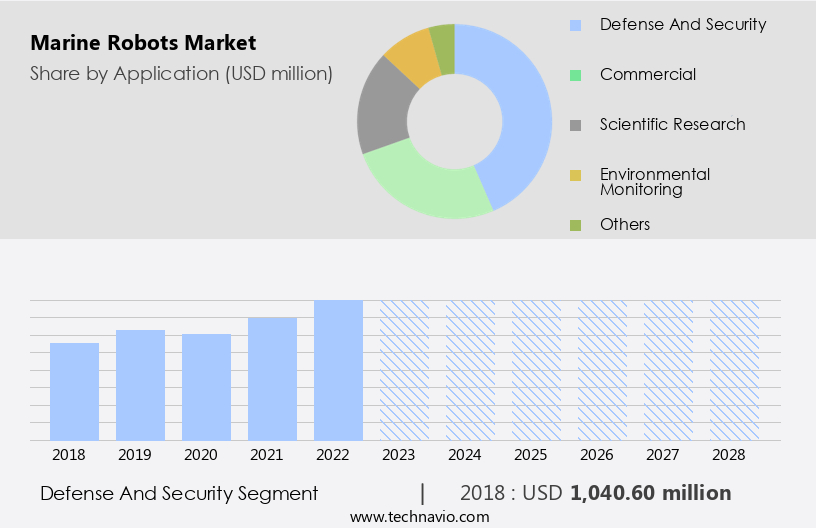
By Application Insights
The defense and security segment is estimated to witness significant growth during the forecast period. The maritime economy is witnessing a notable expansion in the market, driven by the integration of advanced technologies such as Remotely Operated Vehicles (ROVs) and Autonomous Underwater Vehicles (AUVs). Historically, the defense and security sector has overlooked marine robot innovation, with a shift in focus towards desert environments following the end of the Cold War. However, this trend is changing as the strategic significance of marine robots in bolstering naval capabilities and safeguarding maritime security is being recognized. Evidence of this renewed interest includes recent acquisitions and investments in the industry. Offshore energy projects and climate research are also major contributors to the growth of the market.
Oceaneering, Military and Defense, and Fisheries Management are key industries leveraging these technologies to optimize operations and enhance productivity. Artificial Intelligence (AI) is increasingly being integrated into marine robots to improve efficiency and accuracy. Furthermore, marine resource management and environmental conservation are benefiting from the use of these robots to monitor and protect marine ecosystems. The market is poised for continued growth, offering significant opportunities for businesses and investors.
Get a glance at the market share of various segments Request Free Sample
The defense and security segment accounted for USD 1.04 billion in 2018 and showed a gradual increase during the forecast period.
Regional Insights
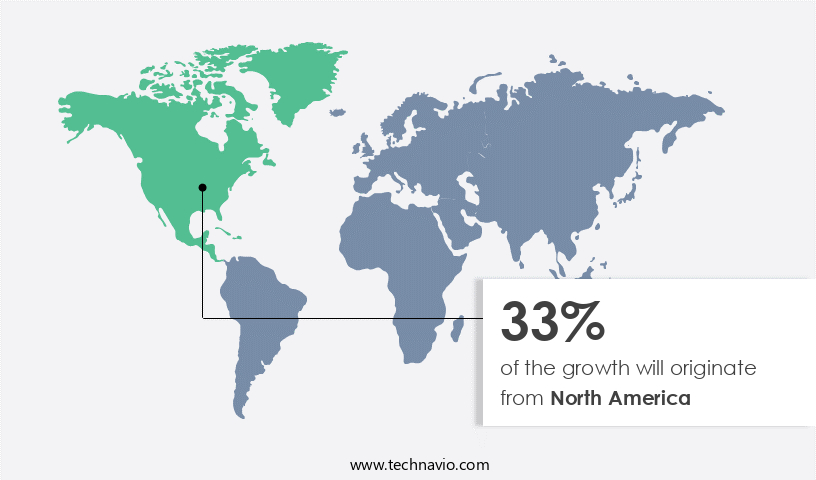
North America is estimated to contribute 33% to the growth of the global market during the forecast period. Technavio's analysts have elaborately explained the regional trends and drivers that shape the market during the forecast period.
For more insights on the market share of various regions Request Free Sample
The market in North America is witnessing significant growth due to the advancement of underwater robotics technology and the increasing demand for underwater surveillance, drilling, repair, and maintenance in various industries. Defense applications, including military and law enforcement, are major contributors to this market's expansion in the region. GrayMatter Robotics Inc., a leading startup in this field, recently raised USD 45 million in funding to revolutionize factory automation. The challenging and hazardous nature of manufacturing jobs, which require extensive training, has intensified this issue, leading to a backlog of orders. Marine robots offer a solution to these challenges by providing efficient underwater operations, reducing the need for human intervention, and increasing operational efficiency. The market is expected to continue growing, driven by technological advancements and the increasing demand for cost-effective and efficient maritime solutions.
Our researchers analyzed the data with 2023 as the base year, along with the key drivers, trends, and challenges. A holistic analysis of drivers will help companies refine their marketing strategies to gain a competitive advantage.
Market Driver
Growing investments in unmanned surface vehicle industry is the key driver of the market. The market, specifically the segment of Unmanned Surface Vehicles (USVs), is experiencing substantial growth due to escalating investments from investors. These funds are essential for enhancing the technology, deployment, and commercialization of USVs, which play a vital role in applications such as maritime security, environmental monitoring, and commercial shipping. A prime illustration of this trend is Nauticus Robotics, a US-based company specializing in ocean robot technology, securing up to USD 20 million in term loan financing from existing investors.
This financing will boost the capabilities of Nauticus' USV fleet, enabling advanced navigation and communication systems. In deep water conditions, USVs employ various technologies such as electromagnetic waves and free-space optical (FSO) for communication and sound waves for navigation. USVs, also known as Autonomous Underwater Vehicles (AUVs), are revolutionizing the marine industry by offering efficient and cost-effective solutions for complex tasks.
Market Trends
Expanding applications of marine robots is the upcoming trend in the market. The market is witnessing significant growth due to the increasing demand for advanced technologies in maritime applications. Traditional methods for addressing marine pollution, such as manual labor and chemical dispersants, have limitations in terms of efficiency and effectiveness, particularly in large-scale oil spills or hard-to-reach areas. These challenges are compounded by adverse weather conditions and ocean currents, leading to delays and increased costs. Marine robots, specifically those utilizing swarm technology, provide a revolutionary solution to these issues. Swarm robots can cover vast areas more efficiently than single robots, and they can adapt to changing conditions, enhancing the overall performance of marine pollution cleanup efforts.
Furthermore, marine robots are increasingly being used for surveillance, mine detection, offshore inspections, subsea maintenance, and ocean monitoring. Advancements in artificial intelligence (AI), machine learning, and sensor technology have significantly improved the capabilities of marine robots. These technologies enable marine robots to analyze data in real-time, identify patterns, and make decisions autonomously. Marine conservation organizations are also utilizing marine robots for research and monitoring purposes, contributing to the preservation of marine ecosystems. In conclusion, the market is experiencing substantial growth due to the need for more efficient and effective solutions in maritime operations. Marine robots, particularly those utilizing swarm technology, offer significant advantages in addressing marine pollution, surveillance, mine detection, offshore inspections, subsea maintenance, and ocean monitoring.
Market Challenge
High capital cost is a key challenge affecting market growth. The marine robots industry encounters considerable financial challenges due to the substantial expenses involved in acquiring, deploying, and maintaining these advanced technologies. The capital investment required for marine robots is considerable, especially for models engineered for offshore deep-sea oil exploration and undersea mineral exploration. These robots are outfitted with sophisticated sensors, advanced propulsion systems, and durable materials to endure the challenging underwater environment, contributing to their high costs. For example, the price range for custom underwater drone robots can significantly differ, with entry-level models priced around USD 4,999 and advanced versions reaching up to USD 19,999. Even standard kits, which contain essential components for underwater education or activities, are priced around USD 2,999.
Oil firms, such as Lukoil, and mining companies are increasingly turning to marine robots for deep-sea exploration and environmental monitoring in the Caspian Sea and other bodies of water. Marine research institutions and organizations are also utilizing these technologies for various purposes, further expanding the market's reach. Despite the initial investment, the cost-effective benefits and increased efficiency offered by marine robots make them a valuable investment for businesses and research institutions.
Exclusive Customer Landscape
The market forecasting report includes the adoption lifecycle of the market, covering from the innovator's stage to the laggard's stage. It focuses on adoption rates in different regions based on penetration. Furthermore, the report also includes key purchase criteria and drivers of price sensitivity to help companies evaluate and develop their market growth analysis strategies.
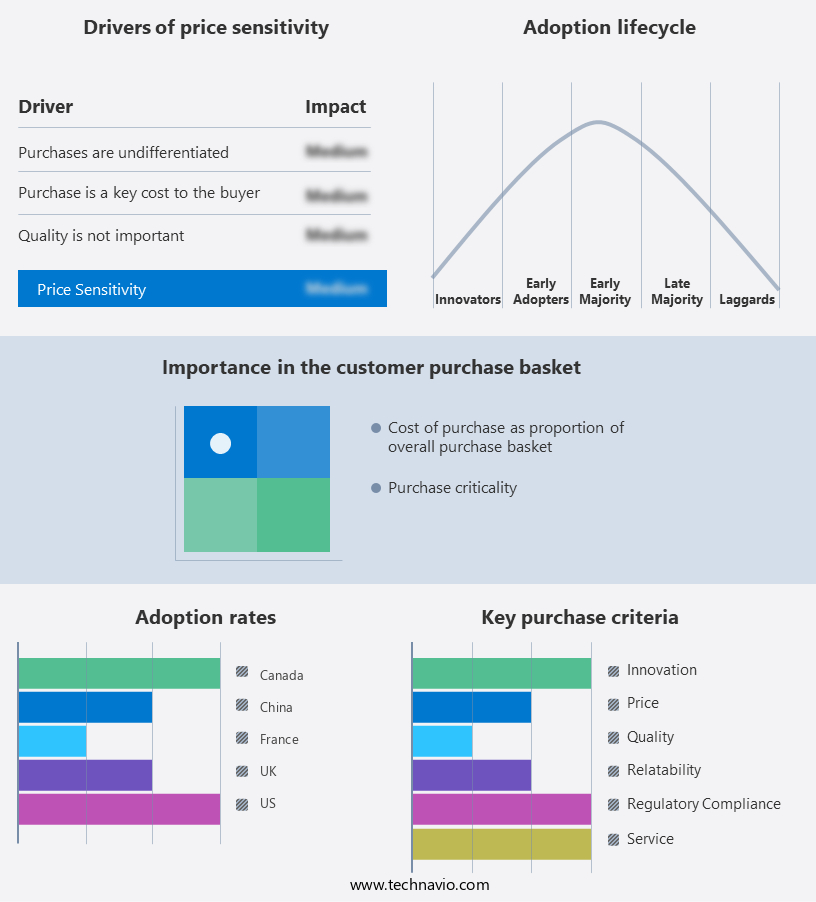
Customer Landscape
Key Companies & Market Insights
Companies are implementing various strategies, such as strategic alliances, partnerships, mergers and acquisitions, geographical expansion, and product/service launches, to enhance their presence in the market.
Anduril Industries Inc. - The company offers marine robots, such as autonomous underwater vehicles, which are utilized for defense and commercial missions.
The market research and growth report includes detailed analyses of the competitive landscape of the market and information about key companies, including:
- Advanced Navigation Pty Ltd.
- BeeX
- Blue Robotics Inc.
- ECA Group
- ecoSUB Robotics Ltd.
- EyeROV
- General Dynamics Mission Systems Inc.
- GrayMatter Robotics
- Hanwha Systems Co.
- International Submarine Engineering Ltd.
- Kongsberg Gruppen ASA
- L3Harris Technologies Inc.
- Liquid Robotics Inc.
- Marine Robotic Technologies Ltd
- Maritime Robotics
- Oceanalpha Group Ltd.
- Planys Technologies
- Saab AB
- Saildrone Inc.
- Sea Machines Robotics, Inc
- SeaSatellites, Inc.
- Teledyne Marine Technologies Inc
- UFRJ Nautilus
Qualitative and quantitative analysis of companies has been conducted to help clients understand the wider business environment as well as the strengths and weaknesses of key market players. Data is qualitatively analyzed to categorize companies as pure play, category-focused, industry-focused, and diversified; it is quantitatively analyzed to categorize companies as dominant, leading, strong, tentative, and weak.
Research Analyst Overview
Underwater robotics is a rapidly growing market, driven by the increasing demand for underwater surveillance, drilling, repair, and maintenance in various industries. This includes defense applications, military, law enforcement, and commercial exploration. Autonomous underwater vehicles (AUVs) and Unmanned Underwater Vehicles (UUVs) are becoming increasingly popular due to their ability to navigate and communicate effectively in deep water conditions. Navigation and communication systems utilize electromagnetic waves and free-space optical (FSO) technology, while underwater vehicles rely on sound waves for navigation. artificial intelligence (AI) and machine learning are being integrated into marine robotics to enhance their capabilities, including mine detection, environmental monitoring, and marine pollution surveillance.
Deep-sea exploration is a significant market for marine robotics, with mining companies and oil firms such as Nautilus Minerals and Lukoil investing in cost-effective systems for offshore deep-sea oil and undersea mineral exploration in the Caspian Sea and other locations. Subsea maintenance and ocean monitoring are also critical applications, with companies like Oceaneering focusing on automation and robotics for offshore inspections and marine resource management. Environmental assessment, security, search and salvage, archaeology, and climate research are other areas where marine robotics are making a significant impact. Robotics automation technologies are transforming underwater inspections, subsea structural examination, and marine conservation efforts. Sensors and imaging systems are essential components of these systems, providing valuable data for marine research and maritime economy development.
|
Market Scope |
|
|
Report Coverage |
Details |
|
Page number |
216 |
|
Base year |
2023 |
|
Historic period |
2018-2022 |
|
Forecast period |
2024-2028 |
|
Growth momentum & CAGR |
Accelerate at a CAGR of 15.6% |
|
Market growth 2024-2028 |
USD 4.94 billion |
|
Market structure |
Fragmented |
|
YoY growth 2023-2024(%) |
14.9 |
|
Regional analysis |
North America, Europe, APAC, South America, and Middle East and Africa |
|
Performing market contribution |
North America at 33% |
|
Key countries |
US, Canada, China, UK, France, Germany, Japan, South Korea, Australia, and Russia |
|
Competitive landscape |
Leading Companies, Market Positioning of Companies, Competitive Strategies, and Industry Risks |
|
Key companies profiled |
Advanced Navigation Pty Ltd., Anduril Industries Inc., BeeX, Blue Robotics Inc., ECA Group, ecoSUB Robotics Ltd., EyeROV, General Dynamics Mission Systems Inc., GrayMatter Robotics, Hanwha Systems Co., International Submarine Engineering Ltd., Kongsberg Gruppen ASA, L3Harris Technologies Inc., Liquid Robotics Inc., Marine Robotic Technologies Ltd, Maritime Robotics, Oceanalpha Group Ltd., Planys Technologies, Saab AB, Saildrone Inc., Sea Machines Robotics, Inc, SeaSatellites, Inc., Teledyne Marine Technologies Inc, and UFRJ Nautilus |
|
Market dynamics |
Parent market analysis, market growth inducers and obstacles, market forecast, fast-growing and slow-growing segment analysis, COVID-19 impact and recovery analysis and future consumer dynamics, market condition analysis for the forecast period |
|
Customization purview |
If our market report has not included the data that you are looking for, you can reach out to our analysts and get segments customized. |
What are the Key Data Covered in this Market Research and Growth Report?
- CAGR of the market during the forecast period
- Detailed information on factors that will drive the market growth and forecasting between 2024 and 2028
- Precise estimation of the size of the market and its contribution of the market in focus to the parent market
- Accurate predictions about upcoming market growth and trends and changes in consumer behaviour
- Growth of the market across North America, Europe, APAC, South America, and Middle East and Africa
- Thorough analysis of the market's competitive landscape and detailed information about companies
- Comprehensive analysis of factors that will challenge the growth of market companies
We can help! Our analysts can customize this market research report to meet your requirements. Get in touch
 RIA -
RIA - 
